한수지 50(1), 001-007, 2017
1
Copyright © 2017 The Korean Society of Fisheries and Aquatic Science pISSN:0374-8111, eISSN:2287-8815 Korean J Fish Aquat Sci 50(1),001-007,2017
Original Article
서 론
우리나라는세계에서해조류를가장많이섭취하는국가중 의하나로오래전부터해조류를즐겨이용해왔다
.
최근해조 류양식기술이발달되어생산량이크게증가되고있으며,
우리나라는
2014
년에약110
만톤을생산하여 세계에서4
번째로많은생산량을보였다
(FAO, 2014).
특히,
해조류중에서파래(Enteromorpha sp.)
는2005
년에1,060
톤이생산되던것이10
년이지난2015
년에는7,661
톤이생산되어7
배이상증가하였 다(Statistics Korea, 2015).
바다에서식하는해조류는Mg, Ca,
I, Fe, Zn
등인체에필요한필수미량원소를많이함유하고있으며
,
해조류종류에따라서인체에유용한생리활성을나타내 는각종유효성분도많이함유하고있다.
특히,
성인병과비만 예방등에효과가있다는것이많은연구자에의해서보고되었 고,
건강식품으로서도주목을받고있다(Cho et al., 1995; Im et al., 2006; Shon, 2009; Son et al., 2012; Mok et al., 2016).
한편
,
육상에서바다로유입되는오염물질들은희석,
확산,
분해등의과정을통하여감소되지만
,
이와는반대로생물에있어 서는생물농축과정을통하여오히려중금속등의오염물질들 이농축하게된다.
이에연안해역에서서식하는파래,
김,
미역 등의해조류는중금속오염에노출되기쉽고,
중금속을체내축 척하여이를섭취하는사람에게건강상유해를미칠우려가있 다(Mok et al., 2005; Son et al., 2012).
특히, As, Cd, Cr, Hg, Pb
등의유해중금속은미량이존재하더라도인체에위해를일으 킬수있다(EOS Ecology, 2012; Mok et al., 2014; Mok et al., 2015a, 2015b).
우리나라에서파래,
김등의해조류에존재하는 유해중금속(Cd, Cr
및Pb)
의함량에관하여는많은연구가수 행되었다(Choi et al., 1998; Kim et al., 2003; Kim et al., 2005;
Mok et al., 2005; Hwang et al., 2007; Son et al., 2012).
또한,
해조류가유해중금속을잘축적하는특성을이용하여해조류 를이용한오염수중에존재하는중금속제거에관한연구는다 수보고되어있으나(Suzuki et al., 2005; Ahmady-Asbchin et al., 2009; Mithra et al., 2012),
파래중에존재하는중금속제거 에대한논문은확인할수없었다.
산 처리에 의한 파래(Enteromorpha sp.)의 유해 중금속 제거
목종수*·손광태
1·이태식·권지영·박큰바위·김지회
국립수산과학원 식품위생가공과, 1국립수산과학원 남동해수산연구소
Elimination of Harmful Heavy Metals from Sea Lettuce Enteromorpha sp. with Acid Treatment
Jong Soo Mok*, Kwang Tae Son
1
, Tae Seek Lee, Ji Young Kwon, Kunbawui Parkand Ji Hoe KimFood Safety and Processing Research Division, National Institute of Fisheries Science, Busan 46083, Korea
1Southeast Sea Fisheries Research Institute, National Institute of Fisheries Science, Tongyeong 53085, Korea
The elimination of harmful heavy metals (Cd, Cr, and Pb) from sea lettuce Enteromorpha sp. was evaluated in filtered seawater over a pH range of 2.0-4.0 using citric, hydrochloric, and nitric acids. We also evaluated the quality of sea lettuce samples after release of their internal constituents into seawater solutions containing acids. The heavy metals that accumulated in raw sea lettuce after incubation for 3 days in seawater containing Cd, Cr, and Pb were, in de- scending order, Pb (120.45 μg/g), Cr (86.04 μg/g), and Cd (18.35 μg/g). The rate of elimination of heavy metals from sea lettuce was higher at lower pH for all of the acids used. However, the color of the sea lettuce changed adversely at below pH 2.5. The heavy metals in sea lettuce samples after 10 min in seawater at pH 3.0 containing the three acids were eliminated in the order Pb (42.2-78.0%), Cd (51.8-55.3%), and Cr (14.0-32.8%). The quality of the sea lettuce was not affected when it was incubated for 30 min at pH above 3.0. The maximum elimination of heavy metals from sea lettuce occurred when it was soaked for 10 min in seawater at pH 3.0 containing citric acid.
Key words: Sea lettuce, Heavy metal, Citric acid, Elimination, Organic acid
This is an Open Access article distributed under the terms of the Creative Commons Attribution Non-Commercial Licens (http://creativecommons.org/licenses/by-nc/3.0/) which permits unrestricted non-commercial use, distribution, and reproduction in any medium, provided the original work is properly cited.
http://dx.doi.org/10.5657/KFAS.2017.0001 Korean J Fish Aquat Sci 50(1) 001-007, February 2017
Received 10 January 2017; Revised 14 February 2017; Accepted 22 February 2017
*Corresponding author: Tel: +82. 51. 720. 2630 Fax: +82. 51. 720. 2619
E-mail address: [email protected]
목종수
ㆍ
손광태ㆍ
이태식ㆍ
권지영ㆍ
박큰바위ㆍ
김지회2
본연구에서는우리나라에서소비자들이많이섭취하는파래
의안전성을확보하기위하여파래에함유된유해중금속
(Cd,
Cr, Pb)
을효과적으로제거하고자하였다.
이를위하여파래에인위적으로유해중금속을축적시켰으며
,
이들유해중금속의 제거를위하여질산,
염산및구연산등의산을이용한최적제 거조건을검토하였다.
재료 및 방법
시료 및 시약
파래
(Enteromorpha sp.)
시료는창원시용원소재위판장에서 판매되고있는것을직접구입하여Whirl-Pak bag (25.4×50.8
cm, Nasco)
에담아아이스박스에넣고10℃
이하로유지시키면서실험실로운반하였다
.
실험실로운반된시료는즉시여과 해수로조체에부착된협잡물을제거한다음탈수하여중금속 제거시험을위하여사용하였다.
중금속분석을위한전처리시약으로질산
(Merck, supra-pure grade, Darmstadt, Germany)
을사용하였고,
물은초순수장치(Milli-Q Biocel, Millipore, Billerica, MA, USA)
로제조한초 순수를사용하였다.
모든초자기구는5%
질산용액에24
시간 이상침지시킨후초순수로깨끗이씻어건조시켜서사용하였 다.
중금속분석을위한표준용액(Merck, Darmstadt, Germa- ny)
은초순수로희석하여사용하였다.
유해 중금속(Cd, Cr, Pb) 및 미네랄 함량 분석
파래중의유해중금속및미네랄함량분석을위한시료의전처리는식품공전
(KMFDS, 2016)
에언급된습식분해법을일부변경하여사용하였다
.
즉,
파래시료를초순수로가볍게씻어동 결건조기(FDU-2100, EYELA, Tokyo, Japan)
로건조한후분 쇄하여사용하였다.
그리고파래분말시료1 g
을테프론튜브 에넣고65%
질산10 mL
를첨가하여상온에서150
분간방치 한후80℃
에서400
분간가열분해하였다.
가열분해한시험용 액의질산은완전히휘발시키고, 2%
질산으로재차용해하여여과한다음
100 mL
로조정하여실험에사용하였다.
중금속및미네랄함량은유도결합플라즈마질량분석기
(ICP- MS, Perkin Elan DRC II, Waltham, MA, USA)
로분석하였 으며, working
표준용액은1,000 mg/kg
의 표준용액(Merck, Darmstadt, Germany)
을 희석하여 사용하였다.
유해 중금속(Cd, Cr, Pb)
의회수율은표준인정물질인(Certified Reference Material)
인Dorm-3 (National Research Council, Nova Scotia, Canada)
를 사용하여 측정하였으며,
회수율은92.1-98.3%
로AOAC International (2002)
에서요구하는수준을만족하였다. 파래 중의 유해 중금속 제거를 위한 최적 산처리 조 건 검토
파래시료에유해중금속
(Cd, Cr, Pb)
을인위적으로농축시킨후파래중에농축된중금속을산을이용하여제거시켰다
.
즉,
유해중금속의농축정도를측정하였으며,
산의종류및첨 가량에따른제거효과정도를검토하여최적산처리조건을검 토하였다.
유해중금속농축을위하여중금속을각각
0.5 μg/mL
농도가되도록첨가한여과해수
(pH 8.2)
에탈수한파래시료를넣고,
온도
10±2℃,
조도550±10 lx
에서정치배양하면서중금속을 인위적으로농축시켰다.
이때,
파래는해수에1:30 (w/v)
비율로 첨가하였으며,
동일한중금속을함유한해수를1
일1
회환수하 였다.
또한,
유해중금속을인위적으로농축시킨파래시료는 조체에부착한중금속을제거하기위하여충분한양의여과해 수로세정한후탈수하였다.
그리고탈수한파래시료는구연산(citric acid),
염산(hydrochloric acid),
질산(nitric acid)
을첨가 하여pH
를2.0, 2.5, 3.0
및4.0
으로조정한해수에넣고처리시 간에따른중금속의제거효율과품질변화를측정하였다.
이때,
파래의품질변화지표로서는세포내부물질의용출정도를측정하기위하여산처리액의흡광도를
265 nm
에서측정하였다.
통계처리
실험결과의통계처리는
SAS
프로그램(SAS Institute, Cary,
NC, USA)
을이용하였으며,
시료간의차이검증은일원배치분산분석
(ANOVA)
을 사용하였다.
또한, Dun can’s multiple range test
에따라P<0.05
수준에서중금속농도간의유의성을 검증하였다(Steel and Torrie, 1980).
결과 및 고찰
파래의 유해 중금속 농축
파래에유해중금속을인위적으로농축시키기위하여유해중
금속
(Cd, Cr, Pb)
을첨가한해수에서파래를넣어시간경과에따른유해중금속의농축함량변화는
Fig. 1
에나타내었다.
유 해중금속중에서파래는Pb
를가장잘농축하였으며,
다음으 로Cr, Cd
순이었다(P<0.05).
또한시간경과에따른파래중 의 중금속함량은초기농도가건조중량당Cd
이0.08 μg/g,
Cr
이2.57 μg/g
및Pb
이0.51 μg/g
이이었던것이,
배양기간이 연장될수록증가하는경향을나타내었다.
그러나장기간배양 을하면파래의조체변색등파래조직에부정적영향이미칠 수있으며,
시험3
일후에는Pb
를제외하고는큰변화가없었 다.
또한3
일간만배양하여도중금속제거시험을위한유해중 금속이충분히농축되는것으로확인되었다.
따라서향후실험 에있어서3
일동안농축시킨시료를중금속제거시험을위한 시료로사용하였다.
중금속을인위적으로첨가한해수에서파 래시료를3
일간배양하였을때중금속농도는건조중량당Pb
(120.45 μg/g), Cr (86.04 μg/g), Cd (18.35 μg/g)
순으로농축 하였다. Mok et al. (2016)
은중금속을인위적으로첨가한해수 에서김을3
일간배양하였을때중금속농도는김시료건조중산 처리에 의한 파래의 유해 중금속 제거
3
량당
Pb (117.79 μg/g), Cr (33.53 μg/g), Cd (10.54 μg/g)
농축 한다고보고하여파래가김보다유해중금속을더잘농축하는 것으로확인되었다.
또한,
우리나라연안에서수집한주요식용 해조류(
김,
미역,
다시마,
파래)
중의중금속함량조사에서도파 래는Cr, Ni
및Pb
를가장많이함유하고있었으며, Cr
과Pb
도다른해조류에비하여많이농축하는것으로보고
(Mok et al.,
2005)
하여본결과와유사한결과를나타내었다.
한편,
본연구 에서파래에인위적으로농축된유해중금속함량은Mok et al.
(2005)
이보고한우리나라연안에서수집한파래중의유해중금속
(Cd, Cr
및Pb)
의평균함량보다각각약52.4, 21.2
및86.7
배높은값이었다.
유해중금속이파래의세포내로농축되어있는지아니면조 체외부에부착되어있는지를알아보기위하여
3
일간유해중 금속을농축시킨파래시료를여과해수에30
분및금속킬레이트제인
0.1 mM EDTA
용액에10
분간침지시킨것의중금속농도를비교하였다
(Table 1).
파래시료는Cd (12.34 μg/g), Cr (65.73 μg/g)
및Pb (118.72 μg/g)
이각각농축되었으며,
이 를해수및0.1 mM EDTA
용액에침지한후에는Cd
는각각10.21
및11.70 μg/g, Cr
은각각58.03
및64.11 μg/g,
그리고Pb
는각각116.25
및97.99 μg/g
이었다.
이상의결과유해중 금속을인위적으로농축시킨파래시료는해수및EDTA
용액 에침지한후에도대조구와유의할만한차이를나타내지않았 다.
즉,
이들중금속은파래의세포내에잘농축되어있는것으 로확인되었다.
산의 종류 및 농도에 따른 파래의 유해 중금속 제거 효과
구연산
,
염산및질산을사용하여pH 2.0-4.0
으로조정한해수에유해중금속
(Cd, Cr, Pb)
을인위적으로농축시킨파래를1:30 (w/v)
비율로첨가하여시험한결과는Fig. 2, 3, 4
에나타 내었다.
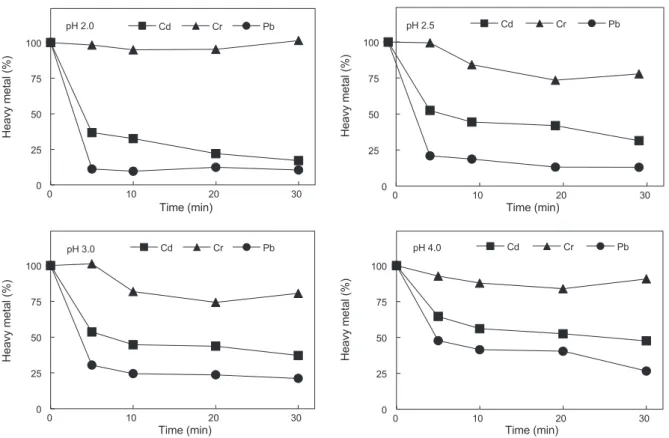
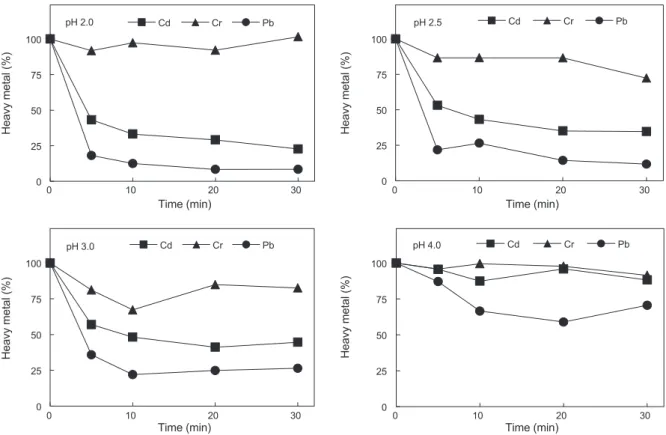
파래중의유해중금속의제거효과는사용한산의종류 에관계없이Pb
이가장잘제거되었으며,
다음으로Cd, Cr
순이 었다.
실험에사용된유해중금속중에서Pb
과Cd
는사용한산의종류에관계없이
pH 2.0-4.0
에서는각비교적잘제거되었으며
, pH
가낮을수록그경향은뚜렷하였다.
처리시간에따라서 는중금속에서초기10
분처리에많은양이제거되고,
그이후 에는제거효과가적었다.
그러나Cr
은다른중금속과는달리제 거율이훨씬낮았다.
한편,
파래는pH 2.0
에서구연산과염산처 리구에서는5
분후,
질산처리구에서는10
분후,
그리고pH 2.5
에서구연산과질산에서는15
분후,
염산처리구에서는30
분후 에각각조체에약간변색되는경향을나타내었으나, pH 3.0
이 상에서는30
분까지시각적으로변색은관찰되지않았다.
따라서산을이용하여중금속을제거할경우파래는
pH 3.0
에서10
분정도처리하는것이가장바람직할것으로생각되었으며
,
이 때각유해중금속의제거율은산의종류에따라다소차이는있 었으나, Pb (42.2-78.0%), Cd (51.8-55.3%), Cr (14.0-32.8%)
로순으로제거되었다.
또한,
유기산인구연산을이용하여파 래를pH 3.0
에서10
분처리하였을때유해중금속제거율은Pb (75.6%), Cd (55.3%)
및Cr (18.2%)
이었다.
한편
,
우리나라식품의약품안전처(KMFDS, 2016)
에서는해 조류중에서김(
조미김포함)
에대해서만Cd
기준을0.3 μg/g (
생물기준,
건물중량으로환산하면약3.03 μg/g
에해당)
으로 설정하고있으며,
파래에대하여는중금속기준이설정되어있 지않다.
또한, Mok et al. (2005)
의보고에의하면Cr
과Pb
은주 요식용해조류(
김,
미역,
다시마및파래)
중에파래에서가장높 게검출되었다고하였다.
따라서파래에대한유해중금속기준 은설정되어있지않으나,
일부유해중금속이파래에서높게검 출되고있으므로이에대한관리및적절한제어기술이필요할 것으로판단된다.
이상의결과
,
유기산인구연산과다른무기산의유해중금속 제거효과는큰차이가없으므로인체에무해한유기산인구연 산을사용하는것이가장바람직할것으로판단되었다. 산 처리에 의한 파래의 품질변화
산
(
구연산,
염산및질산)
을이용하여파래중의유해중금속 을 제거할 때에조체의품질변화 지표로서 처리액의 흡광도(265 nm)
변화를측정하여Fig. 5
에나타내었다.
예비시험에 Table 1. Stability of heavy metals concentrated in sea lettuce En- teromorpha sp.Heavy met- al
Concentration (μg/g dry weight)1 Control
(non-treatment) Seawater
(30 min) 0.1 mM EDTA (10 min)
Cd 12.34±2.422 10.21±3.25 11.70±2.45
Cr 65.73±8.02 58.03±7.02 64.11±7.62
Pb 118.72±6.52 116.25±7.62 97.99±8.98
1 Heavy metal concentrations in sea lettuce samples were deter- mined after soaked in seawater and EDTA (Ethylenediaminetet- raacetic acid) solution using sea lettuce samples accumulating heavy metals for 3 days. 2 Mean value±SD.
0 50 100 150 200
0 1 2 3 4 5 6
Heavy metal (μg/g)
Day
Cd Cr Pb
0.0 0.5 1.0 1.5 2.0
0 10 20 30 40 50 60
265 nm
Time (min)
Citric acid2.0 2.5
3.0 4.0
0.0 0.5 1.0 1.5 2.0
0 10 20 30 40 50 60
265 nm
Time (min)
Hydrochloric acid2.0 2.5
3.0 4.0
0.0 0.5 1.0 1.5 2.0
0 10 20 30 40 50 60
265 nm
Time (min)
Nitric acid2.0 2.5
3.0 4.0
Fig. 1. Accumulation of heavy metals in sea lettuce Enteromorpha sp. during incubation in seawater including Cd, Cr, and Pb.
목종수
ㆍ
손광태ㆍ
이태식ㆍ
권지영ㆍ
박큰바위ㆍ
김지회4
0 25 50 75 100
0 10 20 30
Heavy metal (%)
Time (min)
pH 2.0 Cd Cr Pb
0 25 50 75 100
0 10 20 30
Heavy metal (%)
Time (min)
pH 2.5 Cd Cr Pb
0 25 50 75 100
0 10 20 30
Heavy metal (%)
Time (min)
pH 3.0 Cd Cr Pb
0 25 50 75 100
0 10 20 30
Heavy metal (%)
Time (min)
pH 4.0 Cd Cr Pb
0 25 50 75 100
0 10 20 30
Heavy metal (%)
Time (min)
pH 2.0 Cd Cr Pb
0 25 50 75 100
0 10 20 30
Heavy metal (%)
Time (min)
pH 2.5 Cd Cr Pb
0 25 50 75 100
0 10 20 30
Heavy metal (%)
Time (min)
pH 4.0 Cd Cr Pb
0 25 50 75 100
0 10 20 30
Heavy metal (%)
Time (min)
pH 3.0 Cd Cr Pb
0 25 50 75 100
0 10 20 30
Heavy metal (%)
pH 2.0 Cd Cr Pb
0 25 50 75 100
0 10 20 30
Heavy metal (%)
pH 2.5 Cd Cr Pb
0 25 50 75 100
0 10 20 30
Heavy metal (%)
pH 3.0 Cd Cr Pb
0 25 50 75 100
0 10 20 30
Heavy metal (%)
Time (min) Time (min)
Time (min) Time (min)
pH 4.0 Cd Cr Pb
Fig. 2. Elimination rate of heavy metals in sea lettuce Enteromorpha sp. using citric acid.
0 25 50 75 100
0 10 20 30
Heavy metal (%)
Time (min)
pH 2.0 Cd Cr Pb
0 25 50 75 100
0 10 20 30
Heavy metal (%)
Time (min)
pH 2.5 Cd Cr Pb
0 25 50 75 100
0 10 20 30
Heavy metal (%)
Time (min)
pH 3.0 Cd Cr Pb
0 25 50 75 100
0 10 20 30
Heavy metal (%)
Time (min)
pH 4.0 Cd Cr Pb
0 25 50 75 100
0 10 20 30
Heavy metal (%)
Time (min)
pH 2.0 Cd Cr Pb
0 25 50 75 100
0 10 20 30
Heavy metal (%)
Time (min)
pH 2.5 Cd Cr Pb
0 25 50 75 100
0 10 20 30
Heavy metal (%)
Time (min)
pH 4.0 Cd Cr Pb
0 25 50 75 100
0 10 20 30
Heavy metal (%)
Time (min)
pH 3.0 Cd Cr Pb
0 25 50 75 100
0 10 20 30
Heavy metal (%)
pH 2.0 Cd Cr Pb
0 25 50 75 100
0 10 20 30
Heavy metal (%)
pH 2.5 Cd Cr Pb
0 25 50 75 100
0 10 20 30
Heavy metal (%)
pH 3.0 Cd Cr Pb
0 25 50 75 100
0 10 20 30
Heavy metal (%)
Time (min) Time (min)
Time (min) Time (min)
pH 4.0 Cd Cr Pb
Fig. 3. Elimination rate of heavy metals in sea lettuce Enteromorpha sp. using hydrochloric acid.
산 처리에 의한 파래의 유해 중금속 제거
5
서산을첨가한해수용액에파래를침지시키면용액중으로미 량물질들의용출이추정되었으며
,
처리액의파장을검색한결과
265 nm
에서가장높은흡광도값을나타내어이를지표로선정하였다
.
파래세포내부물질의유출을나타내는처리액의흡광도값은산의종류에관계없이유사한경향을보였으며
, pH
2.0
처리구에서는처리시간20
분까지는증가하였으나그이후 는변화가없었다.
반면, pH 2.5
에서는지속적으로증가하여1
시간후pH 2.0
보다오히려더높은값을나타내었나, pH 3.0
이 상에서는처리시간30
분까지거의변화가없어세포내부물질 의유출이거의없는것으로판단된다.
또한,
파래의클로로필 농도변화는처리하기전인대조구의클로로필함량은건조중 량당약17,000 μg/g
이었고,
산을처리한파래의클로로필함량은산의종류에관계없이
pH 2.0
처리구를제외하면대조구와유의할만한차이는관찰되지않았다
(
결과미제시).
이상의결과에서산처리에의한파래의품질변화지표로사
용된용출되는세포내부물질의함량은
pH 3.0
이상에서는모든산에서처리시간
30
분까지거의변화가없었다.
또한,
파래의클로로필함량도
pH 3.0
이상에서는대조구와유사하였다.
따라서산을이용하여중금속을제거할경우에는품질변화및 식용등을고려하여유기산인구연산으로
pH 3.0
에서10
분이 내로처리하면안정할것으로판단된다.
최적 처리조건에서 파래의 주요 미네랄함량 변화
파래의산처리최적조건으로판단된구연산을이용하여pH 3.0
으로조정한해수에서처리시간에따른주요미네랄성분변화를측정하여
Table 2
에나타내었다.
구연산을처리하지않은대조구의주요미네랄성분의함량은건조중량으로
Ca (2,747 μg/g), Cu (8.7 μg/g), Fe (828 μg/g), Mg (8,409 μg/g), Mn (23.1 μg/g), Zn (21.8 μg/g)
이었다.
최적처리시간인10
분이 내에는Mg 7%, Ca 12%, Fe 15%, Cu 16%, Mn 20%, Zn 22%
의감소율을보였으며
, Mg
및Ca
과같이파래에많이함유되어있는미네랄성분일수록대체로적게감소하는경향을나타 내었다
.
한편,
예비시험에서파래는자연해수에30
분간처리하 였을때약5%
내외의미네랄성분이자연적으로감소하는것 으로확인되었다.
Kim et al. (2005)
은해조류는해수중에많이존재하는Na,
Mg, Ca, K
등의해수로부터다른금속에비하여적게농축하는반면
,
해수중에적게존재하는미량금속은많이농축한다고하 였다.
우리의결과에서는파래에서의제거율도해수에많이들 어있는미네랄성분인Mg
은가장적게제거되는반면,
해수에 거의없는인위적으로농축시킨유해중금속의제거율이이들 보다더높은것은해조류의농축과제거는해수중의미네랄농 도와밀접한관계가있는것으로추정된다.
0 25 50 75 100
0 10 20 30
Heavy metal (%)
Time (min)
pH 2.0 Cd Cr Pb
0 25 50 75 100
0 10 20 30
Heavy metal (%)
Time (min)
pH 2.5 Cd Cr Pb
0 25 50 75 100
0 10 20 30
Heavy metal (%)
Time (min)
pH 3.0 Cd Cr Pb
0 25 50 75 100
0 10 20 30
Heavy metal (%)
Time (min)
pH 4.0 Cd Cr Pb
0 25 50 75 100
0 10 20 30
Heavy metal (%)
Time (min)
pH 2.0 Cd Cr Pb
0 25 50 75 100
0 10 20 30
Heavy metal (%)
Time (min)
pH 2.5 Cd Cr Pb
0 25 50 75 100
0 10 20 30
Heavy metal (%)
Time (min)
pH 4.0 Cd Cr Pb
0 25 50 75 100
0 10 20 30
Heavy metal (%)
Time (min)
pH 3.0 Cd Cr Pb
0 25 50 75 100
0 10 20 30
Heavy metal (%)
pH 2.0 Cd Cr Pb
0 25 50 75 100
0 10 20 30
Heavy metal (%)
pH 2.5 Cd Cr Pb
0 25 50 75 100
0 10 20 30
Heavy metal (%)
pH 3.0 Cd Cr Pb
0 25 50 75 100
0 10 20 30
Heavy metal (%)
Time (min) Time (min)
Time (min) Time (min)
pH 4.0 Cd Cr Pb
Fig. 4. Elimination rate of heavy metals in sea lettuce Enteromorpha sp. using nitric acid.
목종수
ㆍ
손광태ㆍ
이태식ㆍ
권지영ㆍ
박큰바위ㆍ
김지회6
사 사
이 논문은
2017
년도 국립수산과학원 수산과학연구사업(R2017057)
의지원으로수행된연구이며연구비지원에감사드립니다
.
References
Ahmady-Asbchin S, Andres Y, Gerente C and Le Cloirec P.
2009. Natural seaweed waste as sorbent for heavy metal re- moval from solution. Environ Technol 30, 755-762. http://
dx.doi.org/10.1080/09593330902919401.
AOAC International. 2002. AOAC guidelines for single labora- tory vali dation of chemical methods for dietary supplements and botani cals. Gaithersburg, MD, U.S.A.
Cho DM, Kim DS, Lee DS, Kim HR and Pyeun JH. 1995.
Trace components and functional saccharides in seaweed.
1. Changes in proximate composition and trace element ac- cording to the harvest season and places. Bull Kor Fish Soc 28, 49-59.
Choi SN, Lee SU, Chung KH and Ko WB. 1998. A study of heavy metals contents of the seaweeds at various area in Ko- rea. Korean J Soc Food Sci 14, 25-32.
EOS Ecology. 2012. Heavy metals in fish and shellfish, EOS Ecology, Christchurch, New Zealand.
FAO (Food and Agriculture Organization of the United Na- tions). 2014. Global Statistical Collections. Retrieved from http://www.fao.org/fishery/statistics/en on July 11, 2016.
Hwang YO, Kim MS, Park SG and Kim SJ. 2007. Contents of lead, mercury, and cadmium in seaweeds collected in coast- al area of Korea. Analytic Sci Technol 20, 227-236.
Im YG, Choi JS and Kim DS. 2006. Mineral contents of edible seaweeds collected from Gijang and Wando in Korea. J Kor Fish Soc 39, 16-22.
Kim JH, Mok JS and Park HY. 2005. Trace metal contents in seaweeds from Korean coastal area. J Korean Soc Food Sci Nutr 34, 1041-1051.
Kim SY, Sidharthan M, Yoo YH, Lim CY, Jin HJ, Yoo JS and Shin HW. 2003. Accumulation of heavy metals in Ko- rean marine seaweeds. Algae 18, 349-354. http://dx.doi.org/
10.4490/algae.2003.18.4.349.
KMFDS (Korea Ministry of Food and Drug Safety). 2016. Ko- rea food code. Retrieved from http://fse.foodnara.go.kr/resi- due/RS/jsp/menu_02_01_01.jsp on July 11, 2016.
0 50 100 150 200
0 1 2 3 4 5 6
Heavy metal (μg/g)
Day
Cd Cr Pb
0.0 0.5 1.0 1.5 2.0
0 10 20 30 40 50 60
265 nm
Time (min)
Citric acid2.0 2.5
3.0 4.0
0.0 0.5 1.0 1.5 2.0
0 10 20 30 40 50 60
265 nm
Time (min)
Hydrochloric acid2.0 2.5
3.0 4.0
0.0 0.5 1.0 1.5 2.0
0 10 20 30 40 50 60
265 nm
Time (min)
Nitric acid2.0 2.5
3.0 4.0
Fig. 5. Absorbance change of seawater during eliminating heavy metals in sea lettuce Enteromorpha sp. using citric acid, hydro- chloric acid, and nitric acid.
Table 2. Change of mineral concentrations in sea lettuce Entero- morpha sp. by soaking times in pH 2.5 seawater adjusted by citric acid Enteromorpha sp.
Mineral Mineral concentration (μg/g dry weight) 0 min 5 min 10 min 20 min 30 min Ca 2,747±421 2,506±51 2,414±78 2,306±65 2,358±86 Cu 8.7±0.6 8.2±0.4 7.2±0.5 6.8±0.7 6.6±0.6
Fe 828±15 817±8 705±6 682±11 679±9
Mg 8,409±124 8,062±205 7,820±356 7,621±422 7,661±326 Mn 23.1±1.8 21.4±1.4 18.5±1.0 17.9±0.8 17.9±1.2 Zn 21.8±1.6 18.5±0.8 16.9±0.6 16.6±0.8 17.0±0.4
1 Mean value±SD.
산 처리에 의한 파래의 유해 중금속 제거
7
Mithra1 R, Sivaramakrishnan1 S, Santhanam P, Dinesh Kumar S and Nandakumar R. 2012. Investigation on nutrients and heavy metal removal efficacy of seaweeds, Caulerpa taxifo-
lia and Kappaphycus alvarezii for wastewater remediation.
J Algal Biomass Utln 3, 21-27.
Mok JS, Kwon JY, Son KT, Choi WS, Kim PH, Lee TS and Kim JH. 2015a. Distribution of heavy metals in internal or- gans and tissues of Korean molluscan shellfish and potential risk to human health. J Envron Biol 36, 1161-1167.
Mok JS, Park HY and Kim JH. 2005. Trace metal contents of major edible seaweeds and their safety evaluation. J Kor Soc Food Sci Nutr 34, 1464-1470.
Mok JS, SonKT, Lee TS, Lee KJ, Jung YJ and Kim JH. 2016. Re- moval effect of hazardous heavy metals (Cd, Cr, Pb) in laver (Porphyra sp.) by acid treatment. Korean J Fish Aquat Sci 49, 556-563. http://dx.doi.org/10.5657/KFAS.2016.0556.
Mok JS, Yoo HD, Kim PH, Yoon HD, Park YC, Lee TS, Kwon JY, Son KT, Lee HJ, Ha KS, Shim KB, Jo MR and Kim JH. 2014. Bioaccumulation of heavy metals in mussels in the Changseon area, Korea, and assessment of potential risk to human health. Fish Aquat Sci 17, 1-6. http://dx.doi.
org/10.5657/FAS.2014.0001.
Mok JS, Yoo HD, Kim PH, Yoon HD, Park YC, Lee TS, Kwon JY, Son KT, Lee HJ, Ha KS, Shim KB and Kim JH. 2015b.
Bioaccumulation of heavy metals in oysters from the south- ern coast of Korea: Assessment of potential risk to human health. Bull Environ Contam Toxicol 94, 749-755. http://
dx.doi.org/10.1007/s00128-015-1534-4.
Sohn JW. 2009. A study on Korean seaweed foods by literature review. Korean J Food Nutr 1, 75-85.
Son KT, Kwon JY, Jo MR, Choi WS, Kang SR, Ha NY, Shin JW, Park KBW and Kim JH. 2012. Heavy metals (Hg, Pb, Cd) content and risk assessment of commercial dried laver
Porphyra sp. Korean J Fish Aquat Sci 45, 454-459. http://
dx.doi.org/10.5657/KFAS.2012.0454.
Statistics Korea. 2015. Korean statistical information service (KOSIS). Retrieved from http://kosis.kr on July 11, 2016.
Steel RGD and Torrie JH. 1980. Principle and procedure of statistics; a biometrical approach (2nd ed.). MacGraw-Hill Book Company, New York, U.S.A.
Suzuki Y, Kametani T and Maruyama T. 2005. Removal of heavy metals from aqueous solution by nonliving Ulva sea- weed as biosorbent. Water Res 39, 1803-1808. http://dx.doi.
org/10.1016/j.watres.2005.02.020.