서 론
수생태계 내 유해물질의 독성 발현은 수체 내 다양한 물리∙화학적 인자들에 의해 영향을 받게 되며
(Meyer, 1999; Riethmuller et al., 2001; Markich et al., 2006),
이 러한 인자들에는 경도, pH,
온도,
용존산소,
알칼리도 등 이 있다.
특히 경도는 물의 세기를 나타내는 지표로서 수 체 내 함유된Ca
++2, Mg
++2, Fe
++2, Mn
++2, Sr
++2등2
가 양이 온 금속의 함량을 이에 대응하는CaCO
3[mg L
-1]
로 환산 하여 표시하게 된다.
경도는 수체 내에 존재하는 주요 중금속
(
예. Cd, Cu, Cr
3++, Ni, Pb, Ag, Zn
등)
이 수용체에 독 성 영향을 미칠 경우 수용체 내 흡수기작을 교란시켜 독성 발현의 차이를 유발하기 때문에(Genderen et al., 2007;
한,
1988)
수서독성평가에서 필수적으로 고려해야 하는 인자이다
.
일반적으로 수체 내 존재하는 용존성 중금속이 수 용체 내로 침투하였을 때,
경도가 높을수록Ca
2++, Mg
2++ 과 같은 양이온이 증가함에 따라 중금속과 양이온 간 수 용체 내로의 흡수 경쟁이 발생하면서 독성이 감소된다.
또한 중금속 이온과 탄산염(carbonate)
간 결합으로 인 해 착물(complex)
이 형성되어 자유 이온 상태의 중금속 의 활성이 저하되면서 독성이 감소하게 된다(Townsend
─
─ 275 ─ ─
안 윤 주*∙양 창 용∙남 선 화 (건국대학교 환경과학과)
Hardness Correction Algorithm Applicable to Korea as Related to Aquatic Toxicity Variation for Heavy Metals. An, Youn-Joo*, Chang-Yong Yang and Sun-Hwa Nam (Department of Envi- ronmental Science, Konkuk University, Seoul 143-701, Korea)
Water hardness is a significant parameter as related to aquatic toxicity of some hea- vy metals. Hardness dependent metals include cadmium, copper, chromium (III), nickel, lead, zinc and silver. Developed countries have applied the hardness correc- tion procedure to derive the water quality criteria for protecting the aquatic organi- sms. In the present study, we investigated the hardness correction algorithms used in United States of America, European Union, Australia/New Zealand, and Canada, and analyzed the details associated with those algorithms. Toxicity values of heavy metals were definitely different after hardness correction for all of algorithms an- alyzed. We found that the hardness corrected toxicity values followed by the algori- thms of USA and Australia/New Zealand were very similar or same, however they were slightly different for cadmium at the hardness less than 30 mg CaCO
3L
-1. Among the hardness correction algorithms studied, the algorithm used in Australia/
New Zealand appears to be a good choice to apply in Korean situation due to its simplicity compared to the algorithm of USA.
Key words : water hardness, hardness correction, aquatic toxicity, heavy metal
* Corresponding author: Tel: 02) 2049-6090, Fax: 02) 2201-6295, E-mail: [email protected]
et al., 2003; Amor et al., 2004).
경도와 중금속 수서독성 간의 관련성은Daphnia magna
와Ictalurus punctatus
를 이용한 중금속 수서독성 연구를 통해 확인할 수 있다. Daphnia magna
를 이용한Cd, Cu, Zn, Pb
의 급성독성실 험 연구에 따르면,
경도가 증가함에 따라 독성 발현성이 감소하는 것으로 나타났다(Long et al., 2003; Yim et al., 2006).
또한Cu
에 대해Ictalurus punctatus
를 이용한 급 성독성실험에서도 경도가 높을수록 생존율이 증가하는 것으로 보고된 바 있다(Perschbacher et al., 1998).
따라 서 수체 내 중금속 수서독성 발현성은 경도에 따라 상이 하기 때문에 수서독성자료를 경도 보정을 고려하지 않은 채 사용할 경우 그 결과값은 과소평가 또는 과대평가 될 것이다.
미국
,
호주/
뉴질랜드 등 선진국에서는 경도가 중금속 수서독성의 발현성에 영향을 미친다는 점을 인식하게 되 면서,
중금속 수서독성자료 활용 시 경도 보정을 반영하고 있다(ANZECC and ARMCANZ, 2000; S EPA, 2006).
미 국에서는Cd, Cr
3++, Cu, Pb, Ni, Ag, Zn
등 용존성 금속에 대한 수생태계 보호를 위한 준거치 산정 시 경도 보정 알고리즘을 적용하며(US EPA, 2006),
호주/
뉴질랜드에서 도 마찬가지로Cd, Cr
3++, Cu, Pb, Ni, Zn
등 중금속에 대 한 수생태계 보호 권고치 산정 시 경도 보정 알고리즘을 적용하고 있다(ANZECC and ARMCANZ, 2000).
현재까 지 국내에서는2006
년 수행된‘
물환경종합평가방법 개발 조사연구(III)-
인체 및 수생태계 위해성 평가체계 구축’
연구에서 수질유해화학물질에 대한 생태 준거치 산출 과 정에서 미국의 경도 보정 알고리즘을 적용한 바 있다(
환 경부와 국립환경과학원, 2006).
본 연구에서는 미국
,
유럽연합,
호주/
뉴질랜드,
캐나다 등 선진국에서 수생태계 보호를 위해 사용되는 수서독성자 료의 경도 보정 적용 사례를 조사하였으며,
이를 바탕으로 국내 적용 가능한 경도 보정 알고리즘을 제안하였다.
선진국의 경도 보정 알고리즘
1.
미국미국은 수생태계 보호를 위한 준거치를 산정하기 위해 다양한 수서생물을 대상으로 수행된 화학물질별 급성 및 만성독성자료를 기초로 한다
(US EPA, 1980b).
특히 경도 의존 중금속은 수체 내 경도 수준에 따라 독성 영향이 달라지기 때문에 기존 독성 자료를 기준 경도로 보정하 여 표준화된 독성 자료를 활용하게 되며,
다음과 같은 수 식을 적용하여 경도를 보정하게 된다(US EPA, 1985a, b, 2001).
급성독성자료
: Y= =ln W-V (ln X-ln Z)
만성독성자료: Q= =ln M-L (ln P-ln Z)
Y (or Q) :
표준화된 독성치W (or M) :
생물종별 실험 상 독성치의 기하평균X (or P) :
생물종별 실험 상 경도의 기하평균V (or L) :
실험 상 경도에 따른 실험 상 독성치의 기울 기Z :
기준 경도(50 mg CaCO
3L
-1)
한편 수생태계 보호를 위한 국가적 권고치로 활용되고 있는 급성 준거치
(Criteria Maximum Concentration, CMC)
및 만성 준거치(Criteria Continuous Concentra- tion, CCC)
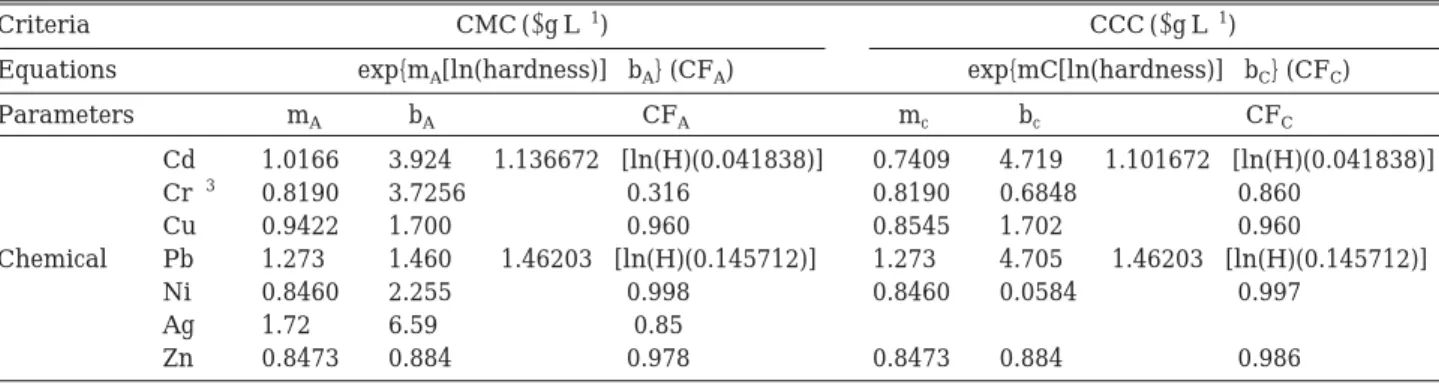
를 명시하기 위해Table 1
과 같은 경도 보정 알고리즘을 제시하고 있다(US EPA, 2006).
이 때 화학물 질별 권고치 목록에 명시된 준거치는 경도100 mg CaCO
3L
-1를 기준으로 제시된 수치로,
경도 보정 알고리 즘을 적용하여 수체 내 경도에 따른 준거치 변동이 가능 하다(US EPA, 1999, 2002, 2006).
또한m
A와m
C는 생물 종별 경도와 독성치의 기울기의 산술평균(pooled slope)
Table 1. Equations and parameters for calculating freshwater dissolved metals criteria that are hardness-dependent in US EPA (2006).
Criteria CMC ( μg L
-1) CCC ( μg L
-1)
Equations exp{m
A[ln(hardness)]
++b
A} (CF
A) exp{mC[ln(hardness)]
++b
C} (CF
C)
Parameters m
Ab
ACF
Am
cb
cCF
CCd 1.0166 -3.924 1.136672-[ln(H)(0.041838)] 0.7409 -4.719 1.101672-[ln(H)(0.041838)]
Cr
++30.8190 3.7256 0.316 0.8190 0.6848 0.860
Cu 0.9422 -1.700 0.960 0.8545 -1.702 0.960
Chemical Pb 1.273 -1.460 1.46203-[ln(H)(0.145712)] 1.273 -4.705 1.46203-[ln(H)(0.145712)]
Ni 0.8460 2.255 0.998 0.8460 0.0584 0.997
Ag 1.72 -6.59 0.85 - - -
Zn 0.8473 0.884 0.978 0.8473 0.884 0.986
2.
유럽연합유럽연합은 현재까지 경도에 따른 카드뮴의 수서독성 영향에 관한 연구가 진행되었으며
,
미국의 경도 보정 수 식을 바탕으로 유럽 회원국 내 경도 수준을 고려하여 무영 향관찰농도(No-Observed Effect Concentration, NOEC)
및 예상무영향농도(Predicted No Effect Concentrations, PNEC)
에 대한 경도를 보정하고 있다(EU, 2007).
먼저 기존 독성 자료의NOEC
에 대한 경도 보정은 다음과 같 으며,
미국의Cd
에 대한 생물종별 경도와 만성 독성치의 기울기의 산술평균(pooled slope)
인0.7409
와 기준 경도50 mg CaCO
3L
-1을 적용하고 있다(EU, 2007)
50
0.7409NOEC
H==50= =NOEC
H{ m mm H mm m }
NOEC
H==50:
기준 경도(50 mg CaCO
3L
-1)
일 때 무영향 관찰농도NOEC
H:
실험 상 경도일 때 무영향관찰농도H :
실험 상 경도한편 유럽연합은 회원국 내 지역차로 인해 지표수의 경도 차이가 존재한다
.
즉,
북유럽국가들 내 지표수의50%
는 경도10 mg CaCO
3L
-1이하로 존재하며,
서유럽국 가들 내 지표수의50%
는 경도200 mg CaCO
3L
-1이상으 로 존재한다(Table 2).
따라서 유럽연합에서는 지역적 특이성으로 인해
PNEC
water, regional산정 시 다음과 같은 수식을 통해 경도보정을 고려하고 있다
(EU, 2007).
PNEC
water, regional= =0.09 {H/50}
0.7409PNEC
water, regional:
지역별 경도일 때 예상무영향농도H :
지역별 경도3.
호주/
뉴질랜드호주
/
뉴질랜드는 경도 보정된 준거치를 산출하기 위해 경도 의존 중금속6
종에 대한 다음과 같은 경도 보정 알 고리즘을 적용하고 있다(ANZECC and ARMCANZ, 2000).
이 때slope factor
는 북미 독성 자료의 급성치와경도 간 관계를 통해 산출되며
,
그 수치는0.82~1.27
로 물질에 따라 상이하다(ANZECC and ARMCANZ, 2000;
Markich, 2001).
HMTV= =TV (H/30)
slope factorHMTV : Hardness Modified Toxicity Value,
경도 보정 된 준거치( μg L
-1)
TV :
기준 경도(30 mg CaCO
3L
-1)
일 때 준거치( μg L
-1) H :
지표수 내 측정 경도slope factor :
실험 상 경도에 따른 실험 상 독성치의 기울기(
단, Cd 0.89, Cr
3++0.82, Cu 0.85, Pb 1.27, Ni 0.85, Zn 0.85
임)
한편 호주
/
뉴질랜드는 지표수 내 측정 경도 범위(
예. soft, moderate, hard, very hard, extremely hard)
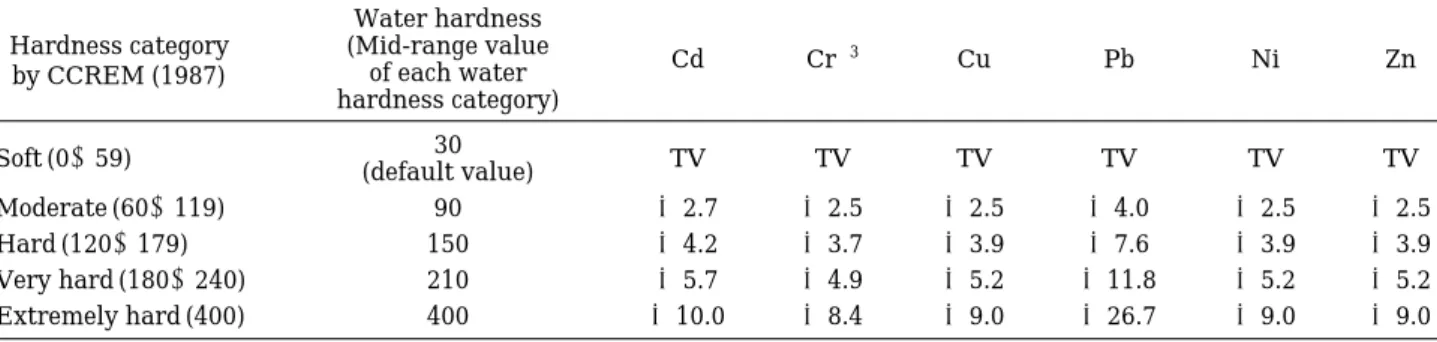
에 따라 준거치를 구분하고 있으며,
각각의 경도 범위의 중간 농 도를 기준으로 준거치를 제시하고 있다.
즉 경도30 mg CaCO
3L
-1을 기준으로TV
를 제시하며,
경도90, 150, 210, 400 mg CaCO
3L
-1에 따라 각 물질별 인자2.5~
56.7
을 곱하여 경도별 준거치를Table 3
과 같이 제시하 고 있다(ANZECC and ARMCANZ, 2000).
4.
캐나다캐나다는 수생태계 보호를 위한 준거치를 산정하기 위 해 경도 의존 중금속 중 카드뮴에 대해
Table 4
와 같은 경도 보정 알고리즘을 적용하여 준거치를 제시하고 있 다.
반면Cu, Pb, Ni
의 경우 경도 범위(
예. 0~60, 60~
120, 120~180,¤180 mg CaCO
3L
-1)
에 따라 준거치를 차 등 적용하고 있다(CCME, 2003).
Sweden 5 8 14 107
Norway 0.7 1.7 4 18
Denmark 14 86 155 272
France 48 83* 217 335 -
Belgium
109 - 240, 500 -
(Flanders)
Germany 30 105 210 -
*: 20
thpercentile
선진국의 경도 보정 알고리즘 비교 분석
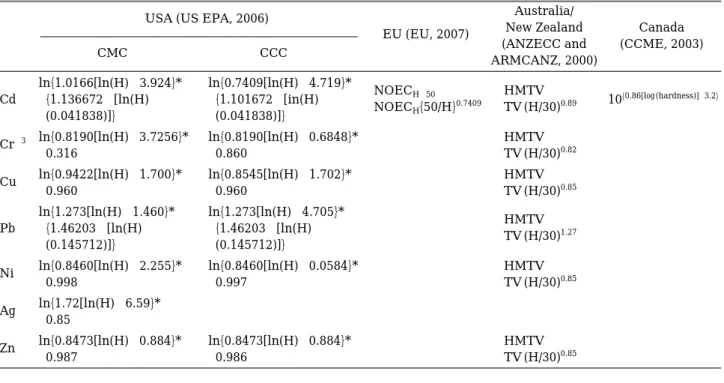
선진국에서 수생태계 보호를 위해 사용되는 수서독성 자료의 경도 보정 적용 사례를 조사한 결과 미국을 중심 으로 유럽연합
,
호주/
뉴질랜드,
캐나다 등의 국가에서 수 서독성자료에 대해 경도 보정 알고리즘을 적용하여 경도 의존 중금속의 독성 영향 변화를 고려하는 것으로 나타 났다.
경도 의존 중금속에 대한 경도 보정은 주로 수서독 성자료의 독성치와 수서독성자료로부터 도출된 준거치에 대해 경도 보정 알고리즘을 적용하는 방법과 수서독성자 료로부터 도출된 준거치를 경도 범위에 따라 차등 제시 하는 방법이 있다.
먼저 경도 보정 알고리즘을 적용하는 방법은 중금속별 독성자료의 양질에 따라 수식 내 인자 및 상수가 상이하게 적용되며,
경도 및 독성치 간 상관관계로부터 수식 내 활용 가능한 일정 상수를 산정하게 된 다
.
즉 미국의 수서독성자료 중 실험 상 경도와 실험 상 독성치의 관계 그래프에서 물질별 해당 기울기가 수식 내 상수로 활용되며,
이러한 방법은 유럽연합,
호주/
뉴질랜드,
캐나다 등의 국가에서도 유사하게 적용된다.
특히 호주/
뉴질랜드는 북미 수서독성자료를 바탕으로 일정 상수를 산정하였기 때문에 중금속6
종(
예. Cd, Cr
3++, Cu, Pb, Ni, Zn)
에 대한slope factor
는 미국의m
A, m
C와 거의 동일한 수치를 나타낸다.
또한 보정 시 기준 경도는 국가별 경도 수준에 따라 상이하게 적용되며,
미국50 mg CaCO
3L
-1,
유럽연합50 mg CaCO
3L
-1,
호주/
뉴질랜드30 mg CaCO
3L
-1을 기준 경도로 사용하고 있다.
다음으로 경도 범위에 따라 준거치를 차등 제시하는 방법은 주로 캐나다에서 사용되고 있으며, Cd
을 제외한Cu, Pb, Ni
에 대한 준거치 를 경도 범위에 따라 제시하고 있다.
국내 적용 가능한 경도 보정 알고리즘 제안
이미 미국
,
유럽연합,
호주/
뉴질랜드,
캐나다 등 주요 국 가에서는 경도 의존 중금속의 경도에 의한 독성 영향 변 화를 인식하였으며,
이를 고려하기 위해 경도 보정 알고 리즘을 개발하여 각각 적용하고 있다.
특히 미국과 호주/
뉴질랜드는 수서독성자료를 기반으로 개발된 알고리즘을 적용하여 주요 경도 의존 중금속에 대한 경도 보정을 수 행하고 있다.
본 연구에서는 국내 적용 가능한 알고리즘을 제안하기 위해 주요 경도 의존 중금속류에 대한 경도 보정 알고리 즘을 제시하고 있는 미국
,
호주/
뉴질랜드 방식을 비교하 였으며,
유럽연합과 캐나다는 오직 카드뮴에 대해서만 알 고리즘을 제시하고 있어 제외하였다.
국가별 보정방법을 비교하기 위해서 수서독성평가에서 대표적으로 활용되는Table 3*. Application factors for soft water trigger values in freshwater of a ragne of water hardness (mg CaCO
3L
-1) in
Australia and New Zealand (ANZECC and ARMCANZ, 2000).
Water hardness Hardness category (Mid-range value
Cd Cr
++3Cu Pb Ni Zn
by CCREM (1987) of each water hardness category)
Soft (0~59) 30
TV TV TV TV TV TV
(default value)
Moderate (60~119) 90 ×2.7 ×2.5 ×2.5 ×4.0 ×2.5 ×2.5
Hard (120~179) 150 ×4.2 ×3.7 ×3.9 ×7.6 ×3.9 ×3.9
Very hard (180~240) 210 ×5.7 ×4.9 ×5.2 ×11.8 ×5.2 ×5.2
Extremely hard (400) 400 ×10.0 ×8.4 ×9.0 ×26.7 ×9.0 ×9.0
*This table is adopted from ANZECC and ARMCANZ (2000)
Table 4. The hardness-related equation and freshwater quality guidelines in Canada (CCME, 2003).
Hardness-related Metals equation or range
Guideline ( μg L
-1) of hardness
(mg CaCO
3L
-1) Cd Water quality guideline
0.017
= =10
{0.86[log(hardness)]-3.2}0~120 2
Cu 120~180 3
¤180 4
0~60 1
Pb 60~12 2
120~180 4
¤180 7
0~60 25
Ni 60~12 65
120~180 110
¤180 150
Daphnia magna
에 대한 독성자료(Kszos et al., 1992;
정 등, 2001; Shaw et al., 2006)
를 바탕으로 미국과 호주/
뉴질랜드의 경도 보정 알고리즘을 각각 적용해보았다
.
즉 미국과 호주/
뉴질랜드의 경도 보정 알고리즘의 기준 경Cd {1.136672-[ln(H) {1.101672-[in(H) NOEC
H{50/H}
0.7409TV (H/30)
0.8910
(0.041838)]} (0.041838)]}
Cr
++3ln{0.8190[ln(H)
++3.7256}* ln{0.8190[ln(H)
++0.6848}*
- HMTV= =
0.316 0.860 TV (H/30)
0.82-
Cu ln{0.9422[ln(H)-1.700}* ln{0.8545[ln(H)-1.702}* - HMTV= =
0.960 0.960 TV (H/30)
0.85-
ln{1.273[ln(H)-1.460}* ln{1.273[ln(H)-4.705}*
HMTV= =
Pb {1.46203-[ln(H) {1.46203-[ln(H) - TV (H/30)
1.27-
(0.145712)]} (0.145712)]}
Ni ln{0.8460[ln(H)-2.255}* ln{0.8460[ln(H)
++0.0584}*
- HMTV= =
0.998 0.997 TV (H/30)
0.85-
Ag ln{1.72[ln(H)-6.59}* - - - -
0.85
Zn ln{0.8473[ln(H)
++0.884}* ln{0.8473[ln(H)
++0.884}*
- HMTV= =
0.987 0.986 TV (H/30)
0.85-
60
40
20
0
100 80 60 40 20 0
330 320 310 300 290 280 15
10
5
0
40 30 20 10 0
3
2
1
0 Toxicity value ( μ gL
-1) Toxicity value ( μ gL
-1)
Cd
Pb
TV HCT_USA HCT_Australia/New Zealand
Ni Zn
Cr (VI) Cu
Fig. 1. The toxicity values corrected by algorithms of USA and Australia and New Zealand. TV: Raw toxicity value, HCT
_USA: Hardness corrected toxicity value by USA’s algorithm, HCT_Australia and New Zealand: Hardness correct-
ed toxicity value by Australia and New Zealand. The HCT presented in the graphs are the toxicity values at the
hardness of 100 mg CaCO
3L
-1; TV in graph is based on the raw hardness of 253, 253, 253, 253, 109, and 30 mg
CaCO
3L
-1for Cd, Cr (VI), Cu, Pb, Ni, and Zn, respectively.
도를
100
으로 설정한 후6
개 중금속에 대한 독성치를 각 각 보정하였다.
그 결과 경도 보정 전후의 독성치의 차이 가 분명하였으며,
경도 보정 후 독성치는 미국과 호주/
뉴 질랜드의 경우 거의 유사한 수준을 나타냈다(Fig. 1).
따 라서 국내 경도 의존 중금속에 대한 수서독성평가에서 미국보다 간단한 알고리즘을 가지고 있는 호주/
뉴질랜드 의 경도 보정 알고리즘 적용이 용이할 것으로 사료된다.
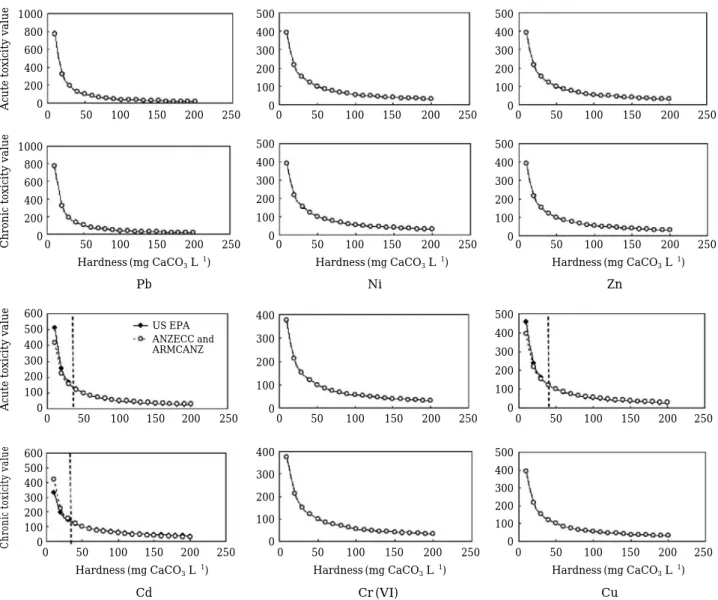
일정 경도 범위 내
(
예. 10~200 mg CaCO
3L
-1)
에서 미 국과 호주/
뉴질랜드의 경도 보정 알고리즘을 적용하여 경도 보정을 한 결과Cd, Cu
를 제외한4
개 중금속 그래 프에서는 동일한 수준을 나타냈으며, Cd
과Cu
의 그래프 에서도30 mg CaCO
3L
-1이상에서는 유사한 수준을 나타 냈다(Fig. 2).
한편Cu
의 경우, pH 6.1~7.8
범위 내에서민감한 수서생물종에 대해 경도영향이 미미한 수준으로 나타나
,
경도 보정의 부적절성이 보고된 바가 있다(Mar- kich et al., 2005).
따라서 본 연구에서는 호주
/
뉴질랜드의 경도 보정 알 고리즘 내 기준 경도 인자를 보완하여 다음과 같은 국내 적용 가능한 경도 보정 알고리즘을 제안하는 바이다.
HCTV= =
실험 상 독성치(
실험 상 경도/
기준 경도)
slope factorHCTV : Hardness Corrected Toxicity Value,
경도 보정 된 독성치slope factor : Cd 0.89, Cr
3++0.82, Cu 0.85, Pb 1.27, Ni 0.85, Zn 0.85
Fig. 2. The hardness corrected toxicity values ( μg L
-1) followed by the algorithms of US EPA and ANZECC/ARMCANZ.
1000 800 600 400 200 0
1000 800 600 400 200 0
600 500 400 300 200 100 0
600 500 400 300 200 100 0
0 50 100 150 200 250
0 50 100 150 200 250
Hardness (mg CaCO
3L
-1)
0 50 100 150 200 250
US EPA ANZECC and ARMCANZ0 50 100 150 200 250 Hardness (mg CaCO
3L
-1)
0 50 100 150 200 250
Hardness (mg CaCO
3L
-1) Pb
Cd Cr (VI) Cu
Ni Zn
0 50 100 150 200 250
0 50 100 150 200 250
Hardness (mg CaCO
3L
-1)
0 50 100 150 200 250
0 50 100 150 200 250
0 50 100 150 200 250
Hardness (mg CaCO
3L
-1)
0 50 100 150 200 250
0 50 100 150 200 250
Hardness (mg CaCO
3L
-1) 500
400 300 200 100 0
500 400 300 200 100 0
400 300 200 100 0
400 300 200 100 0
500 400 300 200 100 0
500 400 300 200 100 0
500 400 300 200 100 0
500 400 300 200 100 0
Acute toxicity value Acute toxicity value Chronic toxicity value Chronic toxicity value
CaCO
3L
-1을 제시하고 있을 뿐 국내 수계의 경도를 대 표할 수 있는 수치가 제시되어 있지 않다.
따라서 국내 기준경도를 제시하기 위한 추후 경도 모니터링 자료가 필요하며,
이를 토대로 선진국처럼 국가수준의 기준경도 를 제시해야 할 것이다.
적 요
본 연구에서는 미국
,
유럽연합,
호주/
뉴질랜드,
캐나다 등 선진국에서 수생태계 보호를 위해 사용되는 수서독성 자료의 경도 보정 적용 사례를 분석하였으며,
이를 바탕 으로 국내 적용 가능한 경도 보정 알고리즘을 제안하였 다.
경도 의존 중금속에 대한 경도 보정은 주로 수서독성 자료의 독성치와 수서독성자료로부터 도출된 준거치에 대해 경도 보정 알고리즘을 적용하는 방법이며,
미국,
유 럽연합,
호주/
뉴질랜드,
캐나다 등 주요 국가에서 적용하 고 있다.
또한 수서독성자료로부터 도출된 준거치를 경도 범위에 따라 차등 제시하는 방법이 있으며,
이는 주로 캐 나다에서 활용하고 있다.
미국과 호주/
뉴질랜드는 수서독 성자료를 기반으로 개발된 알고리즘을 적용하여 주요 경 도 의존 중금속에 대한 경도를 보정한 결과 경도 보정 전후의 독성치의 차이가 분명하였으며,
미국과 호주/
뉴질 랜드의 경도 보정 후 독성치는 거의 유사한 수준을 나타 냈다.
또한 일정 경도 범위 내에서 미국과 호주/
뉴질랜드 의 경도 보정 알고리즘을 적용하여 경도 보정을 한 결과 경도 의존 중금속에서는 미국과 호주/
뉴질랜드의 방법이 유사 또한 동일한 수준을 나타냈다.
그러나 카드뮴의 경 우는 경도30 mg CaCO
3L
-1이하에서 약간 차이가 있었 다.
우리나라는 현재 기준경도를 설정하고 있지 않으나,
호주/
뉴질랜드의 경도 보정 알고리즘 내 기준경도 인자 를 국내 기준경도가 마련되면 국내인자로 보완하여 적용 가능한 경도 보정 알고리즘으로 활용할 수 있을 것으로 사료된다.
인 용 문 헌