454 서 론
최근 국내에서는 생활수준의 향상으로 영양상태의 개선과 사 회적 복지차원의 의료기반이 조성되면서 사람들에게 고령화와 성인병 증가를 초래하게 되었고, 이로 인하여 세계적으로 적절 한 식생활과 건강에 관심을 가지게 되면서 웰빙식품의 하나로 서 수산물의 소비도 증가하는 계기가 되었다. 특히 해조류는 다양한 미네랄 성분을 함유하고 있을 뿐 아니라 종류에 따라서 는 특이한 생리활성을 나타내는 식이섬유를 비롯한 각종 유효 성분을 함유하고 있어 성인병이나 비만 예방효과가 있는 것으 로 알려져 건강식품으로도 주목을 받고 있다(Im et al., 2006;
Cho et al., 1995).
양식기술의 발달로 김, 미역, 다시마 등 해조류의 생산량이 증대되면서 2009년에는 87만톤에 이르렀는데(KREI, 2010), 이 중 김(Porphyra sp.)은 2000년대 중반 이후 20만톤 전후의
수준을 꾸준히 유지해 오고 있으며, 2010년에는 연간 생산량 이 최근 10년 이내 가장 많은 23만톤으로 우리나라의 대표적인 양식품종으로 자리잡게 되었다(MIFAFF, 2011). 이로 인하여 2010년에는 국내 김 양식이 시작된 이래 처음으로 수출금액 1 억 달러를 초과 달성하게 되었으며, 2011년에도 수출 수산물 중 단일품목으로서 오징어, 가다랑어 다음으로 세 번째로 높아 1억 6천만 달러의 외화를 획득하게 되었다(MIFAFF, 2012).
국내에서 양식되고 있는 김의 대표적인 품종으로는 참김(P.
tenera), 방사무늬김(P. yezoensis), 모무늬돌김(P. seriata) 및 잇바디돌김(P. dentata) 등이 있는데, 이들 중 참김과 방사무 늬김이 예로부터 양식되어져 온 주요 품종으로 엽체가 얇고 부 드러운 것이 특징이며 국내 생산량의 약 70%를 차지하고 있다 (Hwang et al., 2005). 시중에 유통되는 마른 김은 100% 돌김 이나 일반적으로 방사무늬김과 돌김이 혼합되어 있는 형태로 양식지역마다 현지 사정에 따라 몇 품종들을 섞어서 마른 김으
Article history;
Received 3 September 2012; Revised 21 September 2012; Accepted 11 October 2012
*Corresponding author: Tel: +82. 51. 720. 2620 Fax: +82. 51. 720. 2619 E-mail address: [email protected]
Kor J Fish Aquat Sci 45(5) 454-459, October 2012 http://dx.doi.org/10.5657/KFAS.2012.0454 pISSN:0374-8111
ⓒ The Korean Society of Fishereis and Aquatic Science. All rights reserved
유통 마른 김(Porphyra sp.)의 중금속(Hg, Pb, Cd) 함량과 위해성 평가
손광태* . 권지영 . 조미라 . 최우석 . 강성림 . 하나영 . 신진월 . 박큰바위1 . 김지회
Heavy Metals (Hg, Pb, Cd) Content and Risk Assessment of Commercial Dried Laver Porphyra sp.
Food Safety Research Division, National Fisheries Research and Development Institute, Busan 619-705, Korea
1Southwest Sea Fisheries Research Institute, National Fisheries Research and Development Institute, Yeosu 556-823 To investigate heavy metals (Hg, Pb and Cd) and their potential health risks in commercial dried laver (Porphyra sp.), we collected 45 samples from the major production areas on the western and southern coasts of Korea (Hwaseong, Seo- cheon, Gunsan, Muan, Shinan, Jindo, Haenam, Wando, Jangheung, Goheung and Busan). The Hg, Pb and Cd concentra- tions were measured using inductively coupled plasma spectrometry (ICP-MS) or a mercury analyzer. The average Hg, Pb and Cd concentrations in the dried laver were 0.006±0.0017, 0.196±0.0614 and 0.894±0.4882 mg/kg, respectively.
Based on the 2007 Korean Public Nutrition Report, these levels are 0.02, 0.11 and 2.47% of the provisional tolerable weekly intake (PTWI) for Hg, Pb and Cd, respectively, established by the FAO/WHO. The hazard quotient (HQ) deter- mined from the ratio of exposure and safe levels were less than 1.0. Therefore, the levels of overall exposure to Hg, Pb and Cd for dried laver were below the recommended JECFA (Joint FAO/WHO Expert Committee on Food Additives) levels, which indicate safe levels for public health.
Key words: Dried laver, Heavy metal, PTWI, Hazard quotient
Kwang-Tae Son*, Ji-Young Kwon, Mi-Ra Jo, Woo-Seok Choi, Sung-Rim Kang, Na-Young Ha, Jin-Wall Shin, Kunbawui Park1 and Ji-Hoe Kim
국립수산과학원 식품안전과, 1남서해수산연구소 해역산업과
로 제조하는 경우가 대부분이다.
한편 급속한 산업발전과 다양한 인간활동으로 각종 생활오 수, 산업폐수 등에 의해 하천 및 연안해역이 중금속을 비롯한 여러 가지 환경물질들에 의해 오염이 가속화되면서, 해조류는 서식환경의 해수로부터 중금속을 흡수하여 체내에 축적하는 위험에 노출되어 있다(Conti and Cecchetti, 2003). 이러한 생 물농축과정을 통하여 해조류에 축적된 중금속은 최종적으로 이를 섭취하는 사람에게 건강상 유해한 영향을 미칠 우려가 있 으므로, 사람들이 섭취 시 그 위해성을 확인하고 관리할 필요 성이 대두되고 있다.
그러나 국내에서는 해조류에 대한 중금속 기준으로서 2012 년 6월에 김에 대한 카드뮴 기준 규격이 행정 예고되어 있을 뿐 그 외에는 부재한 실정이다. 본 연구에서는 우리나라 국민들이 대중적으로 즐겨 먹고 있는 시판 마른 김을 대상으로 장기간 섭 취 시 인체에 매우 유해하다고 알려져 있는 중금속인 수은, 납, 카드뮴을 대상으로 그 오염실태를 파악함과 동시에 인체 위해 성을 평가해 보고자 하였다.
재료 및 방법 시료 및 시약
실험에 사용된 시료는 2012년 3월 한달 동안 마른김협회를 통하여 산지가 명확하게 입증된 서해안 5개소(화성, 서천, 군 산, 무안, 신안), 남해안 6개소(진도, 해남, 완도, 고흥, 장흥, 부산)로부터 제공받은 마른 김(Porphyra sp.)을 대상으로 하였 다. 마른 김은 분쇄기(Ika A 11 basic, Ika, China)로 분쇄하여 실험에 사용하였는데, 이 때 실험에 대한 재현성을 높히기 위 하여 한 지역당 최소 3개 시료를 병행하여 실험을 실시하였다.
실험에 사용된 분해용 시약은 nitric acid (Merck, supra-pure grade, Darmstadt, Germany)을 사용하였고, 물은 초순수장치 (Milli-Q Biocel, Millipore, Billerica, MA, USA)에서 제조한 초순수(18 MΩ 이상)를 사용하였다. 모든 초자기구는 5% 질 산용액에 24시간 이상 침지시킨 후 초순수로 3회 이상 깨끗이 씻은 다음 건조시켜 사용하였다.
중금속 분석
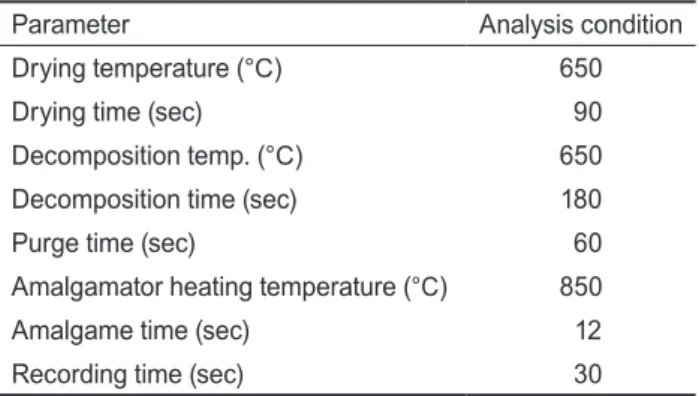
수은은 자동수은분석기(Automatic Mercury analyzer, Model IT/DMA-80, Milestone S&T, Italy)를 사용하여 가열기화 금 아말감법(Combustion gold amalgamation method)으로 측 정하였다. 수은분석을 위한 검량선은 표준인증물질(Certified reference material; 이하 CRM)로 MESS-3 (National Re- search Council, Nova Scotia, Canada)를 사용하였으며, 회수 율은 CRM으로 Dorm-3 ((National Research Council, Nova Scotia, Canada)를 사용하여 측정하였다. 수은 분석에 사용되 는 니켈 boat는 증류수를 이용하여 초음파 세척 후 빈 boat의 height가 0.000-0.003 g 이하가 될 때까지 공시험 후 시료분석
에 사용하였다. 균질화된 시료 약 0.03-0.04 g을 취하여 전처 리 없이 곧바로 수은분석기를 이용하여 분석하였으며, 기기 분 석조건은 Table 1에 나타내었다.
납과 카드뮴분석을 위한 전처리는 식품공전에 언급된 습식분 해법을 일부 변경하여 사용하였다. 즉 균질화한 마른 김 시료 1 g을 테프론 튜브에 넣고 65% nitric acid 10 mL을 첨가하여 상 온에서 150분간 반응시킨 후 80℃에서 400분간 가열분해하였 다. 가열분해한 시험용액의 nitric acid는 완전히 휘발시키고, 2% nitric acid로 재용해하여 여과한 다음 100 mL로 정용하여 실험에 사용하였다.
납 및 카드뮴은 유도결합플라즈마 질량분석기(ICP-MS, Per- kin Elan DRC II, Waltham, MA, USA)로 분석하였는데, 이 때 ICP-MS의 기기분석 조건은 Table 2에 나타내었다. 납 및 카드뮴 분석을 위한 검량선은 1,000 mg/kg의 표준용액을 1, 2.5, 5, 10, 20 μg/kg로 희석하여 사용하였으며, 납, 카드뮴 의 회수율은 수은과 동일한 CRM인 Dorm-3를 사용하여 측 정하였다.
위험성 확인 및 결정
본 연구에서는 FAO/WHO 합동 식품첨가물 전문가위원회 (Joint FAO/WHO Expert Committee on Food Additives ; Table 1. Operating conditions for a mercury analyzer
Parameter Analysis condition
Drying temperature (°C) 650
Drying time (sec) 90
Decomposition temp. (°C) 650
Decomposition time (sec) 180
Purge time (sec) 60
Amalgamator heating temperature (°C) 850
Amalgame time (sec) 12
Recording time (sec) 30
Table 2. Operating conditions of an ICP-MS
Parameter Analysis condition
RF power 1400 Watts
Lens voltage 8.0 V
Nebulizer gas flow (Ar) 0.97 L/min
Plasma gas flow (Ar) 15 L/min
Auxiliary gas flow (Ar) 1.275 L/min
Dwell time 50 ms
Scanning mode Peek hop
Number of replicate 3
Detector Dual
Analytical elements Pb (207.98), Cd (110.9)
이하 JECFA)에서 보고된 수은, 납 및 카드뮴의 독성자료 등을 근거로 위험성을 확인하였다. 총수은의 잠정주간섭취허용량 (Provisional Tolerable Weekly Intake, 이하 PTWI)는 1966 년(10차) 및 1970년(14차) JECFA 회의에서 300 μg/person으 로 설정되었다가 1972년(16차) 회의에서 5 μg/kg b.w./week 로 표기하게 되었다. 그 이후 총수은의 PTWI 설정을 위해 수 차례 과정을 거쳐 2010년 4 μg/kg b.w./week로 재설정하게 되었다(JECFA, 2010). 수은은 상온에서 액체상태로 존재하는 금속으로 무기수은과 유기수은의 형태로 존재하는데(Lee et al., 2006), 어류를 제외하고 대부분의 식품에서는 무기수은의 형태로 존재한다. 유기수은은 어패류 및 해산물에서 다른 식품 들에 비하여 높은 수은 함량을 나타내는데, 90% 이상이 메틸 수은 형태로 존재한다(FAO/UNEP, 1996). 유기수은은 독성이 강하고 중추신경계 특히 뇌장해를 일으키기 쉽고 보행기립 불 능, 사지운동 마비, 언어장해, 시야 축소, 뇌병변 등으로 알려 진 미나마타병을 유발한다(KFDA, 2007a).
납은 1999년 JECFA에서 납 노출에 민감한 영유아 집단의 경 우 식품 섭취를 통해 노출된 납이 40%가 체내로 흡수되고 30% 가 잔존한다는 가정하에 PTWI를 25 μg/kg b.w./week로 설정 하였다(JECFA, 1999). 호흡과 식품을 통해 납이 체내에 흡수 되면 대사되지 않고 대부분이 배출되지만 배출되지 않은 납(약 20%)은 90% 이상이 뼈와 치아 등에 축적되고 적은 양만이 소 변을 통해 배출된다(KFDA, 2007b; Marsden and Rainbow, 2004). 임산부가 납에 노출되면 조산, 유산 또는 저체중아를 낳을 수도 있으며, 특히 태아 및 유아는 납에 대한 저항력이 약해 신장, 간, 신경계 및 면역체계의 미숙을 유발할 수 있다 (Sivaperumal et al., 2007; Miramand et al., 2006).
카드뮴은 2003년 JECFA에서 PTWI가 7 μg/kg b.w./week 로 설정되었다가(JECFA, 2003), 2010년 JECFA 73차 회의 에서 카드뮴이 다른 중금속에 비해 반감기가 비교적 길어 1주 일간의 섭취기준인 PTWI 보다는 1달간의 섭취수준으로 표기 하는 잠정월간섭취허용량(Provisional Tolerable Weekly In- take ; 이하 PTMI)으로서 25 μg/kg b.w./month로 설정되었다
(JECFA 2010). 카드뮴은 국제 암연구소(IARC, International Agency for Research on Cancer)에서 Group I급 발암물질로 규정되어 있고, 뼈 속 칼슘의 골화(mineralization)에 직.간접 적으로 작용함으로써 골다공증을 유발시킨다(Whelton et al., 1997). 그 대표적인 사례가 1940년대 일본에서 알려진‘이타
이이타이병’으로 골다공증 및 구루병을 동반하였다(Miya- hara et al., 1988; Kazantzis, 2004). 카드뮴은 반감기가 약 10-40년으로 비교적 길고, 체내에 유입되면 배설 및 대사가 잘 되지 않아 대부분이 장기에 만성적으로 축적되며, 쉽게 배출되 지 않는다(Elinder et al., 1976; Jarup et al., 1998).
유통 마른 김에 대한 중금속(Hg, Pb, Cd) 위해성 평가 본 연구에 조사된 유통 마른 김에 함유되어 있는 수은, 납, 카 드뮴의 위해성 평가는 주간 섭취량 평가를 위하여 2007년 국 민건강영양조사 결과보고서 중 김의 1인 1일 평균 섭취량을 이 용하여 1일 인체 노출량 및 주간 섭취량을 산출하고, 산출된 결 과를 JECFA의 PTWI (카드뮴은 PTMI 적용)와 비교하여 평 가하였다.
식품섭취에 의한 중금속(수은, 납, 카드뮴) 1일 인체 노출량
그리고 연령별로 마른 김을 하룻동안 섭취함으로써 발생하는 각 중금속의 노출량과 JECFA에서 권고하는 1일 인체 노출량 을 비교한 위해지수(Hazard quotient; HQ)로도 안전성을 평 가하였다.
결과 및 고찰 표준인증물질(CRM)을 이용한 회수율 측정
본 연구에 사용된 시험법의 신뢰성을 확인하기 위하여 CRM 의 한 종류인 DORM-3를 사용하여 수은, 납, 카드뮴의 회수 율을 측정해 본 결과, CRM에서 제시한 인증값에 대하여 수은 은 99.5%, 납은 94.4%, 카드뮴은 98.3%로 비교적 높은 회수 율을 나타내었다(Table 3).
유통 마른 김 중 수은, 납, 카드뮴 함량
서해안 5개 지역(화성, 서천, 군산, 무안, 신안)과 남해안 6 개 지역(진도, 해남, 완도, 고흥, 장흥, 부산)에서 산지가 명확 하게 입증된 마른 김 45개체에서 검출된 수은, 납, 카드뮴 함 량을 Table 4에 나타내었다.
i=1
= ∑n 식품(i)의 중금속 평균오염도(mg/kg)×평균대상 인구집단의 식품 1일 섭취량(g/day) 평가대상 인구집단의 평균체중 (kg b.w.)
김 섭취에 의한 중금속의 1일 인체 노출량 (μg/kg b.w./day)
=
위해지수(HQ)
JECFA의 중금속 인체노출 허용량 (μg/kg b.w./day)
Table 3. Recovery test of certified reference materials (CRM)
Reference material Analyte N1 Certified value (mg/kg) Mean value (mg/kg) Recovery (%)
DORM-3
Hg 5 0.382±0.06 0.380±0.0032 99.5
Pb 5 0.395±0.05 0.373±0.021 94.4
Cd 5 0.290±0.02 0.285±0.008 98.3
1N, Number of samples; 2Mean value±SD.
유통 마른 김에서 검출된 수은의 평균함량은 0.006±0.0017 mg/kg (검출범위 0.003-0.010 mg/kg)이었으며, 무안 시료에 서 0.011 mg/kg로 가장 높은 값을 나타내었다. 이러한 결과는 Hwang et al. (2007)이 보고한 평균함량 0.005±0.004 mg/kg 과 비슷한 값을, 그리고 Kim et al. (2005)과 Choi et al. (1998) 이 보고한 0.01±0.00 mg/kg 및 0.012±0.002보다 낮은 값을 나 타내었다. 15개 지역에서 검출된 수은의 평균함량은 지역적으 로 큰 차이를 나타내지 않았다.
납의 평균 검출함량은 0.196±0.061 mg/kg (검출범위 0.094- 0.302 mg/kg)이었으며, 완도시료에서 0.316 mg/kg으로 가장 높은 값을 나타내었다. 이러한 결과는 Hwang et al. (2007) 이 보고한 평균함량 0.046±0.057 mg/kg보다 다소 높았으며, Kim et al. (2005)과 Choi et al. (1998)이 보고한 0.31±0.38 mg/kg 및 0.680±0.012 mg/kg보다는 낮은 값을 나타내었다.
지역적으로는 부산에서 가장 낮았으며, 완도에서 가장 높은 값 을 나타내었다.
카드뮴의 평균 검출함량은 0.894±0.488 mg/kg (검출범위 0.109- 1.506 mg/kg)이었으며, 군산시료에서 평균 1.506±0.861 mg/
kg로 다른 지역에 비하여 가장 높은 값을 나타내었다. 이는 군 산시료를 2개소에서 채취하여 분석하였는데, 그 중 1개소에서 카드뮴 함량이 최고 2.282 mg/kg로 검출되어 높은 표준편차 를 나타내었다. 그러나 식품의약품안전청에서 2012년 6월 행 정 예고 중인 해조류 중 건조김(조미김 포함)을 대상으로 신설
하고자 하는 카드뮴 기준인 0.3 mg/kg(생물 기준, 건물중량으 로 환산하면 약 3.03 mg/kg에 해당)보다는 낮은 수준을 나타 내었다. 본 연구결과에서 검출된 카드뮴의 평균함량은 Choi et al. (1998)이 보고한 0.096±0.002 mg/kg보다는 높은 결과를 보였으며, Hwang et al. (2007)과 Kim et al. (2005)이 각각 보고한 1.322±0.432 mg/kg 및 1.60±1.19 mg/kg 보다는 낮은 값을 나타내었다.
노출량 평가 및 위해도 결정
마른 김에 대한 위해도 결정은 JECFA에서 설정한 각 중금속 의 PTWI (카드뮴은 PTMI 적용)와 비교하였고, 또한 산출된 수은, 납, 카드뮴의 1일 인체 노출량을 JECFA의 1일 인체 안 전수준과 비교한 위해지수로 평가하였다.
마른 김의 수은, 납, 카드뮴에 대한 1일 인체 노출량 평가는 중금속의 오염도와 1일 평균섭취량에 대하여 한국인 평균 체중 을 고려하여 산출하였으며, 그 결과를 Table 5에 나타내었다. 마 른 김을 하루 평균 1.13 g 섭취 시 노출되는 수은은 1.2×10⁻⁴μg/kg b.w./day, 납은 4.0×10⁻³ μg/kg b.w./day, 카드뮴은 1.8×10⁻² μg/kg b.w./day을 나타내었다. 그리고 45개 시료 중 가장 오 염도가 높은 수은, 납, 카드뮴 함량 기준으로 나타낸 1일 인체 노출량은 각각 2.3×10⁻⁴ μg/kg b.w./day, 6.5×10⁻³ μg/kg b.w./
day, 4.7×10⁻² μg/kg b.w./day이었다. 이 때 김의 1일 섭취량 과 평가대상 인구집단의 평균체중(55 kg)은 2007년 국민건강 Table 4. Heavy metal concentrations of dried laver Porphyra sp. collected from eleven cities of Korea
Sampling regions N1 Hg (mg/kg) Pb (mg/kg) Cd (mg/kg)
Gunsan city 6 0.008±0.00052 0.224±0.034 1.506±0.861
Hwaseong city 3 0.005±0.0006 0.121±0.004 0.516±0.022
Jindo county 3 0.007±0.0002 0.220±0.005 1.279±0.016
Muan county 3 0.010±0.0011 0.177±0.005 1.192±0.069
Seocheon county 6 0.005±0.0007 0.186±0.026 0.939±0.201
Shinan county 3 0.008±0.0002 0.180±0.011 0.368±0.018
Busan city 3 0.003±0.0002 0.094±0.006 0.109±0.009
Goheung county 6 0.006±0.0010 0.217±0.026 0.977±0.017
Haenam county 3 0.006±0.0005 0.234±0.002 1.020±0.010
Jangheung county 3 0.006±0.0010 0.111±0.002 0.341±0.005
Wando county 6 0.007±0.0007 0.302±0.014 1.101±0.097
Total 45 0.006±0.0017
(Max. 0.011) 0.196±0.061
(Max. 0.316) 0.894±0.488 (Max. 2.282)
1N, Number of samples; 2Mean value ± SD.
Table 5. Estimated human exposure assessment of Hg, Pb and Cd for dried laver Porphyra sp. in the Korean overall population Sample Food mean intake (g/day) Exposure of Hg
(μg/kg b.w1)/day) Exposure of Pb
(μg/kg b.w/day) Exposure of Cd (μg/kg b.w/day)
Dried laver 1.13 1.2 × 10⁻⁴
(2.3 × 10⁻⁴)2
4.0 × 10⁻³ (6.5 × 10⁻³)
1.8×10⁻² (4.7 × 10⁻²)
1b.w, body weight; 2Maximum value for each heavy metals of dried laver in this study.
영양조사 자료를 근거로 활용하였다.
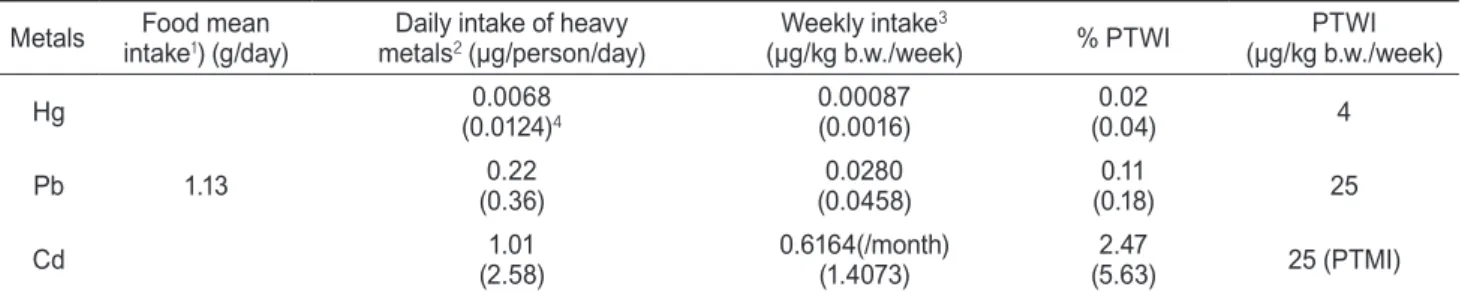
2007년 국민건강 영양조사 자료에 따르면 김의 1일 평균 섭 취량은 1.13 g이며, 평균 체중은 55 kg으로 이를 적용한 수 은과 납의 주간 섭취량은 각각 8.7×10⁻⁴ μg/kg b.w./week, 2.8×10⁻² μg/kg b.w./week이었으며, 카드뮴의 월간 섭취량은 0.62 μg/kg b.w./month로 나타났다(Table 6). 수은과 납의 위 해도는 JECFA에서 설정한 PTWI인 5 μg/kg b.w./week 및 25 μg/kg b.w./week에 대비하여 각각 0.02% 및 0.11%이었으며, 카드뮴은 PTMI인 25 μg/kg b.w./month의 2.47%로 나타나 매 우 안전한 수준이었다. 한편 해조류에서 검출된 중금속 함량을 PTWI에 대비하여 위해성을 평가한 연구들 중에서 Choi et al.
(2012)은 수은이 0.1%, Hwang et al. (2007)은 수은, 납, 카 드뮴이 각각 0.17%, 0.27%, 10.3%, 그리고 Mok et al. (2005) 은 수은, 납, 카드뮴이 각각 0.07%, 1.2%, 3.6%로 보고한 바 본 연구결과보다 다소 높은 값들을 나타내었는데, 이러한 결과 와 비교하여보면 김에서의 중금속 함량이 다른 해조류들보다 훨씬 낮다는 것을 의미하기도 한다.
그리고 실험에 사용된 마른 김 중 각 중금속의 오염도가 가장
높은 값을 기준으로 하였을 때 JECFA에서 설정한 PTWI 대 비한 위해도는 수은이 0.04%, 납이 0.18%, 카드뮴이 5.63% 로 마른 김의 평균 섭취량에 비해서 약 1.6-2.3배 높은 것으로 확인되었다.
한편 마른 김에 함유되어 있는 수은, 납, 카드뮴의 1일 노출 량을 JECFA의 1일 인체노출 허용량과 비교하여 연령별로 위 해지수(QI)를 평가해 보았다(Table 7). 평균 연령을 포함한 모 든 연령대에서 위해지수가 1보다 훨씬 낮아 유해영향 발생이 우려되지 않는 안전한 수준을 나타내었다. 위해지수는 단일물 질에 의한 1일간 인체 노출량을 표준물질에 의한 1일간 인체 노출량으로 나눈 값으로서 1 이상이면 유해영향 발생이 우려 되고, 1보다 같거나 작으면 유해영향 발생이 우려되지 않는 값 을 의미한다(Gerba, 2006; Kim et al., 2012; Lee et al., 2012).
이상의 결과에서 살펴본 바와 같이 국내에서 유통되는 마른 김에 함유되어 있는 중금속(수은, 납, 카드뮴)의 인체 위해도는 JECFA의 권고기준인 PTWI에 대비한 위해도 및 각 중금속의 1 일 노출량에 대한 JECFA의 1일 인체 노출량으로 산출한 위해 지수와 비교해 본 결과 매우 안전한 수준인 것으로 확인되었다.
Table 6. Comparison of average weekly intakes of heavy metals from dried laver Porphyra sp. with PTWI established by FAO/WHO
Metals Food mean
intake1) (g/day) Daily intake of heavy
metals2 (μg/person/day) Weekly intake3
(μg/kg b.w./week) % PTWI PTWI
(μg/kg b.w./week) Hg
1.13
0.0068
(0.0124)4 0.00087
(0.0016) 0.02
(0.04) 4
Pb 0.22
(0.36) 0.0280
(0.0458) 0.11
(0.18) 25
Cd 1.01
(2.58) 0.6164(/month)
(1.4073) 2.47
(5.63) 25 (PTMI)
1Food intake of Korean general population from Korea National Health and Nutrition Examination Survey, 2007.
2Daily intakes of heavy metals per adult (μg/day/person) = Σ[Concentration of heavy metals in each food × daily intakes of foods (g/person/day)].
3Weekly intake of heavy metals (μg/kg b.w/week) = [daily intakes of metal per adult (μg/day/person) × 7days/week] / 55 kg (average body weight per adult).
4Maximum value for each heavy metals of dried laver in this study.
Table 7. Hazard quotient (HQ) for Hg, Pb and Cd in dried laver Porphyra sp. for age category population Category Classification Average body
weight (kg) Food mean
intake (g/day) Hg Pb Cd
General General 55 1.13 2.2×10⁻⁴ 1.1×10⁻³ 2.2×10⁻²
(year)Age
≤ 2 12.31 0.61 5.2×10⁻⁴ 2.7×10⁻³ 5.3×10⁻²
3-6 19.65 1.26 6.7×10⁻⁴ 3.5×10⁻³ 6.9×10⁻²
7-12 36.86 1.21 3.4×10⁻⁴ 1.8×10⁻³ 3.5×10⁻²
13-19 57.88 1.10 2.0×10⁻⁴ 1.0×10⁻³ 2.0×10⁻²
20-29 62.69 1.07 1.8×10⁻⁴ 0.9×10⁻³ 1.8×10⁻²
30-49 63.03 1.36 2.3×10⁻⁴ 1.2×10⁻³ 2.3×10⁻²
50-64 62.21 1.04 1.8×10⁻⁴ 0.9×10⁻³ 1.8×10⁻²
65 > 51.84 0.53 1.1×10⁻⁴ 0.6×10⁻³ 1.1×10⁻²
참고문헌
Cho DM, Kim DS, Lee DS, Kim HR and Pyeun JH. 1995.
Trace components and functional saccharides in seaweed.
-1. Changes in proximate composition and trace element according to the harvest season and places. Bull Kor Fish Soc 28, 49-59.
Choi H, Park SK and Kim MH. 2012. Risk assessment of mer- cury through food intake for Korean population. Korean J Food Sci Technol 44, 106-113.
Choi SN, Lee SU, Chung KH and Ko WB. 1998. A study of heavy metals contents of the seaweeds at various area in Korea. Korean J Soc Food Sci 14, 25-32.
Conti ME and Cecchetti G. 2003. A biomonitoring study : Trace metals in algae and molluscs from Tyrrhenian coastal areas.
Environ Res 93, 99-112.
Elinder CG, Lind B, Kjellstrom T, Linnman L and Friberg L.
1976. Cadmium in kidney cortex, liver, and pancreas from Swedish autopsies. Estimation of biological half time in kidney cortex, considering calorie intake and smoking hab- its. Arch Environ Health 31, 292-302.
FAO/UNEP. 1996. Decision Guidance Documents ; Mercury compounds. In : Joint FAO/UNEP Programme for the Op- eration of Prior Informed Consent. Food and Agriculture Organization of the United Nations/United Nations Envi- ronment Programme, Rome-Geneva 1991; amended 1996.
Gerba CP. 2006. Chapter 14. Risk assessment. In : Environ- mental and Pollution Science (2nd eds). Pepper IL, Gerba CP and Brusseau ML eds. Academic press, San Diego, Cali- fornia, USA.
Hwang MS, Kim SM, Ha DS, Baek JM, Kim HS and Choi HG.
2005. DNA sequences and identification of Porphyra culti- vated by natural seeding on the southwest coast of Korea.
Algae 20, 183-196.
Hwang YO, Kim MS, Park SG and Kim SJ. 2007. Contents of lead, mercury, and cadmium in seaweeds collected in coastal area of Korea. Analytic Sci & Technol 20, 227-236.
Im YG, Choi JS and Kim DS. 2006. Mineral contents of edible seaweeds collected from Gijang and Wando in Korea. J Kor Fish Soc 39, 16-22.
Jarup L, Berlund M, Elinder CG, Nordberg G and Vahter M.
1998. Health effects of cadmium exposure : A review of the literature and a risk estimate. Scand J Work Environ Health 24(Suppl 1), 1-51.
JECFA 1999. Joint FAO/WHO Expert Committee on Food Ad- ditives. 53rd Meeting. Summary and Conclusions. World Health Organization, Geneva, Switzerland.
JECFA 2003. Joint FAO/WHO Expert Committee on Food Ad- ditives. 61st Meeting. Summary and Conclusions. World Health Organization, Rome, Italy.
JECFA. 2010. Summary report of the 72nd meeting of JECFA (JECFA/72/SC). Joint FAO/WHO Expert Committee on Food Additives.
Kanzantzis G. 2004. Cadmium, osteoporosis and calcium me- tabolism. Biometals 17, 493-498.
KFDA (Korea Food & Drug Administration). 2007a. Series of hazard compounds - 21. What is methylmercury in food?
KFDA, Seoul, Korea.
KFDA (Korea Food & Drug Administration). 2007b. What is Food-Borne Lead?. Research Report of KFDA.
Kim JH, Mok JS and Park HY. 2005. Trace metal contents in seaweeds from Korean coastal area. J Korean Soc Food Sci Nutr 34, 1041-1051.
Kim JY, Yoo JH, Lee JH, Kim MJ, Kang DW, Ko HY, Hong SM, Im GJ, Kim DH, Jung GB and Kim WI. 2012. Moni- toring and risk assessment of heavy metals in edible mush- rooms. Korean J Environ Agric 31, 37-44.
KREI (Korea Rural Economic Institute). 2010. Food balance sheet. p.146.
Lee C, Cho SD, Chang DS, Shin DH, Oh DH, Whang IK, Kwon KS, Woo, GJ, Chun HS, Oh SS and Kim
GH. 2006. Food safety guidelines for consumer. Safe Food 1, 31-43.
Lee HJ, Shim JY, Oh HS, Jang MR, Lee YA, Lee RK, Kim MA, Lee SM, Cho TY and Kang HI. 2012. A study on heavy metal contents in processed foods and their safety evalua- tions. Korean J Food Sci Technol 44, 21-17.
Marsden ID and Rainbow PS. 2004. Does the accumulation of trace metals in crustaceans affect their ecology - the amphi- pod example? J Exp Mar Ecol 300 373-408.
MIFFAF (Ministry for Food, Agriculture, Forestry and Fisher- ies). 2011. Food, Agriculture, Forestry and Fisheries Statis- tical yearbook (2011). p.421.
MIFFAF (Ministry for Food, Agriculture, Forestry and Fisher- ies). 2012. Yearbook of fishery products export & import statistics (2011). p.35.
Miramand P, Bustamante P, Bentley D and Koueta N. 2006.
Variation of heavy metal concentrations (Ag, Cd, Co, Cu, Fe, Pb, V, and Zn) during the life cycle of the common cuttlefish Sepia officinalis. Sci Total Environ 361, 132-143.
Miyahara T, Yamada H and Takeuchi M. 1988. Inhibitory ef- fects of cadmium on invitro calcification of a clonal osteo- genic cell, MC3T3-E1. Toxicology Appl Pharmacol 96, 52-59.
Mok JS, Park HY and Kim JH. 2005. Trace metal contents and safety evaluation of major edible seaweeds from Korean coast. J Korean Soc Food Sci Nutr 34, 1464-1470.
Sivaperumal P, Sankar TV and Viswanathan Nair PG. 2007.
Heavy metal concentrations in fish, shellfish and fish prod- ucts from internal markets of India vis-a-vis international standards. Food Chemistry 102, 612-620.
Whelton BD, Peterson DP, Moretti ES, Dare H and Bhattacha- ryya MH. 1997. Skeletal changes in multiparous, nullipa- rous and ovariectomized mice fed either a nutrient-sufficient or -deficient diet containing cadmium. Toxicol 119, 103-121.