Properties of Saeu Jeotgal (Shrimp Jeotgal) Prepared with Different Types of Salts
Jae Min Shim1, Kang Wook Lee1, Zhuang Yao1, Jeong A Kim1, Hyun-Jin Kim1,2, and Jeong Hwan Kim1,2*
1Division of Applied Life Science (BK21 plus), Graduate School, 2Institute of Agriculture and Life Science, Gyeongsang National University, Jinju 52828, Republic of Korea
Received: March 14, 2017 / Revised: August 4, 2017 / Accepted: September 5, 2017
Introduction
Jeotgals are traditional Korean salted and fermented seafoods produced from whole fishes, fish organs, fish eggs, or shell fishes [1]. Many different types of jeotgals are produced depending upon locations, seasons, and personal preferences [2]. But the procedure for jeotgal production is basically the same, raw materials are mixed with salt (20−30%, w/w) in a container, and fer- mentation starts spontaneously. Salted raw materials are stored for several months or years in some cases at room temperature. The main function of salt is preven- tion of growth of spoilage microorganisms [2]. In addi- tion, salt contributes to the development of flavor and
taste of jeotgals during fermentation [3]. Salt has been considered to be important for quality of fermented foods. For this reason, solar salt is popular for the prepa- ration of many fermented foods in Korea including kimchi, soybean paste, soybean sauce, and jeotgals.
Solar salt is produced by crystallization of salt by vapor- izing seawater in a saltern by solar heat and wind [4].
The Korean natural sea salt is reported to have lower NaCl concentration and higher mineral contents includ- ing Ca, Mg, K, S, and other elements as compared to imported salts [5]. Recently, bamboo salt is used for fer- mented foods. Bamboo salt is believed to possess some medicinal activities and started to be used for fermented foods regardless of its high price [6]. But not enough sci- entific data are available on the effects of solar salt and bamboo salt for the qualities of fermented foods. Espe- cially, the effects of different types of salts have been rarely studied on the growth of microorganisms during Saeu (shrimp) jeotgal (SJ) was prepared by mixing with 25% salt with different types: purified salt (PS), solar salt aged for 1 year (SS), and bamboo salt. SJ was fermented for 22 weeks at 15℃. Bacilli and marine bacteria were detected throughout the entire fermentation period, and marine bacteria were present in the largest numbers. Lactic acid bacteria (LAB) were detected only during the first 8-10 weeks, but yeasts appeared at the sixth week and later. Archaea were detected in low numbers only from SS-SJ during the first 8 weeks. BS- SJ showed higher pH and lower titratable acidity (TA) values than other SJs because of strong alkalinity of bamboo salt. Amino-type nitrogen (ANN) contents of SJs increased during fermenta- tion, especially, after 2 and 6 weeks. SS-SJ showed the highest ANN content from the beginning to the end of fermentation. Ammonia-type nitrogen (AMN) contents also increased like the amino-type nitrogen during fermentation. The highest volatile basic nitrogen (VBN) was also observed in SS-SJ. Salinity was kept constant after 4 weeks. SS was better than other salts for SJ fermentation in terms of protein hydrolysis.
Keywords: Saeu jeotgal, solar salt, bamboo salt, purified salt
*Corresponding author
Tel: +82-55-772-1904, Fax: +82-55-772-1909 E-mail: [email protected]
© 2017, The Korean Society for Microbiology and Biotechnology
fermentation. Different types of salts have different chemical compositions and this can affect the growth of microorganisms and the activities of enzymes from raw materials and microorganisms [4]. This eventually affects the final qualities of jeotgals. For these reasons, studies on the effects of each salt-type for the quality of a fermented food are necessary. In this work, saeu (shrimp) jeotgals were prepared with different types of salts: puri- fied salt (PS), 1-year aged solar salt (SS), and bamboo salt melted and recrystallized for 3 times (BS). Jeotgal samples were fermented for 22 weeks at 15℃. During fermentation, the growth of various microorganisms was examined together with other properties of jeotgal samples.
Materials and Methods
Preparation of saeu jeotgals
Saeu (shrimp, Acetes chinensis) was purchased from a local Suhyup at Shinan county, Jeonnam, Korea in December 2015. Immediately after the purchase, saeu was washed three times under running tap water. After removing excess water by standing for 10 min, each 10 kg of saeu was mixed with different types of salts: PS (Hanju, Ulsan, 2015, NaCl content 99.18%), SS (Taepong salt farm, Shinan, Jeonnam, 2015, NaCl content 79.84%), and BS (Insanga, Hamyang, Gyeongnam, 2014, NaCl content 94.54%). The final NaCl concentration of saeu jeotgals was adjusted to 25% (w/w) by adding different amount of each salt: 2,520 g of PS, 3,131 g of SS, and 2,644 g of BS. Salted jeotgals were fermented for 22 weeks at 15℃ and analyzed at every 2 weeks.
Viable cell counting
Ten gram of each saeu jeotgal (SJ) sample was mixed with 90 ml of peptone water prepared with peptone (Sigma-Aldrich, P7750, 0.1%, w/v), and homogenized using a stomacher (Stomacher®80, Seward, USA). The homogenate was filtered with a bag filter (Interscience, France) and diluted serially with peptone water. Diluted samples (0.1 ml) were spreaded on MRS agar plates for lactic acid bacteria (LAB) counting, marine agar plates for marine bacteria counting, LB agar plates for bacilli counting, YM agar plates for yeasts counting, and DSMZ954 agar plates for archaea counting. Plates were incubated for 24 h at 37℃ for marine, LB, and DSMZ954
agar plates, and 48 h at 30℃ for MRS and YM agar plates.
pH and titratable acidity (TA) measurements
Ten gram of a homogenized jeotgal sample was mixed with 40 ml of distilled water, shaken in a water bath (150 rpm, 30℃) for 1 h, and the supernatant was obtained after centrifugation (4,000 ×g, 20 min). pH of the supernatant was measured using a pH meter (DMS, Korea) and TA was calculated by titrating the superna- tant with 0.1 N NaOH until pH 8.4. The amount of NaOH was used to calculate the amount of lactic acid (%).
Amino-type nitrogen (ANN), ammonia-type nitrogen (AMN), and volatile basic nitrogen (VBN) measurements
ANN was measured by formol titration method [7].
Five gram of a homogenized jeotgal sample was mixed with 95 ml of distilled water, and the mixture was shaken in a water bath (150 rpm, 30℃) for 1 h. Superna- tant (10 ml) was titrated with 0.1 N NaOH until pH 8.4.
Sample was mixed with distilled water (10 ml) and form- aldehyde solution (pH 8.4, 10 ml) and stood for 10 min at room temperature. Titration with 0.1 N NaOH was repeated until pH 8.4 and the amount of NaOH was used to calculate ANN content as shown below.
Amino-type nitrogen (mg%)
= [sample titration (ml) − blank test (ml)] × 1.4 × F × D
× 100/S
1.4 corresponds to ANN (in mg) equivalent to 1 ml of 0.1 N NaOH. F is the factor of 0.1 N NaOH, D is dilution fold, and S is the amount of sample (5 g).
AMN was measured by indophenol blue method [8].
Five gram of a homogenized jeotgal sample was mixed with 95 ml of distilled water, and the mixture was shaken in a water bath (150 rpm, 30℃) for 1 h. Superna- tant (1 ml) was mixed with 3 ml of solution A (phenol 10 g, sodium niropursside dehydrate 1 g, EDTA 4 g, dis- tilled water 1 L) and stood for 5 min at room tempera- ture. Then 5 ml of solution B (Na2HPO4·12H2O 9 g, NaOH 6 g and NaOCl 10 ml, distilled water 1 L) was added and reacted for 20 min at 37℃. Changes in absor- bance at 665 nm were measured with a spectrophotometer (UV-1601, Shimadzu, Japan), and AMN was determined on the basis of the standard curve of (NH4)2SO4.
VBN was determined by Conway’s method with some
modifications [4]. A homogenized jeotgal sample (10 g) was mixed with distilled water (30 ml) and 20% trichlo- roacetic acid solution (20 ml). Then the sample was cen- trifuged (8,000 ×g, 10 min, 4℃) and filtrated with a membrane filter (0.45 µm, ADVATEC, Tokyo, Japan).
Pretreated sample (1 ml) was transferred to the outer room of a Conway unit with 1 ml of 1% H3BO3 solution in the inner room. Saturated K2CO3 solution (1 ml) was mixed carefully with the sample solution in the outer room and the Conway unit was sealed and incubated for 1 h at 37℃. The mixture in the outer room was neutral- ized with 0.02 N H2SO4 solution until the H3BO3 solu- tion turned to pink color. VBN value was calculated in the following equation.
VBN (mg/g) = 0.28 × (V1 − V2) × 5000/S
V1 is the volume (ml) of 0.02 N H2SO4 solution, V2 is the volume (ml) of 0.02 N H2SO4 solution in the control
experiment in which equivalent amount of distilled water was used in place of sample solution. 0.28 is the result of 14 (molecular weight of nitrogen) multiplied with the concentration of H2SO4 solution, 0.02, and S is the weight of the sample.
Salinity and color changes
For salinity measurements, 10 g of a homogenized jeotgal sample was mixed with 40 ml of distilled water.
Supernatant was obtained after shaking in a water bath and centrifuged as stated above. Salinity of supernatant was measured by using a saltmeter (PAL-SALT, Atago, Japan). Measurements were repeated 3 times and the average values were shown. Color of jeotgals was mea- sured by using a color meter (Model CR-400, Konica Minolta, Japan). Values were obtained after 12 mea- surements for each sample and expressed as L* (light- ness), a* (redness) and b* (yellowness) units.
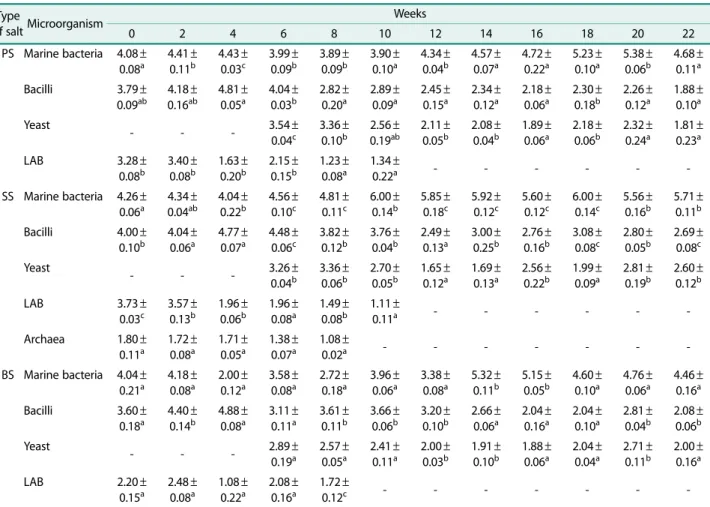
Table 1. Viable counts of marine bacteria, bacilli, yeast, LAB, and archaea of saeu jeotgals during fermentation.
Type
of saltMicroorganism Weeks
0 2 4 6 8 10 12 14 16 18 20 22
PS Marine bacteria 4.08± 0.08a
4.41± 0.11b
4.43±
0.03c
3.99± 0.09b
3.89± 0.09b
3.90±
0.10a
4.34± 0.04b
4.57± 0.07a
4.72±
0.22a
5.23± 0.10a
5.38± 0.06b
4.68±
0.11a
Bacilli 3.79±
0.09ab
4.18± 0.16ab
4.81±
0.05a
4.04± 0.03b
2.82± 0.20a
2.89±
0.09a
2.45± 0.15a
2.34± 0.12a
2.18±
0.06a
2.30± 0.18b
2.26± 0.12a
1.88±
0.10a Yeast
- - - 3.54±
0.04c
3.36± 0.10b
2.56±
0.19ab
2.11± 0.05b
2.08± 0.04b
1.89±
0.06a
2.18± 0.06b
2.32± 0.24a
1.81±
0.23a
LAB 3.28±
0.08b
3.40± 0.08b
1.63±
0.20b
2.15± 0.15b
1.23± 0.08a
1.34±
0.22a - - - - - -
SS Marine bacteria 4.26± 0.06a
4.34± 0.04ab
4.04±
0.22b
4.56± 0.10c
4.81± 0.11c
6.00±
0.14b
5.85± 0.18c
5.92± 0.12c
5.60±
0.12c
6.00± 0.14c
5.56± 0.16b
5.71±
0.11b
Bacilli 4.00±
0.10b
4.04± 0.06a
4.77±
0.07a
4.48± 0.06c
3.82± 0.12b
3.76±
0.04b
2.49± 0.13a
3.00± 0.25b
2.76±
0.16b
3.08± 0.08c
2.80± 0.05b
2.69±
0.08c Yeast
- - - 3.26±
0.04b
3.36± 0.06b
2.70±
0.05b
1.65± 0.12a
1.69± 0.13a
2.56±
0.22b
1.99± 0.09a
2.81± 0.19b
2.60±
0.12b
LAB 3.73±
0.03c
3.57± 0.13b
1.96±
0.06b
1.96± 0.08a
1.49± 0.08b
1.11±
0.11a - - - - - -
Archaea 1.80±
0.11a
1.72± 0.08a
1.71±
0.05a
1.38± 0.07a
1.08±
0.02a - - - - - - -
BS Marine bacteria 4.04± 0.21a
4.18± 0.08a
2.00±
0.12a
3.58± 0.08a
2.72± 0.18a
3.96±
0.06a
3.38± 0.08a
5.32± 0.11b
5.15±
0.05b
4.60± 0.10a
4.76± 0.06a
4.46±
0.16a
Bacilli 3.60±
0.18a
4.40± 0.14b
4.88±
0.08a
3.11± 0.11a
3.61± 0.11b
3.66±
0.06b
3.20± 0.10b
2.66± 0.06a
2.04±
0.16a
2.04± 0.10a
2.81± 0.04b
2.08±
0.06b Yeast
- - - 2.89±
0.19a
2.57± 0.05a
2.41±
0.11a
2.00± 0.03b
1.91± 0.10b
1.88±
0.06a
2.04± 0.04a
2.71± 0.11b
2.00±
0.16a
LAB 2.20±
0.15a
2.48± 0.08a
1.08±
0.22a
2.08± 0.16a
1.72±
0.12c - - - - - - -
Values are means ± SD from triplicate determinations. Significant differences (a−c) in the same tested counts are tested (p < 0.05, Ducan’s mul- tiple range test).
Statistical analyses
All measurements were repeated three times, and the results are shown as the mean± standard deviation.
Data were analyzed by Duncan’s multiple range test using the SPSS ver. 18 (SPSS Inc., USA) package (p <
0.05).
Results and Discussion
Viable counts of LAB, marine bacteria, archaea, bacilli, and yeasts of saeu jeotgals during fermentation
Viable cells of LAB, marine bacteria, archaea, bacilli, and yeasts of SJs were counted every 2 weeks during fer- mentation (Table 1). Marine bacteria were the most dominant group and the numbers were maintained at 4− 5 log CFU/g throughout the fermentation period. Imme- diately after preparation, marine bacteria counts were 4.04−4.26 log CFU/g and then increased gradually and the final counts were 4.46−5.71 log CFU/g at 22 weeks.
The highest counts were observed in SS-SJ followed by PS-SJ and BS-SJ. SS-SJ also showed significantly higher bacilli counts than PS and BS-SJs. During the fermentation period, BS-SJ showed higher bacilli counts than PS-SJ except 6, 16, and 18 weeks. Yeasts were not detected until the sixth week and the numbers decreased until 16−18 weeks, and then increased slightly at 20 week, indicating the appearance of different yeast types during the later stages of fermentation. LAB were detected during the first 10 weeks and not detected thereafter. Archaea were detected from SS-SJ during the first 8 weeks, but not from PS and BS-SJs. Unlike PS, SS and BS contain significant amounts of minerals such as Ca, Mg, K, Fe, and S, and this caused growth stimulation of some microorganisms. Some components of solar salt seemed to encourage the growth of archaea and bacilli. Throughout the entire fermentation period, marine bacteria, bacilli, and yeasts were constantly detected and these groups seemed to be important for the fermentation of SJs with 25% NaCl concentration.
At this salt concentration, halophiles such as Salinicoc- cus and Halomonas are expected to be the dominant organisms [9]. Identification of species of each group in Table 1 will provide valuable informations. Recently, culture-independent and culture-dependent methods have been used to identify microorganisms important for the fermentation of various jeotgals. As results of such
studies, novel species such as Jeotgalicoccus and Weis- sella jogaejeotgali sp. nov. were identified [10, 11]. Future studies on the roles of each identified species will help to understand the fermentation process of SJs and develope suitable starters for the production of high quality SJs.
pH and titratable acidity measurements of SJs
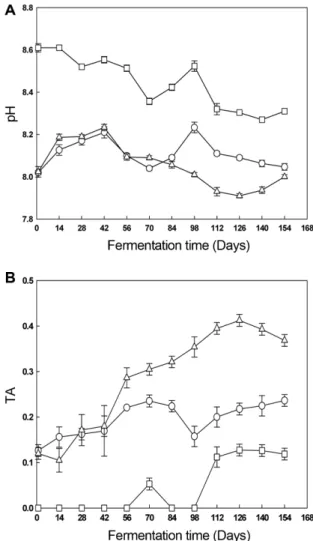
The pH of PS-SJ immediately after preparation was 8.02± 0.02, same with that of SS-SJ (Fig. 1A). But the pH of BS-SJ was 8.61± 0.02, much higher than those of other SJs. This was due to the high alkalinity of the bamboo salt [12]. The pH of BS-SJ decreased gradually during fermentation with up and down, and the final pH was 8.31± 0.01. The pH of PS and SS-SJs increased until the sixth week, reaching 8.21−8.23. Then pH of SS- SJ decreased continuously until the 18th week, reaching
Fig. 1. Changes in pH (A) and titratable acidity (B) of saeu jeotgals during fermentation. ○, purified salt; △, solar salt; □, bamboo salt.
the lowest value, pH 7.91± 0.01. Then the pH increased again, reaching 8.0± 0.01 at 22 week. The pH of PS-SJ decreased after the sixth week, reaching the lowest value of 8.04± 0.01 at 10th week, and then increased and decreased. The final value was 8.05± 0.02, almost same with the starting value. TA values changed like pH val- ues but in an opposite direction. Initial TA values were 0.13, 0.12, and 0.00 for PS, SS, and BS-SJ, respectively.
TA values increased during fermentation, and SS-SJ showed the greatest increase followed by PS-SJ and BS- SJ (Fig. 1B). For SS-SJ, increase in TA was small during the first 6 weeks and then increased significantly, and the final TA was 0.37± 0.01. TA of PS-SJ also increased after the sixth week with up and down, and the final TA was 0.24± 0.01. BS-SJ showed the lowest TA value and the TA increased after 14th week and the final value was 0.12± 0.01.
pH and TA values of fermented foods reflect the com- bined metabolic activities of microorganisms. If organ- isms producing acids like LAB become dominant groups, pH of fermented foods decreases and TA increases [4, 13]. If organisms producing basic compounds such as amines become dominant groups, pH increases and TA decreases [14]. Therefore, fluctuations of pH values of SJs reflect the changes in microflora during fermenta- tion of SJs. Detailed analyses of microbial communities of SJs will help to understand the basis of pH changes.
Most jeotgals show pH values in the range of 5.5 to 6.5, but jeotgals from crustaceans such as shrimp are reported to show higher pH values due to amines pres- ent in high concentration [15].
Amino-type nitrogen (ANN), ammonia-type nitrogen (AMN), and volatile basic nitrogen (VBN) of SJs
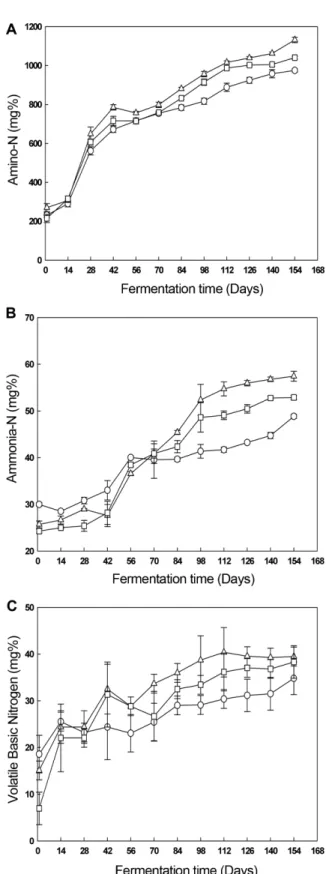
ANN content of a fermented food is used as a valuable index showing the degree of fermentation. Amino acids generated from proteins serve as important nutrients and also sources of umami taste. ANN is also considered an important quality index because it has a strong rela- tionship with flavor [4]. Immediately after preparation, ANN content of SS-SJ was 269.93± 20.96, and those of PS-SJ and BS-SJ were 231.06± 13.59, and 214.61 ± 20.93 mg%, respectively. ANN contents of SJs increased slowly for the first 2 weeks and then increased rapidly until the fourth week, and then increased with reduced rates. The final ANN contents were 1,131.74± 13.97,
Fig. 2. Changes in amino-type nitrogen (A), ammonia-type nitrogen (B), and volatile basic nitrogen (C) of saeu jeotgals during fermentation. ○, purified salt; △, solar salt; □, bamboo salt.
974.92± 8.00, and 1040.60 ± 7.94 mg% for SS, PS, and BS-SJ, respectively at 22 week (Fig. 2). SS-SJ main- tained higher ANN content during the entire fermenta- tion period. A previous study reported that SJ with solar salt showed higher ANN content than SJ with purified salt [3]. It was suspected that inorganic metal ions such as Mn2+,Mg2+, Zn2+, Co2+, and Fe2+ in the solar salt encouraged the growth of microorganisms and caused higher protease activities.
AMN and VBN contents changed similarly with ANN.
Initial AMN values were 29.99± 0.35, 25.70 ± 0.75, and 24.28± 0.41 mg% for PS, SS, and BS-SJ, respectively.
AMN contents increased during fermentation, and the final values were 48.84± 0.44, 57.43 ± 1.06, and 52.87 ± 0.48 mg% for PS, SS, and BS-SJ, respectively. For VBN contents, initial values were 18.57± 4.02, 15.09 ± 2.01, 6.96± 3.48 mg% and the final values were 34.83 ± 3.48, 39.47± 2.01, 38.31 ± 3.48 mg% for PS, SS, BS-SJ, respec- tively. Although the initial VBN of BS-SJ was signifi- cantly lower than those of PS and SS-SJs, the final values were not different significantly. In a previous report, all SJs prepared with different types of salts, the final VBN values were not different significantly [4].
Both AMN and VBN serve as indexes for the degree of protein hydrolysis and freshness of foods. If protein hydrolysis proceeds too further, ammonia and other small sized volatile basic compounds such as trimethyl amine are generated, which adversely affects the flavor and texture of fermented foods. VBN value of less than 30−35 mg% was suggested for acceptable freshness of fish [16].
SS-SJ showed the highest ANN, AMN and VBN val- ues and BS-SJ was the next. Higher ANN, AMN, and VBN values might be caused by higher viable counts or more proteolytically active cells in SS-SJ and BS-SJ compared to PS-SJ. Unlike PS, SS and BS contain min- erals at high concentrations. Many minerals are required for the growth of microorganisms and activities of pro- teolytic enzymes [17]. In this respect, SS and BS have an advantage over PS, stimulation of microorganisms or activation of some enzymes.
Changes in salinity and color of SJs
Salinity of SJs was measured during fermentation (Fig. 3). Initial salinities were 18.78± 0.26, 17.63 ± 0.13, and 16.98± 0.08% for PS, SS, and BS-SJ, respectively.
BS-SJ was the lowest in the salinity and this was due to the low solubility of BS [18]. As fermentation proceeded, salinities of all SJs increased gradually and stabilized at middle stages of fermentation. Cho et al. also reported that salinities of SJs were not constant but became sta- bilized after 8 week [3]. The final salinities were 20.13± 0.03, 20.22 ± 0.10, and 20.45 ± 0.05% for PS, SS, and BS-SJ, respectively. SJ samples consisted of solid parts and liquid parts and only solid parts were used for measurements. Salinities of SJs were less than 25%
because only the solid parts were used. When liquid parts were measured, the salinities were 25% (results not shown).
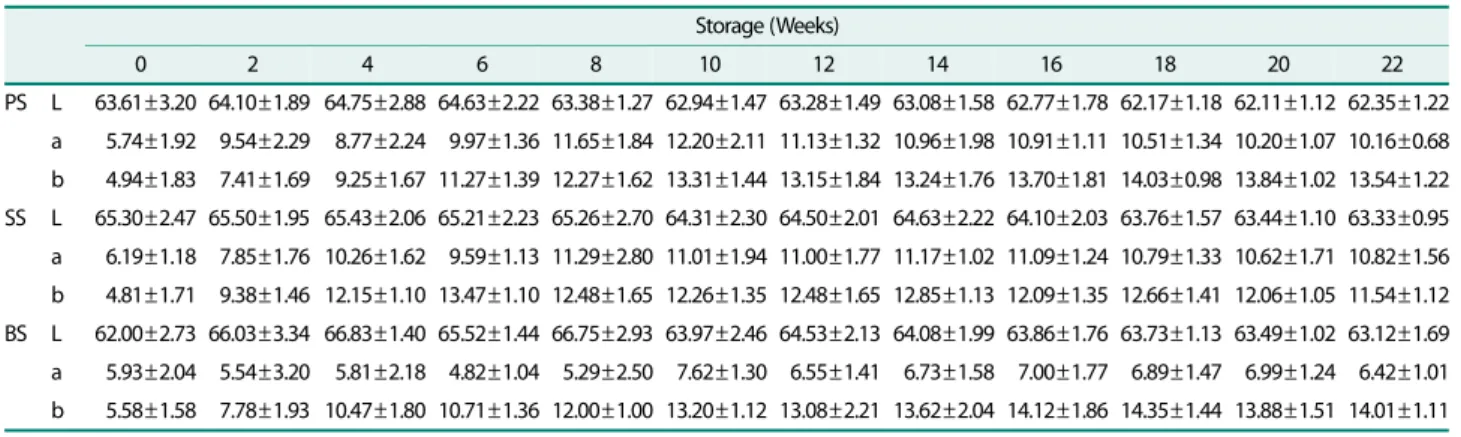
L values (lightness) of SJs were not changed signifi- cantly during fermentation and were not significantly different among SJs (Table 2). The a values (redness) increased during fermentation and the highest values were observed in the middle of fermentation (10 weeks for PS and BS-SJs, and 8 weeks for SS-SJ). Then a val- ues decreased gradually until the end of fermentation.
The a values of PS-SJ and SS-SJ were similar whereas those of BS-SJ were significantly lower. The b values (yellowness) increased and showed the highest values at 18 weeks and then decreased slightly. SS-SJ showed the lowest b values after 10 weeks and the final b value was 11.54± 1.12, lower than PS-SJ (13.54 ± 1.22) and BS-SJ (14.01± 1.11). SS-SJ has an advantage over BS and PS- SJs in its appearance.
From the above results, solar salt seems desirable for Fig. 3. Changes in salinity of saeu jeotgals during fermen- tation. ○, purified salt, △, solar salt, □, bamboo salt.
saeu jeotgal preparation compared to other salt types.
Unlike purified salt, solar salt contains significant amounts of minerals which promote the growth of bacilli and LAB. Enhanced growth of bacilli and LAB acceler- ates jeotgal fermentation by increasing protein hydroly- sis. As a result, higher ANN contents of jeotgals are achieved. It also results in production of favorable flavor compounds and appearance of jeotgals. In this work, bamboo salt was used for saeu jeotgal preparation for the first time and its merits need to be studied further.
The chemical compositions of bamboo salts are different from solar salts, and this affects the growth of microor- ganimsm in jeotgals and eventually the final qualities of jeotgals. Especially, functionalities such as antioxidant activities of BS-SJ should be studied in the future.
Acknowledgments
This work was supported by grant 201300290 to Solar Salt Research Center of Mokpo National University from Ministry of Oceans and Fisheries of Korea. J.M. Shim, K.W. Lee, Z. Yao, and J.A Kim were sup- ported by BK21 plus program from MOE, Republic of Korea.
References
1. Lee KW, Park JY, Sa HD, Jeong JH, Jin DE, Heo HJ, et al. 2014. Probi- otic properties of Pediococcus strains isolated from jeotgals, salted and fermented Korean sea-food. Anaerobe 28: 199-206.
2. Kim MS, Park EJ. 2014. Bacterial communities of traditional salted and fermented seafoods from Jeju island of Korea using 16S rRNA gene clone library analysis. J. Food Sci. 79: M927-M934.
3. Cho SD, Kim GH. 2010. Changes of quality characteristics of salt- fermented shrimp prepared with various salts. Korean J. Food &
Nutr. 23: 291-298.
4. Lee KD, Choi CR, Cho JY, Kim HL, Ham KS. 2008. Physicochemical
and sensory properties of salt-fermented shrimp prepared with various salts. J. Korean Soc. Food Sci. Nutr. 37: 53-59.
5. Park JW, Kim SJ, Kim SH, Kim BH, Kang SG, Nam SH, et al. 2000.
Determination of mineral and heavy metal contents of various salts. Korean J. Food Sci. Technol. 32: 1442- 1445.
6. Zhao X, Song JL, Jung OS, Lim YI, Park KY. 2014. Chemical proper- ties and in vivo gastric protective effects of bamboo salt. Food Sci. Biotechnol. 23: 895-902.
7. Ko BK, Kim KM, Hong YS, Lee CH. 2010. Metabolomic assessment of fermentative capability of soybean starter treated with high pressure. J. Agric. Food Chem. 58: 8738-8747.
8. Tzollas NM, Zachariadis GA, Anthemidis AN, Stratis JA. 2010. A new approach to indophenol blue method for determination of ammonium in geothermal waters with high mineral content.
Intern. J. Environ. Anal. Chem. 90: 115-126.
9. Koo OK, Lee SJ, Chung KR, Jang DJ, Yang HJ, Kwon DY. 2016.
Korean traditional fermented fish products: jeotgal. J. Ethn. Foods 3: 107-116.
10. Yoon JH, Lee KC, Weiss N, Kang KH, Park YH. 2003. Jeotgalicoccus halotolerans gen. nov., sp. nov. and Jeotgalicoccus psychrophilus sp. nov., isolated from the traditional Korean fermented seafood jeotgal. Int. J. Syst. Evol. Microbiol. 53: 595-602.
11. Lee SH, Ku HJ, Ahn MJ, Hong JS, Lee SH, Shin H, et al. 2015. Weis- sella jogaejeotgali sp. nov., isolated from jogae jeotgal, a tradi- tional Korean fermented sea food. Int. J. Syst. Evol. Microbiol. 65:
4674-4681.
12. Zhao X, Jung OS, Park KY. 2012. Alkaline and antioxidant effects of bamboo salt. J. Korean Soc. Food Sci. Nutr. 41: 1301-1304.
13. Fukui Y, Yoshida M, Shozen KI, Funatsu Y, Takeno T, Oikawa H, et al. 2012. Bacterial communities in fish sauce mash using culture- dependent and –independent methods. J. Gen. Appl. Microbiol.
58: 273-281.
14. Cho MJ, Shim JM, Lee JY, Lee KW, Yao Z, Liu X, et al. 2016. Proper- ties of meju fermented with multiple starters. Microbiol. Biotech- nol. Lett. 44: 109-116.
15. Mok CK, Lee JY, Song KT, Kim SY, Lim SB, Woo GJ. 2000. Changes in physicochemical properties of salted and fermented shrimp at different salt levels. Korean J. Food Sci. Technol. 32: 187-191.
Table 2. Changes in color of saeu jeotgals during fermentation.
Storage (Weeks)
0 2 4 6 8 10 12 14 16 18 20 22
PS L 63.61±3.20 64.10±1.89 64.75±2.88 64.63±2.22 63.38±1.27 62.94±1.47 63.28±1.49 63.08±1.58 62.77±1.78 62.17±1.18 62.11±1.12 62.35±1.22 a 5.74±1.92 9.54±2.29 8.77±2.24 9.97±1.36 11.65±1.84 12.20±2.11 11.13±1.32 10.96±1.98 10.91±1.11 10.51±1.34 10.20±1.07 10.16±0.68 b 4.94±1.83 7.41±1.69 9.25±1.67 11.27±1.39 12.27±1.62 13.31±1.44 13.15±1.84 13.24±1.76 13.70±1.81 14.03±0.98 13.84±1.02 13.54±1.22 SS L 65.30±2.47 65.50±1.95 65.43±2.06 65.21±2.23 65.26±2.70 64.31±2.30 64.50±2.01 64.63±2.22 64.10±2.03 63.76±1.57 63.44±1.10 63.33±0.95 a 6.19±1.18 7.85±1.76 10.26±1.62 9.59±1.13 11.29±2.80 11.01±1.94 11.00±1.77 11.17±1.02 11.09±1.24 10.79±1.33 10.62±1.71 10.82±1.56 b 4.81±1.71 9.38±1.46 12.15±1.10 13.47±1.10 12.48±1.65 12.26±1.35 12.48±1.65 12.85±1.13 12.09±1.35 12.66±1.41 12.06±1.05 11.54±1.12 BS L 62.00±2.73 66.03±3.34 66.83±1.40 65.52±1.44 66.75±2.93 63.97±2.46 64.53±2.13 64.08±1.99 63.86±1.76 63.73±1.13 63.49±1.02 63.12±1.69 a 5.93±2.04 5.54±3.20 5.81±2.18 4.82±1.04 5.29±2.50 7.62±1.30 6.55±1.41 6.73±1.58 7.00±1.77 6.89±1.47 6.99±1.24 6.42±1.01 b 5.58±1.58 7.78±1.93 10.47±1.80 10.71±1.36 12.00±1.00 13.20±1.12 13.08±2.21 13.62±2.04 14.12±1.86 14.35±1.44 13.88±1.51 14.01±1.11
16. Adoga IJ, Joseph E, Samuel OF. 2010. Storage life of tilapia (Oreo- chromis niloticus) in ice and ambient temperature. Researcher 2:
39-44.
17. Chang JY, Kim IC, Chang HC. 2011. Effect of solar salt on the fer- mentation characteristics of kimchi. Korean J. Food Preserv. 18:
256-265.
18. Kim SM, Ju JH, Jung OS, Moon SH, Park KY. 2012. Bamboo salt effects on hydrolysis of Estertin (IV) complex. Bull. Korean Chem.
Soc. 33: 2753-2755.
국문초록
다른 종류의 소금들로 제조한 새우 젓갈의 특성 심재민1, 이강욱1, 야오좡1, 김정아1, 김현진1,2, 김정환1,2*
1경상대학교대학원응용생명과학부(BK21 plus)
2경상대학교농업생명과학연구원
정제염(PS), 1년숙성천일염(SS), 3회죽염(BS)들을사용하여새우젓갈들을제조하였다(소금농도 25%). 젓갈들은 22주간 15℃
에서숙성하였다. 바실라이들과해양세균들은 6주차이후검출되었고고세균들은천일염젓갈에서만처음 8주간저농도로관찰
되었다. 죽염젓갈은타젓갈들보다 pH는높고적정산도는낮았다. 아미노태질소는발효중증가했고특히 2주와 6주이후증가
정도가컸으며천일염젓갈이발효초기부터종료시까지타젓갈들보다함량이높았다. 암모니아태질소함량도발효중증가했다.
천일염젓갈이가장높은휘발성염기질소함량을나타내었다. 염도는 4주차이후일정하게유지되었다. 시료의단백질가수분해
측면에서볼때천일염이타염들보다우수하였다.