서론
성공적인 보철 치료를 위해서는 임시 수복물의 역할이 중요하 다.1 임시 수복물은 치은 조직, 자연치, 임플란트를 보호하고 치 아의 위치적 안정성을 제공할 뿐만 아니라 최종 보철물이 장착 되기 전에 기능적, 심미적 및 교합과 관련된 변수를 평가할 수 있 도록 한다.1,2
전통적인 고정성 임시 보철물은 직접법 및 간접법으로 제작
되어 왔다.3 하지만 술자의 숙련도에 대한 의존성과 복잡한 제 작 과정 등이 단점으로 지적되었다.4 최근에는 효율적인 제조 과 정, 높은 정확성, 낮은 비용 등으로 인해 computer-aided design/
computer-aided manufacturing (CAD/CAM) 시스템이 보철물 제작에 폭넓게 활용되고 있다.5-7 이러한 CAD/CAM 시스템을 이용하여 보철물을 제작하는 방법은 절삭 가공법(subtractive manufacturing)과 적층 가공법(additive manufacturing)으로 나 눌 수 있다.8
절삭 및 적층 가공법으로 제작된 3본 고정성 국소의치의 변연 및 내면 적합도에 관한 연구
최재원*
부산대학교 치의학전문대학원 치과보철학교실
Marginal and internal discrepancy of 3-unit fixed dental prostheses fabricated by subtractive and additive manufacturing
Jae-Won Choi*
Department of Prosthodontics, School of Dentistry, Pusan National University, Yangsan, Republic of Korea
Purpose: This study was to evaluate marginal and internal discrepancy of 3-unit fixed dental prostheses (FDP) fabricated by subtractive manufacturing and additive manu- facturing. Materials and methods: 3-unit bridge abutments without the maxillary left second premolar were prepared (reference model) and the reference model scan data was obtained using an intraoral scanner. 3-unit fixed dental prostheses were fabricated in the following three ways: Milled 3-unit FDP (MIL), digital light processing (DLP) 3D printed 3-unit FDP (D3P), stereolithography apparatus (SLA) 3D printed 3-unit FDP (S3P). To evaluate the marginal/internal discrepancy and precision of the prosthesis, scan data were superimposed by the triple-scan protocol and the combinations calculator, respectively. Quantitative and qualitative analysis was performed using root mean square (RMS) value and color difference map in 3D analysis program (Geomagic control X). Statistical analysis was performed using the Kruskal-Wallis test (α=.05), Mann- Whitney U test and Bonferroni correction (α=.05/3=.017). Results: The marginal discrepancy of S3P group was superior to MIL and D3P groups, and MIL and D3P groups were similar. The D3P and S3P groups showed better internal discrepancy than the MIL group, and there was no significant difference between the D3P and S3P groups. The precision was excellent in the order of MIL, S3P, and D3P groups. Conclusion: Within the limitation of this study, the 3-unit fixed dental prostheses fabricated by additive manufacturing showed better marginal and internal discrepancy than the those of fabricated by subtractive manufacturing, but the precision was poor. (J Korean Acad Prosthodont 2020;58:7-13)
Keywords: Additive manufacturing; Internal discrepancy; Marginal discrepancy; Precision; Subtractive manufacturing
*Corresponding Author: Jae-Won Choi
Department of Prosthodontics, School of Dentistry, Pusan National University 20, Geumo-ro, Mulgeum-eup, Yangsan 50612, Republic of Korea
+82 (0)55 360 5133: e-mail, [email protected]
Article history: Received August 28, 2019 / Last Revision October 1, 2019 / Accepted October 3, 2019
2020 The Korean Academy of Prosthodontics
This is an Open Access article distributed under the terms of the Creative Commons Attribution Non-Commercial License (http://creativecommons.org/
licenses/by-nc/4.0) which permits unrestricted non-commercial use, distribution, and reproduction in any medium, provided the original work is properly cited.
c cc
절삭 가공법은 전용의 밀링 블록 또는 디스크를 연삭함으로써 설계된 형상을 얻는 방법으로,4 동질의 보철물을 제작할 수 있다 는 장점이 있는 반면, 재료의 낭비, 유지관리의 어려움, 밀링 버 의 직경의 따라 미세 재현성이 떨어지는 단점이 있다.1,9 또한 밀 링 과정 중의 진동이 보철물의 정밀도에 영향을 줄 수도 있다.10 이와 반대로 3D printing이라고 흔히 알려져 있는 적층 가공법은 분말이나 액체 형태의 재료를 층별로 연속적으로 쌓음으로써 설 계된 형상을 얻는 방법으로,11,12 재료의 낭비가 적고 언더컷이나 복잡한 구조도 정교하게 제작이 가능하다는 장점이 있다.13
한편, 임시 보철물의 장기적인 수명과 성공은 변연 및 내면 적 합도와 관련이 있다.14 보철물의 부정확한 변연 적합은 플라그 축적, 시멘트 미세 누출, 변색으로 인한 비 심미성, 치아 우식 및 치주 질환의 원인이 된다.15 또한, 보철물의 내면 적합이 부적절 한 경우에는 시멘트 두께 증가, 유지력의 변화, 교합에 부적절한 영향을 주고 보철물의 파절 저항성이 감소할 뿐만 아니라 불량 한 변연 적합을 야기할 수 있다.16
최근 치과 분야에서 CAD/CAM 시스템을 이용한 보철물 제작 이 보편화됨에 따라, 절삭 및 적층 가공법으로 제작된 임시 보철 물의 변연 및 내면 적합도에 대한 많은 연구가 있었다.1,4,17,18 하 지만 대부분의 연구들이 단일치에 국한되어 있었을 뿐만 아니라 국내에서 자체 기술로 개발된 3D 프린터 및 임시 수복용 재료로 제작된 임시 보철물의 적합도에 관한 연구는 전무한 실정이다.
이에 본 연구에서는 국내 기술의 적층 가공법으로 제작된 3본 고 정성 보철물과 기존의 절삭 가공법으로 제작된 3본 고정성 보철 물의 변연 및 내면 적합도를 비교 평가하고자 하였다.
재료 및 방법
본 실험을 위해 dentiform (PER5001-UL-SCP-AK-28, Nissin Dental, Kyoto, Japan)의 상악 좌측 제2소구치(#25)를 제거하고 상악 좌측 제1소구치(#24)와 상악 좌측 제1대구치(#26)의 전부 주조관 기성 지대치를 사용하여 3본 고정성 국소의치 형태를 제 작하였으며, 이를 주모형(reference model)으로 설정하였다.
주모형에 빛 반사를 줄이기 위한 파우더(EASY SCAN, PD Dental, Seoul, Korea)를 도포하고, 구강 스캐너(TRIOS 3, 3Shape, Copenhagen, Denmark)로 스캔하여 3차원 모형 데이 터를 얻었다. CAD software (3shape Dental Designer, 3Shape, Copenhagen, Denmark) 상에서 변연부터 1 mm 하방 및 1 mm 상방에 대하여 각각 20 µm와 60 µm의 시멘트 공간을 부여하고 3본 고정성 보철물을 디자인하여 standard triangulated language (STL) 파일을 얻었다. 3본 고정성 보철물을 제작하는 방법에 따 라 3개의 군으로 분류하고 다음과 같이 명명하였으며 각 군당 10개의 보철물을 제작하였다 (Table 1). 1) Milled 3-unit fixed dental prostheses (FDP) (MIL군): Polymethyl methacrylates (PMMA) 블록(TS PMMA block, TS Dental, Tian Shwu Hail- iao, Tainan, Taiwan)을 밀링 장비(ARUM 4X-100, DOOWON ID, Daejeon, Korea)로 절삭하여 제작하였다 (Fig. 1A). 2) DLP 3D printed 3-unit FDP (D3P군): Digital light processing (DLP) 방식의 3D 프린터(ZENITH D, Dentis, Daegu, Korea)와 전용 의 광경화성 수지(ZMD-1000B TEMPORARY, Dentis, Daegu, Korea)를 이용하여 출력각도는 180°, 층 두께는 100 µm로 설정
Table 1. Methods and materials tested in this study
Group Method Product Manufacturer Material Type
MIL Milling ARUM 4X-100 DOOWON ID, Daejeon, Korea TS Dental PMMA
D3P DLP3D Printing ZENITH D Dentis, Daegu, Korea ZMD-1000B TEMPORARY Acrylate Photopolymer
S3P SLA3D Printing ZENITH U Dentis, Daegu, Korea ZMD-1000B TEMPORARY Acrylate Photopolymer MIL, milled 3-unit FDP; D3P, DLP 3D printed 3-unit FDP; S3P, SLA 3D printed 3-unit FDP.
Fig. 1. Fabrication of 3-unit FDPs (upper, occlusal view; lower, buccal view). (A) MIL: milled 3-unit FDP, (B) D3P: DLP 3D printed 3-unit FDP, (C) S3P: SLA 3D printed 3-unit FDP.
A B C
하여 적층 가공하였다. 출력된 보철물을 2분 동안 세정액에 침 전시켜 세척하고, ultraviolet (UV) 경화기(CURE DEN, Dentis, Daegu, Korea)에서 10분 동안 광경화 하였다 (Fig. 1B). 3) SLA 3D printed 3-unit FDP (S3P군): Stereolithography apparatus (SLA) 방식의 3D 프린터(ZENITH U, Dentis, Daegu, Korea) 와 전용의 광경화성 수지(ZMD-1000B TEMPORARY, Dentis, Daegu, Korea)를 이용하여 출력각도는 180°, 층 두께는 100 µm 로 설정하여 적층 가공하였다. 출력된 보철물의 후처리과정은 D3P군과 동일하였다 (Fig. 1C).
보철물의 변연 및 내면 적합도를 평가하기 위해 Triple-scan protocol을 이용하였다. 먼저 정확도가 10 µm인 모델 스캐너 (3Shape E2, 3Shape, Copenhagen, Denmark)로 주모형과 보철 물의 내외면을 스캔한 후, 내면인기제(Fit checker, GC, Corp., Tokyo, Japan)를 이용하여 보철물을 주모형에 장착시킨 상태를 스캔하였다. 3차원 평가 프로그램(Geomagic Control X, 3D sys- tems, Rock Hill, SC, USA)를 이용하여 보철물이 주모형에 장 착된 스캔 데이터 상에 주모형과 보철물 스캔 데이터를 초기 정 렬(Initial alignment) 및 최적 정렬(Best-fit alignment)를 통해 중 첩시킨 후, 최종적으로 중첩된 세 가지 스캔 데이터 중 보철물이 주모형에 장착된 스캔 데이터를 제거하였다. Root mean square (RMS) 값과 color difference map을 이용하여 주모형과 보철물 사이의 정량 및 정성 분석을 시행하였다. 한편, 보철물의 정밀도 는 각 그룹별 내면 스캔 데이터 간의 중첩에 의해 측정되었으며, 동일한 방법으로 정량 및 정성 분석 시행하였다.
RMS 값은 위와 같은 공식에 따라 계산되었다. n은 측정점 의 총 수이고, X1,i는 참조 스캔 데이터의 i번 일 때의 측정점이며 X2,i는 평가 스캔 데이터의 i번 일 때의 측정점이다. 여기서 낮은 RMS 값은 중첩된 데이터의 높은 3차원적 일치를 나타낸다.
통계분석은 SPSS 소프트웨어 버전 25.0 (SPSS Inc., Chicago,
IL, USA)을 사용하였으며, Shapiro-Wilk로 정규성 검정 및 Levene의 등분산성 검정을 시행하였다. 모든 데이터들이 정규분 포를 따르지 않아 비모수 통계법인 Kruskal-Wallis test (α = .05) 와 Mann-Whitney U test 및 Bonferroni correction (α = .05/3 = .017)을 이용하여 각 군의 유의성을 검증하였다.
결과
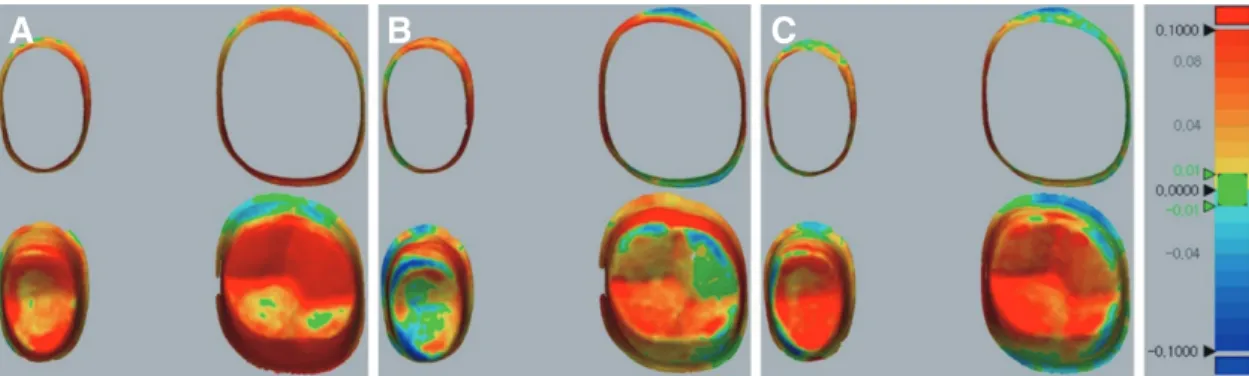
변연 적합도의 RMS 값을 비교한 결과, S3P군(37.6 ± 3.3 µm) 이 MIL군(48.1 ± 5.6 µm), D3P군(48.1 ± 3.6 µm)에 비해 통계 적으로 유의하게 작았으며 (P < .05/3 = .017), MIL군과 D3P군 사이에는 통계적으로 유의한 차이가 없었다 (P > .05/3 = .017) (Table 2). 내면 적합도의 RMS 값을 비교한 결과, MIL군(101.8
± 5.7 µm)이 D3P군(73.3 ± 11.9 µm), S3P군(69.9 ± 20.5 µm) 보다 유의하게 컸으며 (P < .05/3 = .017), D3P군과 S3P군 사이 에는 유의한 차이를 보이지 않았다 (P > .05/3 = .017) (Table 2).
Color difference maps을 비교한 결과, S3P군의 변연부는 MIL 군과 D3P군의 변연부에 비해 넓은 영역에서 초록색의 우수한 적 합도를 보였다 (Fig. 2). 한편, 모든 군은 교합면 우각 부위에서
Table 2. Mean (± SD) RMS values and 95% CIs for marginal and internal discrepancies (unit: µm)
RMS
Marginal discrepancy Internal discrepancy Group Mean ± SD 95% CI Mean ± SD 95% CI
MIL 48.1 ± 5.6a 44.1 - 52.1 101.8 ± 5.7a 97.8 - 105.9 D3P 48.1 ± 3.6a 45.5 - 50.7 73.3 ± 11.9b 64.8 - 81.8 S3P 37.6 ± 3.3b 35.3 - 40.0 69.9 ± 20.5b 74.0 - 89.3
P < .001 < .001
Values followed by the same letter were not significantly different (P > .05/3
= .017). P-values are from a Kruskal-Wallis test.
RMS, root mean square; SD, standard deviation; CI, confidence interval;
MIL, milled 3-unit FDP; D3P, DLP 3D printed 3-unit FDP; S3P, SLA 3D printed 3-unit FDP.
Fig. 2. Color difference maps for qualitative analysis of marginal (upper) and internal discrepancies (lower). (A) MIL: milled 3-unit FDP, (B) D3P: DLP 3D printed 3-unit FDP, (C) S3P: SLA 3D printed 3-unit FDP.
A B C
가장 진한 색의 큰 오차를 나타냈는데, D3P군과 S3P군은 파란 색의 음의 오차가 보인 반면, MIL군의 빨간색의 양의 오차를 보 였다 (Fig. 2).
정밀도의 경우, RMS 값은 D3P군(42.3 ± 14.7 µm)에서 가장 크고, S3P군(27.9 ± 6.8 µm), MIL군(19.9 ± 12.6 µm)순으로 작 았으며, 세 군 모두에서 통계적으로 유의한 차이를 보였다 (P <
.05/3 = .017) (Table 3). Color difference maps을 통한 정성적 분 석에서도 MIL군, S3P군, 그리고 D3P군 순으로 초록색 영역이 많이 분포된 것을 확인할 수 있으며, 교합면 우각 부위에서 상대 적으로 큰 오차들을 발견할 수 있었다 (Fig. 3).
고찰
CAD/CAM 시스템은 스캐너에 의한 지대치 스캔, 컴퓨터를 이용한 수복물을 설계하고 제작하기 때문에 제작 비용과 시간을 단축시킬 뿐만 아니라 재제작과 수정 또한 용이하다.19,20 CAM 은 절삭 가공법과 적층 가공법으로 분류할 수 있으며,1 최근에는 최소한의 재료로 미세한 부분까지 재현이 가능한 적층 가공법 이 의학 및 치과 분야에서 점점 더 많이 사용되고 있다.21 국내에 서도 자체 기술로 개발된 3D 프린터 및 임시 수복용 재료가 식약 처로부터 허가를 받고 시판되어 사용되고 있다. 최근에 이와 관 련하여 내마모성 및 기계적 특성에 관한 연구는 있었으나,22,23 보
철물의 장기간의 성공과 수명에 직접적인 영향을 미치는 적합도 에 관한 연구는 전무하였다. 또한, CAD/CAM 시스템으로 제작 된 보철물의 적합도에 관한 연구가 주로 단일치에 국한되어 왔 기 때문에, 본 연구에서는 3본 고정성 국소의치를 지대치로 선정 하여 절삭 및 적층 가공법으로 제작한 보철물의 적합도를 평가 하고자 하였다.
보철물의 적합도를 비교하는 데는 여러가지 방법이 있다.4 전 통적으로는 보철물을 합착 후 원하는 부위를 광학 또는 주사 전 자 현미경으로 직접 관찰하는 방법이 있다.24,25 이는 보철물을 절 단하여 관찰함으로써 변연 및 내면 적합도를 정확하게 측정할 수 있다는 장점이 있지만, 시편을 손상시키고 구강 내에서 직접 측정할 수 없다는 단점이 있다.26 또 다른 방법으로는 실리콘 보 철물의 내면을 복제하여 관찰하는 방법이다.27 이 방법은 구강 내에서 직접 측정이 가능하고 비교적 간단하며 저렴하다는 장점 이 있는 반면,28,29 인상체의 변형 및 손상의 위험이 있다.30,31 이같 은 방법들은 2차원 분석만이 가능하기 때문에 측정 지점이 제한 적일 수 밖에 없어 보철물 전체의 적합도를 나타내기는 어렵다.16 한편, triple-scan protocol을 이용하여 보철물의 적합도를 평가 하는 방법은 스캔한 3차원 데이터를 사용하여 분석 소프트웨어 에서 평가하기 때문에 언제든지 결과해석이 가능하고 비 침습적 일 뿐만 아니라 시편의 손상 없이 데이터의 양적 및 질적 분석이 가능하다.1,25 이에 본 연구에서는 triple-scan protocol을 통해 3 차원 분석을 시행하고자 하였다.32,33
본 실험 결과, 적층 가공법으로 제작한 3본 고정성 보철물 (D3P군, S3P군)은 절삭 가공법으로 제작한 3본 고정성 보철물 (MIL군)보다 우수한 적합도를 보였는데, 이는 이전 연구들과도 일치한다.4,17 절삭 가공법의 경우, 밀링 버의 직경에 의한 가공 오 차가 발생할 수 있고 절삭 과정에서도 기계나 회전축의 떨림이 있을 수 있으며,7,19 특히 습식의 밀링 방식은 보철물 내면에 불필 요한 잔류물을 만드는 원인이 되기도 한다.34 또한, 3본 고정성 보철물일 경우 보철물의 형태, 지대치의 방향, 밀링용 블록의 두 께에 따라 절삭 각도나 방향 등이 달라질 수 있다는 점 역시 이러 한 결과를 어느정도 뒷받침 할 수 있으리라 생각된다.35 한편 적 층 가공법 간의 비교에서 S3P군이 D3P군보다 우수한 변연 및 내면 적합도를 보였는데, 이는 각 3D 프린터의 특성에 기인한 것 으로 추측된다. 본 연구에서 사용된 S3P군의 SLA 3D 프린터와
Fig. 3. Color difference maps for qualitative analysis of inner surfaces. (A) MIL: milled 3-unit FDP, (B) D3P: DLP 3D printed 3-unit FDP, (C) S3P: SLA 3D printed 3-unit FDP.
A B C
Table 3. Precision based on mean (± SD) RMS values and 95% CIs for 3-unit FDPs fabricated by different methods (unit: µm)
RMS
Group Mean ± SD 95% CI
MIL 19.9 ± 12.6a 16.1 - 23.7
D3P 42.3 ± 14.7b 37.9 - 46.7
S3P 27.9 ± 6.8c 25.9 - 30.0
P < .001
Values followed by the same letter were not significantly different (P > .05/3
= .017). P-values are from a Kruskal-Wallis test.
RMS, root mean square; SD, standard deviation; CI, confidence interval;
MIL, milled 3-unit FDP; D3P, DLP 3D printed 3-unit FDP; S3P, SLA 3D printed 3-unit FDP.
D3P군의 DLP 3D 프린터는 광경화성 수지에 광중합시켜 층별 로 적층하는 방식은 동일하나, S3P군의 SLA 3D 프린터는 UV 레이저를 광원으로 하여 점(point)단위로 각 층을 경화시키는 반 면에 D3P군의 DLP 3D 프린터는 light emitting diode (LED)를 사용하여 면(face)단위로 각 층을 경화시킨다.36 따라서 SLA 3D 프린터는 DLP 3D 프린터에 비해 층의 전반적인 두께에 걸쳐 완 전한 중합이 이뤄지고 적은 양의 잔류 단량체를 남김으로써 더 욱 정밀한 보철물을 제작할 수 있다.37
정밀도에 있어서는 절삭 가공법으로 제작한 3본 고정성 보철 물(MIL군)이 적층 가공법으로 제작한 3본 고정성 보철물(D3P 군, S3P군)보다 우수한 결과를 보였는데, 이는 이전의 연구 결과 와 일치한다.1 절삭 가공법에서 사용된 PMMA 블록은 제조 과정 에서 미리 중합하기 때문에 높은 기계적 강도와 낮은 다공성을 가질 뿐만 아니라,38,39 설계된 형태와 동일한 크기로 가공되기 때 문에 밀링 과정 중에 재료의 팽창이나 수축의 문제를 최소화할 수 있다.10 반면에 적층 가공법은 출력 후 후처리 과정으로 post curing을 시행하는 동안 보철물의 잔류 내부 응력에 의한 변형이 일어날 수 있고,40 제조하는 과정에서 빛의 양이나 산란, 회절 현 상으로 인해 오차가 발생할 수 있다.41,42
적층 가공법의 출력 각도는 보철물의 정밀도에 영향을 줄 수 있으며, 이전의 연구들에서 DLP와 SLA 3D 프린터로 제작한 보 철물은 각각 135°, 120°의 출력 각도에서 가장 우수한 적합도를 보인다고 하였다.43,44 하지만 본 연구에서는 보철물의 내면에 지 지대가 생성되는 것을 막고 변연의 손상을 방지하기 위해 출력 각도를 180°로 설정하였다. 한편, 본 연구에서는 내구성이 뛰어 나고 온도나 수분에 대한 변형을 최소화하며, 동일한 조건을 제 공하기 위하여 표준 형태의 기성품 아크릴 수지 치아를 지대치로 사용하였다.32 하지만 화학 성분, 표면 구조, 광학적 성질이 자연 치와 다르고 스캔 시 영향을 줄 수 있는 연조직 및 타액의 부재, 환자의 움직임, 주변 온도나 습도 등의 요소들 또한 실제 구강 내의 환경과 다르다.32,45 따라서 추후 연구에서는 보철물의 적합 도에 영향을 줄 수 있는 다양한 조건하에서 실험을 설계할 뿐만 아니라, 객관적이고 신뢰성 있는 결과를 도출하기 위한 장기적인 임상 연구도 필요할 것으로 생각된다.
결론
본 연구의 한계 내에서, 적층 가공법으로 제작된 3본 고정성 보철물의 변연 및 내면 적합도는 절삭 가공법으로 제작된 3본 고 정성 보철물보다 우수한 반면, 정밀도는 다소 떨어지는 경향을 보였다. 디지털 치의학의 보급과 더불어 치과 분야에서의 적층 가공법의 적용 및 활용 가능성은 향후 치의학 발전에 있어서 큰 밑거름이 될 것이다.
ORCID
Jae-Won Choi https://orcid.org/0000-0001-6786-9251
References
1. Kang SY, Park JH, Kim JH, Kim WC. Accuracy of provi- sional crowns made using stereolithography apparatus and subtractive technique. J Adv Prosthodont 2018;10:354-60.
2. Rakhshan V. Marginal integrity of provisional resin restora- tion materials: A review of the literature. Saudi J Dent Res 2015;6:33-40.
3. Tom T, Uthappa M, Sunny K, Begum F, Nautiyal M, Tamore S. Provisional restorations: An overview of materials used. J Adv Clin Res Insights 2016;3:212-4.
4. Lee WS, Lee DH, Lee KB. Evaluation of internal fit of inter- im crown fabricated with CAD/CAM milling and 3D printing system. J Adv Prosthodont 2017;9:265-70.
5. Alharbi N, Osman R, Wismeijer D. Effects of build direction on the mechanical properties of 3D-printed complete cover- age interim dental restorations. J Prosthet Dent 2016;115:760- 6. Abdullah AO, Tsitrou EA, Pollington S. Comparative in vitro 7.
evaluation of CAD/CAM vs conventional provisional crowns.
J Appl Oral Sci 2016;24:258-63.
7. Beuer F, Schweiger J, Edelhoff D. Digital dentistry: an over- view of recent developments for CAD/CAM generated resto- rations. Br Dent J 2008;204:505-11.
8. van Noort R. The future of dental devices is digital. Dent Ma- ter 2012;28:3-12.
9. Torabi K, Farjood E, Hamedani S. Rapid prototyping tech- nologies and their applications in prosthodontics, a review of literature. J Dent (Shiraz) 2015;16:1-9.
10. Kim CM, Kim SR, Kim JH, Kim HY, Kim WC. Trueness of milled prostheses according to number of ball-end mill burs. J Prosthet Dent 2016;115:624-9.
11. Hoang LN, Thompson GA, Cho SH, Berzins DW, Ahn KW. Die spacer thickness reproduction for central incisor crown fabrication with combined computer-aided design and 3D printing technology: an in vitro study. J Prosthet Dent 2015;113:398-404.
12. Sun J, Zhang FQ. The application of rapid prototyping in prosthodontics. J Prosthodont 2012;21:641-4.
13. Liu Q, Leu MC, Schmitt SM. Rapid prototyping in den- tistry: technology and application. Int J Adv Manuf Technol 2006;29:317-35.
14. Özçelik TB, Yilmaz B, Şeker E, Shah K. Marginal adaptation of provisional CAD/CAM restorations fabricated using vari- ous simulated digital cement space settings. Int J Oral Maxil- lofac Implants 2018;33:1064-9.
15. Burns DR1, Beck DA, Nelson SK; Committee on research in fixed prosthodontics of the academy of fixed prosthodontics.
A review of selected dental literature on contemporary provi- sional fixed prosthodontic treatment: report of the committee on research in fixed prosthodontics of the academy of fixed prosthodontics. J Prosthet Dent 2003;90:474-97.
16. Goujat A, Abouelleil H, Colon P, Jeannin C, Pradelle N, Seux
D, Grosgogeat B. Marginal and internal fit of CAD-CAM in- lay/onlay restorations: A systematic review of in vitro studies.
J Prosthet Dent 2019;121:590-7.
17. Alharbi N, Alharbi S, Cuijpers VMJI, Osman RB, Wismeijer D. Three-dimensional evaluation of marginal and internal fit of 3D-printed interim restorations fabricated on different fin- ish line designs. J Prosthodont Res 2018;62:218-26.
18. Mai HN, Lee KB, Lee DH. Fit of interim crowns fabricated using photopolymer-jetting 3D printing. J Prosthet Dent 2017;118:208-15.
19. Huh JB, Kim US, Kim HY, Kim JE, Lee JY, Kim YS, Jeon YC, Shin SW. Marginal and internal fitness of three-unit zir- conia cores fabricated using several CAD/CAM systems. J Korean Acad Prosthodont 2011;49:236-44.
20. Christensen GJ. The state of fixed prosthodontic impressions:
room for improvement. J Am Dent Assoc 2005;136:343-6.
21. Homsy FR, Özcan M, Khoury M, Majzoub ZAK. Marginal and internal fit of pressed lithium disilicate inlays fabricated with milling, 3D printing, and conventional technologies. J Prosthet Dent 2018;119:783-90.
22. Ahn JJ, Huh JB, Choi JW. In vitro evaluation of the wear re- sistance of provisional resin materials fabricated by different methods. J Korean Acad Prosthodont 2019;57:110-7.
23. Cho WT, Choi JW. Comparison analysis of fracture load and flexural strength of provisional restorative resins fabricated by different methods. J Korean Acad Prosthodont 2019;57:225- 24. Schaefer O, Watts DC, Sigusch BW, Kuepper H, Guentsch A. 31.
Marginal and internal fit of pressed lithium disilicate partial crowns in vitro: a three-dimensional analysis of accuracy and reproducibility. Dent Mater 2012;28:320-6.
25. Son K, Lee S, Kang SH, Park J, Lee KB, Jeon M, Yun BJ.
A comparison study of marginal and internal fit assessment methods for fixed dental prostheses. J Clin Med 2019;8:785.
26. Sachs C, Groesser J, Stadelmann M, Schweiger J, Erdelt K, Beuer F. Full-arch prostheses from translucent zirconia: accu- racy of fit. Dent Mater 2014;30:817-23.
27. Molin M, Karlsson S. The fit of gold inlays and three ceramic inlay systems. A clinical and in vitro study. Acta Odontol Scand 1993;51:201-6.
28. Colpani JT, Borba M, Della Bona A. Evaluation of mar- ginal and internal fit of ceramic crown copings. Dent Mater 2013;29:174-80.
29. Praça L, Pekam FC, Rego RO, Radermacher K, Wolfart S, Marotti J. Accuracy of single crowns fabricated from ultra- sound digital impressions. Dent Mater 2018;34:e280-8.
30. Laurent M, Scheer P, Dejou J, Laborde G. Clinical evaluation of the marginal fit of cast crowns-validation of the silicone replica method. J Oral Rehabil 2008;35:116-22.
31. Park JY, Bae SY, Lee JJ, Kim JH, Kim HY, Kim WC. Evalua- tion of the marginal and internal gaps of three different dental prostheses: comparison of the silicone replica technique and three-dimensional superimposition analysis. J Adv Prostho-
dont 2017;9:159-69.
32. Schaefer O, Decker M, Wittstock F, Kuepper H, Guentsch A. Impact of digital impression techniques on the adaption of ceramic partial crowns in vitro. J Dent 2014;42:677-83.
33. Dahl BE, Rønold HJ, Dahl JE. Internal fit of single crowns produced by CAD-CAM and lost-wax metal casting tech- nique assessed by the triple-scan protocol. J Prosthet Dent 2017;117:400-4.
34. Alghazzawi TF. Advancements in CAD/CAM technology:
Options for practical implementation. J Prosthodont Res 2016;60:72-84.
35. De Souz a AF, Diniz AE, Rodrigues AR, Coelho RT. Inves- tigating the cutting phenomena in free-form milling using a ball-end cutting tool for die and mold manufacturing. Int J Adv Manuf Technol 2014;71:1565-77.
36. Lee S. Prospect for 3D printing technology in medical, den- tal, and pediatric dental field. J Korean Acad Pediatr Dent 2016;43:93-108.
37. Dikova T, Dzhendov DA, Ivanov D, Bliznakova K. Dimen- sional accuracy and surface roughness of polymeric dental bridges produced by different 3D printing processes. Arch Mater Sci Eng 2018;94:65-75.
38. Nejatidanesh F, Lotfi HR, Savabi O. Marginal accuracy of in- terim restorations fabricated from four interim autopolymer- izing resins. J Prosthet Dent 2006;95:364-7.
39. Yao J, Li J, Wang Y, Huang H. Comparison of the flexural strength and marginal accuracy of traditional and CAD/CAM interim materials before and after thermal cycling. J Prosthet Dent 2014;112:649-57.
40. Jeong SJ, Cho HW, Jung JH, Kim JM, Kim YL. Compara- tive evaluation of marginal and internal fit of metal copings fabricated by various CAD/CAM methods. J Korean Acad Prosthodont 2019;57:211-8.
41. Kim DY, Jeon JH, Kim JH, Kim HY, Kim WC. Reproduc- ibility of different arrangement of resin copings by dental microstereolithography: Evaluating the marginal discrepancy of resin copings. J Prosthet Dent 2017;117:260-5.
42. Berger U. Aspects of accuracy and precision in the addi- tive manufacturing of plastic gears. Virtual Phys Prototype 2015;10:49-57.
43. Osman RB, Alharbi N, Wismeijer D. Build angle: Does it influence the accuracy of 3D-printed dental restorations us- ing digital light-processing technology? Int J Prosthodont 2017;30:182-8.
44. Alharbi N, Osman RB, Wismeijer D. Factors influencing the dimensional accuracy of 3D-printed full-coverage dental restorations using stereolithography technology. Int J Prostho- dont 2016;29:503-10.
45. Shembesh M, Ali A, Finkelman M, Weber HP, Zandparsa R.
An in vitro comparison of the marginal adaptation accuracy of CAD/CAM restorations using different impression systems. J Prosthodont 2017;26:581-6.
절삭 및 적층 가공법으로 제작된 3본 고정성 국소의치의 변연 및 내면 적합도에 관한 연구
최재원*
부산대학교 치의학전문대학원 치과보철학교실
목적: 본 연구의 목적은 절삭 가공법 및 적층 가공법에 의해 제작된 3본 고정성 국소의치의 변연 및 내면 적합도를 비교하는 것이다.
재료 및 방법: 상악 좌측 제2소구치가 상실된 3본 고정성 국소의치 지대치를 제작하고(주모형), 구강 스캐너를 이용해 주모형 스캔 데이터를 얻었다. 3 본 고정성 보철물은 다음과 같은 3가지 방법으로 제작하였다: Milled 3-unit fixed dental prostheses (FDP) (MIL군), digital light processing (DLP) 3D printed 3-unit FDP (D3P군), stereolithography apparatus (SLA) 3D printed 3-unit FDP (S3P군). 보철물의 변연 및 내면 적합도와 내면 정밀도 평가하 기 위해 각각 triple-scan protocol과 콤비네이션 수식을 사용하여 스캔 데이터를 중첩하였다. 3차원 분석 프로그램(Geomagic control X)을 사용하여 root mean square (RMS) 값과 color difference map 통해 정량 및 정성 분석 시행하였다. Kruskal-Wallis test (α = .05)와 Mann-Whitney U test 및 Bon- ferroni correction (α = .05/3 = .017)을 이용하여 통계 분석하였다.
결과: S3P군의 변연 적합도는 MIL군과 D3P군에 비해 우수하였으며, MIL군과 D3P군은 비슷한 수준을 보였다. D3P군과 S3P군은 MIL군에 비해 상 대적으로 우수한 내면 적합도를 보였으며, D3P군과 S3P군 사이에는 유의한 차이가 없었다. 한편, MIL군, S3P군, 그리고 D3P군 순으로 우수한 정밀도 를 보였다.
결론: 본 연구의 한계 내에서 적층 가공법으로 제작된 3본 고정성 보철물은 절삭 가공법으로 제작된 3본 고정성 보철물에 비해 우수한 변연 및 내면 적 합도를 보인 반면 정밀도는 떨어지는 것으로 나타났다. (대한치과보철학회지 2020;58:7-13)
주요단어: 적층 가공; 내면적합도; 변연적합도; 정밀도; 절삭 가공
*교신저자: 최재원
50612 경남 양산시 물금읍 금오로 20 부산대학교 치의학전문대학원 치과보철학교실 055 360 5133: e-mail, [email protected]
원고접수일: 2019년 8월 28일 / 원고최종수정일: 2019년 10월 1일 / 원고채택일: 2019년 10월 3일
2020 대한치과보철학회
이 글은 크리에이티브 커먼즈 코리아 저작자표시-비영리 4.0 대한민국 라이선스에 따라 이용하실 수 있습니다.
c cc