Journal of the Korean Chemical Society 2017, Vol. 61, No. 1
Printed in the Republic of Korea https://doi.org/10.5012/jkcs.2017.61.1.25
-25-
Application of the Extended Grunwald-Winstein Equation to the Solvolyses of 4-(Chlorosulfonyl)biphenyl
Suk Jin Kang and Han Joong Koh*
Department of Science Education, Jeonju National University of Education, Jeonju, 55069, Korea.
*E-mail: [email protected]
(Received October 18, 2016; Accepted December 3, 2016)
ABSTRACT. Solvolyses with the reaction center being the sulfur of 4-(chlorosulfonyl)biphenyl (C6H5C6H4SO2Cl, 1) was studied under solvolytic conditions and the extended Grunwald-Winstein equation was applied. The thirty five kinds of solvents gave a reasonable extended Grunwald-Winstein plot with a correlation coefficient (R) of 0.940. The sensitivity values (l = 0.60 and m = 0.47) of 1 were smaller than those obtained for benzenesulfonyl chloride (C6H5SO2Cl, 2; l = 1.10 and m = 0.61) proposed to undergo dissociative SN2 mechanism. These l and m values for the solvolyses of 1 can be considered to support a SN2 path- way with some ionization reaction. The activation parameters, ΔH≠ and ΔS≠, were determined and they are also in line with values expected for a bimolecular reaction. The kinetic solvent isotope effect (KSIE) of 1.26 is also in accord with a bimolecu- lar mechanism, probably assisted by general-base catalysis.
Key words: 4-(Chlorosulfonyl)biphenyl, Extended Grunwald-Winstein equation, SN2 pathway, Kinetic solvent isotope effect
INTRODUCTION
Kinetic study is an important method for mechanistic investigation in organic chemistry. Value evidence such as activation parameters, the effect of solvent or substituents, kinetic solvent isotope effects, and evaluating of differences between related structures could provide valuable infor- mation about reaction mechanism.
The Grunwald-Winstein equation1 (eq. 1) is a useful tool for correlating the solvent dependence of rates of sol- volysis. The sensitivity (m) can be determined by studying the rates of solvolysis reaction of a standard substrate.
However, Fainberg and Winstein2 found that the plots for some substrates showed a scattering of plots in binary solvent systems due to the solvent nucleophilicity.
log (k/ko) = mYx + c (1)
Nucleophilic solvent assistance can be defined as an elec- tron donation from solvent to the developing positive dipole of a reacting C-X bond and an electron acceptance by the solvent of the leaving group (X), Scheme 1.
Kevill and coworks3 established a solvent nucleophilic- ity scale based on the solvolysis of S-methyldibenzo- thio- phenium ion. They introduced a new term governed by the solvent nucleophilicity. The extended Grunwald-Winstein equation can be expressed as equation 2. In equation 2, k and ko represent the rate constants of the solvolyses of a substrate RX in a given solvent and in the standard solvent (80% ethanol), respectively; l is the sensitivity of the sol- volysis to changes in solvent nucleophilicity (NT)4; m is the sensitivity of the solvolysis to changes in solvent ionizing power (Yx, for a leaving group X)5; c is a constant (residual).
A considerable recent effort
log (k/ko) = lNT + mYx + c (2) has been to exerted study the extent to which the solvent nucleophilicity and the solvent ionizing power scales, devel- oped for a substitution at carbon, can be applied to the sub- stitution reactions taking place at a hetero atom.4b
The nucleophilic substitution reaction of benzenesulfonyl chloride (C6H5SO2Cl) has been extensively studied.6 In this reaction, chloride is displaced by a nucleophile at the sulfur atom (S) on sulfonyl group. Both SN17 and SN28 mech- anism have been reported.
In limiting SN2 mechanism, the nucleophile approaches by donation of its electron pair begins to form a bond to sulfur while the sulfur-leaving group bond is breaking (Scheme 1).
The reaction is complected in a single step and both the nucleophile and the substrate take part in the transition state Scheme 1. Nucleophilic solvent assistance and electron accep-
tance.
Journal of the Korean Chemical Society
26 Suk Jin Kang and Han Joong Koh
with the rate is second-order.9
On the other hand, the reaction could be a limiting SN1 mechanism for the solvolysis of benzenesulfonyl chlo- ride, Scheme 2, where substrate is ionized without a nuc- leophilic assistance.9
The purpose of this study is to gain a further understanding of the mechanism of sulfonyl transfer. We carried out kinetic investigations of the solvolyses of 4-(chlorosulfonyl)biphenyl (C6H5C6H4SO2Cl, 1) in a variety of pure and binary solvents at 55.0oC, Eq. (3).
SOH + Products (3)
EXPERIMENTAL Materials
Solvents were purified as previously described.10 4-(chlorosulfonyl)biphenyl (1, 98%) was used as received.
The substrate did not react with the pure acetonitrile within the stock solution.
Kinetic Procedures
The electrical conductance of a solution depends strongly on the concentration and identity of any ion present. The following nucleophilic displacement reaction in solvent has been studied through conductance measurements. The fact that the reactants are neutral and the products are charged, so the conductance increase as the reaction proceeds. Pseudo- first-order rates (kobs) were followed conductimetrically and the kobs values were obtained by the curve fitting method.10b The rate (k) values reported are the averages of more than
triplicate runs and were reproducible to within ±3%.
RESULTS AND DISCUSSION
Solvolysis rate constants for 4-(chlorosulfonyl)biphenyl in ethanol, methanol, and binary mixtures of water with eth- Scheme 2. A limiting SN2 mechanism.
Scheme 3. A limiting SN1 mechanism.
Table 1. Rate constants of solvolysis of 4-(chlorosulfonyl)biphenyl (1)a in a variety of pure and mixed solvents at 55.0oC and the NT
and the YCl values for the solvents
Solventb k (s−1) NTc YCld
100%EtOH 4.17×10⁻⁴ 0.37 −2.52
90%EtOH 1.07×10⁻³ 0.16 −0.94
80%EtOH 1.77×10⁻³ 0.00 0.00
70%EtOH 2.44×10⁻³ −0.20 0.78
60%EtOH 3.98×10⁻³ −0.38 1.38
50%EtOH 5.70×10⁻³ −0.58 2.02
40%EtOH 8.25×10⁻³ −0.74 2.75
30%EtOH 1.51×10⁻² −0.93 3.53
20%EtOH 1.95×10⁻² −1.16 4.09
100%MeOHe 1.55×10⁻³ 0.17 −1.20
90%MeOH 3.57×10⁻³ −0.01 −0.20
80%MeOH 5.48×10⁻³ −0.06 0.67
70%MeOH 9.02×10⁻³ −0.40 1.46
60%MeOH 1.26×10⁻² −0.54 2.07
50%MeOH 1.88×10⁻² −0.75 2.70
40%MeOH 2.57×10⁻² −0.87 3.25
30%MeOH 3.72×10⁻² −1.06 3.73
20%MeOH 4.79×10⁻² −1.23 4.10
90%Acetone 6.46×10⁻⁵ −0.35 −2.39
80%Acetone 2.94×10⁻⁴ −0.37 −0.83
70%Acetone 5.86×10-−4 −0.42 0.17
60%Acetone 1.28×10⁻³ −0.52 1.00
50%Acetone 2.34×10⁻³ −0.70 1.73
40%Acetone 4.33×10⁻³ −0.83 2.46
30%Acetone 9.12×10⁻³ −0.96 3.21
20%Acetone 1.38×10⁻² −1.11 3.77
97%TFEf 2.57×10⁻³ −3.30 2.83
90%TFE 2.75×10⁻³ −2.55 2.85
80%TFE 3.02×10⁻³ −2.19 2.90
70%TFE 3.43×10⁻³ −1.98 2.96
50%TFE 5.27×10⁻³ −1.73 3.16
80T-20Eg 5.50×10⁻⁴ −1.76 1.89
60T-40E 4.11×10⁻⁴ −0.94 0.63
40T-60E 3.69×10⁻⁴ −0.34 −0.48
20T-80E 2.52×10⁻⁴ 0.08 −1.42
aUnless otherwise indicated, a 1.0 mol dm−3 solution of the substrate in the indicated solvent, containing 0.1% CH3CN. bOn a volume- volume content at 25.0oC, other component is water. cValues from ref. 4. dValues from ref. 5. eValues of k [=1.23×10⁻³s−1] in deuterated methanol (CH3OD), corresponding to kCH3OH/kCH3OD value of 1.26.
fSolvent prepared on a weight-weight basis at 25.0oC, other com- ponent is water. gTFE-ethanol mixtures.
Application of the Extended Grunwald-Winstein Equation to the Solvolyses of 4-(Chlorosulfonyl)biphenyl 27
2017, Vol. 61, No. 1
anol, methanol, acetone, and 2,2,2-trifluroethanol (TFE) and the binary mixtures of TFE with ethanol are summa- rized in Table 1 together with the NT4 and the YCl5 values.
Rates were observed to increase in binary aqueous mixture solvents with increasing water content (Table 1). These results insisted that the solvolysis of 1 is dominated by a bimo- lecular reaction mechanism.11
The dielectric constants of TFE (ε = 26.7) is about three times smaller than and H2O (ε = 80.0). The dielectric con- stant of EtOH (ε = 24.3) is quite similar to that for TFE.12 The solvent nucleophilicity exhibit a concerted increase in TFE-EtOH mixtures with increasing EtOH content. Although the ionizing power decreases of the similarity in dielectric constants, this effect is counter balanced and swamped out by the change in solvent nucleophilicity. These results showed normal behavior since ionizing power increases as water fraction increases.
The enthalpies (∆H≠) and the entropies (∆S≠) of acti- vation for solvolysis of 1 are determined in four solvents in Table 2. Relatively small ∆H≠ (12.9~15.2 kcal·mol−1) and a large negative ∆S≠ (−28.1~−36.0 cal·mol−1·K−1) values are consistent with the proposed bimolecular reactions.10b The application of the extended Grunwald-Winstein equation (2) to the solvolyses of 1 led to only moderate correlation with dispersal for different binary mixtures.
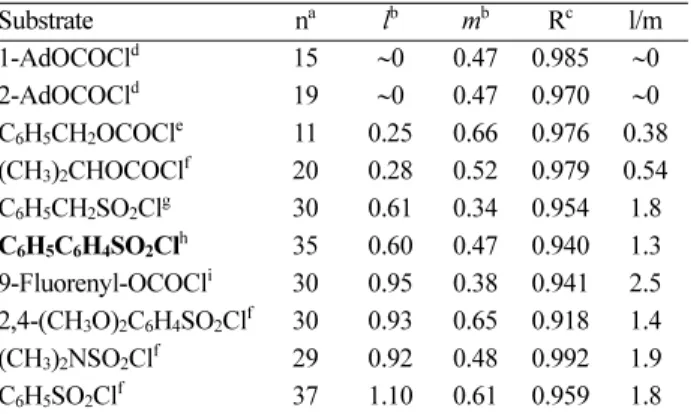
For all kinds of solvents, values obtained were 0.60 ± 0.09 for l, 0.47 ± 0.03 for m; the standard error of the estimate was 0.04; the correlation coefficient (R) value was 0.940 (Fig. 1). The sensitivity values, l and m, are reported in
Table 3, along with the corresponding parameters obtained in the analyses of previously studied substrates, to compare them with literature values for related substrates.
In general, for an SN1 reaction without nucleophilic assistance, l value would be zero and m value would be close to unity while l value would be near unity and m value would Table 2. Rate constants and activation parameters for the solvol-
yses of 4-(chlorosulfonyl)biphenyl (1)a in pure and aqueous sol- vents at various temperatures
Solvent (%)
Temp.
(oC)
104 k (s−1)
∆H≠ (kcal·mol−1)b
−∆S≠ (cal·mol−1·K−1)b
100EtOH 35.0 45.0 55.0
1.09 2.09 4.17
12.9±0.2 36.0±0.8
80EtOHc 35.0 45.0 55.0
3.96 8.85 17.7
14.7±0.2 30.0±0.6
100MeOH 35.0 45.0 55.0
3.21 7.38 15.5
15.2±0.1 28.1±0.3
80Acetone 35.0 45.0 55.0
0.639 1.28 2.94
14.7±0.5 29.8±1.8
aA 1.0 mol dm−3 solution of the substrate in the indicated solvent, also containing 0.1% CH3CN. bThe activation parameters are accompanied by the standard error. cOn a volume-volume content at 25.0oC, other component is water.
Table 3. Extended Grunwald-Winstein equation correlations of the kinetics of solvolytic displacement of chloride
Substrate na lb mb Rc l/m
1-AdOCOCld 15 ∼0 0.47 0.985 ∼0
2-AdOCOCld 19 ∼0 0.47 0.970 ∼0
C6H5CH2OCOCle 11 0.25 0.66 0.976 0.38 (CH3)2CHOCOClf 20 0.28 0.52 0.979 0.54 C6H5CH2SO2Clg 30 0.61 0.34 0.954 1.8 C6H5C6H4SO2Clh 35 0.60 0.47 0.940 1.3 9-Fluorenyl-OCOCli 30 0.95 0.38 0.941 2.5 2,4-(CH3O)2C6H4SO2Clf 30 0.93 0.65 0.918 1.4 (CH3)2NSO2Clf 29 0.92 0.48 0.992 1.9 C6H5SO2Clf 37 1.10 0.61 0.959 1.8
aNumber of solvents. bFrom eqn. (2). cCorrelation coefficient. dRef.
13. eRef. 14. fRef. 15. gRef. 12c. hThis work. iRef. 16.
Figure 1. The plot of log (k/k0) for solvolyses of 4-(chlorosul- fonyl)biphenyl against 0.60NT + 0.47YCl at 55.0oC.
Journal of the Korean Chemical Society
28 Suk Jin Kang and Han Joong Koh
be near 0.5 for a conventional SN2 mechanism.10 We com- pare l value (= 0.60) for the solvolysis of 1 with reported of the solvolysis of 9-fluorenyl chloroformate16 (l = 0.95), dimethoxybenzenesulfonyl chloride15 (l = 0.93), N,N-dimethyl sulfamoyl chloride15 (l = 0.92), and benzenesulfonyl chloride15 (l = 1.10) which are believed to be normal SN2 mecha- nism in Table 3. The l value of 0.60 for the solvolyses of 1 is smaller than those for the solvolyses proceed through a SN2 mechanism (l = 0.92~1.10). This l value (= 0.60) is similar to those previously reported for the solvolyses of benzylsulfonyl chloride (2)16 proposed as SN2 mechanism with some SN1 reaction pathway. Therefore, this similarity suggest that the solvolysis of 1 proceed through an SN2 mechanism involving an attack by solvent at sulfur atom in substrate with some character of SN1 mechanism.
The l/m values from the extended Grunwald-Winstein equation could be a useful mechanistic criteria; l/m values of 1.4 to 2.5 for bimolecular mechanism; below 0.5 for an ionization pathway10 (Table 3). For solvolysis of 1, the l/m value was 1.3 which is within the similar range of the pro- posed bimolecular pathway.
A kinetic solvent isotope effect (kCH3OH/kCH3OD) of 1.26 ± 0.04 at 55.0oC is observed. In general, for the SN2 reaction, KSIEs are in the range of values from 1.58 to 2.31, whereas for an SN1 reaction without nucleophilic assistance, KSIEs are close to unity.16 The lower KSIE value (1.26) for 1 compare to the normal SN2 mechanism suggests a dissociative SN2 mechanism with some SN1 reaction.
CONCLUSION
The solvolysis rate constants of 4-(chlorosulfonyl)biphenyl (1) in 35 different solvents are well correlated with the extended Grunwald-Winstein equation, using the NT solvent nuc- leophilicity scale and the YCl solvent ionizing power scale, with sensitivity values of 0.60 and 0.47 for l and m, respec- tively. The activation enthalpies (∆H≠) were 12.9 to 15.2 kcal·mol−1, the activation entropies (∆S≠) were −28.1 to −36.0 cal·mol−1·K−1, and the kinetic solvent isotope effect was 1.26. Based on these results, we suggest that the solvolysis of 1 has a dissociative SN2 mechanism with some char- acter of SN1 reaction.
REFERENCES
1. (a) Grunwald, E.; Winstein, S. J. Am. Chem. Soc. 1948, 70, 846. (b) Winstein, S.; Grunwald, E.; Jones, H. W. J. Am.
Chem. Soc. 1951, 73, 2700.
2. (a) Fainberg, A. H.; Winstein, S. J. Am. Chem. Soc. 1957, 79, 1579. (b) Fainberg, A. H.; Winstein, S. J. Am. Chem.
Soc. 1957, 79, 1602.
3. (a) Kevill, D. N.; Lin, G. M. L. J. Am. Chem. Soc. 1979, 101, 3916. (b) Kevill, D. N.; Anderson, S. W. J. Am. Chem.
Soc. 1986, 108, 1579.
4. (a) Kevill, D. N. In Advances in Quantitative Structure- Property Relationships, Vol. 4; Charton, M., Ed.; JAI Press:
Greenwich, CT, 1996; pp. 81−115. (b) Kevill, N. D.; D’Souza, M. J. Collect. Czech. Chem. Commun. 1999, 64, 1790.
5. Bentley, T. W.; Llewellyn, G. Prog. Phys. Org. Chem. 1990, 17, 121.
6. (a) Swain, C. G.; Langsdorf, W. P. J. Am. Chem. Soc. 1951, 73, 2813. (b) Jenkins, F. E.; Hambly, A. N. Austral. J. Chem.
1961, 14, 205.
7. (a) Jr. Hall, H. K. J. Am. Chem. Soc. 1956, 78, 1450. (b) Jr.
Hall, H. K.; Lucck, C. H. J. Org. Chem. 1963, 28, 2818.
(c) Ko, E. C. F.; Robertson, R. E. J. Am. Chem. Soc. 1972, 94, 573.
8. (a) Rogne, O. J. Chem. Soc, B. 1969, 663. (b) Lee, B. C.;
Lee, I. J. Korean Chem. Soc. 1980, 24, 342.
9. (a) Kim, S. R.; Choi, H. J.; Park, J. K.; Koo, I. S.; Koh, H. J. Bull. Korean Chem. Soc. 2014, 35, 51. (b) Ingold, C.
K. Structure and Mechanism in Organic Chemistry, 2d ed.;
Cornell University Press: Ithaca, N. Y., 1969; pp. 427−457.
10. (a) Lee, S. H.; Rhu, C. J.; Kyong, J. B.; Kim, D. K.; Kev- ill, D. N. Bull. Korean Chem. Soc. 2007, 28, 657. (b) Koh, H. J.; Kang, S. J.; Kevill, D. N. Bull. Korean Chem. Soc.
2009, 30, 383. (c) Seong, M. H.; Choi, S. H.; Lee, Y. W.;
Kyong, J. B.; Kim, D. K. Bull. Korean Chem. Soc. 2009, 30, 3408. (d) Seong, M. H.; Kyong, J. B.; Lee, Y. H.; Kevill, D. N. Int. J. Mol. Sci. 2009, 10, 929.
11. (a) Lee, Y. W.; Seong, M. H.; Kyong, J. B.; Kevill, D. N.
Bull. Korean Chem. Soc. 2010, 31, 3366. (b) Kyong, J.
B.; Park, B. C.; Kim, C. B.; Kevill, D. N. J. Org. Chem.
2000, 65, 8051. (c) Koh, H. J.; Kang, S. J. Bull. Korean Chem. Soc. 2011, 32, 1897.
12. (a) Kevill, D. N.; Kamil, W. A. J. Org. Chem. 1982, 47, 3785. (b) Kaspi, J.; Rappoport, Z. J. J. Am. Chem. Soc.
1980, 102, 3829.
13. Koh, H. J.; Kang, S. J.; Kim, C. J. J. Bull. Korean Chem.
Soc. 2009, 30, 378.
14. Kyong, J. B.; Park, B. C.; Kim, C. B.; Kevill, D. N. J.
Org. Chem. 2000, 65, 8051.
15. D’Souza, M. J.; Reed, D. N.; Erdman, K. J.; Kyong, J. B.;
Kevill, D. N. Int. J. Mol. Sci. 2009, 10, 862.
16. Koh, H. J.; Kang, S. J. Bull. Korean Chem. Soc. 2011, 32, 3799.