Vol. 18, No. 11 pp. 282-289, 2017
바닥형과 현수형 환경 보조물이 육성돈의 행동에 미치는 영향
김두완, 김영화, 민예진, 유동조, 정용대*
농촌진흥청 국립축산과학원 양돈과
Effects of floor type and hanging type environmental enrichment on the behavior of growing pigs
Doo-Wan Kim, Young-Hwa Kim, Ye-Jin Min, Dong-Jo Yu, Yong-Dae Jeong
*Swine Division, National Institute of Animal Science, Rural Development Administration
요 약 경제동물에 대한 동물복지에 대한 관심은 전세계적으로 고조되고 있는 추세이다. 그러나, 국내 양돈농가는 경제성 등을 이유로 고려하지 않거나 미비한 도입으로 돼지 본연의 행동이 제한되고 있다. 따라서, 본 연구의 목적은 일반적인 사육 환경에 환경보조물의 제공이 육성돈의 행동특성에 미치는 영향을 구명하고자 실시하였다. 실험동물은 45두의 3원 교잡육성 돈(요크셔×랜드레이스×두록; 평균체중, 33.35±5.5 kg)을 준비하였고, 완전임의배치법(randomized complete block design)에 의 해 3개 처리구(대조구; 현수형 환경보조물, T1; 바닥형 환경보조물, T2)에 처리구당 3반복, 반복당 5두씩 반슬러리 돈방에 배치하였다. 현수형 환경보조물은 돼지의 어깨 높이에 현수하였고, 바닥형은 돈방의 가운데에 고정시켰다. 시험기간은 14일 간 수행하였으며 시험종료일에 스트레스호르몬인 코티졸(cortisol) 농도를 분석하였고 행동특성은 1과 8일차에 촬영하였고 베가스 프로(Vegas Pro) 13.0 프로그램을 활용하여 및 분석하였다. 체중 및 일당증체량은 대조구와 처리구들간 차이가 없었 다. 코티졸호르몬은 T2(25.28 ng/mL)에서 대조구(46.75 ng/mL)보다 유의적으로 낮았다(p<0.05). 1일차 행동 유형별 지속시간 은 움직임과 공격 항목에서 대조구에 비해 처리구에서 유의적으로 낮았다(p<0.01). 8일차 놀이행동 지속시간에서 처리구2는 925.12초로 T1의 323.91초 보다 유의적으로 높았다(p<0.01). 반면에 처리구들에 비해 대조구는 움직이지 않는 시간이 많았다 (p<0.01). 이러한 결과는 환경보조물 제공이 돼지간 공격성을 감소시키고 돼지의 행동을 활동적으로 만들어 돼지 본연의 행 동요구를 충족시킬 수 있음을 시사한다. 그러나, 국내에서 환경보조물에 대한 연구는 미흡하므로 본 연구결과는 보조물을 이용한 동물복지에 대한 기초자료로서 활용 가능할 것으로 사료된다.
Abstract Animal Welfare is spreading throughout the world, but remains weak in Korean swine farms. Therefore, the aim of this study was to identify the effect of floor type and hanging type environmental enrichment on the behavior of growing pigs under the traditional feeding environment. A total of 45 crossbred pigs (Yorkshire×Landrace×Duroc; average weight, 33.35±5.5 kg) were assigned into three treatments consisting of control, hanging type(T1) and floor type(T2) with three replicates in semi-slurry pen. The hanging enrichment was suspended at shoulder height of the pigs, and the floor enrichment was fixed in the center of the pens. Growth and cortisol were estimated at the end of the experimental period. Behaviour patterns were analyzed on the first and eighth days after starting the experiment. Growth was not differed among control and treatments. However, cortisol was decreased in T2 compared to control(25.28 vs. 46.75 ng/mL; p<0.05). On the first day, movement and aggression were lower in both treatments than in control(p<0.01). On the eighth day, time and frequency of playing action were increased in T2 compared to T1(p<0.01) and both treatment groups showed more active behaviour than control(p<0.01). These results suggested that the enrichment may meet the natural action requirement of pigs. Therefore, our data can be utilized as basic information for welfare with environmental enrichments in farm animals.
Keywords : behaviour, cortisol, environmental enrichment, growing pigs, welfare
본 논문은 농촌진흥청 연구사업(과제번호: PJ01198002)의 지원에 의해 이루어진 것임
본 연구는 2017년도 농촌진흥청 국립축산과학원 전문연구원 과정 지원사업에 의해 이루어진 것임.
*Corresponding Author : Yong-Dae Jeong (National Institute of Animal Science) Tel: +82-41-580-34487 email: [email protected]
Received September 29, 2017 Revised October 17, 2017 Accepted November 3, 2017 Published November 30, 2017
1. 서론
농장동물의 복지는 영국 정부 독립자문기구인 농장동 물복지위원회(Farm Animal Welfare Council)에서 1993 년에 제시한 “동물의 다섯 가지 자유”가 농장동물복지의 기본 골격이 되고 있으며 세계 각국의 동물복지활동과 입법에도 큰 영향을 미치고 있다. 농장동물복지의 관심 은 전 세계적으로 확산 및 고조되고 있으며 유럽에서는 동물복지적용 축산물 브랜드가 별도로 판매되고 있고 축 산물이 생산되는 과정(사육, 도축, 가공 등)에서도 동물 복지 수준에 대한 평가가 요구되고 있다[1]. 우리나라에 서도 국제적인 흐름에 따라 1991년 “동물보호법”이 제 정된 이후 동물복지가 사회적 이슈로 부각되면서 농장동 물에 대한 “동물복지 축산농가 인증제”를 2012년 산란 계를 시작으로, 2013년에는 돼지, 2014년에는 육계, 2015년에는 한우와 젖소 사육농장 등으로 축종을 확대 해 나가고 있다. 이러한 것은 동물복지의 기본을 충족시 키기 위한 시설과 환경 제공, 즉 동물의 생명유지와 생산 활동이 이루어지는 생활환경을 최상의 상태로 제공하여 야 한다는 것을 의미한다[1]. 국내의 동물복지 인증기준 은 돼지의 욕구를 충족시킬 수 있는 구비조건으로 먹을 것을 찾아 코로 파헤치고 발로 긁고 씹는 행동욕구를 충 족시킬 수 있도록 짚, 나무 조각, 톱밥, 가죽 끈 등 적합 한 보조물을 제공하는 것과 다른 돼지의 꼬리, 옆구리, 귀, 음문 등을 무는 등 비정상적인 행동을 할 경우 씹거 나 입으로 가지고 놀 수 있는 흥미 있는 보조물을 즉시 제공 하도록 되어 있다.
돼지의 사물에 대한 행동요구를 대체할 수 있는 보조 물 제공을 통한 동물복지 향상은 이전 연구들에서 확인 되고 왔다[2-4]. 수년전부터 유럽은 돼지에게 짚이나 톱 밥, 나무조각, 플라스틱통 등 다양한 형태의 보조물 등을 돼지의 행동 욕구를 충족시키기 위해 제공하고 있다. 예 를 들어, 짚(건초)의 제공은 놀이 활동 자극, 영양 물질 제공, 잠자리로 이용 등 동물복지를 효과적인 환경 보조 물이다[5]. 반면에, 보조물 미제공 사육환경의 돼지는 뿌 리 뽑기나 씹기와 같이 매우 강하게 부여된 구강 활동욕 구를 동료 돼지[6,7]나 돈방의 시설로 전환하여 행동하 는 경향이 있다[8]. 돼지는 생리적으로 체온조절기능이 잘 발달되어 있지 않으며, 각질화된 땀샘으로 인해 피부 를 통한 땀 배출기능이 미비하고 더불어 두꺼운 피하지 방층은 체내의 열 발산을 어렵게 만든다[9]. 그 결과, 높
은 주변 환경온도는 스트레스로 작용하고 소화관 내 장 상피세포의 손상을 유발하여 영양소의 소화와 흡수율을 감소시킨다[10]. 이와 같은 환경적 스트레스로 인한 양 돈 생산성 저감 예방에 환경 보조물은 효과적인 것으로 알려져 있다[2].
최근 국내에서 신축되는 비육돈 돈사 시설은 대부분 분뇨처리를 용이하게 처리하기 위해 돈사바닥의 분뇨가 자연스럽게 낙하하는 슬러리 방식을 채택하고 있다. 그 러나 짚이나 톱밥과 같은 보조물은 슬러리 밑으로 떨어 져 분뇨와 혼합되고 혼합된 짚 등은 분뇨관을 막아 농장 내 분뇨처리과정을 방해하므로 환경 보조물로서 부적합 하다. 따라서, 관행적인 환경보조물인 짚 및 톱밥의 대체 보조물로서 슬러리 구조의 돈사에서 사용가능한 플라스 틱으로 제조된 보조물에 대한 관심이 높아지고 있다. 따 라서, 본 연구는 플라스틱 소재의 환경 보조물이 육성돈 의 행동 특성에 미치는 영향을 구명하고자 실시하였다.
(C) (T1) (T2)
Fig. 1. Image and location of experimental enrichments in semi-slurry pen for pigs. (C) customary breeding without enrichment, (T1) a hanging type enrichment device, (T2) a floor type enrichment device
2. 재료 및 방법
2.1 공시동물 및 실험설계
본 연구에 사용된 실험동물은 총 45두의 3원교잡종 돼지(Yorkshire×Landrace×Duroc; 평균 체중, 33.35±5.5 kg)를 공시하였다. 처리구는 대조구(C), 현수형 환경 보 조물(T1), 바닥형 환경 보조물(T1)이며 처리구당 3반복, 반복당 5두씩 실험동물을 체중에 따라 완전임의배치법 에 의거하여 배치하였다. 설치한 T1 환경보조물 (Bite-Rite, Ikadan System, Denmark)은 돈방 중앙의 천 장에 현수하여 돼지의 어깨 높이에 맞게 매달았으며 T2 환경보조물(Circular silicon material enrichment, Korea) 은 체인을 연결하여 움직일 수 있도록 돈방 중앙의 바닥 에 고정하였다(Figure 1). 시험은 2017년 6월 14일부터
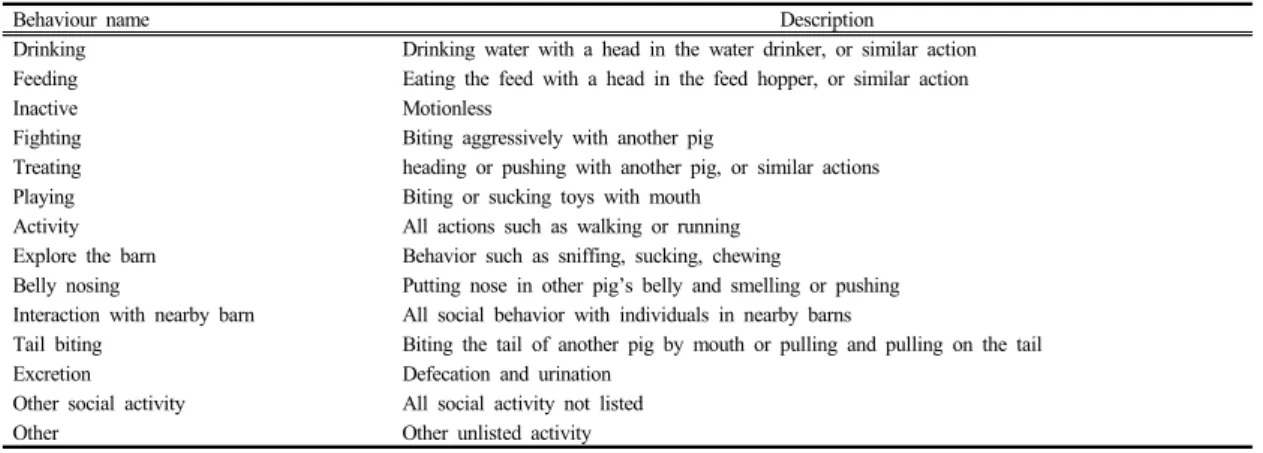
Behaviour name Description
Drinking Drinking water with a head in the water drinker, or similar action Feeding Eating the feed with a head in the feed hopper, or similar action
Inactive Motionless
Fighting Biting aggressively with another pig
Treating heading or pushing with another pig, or similar actions
Playing Biting or sucking toys with mouth
Activity All actions such as walking or running
Explore the barn Behavior such as sniffing, sucking, chewing
Belly nosing Putting nose in other pig’s belly and smelling or pushing Interaction with nearby barn All social behavior with individuals in nearby barns
Tail biting Biting the tail of another pig by mouth or pulling and pulling on the tail
Excretion Defecation and urination
Other social activity All social activity not listed
Other Other unlisted activity
Table 1. Behavior types of pigs 6월 27일까지 총 14일동안 수행하였다.
사양관리는 국립축산과학원 실험동물윤리위원회의 가이드라인에 의거하였다. 시험기간동안 외부요인을 배 제하기 위해 자동 환경제어시스템 돈사에서 사육하였고 사료 및 물은 자유롭게 접근하게 하였다. 시험돈방은 3.1 m×3.4 m이며 바닥의 70% 콘크리트이며 30% 플라스틱 패드된 semi-slurry pen으로 조성되어 있다.
2.2 혈중 cortisol 분석
시험 종료일에 모든 시험돈방에서 각각 임의로 2두씩 선발하여 혈액을 수집한 후 원심분리(2,500 rpm, 15분, 4℃)하여 혈청을 분리하였다. 혈중 코티졸 분석은 ELISA kit(CSB-E06811p, Cusabio Biotech Co. Ltd., China)를 이용하여 측정하였고 분석은 제조사에서 권장하는 방법 에 준하여 실시하였다.
2.3 행동조사
행동 조사는 각각의 돈방의 맞은편에 digital camera(XIAOYI, YI Action Camera, China)를 설치하 여 실험개시 2일차와 8일차에 오전 10시부터 저녁 6시 까지 8시간동안 연속으로 돼지의 행동을 촬영 및 녹화하 였다. 공시축의 개체별 구분을 위해서 돼지 머리쪽과 꼬 리쪽의 등 부위에 파란색, 빨간색, 검정색 락커를 이용하 여 표시하였다.
영상분석은 일별 촬영된 영상을 각 시간대별로 구분 및 편집하여 돼지의 행동을 대표할 수 있는 10분간의 영 상을 발췌하였다. 편집 및 발취된 영상은 Vegas Pro 13.0 프로그램을 활용하여 분석을 실시하였다. 실험기간
동안 돼지의 행동을 파악한 결과는 Table 1의 유형과 같 이 행동유형별로 구분하였다.
2.4 통계분석
수집된 모든 결과들은 통계프로그램 SPSS version 17.0을 이용하여 일원배치분산분석을 하였다. 처리구간 유의성은 tukey법을 사용하여 p값이 0.05미만일 때 인정 하였다. 행동유형에 따른 통계 검증은 Kruskal -Wallis test를 이용하여 실시하였다.
3. 결과 및 고찰
3.1 체중변화
14일의 실험기간동안 환경 보조물제공에 의한 증체량 은 T1 처리구가 15.23 kg, T2 처리구는 14.63 kg, 대조 구는 14.24 kg로 계산되었다(Table 2). 그러나, 처리구간 통계적인 차이는 나타내지 않았다. Gregurić Gračner et al.[11]는 60일동안 보조물 무처리구, 자동차 모양 바닥 형 보조물, 체인 현수형 보조물의 제공은 이유자돈의 체 중변화에 영향을 미치지 않지만 공(ball)모양의 현수형 또는 바닥형 보조물보다 증체량 증가를 보고하였다. 선 행연구의 결과는 보조물의 제공형태보다 모양에 의해 돼 지의 증체량이 영향을 받는 것을 의미한다. 본 연구에서 도 현수형(T1)과 바닥형(T2)과 증체량에서 차이를 나타 내지 않아 선행연구와 일치하였다. 그러나, 선행연구와 본 연구에서 사용된 보조물의 모양은 상이하므로 직접적 인 비교는 할 수 없으나 선행연구보다 환경 보조물의 제 공기간이 짧아서 돼지의 생산성인 증체량에 크게 영향을
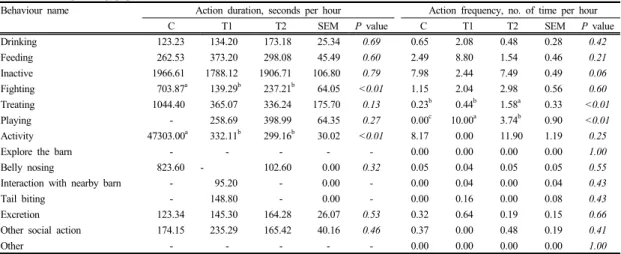
Table 4. Action duration and frequency of behaviour at the first days after provide of environmental enrichment devices to growing pigs (n=15) Behaviour name Action duration, seconds per hour Action frequency, no. of time per hour
C T1 T2 SEM P value C T1 T2 SEM P value
Drinking 123.23 134.20 173.18 25.34 0.69 0.65 2.08 0.48 0.28 0.42
Feeding 262.53 373.20 298.08 45.49 0.60 2.49 8.80 1.54 0.46 0.21
Inactive 1966.61 1788.12 1906.71 106.80 0.79 7.98 2.44 7.49 0.49 0.06
Fighting 703.87a 139.29b 237.21b 64.05 <0.01 1.15 2.04 2.98 0.56 0.60 Treating 1044.40 365.07 336.24 175.70 0.13 0.23b 0.44b 1.58a 0.33 <0.01
Playing - 258.69 398.99 64.35 0.27 0.00c 10.00a 3.74b 0.90 <0.01
Activity 47303.00a 332.11b 299.16b 30.02 <0.01 8.17 0.00 11.90 1.19 0.25
Explore the barn - - - - - 0.00 0.00 0.00 0.00 1.00
Belly nosing 823.60 - 102.60 0.00 0.32 0.05 0.04 0.05 0.05 0.55
Interaction with nearby barn - 95.20 - 0.00 - 0.00 0.04 0.00 0.04 0.43
Tail biting - 148.80 - 0.00 - 0.00 0.16 0.00 0.08 0.43
Excretion 123.34 145.30 164.28 26.07 0.53 0.32 0.64 0.19 0.15 0.66
Other social action 174.15 235.29 165.42 40.16 0.46 0.37 0.00 0.48 0.19 0.41
Other - - - - - 0.00 0.00 0.00 0.00 1.00
Values are mean. C, no enrichment device; T1, the treatment group, as these pigs receive a suspension type enrichment device; T2, the treatment group, as these pigs receive a bottom type enrichment device; SEM, standard error mean. a,b means with different superscript in same row differ below 0.05 of p value.
미치지는 않는 것으로 사료된다.
Table 2. Effect of environmental enrichment devices type on growth of growing pigs (n=45)
Items, kg C T1 T2 SEM P value
Initial BW 33.35 33.35 33.35 0.81 0.99
Ending BW 47.59 48.58 47.98 0.84 0.89
Weight gain 14.24 15.23 14.63 0.28 0.36
Values are mean. C, no enrichment device; T1, the treatment group, as these pigs receive a suspension type enrichment device; T2, the treatment group, as these pigs receive a bottom type enrichment device;
SEM, standard error mean.
3.2 혈중 코티졸 농도
Table 3은 육성돈에 환경 보조물의 제공이 혈액 내 코티졸 농도에 미치는 영향을 나타냈다. 혈중 코티졸은 대조구보다 T2 처리구에서 감소하였다(46.75 vs. 25.28 ng/mL; p<0.05). T1의 코티졸 농도는 31.03 ng/mL이며 대조구와 통계적인 차이는 없으나 수치적으로 낮게 분석 되었다. 코티졸 호르몬은 부신피질에서 분비되는 스테로 이드성 호르몬으로 스트레스에 의해 활성화된 교감신경 반응의 결과로 발생되며, 돼지에서는 스트레스를 감지하 는 데 가장 널리 사용되는 바이오 마커들 중 하나이다 [12-15]. 돼지의 주요 스트레스인자인 높은 사육온도는 코티졸 농도를 증가시키는 것으로 알려져 있다. 육성돈 의 적정 사육 온도인 17.6-26.6℃에서 22.2-32.8℃보다 혈중 코티졸 농도가 낮게 측정되었다[16]. 다른 선행연 구는 비육돈에서 적온기에 비해 고온기에서 코티졸의 증
가됨을 보고하였다[17]. 그러므로 코티졸은 스트레스 정 도에 의해 체내에서 분비되는 반응물임을 시사한다. 따 라서, 환경 보조물 제공은 스트레스를 저감시켜 돼지의 복지향상에 긍정적인 영향을 미칠 수 있을 것으로 판단 된다.
Table 3. Effect of environmental enrichment devices type on cortisol concentration in blood of growing pigs (n=18)
Items, g/mL C T1 T2 SEM P value
Cortisol 46.75a 31.03ab 25.28b 3.82 0.048 Values are mean. C, no enrichment device; T1, the treatment group, as these pigs receive a suspension type enrichment device; T2, the treatment group, as these pigs receive a bottom type enrichment device;
SEM, standard error mean. a,b means with different superscript in same row differ below 0.05 of p value.
3.3 행동특성
Table 4는 환경 보조물을 제공 2일차에 돼지의 행동 유형별에 따른 지속시간 및 행동빈도를 나타냈다. 대조 구가 T1과 T2 처리구보다 활동성(703.87 vs. 139.29 and 237.21 s)과 공격적인 행동(47303 vs. 332.11 and 299.16 s)항목에서 지속시간이 유의적으로 높으나 (p<0.01), 다른 항목에서는 차이가 없었다. 2일차에 돼 지를 머리로 미는 행동빈도에서는 T2 처리구가 C와 T1 처리구보다 유의적으로 높았다(1.58 vs. 0.23 and 0.44;
p<0.01). 환경 보조물을 가지고 노는 행동빈도에서는 T1 처리구가 T2 처리구보다 유의적으로 증가했다(10.00
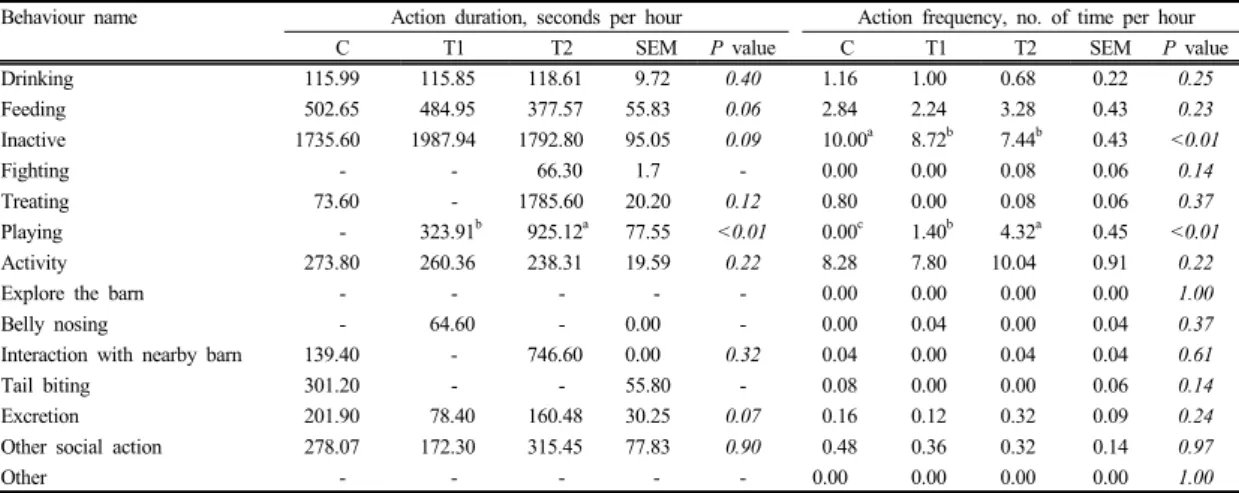
Table 5. Action duration and frequency of behaviour at the eight days after provide of environmental enrichment devices to growing pigs (n=15) Behaviour name Action duration, seconds per hour Action frequency, no. of time per hour
C T1 T2 SEM P value C T1 T2 SEM P value
Drinking 115.99 115.85 118.61 9.72 0.40 1.16 1.00 0.68 0.22 0.25
Feeding 502.65 484.95 377.57 55.83 0.06 2.84 2.24 3.28 0.43 0.23
Inactive 1735.60 1987.94 1792.80 95.05 0.09 10.00a 8.72b 7.44b 0.43 <0.01
Fighting - - 66.30 1.7 - 0.00 0.00 0.08 0.06 0.14
Treating 73.60 - 1785.60 20.20 0.12 0.80 0.00 0.08 0.06 0.37
Playing - 323.91b 925.12a 77.55 <0.01 0.00c 1.40b 4.32a 0.45 <0.01
Activity 273.80 260.36 238.31 19.59 0.22 8.28 7.80 10.04 0.91 0.22
Explore the barn - - - 0.00 0.00 0.00 0.00 1.00
Belly nosing - 64.60 - 0.00 - 0.00 0.04 0.00 0.04 0.37
Interaction with nearby barn 139.40 - 746.60 0.00 0.32 0.04 0.00 0.04 0.04 0.61
Tail biting 301.20 - - 55.80 - 0.08 0.00 0.00 0.06 0.14
Excretion 201.90 78.40 160.48 30.25 0.07 0.16 0.12 0.32 0.09 0.24
Other social action 278.07 172.30 315.45 77.83 0.90 0.48 0.36 0.32 0.14 0.97
Other - - - 0.00 0.00 0.00 0.00 1.00
Values are mean. C, no enrichment device; T1, the treatment group, as these pigs receive a suspension type enrichment device; T2, the treatment group, as these pigs receive a bottom type enrichment device; SEM, standard error mean. a,b,c means with different superscript in same row differ below 0.05 of p value.
vs. 3.74; p<0.01).
Table 5는 환경 보조물 제공 8일차에 돼지의 행동 유 형별에 따른 지속시간 및 행동빈도를 나타냈다. 환경적 보조물을 가지고 노는 행동 지속시간은 T2 처리구가 T1 처리구보다 유의적으로 높게 나타났으나(925.12 vs.
323.91 s; p<0.01), 다른 항목에서는 처리구간 차이가 없 다. 움직이지 않는 행동빈도는 대조구가 T1과 T2 처리 구보다 유의적으로 높았고(10.00 vs. 8.72 and 7.44;
p<0.01), 환경적 보조물을 가지고 노는 행동 빈도에서는 T2의 처리구가 T1의 처리구보다 로 유의적으로 높은 빈 도를 나타냈다(4.32 VS 1.40; p<0.01). 전체적으로 살펴 보면, 1일차에는 환경적 보조물을 제공하지 않은 대조구 에서 T1과 T2 처리구보다 싸움과 활동적인 행동 시간이 많았고, 8일차에는 움직이지 않는 행동시간이 대조구가 T1과 T2 처리구보다 높았다. 이러한 것은 환경적 보조 물을 제공하지 않은 상태에서는 다른 돼지들과 서열 경 쟁이 초기에 빠르게 진행되었다가 시간이 지남에 따라 서열이 정해져서 더 이상 싸우지 않은 상태가 되지만 서 열로 인해 상호간에 스트레스를 받는데 반면, 환경적 보 조물을 제공한 처리구에서는 보조물에 대한 흥미와 관심 으로 상대적으로 다른 돼지들과의 서열 경쟁이 약해졌고 지속적으로 보조물에 대한 놀이로 인해 스트레스를 해소 하는 것으로 보인다. 14일령에 코티졸 수준에서 보듯 환 경적 보조물을 제공한 처리구가 보조물에 대한 놀이시간 으로 인해 스트레스를 덜 받고 있음을 알 수 있다. 특히,
8일령에서 T2 처리구의 보조물에 대한 놀이 시간과 빈 도가 T1의 처리구보다 유의적으로 높게 나타난 것은 14 일령의 T2의 처리구가 T1의 처리구에 비해 코티졸 수준 이 낮은 것과 연관되어 있음을 유추해 볼 수 있다. 즉, 시간이 지남에 따라 T2의 환경적 보조물에서의 놀이 시 간과 빈도가 높아짐으로써 스트레스가 완화되어 있음을 알 수 있다.
돼지는 기능성이 있는 보조물을 제공받을 필요가 있 으며, 이는 부정적인 행동을 하지 못하도록 돼지의 행동 을 잡아주는 것으로 정의된다[18]. 밀집사육형태의 돼지 농장에서 환경 보조물의 선택은 동물 자체의 요구보다 경제적 또는 건강 관련 요소에 더 중점을 두고 선택하고 있다[19]. 양돈농가의 주관적인 선택으로 바닥형 환경 보조물을 제공하게 되면 일상적인 돼지관리에 방해가 되 기 때문에 현수형 환경 보조물을 더 선호한다[19]. 그러 나 일부 선행연구에서는 현수형 보조물을 제공하는 것이 바닥에 잠자리용으로 짚을 제공하는 것보다 보조물에 대 한 점유가 매우 낮다고 보고하고 있다[18,20-22]. 현수형 또는 바닥형 환경 보조물의 재질은 대부분 플라스틱 또 는 철재로 제조되어 내구력이 강하지만, Ruis et al.[14]
의 연구에 의하면 돼지가 가장 선호하는 환경 보조물의 재질은 섭취가 가능하고, 냄새를 맡을 수 있어야 하며, 씹기가 쉽고, 변형 또는 파괴가 가능 한 특성을 가진 보 조재를 가장 선호한다고 하였다.
4. 결론
본 연구 결과를 종합해보면, 돼지의 육성기에 환경적 보조물을 제공하는 것은 돼지의 서열경쟁과 같은 부정적 인 행동을 보조물로 흥미와 관심을 돌리게 하여 상호간 의 스트레스를 덜 받게 하는 효과가 있는 것으로 보인다.
14일령에 코티졸 호르몬 수준에서 보듯 환경적 보조물 을 제공한 처리구의 돼지에서 코티졸의 농도 수준이 유 의적으로 낮아졌고, 특히 8일령에서는 바닥형 보조물의 처리구에서의 보조물에 대한 놀이 시간과 빈도가 현수형 보조물의 처리구보다 유의적으로 높게 나왔다.또한, 이 것은 14일령에서 바닥형 보조물의 처리구가 현수형 보 조물의 처리구에 비해 코티졸 수준이 낮은 것과 연관되 어 있음을 유추해 볼 수 있다. 환경적 보조물의 적용은 돼지에게 있어 스트레스를 완화해주는 효과가 있다. 환 경적 보조물의 적용은 동물복지차원에서 확대 적용이 필 요하다. 하지만 양돈농가는 이것을 현장에 바로 적용하 기가 쉽지 않다. 특히 슬러리 돈사는 짚과 같은 건초를 바닥에 제공할 수 없는 시설이므로 양돈농가에서는 환경 적 보조물을 제공에 있어 바닥형 보조물보다 현수형 보 조물을 더 많이 선호 하고 있다. 제공하는 재질도 플라스 틱 또는 철재와 같은 보조물을 제공하고 있다. 많은 연구 에서 가장 좋은 환경적 보조물은 잠자리용으로 짚이나 톱밥과 같은 천연소재로 된 것을 제공하는 것이 효과가 좋다는 보고가 많다. 국내에서도 이에 맞는 친환경 천연 소재로 제공하는 환경적 보조물에 대한 연구와 조사가 더 많이 요구된다.
References
[1] Y. G. Moon, D. M. Ha, J. H, Jeon, D. H. Kim, "A study on the selection of specific behaviours of pigs as a measure of animal welfare assessment", Journal of Agriculture & Life Science, vol. 48, no. 5, pp. 63–72, 2014.
DOI: https://doi.org/10.14397/jals.2014.48.5.63
[2] V. E. Beattie, N. E. O’Connell, B. W, Moss, "Influence of environmental enrichment on the behaviour, performance and meat quality of domestic pigs", Livestock Production Science, vol. 65, no. 1-2, pp. 71– 79, 2000.
DOI: https://doi.org/10.1016/S0301-6226(99)00179-7 [3] V. Petersen, H. B. Simonsen, L. G. Lawson, "The effect
of environmental stimulation on the development of behaviour in pigs", Applied Animal Behaviour Science, vol. 45, no. 3-4, pp. 215-224, 1995.
DOI: https://doi.org/10.1016/0168-1591(95)00631-2 [4] D. S. Arey, "The effect of bedding on the behaviour and
welfare of pigs", Animal Welfare, vol. 2, no. 3, pp.
235-246, 1993.
[5] D. Fraser, P. A. Phillips, B. K. Thompson, T. Tennessen,
"Effects of straw on the behaviour of growing pigs", Applied Animal Behaviour Science, vol. 30, no. 3-4, pp.
307-318. 1991.
DOI: https://doi.org/10.1016/0168-1591(91)90135-K [6] C. A. P. Lyons, J. M. Bruce, V. R. Fowler, P. R.
English, "A comparison of productivity and welfare of growing pigs in four intensive systems", Livestock Production Science, vol. 43, no. 3, pp. 265-274, 1995.
DOI: https://doi.org/10.1016/0301-6226(95)00050-U [7] H. R. C. Kelly, J. M. Bruce, P. R. English, V. R.
Fowler, S. A. Edwards, "Behaviour of 3-week weaned pigs in straw-flow, deep straw and flat deck housing systems", Applied Animal Behaviour Science, vol. 68, no, 4, pp. 269-280, 2000.
DOI: https://doi.org/10.1016/S0168-1591(00)00109-X [8] J. H. Guy, P. Rowlinson, J. P. Chadwick, A. Ellis,
"Behaviour of two genotypes of growing-finishing pig in three different housing systems", Applied. Animal Behaviour Science, vol. 75, no. 23, pp. 193-206, 2002.
DOI: https://doi.org/10.1016/S0168-1591(01)00197-6 [9] D. W. Kim, Y. H. Kim, K. S. Kim, K. H. Kim, "Effect
of mixing of suckling piglets on change of body surface temperature in sows and piglets", Journal of the Korea Academia-Industrial cooperation Society, vol. 18, no. 1, pp. 135-140, 2017.
DOI: https://doi.org/10.5762/KAIS.2017.18.1.135 [10] K. H. Kim, K. S. Kim, D. W. Kim, S. J. Sa, Y. H. Kim,
"Effects of supplementation of dietary betaine on apparent nutrient digestibility and physiological responses in finishing pigs", Journal of the Korea Academia-Industrial cooperation Society, vol. 17, no. 12, pp. 407-414, 2016.
DOI: http://dx.doi.org/10.5762/KAIS.2016.17.12.407 [11] G. Gregurić Gračner, N. Šemiga, M. Ostović, A. Ekert
Kabalin, K. Matković, Ž. Pavičić, "The effect of environmental enrichment objects on weight gain in weaned pigs", Veterinarski Arhiv, vol. 83, no. 3, pp.
333-339, 2013.
[12] G. D. Bottoms, O. F. Roesel, F. D. Rausch, E. L. Akins,
"Circadian variation in plasma cortisol and corticosterone in pigs and mares" American Journal of Veterinary Research, vol. 33, no. 4, pp. 785-790, 1972.
[13] J. L. Barnett, G. M. Cronin, T. H. McCallum, "Effects of grouping unfamiliar adults pigs after dark, after treatment with amperozide and by using pens with stalls, on aggression, skin lesions and plasma cortisol concentrations", Applied Animal Behaviour Science, vol.
50, no. 2, pp. 121–133, 1996.
DOI: https://doi.org/10.1016/0168-1591(96)01084-2 [14] M. A. W. Ruis, J. H. A. Brake, B. Engel, E. D. Ekkel,
W. G. Buist, H. J. Blokhuis, J. M. Koolhaas, "The circadian rhythm of salivary cortisol in growing pigs:
effects of age, gender, and stress", Physiology &
Behavior, vol. 62, no. 3, pp. 623–630, 1997.
DOI: https://doi.org/10.1016/S0031-9384(97)00177-7
[15] K. H. Kim, K. S. Kim, D. W. Kim, S. J. Sa, Y. H. Kim,
"Evaluation of valid time for analysis of complete blood cell in pig blood using the Hemavet 950FS", Journal of the Korea Academia-Industrial cooperation Society, vol.
18, no. 1, pp. 194-201, 2017.
DOI: https://doi.org/10.5762/KAIS.2017.18.1.194 [16] A. C. A. Fagundes, J. A. Negrão, R. G. Silva, J. D. F.
Gomes, L. W. O. Souza, R. S. Fukushima,
"Environmental temperature and serum cortisol levels in growing-finishing pigs" Brazilian Journal of Veterinary Research and Animal Science, São Paulo, vol. 45, suplemento, pp. 136-140, 2008.
DOI: https://doi.org/10.11606/S1413-95962008000700019 [17] S. Y. Oh, Y. D. Jeong, D. W. Kim, Y. J. Min, D. J. Yu,
K. H. Kim, Y. H. Kim, "Effect of heat stress on growth performance and physiological changes of pigs in commercial farm", Journal of the Korea Academia-Industrial cooperation Society, vol. 18, no. 7, pp. 130-139, 2017.
DOI: https://doi.org/10.5762/KAIS.2017.18.7.130 [18] H. A. Van de Weerd, C. M. Docking, J. E. L. Day, S.
A. Edwards, "The development of harmful social behaviour in pigs with intact tails and different enrichment backgrounds in two housing systems", Animal Science, vol. 80, pp. 289-298, 2005.
DOI: https://doi.org/10.1079/ASC40450289
[19] H. A. Van de Weerd, C. M. Docking, J. E. L. Day, P.
J. Avery, S. A. Edwards, "A systematic approach towards developing environmental enrichment for pigs", Applied Animal Behaviour Science, vol. 84, no. 2, pp.
101-118, 2003.
DOI: https://doi.org/10.1016/S0168-1591(03)00150-3 [20] J. E. L. Day, H. A. M. Spoolder, A. Burfoot, H. L.
Chamberlain, S. A. Edwards, "The separate and interactive effects of handling and environmental enrichment on the behaviour and welfare of growing pigs" Applied Animal Behaviour Science, vol. 75, no. 3, pp. 177–192, 2002.
DOI: https://doi.org/10.1016/S0168-1591(01)00199-X [21] K. Scott, L. Taylor, B. P. Gill, S. A. Edwards,
"Influence of different types of environmental enrichment on the behaviour of finishing pigs in two different housing systems. 1. Hanging toy versus rootable substrate", Applied Animal Behaviour Science, vol. 99, no. 3-4, pp. 222–229, 2006.
DOI: https://doi.org/10.1016/j.applanim.2005.10.013 [22] K. Scott, L. Taylor, B. P. Gill, S. A. Edwards,
"Influence of different types of environmental enrichment on the behaviour of finishing pigs in two different housing systems. 2. Ratio of pigs to enrichment", Applied Animal Behaviour Science, vol.
105, no. 1-3, pp. 51–58, 2007.
DOI: https://doi.org/10.1016/j.applanim.2006.05.042
김 두 완(Doo-Wan Kim) [정회원]
•1998년 2월 : 전남대학교 농과대 학 축산학과 (축산학학사)
•2016년 2월 : 전북대학교 축산학 과 (식육가공석사)
•2006년 3월 ∼ 현재 : 농촌진흥청 국립축산과학원 농업연구사
<관심분야>
가축사양, 식육
김 영 화(Young-Hwa Kim) [정회원]
•1987년 5월 ∼ 1991년 12월 : 영 천군농촌지도소 농촌지도사
•1997년 2월 : 전남대학교 대학원 축산학과 (농학석사)
•2002년 2월 : 경상대학교 대학원 축산학과 (농학박사)
•1992년 1월 ∼ 현재 : 농촌진흥청 국립축산과학원 농업연구사
<관심분야>
동물영양, 가축사양
민 예 진(Ye-Jin Min) [정회원]
•2016년 2월 : 충남대학교 농과대 학 동물자원생명과학과 (농학학사)
•2016년 10월 ∼ 현재 : 농촌진흥 청 국립축산과학원 농업연구사
<관심분야>
동물영양, 가축사양
유 동 조(Dong-Jo Yu) [정회원]
•1997년 2월 : 충남대학교 농과대 학 축산학과 (농학석사)
•2001년 8월 : 충남대학교 농과대 학 축산학과 (농학박사)
•2006년 4월 ∼ 2016년 4월 : 농 촌진흥청 국립축산과학원 농업연 구사
•2016년 4월 ∼ 현재 : 농촌진흥청 국립축산과학원 농업연구관
<관심분야>
동물영양, 가축사양
정 용 대(Yong-Dae Jeong) [정회원]
•2008년 2월 : 전북대학교 축산학 가금영양생리전공 (농학석사)
•2016년 2월 : 전북대학교 축산학 분자영양생리 (농학박사)
•2016년 3월 ∼ 현재 : 농촌진흥청 국립축산과학원 박사 후 연구원
<관심분야>
동물영양생리, 단위동물사양