Bond strength of veneer ceramic and zirconia cores with different surface modifications after microwave sintering
Muhammet Saka, DDS, PhD, Bulem Yuzugullu*, DDS, PhD
Department of Prosthodontics, Faculty of Dentistry, Baskent University, Ankara, Turkey
PURPOSE. To evaluate the effects of surface treatments on shear bond strength (SBS) between microwave and conventionally sintered zirconia core/veneers. MATERIALS AND METHODS. 96 disc shaped Noritake Alliance zirconia specimens were fabricated using YenaDent CAM unit and were divided in 2 groups with respect to microwave or conventional methods (n=48/group). Surface roughness (Ra) evaluation was made with a
profilometer on randomly selected microwave (n=10) and conventionally sintered (n=10) cores. Specimens were then assessed into 4 subgroups according to surface treatments applied (n=12/group). Groups for microwave (M) and conventionally (C) sintered core specimens were as follows; MC,CC: untreated (control group), M1,C1:Al2O3 sandblasting, M2,C2:liner, M3,C3:Al2O3 sandblasting followed by liner. Veneer ceramic was fired on zirconia cores and specimens were thermocycled (6000 cycles between 5°-55℃). All specimens were subjected to SBS test using a universal testing machine at 0.5 mm/min, failure were evaluated under an optical microscope. Data were statistically analyzed using Shapiro Wilk, Levene, Post-hoc Tukey HSD and Student’s t tests, Two-Way-Variance- Analysis and One-Way-Variance-Analysis (α=.05). RESULTS. Conventionally sintered specimens (1.06 ± 0.32 μm) showed rougher surfaces compared to microwave sintered ones (0.76 ± 0.32 μm)(P=.046), however, no correlation was found between SBS and surface roughness (r=-0.109, P=.658). The statistical comparison of the shear bond strengths of C3 and C1 group (P=.015); CC and MC group (P=.004) and C3 and M3 group presented statistically higher (P=.005) values. While adhesive failure was not seen in any of the groups, cohesive and combined patterns were seen in all groups. CONCLUSION. Based on the results of this in-vitro study, Al2O3- sandblasting followed by liner application on conventionally sintered zirconia cores may be preferred to enhance bond strength. [J Adv Prosthodont 2013;5:485-93]
KEY WORDS: Microwave sintered zirconia; Shear bond strength; Al2O3 sandblasting; Liner; Optical microscope;
Chipping
INTRODUCTION
All-ceramic restorations have gained considerable attention and popularity due to their esthetic performance and excel-
lent biocompatibility with the increasing esthetic demand of the society. Likewise, high-strength zirconium oxide ceramics (zirconia) have become widely used because of their chemical stability, physical and mechanical characteris- tics. Yttria-stabilized tetragonal zirconia polycrystalline (Y-TZP) is a polymorphic material with three different allo- tropes (monoclinic, tetragonal and cubic). Inserting force on its surface can lead to transition between its different crystalline reticulations that produce a volumetric change and create compressive stresses that seal the cracks. Due to the transformation toughening mechanism, Y-TZP has been shown to have superior mechanical properties com- pared to other all-ceramic systems.1
With the introduction of modern technologies such as Computer Aided Design/Computer Aided Manufacture (CAD/CAM), fabrication of core designs for all-ceramic
Corresponding author:
Bulem Yuzugullu
Department of Prosthodontics, Faculty of Dentistry, Baskent University, 11. St No:26 06490 Bahcelievler, Ankara, Turkey
Tel. 903122151336: e-mail, [email protected]
Received September 25, 2013 / Last Revision November 12, 2013 / Accepted November 14, 2013
© 2013 The Korean Academy of Prosthodontics
This is an Open Access article distributed under the terms of the Creative Commons Attribution Non-Commercial License (http://creativecommons.
org/licenses/by-nc/3.0) which permits unrestricted non-commercial use, distribution, and reproduction in any medium, provided the original work is properly cited.
restorations have revolutionized.1 Every pore and imperfec- tion is a potential starting point for cracks that can propa- gate and may lead to clinical failure of ceramic restorations.
However, with the advances in CAD/CAM technology, it is possible to achieve industrial quality standards.2 These sys- tems are used for a range of applications, including precise- ly milled Y-TZP frameworks for fixed dental prosthesis.
CAD/CAM technology was originally intended for fully sintered ceramic blocks (hard machining), up to-date, its indications have been expanded to partially sintered ceram- ics (soft machining), fully heat treated to ensure adequate sintering. Besides, these partially sintered blocks are easy to mill, which leads to substantial savings in time and tool wear.1
Microwave sintering of ceramics is a novel technique that gained much attention because of rapid heating, enhanced densification rate and improved microstructure.3 The primary reasons of better mechanical properties of microwave process are the fine grain size produced and uniform volumetric heating with extremely rapid heat-up rates.4,5 It is interesting to note that the stability and there- fore the mechanical properties of zirconia strongly depend on its grain size.6 Grain size is determined by the sintering conditions and particularly the sintering temperature and duration of the process.1 Higher temperatures and longer durations lead to larger grain sizes, which can lead to inferi- or products with higher failure rates.5 In conventional sin- tering methods, thermal radiation received on the surface of the ceramic component reaches the core by thermal conduction producing high temperature gradients and stresses.7 The use of microwaves allows transfer of energy directly into the materials to take place, where it is convert- ed into heat through absorption mechanisms, such as ionic conduction, dipole relaxation and photon-phonon interac- tions. In this context of microwave heating, each constitu- ent unit of the crystal lattice raises a certain constant ampli- tude vibration, which results in a highly uniform distribu- tion of heat in the ceramic body.7
Combining the strength of ceramic cores and the esthetics of veneering ceramics and using layering tech- niques allowbuilding unique, esthetic restorations with its own individual character.8 Delamination and ‘chipping’ of the veneering ceramic in zirconia-based restorations are described to be the most frequent failure reasons and their reasons are considered to be multi-factorial.9-11 The strength of layered all-ceramic structure is determined by its weakest component, which will usually be the core/veneer bond strength or the veneering material itself.12 It has been stated that the success of all core/veneer bilayered restorations depends on the mechanical adhesion between the veneering ceramic and zirconia core.13 Core/veneer bond strength may be affected by mechanical retention due to the surface roughness of the core, residual stresses generated by mis- match in thermal expansion coefficient, development of flaws and structure defects at the core/veneer interface, fir- ing shrinkage and wetting properties of the veneering ceramic, the core/veneer thickness ratio, restoration geom-
etry and inadequate core design.10,14-17 The microwave sin- tered ceramic surfaces tend to show a dense structure com- pared with conventionally sintered cores due to reduced number of porosities, which in turn may lead to better bond strength between the core/veneer structure.18 Property changes may also occur at the core/veneer interface, as sili- ca in the veneering ceramic may dissolve the stabilizing dopant (yttria) and induce a phase transformation of the zirconia or disturbing of grain boundries, either of which could translate into chipping at the surface.19 Clinical fail- ures related to chipping of the veneering ceramic over the zirconia cores were observed as 25% after 31 months and 13% after 3 years of follow-up.13,17 In contrast, failure rates of metal ceramic fixed partial dentures were between 8%-10% after 10 years.20 Other studies even revealed lower rates of 2.7% and 5.5% during a longer observation period of 10 and 15 years.21,22 Sufficient bond strength between the core/veneer interfaces is therefore a concern for the long- term clinical success of zirconia restorations.
It has been reported that the bond strength and the mode of failure were significantly affected by surface treat- ments such as sandblasting, grinding, polishing, silica-coat- ing, use of liner material or a combination of these treat- ments and type of zirconia core material, though the effects are not yet fully understood.11,23-27 To induce phase transfor- mation, the higher effect of hand grinding over lapper- machine grinding and sandblasting over grinding was reported.12 Sandblasting, a popular treatment procedure for achieving strong adhesion of veneering ceramics, works by increasing surface roughness and providing undercuts.28 It is a process that can induce monoclinic phase transition without developing high temperatures or creating severe surface damage. However, it may initiate some surface defects and compromise the mechanical strength of the ceramic.10,12 Liners are proprietary ceramic materials that are suggested by some manufacturers to apply as an intermedi- ate layer between the zirconia core and the veneer to maxi- mize bond strength, shade effects, fluorescence and to increase the wetting property on the zirconia surface.23,26 Effects of different surface treatments to enhance bond strength of zirconia/veneer restorations are still controversial.
Conventional sintering methods of all-ceramics have been used in routine practice. Although microwaves have been used in different procedures in dentistry, namely, polymerization of acrylic resins and disinfection of materi- als; their use for sintering of zirconia ceramics is novel.29,30 The primary factors behind the bonding mechanism between zirconia and veneering ceramic are still unclear and many manufacturers recommend a surface treatment to enhance bond strength.31 The effects of surface treatments and surface roughness of conventionally sintered zirconia cores on bond strength have been studiedprevious- ly,9-11,23-27,31 however, to the authors’ knowledge, there is no published research related to these effects on microwave sintered zirconia cores. Hence, the aim of this in vitro study was to evaluate and compare the effects of surface rough- ness, microwave/conventional sintering methods, and sand-
blasting, liner application and combination of these surface treatments to the zirconia core/veneer shear bond strength.
The null hypothesis was that; 1) conventionally sintered zir- conia cores would reveal rougher surfaces compared to the microwave sintered ones, and surface roughness would influence the bond strength of core/veneer structures, 2) the bond strength of microwave sintered zirconia core/
veneer structures would be higher for all surface treatments applied.
MATERIALS AND METHODS
Ninety-six disc shaped zirconia core specimens (4 mm in height, 10 mm in diameter) were fabricated from Noritake Alliance (Noritake Dental Supply Co., Ltd., Japan) Y-TZP partially sintered blocks using the Dental Wings CAD (Dental Wings Open System, DWOS, Montreal, Canada) and Yenadent D40 CAM unit (Yenadent, ZenoTec, İstanbul, Turkey). The discs were then randomly divided into two groups according to sintering methods applied (n=48). The first group was sintered in a microwave furnace (Micros- interwave, A1614, AZ) with a power output of 1.4 kW; in a total of 90 minutes, with 30℃/min temperature rise to a maximum of 1600℃. Temperature in the furnace was con- trolled using an optical infrared pyrometer (250-1650℃ ± 0.5℃). Cooling of the system was obtained by air-blow. The second group was sintered in a conventional furnace (Protherm, HLF 100, Turkey) according to the manufactur- er’s instructions in a total of 8 hours, with 10℃/min tem- perature rise to a maximum of 1375℃. All specimens in both groups were subjected to ultrasonic treatment (Ultra- sonic Cleaner SUC-110, Shofu, Japan) in distilled water to remove any surface residues and dried.
Surface roughness (Ra in µm) measurements were per- formed on randomly chosen microwave (n=10) and con- ventionally (n=10) sintered zirconia discs using a profilom- eter (MitutoyoSurftest SJ-201P Surface Roughness Tester, Mitutoyo Co., Tokyo, Japan) with a cut-off value of 0.8 mm and measuring length of 4 mm. The Ra value denotes the average roughness value for a surface that has been traced by the profilometer. A higher Ra value indicates a rougher surface. Five tracings at different locations on each speci- men were obtained and a mean value was calculated. Prior
to measuring, the profilometer was calibrated against a ref- erence block, of which the Ra value was 3.05 µm.
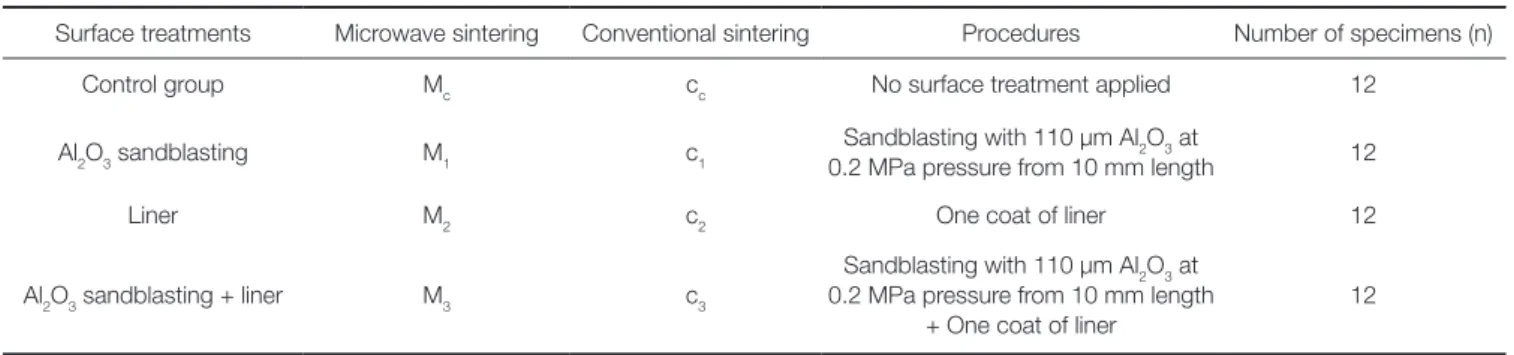
Prior to veneer application on the zirconia cores, the disc specimens used for surface analysis were subjected to ultrasonic bath and dried. Thereafter, microwave and con- ventionally sintered zirconia core specimen groups were randomly assigned to 4 subgroups (n=12), according to the surface treatments applied. A single operator applied all surface treatments. The bonding surface of the discs received treatments as follows (Table 1):
Group MC and CC-untreated (control): No treatment was applied on the microwave (M) and conventionally (C) sintered zirconia core surfaces.
Group M1 and C1-sandblasted: Bonding surfaces of the microwave and conventionally sintered zirconia cores were sandblasted (Heraeus, Combilabor, CL-FSG 3, Germany) with 50 µm Al2O3 at 0.2 MPa pressure for 10 seconds.
Specimens were mounted in a special holder at a distance of 10 mm between the surface of the specimen and the blasting tip. After sandblasting, the specimens were rinsed under running water then dried with oil-free compressed air to remove the remnants.
Group M2 and C2-liner applied: One coat of liner (CZR, Noritake, Japan) was applied with a brush on the bonding surfaces of the microwave and conventionally sintered zir- conia cores to create an even layer, then following the man- ufacturer’s instructions the specimens were fired (Ivoclar P300, Vivadent, Germany) with 65℃/min temperature rise to a maximum of 1090℃.
Group M3 and C3-sandblasted and liner applied: The specimens were sandblasted as in Group M1 and C1, and liner application was accomplished as in Group M2 and C2.
Specially designed polymethylmethacrylate (PMMA) (Imıcryl, Konya, Turkey) splitmoldwasusedin order to fabri- cate the veneering ceramic. By the help of this index, Cerabien CZR powder/liquid mixture was applied on all cores, the mixture was condensed and the excess liquid was removed by paper towels (Selpak, Eczacıbası Grup, Turkey) (Fig. 1). Thereafter, the core-veneer specimens were fired according to the manufacturer’s instructions with 45℃/min temperature rise to a maximum of 930℃. To compensate the ceramic shrinkage, two separate firing cycles were required. The specimens were stabilized on a surveyor, to
Table 1. Surface treatments applied on the microwave and conventionally sintered zirconia cores
Surface treatments Microwave sintering Conventional sintering Procedures Number of specimens (n)
Control group Mc cc No surface treatment applied 12
Al2O3 sandblasting M1 c1 Sandblasting with 110 µm Al2O3 at
0.2 MPa pressure from 10 mm length 12
Liner M2 c2 One coat of liner 12
Al2O3 sandblasting + liner M3 c3
Sandblasting with 110 µm Al2O3 at 0.2 MPa pressure from 10 mm length
+ One coat of liner
12
establish the correct diameter of the veneering ceramic, after they were mounted on to a Type IV gypsum base (GcFujiRock, Japan) with a cyanoacrylate resin (Pattex, Germany). The veneering ceramic diameter for each com- pleted specimen was checked to be 3 mm by a caliper (Dial caliper, UK).
All core/veneer specimens were thermocycled (NüveSanayi Malzemeleri, Ankara, Turkey) for 6000 cycles between 5 and 55℃ with a dwell time of 30 seconds in each bath.
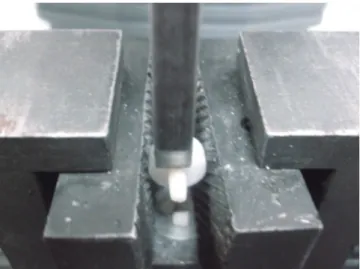
Shear bond strength (SBS) was tested using a universal testing machine (Lloyd-LRX; Lloyd Instruments, Fareham, UK) at a crosshead speed of 0.5 mm/min. Shear load at failure was recorded (Fig. 2). The bond strength (σ) values (expressed in MPa) were calculated using the formula:
σ = L ⁄ A;
where L is the load at failure (in N) and A is the core/
veneer ceramic interface area (in mm2). Shear load at failure was recorded.
Following the SBS test, fractured surfaces were visually observed with an optical microscope (Zeis, V20 Discovery, Oberkochen, Germany) at ×50 magnification to assess the mode of failure. Fracture patterns were classified and assigned as; adhesive fracture between the core and the veneer, cohesive fracture within the veneer, and a combina- tion of cohesive and adhesive fracture.10
In order to perform further qualitative micromorpho- logic examination of core surfaces, one additional specimen from microwave and conventionally sintered zirconia speci- men was sputter-coated with 5 µm gold-palladium and ana- lyzed using a scanning electron microscope (SEM) (JSM- 5310; JEOL, Peabody, MA, USA) at 15 kV under ×20,000 magnification. SEM analysis was also obtained from one representative specimen from each group of specimens after SBS tests were completed. Photomicrographs of rep- resentative areas for the surface treatments applied on spec- imen surfaces were obtained at ×73-×75 magnification.
Data were analyzed using SPSS for Windows 11.5 pro- gramme. The distribution of the SBS data was evaluated by Shapiro Wilk test and the homogeneity of the variance were analyzed by Levene test. Two-way analysis of variance (ANOVA) was used to determine the effect of surface treatments on sintering methods. Multiple comparisons of groups were analyzed by two-way ANOVA test. Within the sintering groups, mean shear bond strength differences among different surface treatments were analyzed by one- way ANOVA followed by post-hoc Tukey HSD test. Within each surface treatment group, difference in shear bond strength values according to sintering methods were ana- lyzed using Student’s t test. Correlation between shear bond strength and surface roughness was determined using the Spearman’s correlation test. A P value of <.05 was consid- ered significant.
RESULTS
The values of each specimen obtained after surface rough- ness and SBS evaluations were compared to that specimen’s untreated (control) value.
The results of the surface roughness evaluation tests showed that conventionally sintered specimens (1.06 ± 0.32 µm) revealed rougher surfaces compared to the microwave sintered ones (0.76 ± 0.32 µm) (P=.046).
The descriptive statistics and the statistical comparisons of the groups of the SBS test data was shown in Table 2 and the graphical representation of the overall SBS data are shown in Fig. 3. The mean shear bond strength range was between 13.6 ± 3.6 and 17.6 ± 5.35 MPa for the microwave sintered and 15.8 ± 2.99 and 20.5 ± 4.07 MPa for the con- ventionally sintered groups. Group Mc showed the lowest bond strength, while Group C3 showed the highest one.
Since the correlation between sintering methods and surface treatments on shear bond strength was statistically
Fig. 1. Veneer ceramic fabrication using a specially
designed split mold. Fig. 2. Shear bond strength testing using a semicircular
blade attached to the universal testing machine.
significant (F=4.52 ve P=.006), multiple comparisons were carried on (Table 3). For the microwave sintering groups, there was no statistical significance among the shear bond strength values of different surface treatments applied (P=.113). Within the conventional sintering groups, shear bond strength of Group C3 was significantly higher than of the Group C1 (P=.015). Shear bond strength of the Group
Cc was significantly higher than of the Group Mc (P=.004) and the values for the Group C3 was significantly higher than the Group M3 (P=.005) (Table 2).
There was no statistically significant correlation between the SBS values and surface roughness of microwave and conventionally sintered zirconia specimens (r=-0.109 and P=.658).
The visual analysis of fracture patterns under ×50 mag- nification under optical microscope revealed that none of the specimens revealed adhesive fracture. There were a total of 8 cohesive and 40 combined fractures seen in the micro- wave sintered specimen groups, while, 7 cohesive and 41 combined fractures were seen in the conventionally sintered specimens (Table 4).
Table 2. Shear bond strength values (MPa)
Surface treatments
Sintering methods Control M (SD)
Al2O3 sandblasting M (SD)
Liner M (SD)
Al2O3 sandblasting + liner M (SD)
Pa
Microwave 13.6 (3.61) 17.6 (5.35) 16.6 (3.23) 15.4 (3.44) 0.113
Conventional 18.7 (3.99) 15.8 (2.99)c 17.4 (2.98) 20.5 (4.07)c 0.022
Pb 0.004 0.334 0.535 0.005
a: Within group comparisons according to sintering methods, One-Way ANOVA; b: Comparisons among surface treatments of different sintering methods, Student’s t test; c: Comparison between Al2O3 sandblasting and Al2O3 sandblasting + liner applied conventionally sintered groups, Post-Hoc Tukey HSD test; M (SD): Mean values
± Standard deviation.
Fig. 3. Comparison of shear bond strength values (MPa) of specimens.
Table 4. Distribution of fracture patterns according to test groups
Groups (n=12)
Adhesive fracture
Cohesive fracture
Combined fracture
Cc - 2 10
C1 - 3 9
C2 - 1 11
C3 - 1 11
Mc - 3 9
M1 - 3 9
M2 - 1 11
M3 - 1 11
Table 3. Two-way ANOVA results for comparison of bond strength with different sintering methods and surface treatments
Variation data Sum of squares df Mean square F P
Sintering 117.599 1 117.599 8.404 0.005
Surface treatment 37.751 3 12.584 0.899 0.445
Sintering x Surface treatment 189.734 3 63.245 4.520 0.006
Error 1147.376 82 13.992
Total 1492.460 89
df = degree of freedom
A specimen from both microwave and conventionally sintered zirconia cores were evaluated without any surface treatment under SEM, which revealed that microwave sin- tered zirconia surface had more uniform and dense grain structure (Fig. 4). One representative specimen for cohesive and combined fracture patterns of both sintered groups was also further analyzed under SEM (Fig. 5 and Fig. 6).
Fig. 4. Microstructure of (A) conventionally and (B) microwave sintered zirconia cores (×20,000).
Fig. 5. Scanning electron microscopy of fracture surfaces of conventionally sintered zirconia and veneer ceramic specimens (A) Combined fracture pattern, (B) Cohesive fracture pattern.
Fig. 6. Scanning electron microscopy of fracture surfaces of microwave sintered zirconia and veneer ceramic specimens (A) Combined fracture pattern, (B) Cohesive fracture pattern.
DISCUSSION
The aim of the study was to evaluate the effect of different sintering methods and surface treatments of zirconia core on shear bond strength of core/veneer structures. The rela- tionship between surface roughness of the core and bond strength was also determined. Based on the results of the present in vitro study, the null hypothesis was partially accepted, such that; 1) conventionally sintered zirconia
cores revealed rougher surfaces compared to microwave sintered ones, however, surface roughness was found to be non-effective on the shear bond strength of core/veneer structures, 2) the correlation between sintering methods and surface treatments on shear bond strength was significant.
Several test methods, namely, shear bond, 3- and 4-point flexure, tensile and microtensile bond tests have been suggested for evaluation of the bond strength of veneering ceramic to core structures. Shear bond test has been reported in the literature as the most prevalent bond strength test.9-11,24,25,31 Clearly, differing methods of load application lead to differing stress distributions. Thus, one must expect uneven stress distributions and acknowledge that the bond strengths reported are nominal values and need cautious interpretation. The use of bond strength data based on static load-to-failure tests should be restricted to comparisons of relative effects of material properties, material microstructure and treatment conditions that may enhance the resistance to fracture.32 Shear bond strength test is relatively simple and easy to perform. Accurate mea- surement of bond strength at the zirconia core/veneer interface is complex, and there may not currently be an ide- al test design. However, shear bond tests are common methods that can be applied to bilayered zirconia-based ceramic systems. 9,11 Hence, shear bond test was used in the present study to evaluate the bond strength of veneer ceramic to microwave and conventionally sintered zirconia cores with modified surfaces.
The presence of voids and porosities has been shown to not only increase surface roughness but to decrease strength of ceramics.33 The results of the present study show that the surface roughness of the microwave sintered zirconia was lower than of conventionally sintered cores.
This may be attributed to the fact that microwave sintering of the core resulted in a reduced number of porosities, similarly shown on microwave glazed surface in a previous study.18 However, surface roughness was found to be non- effective on shear bond strengths of either microwave or conventionally sintered core/veneer structures. According to Fischer et al.,25 strong bonding of the veneering ceramics to polished zirconia surfaces suggest that chemical bonds were established between both materials during firing.
Consequently, their results showed that increased surface roughness did not enhance shear bond strength.
An adequate bond for metal ceramic restorations occurs when the fracture stress is greater than 25 MPa.34 However, adequate bond strength for all-ceramic materials has not been determined up to date. The shear bond strength mea- sured in the present study ranged from 13.6 ± 3.6 to 17.6 ± 5.35 MPa for the microwave sintered and 15.8 ± 2.99 to 20.5 ± 4.07 MPa for the conventionally sintered groups.
The shear bond strength of conventionally sintered zirco- nia groups were on the lower end of the range but compa- rable to the previously published values,9,10,24,25 except for the results reported by Guess et al.11 They have found mean shear bond strengths of veneering ceramic to zirconia frameworks of 9.4 to 12.5 MPa. The difference in the find-
ings may be attributed to differing test methods, particularly in the size and form of specimens. However, bond strength values for microwave sintered zirconia were lower than the previously reported results for conventionally sintered zir- conia. No known studies to date have been published that investigate the shear bond strength of microwave sintered zirconia, so a direct comparison with other zirconia core systems is almost impossible. The low bond strength may be due to the use of a soft machined zirconia core used in the present study whereas fully sintered hot isostatically pressed zirconia blocks was reported to lead to higher bonding performance.16 According to most studies on bond strength, the actual bond strength would be lower than expected since the bond strength would decrease further with thermocycling or artificial aging,35 as might have also been the case for low bond strength observed in the pres- ent study, since all specimens were thermocycled.
The results about the effects of using liners or applying airborne particle abrasion on zirconia cores on bond strength have been controversial in literature. Mostly the effects of liners have been shown to decrease the bond strength,23,24,26,31 very few studies have stated that it has either no effect25 or has caused an increase.27 Also, study results bared an increase,31 decrease23,26 or no effect11 in bond strength when sandblasting was applied on the zirco- nia core surfaces. In contrast to the findings of the present study, Fischer et al.25 have shown that applying airborne par- ticle abrasion and liners together have caused a significant decrease in the shear bond strength. Applying veneer ceramic over a smooth as fired liner material may result in poor contact between core/veneer and thus the interface becomes a site for crack initiation.26 Aboushelib et al.26 have stated that, since sandblasting the core surface causes an increase in surface roughness, sandblasting the liner materi- al before veneering improves the core/veneer interface.
The results of the present study indicate that sandblasting followed by liner application over conventionally sintered zirconia core yielded to the highest bond strength among all groups. Liner application over a rough surface may have caused this enhancement. Sandblasting either microwave or conventionally sintered core surfaces alone did not increase the bond strength in the present study, which are also in accordance with previous studies by Harding et al.,23 Aboushelib et al.26 and Guess et al.11 This result may be attributed to different adhesion mechanisms of zirconia ceramics to the veneer since this mechanism is still unclear.
Based on investigations on the wettability of zirconia core with veneering ceramics, micromechanical interactions were merely assumed.11 Also, the overall lower bond strengths of microwave sintered zirconia groups in the present study may be due to the better chemical compatibility of conven- tional sintered zirconia groups implying a bond strong enough to resist both transient and residual thermal stresses during veneer firing.
The fracture patterns for both microwave and conven- tionally sintered zirconia specimens showed predominantly combined, and to a lesser extent cohesive failures, which
were consistent with the results of previous reports.9-11 These findings suggest that the veneering ceramic would remain on the zirconia core surface, indicating cohesive fail- ures. Adhesive failure was not seen due to the fact that the two materials fuse together and certain elements diffuse across the interface.9 Therefore, the shear bond strengths obtained in the present study may be due to the shear strength of the veneering ceramic, which would be the weak link. The clinical implication would be that the investigated all-ceramic systems could have a tendency to produce chip- off failures of the veneering ceramic and delamination rath- er than catastrophic failure of the core structure.11
According to the results of this study, sandblasting fol- lowed by liner application on conventionally sintered zirco- nia cores may enhance bond strength. A limitation of the study was that the design and dimensions of the specimens might not fully reflect the clinical shape of dental restora- tions, but provide a geometry that permits shear bond strength measurements. Also, the wetting or other surface properties of core surfaces were not accounted. The authors believe that the result of the present study will enlighten future studies on microwave sintered zirconia.
However, the results of in vitro studies apply to specific types of zirconia/veneer combinations, specimen sizes/
preparations and test setups used. Therefore, there is more clinical and in vitro research needed to confirm the validity of these results.
CONCLUSION
Within the limitations of this in vitro study, surface rough- ness of different types of core surfaces does not seem to have an effect on shear bond strength of core/veneer structures. Irrespective of the sintering method and core materials, the predominant failure mode was combined fracture. Based on the study results, compared with micro- wave sintered zirconia, sandblasting followed by liner appli- cation on conventionally sintered zirconia cores may enhance bond strength.
REFERENCES
1. Denry I, Holloway JA. Ceramics for dental applications: A review. Materials 2010;3:351-68.
2. Beuer F, Schweiger J, Eichberger M, Kappert HF, Gernet W, Edelhoff D. igh-strength CAD/CAM-fabricated veneering material sintered to zirconia copings-a new fabrication mode for all-ceramic restorations. Dent Mater 2009;25:121-8.
3. Huang SG, Li L, van der Biest O, Vleugels J. Microwave sin- tering of CeO2 and Y2O3 co-stabilised ZrO2 from stabiliser- coated nanopowders. J Eur Ceram Soc 2007;27:689-93.
4. Roy R, Agrawal D, Cheng J, Gedevanishvili S. Full sintering of powdered-metal bodies in a microwave field. Nature 1999;
399:668-70.
5. Katz JD. Microwave sintering of ceramics. Annu Rev Mater Sci 1992;22:153-70.
6. Ruiz L, Readey MJ. Effect of heat-treatment on grain size,
phase assemblage and mechanical properties of 3 mol%
Y-TZP. J Am Ceram Soc 1996;79:2331-40.
7. Upadhyaya DD, Ghosh A, Dey GK, Prasad R, Suri AK.
Microwave sintering of zirconia ceramics. J Mater Sci 2001;
36;4707-10.
8. Deng Y, Miranda P, Pajares A, Guiberteau F, Lawn BR.
Fracture of ceramic/ceramic/polymer trilayers for biome- chanical applications. J Biomed Mater Res A 2003;67:828-33.
9. Al-Dohan HM, Yaman P, Dennison JB, Razzoog ME, Lang BR. Shear strength of core-veneer interface in bi-layered ce- ramics. J Prosthet Dent 2004;91:349-55.
10. Saito A, Komine F, Blatz MB, Matsumura H. A comparison of bond strength of layered veneering porcelains to zirconia and metal. J Prosthet Dent 2010;104:247-57.
11. Guess PC, Kulis A, Witkowski S, Wolkewitz M, Zhang Y, Strub JR. Shear bond strengths between different zirconia cores and veneering ceramics and their susceptibility to ther- mocycling. Dent Mater 2008;24:1556-67.
12. Guazzato M, Proos K, Sara G, Swain MV. Strength, reliabili- ty, and mode of fracture of bilayered porcelain/core ceram- ics. Int J Prosthodont 2004;17:142-9.
13. Raigrodski AJ, Chiche GJ, Potiket N, Hochstedler JL, Mohamed SE, Billiot S, Mercante DE. The efficacy of poste- rior three-unit zirconium-oxide-based ceramic fixed partial dental prostheses: a prospective clinical pilot study. J Prosthet Dent 2006;96:237-44.
14. Isgrò G, Pallav P, van der Zel JM, Feilzer AJ. The influence of the veneering porcelain and different surface treatments on the biaxial flexural strength of a heat-pressed ceramic. J Prosthet Dent 2003;90:465-73.
15. al-Shehri SA, Mohammed H, Wilson CA. Influence of lami- nation on the flexural strength of a dental castable glass ce- ramic. J Prosthet Dent 1996;76:23-8.
16. Özyurt Z, Kazazoğlu Z, Ünal A. In vitro evaluation of shear bond strength of veneering ceramics to zirconia. Dent Mater J 2010;29:138-46.
17. Sailer I, Fehér A, Filser F, Lüthy H, Gauckler LJ, Schärer P, Franz Hämmerle CH. Prospective clinical study of zirconia posterior fixed partial dentures: 3-year follow-up. Quinte- ssence Int 2006;37:685-93.
18. Prasad S, Monaco EA Jr, Kim H, Davis EL, Brewer JD.
Comparison of porcelain surface and flexural strength ob- tained by microwave and conventional oven glazing. J Prosthet Dent 2009;101:20-8.
19. Denry I, Kelly JR. State of the art of zirconia for dental ap- plications. Dent Mater 2008;24:299-307.
20. Creugers NH, Käyser AF, van ‹t Hof MA. A meta-analysis of durability data on conventional fixed bridges. Community Dent Oral Epidemiol 1994;22:448-52.
21. Coornaert J, Adriaens P, De Boever J. Long-term clinical study of porcelain-fused-to-gold restorations. J Prosthet Dent 1984;51:338-42.
22. Valderhaug J. A 15-year clinical evaluation of fixed prosth- odontics. Acta Odontol Scand 1991;49:35-40.
23. Harding AB, Norling BK, Teixeira EC. The effect of surface treatment of the interfacial surface on fatigue-related micro- tensile bond strength of milled zirconia to veneering porce-
lain. J Prosthodont 2012;21:346-52.
24. Mosharraf R, Rismanchian M, Savabi O, Ashtiani AH.
Influence of surface modification techniques on shear bond strength between different zirconia cores and veneering ce- ramics. J Adv Prosthodont 2011;3:221-8.
25. Fischer J, Grohmann P, Stawarczyk B. Effect of zirconia sur- face treatments on the shear strength of zirconia/veneering ceramic composites. Dent Mater J 2008;27:448-54.
26. Aboushelib MN, Kleverlaan CJ, Feilzer AJ. Microtensile bond strength of different components of core veneered all-ce- ramic restorations. Part II: Zirconia veneering ceramics. Dent Mater 2006;22:857-63.
27. Aboushelib MN, de Jager N, Kleverlaan CJ, Feilzer AJ.
Microtensile bond strength of different components of core veneered all-ceramic restorations. Dent Mater 2005;21:984- 91.
28. Guazzato M, Albakry M, Quach L, Swain MV. Influence of surface and heat treatments on the flexural strength of a glass-infiltrated alumina/zirconia-reinforced dental ceramic.
Dent Mater 2005;21:454-63.
29. Çelebi N, Yüzügüllü B, Canay Ş, Yücel Ü. Effect of polymer- ization methods on the residual monomer level of acrylic resin denture base polymers. Polym Adv Technol 2008;19:
201-6.
30. Vasconcelos LR, Consani RL, Mesquita MF, Sinhoreti MA.
Effect of chemical and microwave disinfection on the sur- face microhardness of acrylic resin denture teeth. J Prostho- dont 2013;22:298-303.
31. Kim HJ, Lim HP, Park YJ, Vang MS. Effect of zirconia sur- face treatments on the shear bond strength of veneering ce- ramic. J Prosthet Dent 2011;105:315-22.
32. DeHoff PH, Anusavice KJ, Wang Z. Three-dimensional fi- nite element analysis of the shear bond test. Dent Mater 1995;11:126-31.
33. Cheung KC, Darvell BW. Sintering of dental porcelain: effect of time and temperature on appearance and porosity. Dent Mater 2002;18:163-73.
34. Craig RG, Powers JM, Wataha JC. Dental materials: proper- ties and manuplation. 8th ed. St Louis: Mosby; 2004, p.578-80.
35. Sobrinho LC, Cattell MJ, Glover RH, Knowles JC. Investi- gation of the dry and wet fatigue properties of three all-ce- ramic crown systems. Int J Prosthodont 1998;11:255-62.