| Abstract |
8)PURPOSE: This study was conducted as a literature review to analyze the research trends related to the International Classification of Functioning, Disability and Health (ICF) in Korea from 2015 to 2020.
METHODS: Precedent studies were searched with the search term “ICF” or “international classification of functioning, disability and health” from the databases of RISS, KISS, DBpia, and Pubmed. The inclusion criteria are that the studies have been carried out in Korea from 2015 to 2020 using ICF by researchers consisting of one or more Koreans and have been peer-reviewed.
RESULTS: Of the total 269 studies, 107 that met the inclusion criteria were analyzed. It was found that these studies were published at a similar frequency each year. The most common area of expertise was identified as the clinical area (n = 67), followed by special education (n = 21) and social welfare (n = 13). The study subject groups were mostly patients (n = 39), disabled people (n = 25), and related experts (n = 13). The most common research topic was functioning
†Corresponding Author : Ju-Min Song
[email protected], https://orcid.org/0000-0001-8469-3550 This is an Open Access article distributed under the terms of the Creative Commons Attribution Non-Commercial License (http://creativecommons.org/licenses/by-nc/3.0) which permits unrestricted non-commercial use, distribution, and reproduction in any medium, provided the original work is properly cited.
evaluation (n = 49) and followed by a literature review (n = 29), and the most frequently used components in all the areas of expertise were activity and participation (n = 98), body function and structure (n = 73), and environmental factors (n
= 61).
CONCLUSION: For the past six years, domestic ICF- related research has been conducted in a wider range of expertise areas on more subdivised subject groups.
Continuous research, development of standardized curricula and contents, and development of coding tools are considered to be important in vitalizing the use of the ICF.
Key Words: ICF, Functioning, Disability, Research trend.
Ⅰ. Introduction
The International Classification of Functioning, Disability and Health (ICF) was established in 2001 by the World Health Organization to classify health and health-related conditions in terms of functioning and to use the framework in a unified and standardized language.
The components of the ICF, one of the health-related international standard classification systems, consist of body function and structure, activity and participation, and environmental factors. The ICF framework explains that these components interact with each other, to affect the degrees of functioning and disability of individuals [1].
Research Article Open Access
A Review of Domestic Research Trends Related to the International Classification of Functioning, Disability and Health (ICF): 2015-2020
Ju-Min Song, PT, PhD
†Department of Physical Therapy, Silla University
Received: July 15, 2021 / Revised: July 15, 2021 / Accepted: August 1, 2021
ⓒ 2021 J Korean Soc Phys Med
The ICF consists of about 1500 categories, and the degrees of functioning and disability can be rated by putting a dot after the relevant item and applying a qualifier from 0 to 4 that connote the levels of a difficulty, barrier or facilitator. This system, therefore, allows various groups of people using different languages or unfamiliar with technical terms to efficiently compare the related information.
These characteristics make the ICF framework a common language that enables communication on functioning-related information among users in various fields such as health experts, researchers, policy makers, and educators [2].
As a biopsychosocial model that can be approached from a multi-faceted perspective, the ICF can be applied as a statistical, research, clinical, social policy, and educational tool [1]. The evaluation of functioning in the concerned area and relevant planning and application through this approach can be expected and reported to improve the functioning and mitigate the impact of disability [3].
Research related to the ICF has been reported in various countries with topics such as introduction to the concept of the ICF, evaluation of functioning levels, analysis and development of evaluation tools, and review of related papers [4,5]. In recent years, the ICF-related research has mainly focused on how to utilize the framework for the better understanding and correct use of it, the validity of the ICF core set designed to classify the functioning level of a specific subject from the perspective of the area of expertise, and the development of new functional evaluation tools [6-9]. In particular, research related to the ICF utilization measures is important for the correct understanding and accurate application of the system and is considered essential to select and apply appropriate items for profiling the subject's functioning among 1500 items.
It is thought that the ICF utilization measures should be set up in the way that maintains its nature as a standard classification framework while reflecting the characteristics of the country or field, and such measures can be found in the process of analyzing the trends in preceding studies,
identifying the problems in them, and suggesting research directions.
There have been studies to analyze the trends in ICF-related research in Korea as well, reporting that ICF-related research on patients and the disabled is gradually increasing mainly in the clinical, social welfare, and special education areas [4,10]. These studies were, however, conducted on domestic ICF-related research published before 2015, and the other studies that analyzed the ICF research trends only analyzed the trends in research on some specific areas or the core set [11,12], which indicates a lack of studies analyzing the overall trends in recent domestic ICF-related research. Therefore, this study intended to analyze domestic ICF research trends from 2015 to 2020 in order to present the current status of the research and suggest measures to promote the use of the ICF framework.
Ⅱ. Methods
1. Search Methods and Selection Criteria for Subjects
To investigate domestic ICF-related research trends, a paper search was conducted for four weeks from March 2021. As the domestic database, RISS of the Korea Education and Research Information Service, KISS of Korean Studies Information, and DBpia of Nurimedia were used. The search terms included “ICF”, “international classification of functioning, disability and health”, and “국 제기능장애건강분류”, with the operator “or” put between each search term. PubMed was used to search for papers published in foreign journals with the search terms “ICF”
and “international classification of functioning, disability and health.” The operator “or” was applied between each term and the word “Korean” was added at the end with the conjunction “and”.
The criteria for the selection of papers for this study
were as follows. First, the papers have a title or an abstract
that include these search terms. Second, the studies were conducted with the ICF in Korea by researchers consisting of one or more Koreans. Third, in the case of papers published in Korea, they appeared in journals registered in the National Research Foundation of Korea and candidate journals that require peer-review. Fourth, the papers were published during the period from 2015 to December 2020, after the previous studies on the domestic ICF research trends had been reported.
The papers that fell under the exclusion criteria included:
papers in which “ICF” does not mean “international classification of functioning, disability and health”; papers published in journals other than those registered in the National Research Foundation of Korea and candidate journals; studies that do not use the ICF framework or items; and publications in foreign settings, though they were published in either of the aforementioned domestic journals.
A total of 269 papers published during the period were retrieved from the database: 150 from RISS, 66 from KISS, 49 from DBpia, and 4 from Pubmed. After deleting 107 redundancies from the searched papers, to assess the remaining papers by the inclusion and exclusion criteria, the abstracts and main texts of each paper were read. As a result, a total of 107 papers were selected as study subjects, by excluding 52 papers where “ICF” did not mean
“international classification of functioning, disability and health,” one paper that did not apply ICF components or items, and two papers related to Taiwan.
2. Analysis Criteria for Subjects
For the analysis of the papers selected as subjects, the analytic framework presented in the previous studies was reconstructed [4,10]. A coding process was carried out for the title of the paper, year of publication, name of the researcher, area of expertise, type of research subjects, degree of the use of ICF, components of the ICF used, research topic, name of the published journal, and major
issues.
Based on the coded data, the selected papers were classified according to the year of the research activity on the ICF, and the researchers' areas of expertise were divided into clinical, special education, social welfare, vocational rehabilitation, and physical education areas depending on the main researcher's area of expertise. The clinical area included physical therapy, occupational therapy, rehabilitation medicine, speech therapy, and nursing. Research topics were classified into evaluation using ICF, consideration of ICF, tool development and analysis, case reporting, and others. The studies that had performed an assessment of the subjects for the analysis of the measurement tool were classified into both the categories of evaluation and tool analysis and development.
The types of study subjects were divided into patients, the disabled, experts in the relevant areas, the elderly, parents, the general public, and others according to the types of subjects who had participated in the studies. Of the subjects with disabilities, those who had been engaged in treatment in the clinical setting were classified as
“patients”. The subjects categorized into more than one type were included as duplicates. In the case that study subjects were other research papers or measurement tools, they were excluded from the analysis. The components of the ICF used in the research papers were divided into physical function and structure, activity and participation, and environmental factors.
3. Data Analysis
Data analysis was performed by organizing the coded
data based on the analytic framework and summing the
numbers of papers classified into each category. Some
research subjects and used ICF components were classified
into multiple categories, so duplicate frequencies were
allowed in the data. The organized data were analyzed
with the IBM SPSS. 23 using multiple response cross
tabulation analysis for frequency and case percentages
calculation based on the analytic framework.
Ⅲ. Results
1. ICF Research Trends by Year of Publication and Area of Expertise
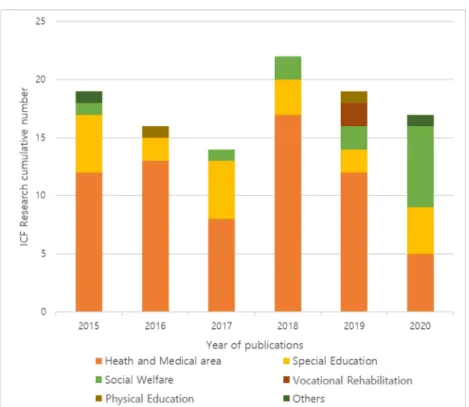
Fig. 1 shows the results of the cross tabulation analysis of the frequencies of ICF-related domestic papers published in academic journals from 2015 to 2020 using two variables, year of publication and area of expertise. The year 2018 saw the highest number of published papers (22) while the year 2017 recorded the lowest number of published papers (14); however, there was no obvious trend of increase or decrease in the number of papers according to the year. In terms of the area of expertise of papers published each year, the most commonly addressed area was clinical area, followed by special education and social welfare. In 2020, however, the most number of ICF-related
studies were published in the social welfare area. The total numbers of studies published in each area during the entire period were 67 in clinical area (62.62%), 21 in special education (19.63%), and 13 in social welfare (12.15%), in the order of frequency.
2. ICF Research Trends by Research Topic
Table 1 presents the results of classifying 107 papers
selected as the subjects of this study. The use of the ICF
as an evaluation tool to assess the degree and characteristics
of study subjects' functioning was the most common
research topic, featured in 49 papers (43.36%). The next
most frequent topic was ICF-related consideration based
on a review of preceding literature, addressed in 29 papers
(25.66%). The other common topics included the
development of a measurement tool to which the ICF
concept was applied, the analysis of the previously
developed measurement tool with ICF components or
Fig. 1. Research trends according to published year and area of expertise.
items, and case studies using the ICF, in descending order.
Meanwhile, six studies were found to have performed subject evaluation for functioning measurement tool analysis and were also counted as studies on the use of the ICF as an evaluation tool.
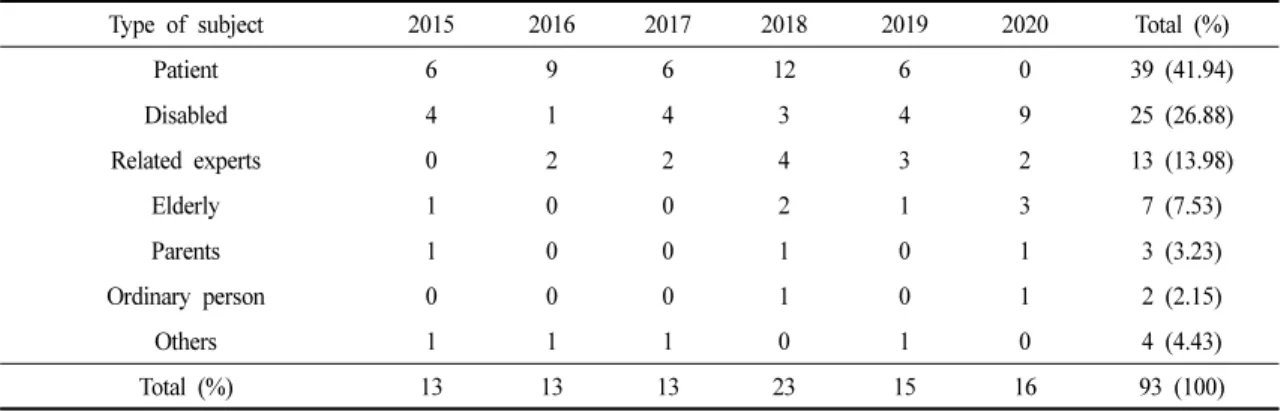
3. ICF Research Trends by Research Subject Type Table 2 shows the results of analyzing the papers selected for this study according to the types of research subjects. Papers with more than one type of study subjects were analyzed for each type, including duplicates.
According to the yearly analysis, the most frequent type of study subjects was patients, followed by the disabled and relevant experts. In 2020, however, the most common type of study subjects was the disabled, followed by relevant experts. In all years, the two most common types of patients were those with stroke (25 cases, 64.10%) and
cerebral palsy (3 cases, 7.69%), with one case of back pain, dementia, psychiatric disease, and Parkinson's disease, respectively. Among the disabled, adults with disabilities (8 cases, 32%) and students with disabilities (7 cases, 28%) were the two most common groups, followed by disabled workers, the elderly with disabilities, and infants with disabilities.
4. ICF Research Trends by used ICF Component The ICF components used in the domestic ICF-related papers selected for this study were analyzed for each category, including duplicates, and the results are as presented in Fig. 2. Activity and participation components were found to be most used in clinical, special education, and social welfare areas (97 cases, 40.9%), followed by body function and structure components.
2015 2016 2017 2018 2019 2020 Total (%)
Evaluation 11 7 5 13 6 7 49 (43.36)
Review 6 4 3 2 7 7 29 (27.10)
Tool development and analysis 0 2 2 5 7 2 18 (15.93)
Case report 1 3 2 3 0 1 10 (8.85)
Others 1 2 2 1 1 0 7 (6.19)
Total 19 18 14 24 21 17 113 (100%)
Table 1. ICF Research Trends by Research Topic (Duplicate Frequency)
Type of subject 2015 2016 2017 2018 2019 2020 Total (%)
Patient 6 9 6 12 6 0 39 (41.94)
Disabled 4 1 4 3 4 9 25 (26.88)
Related experts 0 2 2 4 3 2 13 (13.98)
Elderly 1 0 0 2 1 3 7 (7.53)
Parents 1 0 0 1 0 1 3 (3.23)
Ordinary person 0 0 0 1 0 1 2 (2.15)
Others 1 1 1 0 1 0 4 (4.43)
Total (%) 13 13 13 23 15 16 93 (100)
Table 2. ICF Research Trends According to Published Year and Type of Subject (Excluding Review Researches, Duplicate
Frequency)
Ⅳ. Discussion
This study was conducted on the papers that met the inclusion criteria among research papers published during the period from 2015 to 2020, after the release of preceding studies on domestic ICF-related research trends [4,10]. The research papers selected as the subjects of this study were classified and analyzed by year of publication, area of expertise, research topic, research subject type, and used components, and based on the results obtained, the following discussions can be made.
The frequencies of domestic ICF-related papers published in academic journals from 2015 to 2020, the research subject did not show a distinct increase or decrease according to the year of publication. This result was not consistent with the previous studies reporting a clear increasing trend [4,10]. However, the numbers of yearly published papers since 2012 were reported as around 20 each year in these studies, which is consistent with the observations by year of this study. The areas of expertise
that were addressed the most in domestic ICF-related research were clinical, special education, and social welfare areas, a similar finding to that of the previous studies [4,10,11]. These results are considered to indicate that research to utilize the ICF in collecting and analyzing information on the subjects' functioning in these areas has been continuously conducted.
Areas of expertise not observed in the previous studies were also identified. A study in the industrial design field provided an outline of the body function and structure area of the ICF for the purpose of developing a classification and evaluation system for daily body functions applicable to inclusive design for products that do not require a distinction between people with disabilities or physical function limitations and those who do not [13]. There was also another study that developed an ICF core set for psychiatric patients in the medical information field [14].
In the field of public health as well, a study based on
a literature review analyzed research trends on students
with disabilities and presented future research directions
Fig. 2. Distribution of ICF component in ICF Research (Duplicate frequency).
and policy measures for this group of students [15]. In the field of vocational rehabilitation, a study confirmed that the ICF is an important tool for planning and obtaining basic evaluation information in education and employment support for the youth with disabilities based on a precedent study [16] analyzing the ICF core set for vocational rehabilitation and the existing presenteeism tools and a literature review [17]. This trend suggests the continuous expansion of the areas of ICF research. While many studies in the newly identified areas are mainly about introducing the related ICF concepts, in the areas where continuous research has been conducted, more detailed and specialized research is being conducted. It is thought that active ICF-related research in various areas of expertise will facilitate communication between these different areas by using the ICF, a common language for the functioning of subjects.
In this study, the selected papers were classified according to the research topics including the evaluation of functioning, ICF-related consideration, tool analysis and development, and case reporting. The most number of the analyzed studies used the ICF to evaluate the degree and characteristics of the subjects' functioning, which is consistent with the findings of the previous studies [4,10].
This can be attributed to the fact that many studies were conducted in clinical area and that the evaluation was performed in various areas of expertise to collect information on the functioning of subjects by applying the ICF in line with the characteristics of each area.
The common topics of consideration studies were identified as specific interventions [18-20], functioning- related evaluation tools [21,22], research trends [11,15,23], and others. There was a tendency that these consideration studies were conducted in more subdivised areas than reported in the preceding studies [4,5,10]. This trend may be attributed to the process of determining the conformity of the interventions or evaluation performed in the areas to the ICF framework and the necessity of additional
application, which is deemed essential to enhance the accuracy of ICF utilization in the areas.
Some of the newly found study topics included tool analysis by linking the concepts contained in the items of functioning measurement tools that are typically used in the concerned areas of expertise with ICF items, and the assessment of possibility of coding medical records with the relevant ICF items [24-27]. It is believed that these studies will be helpful in facilitating the selection of specific items suitable for subjects among over 1500 ICF items. This sort of research, as a way to increase the understanding of the ICF and make it easier to apply, is required in a wider range of areas.
Among other newly observed research topics were the analysis of ICF items based on their concepts in the process of developing items for designing a new functioning measurement tool [28,29], and the application of the ICF framework to daily life guidelines and educational materials for the parents of children with disabilities [30-32]. These new research topics imply that the ICF, a biopsychosocial model, has been applied to the development of tools for various purposes.
Case studies using the ICF were characteristically observed in clinical area, and not a few of these studies used ICF tools. This trend is similar to the findings of the previous studies. These case studies used ICF tools to present the goals, plans, evaluation, and prognosis of particular interventions [33,34] and were frequently published in a specific journal. This is because physical therapists are encouraged and educated to apply the ICF to the treatment and evaluation of patients in clinical practice. Especially, the setting of treatment goals from a patient's point of view is thought to be useful for a patient-centered therapeutic approach.
Since the most common area of expertise was clinical area for all years, the most frequent type of study subjects was patients, followed by the disabled and related experts.
In 2020, however, as many studies in the clinical area were
conducted as consideration studies and the number of studies in the social welfare area rapidly increased, the disabled became the most observed subject type. Of all patient types, those with stroke and cerebral palsy showed the highest frequencies, similar to the results of the previous studies [4,10]. The types of disabilities included sensory disorders [15], intellectual disabilities [29], autistic disorders [35,36], cognitive disorders [37], etc. as well as physical disabilities, which is in contrast to the previous studies where most of the disabled subjects had physical disabilities [5,10].
In the area of special education, some studies were conducted by reflecting the characteristics of disabilities found in various age groups from infants to college students [15,36,38]. There were also studies carried out on parents for information collection and education related to functioning [31,39]. As for studies on the elderly, studies for evaluation using previously collected elderly survey data and for predictive model development were identified [40,41]. This trend suggests that in the application of the ICF, detailed and specialized approaches are actively taken to reflect the levels and characteristics of each age groups' functioning. If research involving more diverse types of subjects is conducted in various areas of expertise, it will further facilitate the communication on functioning between experts of these different areas using the ICF. Meanwhile, of all the analyzed studies, those on related experts were mainly aimed at collecting expert opinions for tool development [42,43].
The most frequently used type of ICF components in all the areas of expertise was activity and participation.
In this study, the numbers of components related to body function and structure were summed up for analysis, unlike the previous studies reporting that body function and structure components were used the most in clinical area and all the areas of expertise, respectively. The previous studies noted that it is appropriate to apply all three components for the evaluation of functioning and pointed
out that the application of environmental factors was at an insufficient level [10,44]. According to the results of this study, while there is relatively less information on environmental factors, the application of these factors has increased when compared with the previous studies. In particular, in the area of social welfare, environmental factors were being applied relatively more actively than in other areas. In addition, the application of environmental factors was more frequently observed in the special education area than in the clinical area. These findings are considered to reflect the tendency to integrate the concepts related to functioning and disabilities with the medical and social models and the characteristics of the ICF as a biopsychosocial model. It may also be because the importance of the impact of environmental factors on social activity and participation is widely recognized [2].
As the coordination of environment can act as a factor that can compensate for any difficulty in functioning, the collection of related information is considered essential to support the social activity and participation of subjects.
The limitations of this study are that there may be missing papers by searching using only four databases, RISS, KISS, DBpia, and Pubmed and researches that were not published in journals registered in the National Research Foundation of Korea were excluded, so all domestic research papers published during the entire period were not included in the analysis. However, it is a meaningful approach to look at the overall trend of domestic ICF-related research over the past 6 years and to find a way to promote the use of ICF.
After reviewing domestic ICF-related studies, I would like to suggest the following so that ICF, an international standard classification, can accurately and easily communicate information related to functioning among various specialized areas, institutions and countries.
In order to select an appropriate code among about 1500
codes and to profile the function performance information
of an individual or group, an understanding of ICF must
be preceded. For this, education is very important, so research on standardized curriculum, materials and methods are needed for ICF education suitable for the characteristics of each specialized area. The development of educational tools that reflect the characteristics of domestic specialized areas and include Korean cases will help to enhance the understanding of ICF.
In addition, functioning-related data that can be comparatively analyzed in the field should be accumulated.
For this, the development of ICF coding tools is required.
It is necessary to develop a coding tool that can easily and accurately present ICF codes and classify functioning data based on the input of functioning information, and to develop guidelines for using the tool.
In order to communicate between specialized fields using ICF, research related to system construction is also required in addition to education and coding programs.
If the ICF-related data that started in the clinical field can be used in connection with institutions such as schools, welfare centers, and nursing homes through the system, and if the accumulated data can be used as national statistics, appropriate support will be available for individuals or groups in need of services. In addition, it can be used as evidence data in the planning stage for providing these services.
Lastly, since the above studies require an interdisciplinary approach, collaboration among experts in various area of expertise is required, so research at the national level needs to be carried out.
Ⅴ. Conclusions
This study was conducted to identify the trends in ICF-related research conducted in Korea for the past six years and to seek ways to vitalize the use of the ICF framework. Research that applied the ICF to patients, the disabled, and related experts has been steadily carried out in clinical, special education, and social welfare areas, and
the application areas have been expanded into a wider range of fields. To revitalize the domestic use of ICF in the future, standardized education, development of coding tools, establishment of a linkage system between specialized fields, and multi-disciplinary research at the national level are suggested.
References
[1] WHO. International classification of functioning, disability and health. 2001.
[2] Jette AM. Toward a common language for function, disability, and Health. Physical Therapy. 2006;86(5):
726-34.
[3] Park JK, Seo BS, Koh HJ, et al. A study to develop the ICF-CY based diagnostic inventory for rehabilitation for students with severe and multiple disabilities. Korean Journal of Physical, Multiple & Health Disabilities.
2016;59(3):129-61.
[4] Lee HJ, Song JM. An Overview of the ICF's use in Korea. J Kor Phys Ther. 2015;27(5):356-63.
[5] Choi JH, Moon SY. Systematic review of ICF Core Set:
from 2012 to 2018 years. The Journal of Special Children Education. 2018;20(2):51-82.
[6] Stucki G, Pollock A, Engkasan JP, et al. How to use the International Classification of Functioning, Disability and Health as a reference system for comparative evaluation and standardized reporting of rehabilitation interventions. Eur J Phys Rehabil Med. 2019;55(3):3 84-94.
[7] Medica EM. Mapping the primary outcomes reported in Cochrane systematic reviews regarding stroke with the International Classification of Functioning, Disability and Health (ICF) domains: current trend and future recommendations. European journal of physical and rehabilitation medicine. 2019.
[8] Prodinger B, Cieza A, Oberhauser C, et al. Toward the
international classification of functioning, disability and
health (ICF) rehabilitation set: a minimal generic set of domains for rehabilitation as a health strategy. Archives of physical medicine and rehabilitation. 2016;97(6):
875-84.
[9] Book S, Ulbrecht G, Tomandl J, et al. Laying the foundation for an International Classification of Functioning, Disability and Health Core Set for community-dwelling elderly adults in primary care: the clinical perspective identified in a cross-sectional study. BMJ open. 2020;
10(11):e038434.
[10] Kim SW, Kim JY. Analysis of domestic research trends related to international classification of functioning, disability and health(ICF). Journal of Special Education
& Rehabilitation Science. 2015;54(3):149-72.
[11] Choi JH, Park JK, Han YS, et al. Analysis of research trends in ICF-CY literatures for its application in special education: North America, Europe, Japan, and South Korea. Journal of Educational Innovation Research.
2016;26(2):65-89.
[12] Choi JH, Park JK, Park SH, et al. Systematic review of ICF Core Set: from 2012 to 2018 years. The Journal of Special Children Education.2018;2(20):51-82.
[13] Kim TS, Cho JK. Developing guidelines of a comprehensive body function classification and assessment system from the inclusive design perspective.
JPR. 2015;33(2):117-27.
[14] Jin MJ, Kang GW, Lee YS. An exploratory study on ICF Core Set clinical apply for mental illness psychiatric hospital in Korea. Disability & Employment. 2016;26(2):
29-47.
[15] Park DB, Lee JH, Moon YM. A systematic review of college students with disabilities in South Korea: Focus on the ICF framework. Korean Journal of Physical, Multiple & Health Disabilities. 2020;63(4):165-216.
[16] Kim M, Choi MO, Chun DI. Content analysis of presentism scales using ICF. JKAS. 2019;20(8):38-46.
[17] Lee DY. Implications of international classification of functioning, disability and health for the special education
and rehabilitation counseling. Korean Journal of Physical, Multiple & Health Disabilities. 2019;62(1):147-64.
[18] Park SY. The effects of robot-assisted gait training for the patient with post stroke: A meta-analysis. Phys Ther Korea. 2015;22(2):30-40.
[19] Kim EJ. Rehabilitation interventions for social participation of chronic sStroke: A systematic review and meta-analysis. Journal of Rehabilitation Research.
2019;23(2):125-41.
[20] Lee DK, Park JH, Lee KJ. Research review in rehabilitation program for elderly with disabilities applying virtual reality. Journal of Adapted Physical Activity. 2019;
27(1):19-33.
[21] Choi YJ, Jung MY. Systematic review on the assessment tool of school participation with elementary school children. Journal of Special Education & Rehabilitation Science. 2015;54(3):311-25.
[22] Kang JW, Park JH. A systematic rReview of assessment tools of activities of daily living for stroke patients. TSNR.
2017;6(2):11-28.
[23] Kim MJ. Research trends in rehabilitaion program for disabled applying virtual reality technology in Korea.
Journal of Digital Convergence. 2015;13(2):381-91.
[24] Lee H, Song J. Functioning characteristics of patients with neck pain: ICF concept based. J Kor Phys Ther.
2019;31(4):242-7.
[25] Lee HJ, Song JM. Mapping items of functioning questionnaires into the international classification of functioning, disability and health: Low back pain. J Kor Phys Ther. 2016;28(5):321-7.
[26] Song JM, Lee HJ. Mapping items of functioning questionnaires into the international classification of functioning, disability and health: Stroke. J Kor Phys Ther. 2016;28(5):341-7.
[27] Lee HJ, Song JM. Linking of items in two function-related
questionnaires to the international classification of
functioning, disability and health: Shoulder Pain. J Kor
Phys Ther. 2018;30(6):239-45.
[28] Park JK, Park SH, Choi JH, et al. A study of validation of ICF-CY based diagnostic inventory for rehabilitation for students with severe and multiple disabilities. Journal of Special Education & Rehabilitation Science. 2018;
20(1):27-51.
[29] Yoon JY, Park CO, Park SW. A study on the construct measurement of support needs for people with intellectual disabilites. Journal of Digital Convergence. 2018;16(5):
477-85.
[30] Kim SB, Park JS, Choi SS. Prediction model of suicidal ideation among elderly Koreans living alone based on ICF model. KAQSW. 2019;63(-):129-67.
[31] Jeon HI, Son JY, Shim EJ. Content structure development for parent education in case of children with developmental disabilities - Focusing on the ICF mode. Special Education Research. 2020;19(3):147-72.
[32] Song YH, Jung CW, Lee HM. Development of an application for Activities of daily living guidelines for stroke patients and caregivers. journal of KOEN.
2017;11(5):245-52.
[33] Kang TW, Kim TY. A Case report of PNF strategy applied ICF tool on upper extremity function for patient adhesive capsulitis. J Korean Soc Phys Med. 2017;12(4):19-28.
[34] Kim JC, Lee JA. A PNF intervention strategy with ICF tool applied for improvement of dressing in a patient with rotator cuff syndrome : A case report. J Korean Soc Phys Med. 2018;13(3):49-60.
[35] Kim HY. A comparaive study of special education eligibility for childer with autism in four countries. The Korean Journal of Applied Developmental Psychology.
2017;6(1):1-19.
[36] Kim JE, Choi YH. The effects of joint attention based AAC modeling intervention on social-communication with minimally verbal young children with ASD. The
Journal of Special Children Education. 2020;20(2):
217-52.
[37] Kim EJ, Park YJ. The effects of community-based rehabilitation (CBR) on the elderly with mild cognitive impairment (MCI): A systematic review and meta-analysis.
Jour of KoCon a. 2019;19(7):628-37.
[38] Kim JE, Choi YH. Concepts of engagement in inclusive settings and literature review on intervention of engagement of preschoolers with disabilities. The Journal of Special Children Education. 2017;17(1):67-94.
[39] Hyun Sook K, Sung Min S. Research on the quality of life of the parents by functions, activities, participation, and environmental factors of children with cerebral palsy using ICF-CY Checklist. J Kor Phys Ther. 2018;
30(1):35-40.
[40] Cho SE. Using the ICF framework to examine the association between Health and multidimensional disability at older age: Moderating effects of supporting environments. Journal of Wellness (KSW). 2020;15(1):
399-408.
[41] Park YK, Suh SR. A predictive model of instrumental activities of daily living in community-dwelling elderly based on ICF model. Jour of KoCon a. 2018;18(2):129-67.
[42] Choi JH, Park JK, Park SH, et al. A Study to Develop the ICF Core Set for Developmental Disabilities. Journal of Educational Innovation Research. 2018;28(4):265-94.
[43] Lee YJ, Lim HG. Development of the ICF core set for multidimensional evaluation of persons with severe intellectual disabilities: Focusing on item extraction through interviews with field experts. Journal of Educational Innovation Research. 2019;29(1).
[44] Song JM, Lee HJ. Which information of ICF was collected to understand our clients? J Kor Phys Ther. 2016;
28(2):77-8.
Title Auther Journal Year
1 Application of International Classification of Functioning, Disability and Health
(ICF) Core Sets in Outcome Measurements for Hearing Loss Oh SH ASR 2015
2 The Effect of the Stroke Patient's Sexual Life and Satisfaction on their
Entertainment Life - Applying ICF - Son BY, Bang YS, Hwang MJ Journal of KOEN 2015
3
The Correlation Analysis for Wellness Factors Related to Vocational Rehabilitation of Workers with Disabilities - Application of Comprehensive ICF Core Sets for Vocational Rehabilitation -
Hwang MJ, Bang YS Journal of KOEN 2015
4 The correlation of body function between resilience of students with health
impairments Lim HG, Park JK The Journal of Special
Children Education 2015
5 Which Information is Commonly Used for Patients with Stroke at Rehabilitation
Settings? Lee HJ, Song JM J Kor Phys Ther 2015
6 Exploring the Factors Affecting on the Independent Living of the Individuals
with Disabilities–Based on the ICF– Lim HG, Park Jk, Kim ER The Journal of Special
Children Education 2015
7 Relationship between the Environmental Factors and Social Participation of
Individuals with Disabilities based on the ICF Lim HG, Park JK, Kim ER JSPED 2015
8
The Analysis on Activity and Participation Performance Levels based on the ICF-CY for Preparation for Independent Living for Students with Disabilities -Focused on Parent`s perception-
Lim HG, Park JK, Kim JH Journal of Intellectual Disabilities 2015
9 Feasibility of Applying the Extended ICF Core Set for Stroke to Clinical Settings
in Rehabilitation: A Preliminary Study Han KY, Kim HJ, Bang HJ ARM 2015
10 Mediating Effect of Social Support on the Relationship between Experience of
Ageism and Difficulties in Social Activities in the Elderly Yun EG KACM 2015
11 Engagement in Play of Preschool Aged Cerebral Palsy Children and Its Relative
Factors Based on ICF-CY Kim HY Journal of KOEN 2015
12 The Effects of Robot-Assisted Gait Training for the Patient with Post Stroke:
A Meta-Analysis Park SY PTK 2015
13 The Problem-Solving Approach for Improving Walking Ability in Patient with
Total Hip Replacement: Applied ICF Tool for Case Study Song HS, Kim SY Kor Acad Ortho Man Phys
Ther 2015
14 Analysis of Domestic Research Trends Related to International Classification of
Functioning, Disability and Health (ICF) Kim SW, Kim JY
Journal of Special Education& Rehabilitation
Science
2015
15 An Overview of the ICF's Use in Korea Lee HJ, Song JM J Kor Phys Ther 2015
16 Effects of Computer Based Virtual Reality Program on Clinical Rehabilitation
in Korea: A Meta-analysis Kwon JS Journal of Digital
Convergence 2015
17 Systematic Review on the Assessment Tool of School Participation with
Elementary School Children Choi YJ, Jung MY
Journal of Special Education& Rehabilitation
Science
2015
18 Research trends in rehabilitation program for disabled applying virtual reality
technology in Korea Kim MJ Journal of Digital
Convergence 2015
19 Developing Guidelines of a Comprehensive Body Function Classification and
Assessment System from the Inclusive Design Perspective Kim TS, Cho JK JPR 2015
20 An Exploratory Study on ICF Core Set Clinical Apply for Mental Illness Psychiatric
Hospital in Korea Jin MJ, Kang GW, Lee YS Disability & Employment 2016
21 Monitoring of Functioning Status in Subjects with Chronic Stroke in South Korea Using WHODAS II
Kwon SY, Hong SE, Kim EJ,
et al. ARM 2016
22 Dilemmas of Korean Athletes with a Spinal Cord Injury to Participate in Sports:
A Survey Based on the ICF Core Set for Spinal Cord Injury Nam JS, Lee KE, Jun AY, et al. ARM 2016
23 A Comprehensive Rehabilitation Approach in a Patient with Serious
Neuropsychiatric Systemic Lupus Erythematosus Ko YJ, Lee YG, Park JW, et al. ARM 2016
Appendix. List of Subject Articles
Title Auther Journal Year
24 An ICF-Core Sets for Children and Youth with Cerebral Palsy Based Approach
from a Physical Therapist Perspective: A Single Case Study Kim JH, Kim TH PTK 2016
25 Case Report of Physical Therapy using Proprioceptive Neuromuscular Facilitation
for Activity Improvement in a Patient with Parkinson’s Disease Shin JW, Kim JJ PNF & Mov 2016
26
Literature Review of Korean Occupational Therapy Research for Children and Youth Regarding the International Classification of Functioning: Focusing on the Korean Society of Occupational Therapy
Kim SY, Min YS KSOT 2016
27 Which Information of ICF was Collected to Understand Our Clients? Song JM, Lee HJ J Kor Phys Ther 2016
28 Analysis of Research Trends in ICF-CY Literatures for its application in Special
Education: North America, Europe, Japan, and South Korea Choi JH, Park JK, Han YS Journal of Educational Innovation Research 2016
29 The Study of Physical Activity Participation Facilitators Analysis for Older Adults with Physical Disabilities
Koo KM, Kim CJ, Park CH, et al.
Journal of Sport and Leisure
Studies 2016
30 A Study on Standard Terminology for Occupational Therapy Documentations Focusing on Korean-Type Medical Institutions
Song YJ, Woo HS, Lee HS,
et al. KSOT 2016
31 A Study to Develop the ICF-CY based Diagnostic Inventory for Rehabilitation
for Students with Severe and Multiple Disabilities Park JK, Seo BS, Koh HJ, et al.
Korean Journal of Physical, Multiple, & Health
Disabilities
2016
32 Information on functioning found in the medical records of patients with stroke Lee HJ, Seo SH, Song JM Journal of Physical Therapy
Science 2016
33 Mapping Items of Functioning Questionnaires into the International Classification
of Functioning, Disability and Health: Stroke Song JM, Lee HJ J Kor Phys Ther 2016
34 Mapping Items of Functioning Questionnaires into the International Classification
of Functioning, Disability and Health: Low Back Pain Lee HJ, Song JM J Kor Phys Ther 2016
35 The Perspectives of ICF Framework on Educational Programs for CBR (Community-based Rehabilitation) Worker
Cho KY, Kim WH, Yim HJ, et al.
Korean Journal of Physical, Multiple, & Health
Disabilities
2016
36 Social Support and Relations according to Personality Changes in Stroke Elderly
Patients Kim HY OTAD 2017
37 Chronic Illnesses and Multidimensional Disability among Older Adults with
Disabilities: Applying the ICF Framework Cho SE Korean Journal of Social
Welfare Studies 2017
38 Is WHODAS 2.0 Useful for Colorectal Cancer Survivors? Lee HH, Shin EK, Shin HI,
et al. ARM 2017
39 Importance-performance analysis of diagnostic inventory on sensory motor based
on ICF-CY for students with disabilities: Focused on types of disabilities Park JK, Seo BS, Choi YM
Korean Journal of Physical, Multiple, & Health
Disabilities
2017
40
The Effect of Dual Task Training based on the International Classification of Functioning, Disability, and Health on Walking Ability and Self-Efficacy in Chronic Stroke
Lee JA, Lee HM J Korean Soc Phys Med 2017
41
A Case Report of a Proprioceptive Neuromuscular Facilitation Intervention Strategy Applied with an ICF Tool in a Patient with Anterior Cruciate Ligament Reconstruction
Song MS, Kim BR, Kim CH,
et al. PNF & Mov 2017
42 A Case Report of PNF Strategy Applied ICF Tool on Upper Extremity Function
for Patient Adhesive Capsulitis Kang TW, Kim TY J Korean Soc Phys Med 2017
43 A Systematic Review of Assessment Tools of Activities of Daily Living for Stroke
Patients Kang JW, Park JH TSNR 2017
44 A Comparative Study of Special Education Eligibility for Children with Autism
in Four Countries Kim HY
The Korean Journal of Applied Developmental
Psychoology
2017
45 Concepts of Engagement in Inclusive Settings and Literature Review on
Intervention of Engagement of Preschoolers with Disabilities Choi YH, Kim JE
Korean Journal of Early Childhood Special
Education
2017
Title Auther Journal Year
46
Exploring Factors for Physical Activity Improvement of Older Adults with Physical Disabilities: Preliminary Study Applying International Classification of Functioning, Disability and Health (ICF)
Koo KM, Park CH, Kim CJ Journal of Sport and Leisure
Studies 2017
47 Development of an Application for Activities of Daily Living Guidelines for Stroke
Patients and Caregivers Song YH, Jung CW, Lee HM Journal of KOEN 2017
48 Analysis of Medical Rehabilitation’s Fee Using National Health Insurance Service’s
Big Data: Focusing on ICF Model Cha YJ, Song YJ, Kim EY, et al. KSOT 2017
49 Implications of Artificial Intelligence Technology for Educating Students with
Severe and Multiple Disabilities Han KG
Korean Journal of Physical, Multiple, & Health
Disabilities
2017
50 The Effect of Health-Related Factors of Stroke Patients in Local Community
on Their Wellness Kim HM, Kim H Korean J of Occup Ther 2018
51
The association of health and multidimensional disability by the types of support systems among adults with developmental disabilities: Using the International Classification of Functioning, disability and health (ICF)
Cho SE
KOREAN JOURNAL OF HEALTH EDUCATION
AND PROMOTION 2018
52
A Preliminary Study on the Correlation Between ICF and Functions of Upper Limbs of Chronic Stroke Patients: ICF Activities, Participations, and Environmental Factors
Im JW, Yun SG, Lee YM PNF & Mov 2018
53 The Correlation Between ICF and Clinical Assessment Tools in Chronic Stroke
Patients Lee JA, Lee HM, Kim JC
JOURNAL OF SPECIAL EDUCATION &
REHABILITION SCIENCE 2018
54
Predictive Analyses for Activities of the Upper Extremity and Daily Living based on Impairment of the Upper Extremity in People with Stroke - Preliminary Study using Clinical Scales
Jung YI, Woo YK PNF & Mov 2018
55 A Comparison of the ICF-CY and Quality of Life among Cerebral Palsy, Down
Syndrome and Typically Developing Children Jeong HG, Chung EJ, Lee BH Journal of Rehabilitation
Research 2018
56
Research on the Quality of Life of the Parents by Functions, Activities, Participation, and Environmental Factors of Children with Cerebral Palsy Using ICF-CY Checklist
Kwon HS, Son SM J Kor Phys Ther 2018
57 Factors Related to Job Performance of Female Patients with Workplace Injuries
by using ICF Model Lee MJ, Kim H J Korean Soc Phys Med 2018
58
Factors Analysis Associated with Body Function and Activity & Participations in patients with stroke: Using International Classification of Functioning, Disability and Health (ICF)
Seong HY, Ko SH, Lee EC, et al.
Korean Aging Friendly Industry Association 2018
59 A Predictive Model of Instrumental Activities of Daily Living in
Community-dwelling Elderly Based on ICF Model Park YK, Suh SR Jour of KoCon.a 2018
60 A PNF Intervention Strategy with ICF Tool Applied for Improvement of Dressing
in a Patient with Rotator Cuff Syndrome: A Case Report Kim JC, Lee JA J Korean Soc Phys Med 2018
61 Influence of proprioceptive neuromuscular facilitation therapeutic exercise on
woman with temporomandibular joint disorder: a case study Lee BK J. Exerc. Rehabil. 2018
62 The Effect of Coordinative Locomotor Training on Walking in a Chronic Stroke
Patient -A Single Subject Design- Kim JC, Lee MK, Lee JA, et al. PNF & Mov 2018
63 Therapeutic Intervention for Visuo-Spatial Neglect after Stroke: A Meta-Analysis
of Randomized Controlled Trials Kwon JS Osong Public Health Res
Perspect 2018
64 Systematic review of ICF Core Set: from 2012 to 2018 years Choi JH, Moon SY The Journal of Special Children Education 2018
65 A Study of Validation of ICF-CY based Diagnostic Inventory for Rehabilitation for Students with Severe and Multiple Disabilities
Park JK, Park SH, Choi JH, et al.
The Journal of Special Children Education 2018
66 A Study to Develop the ICF Core Set for Developmental Disabilities Choi JH, Park JK, Park SH, et al.
Journal of Educational Innovation Research 2018
67 The Preliminary Study for Development of Occupational Therapy Model Focused on Improving Living Functions within the Community Care System
Lee CY, Park YJ, Park KH,
et al. JKCBOT 2018
Title Auther Journal Year
68 A Study on the Construct Measurement of Support Needs for People with
Intellectual Disabilities Yoon JY, Park CO, Park SW Journal of Digital
Convergence 2018
69 Linking of Items in Two Function-related Questionnaires to the International
Classification of Functioning, Disability and Health: Shoulder Pain Lee HJ, Song JM J Kor Phys Ther 2018
70 Korean Cultural Adaptation of WHODAS 2.0 (36-Item Version): Reliability and
Linking to ICF Song JM, Lee HJ J Kor Phys Ther 2018
71 The Survey of Necessity on Home Visiting Physical Therapy Based on International
Classification of Function, Disability and Health Kim BJ HSS21 2018
72 Analysis of Factors Restricting Return to Work for Stroke: Based on ICF Nam JH, Kim SK, Lee JS, et al. Korean J of Occup Ther 2019
73
The Effects of Task Performance on Social Participation of Students with Developmental Disabilities Based on ICF Core Set: Focused on Mediating Effect of Communication
Choi JH, Kim ER, Park JK,
et al. JSPED 2019
74 A Comparative Study on the Effects of GMFM and ICF Sub-item Function on
the Sub-item Activity and Participation Restriction of the ICF Lee J, Kim EK, Chun HL JSPED 2019
75 Examination on the Influential Factors of the disabled person’s Social Participation
from the Universalistic Perspectives Using the Hierarchical Linear Model Park YG, Kim JG
KOREAN JOURNAL OF SOCIAL WELFARE
RESEARCH
2019
76 Assessment Using the ICF-core set for Children and Youth with Cerebral Palsy:
A Single Case Study Yun YN, Choi GE, Lim HW J Kor Phys Ther 2019
77
Implications of International Classification of Functioning, Disability and Health for the Special Education and Rehabilitation Counseling Research, Practice, and Policy
Lee DY
Korean council of Physical, Multiple, & Health
Disabilities
2019
78 Effects of Cognitive Intervention Activities for the Elderly with Dementia in Korea:
A Meta-Analysis Kwon JS J Health Info Stat 2019
79 Occupational Therapy for Activity and Participation of Children and Adolescents
with Developmental Disability: A Systematic Review Park JH, Choi JS, Hong EK Korean Academy of Sensory Integration 2019
80 Research review in rehabilitation program for elderly with disabilities applying
virtual reality Lee DK, Park JH, Lee KJ Journal of adapted physical
activity and exercise 2019
81 Rehabilitation Interventions for Social Participation of Chronic Stroke: A
Systematic Review and Meta-Analysis Kim EJ Journal of Rehabilitation
Research 2019
82 A systematic review of clinical assessment tools used to measure feeding
intervention results in children with cerebral palsy Seo SM, Kim JB JDCS 2019
83 The Effects of Community-Based Rehabilitation (CBR) on the Elderly with Mild
Cognitive Impairment (MCI): A Systematic Review and Meta Analysis Kim EJ, Park YJ Jour of KoCon.a 2019 84 Roles of Occupational Therapist in Community Care System Park YJ, Lee CY, Ji SY, et al. KSOT 2019
85
Development of the ICF Core Set for Multidimensional Evaluation of Persons with Severe Intellectual Disabilities: Focusing on Item Extraction through Interviews with Field Experts
Lee YJ, Lim HG Journal of Educational Innovation Research 2019
86 ICT-Based Comprehensive Health and Social-Needs Assessment System for Supporting Person-Centered Community Care
Park MH, Choi EJ, Jeong MR,
et al. Healthc Inform Res 2019
87 Prediction Model of Suicidal Ideation among Elderly Koreans Living Alone Based
on ICF Model Kim SB, Park JS, Choi SS Korean Journal of Social
Welfare Research 2019 88 Development of the Korean version of ICF e-Learning tool Lee HJ, Song JM J Kor Phys Ther 2019
89 Content Analysis of Presenteeism Scales Using ICF Kim M, Chop MO, Chun DI JKAIS 2019
90 Functioning Characteristics of Patients with Neck Pain: ICF Concept Based Lee HJ, Song JM J Kor Phys Ther 2019
91 The Effects of Late-life Health and Multidimensional Disability on Life
Satisfaction: Using the Revised ICF Framework Cho SE HSS21 2020
92
Using the ICF Framework to Examine the Association between Health and Multidimensional Disability at Older Age: Moderating Effects of Supporting Environments
Cho SE KSW 2020
Title Auther Journal Year
93 Investigating similarities and differences in health needs according to disability
type using the International Classification of Functioning, Disability and Health Lee MY, Heo HH Disability and
Rehabilitation 2020
94 Empirical study on calculation criteria related to disability prevalence in Korea
based on ICF disability concept – using on MDS method Cho YH, Moon HM, Kim TY Korea Academy of Disability and Welfare 2020
95
A Study on the Accessibility Requirements Analysis Model for the Preventive Safety and Disaster Service Information System - Focusing on the Communication Ability
Lee YJ, Ji SY, Kim SH JKCBOT 2020
96 The Effects of Joint Attention Based AAC Modeling Intervention on
Social-Communication with Minimally Verbal Young Children with ASD Kim JE, Choi YH
Korean Journal of Early Childhood Special
Education
2020
97
Associativity Among OTPF and the International Classification of Function, Disorder and Health: Focusing on the Activity and Participation Centered on Life Care
Bae SH, Jang YS, Kim HD,
et al. Journal of KOEN 2020
98 A Study of Activity Participation Level and Functional Disability for The Elderly
Aged Over 65 years Park KY, Shin SJ JCIT 2020
99 Meta-analysis of the Effects on Physical Activity Dementia Prevention Program
for Korean Elderly: Based on ICF Min HJ, Chang JK HSS21 2020
100 A Systematic Review of Sensory Integration Intervention for Children in Korea Hong EK
The Journal of Korean Academy of Sensory
Integration
2020
101 A Systematic Review of College Students with Disabilities in South Korea: Focus
on the ICF Framework Park DB, Lee JH, Moon YM
Korean Journal of Physical, Multiple, & Health
Disabilities
2020
102 A Review of the Domestic Research on Virtual Reality Based Interventions for
Students with Severe Disabilities Bak SH, Lee SA
Korean Journal of Physical, Multiple, & Health
Disabilities
2020
103 Assessing Work Ability as an Alternative to the Medical Disability Grade in
Korea Lee SW, Oh UC The Korea Social Security
Association 2020
104 Measures for Improving Disability Statistics of Korea in Line with International
Standards Byun YC Journal of Rehabilitation
Research 2020
105 A review of WHODAS 2.0 application in Korea Kim JH J Korean Acad Ther 2020
106 Development of the Comprehensive ICF Core Set for Multidimensional Evaluation
of Individuals with Severe Intellectual Disabilities Lim HG, Lee YJ Journal of Educational Innovation Research 2020
107 Content Structure Development for Parent Education in Case of Children with
Developmental Disabilities - Focusing on the ICF Model - Jeon HI, Son JY, Shim EJ Special Education Research 2020