• 검색 결과가 없습니다.

Successful Management of Pulmonary and Inferior Vena Cava Tumor Embolism from Renal Cell Carcinoma

N/A
N/A
Protected

Academic year: 2021

Share "Successful Management of Pulmonary and Inferior Vena Cava Tumor Embolism from Renal Cell Carcinoma"

Copied!
3
0
0

로드 중.... (전체 텍스트 보기)

전체 글

(1)

Korean J Thorac Cardiovasc Surg 2012;45:323-325 □ Case Report □ http://dx.doi.org/10.5090/kjtcs.2012.45.5.323 ISSN: 2233-601X (Print) ISSN: 2093-6516 (Online)

− 323 −

1

Division of Cardiovascular Surgery, Department of Cardiothoracic Surgery,

2

Division of Vascular Surgery, Department of Surgery,

3

Division of Cardiology, Department of Medicine, Samsung Medical Center, Sungkyunkwan University School of Medicine

Received: February 27, 2012, Revised: March 3, 2012, Accepted: March 7, 2012

Corresponding author: Wook Sung Kim, Department of Cardiovascular Surgery, Samsung Medical Center, Sungkyunkwan University School of Medicine, 81 Irwon-ro, Gangnam-gu, Seoul 135-710, Korea

(Tel) 82-2-3410-3486 (Fax) 82-2-3410-0089 (E-mail) [email protected]

C

The Korean Society for Thoracic and Cardiovascular Surgery. 2012. All right reserved.

CC
This is an open access article distributed under the terms of the Creative Commons Attribution Non-Commercial License (http://creative- commons.org/licenses/by-nc/3.0) which permits unrestricted non-commercial use, distribution, and reproduction in any medium, provided the original work is properly cited.

Successful Management of Pulmonary and Inferior Vena Cava Tumor Embolism from Renal Cell Carcinoma

Hunbo Shim, M.D.

1

, Wook Sung Kim, M.D., Ph.D.

1

, Young-Wook Kim, M.D., Ph.D.

2

, Shin-Seok Yang, M.D.

2

, Duk-Kyung Kim, M.D., Ph.D.

3

Pulmonary tumor embolism can be a cause of respiratory failure in patients with cancer even though it occurs rarely. We describe a 56-year-old man who underwent a pulmonary tumor embolectomy using cardiopulmonary by- pass on beating heart combined with inferior vena cava embolectomy and right radical nephrectomy. Aggressive surgical treatment in this severe case is necessary not only to reduce the fatal outcome of pulmonary embolism in the short run, but also to improve the oncological prognosis in the long term.

Key words: 1. Pulmonary embolism 2. Cancer

3. Great vessels 4. Embolectomy

CASE REPORT

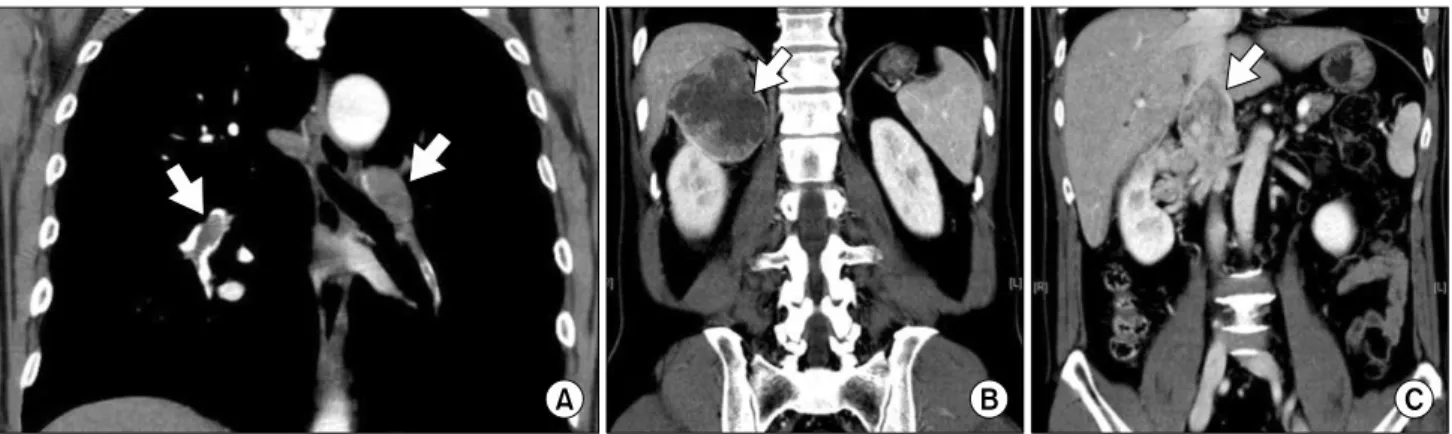
A 56-year-old man who had a 2-month history of shortness of breath was presented to a local clinic with a sudden onset of chest pain. He was transferred to the local hospital and was tested. Physical examination revealed tachycardia and mild tachypnea. Coronary arteriography showed normal coro- nary arteries. The next day, a chest computed tomography (CT) was performed and heavy burden of pulmonary emboli in bilateral pulmonary arteries and branches were shown (Fig.

1A). An abdominal CT revealed a large mass in the right kidney (Fig. 1B) and a thrombus in the right renal vein ex- tending into an inferior vena cava (IVC) (Fig. 1C). Echocar- diography showed mild to moderate tricuspid regurgitation with mild pulmonary hypertension. Low molecular weight

heparin was initiated and the patient was admitted to

Samsung Medical Center. Seven days later, the patient under-

went a right radical nephrectomy, a resection of the extended

tumor in the abdominal IVC and a pulmonary embolectomy

in one session. The right radical nephrectomy was performed

via laparotomy first. At the same time, the lower abdominal

IVC was exposed to insert venous cannula to run the

heart-lung machine. In succeeding, through a median sternot-

omy, ascending aortic arterial cannulation and triple venous

cannulation of superior vena cava, thoracic IVC, and in-

fra-renal IVC were made. On beating heart under car-

diopulmonary bypass, resection of the extended tumor in the

abdominal IVC was performed (Fig. 2A). And then, emboli

in the left pulmonary artery and its branches were pulled out

with forceps via left pulmonary arteriotomy following vent

(2)

Hunbo Shim, et al

− 324 −

Fig. 1. (A) Chest computed tomography shows filling defects in the pulmonary arteries, characteristic of pulmonary embolism. (B) A large mass in the upper pole of right kidney. (C) The thrombus is detected as a hypodense filling defect within the contrast enhanced inferior vena cava.

Fig. 2. (A) Specimens removed from the inferior vena cava, (B) the left pulmonary artery and (C) the right pulmonary artery.

catheter insertion into right ventricle through proximal main pulmonary artery with distal main pulmonary artery snaring (Fig. 2B). The emboli on the other side were removed with same manner via right pulmonary arteriotomy (Fig. 2C). After primary repair of both pulmonary arteries, cardiopulmonary bypass was weaned off. Total cardiopulmonary bypass time was 208 minutes. The renal mass was proved to be renal cell

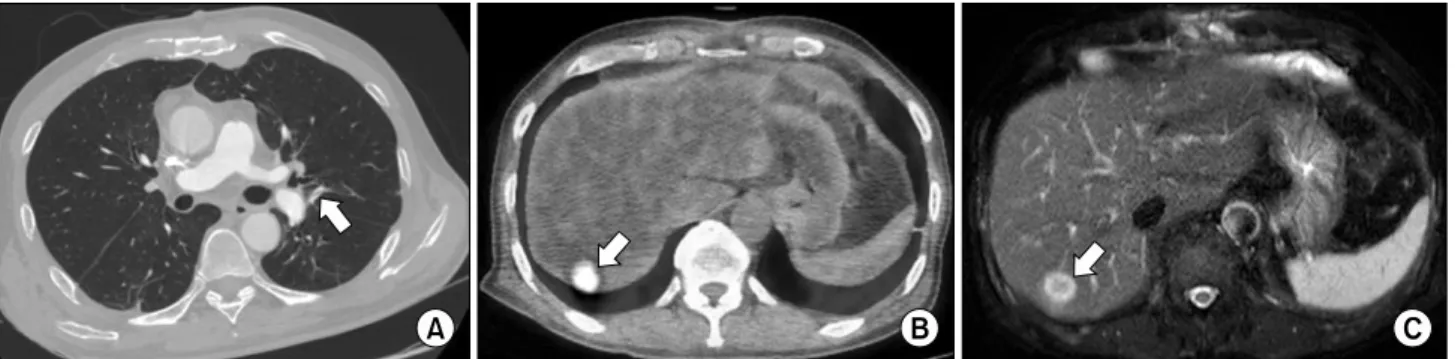
carcinoma. Thrombi in abdominal IVC and pulmonary ar- teries were confirmed as tumor emboli of renal cell carcinoma. Seventeen days after the surgery, the patient was discharged without any complications. In the follow-up chest CT taken one week after operation, most of emboli were re- moved except tiny remnant in the left lower lobe posterobasal segmental pulmonary artery (Fig. 3A). Two months after op- eration, positron emission tomography-CT (Fig. 3B) and mag- netic resonance imaging (Fig. 3C) showed single metastatic liver mass, but no pulmonary metastasis. Patient underwent radiofrequency ablation of liver mass. And the mass was completely destroyed. No further treatment was recommended by oncologist other than regular follow-up.

DISCUSSION

While pulmonary tumor embolism occurs rarely, it can be a cause of respiratory failure in patients with cancer. It is not easy to differentiate tumor embolism from the more common thrombotic embolism on clinical grounds since they have similar symptoms. Such an embolism may appear at any stage of the patient's illness and may even be the first pre- sentation of an occult carcinoma [1]. Tumor pulmonary em- bolism is thought to be a filtered tumor during seeding the systemic circulation with individual cells or cell clusters [2].

Tumor embolism of large fragments is rare but has been re-

ported in chondrosarcoma, renal cell carcinoma, right atrial

myxoma, and Wilms’ tumor [2]. It presents as an acute event

(3)

Mangement of Multiple Emboli of Renal Cancer

− 325 −

Fig. 3. (A) Tiny remnant remained in the left lower lobe posterobasal segmental pulmonary artery. (B) Single metastatic liver mass was found in positron emission tomography-computed tomography and (C) in magnetic resonance imaging two months after operation. However no pulmonary metastasis was shown.

with symptoms of massive pulmonary embolism including dyspnea, chest pain accompanied by hypoxemia, and acute cor pulmonale with hemodynamic collapse [2]. Microvessel tumor emboli have been reported more frequently. Common sources of such emboli are liver, breast, stomach, renal and prostatic cancers and choriocarcinoma [1-3]. The clinical pre- sentation of such embolism is typically subacute. Dyspnea de- velops over days to weeks and is sometimes accompanied by chest pain, cough, and hemoptysis [2].

In this case, renal cell carcinoma extended into IVC and made emboli at both pulmonary arteries and its branches. The classic triad of flank pain, hematuria, and abdominal mass is present in only approximately 15% of patients who are diag- nosed with renal cell carcinoma. Rarely, pulmonary embolism can be the initial manifestation of renal cell carcinoma [4].

Such an embolus originates in tumor involvement of the renal vein (33%), with extension to the inferior vena cava in 6% of cases [5]. To prevent worsening the patient’s condition, a proper treatment including embolectomy is necessary as soon as possible to reduce fatal events. Interestingly, tumor emboli do not always lead to pulmonary metastasis. The establish- ment of pulmonary metastasis requires not only mechanical trapping of carcinoma cells in pulmonary vasculature, but an invasive potential of the cells themselves and appropriate mi- croenvironment to enhance the local growth of cells [6].

Extension of renal cell carcinoma through the venous drain is not a sign of aggressiveness of the tumor. Metastatic behavior of the tumor is more important than the level of embolus in determining the prognosis [7]. Although liver metastasis was

found in this patient after operation, the metastatic mass was removed completely with simple intervention and pulmonary metastasis did not exist in spite of pulmonary embolism.

Therefore, aggressive approach towards total resection of re- nal tumor and emboli improves the prognosis of patients as well as resolving the respiratory problems.

In conclusion, this severe case requires surgical pulmonary embolectomy for positive prognosis in the long term from an oncological view in addition to reducing fatal outcome in the short run.

REFERENCES

1. Veinot JP, Ford SE, Price RG. Subacute cor pulmonale due to tumor embolization. Arch Pathol Lab Med 1992;116:

131-4.

2. King MB, Harmon KR. Unusual forms of pulmonary embolism. Clin Chest Med 1994;15:561-80.

3. Rossi SE, Goodman PC, Franquet T. Nonthrombotic pulmo- nary emboli. AJR Am J Roentgenol 2000;174:1499-508.

4. Daughtry JD, Stewart BH, Golding LA, Groves LK.

Pulmonary embolus presenting as the initial manifestation of renal cell carcinoma. Ann Thorac Surg 1977;24:178-81.

5. Marshall VF, Middleton RG, Holswade GR, Goldsmith EI.

Surgery for renal cell carcinoma in the vena cava. J Urol 1970;103:414-20.

6. Masumori N, Kumamoto Y, Tsukamoto T, et al. Studies on pulmonary metastasis of renal cell carcinoma: pulmonary embolism revealed by lung-perfusion imaging and metastasis.

Nihon Hinyokika Gakkai Zasshi 1991;82:769-75.

7. Yazici S, Inci K, Bilen CY, et al. Renal cell carcinoma with

inferior vena cava thrombus: the Hacettepe experience. Urol

Oncol 2010;28:603-9.

수치

Fig. 1. (A) Chest computed tomography shows filling defects in the pulmonary arteries, characteristic of pulmonary embolism
Fig. 3. (A) Tiny remnant remained in the left lower lobe posterobasal segmental pulmonary artery

참조

관련 문서

We reported successful prevention of inferior vena cava filter implantation in nephrotic syndrome patient with pulmonary embolism, inferior vena cava and deep vein thrombosis..

Intra-cardiac Embolism of a Large Bone Cement Material after Percutaneous Vertebroplasty Removed through a Combination of an Endovascular Procedure and an Inferior Vena Cava

Here, we report on a case of uterine leiomyomatosis, which presented with tumor progression through the right iliac vein, along the entire inferior vena cava (IVC) and up to the

Contrast enhanced CT scans shows dilatation and oc- clusion of the inferior vena cava above the renal hilus extending proximally to the right atrium (a).. There

Anderson R C, Adams PA , Burke B: Anomalous inferior vena cava with azygos continuation (infrahepatic inter- ruption of lhe in{erior vena cava).. Ch uang VP , Mena CE

Fig. Reconstructed image of great vessels shows transposition of vena cava in infrarenal portion.. A schematic diagram showing the precur. sors of different segments of

Here, we report a case of a primary intrarenal YST with tumor thrombus of the inferior vena cava and left renal vein in a 2-year- old boy, with an emphasis on the CT features.. To

Axial sonogram shows (A) right renal vein (RRV) (arrowhead) crossing retroaortically to area of left-sided infrarenal inferior vena cava (L-IVC) (long arrow) and no tubular