• 검색 결과가 없습니다.

Comparison of Random and Blocked Practice during Performance of the Stop Signal Task

N/A
N/A
Protected

Academic year: 2021

Share "Comparison of Random and Blocked Practice during Performance of the Stop Signal Task"

Copied!
6
0
0

로드 중.... (전체 텍스트 보기)

전체 글

(1)

Jung-Won Kwon, PT, MS; Seok-Hyun Nam, PT; Chung-Sun Kim, PT, PhD

1

Department of Rehabilitation Science, Graduate School of Daegu University;

1

Department of Physical Therapy, College of Rehabilitation Science, Daegu University

Purpose: We  investigated  the  changes  in  the  stop‐signal  reaction  time  (SSRT)  and  the  no‐signal  reaction  time  (NSRT)  following motor sequential learning in the stop‐signal task (SST). This study also determined which of the reduction0s of  spatial processing time was better between blocked‐ and random‐SST. 

Methods: Thirty right‐handed healthy subjects without a history of neurological dysfunction were recruited. In all subjects,  both the SSRT and the NSRT were measured for the SST. Tasks were classified into two categories based on the stop‐signal  patterns, the blocked‐SST practice group and random‐SST practice group. All subjects gave written informed consent.

Results: In the blocked‐SST group, both the SSRT and the NSRT was significantly decreased (p<0.05) but not significantly  changed in the random‐SST group. In the SSRT and the NSRT, the blocked‐SST group was faster than the random‐SST group  (p<0.05). In the post‐test SST after practice of each group, the SSRT was significantly decreased in the random‐SST group  (p<0.05), but the NSRT showed no significant changes in either group. 

Conclusion:  These  findings  demonstrate  that  random‐SST  practice  resulted  in  a  decrease  in  internal  processing  times  needed for a rapid stop to visual signals, indicating motor skill learning is acquired through improved response selection and  inhibition. 

Keywords: Stop function, Stop signal task, Motor sequential learning  Received: March 07, 2011

Revised: June 07, 2011 Accepted: June 14, 2011

Corresponding author: Chung-Sun Kim, [email protected]

Performance of the Stop Signal Task

The Journal of Korean Society of Physical Therapy
I. Introduction

Stop function is a notable feature of executive control in response to changes in internal states or changes in the envir- onment. This ability to stop inappropriate or irrelevant res- ponses supports flexible and goal-directed behavior in every changing environment.

1,2

The deficits in stop function should be one of the key features of some neurological and psycho- pathological disorders such as Parkinson’s disease, Huntington’s disease, attention-deficit/hyperactivity disorder, and compulsive disorder.

3-7

Many previous studies have typically investigated the process of stop function using the stop signal paradigm, which was directly related to self-regulation of goal-directed behavior.

8-10

The stop signal task (SST) is based on the race model of the stop signal paradigm.

11-13

Subjects perform the ongoing process,

and occasionally, the ongoingprocess is followed by a stop- signal, which instructs subjects to stop the response (the stop process). Stopping a response requires a fast control mechanism that prevents the execution of the motor response. These processes interact with slower control mechanisms that monitor and adjust performance. Under the assumption of a race between ongoing and stopping processes, the stop-signal reac- tion time (SSRT) measures the time it takes for subjects to stop their response. The SSRT has proven to be an important meas- ure of the executive control processes that are involved in stop- ping. Thus, successful performance in the SST involves monitoring the ongoing and stopping performance and adjust- ing response strategies to find an optimal balance between conflicting demands of the go- and stop-task.

Many previous studies have reported that subjects change

(2)

response strategies reactively after stop-signal trials.

14-16

Several studies indicated that subjects change response strategies proactively when they expect stop-signals to occur, trading speed in the go-task for success in the stop task.

17,18

Recent studies shown that stimulus repetition might be a crucial variable responding after successful stopping is typically slower when the stimulus from the stop trial is repeated, and retrieval of that association impaired go performance.

19

This stimulus-specific slowing can persist over many intervening trials and might support the development of automatic stop function.

20,21

According to functional MRI, cortical excitability and the involved regional area are altered after performance of the SST.

Many studies have reported that successful stopping is associated with higher cortical function in the inferior frontal cortex (IFC) and dorsal medial frontal regions, especially the pre-supple- mentary motor area (pre-SMA) in voluntary stop.

11,15,22

The activation of these cortical regions through motor sequential learning of the SST can improve error detection and lessen conflict between responses and action plans, which are associated with monitoring and adjusting behavior. However, although the evidence for neural contribution to motor learning of ongoing performance such as the serial reaction time task is well established,

23,24

nothing has been presented the contri- bution to motor learning in resolving the conflict between the opposing task demands in the SST. Moreover, studies in human normal stop function would likely help us in understanding the automaticity process in motor sequence learning.

Therefore, we tried to demonstrate whether or not a blocked or random stop-signal pattern led to a change between the stop- signal reaction time and the no-signal reaction timefollowing motor sequential learning, as the final temporal response time was reduced after motor acquisition in the SST.

II. Methods

1. Subjects

Thirty healthy subjects were recruited using the following inclusion criteria: (1) right-handed as verified by a handedness questionnaire in the modified Edinburgh Handedness Inven- tory, (2) no pathology of musculoskeletal function in the upper limb, (3) no previous history of neurological or psychiatric disorders, (4) no previous exposure to other sequence-learning

studies. All subjects were randomly assigned to a Blocked-SST practice group or a Random-SST practice group. All subjects gave their written informed consent prior to this experiment, which was in accordance with ethical standards of the Declaration of Helsinki.

2. Equipment and procedures 1) Stop Signal Task (SST)

The stop signal task (SST) was performed on the computer using stimulus presentation software (STOP-IT, Universiteit Gent, Belgium) and consisted of Go (75% of all trials) and Stop (25%) trials.

25,26

During the Go trial, visual stimuli with no colors, such as the square (■), circle (●), diamond (◆), or triangle (▲) was randomly displayed on a monitor to a subject, who was instructed to then press a response key consisting of a left (←), right (→), up (↑), or down (↑) arrow on the keyboard.

During the Stop trial, a stop-signal (X shape) was presented following a particular delay (stop-signal delay, SSD), subse- quently overlapping the figure signal. The SSD was initially set at 250 ms and continually adjusted according to a tracking procedure to obtain a probability of stopping of 0.50. If the subject successfully stopped the button press during a stop trial, the next stop trial became more difficult by increasing the SSD by 50 ms. If the subject failed to stop the button press, the next stop trial was made easier by decreasing the SSD by 50 ms.

The program ANALYZE-IT (Universiteit Gent, Belgium) was used for statistical analysis. Stop-signal reaction time (SSRT) and no-signal reaction time (NSRT) were estimated by calculating the mean SSD, the mean percentage of correct responses on the Go trials, and the probability of responding on the Stop trials according the stop signal paradigm.

25

2) Experimental procedure

All subjects were seated in front of a table with the right hand on

the response key. Subjects of each group performed the

predictableor random SST, which consisted of the previously

mentioned five figures (■, ●, ▲, ◆ and X) presented

randomly on the center of a computer monitor. In the

Blocked-SST, a Stop-signal was presented as every fourth signal

within the Go trial, whereas a Stop-signal was randomly

presented in the Random-SST. The SST was to respond to each

stimulus with a predetermined set of response keys: the square

meant that the subject had to press the “←” button; the circle

(3)

Blocked-SST group Random-SST group

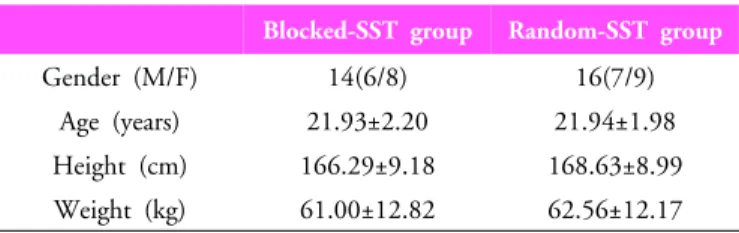
Gender (M/F) 14(6/8) 16(7/9)

Age (years) 21.93±2.20 21.94±1.98 Height (cm) 166.29±9.18 168.63±8.99 Weight (kg) 61.00±12.82 62.56±12.17 SST: Stop signal task

Table 1. General characteristic of each subject indicated the “→” button; the diamond indicated the “↑”

button; and the triangle indicated the “↓” button.

In Go trials, the subjects were instructed to press the button as quickly as possible, but the subjects were not instructed to press the button during the Stop trials. The SST consisted of three blocks of 96 trials (Go trials: 72, Stop trials: 24) per session one of the three-time practice, whereas the SST consisted of one block of 128 trials (Go trials: 96, Stop trials: 32)in the test session. A fixation cross was shown on themonitor for a null (baseline) period until the start of the next trial. All subjects were instructed not to wait for the stop-signals.

The stimulus remained on the monitor until subjects responded or until 1,250 msec elapsed. The default inter- stimulus interval is 2,000 msec and is independent of reaction time. Each trial starts with the presentation of the fixation cross, which is replaced by the Go trial stimulus after 250 msec.

3. Statistical analysis

All the data and two dependent variables, such as the NSRT and the SSRT, were analyzed. The SSRT was calculated by subtracting mean SSD from the untrimmed mean reaction time.

The mean raw reaction time for all no-signal trials were calculated at the first (i.e., the NSRT), and then mean SSD is subtracted from this value.

The effect of each practice was determined using two-way ANOVA (groups: Blocked-SST, Random-SST × practice session: P1, P2, P3) with repeated measures of the two dependent variables, the NSRT and the SSRT. The paired t-test was used to compare the NSRT and the SSRT between the practice session and test session (post-test). All statistical analyses were performed using SPSS, version 15.0. A p value <0.05 was considered significant.

III. Results

Between the two groups, there was no significant difference in terms of gender, age, height, and weight, which are known to affect the performance of the SST task (Table 1). In the SSRT of each group, the main effect of practice level was statistically significant (p<0.05)(Table 2). The interaction between practice and group main effects was statistically significant, and it was the difference between the groups (p<0.05)(Table 2). In the NSRT

of each group, the main effect of practicelevel was not statistically significant (p>0.05)(Table 3), whereas the inter- action between practiceand group main effects was statistically significant, and it was the difference between the groups (p<0.05)(Table 3). Table 4 presents the SSRT and the NSRT scores in the post-test SST after practice of each task. After the random-SST group practiced, the SSRT was significantly decreased (p<0.05), whereas the NSRT was not significantly changed (p>0.05). After the blocked-SST group practiced, both the SSRT and the NSRT were increased but there were no significant change (p>0.05).

IV. Discussion

Stop function is considered to be a key component of executive control. In the current study, we found that both the SSRT and the NSRT was significantly decreased in the blocked-SST group, but not significantly changed in the random-SST group. In addition, the blocked-SST group was faster than the random- SST group in ongoing and stopping process times. In the post-test SST after practice of each group, the SSRT was significantly decreased in the random-SST group, but no significant reduction was observed in the blocked-SST group. In the NSRT of post-test SST, there were no significant changes in all groups, which suggests that the random-SST practice for three consecutive days resulted in a decrease in the internal processing times needed for a rapid stop to visual signals, because motor skill learning is acquired through random-SST practice.

Our findings showing a decline in stopping process times,

were in line with previous SST experiments, which influenced

by automatic processing through task goals can be

primed.

16,21,27,28

These studies have reported that goal-directed

actions can be started and guided to completion automatically

(4)

Group SSRT

Practice Group Interaction (Practice x Group)

P1 P2 P3

Blocked-SST 235.06±49.75 203.96±52.52 177.96±53.32

0.04* 0.00* 0.00*

Random-SST 272.96±39.06 294.98±44.19 305.23±46.24

*p<0.05

P1, 2, 3: Practice levels SST: Stop signal task

SSRT: Stop-signal reaction time

Table 2. Changes of the stopping process time from the visual stimuli at practice levels of both groups (Unit: ms)

Group NSRT

Practice Group Interaction (Practice x Group)

P1 P2 P3

Blocked-SST 732.90±50.13 701.37±52.69 665.29±58.36

0.15 0.01* 0.00*

Random-SST 777.22±143.07 832.69±151.93 805.47±160.54

*p<0.05

P1, 2, 3: Practice levels SST: Stop signal task NSRT: No-signal reaction time

Table 3. Changes of the ongoing process time from the visual stimuli at practice levels of both groups (Unit: ms)

Group SSRT

p NSRT

last-practice post-test last-practice post-test p

Blocked-SST 177.96±53.32 174.35±51.14 0.82 665.29±58.36 682.59±66.97 0.07 Random-SST 305.23±46.24 272.81±39.95 0.01* 805.47±160.54 839.33±175.48 0.06

*p<0.05

SST: Stop signal task

SSRT: Stop-signal reaction time NSRT: No-signal reaction time

Table 4. The comparison of the stopping and ongoing process time between the last-practice and post-test on each group (Unit: ms) by information in the task environment. This means the

automatically activated goals interfered with performance, but the intentionally activated goals determined whether subjects actually respondedor stopped. Moreover, goal priming depended on the relevance of the task goal to the task context.

This means that priming incongruent goals interfered with performance, but intentionally activated goals determined which response was executed. Accordingly, the goals of stopping can be activated automatically by implicating associations between irrelevant information in the task environment and task goals. It appears that executive control, such as stopping, can be triggered in both downward decisions and upward control, which reduces the need for intention.

Many previous studies have demonstrated behavioral changes in executive control influenced by differential recruit- ment of response selection and inhibition in the stop fun-

ction.

7,15,22,29

The response inhibition in the stop function is one

facet of response selection, such that inhibiting a response is an

internal response involving a lack of movement. The response

selection in the stop function is a form of cognitive control that

involves selecting an appropriate goal-related response. Some

studies have reported that a strong association was observed

between the response selection and inhibition to be involved in

controlled ongoing and stopping processes. Furthermore, other

studies have revealed that the efficiency of response inhibition

improves in concert with increases in the extent of the

preparation ongoing before stop-signals and that this improve-

ment can reduce the demand of response inhibition during the

stopping process.

14

The sufficient preparation shortened the

reaction time of the stop process (i.e., SSRT), whereas it reduced

inhibition-related activity in imagining results. It appears that

the shorter time of preparation cost the faster responses stop.

(5)

Accordingly, the stop functions of the SST correspond to the preparation cost of response conflict between selection and inhibition that suggests it may to some degree recruit stop processing before a stop-signal.

In the current study, we found that the random-SST efficiently improved stop functions which adjust response strategies to balance the opposing demands of the ongoing and the stopping for goal-related preparation. In addition, these findings showed that the random-practice for motor skill acquisition in the SST could provide a highly effective intervention and improve the ability of executive control in patients with cognitive disorders of stop functions. Combining blocked-practice with random-practice can improve monitoring or adjusting between response selection and inhibition, and it may be valuable rehabilitation training for therapeutic inter- vention. The limitation of this study was the lack of variety of stop-signals in stop-related movements. Additionally, factors, such as a person’s motor performance ability and attention of goal-directed stop on the task, are crucial components that cannot be quantified. Thus, further studies will be required to ascertain the detailed mechanisms of motor skill learning in stopping and to investigatethe neurobehavioral connection between the ongoing and stopping process.

Author Contributions Research design: Kwon JW

Acquisition of data: Kwon JW, Nam SH

Analysis and interpretation of data: Kwon JW, Nam SH Drafting of the manuscript: Kwon JW

Research supervision: Kim CS

References

1. Aron AR. The neural basis of inhibition in cognitive control.

Neuroscientist. 2007;13(3):214-28.

2. Miyake A, Friedman NP, Emerson MJ et al. The unity and diversity of executive functions and their contributions to complex "Frontal lobe" Tasks: A latent variable analysis. Cogn Psychol. 2000;41(1):49-100.

3. Aron AR, Poldrack RA. Cortical and subcortical contributions to stop signal response inhibition: Role of the subthalamic nucleus. J Neurosci. 2006;26(9):2424-33.

4. Bekker EM, Overtoom CC, Kooij JJ et al. Disentangling

deficits in adults with attention-deficit/hyperactivity disorder.

Arch Gen Psychiatry. 2005;62(10):1129-36.

5. Chamberlain SR, Fineberg NA, Blackwell AD et al. Motor inhibition and cognitive flexibility in obsessive-compulsive disorder and trichotillomania. Am J Psychiatry. 2006;163(7):

1282-4.

6. Gauggel S, Rieger M, Feghoff TA. Inhibition of ongoing responses in patients with parkinson's disease. J Neurol Neurosurg Psychiatry. 2004;75(4):539-44.

7. van den Wildenberg WP, van Boxtel GJ, van der Molen MW et al. Stimulation of the subthalamic region facilitates the selection and inhibition of motor responses in parkinson's disease. J Cogn Neurosci. 2006;18(4):626-36.

8. Barkley RA. Behavioral inhibition, sustained attention, and executive functions: constructing a unifying theory of adhd.

Psychol Bull. 1997;121(1):65-94.

9. Logan GD, Schachar RJ, Tannock R. Impulsivity and inhibi- tory control. Psychological Science. 1997;8:60-4.

10. Williams BR, Ponesse JS, Schachar RJ et al. Development of inhibitory control across the life span. Dev Psychol. 1999;

35(1):205-13.

11. Verbruggen F, Logan GD. Response inhibition in the stop-signal paradigm. Trends Cogn Sci. 2008;12(11):418-24.

12. Verbruggen F, Logan GD. Models of response inhibition in the stop-signal and stop-change paradigms. Neurosci Biobehav Rev. 2009;33(5):647-61.

13. Band GP, van der Molen MW, Logan GD. Horse-race model simulations of the stop-signal procedure. Acta Psychol (Amst).

2003;112(2):105-42.

14. Chikazoe J, Jimura K, Hirose S et al. Preparation to inhibit a response complements response inhibition during perfor- mance of a stop-signal task. J Neurosci. 2009;29(50): 15870-7.

15. Goghari VM, MacDonald AW, 3rd. The neural basis of cognitive control: Response selection and inhibition. Brain Cogn. 2009;71(2):72-83.

16. Verbruggen F, Logan GD. Automaticity of cognitive control:

Goal priming in response-inhibition paradigms. J Exp Psychol Learn Mem Cogn. 2009;35(5):1381-8.

17. Cohen JR, Poldrack RA. Automaticity in motor sequence learning does not impair response inhibition. Psychon Bull Rev.

2008;15(1):108-15.

18. Verbruggen F, Logan GD. Proactive adjustments of response

strategies in the stop-signal paradigm. J Exp Psychol Hum

Percept Perform. 2009;35(3):835-54.

(6)

19. Verbruggen F, Logan GD, Liefooghe B et al. Short-term aftereffects of response inhibition: Repetition priming or between-trial control adjustments? J Exp Psychol Hum Percept Perform. 2008;34(2):413-26.

20. Verbruggen F, Logan GD. Automatic and controlled response inhibition: Associative learning in the go/no-go and stop-signal paradigms. J Exp Psychol Gen. 2008;137(4):649-72.

21. Verbruggen F, Logan GD. Long-term aftereffects of response inhibition: Memory retrieval, task goals, and cognitive control.

J Exp Psychol Hum Percept Perform. 2008;34(5):1229-35.

22. Seiss E, Praamstra P. The basal ganglia and inhibitory mechanisms in response selection: Evidence from subliminal priming of motor responses in parkinson's disease. Brain.

2004;127(Pt 2):330-9.

23. Kwon YH, Jang JS, Kim CS. Changes of cortical activation pattern induced by motor learning with serial reaction time task. J Kor Soc Phys Ther. 2009;21(1):65-72.

24. Lee MY, Park RJ, Nam KS. The effect of implicit motor sequence learning through perceptual-motor task in patients with subacute stroke. J Kor Soc Phys Ther. 2008;20(3):1-8.

25. Verbruggen F, Logan GD, Stevens MA. Stop-it: Windows executable software for the stop-signal paradigm. Behav Res Methods. 2008;40(2):479-83.

26. Won JY, Kim EJ. Validation of stop-signal task. Journal of Korean Psychological Association. 2008;27(1):217-34.

27. Claffey MP, Sheldon S, Stinear CM et al. Having a goal to stop action is associated with advance control of specific motor representations. Neuropsychologia. 2010;48:541-8.

28. Kwon JW, Nam SH, Kim CS. The effect of rehabilitation of a stop signal task on the execution and stop function of movement. J Kor Soc Phys Ther. 2011;23(2):37-43.

29. Verbruggen F, Liefooghe B, Vandierendonck A. Selective

stopping in task switching: The role of response selection and

response execution. Exp Psychol. 2006;53(1):48-57.

수치

Table 1.  General  characteristic of each subject indicated the “→” button; the diamond indicated the “↑”
Table 3.  Changes of  the ongoing process time from the visual stimuli at practice levels of  both groups (Unit: ms)

참조

관련 문서

This research further enriches the previous research on the influencing factors of employee organizational commitment and OCB, which help Chinese companies

Example 16.5: Small-Signal Gain Variation of NMOS Inverter..  the small-signal gain is the largest in

In order to process massive signal data of the multi-beam side scan sonar, the effective signal processing algorithm based on the quadrature method is developed, which can

이하선의 실질 속에서 하악경의 후내측에서 나와 하악지의 내측면을 따라 앞으로 간다. (귀밑샘 부위에서 갈라져 나와

• Analysis: A band-limited signal of finite energy that has no frequency components higher than W herts is completely described by specifying the values of the signal at

1) Start/stop the pump with the START/STOP buttons on the front panel or START/STOP signal connected to the remote connector or SERIAL COMMUNICATION connector on the rear

6.56 Usinga computer analysis, investigate the effect of the transistor parameters  and on the small-signal voltage gain and output resistance of the source-follower

1 John Owen, Justification by Faith Alone, in The Works of John Owen, ed. John Bolt, trans. Scott Clark, &#34;Do This and Live: Christ's Active Obedience as the
