INTRODUCTION
Cleft lip and palate are the most common congenital mal- formations in the head and neck throughout the world. Sur- gical techniques for the appropriate treatment of cleft lip and palate have developed very rapidly, but the epidemiologic study for prevention remains in its infancy. Both genetic and environmental influences are believed to cause cleft lip and palate (1-3). Many authors have investigated the epidemiol- ogy and etiologic factors of cleft lip and palate. Though sev- eral investigations have been performed in Korea, the epidemi- ologic studies of cleft lip and palate have been based on only one or a few hospitals (4-8). Hence, the previous data do not represent the nationwide epidemiologic status in Korea.
Since 1989, National Federation of Medical Insurance (NFMI) system has been operative in Korea. A nationwide investi- gation of the prevalences of other congenital malformations was performed with using this medical insurance data (9).
There has not been any birth defect monitoring project in Korea, so we investigated the incidence of cleft lip and palate among the live births in Korea using the medical insurance data. This is the first study that covered throughout the country.
MATERIALS AND METHODS
We could obtain the annual birth rates and the number of
the babies with cleft lip and palate from the NFMI in Korea.
Since 1989, the medical insurance has covered on nation-wide all the people in Korea. The current payment system for med- ical services is an indirect one. Direct contact with the insured is made by medical care institutions, which in turn submit medical care bills to NFMI. By the help of NFMI, we could collect data from the submitted claims from medical institu- tions for the patients who have been first diagnosed as cleft lip and/or palate.
Because the system of the early period was not fully set up, the data for 1991 and 1992 were not reliable. As shown in Table 1, most patients with cleft lip and palate were diagnosed with their diseases within the first three years of age. Also NFMI followed the International classification of disease (ICD) 10 as a reference of disease classification instead of the ICD 9 since 1996, the disease classification was not consistent with former years. So we estimated the incidence in the group of babies born in 1993, using the data of the newly diagnosed cases during the first 3 yr from 1993 to 1995.
According to Ryu et al., the accuracy of medical insurance claim data is about 76% in Korea (10), and Lee also has reported that the agreement rate between medical records and medical claim data was about 80% (11). Therefore assum- ing that the NFMI’s data has about 80% accuracy, we used the following method to decide the sample size to study the validity, and to get precise information from medical records.
We wanted to estimate validity with 95% confidence interval Sukwha Kim, Woo Jung Kim,
Changhyun Oh*, Jae-Chan Kim
Department of Reconstructive Plastic Surgery, College of Medicine, Seoul National University;
Division of Pediatric Plastic Surgery, Seoul National University Children’s Hospital; Ye Plastic &
Aesthetic Surgery Clinic*, Seoul, Korea Received : 4 June 2001
Accepted : 26 September 2001 Address for correspondence Sukwha Kim, M.D.
Chief, Division of Pediatric Plastic Surgery, Seoul National University Children’s Hospital, 28 Yongon-dong, Chongno-gu, Seoul 110-744, Korea Tel : +82.2-760-3530, Fax : +82.2-3675-3680 E-mail : [email protected]
*A paper presented in part at the 4th Korean- Japanese Congress of Plastic and Reconstructive Surgery, May 21-23, 1998, Kyongju, Korea.
49 J Korean Med Sci 2002; 17: 49-52
ISSN 1011-8934
Copyright � The Korean Academy of Medical Sciences
Cleft lip and Palate Incidence Among the Live Births in the Republic of Korea
We present an epidemiologic study of cleft lip and palate in the Republic of Korea from January 1, 1993 through December 31, 1993. In 1993, the number of total live births was 715,817. And from 1993 through 1995, a total of 1,293 new patients with cleft lip and palate who were born in 1993 were identified. The incidence of cleft lip and palate was 1.81 per 1000, that is, 1 per 554 live births.
The cleft lip: cleft lip and palate: cleft palate alone ratio was 1.13:1:1.19. The male: female ratio was 2.1:1 in the cleft lip group, and 2.5:1 in the cleft lip and palate group. We could detect a male predominance in both groups. In contrast, the ratio was 0.95:1 in the cleft palate group. The left: right: bilateral ratio was 1.9:1:0.23 in cleft lip group, and the ratio was 2.2:1:1.1 in the cleft lip and palate group. This is the first nation-wide study to provide detailed data on the inci- dence of cleft lip and palate in the live births in the Republic of Korea.
Key Words : Cleft Lip; Cleft Palate; Incidence; Korea; Epidemiology
50 S. Kim, W.J. Kim, C. Oh, et al.
(alpha=0.05), allowing 5% measured error (d=0.05). We knew that estimated P*is about 0.8 based on the previous studies (Rue 2000, Lee 1994). Using following sample size equation N>P* (1-P*) [Z /2/d]2(Z=cumulative normal dis- tribution), we concluded that more than 256 cases were re- quired to satisfy the condition. So we visited 9 hospitals from all over the country and reviewed 351 candidate cases of cleft lip and palate who were born in 1993 by cluster random sam- pling. We found that only 299 babies were compatible with the diagnosis of cleft lip and palate. Therefore the validity of the NFMI’s cleft lip and palate data was estimated to be 85%. So we estimated that 1,293 babies (85% of the 1,526 babies who were born in 1993 and diagnosed with cleft lip and palate in their first 3 yr of age) had cleft lip and palate.
Then the patients were subdivided as having cleft lip, cleft lip and palate, and cleft palate. The incidence, sexual ratio, laterality pattern, family history, and associated anomalies and syndromes were investigated.
RESULTS
According to the data from NFMI, the number of total live births in 1993 was 715,817. And we identified 1,293 new patients with cleft lip and palate who were born in 1993 during the period from 1993 to 1995. So the overall incidence of cleft lip and palate was 1.81 per 1,000, that is, 1 per 554
live births. In Korea, previous investigations reported that the incidence of cleft lip and palate was from 1.16 to 1.77 per 1000 (4-8). These studies were based on a few hospitals or limited area except Min’s reports which was not based on all live births in one year but cumulative live births data from 1984 to 1994 (5).
Also we could get more detailed epidemiologic information through a supplementary inspection of the selected medical records (299 patients) among the newly identified 1,293 cases with cleft lip and palate.
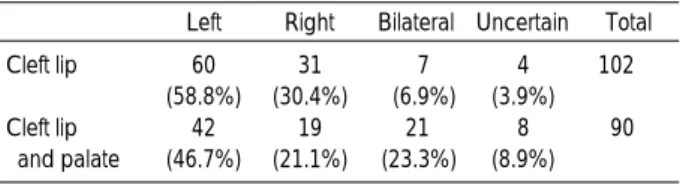
Among the 299 cases, there were 102 cases of cleft lip, 90 cases of cleft lip and palate, and 107 cases of cleft palate (Table 2). The male: female ratio was 2.1:1 in the cleft lip group, and was 2.5:1 in the cleft lip and palate group. We could detect a male predominance in both groups. In contrast, the ratio was 0.95:1 in the cleft palate group (Table 3). We also observed that the unilateral cleft lip occurred more frequently on the left side than on the right side in both cleft lip only and cleft lip and palate group. Bilateral cleft cases were more frequent in the cleft lip and palate group than in the cleft lip only group (Table 4). The family history of cleft lip and palate was detected in 21 out of 299 cases. The frequency of positive family history was higher in the cleft lip group than in the other groups (Table 5).
In this study, we included the cases of cleft lip and palate in association with other anomalies and recognized syndromes.
A total of 25 out of 299 (8.4%) cases of cleft lip and palate were associated with other anomalies. Congenital heart dis-
Birth year Year the diagnosis was first made 1991 1992 1993 1994 1995 Total
1991 244 217 290 118 68 937
1992 0 429 554 204 39 1,226
1993 0 0 841 543 142 1,526
1994 0 0 0 895 457 1,352
1995 0 0 0 0 710 710
Table 1.The chronological distribution of the cases of cleft lip and palate
Type Frequency Percent
Cleft lip 102 34.1
Cleft lip and palate 90 30.1
Cleft palate 107 35.8
Total 299 100
Table 2.The distribution of the cleft types
Left Right Bilateral Uncertain Total
Cleft lip 60 31 7 4 102
(58.8%) (30.4%) (6.9%) (3.9%)
Cleft lip 42 19 21 8 90
and palate (46.7%) (21.1%) (23.3%) (8.9%) Table 4.Laterality pattern of the cleft deformities
Male Female
Percent Frequency Percent Frequency
Cleft lip 69 67.7 33 32.3
Cleft lip and palate 64 71.1 26 28.9
Cleft palate 52 48.6 55 51.4
Table 3.Sexual distribution
Case Percent
Cleft lip 11/102 10.8
Cleft lip and palate 6/90 6.7
Cleft palate 4/107 3.7
Total 21/299 7
Table 5.The frequency of positive family history
Anomalies Frequency Percent
Congenital heart disease 16 5.4
Short frenulum 5 1.7
Hernia 1 0.3
Accessary ear lobe 1 0.3
Congenital megacolon 1 0.3
Extremity malformation 1 0.3
None 274 91.6
Table 6.Associated anomalies
Cleft Lip and Palate Incidence in the Republic of Korea 51
ease was the most frequently combined anomaly in 16 cases, followed by short frenulum in 5 cases (Table 6). Pierre-Robin syndrome was associated in 4 of 7 cases with combined syn- droms. There were one each of Down syndrome, Patau syn- drome, and Van der Woude syndrome. Syndromic diseases were more frequently combined with cleft palate: 4 out of 7 cases with syndromic diseases were combined with cleft palate.
DISCUSSION
In the majority of the isolated cleft lip and palate, the etio- logy has been considered to be multifactorial: combined gene- tic and environmental factors. According to Fogh-Andersen in Denmark, the incidence of cleft lip and palate doubled during the last 50 yr and tripled during the last 100 yr (12).
A 30-yr follow-up study of Rintala et al. in Finland also showed a clear trend of rapid increase in cleft lip and palate (1). These investigations suggest an increasing effect of the environmental factors.
In our study, the proportion of cleft palate was higher than in other studies (2, 13) (Table 2). In fact, we included the cleft lip and palate associated with other anomalies and syndromes in our investigation, and this might have contributed to the high ratio of cleft palate. But even after an exclusion of such cases, the proportion of cleft palate (33%) is still higher than that in other investigations. So the high ratio of cleft palate in Korea might be the result of different genetic background.
Similar to Rintala’s study in Finland (14), the Koreans are genetically fairly homogeneous population of 46 million peo- ple and have almost same culture and environment. The genetic inheritance may play a significant role in the cleft lip and palate in Korea. So Korea seems to be an ideal coun- try for epidemiologic studies of cleft lip and palate.
This study included all the live births born in 1993. This is the first nationwide investigation in Korea. Until now in Korea, a nationwide registration system for congenital anoma- lies has not been fully set up. All the data used in our study were derived from the submitted claims from medical institu- tions to NFMI. But these data had several limitations. Because the data recording was not performed by plastic surgeon, the case ascertainment was relatively incomplete. So we investi- gated the validity of NFMI’s data by chart review. But the validity test of these data was performed with cluster random sampling (9 hospitals). If the validity test was performed with random sampling, more precise result could be obtained.
But it is expensive and time consuming because there are so many hospitals in Korea.
The primary surgery of cleft lip and/or palate was covered by the NFMI system, therefore all the cases of primary surgery of cleft lip and palate were claimed to NFMI. If cleft lip and palate patients did not visit hospital or did not recognize their deformities (in case of submucous cleft palate or microform cleft lip, etc.), the incidence might be underestimated. Never-
theless, the estimated incidence of cleft lip and palate in Korea is rather higher than in other Asian countries, especially the neighboring country, Japan. Natsume reported the incidence of cleft lip and palate among Japanese people as 1.65 per 1000, or 1 out of 607.6 newborns (15).
The review by Apostole suggests that the incidence of cleft lip and palate differs among races (16). The American Indi- ans showed the highest values followed by the Japanese, the Maoris, and the Chinese. The Whites showed lower values and the Blacks the lowest values. The incidence of cleft lip and palate in Korea may be ranked between the American Indians and Japanese.
We could not get the respective incidences of cleft lip, cleft lip and palate, and cleft palate in this study. Until 1995, NFMI followed the ICD 9 as a reference of disease classifica- tion. In ICD 9, cleft deformities (cleft lip, cleft lip and palate, and cleft palate alone) are classified as a unicode. So we could get only the total incidence of cleft deformities and the ratio could be obtained from a sample study. ICD 10, which sub- divided the cleft deformities, was introduced in Korea since 1996. We are planning to make a more meticulous epidemi- ologic study of the clefts, through a longer follow-up.
Many authors have used the Japanese and Chinese data as a reference incidence of cleft lip and palate in Asians. This study will provide another valid incidence of cleft lip and palate in Asians.
In conclusion, from the nationwide epidemiologic study in 1993, we could determine the incidence of cleft lip and palate in the Republic of Korea as 1.81 per 1000 or 1 out of 554 live births. Genetic influence was suggested as an etiology of the relatively high ratio of cleft palate in the Republic of Korea, and this needs to be verified by a further prospective epidemiologic study.
ACKNOWLEDGMENTS
We thank Dr. Keunyoung Yoo and Daesung Kim for valu- able suggestions concerning the analysis of the study. We also appreciate the help of Department of Preventive Medicine, College of Medicine, Seoul National University.
REFRENCES
1. Rintala A, Ponka A, Sarna S, Stegars T. Cleft lip and palate in Fin- land in 1948-75: correlations to infections, seasonal and yearly vari- ations. Scand J Plast Reconstr Surg 1983; 17: 197-201.
2. Owens JR, Jones JW, Harris F. Epidemiology of facial clefting. Arch Dis Child 1985; 60: 521-4.
3. Jones MC. Etiology of facial clefts: prospective evaluation of 428 patients. Cleft Palate J 1988; 25: 16-20.
4. Kim HS, Ahn SY, Lee MS. Incidence of cleft lip and palate. J Korean Soc Plast Reconstr Surg 1996; 23: 98-107.
52 S. Kim, W.J. Kim, C. Oh, et al.
5. Min DW, Jang HJ, Hong IP, Kim JH, Lee SI. Recent 10 years’inci- dence of cleft lip, cleft palate and cleft lip and palate. J Korean Soc Plast Reconstr Surg 1996; 23: 1337-43.
6. Shin KS, Lee YH, Lew JD. Cleft lip and Cleft palate in Korea. Yon- sei Med J 1985; 26: 184-90.
7. Kim YB, Lew JM. Clinical study of frequency and etiological factors of cleft lip and cleft palate. J Korean Soc Plast Reconstr Surg 1982;
9: 407-15.
8. Shin J, Lee YH, Lew JD. Clinical observation of cleft palate. J Kore- an Soc Plast Reconstr Surg 1979; 6: 39-49.
9. Jung SC, Kim SS, Yoon KS, Lee JS. Prevalence of congenital malfor- mations and genetic diseases in Korea. J Hum Genet 1999; 44: 30-4.
10. Ryu SY, Park JK, Suh I, Jee SH, Park J. Kim CB, Kim KS. The accu- racy of myocardial infarction diagnosis in medical insurance claims:
Korean research group for cardiovascular disease prevention and
control. Yonsei Med J 2000; 41: 570-6.
11. Lee GS. Diagnosis coding agreement between medical records and medical claim billing data. A thesis for a degree. College of Medicine, Seoul National University (in Korean) 1994.
12. Fogh-Andersen P. Genetic and non-genetic factors in the etiology of facial clefts. Scand J Plast Reconstr Surg 1967; 1: 22-9.
13. Natsume N, Kawai T. Incidence of cleft lip and cleft palate in 39,696 Japanese babies born during 1983. Int J Oral Maxillofac Surg 1986;
15: 565-8.
14. Rintala AE. Epidemiology of orofacial clefts in Finland: a review.
Annal Plastic Surg 1986; 17: 456-9.
15. Natsume N. Incidence of cleft lip and palate among Japanese new- borns, 1982 to 1984. Plast Reconstr Surg 1987; 79: 499-501.
16. Vanderas AP. Incidence of cleft lip, cleft palate, and cleft lip and palate among races: a review. Cleft Palate J 1987; 24: 216-25.