• 검색 결과가 없습니다.

Development of Cobalt Sulfide-graphene Composite for Supercapacitor Applications

N/A
N/A
Protected

Academic year: 2021

Share "Development of Cobalt Sulfide-graphene Composite for Supercapacitor Applications"

Copied!
6
0
0

로드 중.... (전체 텍스트 보기)

전체 글

(1)

Special Issue Paper

Development of Cobalt Sulfide-graphene Composite for Supercapacitor Applications

Milan Jana*, Pranab Samanta*, Naresh Chandra Murmu*, Nam Hoon Kim**, Tapas Kuila* , Joong Hee Lee**

ABSTRACT: Co

9

S

8

/reduced graphene (CSRG) has been prepared by a facile two step hydrothermal method and used as a supercapacitor electrode material. It is anticipated that the Co

9

S

8

and reduced graphene oxide (RGO) would serve as a spacer material to each other to stop the agglomeration and simultaneous contribution of electrical double layer capacitance (RGO) and pseudocapacitance (Co

9

S

8

) would provide high electrochemical properties. The chemical analysis has been done by Fourier transform infrared spectroscopy and the morphology is characterised by field emission scanning electron microscopy. CSRG shows a high electrical conductivity of 98 S m

-1

. The symmetric supercapacitor shows a specific capacitance of ~728 F g

-1

with a current density of 2 A g

-1

. CSRG also showed an energy density of 25.2 Wh kg

-1

with a power density of 1000 W kg

-1

.

Key Words: Co

9

S

8

/reduced graphene oxide, Supercapacitor, Energy density, Power density

1. INTRODUCTION

The increasing demand of energy in the 21 st century has been triggered off numerous research efforts in energy con- version and storage from the renewable and green resources.

Solar power and wind energy can be the substitute of the fossil fuel by storing these energies efficiently for future applications [1-7]. Electrochemical capacitors (EDLC) can complement or even substitute batteries in energy storage applications [7].

Colossal research attempts have been paid on supercapacitor electrode materials and electrolyte through the last two decades to get its application in reality [1-9]. Different electro active materials such as Nio, Co 3 O 4 , MnO 2 , Cuo, CoS, etc.

have been examined as supercapacitors electrode [8,9]. How- ever the energy density and power density obtained from these electrode materials were very low due to their lower operating voltage. The newly found carbonaceous material graphene attracted the research scientists due to its higher surface area, good electrical conductivity and lower production cost and

can survive as a very good electrochemical material for super- capacitors electrode [9]. It is hoped that the interrogation of metal oxides or metal sulfides with graphene can enhance the supercapacitor properties [10,11]. Metal sulfide has been stud- ied very less as supercapacitor electrode materials. Lou et al.

Reported a CoS 2 supercapacitor electrode with a specific capacitance ~1040 F g -1 at current density of 0.5 A g -1 [12]. Pu et al. prepared a Co 9 S 8 -based supercapacitor with a specific capacitance of ~1775 F g -1 at 4 A g -1 [8]. Herein, we developed Co 9 S 8 /reduced graphene composite (CSRG) by a two step hydrothermal reaction and used as supercapacitor electrode material. The CSRG electrodes exhibit a very high specific capacitance of ~728 F g -1 at a current density of 2 A g -1 .

2. EXPERIMENTAL

2.1 Materials

Natural flake graphite and polyvinylidene fluoride (PVDF) was obtained from Sigma-Aldrich. Hydrochloric acid, potas-

Received 16 August 2016, received in revised form 30 August 2016, accepted 30 August 2016

*

**

Surface Engineering & Tribology Division, Council of Scientific and Industrial Research-Central Mechanical Engineering Research Institute, Durgapur-713209, India

Advanced Materials Research Institute for BIN Convergence Technology (BK Plus Global, Program), Department of BIN Convergence Technology, Chonbuk National University, Jeonju, Jeonbuk 54896, Korea

Corresponding authors, Dr. Tapas Kuila (E-mail: [email protected]) and Prof. Joong Hee Lee (E-mail: [email protected])

(2)

sium permanganate, hydrogen peroxide, potassium hydroxide, sulphuric acid and N,N-dimethyle formamide were purchased from Merck, Mumbai, India. Cobalt chloride, urea and sodium sulfide were obtained from SRL, Mumbai, India.

Nickel foam and carbon black was obtained from Shanghai Winfay New Material Co., Ltd, China and MTI Corporation, USA, respectively.

2.2 Synthesis of Co

9

S

8

nano rods on reduced graphene surface

Graphene oxide (GO) is prepared by a modified Hummers method. Around 190 mg CoCl 2 ·6H 2 O was added to 60 ml of graphene oxide solution (1 mg ml -1 )) and sonicated 30 min- utes. 240 mg urea was added to the solution and it was trans- ferred to a 100 ml stainless steel autoclave. The autoclave was then heated for 8 h at 95°C in hot air oven. The collected prod- uct was treated hydrothermally for 2 h with 0.2 M Na 2 S solu- tion. It is anticipated that the Co 2+ ions are adsorbed on the GO surface due to the electrostatic attraction force of oxidative debris.

Urea plays an important role to provide hydroxyl groups to form the intermediate Co(CO) 0.35 Cl 0.20 (OH) 1.10 . The GO is reduced by the ammonia released during the hydrolysis of urea. The adsorbed Co 2+ ions has been converted to an inter- mediate Co(CO) 0.35 Cl 0.20 (OH) 1.10 and GO is reduced to RGO during the first step of the reaction in presence of urea at 95 C.

The S 2 ions reacts to the intermediate The Co(CO) 0.35

Cl 0.20 (OH) 1.10 to form Co 9 S 8 during the second step of reaction in presence of Na 2 S at 120 C. The schematic for the probable formation mechanism of CSRG is presented in Fig. 1.

2.3 Characterization

Fourier transform infrared spectroscopy (FT-IR) of the sam- ple was characterised by Nicolet 6700 spectrometer (Thermo scientific, USA). The morphology was characterised by field emission scanning microscopy (FE-SEM) using Σigma HD, Carl Zeiss, Germany. Transmission electron microscopy (TEM) and selected area electron diffraction (SAED) of CSRG was obtained from JEM-2100 FS (JEOL, Japan). The electrical

conductivity of the samples was measured by a KEITHLEY Delta arrangement consisting of AC & DC current source, model: 6221 and Nanovoltmeter, model: 2182A. The cyclic voltammetry (CV), galvanostatic charge-discharge and elec- trochemical impedance spectroscopy (EIS) were performed in a PARSTAT 4000 (Princeton Applied Research, USA) elec- trochemical workstation in a two electrode system. The elec- trode was prepared through drop casting electrode materials on 1 cm diameter nickel foam substrate. CSRG, carbon black and polyvinylidene fluoride were mixed properly with a mass ratio of 8 : 1.5 : 0.5 in dimethylformamide. The slurry was drop casted over the Nickel foam (current collector). What- man 42 filter paper was used as the separator to design a sym- metric supercapacitor, where 6 (M) KOH was used as electrolyte.

3. RESULTS AND DISCUSSION

3.1 FT-IR Spectra analysis

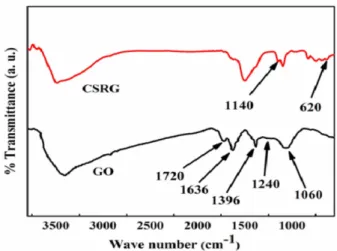
Fig. 2 shows the FT-IR spectrum of GO and CSRG com- posite. The stretching vibration peak of -OH functional group of water appeared at 3430 cm -1 . The stretching vibration peaks of alkoxy and epoxy groups of GO appeared at 1060 and 1240 cm -1 . The peak corresponding to carboxylic groups appeared at 1720 cm -1 of GO [13]. The peak at 1140 cm -1 in the spectra of CSRG indicated the bending vibration peak of sulfonated group of cobalt sulfide [11]. The stretching vibra- tion of Co atom in Co 9 S 8 was represented by the peak at 620 cm -1 [11]. Both the characteristic peaks of Co 9 S 8 nano- rods were present in the spectrum of CSRG, suggested the suc- cessful decoration of Co 9 S 8 nanorods on the reduced graphene (RGO) surfaces. The peaks corresponding to oxygen func- tional groups of GO were either decreased or removed from the FT-IR spectrum of CSRG. It suggested the reduction of GO during the hydrothermal process.

Fig. 1. Schematic representation of formation mechanism of

Co

9

S

8

nano particles on RGO Fig. 2. FT-IR spectra of CSRG and GO

(3)

3.2 FE-SEM and TEM analysis

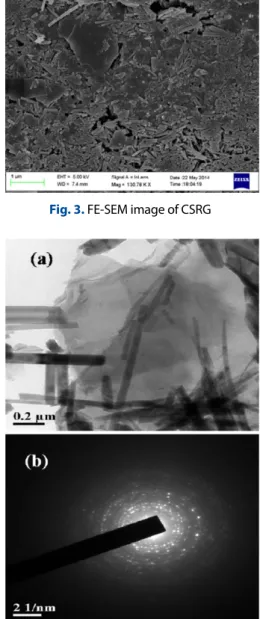
Fig. 3 represents the FE-SEM image of CSRG. It clearly revealed the decorating of Co 9 S 8 nanorods on RGO surfaces.

The typical porous nature of CSRG helped to improve the electrochemical performances. The TEM image of CSRG is presented in the Fig. 4(a). The TEM image reveals that the Co 9 S 8 nanorods are randomly decorated over RGO sheets. The well separated Co 9 S 8 nanorods can get a good access of elec- trolyte to contribute pseudocapacitance to the EDLC of RGO.

The polycrystalline nature of the CSRG (as experienced from the SAED pattern image) further confirms the hybridization of Co 9 S 8 and RGO.

3.3 Electrical conductivity measurements

The electrical conductivity was measured by a four probe method using the formula

Electrical conductivity = 1/(4.53 × R × d) (1) Where R is the resistance and d is the thickness. The con- ductivity of GO, pure Co 9 S 8 and CSRG were found to be

~9.5 × 10 -2 , 1.4 and 98 S m -1 respectively. The increment in electrical conductivity in CSRG than pure Co 9 S 8 and GO con- firmed the reduction of GO and successful anchoring of Co 9 S 8 nano rods on to the conjugated sp 2 network of RGO.

3.4 Electrochemical performances

The electrochemical performance of CSRG and pure is experienced by designing two electrode based supercapacitor devices, where 6 (M) KOH has been used electrolyte. The CV response of pure Co 9 S 8 and CSRG at scan rate of 50 mV s -1 at the voltage range of 0-1 V are shown in Fig. 5(a). Theoretically an ideal supercapacitor should show a rectangular nearly CV curve with reversible cathodic and anodic loops [7,15]. The curve of pure Co 9 S 8 was deformed from its reversible nature at higher voltage range ~0.8 V. Whereas, the CV loop of CSRG was comparably reversible and mirror image like in nature.

The CV loops of the CSRG showed higher current response than pure Co 9 S 8 . It clearly revealed that CSRG afford greater electrochemical performances than pure Co 9 S 8 [15,16]. The quasi-rectangular CV curves of CSRG confirm the reversible nature of the redox reactions. The galvanostatic charge-dis- Fig. 3. FE-SEM image of CSRG

Fig. 4. (a) TEM and (b) SAED pattern image of CSRG

Fig. 5. (a) Cyclic voltammetry curves, (b) galvanostatic charge-

discharge curves of CSRG and pure Co

9

S

8

(4)

charge curves of pure Co 9 S 8 and CSRG are represented in Fig.

5(b) at current density of 2 A g -1 .

The coulombic efficiency (CE) was calculated by using the equation

CE = (discharging time/charging time) × 100 (2) The CE was found to be 41 and 50% respectively for pure Co 9 S 8 and CSRG. The increment in CE may be due to the introduction of electrical double layer nature (EDL) of RGO to the redox nature of Co 9 S 8 . The specific capacitance (SC) of the pure Co 9 S 8 and CSRG was calculated from the charge-dis- charge curves using the formula

SC = 4 × I

m

× (Δt/ΔV) (3)

Where, I

m

is the current density, Δt is the discharging time, ΔV is the operating voltage. The SC of pure Co 9 S 8 was found to be 392 F g -1 , whereas the SC of CSRG was calculated to be 728 F g -1 at a current density of 2 A g -1 .

Fig. 6(a) shows the charge-discharge curves of CSRG at dif- ferent current densities. Interestingly, it is notified that the CE values increased with increasing the current densities and found to be ~78% at high current density of 5 A g -1 . The SC values of CSRG have been found to be ~684, 480, and 340 F g -1 at current densities of ~3, 4 and 5 A g -1 . The charge storage mechanism of Co 9 S 8 in the KOH medium can be explained by

the following reversible reaction [17].

Co 9 S 8 + OH ↔ Co 9 S 8 - OH + e (4) Co 9 S 8 - OH + OH ↔ Co 9 S 8 O + H 2 O + e (5) The pseudocapacitance of Co 9 S 8 combined with the EDLC of RGO in the CSRG composite, which shows high electro- chemical properties. The energy and power density of both the compound were calculated by using the equation,

Energy density (E) = 1/8(CV 2 ) (6)

Power density = E/Δt (7)

The energy density of pure Co 9 S 8 and CSRG were found to be 25.2 and 13.6 Wh kg -1 at a power density of 1000 W kg -1 respectively. The energy density found to be ~ 1.8 Wh kg -1 at a high power density of ~2500 W kg -1 .

In order to further characterise the electrochemical perfor- mances EIS was performed in the frequency range of 10 4 -1 Hz with 10 mV sinusoidal DC bias. A semicircle was formed at the higher frequency region of CSRG, indicated very good capacitive behaviour. The solution resistant (SR) was calcu- lated from the X- axis intercept of the Nyquist. The SR of pure Co 9 S 8 and CSRG were found to be 1.3 and 6.6 Ω respectively.

At the lower frequency region the imaginary part increased sharply with a lower Warburg resistance for CSRG than pure Co 9 S 8 . The improvement of SC value in the CSRG composite is attributed to the distinctive structure of the nano compos- ites. The charge-discharge cyclic stability is an important parameter for the real application of the supercapacitor. The charge-discharge cycles are performed up to 1000 cycles at a current density of ~5 A g -1 (Fig. 7). It is noticed that the SC values decreased with no of cycles. The retention of SC is found to be ~98% after 500 cycles and finally it is found ~97%

after 1000 charge-discharge cycles. The decrease of SC with no of cycles may be due to the partial ir-reversibility of the cor- responding redox reactions. In order to obtain high working potential 4 symmetric devices were connected in a series and Fig. 6. (a) Galvanostatic charge-discharge curves of CSRG at dif-

ferent current densities, (b) Nyquist plot of CSRG and pure Co

9

S

8

Fig. 7. Charge-discharge cyclic stability profile of CSRG

(5)

the total system, which successfully powered a green LED, provided a working potential ~3.1 V (Fig. 8).

4. CONCLUSIONS

CSRG composite provides high supercapacitive properties.

The FT-IR spectra reveals the reduction of GO and formation of Co 9 S 8 by the two step hydrothermal method. The rod like Co 9 S 8 decorated over RGO sheets are clearly visible from the FE-SEM and TEM images. The polycrystalline nature is observed by the SAED pattern image of CSRGO. The well exfoliated RGO sheets and the randomly oriented Co 9 S 8 nano rods provide well electrode to electrolyte interaction. The RGO is used here as a binder and as well as conducting spacer to the Co 9 S 8 nano rods. It is assumed that the redox nature of Co 9 S 8 with EDLC nature of RGO synergistically provided the higher supercapacitive performances in CSRG composite. The high electrical conductivity ~98 S m -1 of CSRG confirms the reduction of GO by the hydrothermal reaction. The CSRG device exhibits a high specific capacitance ~728 F g -1 at a cur- rent density of 2 A g -1 with an energy density of ~25.2 Wh kg -1 at a power density of 1000 W kg -1 . The retention in Sc for CSRG is ~97% after 1000 charge-discharge cycles. Overall an easy way is reported to prepare a conductive electrode material to fabricate a high performance supercapacitor.

ACKNOWLEDGEMENT

Authors are thankful to Director of CSIR-CMERI. Authors are also thankful to Department of Science and Technology, New Delhi, India for the financial supports vide DST-INSPIRE Faculty Scheme INSPIRE Programme and Council of Scien- tific and Industrial Research, New Delhi, India for funding MEGA Institutional project (ESC0112/RP-II). Also supported by Nano·Material Technology Development Program (2016M3A7B4900117) through the Ministry of Science, ICT

& Future Planning, Republic of Korea.

REFERENCES

1. Chen, S.-M., Ramachandran, R., Mani, V., and Ramiah, S.,

“Recent Advancements in Electrode Materials for the High- performance Electrochemical Supercapacitors: A Review”, International Journal of Electrochemical Science, Vol. 9, 2014, pp. 4072-4085.

2. Zhong, C., Deng, Y., Hu, W., Qiao, J., Zhang, L., and Zhang, J.,

“A Review of Electrolyte Materials and Compositions for Elec- trochemical Supercapacitors” Chemical Society Reviews, Vol. 44, No. 21, 2015, pp. 7484-7539.

3. Peng, X., Peng, L., Wu, C., and Xie, Y., “Two Dimensional Nanomaterials for Flexible Supercapacitors”, Chemical Society Reviews, Vol. 43, No. 10, 2014, pp. 3303-3323.

4. Chen, T., and Dai, L., “Flexible Supercapacitors Based on Car- bon Nanomaterials”, Journal of Materials Chemistry A, Vol. 2, No. 28, 2014, pp. 10756-10775.

5. Tan, Y.B., and Lee, J.-M., “Graphene for Supercapacitor Appli- cations”, Journal of Materials Chemistry A, Vol. 1, No. 47, 2013, pp. 14814-14843.

6. Yu, Z., Tetard, L., Zhai, L., and Thomas, J., “Supercapacitor Electrode Materials: Nanostructures from 0 to 3 Dimensions”, Energy & Environmental Science, Vol. 8, No. 3, 2015, pp. 702- 730.

7. Conway, B.E., Electrochemical Supercapacitors, Plenum Pub- lishing, New York, 1999.

8. Pu, J., Wang, Z., Wu, K., Yu, N., and Sheng, E., “Co

9

S

8

Nano- tube Arrays Supported on Nickel Foam for High-performance Supercapacitors,” Physical Chemistry Chemical Physics, Vol. 16, No. 2, 2014, pp. 785-791.

9. Hu, C.C., Chang, K.H., Lin, M.C., and Wu, Y.T., “Design and Tailoring of the Nano Tubular Arrayed Architecture of Hydrous RuO

2

for Next Generation Supercapacitors” Nano Let- ters, Vol. 6, No. 12, 2006, pp. 2690-2695.

10. Zhang, D., and Zou, W., “Decorating Reduced Graphene Oxide with Co

3

O

4

Hollow Spheres and Their Application in Super- capacitor Materials,” Current Applied Physics, Vol. 13, No. 48, 2013, pp. 1796-1800.

11. Ramachandrana, R., Saranyaa, M., Santhosha, C., Velmuru- gana, V., Raghupathy, B.P.C., Jeong, S.K., and Gracea, A.N.,

“Co

9

S

8

Nanoflakes on Graphene (Co

9

S

8

/G) Nanocomposites for High Performance Supercapacitors,” RSC Advance, Vol. 4, No. 40, 2014, pp. 21151-21162.

12. Zhang, L., Wu, H.B., and Lou, X.W., “Unusual CoS

2

Ellipsoids with Anisotropic Tube-like Cavities and Their Application in Supercapacitors,” Chemical Communications, Vol. 48, No. 55, 2012, pp. 6912-6914.

13. Jana, M., Khanra, P., Murmu, N.C., Samanta, P., Lee, J.H., and Kuila, T., “Covalent Surface Modification of Chemically Derived Graphene and Its Application as Supercapacitor Elec- trode Material,” Physical Chemistry Chemical Physics, Vol. 16, No. 16, 2014, pp. 7618-7626.

14. Wang, Q., Jiao, L., Du, H., Yang, J., Huan, Q., Peng, W., Si, Y.,

Wang, Y., and Yuan, H., “Facile Synthesis and Superior Super-

capacitor Performances of Three-dimensional Cobalt Sulfide

Fig. 8. Digital photograph of four symmetric devices in a series

(6)

Hierarchitectures”, Cryst Eng Comm, Vol. 13, No. 23, 2011, pp.

6960-6963.

15. Huang, S., Jin, Y., and Jia, M., “Preparation of Graphene/Co

3

O

4

Composites by Hydrothermal Method and Their Electrochem- ical Properties”, Electrochimica Acta, Vol. 95, 2013, pp. 139-145.

16. He, G., Wang, L., Chen, H., Sun, X., and Wang, X., “Preparation

and Performance of NiCo

2

O

4

Nano Wires-loaded Graphene as

Supercapacitor Material”, Materials Letters, Vol. 98, 2013, pp. 164-

167.

수치

Fig. 2 shows the FT-IR spectrum of GO and CSRG com- com-posite. The stretching vibration peak of -OH functional group of water appeared at 3430 cm -1
Fig. 3 represents the FE-SEM image of CSRG. It clearly revealed the decorating of Co 9 S 8  nanorods on RGO surfaces.
Fig. 7. Charge-discharge cyclic stability profile of CSRG

참조

관련 문서

The reason why the Ni-HM secondary battery is not widely used is not necessarily the development technology of the negative electrode material but problem

In this study, the performance characteristics of a two-stage CO 2 system with two-different evaporator temperature have been analyzed according to outdoor

In the past year, it is obvious that this cooperation development has also promoted in Vietnam the formation and development of a Korean studies training

Within the limitations of this study, it is concluded that pretreatment of desensitizing agent (Seal&Protect) reduced the bond strength of two-step self-etch adhesive

ECG is a valuable noninvasive diagnostic method for detection of NSTE-ACS. In addition, it has a important role in the management of NSTE-ACS such as

 Euler buckling strength of long column cannot be improved by higher- strength material since it is due to the instability of the column as a whole.  For a column

Eucommia ulmoides is a Traditional Chinese Medicine that has been used for longevity, being strengthen the muscles and joints. While traditional application of Eucommia was

After that, we look forward to the results and expect that it will be used as a tool to determine the direction of brand development and renewal by