Introduction
Shoulder horizontal adduction (HA) involves many activities of daily living (ADL) such as brushing teeth, washing face, and combing hair (Sheikhzadeh et al, 2008). Namdari et al (2012) demonstrated that complete ADL requires 115° of HA. HA involves not only ADL, but sports activities such as baseball, football, golf, tennis, and rugby (Fleisig et al, 1996;
Helgeson and Stoneman, 2014; Mitchell et al, 2003;
Silva et al, 2006). HA occurs in the glenohumeral (GH) joint and scapulothoracic joint. The range of motion (ROM) of HA is measured at 90° shoulder abduction and 90° elbow flexion and then the sub- jects horizontally adduct their shoulder (Hislop and Montgomery, 2007).
Dashottar et al (2014) mentioned that the limited range of motion (LROM) of HA in the GH joint may Corresponding author: Oh-yun Kwon [email protected]
Comparison of Scapular Kinematics During Active Shoulder Horizontal Adduction Between Subjects With and Without Limited
Range of Motion of Shoulder Horizontal Adduction
Ha-na Joung
1,2, BPT, PT, Moon-hwan Kim
1,3,PhD, PT, In-cheol Jeon
1,2, MSc, PT Ui-jae Hwang
1,2, BPT, PT, Oh-yun Kwon
1,4,5, PhD, PT
1Kinetic Ergocise Based on Movement Analysis Laboratory
2Dept. of Physical Therapy, The Graduate School, Yonsei University
3Dept. of Rehabilitation Medicine, Wonju Severance Christian Hospital
4Dept. of Physial Therapy, College of Health Science, Yonsei University
5Dept. of Ergonomic Therapy, The Graduate School of Health and Environment, Yonsei University
Abstract 1)
Background: Shoulder horizontal adduction (HA) is performed in many activities of daily living. The limited range of motion (LROM) of HA is affected by the tightness of the posterior deltoid, infraspinatus, teres major, and posterior capsule of glenohumeral joint. The LROM of shoulder HA contributes to excessive scapular abduction.
Objects: The aim of this study is to compare the scapular abduction distance and three-dimensional displacement of the scapula during shoulder horizontal adduction between subjects with and without the LROM of shoulder HA.
Methods: 24 subjects (12 people in LROM group and 12 people in normal ROM group) participated.
Subjects with less than 115° of HA ROM were included in LROM group. Shoulder HA was performed 3 times for measuring scapular abduction distance and three-dimensional displacement of the scapula. Tape measure was used for measuring scapular abduction distance. Scapular abduction distance was normalized by dividing the scapular size. Polhemus Liberty was used for measuring the three-dimensional displacement of the scapula.
Results: Normalized scapular abduction distance was significantly greater in LROM group than normal ROM group (p<.001). Three-dimensional displacement of the scapula during shoulder HA was greater in LROM group than normal ROM group (p<.05).
Conclusion: LROM group had a greater scapular abduction and three-dimensional displacement of the scapula during shoulder HA compared to normal ROM group.
Key Words: Scapular abduction; Scapular kinematics; Shoulder horizontal adduction.
be affected by the tightness of posterior deltoid, in- fraspinatus, teres major, latissimus dorsi, and poste- rior capsule of GH joint. The extensibility of the shoulder’s external muscles also affects HA. Laudner et al (2012) mentioned that the accumulation of forces at the posterior shoulder causes posterior shoulder tightness which appeared in the LROM of the GH joint internal rotation and HA. Sahrmann (2002) mentioned that the LROM of HA contributes to excessive scapular abduction. Excessive scapular abduction induces pain at the anterior or posterior shoulder or deltoid area and pain during overhead activities and reaching forward, not being able to lie on the painful side (Sahrmann, 2002). When throwers horizontally adduct their arm, the throwing shoulder has less ROM than the non-throwing shoulder (Borsa et al, 2008). Borsa et al (2008) mentioned that throw- ers with posterior shoulder tightness might be asso- ciated with reactive scarring or contracture of the per- iscapular soft tissue structures. Because excessive pos- terior shoulder tightness causes various shoulder prob- lems, previous studies have investigated the effects of posterior shoulder stretching exercise (Laudner et al, 2012; Salamh et al, 2015; McClure et al, 2007).
Scapular kinematics has been investigated in vari- ous ways. Lin et al (2006) compared scapular kine- matics between subjects with posterior shoulder tightness and anterior shoulder tightness during arm elevation. They found that subjects with anterior shoulder tightness had more anterior tipped scapular position and more excessive scapular upward rotation. Karduna et al (2001) investigated scapular kinematics during shoulder flexion in the scapular plane and sagittal plane, and internal to external
shoulder rotation. They found errors between (1) tracker method which is a bone-based receiver and (2) acromial method which is a skin-based receiver.
Yang et al (2009) investigated scapular kinematics during active shoulder abduction in the scapular plane between subjects with anterior shoulder tight- ness and with posterior shoulder tightness. They found that subjects with anterior shoulder tightness had significant correlation with scapular tipping.
In previous studies, scapular kinematics was re- searched during shoulder flexion in the scapular plane and sagittal plane, and during shoulder abduction. However, no studies have investigated about scapular kinematics during shoulder HA, al- though shoulder HA happens a lot in ADL and sport. The purpose of this study is to compare the scapular kinematics during active shoulder HA be- tween subjects with and without LROM of shoulder HA. We hypothesized that (1) normalized scapular abduction distance would be greater in subjects with LROM of shoulder HA compared with those without LROM and (2) three-dimensional displacement of the scapula would be greater in subjects with LROM of shoulder HA compared with those without LROM.
Methods
Subjects
24 subjects (12 subjects in LROM group, 12 sub- jects in normal ROM group; 14 males and 10 fe- males) were recruited from Yonsei University (Table 1). The inclusion criterion of LROM group is less than 115° of HA ROM (Namdari et al, 2012). People
Characteristics Normal ROM
agroup (n
1=12) LROM
bgroup (n
2=12)
Age (year) 21.8±1.1
c21.8±2.2
Height (㎝) 168.0±7.7 169.4±8.3
Weight (㎏) 66.2±11.2 67.5±13.4
BMI
d(㎏/㎡) 23.3±2.9 23.4±3.5
a
range of motion,
blimited range of motion,
cmean±standard deviation,
dbody mass index.
Table 1. Characteristics of the subjects (N=24)
who had a history of shoulder surgery and shoulder symptoms needed medical treatment in the last year, or shoulder pain at the time of study were excluded (Manske et al, 2010). Before this study, procedures were explained in detail, and all subjects signed the consent form. The study was approved by the Yonsei University Wonju Institutional Review Board (approval number: 1041849-201511-BM-073-02).
Tape measure
To measure the distance between 3rd thoracic spi- nous process and root of the scapular spine, and the distance between the root of the scapular spine and posterolateral acromion, the 3rd thoracic spinous process and acromion were marked by a wa- ter-based marker. Tape measure was used for meas- uring the distance between markers.
Polhemus Liberty™
The Polhemus Liberty
™(Polhemus Navigation Science Division, Kaiser Aerospace, Vermont, USA) is an electromagnetic motion-tracking device. It was used to collect the three-dimensional kinematic data of scapula during active HA. Liberty consists of a transmitter that creates electromagnetic field, and sensors that detect its position and orientation. Data were stored on a personal computer and scapular kinematic data were collected at a sampling rate of 120 ㎐. The orientation of the transmitter and sensors was represented using Euler angle sequence with X axis-left, Y axis-forward, Z axis-up (Karduna et al,
2001). Liberty had an accuracy of .3° to .7° for rotation and .4 ㎝ for translation, and repeatability for the scap- ular kinematics was between .68 to .91 (Shih and Kao, 2011). This device was used for measuring the three-di- mensional displacement of the scapula in this study.
Procedure
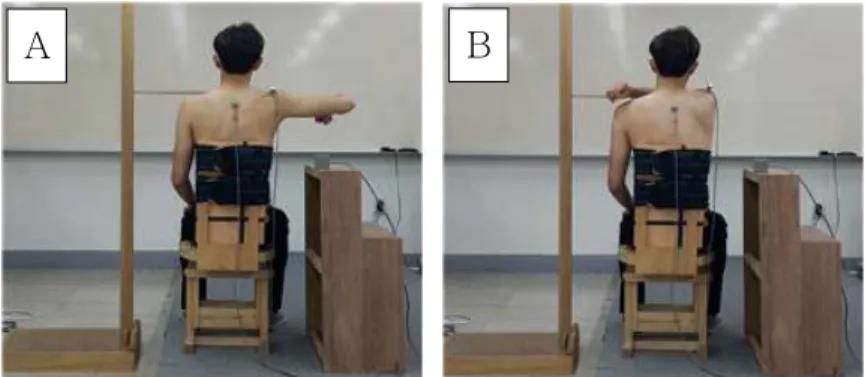
Subjects wore a sleeveless shirt and sat on an ad- justable chair with 90° hip and knee flexion and feet on the ground (Ahn et al, 2014). The subject’s arm was lying freely at the side of the body. To prevent the compensatory motion of trunk, straps were applied on the rib (Ahn et al, 2014). To measure the scapular size for normalizing scapular abduction distance, the distance between the 3rd thoracic spinous process and root of the scapular spine, and the distance between the 3rd thoracic spinous process and posterolateral ac- romion were measured (DiVeta et al, 1990). Liberty sensors were attached to the 3rd thoracic spinous process and flat surface on the posterolateral acromion with double-sided tape (Karduna et al, 2001; Ludewig and Cook, 2000; Hsu et al, 2009). The wooden target bar was set to 130° HA measured by goniometer. The subjects abducted their arm to 90° for 5 seconds, moved toward the target bar, and maintained an end position in 5 seconds using metronome for collecting the data of Liberty (Figure 1). At the end position of each trial, the distance between the 3rd thoracic spi- nous process and root of the scapula was measured by tape measure. Shoulder HA was repeated 3 times with 10 seconds resting time during the trials.
A B
Figure 1. Shoulder horizontal adduction (A: start position, B: end position).
Data collection
To measure the differences between the pre-test and post-test of the normalized scapular abduction distance and three-dimensional displacement of the scapula, post-test value subtracted from pre-test value was calculated.
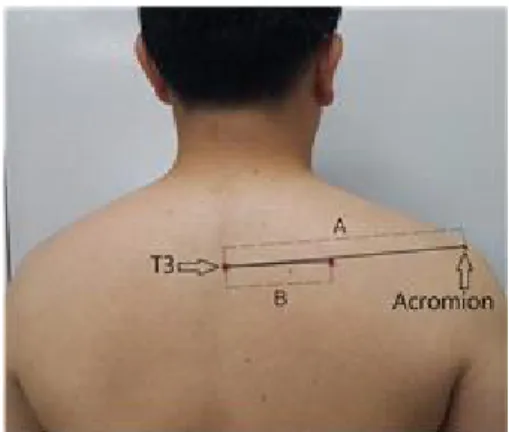
Normalized scapular abduction distance The distance of the scapular abduction was needed for normalization because even though the distance from the 3rd spinous process to the root of the scap- ular spine was the same, the value of the scapular abduction could be different depending on the scap- ular size (DiVeta et al, 1990). Scapular abduction was normalized to scapular size by dividing the distance from the 3rd thoracic spinous process to posterolateral acromion by the scapular size (DiVeta et al, 1990).
To measure the scapular size for normalizing scap- ular abduction distance, the distance between the 3rd thoracic spinous process and root of the scapular spine subtracted from the distance between the 3rd thoracic spinous process and posterolateral acromion (DiVeta et al, 1990). The total scapular abduction distance at end position was calculated by adding the scapular size and the distance between the 3rd spinous process and root of the scapular spine.
Normalized scapular abduction distance was calcu- lated by dividing the total scapular distance at end position into the scapular size (DiVeta et al, 1990) (Figure 2). Normalized scapular abduction distance was measured 3 times at end position. The data were averaged and calculated.
Three-dimensional displacement of the scapula Liberty was used for collecting three-dimensional displacement data; however, the tape measure was two-dimensional. The tape measure was used to measure scapular abduction and protraction although scapular movement might result not only to abduc- tion and protraction but also to other movements.
Thus, Liberty was used to measure overall scapular movement, namely the three-dimensional displace-
ment of the scapula. Three-dimensional displacement of the scapula was described as the relative orientation between the thoracic spine and scapula, which were measured by Liberty. It was scapular displacement on the basis of the 3rd thoracic spinous process displacement. To calculate the three-dimensional dis- placement of the scapula, Euler angle was used. The subjects maintained their start position and end posi- tion for 5 seconds to save Liberty data. The data dur- ing the middle 3 seconds were used and averaged.
Statistical Analysis
For statistical analyses, SPSS ver. 21.0 (SPSS Inc., Chicago, IL, USA) was used. Normal distribution was examined using Kolmogorov-Smirnov Z-test, and an independent t-test was used to compare normalized scapular abduction distance and the distance of scap- ular movement between groups with LROM and nor- mal ROM. The level of significance was set to .05.
Results
Normalized scapular abduction distance The results indicate the difference value between the pre-test and post-test of the normalized scapular
Figure 2. Scapular size was measured by the distance difference value between (A) from the 3rd thoracic spinous process to posterolateral acromion and (B) from the 3rd thoracic spinous process to root of the scapular spine.
Normalized scapular abduction distance=[scapular
size+(B)]/scapular size.
abduction distance. The change of normalized scap- ular abduction distance was significantly greater in LROM group compared to normal ROM group (p<.001) (Table 2). The ratio of LROM group to normal ROM group was 2.55.
Three-dimensional displacement of the scapula The three-dimensional displacement of the scapula was expressed as a relative orientation between the thoracic spine movement and scapular movement.
The results indicated the difference value between the pre-test and post-test of the three-dimensional displacement of the scapula. The change of three-di- mensional displacement of the scapula was sig- nificantly greater in LROM group compared to nor- mal ROM group (p<.05) (Table 3). The ratio of LROM group to normal ROM group was 1.33.
Discussion
In this study, normalized scapular abduction dis- tance and three-dimensional displacement of the scapula during shoulder HA was investigated in subjects with and without LROM of shoulder HA.
Normalized scapular abduction distance was sig- nificantly greater in LROM group than normal ROM group. LROM group was 2.55 times as big as nor-
mal ROM group. Three-dimensional displacement of the scapula was significantly greater in LROM group than normal ROM group. LROM group was 1.33 times as big as normal ROM group.
LROM group had significantly greater normalized scapular abduction distance than normal ROM group.
This can be explained by shortened/dominant poste- rior deltoid (Sahrmann, 2002). If posterior shoulder is shortened, humeral movement would be followed by the scapula during shoulder HA because the domi- nance of the posterior deltoid leads to progress of shortness of the posterior deltoid muscle (Sahrmann, 2002). Relative muscle stiffness is defined as a series of springs of diverse stiffness (Sahrmann, 2002).
This can be explained by shoulder horizontal abduc- tors being stiffer than shoulder horizontal adductors, so the spring of shoulder horizontal abductor is stronger than the spring of shoulder horizontal adductors. The more flexible the spring is, the easier to move. This means that relative stiffness on poste- rior deltoid muscle influences this result. Another study indicated that scapula moves and cannot iso- late the soft tissue surrounding the posterior GH joint when the horizontal adduction is performed without scapular stabilization (Salamh et al, 2015).
This means that if the soft tissue of the posterior GH joint could not be isolated, then scapula would follow the humeral movement. Thus, normalized
Displacement of the scapula Mean±SD
ap value
Normal ROM
bgroup 2.52±.50
LROM
cgroup 3.36±.78 .005
a
standard deviation,
brange of motion,
climited range of motion.
Table 3. Comparison of the three-dimensional displacement of the scapula between normal ROM group and
LROM group (Unit: ㎝)
Scapular abduction Mean±SD
ap value
Normal ROM
bgroup .05±.02
<.001
LROM
cgroup .13±.05
a