Effects of Coupling and Dispersion Agents on the Properties of Styrene-Butadiene Rubber/Butadiene Rubber Compounds Reinforced with Different Silica Contents
Jae-Kyoung Yang *,** , Wonhyeong Park * , Changseok Ryu * , Sun Jung Kim * , Doil Kim * , Jong-Ho Kim ** , and Gon Seo *,**,†
*
Mirae SI, 10, Cheomdanventure-ro 16th, Buk-gu, Gwangju 61009, Republic of Korea
**
School of Chemical Engineering, Chonnam National University, 77 Yongbong-ro, Buk-gu, Gwangju 59626, Republic of Korea (Received June 27, 2018, Revised July 12, 2018, Accepted July 16, 2018)
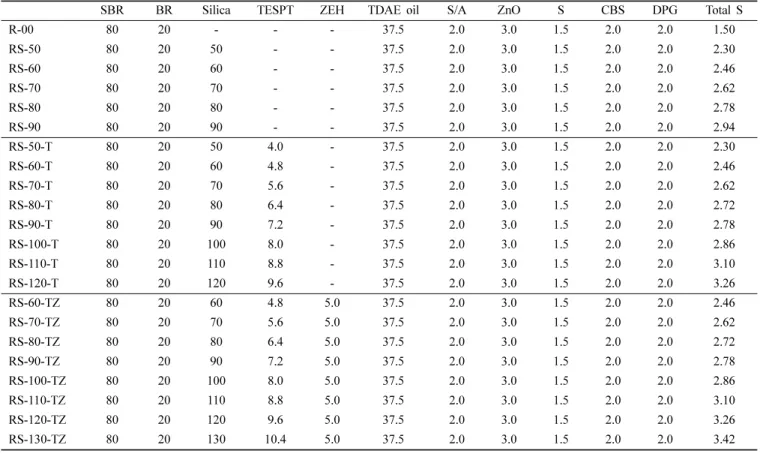
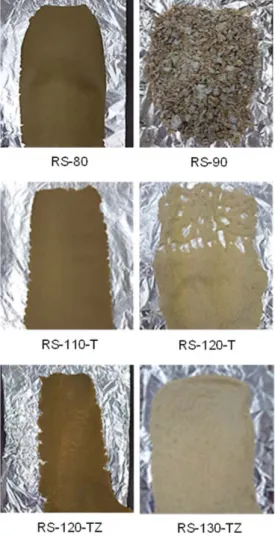
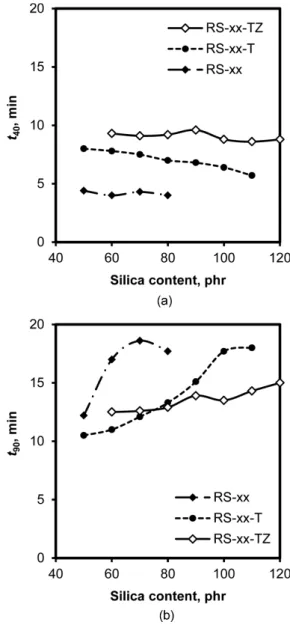
Abstract: The effect of the silica content on the state and properties of silica-filled styrene-butadiene rubber/butadiene rubber (SBR/BR) compounds containing coupling and dispersion agents was evaluated by varying the content of silica from 50 to 120 phr. Bis-[(triethoxysilyl)propyl] tetrasulfide (TESPT) and zinc 2-ethylhexanoate (ZEH) were used as the coupling and dispersion agents, respectively. The maximum silica content in the pristine material was 80 phr, which increased to 120 phr upon the addition of TESPT and ZEH. The incorporation of TESPT considerably improved most of the rubber properties due to its coupling action and the suppression of silica flocculation, while further addition of ZEH resulted in additional improvements. The properties of the rubber compounds with different silica contents can be fully explained either by an enhancement of the rubber–silica interactions or by their deterioration due to an excessive amount of silica aggregates.
Keywords: SBR/BR, silica content, coupling agent, dispersion agent, physical property
Introduction
Since the rolling resistance of tread rubber is directly related to the fuel efficiency of cars, the reduction of rolling resistance has become an important research topic to save on fuel consumption as well as to decrease carbon dioxide emis- sions.
1,2The composition of tread rubber compounds has been optimized to lower rolling resistance and their filler has also been changed from carbon black to silica that can simul- taneously improve the wet traction and rolling resistance of styrene butadiene rubber (SBR) compounds.
3The addition of butadiene rubber (BR) to SBR enhances resistance against wear, and thereby silica-filled SBR/BR compounds have widely been used as tread rubber for high performance of tires with better traction, rolling resistance, and abrasion resistance.
4In addition to the enhancement of silica dispersion, the content of silica in tread rubber has been steadily increased to meet strengthening regulations on the fuel efficiency of cars.
5Coupling agents that have two different functional groups combining rubber chains and silica particles through
covalent bonds are essential in reinforcing the performance of silica.
6The development of many coupling agents involv- ing bis-[(triethoxysilyl)propyl]-tetrasulfide (TESPT) facili- tates the manufacture of green tires with low rolling resistance. Furthermore, the treatment of silica surface with coupling agents,
7accelerator,
8antioxidants,
9or networking materials
10-12has been tried to enhance the dispersion of silica and to increase the content of silica. However, the increase of silica content in rubber compounds above 100 phr inev- itably leads to several disadvantages such as an increase in viscosity, decrease in silica dispersion, and deterioration of their dynamic and abrasive properties. Heavy silica floccu- lation with the increase in silica content limits its content in rubber, so the content of silica addressed in most papers has dealt with the role and performance of silica as a reinforcing filler in SBR, and SBR/BR compounds have remained around 80 phr.
13-16Therefore, papers reporting on the effect of silica content in the preparation and properties of silica- filled rubber compounds on a wide range are very rare.
Although the main role of coupling agents is to form cova- lent bonds between rubber chains and silica particles, the reaction of their alkoxy groups with the hydroxyl groups of silica reduces the attrition between hydrophobic rubber and
†