초등학생 기도과민성의 유병률과 연관 인자
김미숙1, 김영호1,2, 서동인1, 고영률1, 김병주3, 김효빈4, 이소연5, 송대진6, 김우경7, 장광천8, 심정연9, 홍수종10,11, 권지원1,2
1서울대학교 의과대학 소아과학교실, 2분당서울대학교병원 소아청소년과, 3인제대학교 의과대학 해운대백병원 소아청소년과, 4인제대학교 의과대학 상계백병원
소아청소년과, 5한림대학교 의과대학 한림대성심병원 소아청소년과, 6고려대학교 의과대학 구로병원 소아청소년과, 7인제대학교 의과대학 서울백병원 소아청소년과,
8국민건강보험 일산병원 소아청소년과, 9성균관대학교 의과대학 강북삼성병원 소아청소년과, 10울산대학교 의과대학 서울아산병원 소아청소년과 소아천식아토피센터,
11알레르기질환표준화연구센터
The prevalence of bronchial hyperresponsiveness in elementary school children and its associated factors
Mi Suk Kim1, Young Ho Kim1,2, Dong In Suh1, Young Yull Koh1, Byoung-Ju Kim3, Hyo Bin Kim4, So Yeon Lee5, Dae Jin Song6, Woo-Kyung Kim7, Gwang Cheon Jang8, Jung Yeon Shim9, Soo-Jong Hong10,11, Ji-Won Kwon1,2
1Department of Pediatrics, Seoul National University College of Medicine, Seoul; 2Department of Pediatrics, Seoul National University Bundang Hospital, Seongnam; 3Department of Pediatrics, Inje University Haeundae Paik Hospital, Inje University College of Medicine, Busan; 4Department of Pediatrics, Inje University Sanggye Paik Hospital, Inje University College of Medicine, Seoul; 5Department of Pediatrics, Hallym University Secred Heart Hospital, Hallym University College of Medicine, Anyang; 6Department of Pediatrics, Korea University Guro Hospital, Korea University College of Medicine, Seoul; 7Department of Pediatrics, Inje University Seoul Paik Hospital, Inje University College of Medicine, Seoul; 8Department of Pediatrics, National Health Insurance Corporation Ilsan Hospital, Goyang; 9Department of Pediatrics, Kangbuk Samsung Medical Center, Sungkyunkwan University School of Medicine, Seoul; 10Childhood Asthma Atopy Center, Department of Pediatrics, Asan Medical Center, University of Ulsan College of Medicine, Seoul; 11Research Center for Standardization of Allergic Diseases, Seoul, Korea
Purpose: We investigated the prevalence of bronchial hyperresponsiveness (BHR) and its associated factors in population-based el- ementary school children.
Methods: Methacholine bronchial provocation tests were performed on 1,151 elementary school children and BHR was defined as PC20 (provocative concentration of methacholine causing a 20% fall in forced expiratory volume in 1 second [FEV1]) ≤ 8 mg/mL. We analyzed the prevalence of BHR according to age and sex. The Korean version of International Study of Asthma and Allergies in Childhood (ISAAC) questionnaire, skin prick test, pulmonary function test, and blood tests were performed to determine associated factors for BHR.
Results: A total of 1,106 students eligible for provocation tests were included in the analysis. The overall prevalence of PC20 ≤8 mg/
mL was 11.5% (95% confidence interval, 10.6–13.4) and BHR decreased with age (P-value for trend <0.001). Younger age (adjusted odds ratio [aOR], 0.860; P=0.032), higher blood eosinophil % (aOR, 1.151; P= 0.001), lower predictive % of FEV1 (aOR, 0.977; P= 0.029), fraction of exhaled nitric oxide (FeNO) ≥ 25 ppb (aOR, 2.118; P= 0.025), and sensitization to mites (aOR, 1.705; P= 0.034) were associ- ated with BHR. Preterm birth (aOR, 2.056; P= 0.068) showed borderline significance. The associated factors for BHR with atopy were lower body mass index (aOR, 0.838; P=0.005), preterm birth (aOR, 4.361; P=0.003), and FeNO ≥25 ppb (aOR, 2.161; P=0.043). Younger age (aOR, 0.810; P= 0.037) and higher blood eosinophil % (aOR, 1.296; P< 0.001) were associated with BHR without atopy.
Conclusion: The prevalence of BHR decreased with age in elementary school children. Younger age, preterm birth, eosinophilia, sensitization to mites, lower lung function, and higher FeNO level were independently associated with BHR. (Allergy Asthma Respir Dis 2014;2:171-178)
Keywords: Bronchial hyperreactivity, Prevalence, Associated factors, Child
서 론
천식을 포함한 알레르기질환은 우리 나라를 포함하여 전세계적
으로 증가하는 추세를 보이고 있다.1-6) 천식의 유병률 증가와 함께 그로 인한 사회적 비용의 증가로 사회적 관심이 증대되면서 전세계 적으로 이 질환에 대한 체계적 관리와 예방의 필요성에 대한 공감 Allergy Asthma Respir Dis 2(3):171-178, July 2014 http://dx.doi.org/10.4168/aard.2014.2.3.171 ORIGINAL ARTICLE
Correspondence to: Ji-Won Kwon
Department of Pediatrics, Seoul National University Bundang Hospital, Seoul National University College of Medicine, 82 Gumi-ro 173beon-gil, Bundang-gu, Seongnam 463-707, Korea
Tel: +82-31-787-7296, Fax: +82-31-787-4054, E-mail: [email protected]
• This study was supported by a grant from the Korea Healthcare Technology R&D Project, Ministry for Health, Welfare, Republic of Korea (A092076).
Received: August 26, 2013 Revised: October 10, 2013 Accepted: October 16, 2013
© 2013 The Korean Academy of Pediatric Allergy and Respiratory Disease The Korean Academy of Asthma, Allergy and Clinical Immunology This is an Open Access article distributed under the terms of the Creative Commons Attribution Non-Commercial License
대가 형성되어 ‘국제 소아 천식 및 알레르기질환의 역학조사(Inter- national Study of Asthma and Allergies in Childhood, ISAAC)’가 1995년부터 시행되었다.6-8) 우리나라에서도 ISAAC를 토대로 한 역 학조사 연구를 통하여 천식의 유병률 및 위험 인자에 대한 연구가 이뤄지고 있다.
기도과민성(bronchial hyperresponsiveness, BHR)은 천식의 주 된 특성으로 이와 관련하여 발생하는 다양한 정도의 기도폐쇄로 천식의 증상이 나타나게 된다. 기도과민성의 정도가 심할수록 천 식의 중증도는 높은 것으로 알려져 있으며,9-11) 유아기 알레르기질 환의 병력, 저체중 출생 및 출생 당시 부모의 사회, 경제적 위치가 상 위에 속한 경우 학동기 기도과민성의 위험 요인이 된다는 보고가 있었다.12) 또한 기도과민성은 천식의 지속에도 영향을 미쳐 학동기 의 기도과민성 증가가 성인 초기 폐기능 및 기도과민성과 관련이 있는 것으로 나타났다.13,14) 기도과민성의 지속과 관련된 요인으로 는 여아, 학동기 연령, 천식 진단 시 중증도, 알레르기질환의 가족 력, 아토피 병력, 환경에 따른 학동기 항원감작, 혈청 총 IgE치, 조기 호흡기 감염, 기도 개형 등이 보고되었다.13,15,16) 기도과민성은 천식 의 주된 특성이며 학동기 기도과민성 증가가 성인기까지 천식 증상 의 지속에 영향을 미치므로 기도과민성과 관련된 요인을 밝히는 것은 천식의 예방, 치료 및 예후 예측에 도움이 될 수 있다. 우리나 라에서는 고등학생 연령에서 혈청 총 IgE와 흡입 알레르겐 감작이 기도과민성과 연관된다는 연구가 있었으나,17) 아직 초등학생 연령 에서 이루어진 연구는 없다. 이에 저자들은 초등학생 일반군을 대 상으로 연령과 성별에 따른 기도과민성의 유병률을 알아보고, 기 도 과민성과 연관된 요인에 대하여 알아보고자 하였다.
대상 및 방법
1. 연구 대상
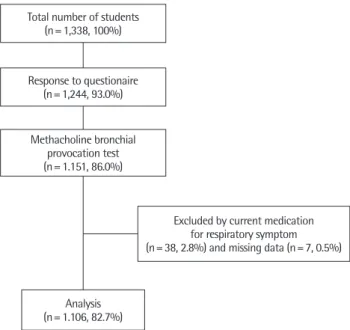
2012년 6월 4일에서 29일까지 서울시 성동구 소재 초등학교 한 곳에 재학중인 1,338명의 학생 중 1,244명의 소아를 대상으로 설문 조사를 실시하고(응답률 93.0%), 그 중 1,151명에서 메타콜린 기관 지유발시험을 시행하였다(검사율 86.0%). 기관지유발시험을 시행 받은 학생 중 호흡기 증상으로 약물을 복용하고 있던 38명과 약물 복용 유무에 대한 질문에 응답하지 않은 7명은 분석에서 제외하여 총 1,106명의 환자에 대하여 분석을 시행하였다(Fig. 1). 모든 설문 조사와 검사는 보건복지부 알레르기질환 표준화 연구의 일환으로 질병관리본부 기관윤리심의위원회의 승인을 거쳐 진행되었다.
2. 조사항목 1) 기관지유발시험
메타콜린 기관지유발시험(methacholine bronchial provocation test)은 미국흉부학회(American Thoracic Society, ATS)에서 권유
하는 방식에 따라 시행하였다.18) 생리식염수를 5회 평상 호흡을 통 해 흡입시킨 후 측정한 1초간 노력성호기량(forced expiratory vol- ume in 1 second, FEV1)을 비교 기준치로 하여, 메타콜린을 0.62, 1.25, 2.5, 5, 12.5, 25 mg/mL의 농도로 희석하여 각 농도의 메타콜 린을 생리식염수와 같은 방식으로 흡입한 뒤 FEV1 값을 측정하였 다. 생리식염수 흡입 후 측정된 FEV1보다 20% 이상 감소하는 지점 의 메타콜린 농도를 PC20 (provocative concentration of methacho- line causing a 20% fall in FEV1) 으로 정하여 PC20≤8 mg/mL, 16 mg/mL인 경우의 빈도를 조사하였다.18)
2) 설문조사
기도과민성검사와 함께 천명 또는 천식의 유병률을 조사하기 위 하여 한국형 ISAAC 설문지를 이용하여 평생 및 최근 12개월 동안 의 천명 증상, 의사로부터 진단받은 천식, 최근 1년간 천식 치료 유 무에 대해 조사하였고, 천식 진단을 받고 최근 12개월 동안 천명을 보인 경우는 현증 천식으로 정의하여 그 유무를 함께 조사하였다.
설문에 대한 응답자는 소아와 생활하는 부모 또는 보호자였다.
3) 피부단자시험
알레르기 피부단자시험은 히스타민을 양성대조액으로, 생리식 염수를 음성대조액으로 사용하였으며, 항원에 대한 팽진이 3 mm 이상이면서 동시에 양성대조액보다 클 때를 양성으로 정의하였다.
원인 항원(Allergopharma GmbH & Co. KG, Darmstadt, Germa- ny)으로는 국내에서 흔한 흡입항원과 식품항원을 사용하였으며, 실내 흡입항원으로 집먼지진드기 2종류(Dermatophagoides pter-
Total number of students (n= 1,338, 100%)
Response to questionaire (n= 1,244, 93.0%)
Methacholine bronchial provocation test (n= 1.151, 86.0%)
Analysis (n= 1.106, 82.7%)
Excluded by current medication for respiratory symptom (n= 38, 2.8%) and missing data (n= 7, 0.5%)
Fig. 1. Scheme of subject eligibility for the study. Total 1,106 students eligible for provocation tests were included in the analysis (82.7%).
onyssinus, Dermatophagoides farinae), 개와 고양이 상피(dog epi- thelia, cat epithelia), 바퀴벌레, 곰팡이 2종류(Alternaria alternate, Aspergillus fumigatus), 실외 흡입항원으로 잔디화분(grass pollen), 돼지풀(ragweed), 쑥(mugwort), 오리나무(alder), 떡갈나무(oak), 자작나무(birch), 식품항원으로 땅콩, 우유, 계란 흰자 및 콩을 각각 사용하였다.
4) 폐기능검사
폐기능검사는 미국흉부학회와 유럽호흡기학회에서 권유하는 기준에 따라 시행하였다.19) 훈련된 검사요원에 의해 학교를 직접 방 문하여 시행하였으며 휴대용 Microspirometer (Microspiro HI-298, Chest Co., Tokyo, Japan)를 이용하여 노력성폐활량(forced vital capacity, FVC), 1초간노력성호기량(FEV1)과 FEV1/FVC 비율을 산 출하였다.
3. 통계분석
설문조사 및 각 검사를 통하여 얻어진 자료는 SPSS ver. 15.0 (SPSS Inc., Chicago, IL, USA)를 사용하여 분석하였다. 기도과민성 에 영향을 주는 요인을 분석하기 위하여 나이, 성별, 체질량지수, 부 모의 학력, 아토피 피부염 및 알레르기 비염의 과거력, 생후 2세 이 전의 모세기관지염 병력, 6개월 이상 모유수유, 1세 이전 3일 이상 의 항생제 투여력, 부모의 천식, 미숙아 출생, 제왕절개 출생력 등의 변수를 사용하여 각각의 교차비와 95% 신뢰구간을 구하였다. 또 한 로지스틱 회기분석을 이용하여 나이, 성별, 체질량지수, 아토피 피부염의 병력, 모친의 교육 수준, 가정 소득, 아토피, 간접흡연(en- vironmental tobacco smoke), 혈액 내 호산구분율(eosinophil per- cent) 및 log IgE치, predictive percent of FEV1 등을 보정한 교차비 와 95% 신뢰구간을 제시하였다. 모든 통계분석에서 P값이 0.05 미 만인 경우 통계적으로 유의하다고 평가하였다.
결 과
1. 대상 환아의 일반적 특성
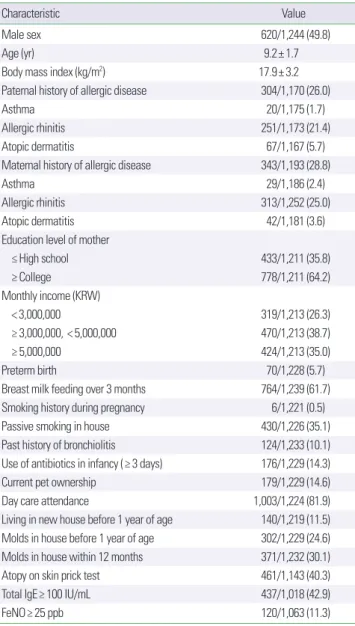
설문조사에 응한 1,244명 중 남아는 49.8%, 여아는 50.2%였으며 평균 나이는 9.2±1.7세, 체질량지수는 17.9±3.2 kg/m2 였다. 부친 이 천식, 비염, 아토피피부염 등 알레르기질환의 병력이 있는 경우 는 전체의 26.0%였고, 모친이 알레르기질환을 가진 경우는 28.8%
였다. 미숙아 출생은 전체의 5.7%였고, 3개월 이상 모유 수유를 하 였던 경우는 61.7%였다. 집안에서 간접흡연을 경험한 경우는 전체 의 35.1%, 애완견을 기른 경우는 14.6%였으며, 최근 12개월 이내에 집안에서 곰팡이가 관찰되었던 경우는 30.1%였다. 2세 이전에 모 세기관지염을 앓았던 병력이 있는 경우는 10.1%였고, 영아기에 3일 이상 항생제를 투여 받은 경우는 14.3%였다. 전체의 40.3%가 아토
피 양성 소견을 보였으며, 혈청 총 IgE치가 100 IU/mL 이상인 경우 는 42.9%였다(Table 1).
2. 기도과민성, 천명 및 천식의 유병률
PC20≤8 mg/mL을 기준으로 하였을 때 기도과민성 양성은 전체 의 11.5% (95% confidence interval [CI], 10.6–13.4)였으며, PC20≤16 mg/mL을 기준으로 하였을 때는 19.4% (95% CI, 17.1–21.7)였다. 최 근 1년간 천명을 경험한 경우는 3.5% (95% CI, 2.5–4.5), 의사로부 터 천식 진단을 받은 경우는 5.1% (95% CI, 3.9–6.3), 최근 1년간 천 식 치료를 받은 경우는 전체의 1.3% (95% CI, 0.7–1.9)였으며, 현증 천식의 유병률은 0.8% (95% CI, 0.3–1.3)였다(Table 2).
Table 1. Characteristics of the subjects
Characteristic Value
Male sex 620/1,244 (49.8)
Age (yr) 9.2± 1.7
Body mass index (kg/m2) 17.9± 3.2
Paternal history of allergic disease 304/1,170 (26.0)
Asthma 20/1,175 (1.7)
Allergic rhinitis 251/1,173 (21.4)
Atopic dermatitis 67/1,167 (5.7)
Maternal history of allergic disease 343/1,193 (28.8)
Asthma 29/1,186 (2.4)
Allergic rhinitis 313/1,252 (25.0)
Atopic dermatitis 42/1,181 (3.6)
Education level of mother
≤ High school 433/1,211 (35.8)
≥ College 778/1,211 (64.2)
Monthly income (KRW)
< 3,000,000 319/1,213 (26.3)
≥ 3,000,000, < 5,000,000 470/1,213 (38.7)
≥ 5,000,000 424/1,213 (35.0)
Preterm birth 70/1,228 (5.7)
Breast milk feeding over 3 months 764/1,239 (61.7)
Smoking history during pregnancy 6/1,221 (0.5)
Passive smoking in house 430/1,226 (35.1)
Past history of bronchiolitis 124/1,233 (10.1)
Use of antibiotics in infancy (≥ 3 days) 176/1,229 (14.3)
Current pet ownership 179/1,229 (14.6)
Day care attendance 1,003/1,224 (81.9)
Living in new house before 1 year of age 140/1,219 (11.5) Molds in house before 1 year of age 302/1,229 (24.6) Molds in house within 12 months 371/1,232 (30.1)
Atopy on skin prick test 461/1,143 (40.3)
Total IgE≥ 100 IU/mL 437/1,018 (42.9)
FeNO≥ 25 ppb 120/1,063 (11.3)
Values are presented as number (%) or mean± standard deviation.
KRW, Korean Won (the currency of South Korea); IgE, immunoglobulin E; FeNO, frac- tion of exhaled nitric oxide.
PC20≤8 mg/mL을 기준으로 하였을 때 기도과민성 양성률은 연 령이 증가함에 따라 감소하는 양상을 보였으며(P value for trend<
0.001), 연령별 성별에 따른 차이는 보이지 않았다(Fig. 2).
3. 기도과민성에 영향을 주는 인자
1) 전체 대상군에서 기도과민성에 영향을 주는 인자
연령이 어릴수록 기도과민성의 양성률이 높은 것으로 나타났으 나(adjusted OR [aOR], 0.860; 95% CI, 0.750–0.987), 성별에 따른 차이는 없었다. 미숙아 출생력은 통계적 유의성은 없었으나 경계선 상의 관련성을 보였다(aOR, 2.056; 95% CI, 0.948–4.459). 생물학적 지표 중 혈청 호산구분율이 높은 경우(aOR, 1.151; 95% CI, 1.058–
1.251), predictive percent of FEV1이 낮은 경우(aOR, 0.977; 95% CI, 0.957–0.998), 호기산화질소 농도가 25 ppb 이상인 경우(aOR, 2.118;
95% CI, 1.101–4.073), 집먼지진드기에 감작된 경우(aOR, 1.656;
95% CI, 1.016–2.700) 기도과민성이 증가하였으며, 최근 12개월 이 내에 집안에서 곰팡이가 관찰되었던 경우에 기도과민성이 감소하 는(aOR, 0.447; 95% CI, 0.256–0.778) 것으로 나타났다(Table 3).
2) 아토피 유무에 따라 기도과민성에 영향을 주는 요인
아토피유무에 따라 기도과민성에 영향을 주는 요인을 분석한 결과, 아토피가 있는 경우에는 낮은 체질량지수(aOR, 0.838; 95%
CI, 0.741–0.948), 미숙아 출생력(aOR, 4.361; 95% CI, 1.672–11.372), 호기산화질소농도가 25 ppb 이상인 경우(aOR, 2.161; 95% CI, 1.023–4.561)에 기도과민성이 높은 것으로 나타났다. 그리고 아토 피가 없는 경우에는 연령이 어릴수록(aOR, 0.810; 95% CI, 0.666–
0.987), 말초혈액 호산구분율이 높을수록(aOR, 1.296; 95% CI, 1.126–1.492) 기도과민성이 증가하는 것으로 나타났으나, 알레르겐 에 감작되지 않은 아토피 피부염의 경우 기도과민성이 낮은(aOR, 0.456; 95% CI, 0.210–0.990) 것으로 나타났다(Table 4).
고 찰
기도과민성이 곧 천식을 의미하는 것은 아니나 기도과민성이 증 가할수록 천식 증상이 심하게 나타나며, 성인기까지 천식 증상이 지속되고 성인기 폐기능 감소에 영향을 줄 수 있으므로 소아청소년 기에 기도과민성에 영향을 주는 요인을 조사하는 것은 중요하다.
본 연구에서는 초등학생에서 나이가 증가함에 따라 기도과민성이 감소하고, 높은 혈액 호산구 수와 호기산화질소, 낮은 폐기능, 집먼 지진드기 감작, 미숙아 출생 등의 경우 기도과민성이 높은 것을 관 찰하였는데, 이는 초등학생 일반군을 대상으로 기도과민성의 유병 률과 관련 요인을 제시한 국내 첫 논문으로 그 의의가 있다.
기도과민성의 경우 비염이나 천식의 증상을 보이지 않은 일반인 을 대상으로 하였을 때 약 5%–8%에서 양성 소견을 보였으며, 기도 과민성이 양성이었던 대상군의 약 50% 정도에서 천식 환자로 진단 받는 것으로 알려져 있다.20) 이는 기도과민성이 만성 호흡기질환 또 는 알레르기비염 환자의 상당수에서 나타나며, 만성 호흡기질환에 이환되지 않은 정상인이 바이러스에 감염되었을 때도 양성 소견을 보일 수 있기 때문이다. 그동안 국내에서 천명 또는 천식의 유병률 에 대한 여러 선행 연구들이 있었으나 기도과민성의 유병률 자체에 대한 연구는 거의 없었으며, 천식과 연관된 요인으로서 기도과민성 이 천식 증상의 지속에 영향을 준다는 연구가 시행된 바 있다.10)
일반 초등학생을 대상으로 시행된 본 연구에서 기도과민성의 유 병률은 기도과민성 양성 기준을 ATS 가이드라인18)에서 제시하고 있는 borderline BHR의 기준(PC20, 4–16 mg/mL)인 PC20≤8 mg/mL 로 하였을 때 약 11.5%, PC20≤16 mg/mL 를 기준으로 하였을 때는 약 19.4% 정도 되는 것으로 나타났다. 또한 기도과민성의 양성률은 연령이 증가함에 따라 감소하는 것으로 나타났으며, 이러한 경향은 성별에 따른 차이를 보이지는 않았다. 연령이 어릴수록 같은 기준 Table 2. Prevalence of wheezing, asthma, and bronchial hyperresponsiveness
(BHR)
Variable No. % (95% CI)
Wheeze ever 152/1,240 12.3 (10.5–14.1)
Wheeze, last 12 months 43/1,240 3.5 (2.5–4.5)
Diagnosis of asthma ever 63/1,240 5.1 (3.9–6.3) Treatment of asthma, last 12 months 15/1,193 1.3 (0.7–1.9)
Current asthma 10/1,239 0.8 (0.3–1.3)
BHR
PC20≤ 8 mg/mL 127/1,106 11.5 (10.6–13.4)
PC20≤ 16 mg/mL 127/1,106 19.4 (17.1–21.7)
CI, confidence interval; PC20, provocative concentration of methacholine causing a
20% fall in forced expiratory volume in 1 second. Fig. 2. Prevalence of bronchial hyperresponsiveness (PC20≤ 8 mg/mL) according to age and sex. The P value for trend was 0.009 in males, 0.001 in females, and
< 0.001 in total subjects. There were no sex differences in each age; PC20, pro- vocative concentration of methacholine causing a 20% fall in forced expiratory volume in 1 second.
Male Female 25
20
15
10
5
0 6 7 8 9 10 11 12
Prevalence (%)
Age (yr)
에서의 기도과민성이 증가하는 이유 중 하나는 기도의 구조와 임 피던스(impedance), 기관지 평활근의 수축력이 연령이 증가함에 따라 변화하기 때문이다. 즉, 연령이 증가함에 따라 기도의 유순도 는 감소하고, 폐의 탄성반동(elastic recoil)은 증가함으로써 기도 평 활근의 기계적 임피던스(impedance)가 증가하게 되어 결과적으로
연령이 증가함에 따라 기도과민성은 감소하게 된다.21-23) 이와 함께 연령이 증가함에 따라 기도의 절대적 크기가 증가하는 것 또한 기 도과민성의 감소에 영향을 주게 된다.
본 연구에서는 기도과민성의 유병률과 더불어 ISAAC 설문을 이 용한 천명과 천식의 유병률을 함께 조사하였다. 국내 학동기 소아 Table 3. Associated factors for bronchial hyperresponsiveness (PC20≤ 8 mg/mL) in elementary school children
Associated factor PC20
OR (95% CI) P-value aOR (95% CI) P-value
Demographic factors
Age 0.793 (0.708–0.887) < 0.001 0.860 (0.750–0.987) 0.032
Male sex 1.110 (0.766–1.607) 0.581 1.204 (0.771–1.880) 0.415
Body mass index (≥ 85 percentile) 0.887 (0.828–0.949) 0.001 0.941 (0.867–1.021) 0.941
Maternal education (≥ college graduate) 0.824 (0.561–1.209) 0.323 0.769 (0.481–1.228) 0.271
Personal history
Past history of AD diagnosis 0.948 (0.636–1.412) 0.792 0.706 (0.442–1.127) 0.144
Past history of AR diagnosis 1.303 (0.891–1.904) 0.172 1.295 (0.822–2.041) 0.265
History of bronchiolitis before 2 years old 0.842 (0.438–1.618) 0.606 0.781 (0.372–1.638) 0.513
Breast milk feeding≥ 6 months 1.256 (0.761–2.072) 0.373 1.231 (0.682–2.223) 0.490
Use of antibiotics in infancy (≥ 3 days) 0.760 (0.386–1.495) 0.426 0.650 (0.294–1.438) 0.288
Genetic factors
Parental asthma 0.763 (0.268–2.170) 0.612 0.735 (0.248–2.174) 0.578
Factors associated with pregnancy
Premature birth 2.532 (1.374–4.667) 0.003 2.056 (0.948–4.459) 0.068
Birth weight 0.975 (0.669–1.421) 0.894 1.166 (0.744–1.828) 0.503
Delivery (cesarean section) 0.985 (0.673–1.440) 0.936 0.972 (0.622–1.518) 0.901
Environmental factors
Environmental tobacco smoking 0.802 (0.535–1.201) 0.285 0.834 (0.523–1.331) 0.447
Current pet ownership 1.803 (0.455–1.418) 0.449 0.772 (0.399–1.492) 0.441
Pet ownership in pregnancy or infancy 1.669 (0.821–3.393) 0.157 1.324 (0.568–3.088) 0.516
Having older siblings 1.118 (0.771–1.621) 0.558 0.968 (0.626–1.498) 0.886
Having younger siblings 0.904 (0.621–1.318) 0.601 0.851 (0.549–1.319) 0.470
Day care attendance 0.955 (0.590–1.546) 0.851 0.777 (0.449–1.344) 0.366
Living in new house before 1 year of age 1.255 (0.724–2.175) 0.418 1.050 (0.557–1.982) 0.880
Molds in house before 1 year of age 0.911 (0.587–1.415) 0.691 0.902 (0.542–1.504) 0.693
Molds in house within 12 months 0.680 (0.439–1.053) 0.084 0.447 (0.256–0.778) 0.004
Biologic markers
Log serum total IgE 1.953 (1.396–2.733) < 0.001 1.375 (0.847–2.233) 0.198
Eosinophil % in peripheral blood 1.203 (1.127–1.285) < 0.001 1.151 (1.058–1.251) 0.001
FEV1, predictive % 0.984 (0.967–1.002) 0.078 0.977 (0.957–0.998) 0.029
FEV1/FVC 0.974 (0.944–1.005) 0.104 0.978 (0.941–1.017) 0.260
FeNO≥ 25 ppb 2.635 (1.605–4.325) < 0.001 2.118 (1.101–4.073) 0.025
Atopy on skin prick test, any allergen
Atopy to house dust mites 2.069 (1.427–3.000) < 0.001 1.656 (1.016–2.700) 0.043
Atopy to pollen 0.871 (0.454–1.672) 0.846 0.791 (0.378–1.655) 0.533
Atopy to fungus 1.563 (0.639–3.822) 0.328 0.904 (0.292–2.798) 0.861
aOR: adjusted by age, sex, body mass index, personal AD, parental asthma, maternal education, monthly income, environmental tobacco smoke, log IgE, eosinophil percent, predictive % of FEV1, and atopy on skin prick test.
PC20, provocative concentration of methacholine causing a 20% fall in FEV1; OR, odds ratio; CI, confidence interval; aOR, adjusted OR; AD, atopic dermatitis; AR, allergic rhinitis;
IgE, immunogloulin E; FEV1, forced expiratory volume in 1 second; FVC, forced vital capacity; FeNO, fraction of exhaled nitric oxide.
를 대상으로 한 선행 연구에서 12개월 동안의 천명의 유병률은 평 균 약 5%–6%, 평생 천식 진단의 유병률은 약 8%–9%, 12개월 동안 천식으로 치료받은 유병률은 약 3%였다.2,4,24,25) 본 연구에서는 12개 월 동안의 천명의 유병률은 평균 약 3.5%, 평생 천식 진단의 유병률 은 약 5.1%, 12개월 동안 천식으로 치료받은 유병률은 약 1.3%로 선 행 연구와 비교하여 전반적인 유병률이 낮은 것으로 나타났다. 이 러한 차이는 본 연구가 한 지역만을 대상으로 시행된 점과 설문조 사 과정에서 회상편견의 가능성 때문일 수 있으나, 서울시 자치구
중 소득이 평균인 지역으로 조사 대상을 선정한 점, 1995년부터 2008년까지 서울 지역에서의 소아 천식의 유병률의 변화에 대한 이 전 연구에서 유병률이 더 이상 증가하지 않고 정체되어 있는 것으 로 나타난 점,2) 전 세계적으로 1, 2차 ISAAC 조사에서 유병률이 높 았던 나라들은 3차 조사에서 유병률이 감소하거나 정체하는 양상 을 보인 점6) 등을 고려하여 해석해야 하며 향후 대규모 조사를 통 한 유병률 변화추이를 관찰하는 것이 필요하다.
본 연구에서는 미숙아출생이 기도과민성, 특히 아토피가 있는 Table 4. Associated factors for bronchial hyperresponsiveness (PC20≤ 8 mg/mL) according to atopy
Associated factor
PC20
Atopic (n= 461) Nonatopic (n= 682)
aOR (95% CI) P-value aOR (95% CI) P-value
Demographic factor
Age 0.887 (0.729–1.081) 0.234 0.810 (0.666–0.987) 0.037
Male sex 0.718 (0.380–1.357) 0.308 1.663 (0.871–3.176) 0.123
Body mass index (≥ 85 percentile) 0.838 (0.741–0.948) 0.005 1.055 (0.945–1.177) 0.339
Maternal education (≥ graduate) 0.748 (0.368–1.448) 0.388 0.899 (0.452–1.789) 0.761
Personal history
Past history of AD diagnosis 0.769 (0.416–1.425) 0.404 0.456 (0.210–0.990) 0.047
Past history of AR diagnosis 1.585 (0.846–2.972) 0.150 0.951 (0.470–1.926) 0.889
History of bronchiolitis before 2 years old 1.074 (0.411–2.806) 0.883 0.879 (0.305–2.533) 0.811
Breast milk feeding≥ 6 months 1.105 (0.483–2.528) 0.814 1.678 (0.647–4.352) 0.287
Use of antibiotics in infancy (≥ 3 days) 0.896 (0.325–2.470) 0.832 0.339 (0.087–1.324) 0.120
Genetic factors
Parental asthma 0.884 (0.238–3.284) 0.854 0.543 (0.068–.4.329) 0.564
Factors associated with pregnancy
Premature birth 4.361 (1.672–11.372) 0.003 0.239 (0.019–3.014) 0.268
Birth weight 1.081 (0.608–1.922) 0.790 1.105 (0.535–2.283) 0.787
Delivery (cesarean section) 0.709 (0.370–1.361) 0.301 1.111 (0.584–2.111) 0.749
Environmental factors
Environmental tobacco smoking 0.554 (0.277–1.109) 0.095 1.181 (0.623–2.236) 0.611
Current pet ownership 0.771 (0.314–1.895) 0.571 0.635 (0.109–3.692) 0.613
Pet ownership in pregnancy or infancy 1.494 (0.515–4.322) 0.460 1.494 (0.515–4.322) 0.460
Having older siblings 0.973 (0.530–1.788) 0.931 0.989 (0.519–1.884) 0.973
Having younger siblings 0.919 (0.502–1.681) 0.784 0.755 (0.400–1.501) 0.450
Day care attendance 0.947 (0.425–2.112) 0.895 0.647 (0.302–1.384) 0.261
Living in new house before 1 year of age 0.740 (0.302–1.813) 0.510 1.468 (0.593–3.634) 0.407
Molds in house before 1 year of age 0.837 (0.392–1.786) 0.646 0.942 (0.462–1.922) 0.870
Molds in house within 12 months 0.403 (0.190–0.856) 0.018 0.655 (0.300–1.427) 0.286
Biologic markers
Log serum total IgE 1.211 (0.585–2.507) 0.606 1.272 (0.654–2.472) 0.479
Eosinophil % in peripheral blood 1.090 (0.981–1.212) 0.111 1.296 (1.126–1.492) < 0.001
FEV1, predictive % 0.911 (0.948–1.008) 0.145 0.979 (0.952–1.006) 0.131
FEV1/FVC 0.984 (0.927–1.044) 0.584 0.962 (0.914–1.013) 0.144
FeNO≥ 25 ppb 2.161 (1.023–4.561) 0.043 3.356 (0.644–14.476) 0.150
aOR: adjusted by age, sex, body mass index, personal AD, parental asthma, maternal education, monthly income, environmental tobacco smoke, log IgE, eosinophil percent, predictive % of FEV1, and atopy on skin prick test.
PC20, provocative concentration of methacholine causing a 20% fall in FEV1; aOR, adjusted odds ratio; CI, confidence interval; AD, atopic dermatitis; AR, allergic rhinitis; IgE, im- munogloulin E; FEV1, forced expiratory volume in 1 second; FVC, forced vital capacity; FeNO, fraction of exhaled nitric oxide.
대상군에서 기도과민성의 증가와 연관되는 것으로 나타났다. 미숙 아의 경우 자궁 내에서 폐성숙이 이뤄져야 할 시기에 출생하게 되 어 폐 손상을 유발할 수 있는 자궁 밖의 위험환경, 산소흡입, 기계호 흡 등에 노출되면서 미성숙한 호흡기계에 구조적, 기능적 변화가 생길 수 있다. 이러한 변화는 기도과민성에도 영향을 미쳐 미숙아 로 출생한 대상군에서 기도과민성의 유병률이 높은 것으로 알려져 있다.26) 선행 연구에 의하면 만삭아로 출생한 대상군에서의 기도과 민성은 유전, 알레르기 병력, 간접흡연의 노출력 및 기관지의 염증 정도를 반영하는 표지자와 관련성을 보인 반면, 미숙아로 출생한 대상군에서의 기도과민성은 이들과의 연관성은 뚜렷하지 않고 미 숙아 시기 기관지폐이형성의 병력 및 장기간 산소를 필요로 하였던 경우 기도과민성이 증가하는 것으로 보고된 바 있다.27) 그러나 본 연구에서는 미숙아 출생력이 아토피 성향이 있는 대상군의 기도과 민성에 더 뚜렷하게 영향을 주는 것으로 관찰되었다. 이는 본 연구 의 대상군이 대부분 재태연령 34주 이상, 1,500 g 이상으로 이들에 서의 기도과민성의 증가는 호흡기계 손상과 기관지폐이형성에 의 한 영향보다는 미숙함 자체에 의한 낮은 폐기능에 의한 현상일 수 있다. 실제로 재태연령 33, 34주로 태어난 미숙아의 폐기능이 낮으 며, 이러한 현상이 8, 9세까지 지속된다는 보고가 있다.28)
일반적으로 곰팡이 및 집먼지진드기에 감작되어 있는 경우 기도 과민성의 정도가 증가하는 것으로 알려져 있다.29) 본 연구에서 집먼 지진드기에 감작되어 있는 경우에 기도과민성이 증가하는 것으로 나타났으나, Alternaria나 Asperigillus 감작과는 관련성이 없었으 며, 최근 12개월 이내에 집안에서 곰팡이가 관찰되었던 경우에는 오히려 기도과민성이 감소하는 것으로 나타났다. 이는 항원에 자주 노출되어 면역관용을 획득할 경우 오히려 알레르기질환의 발생률 이 감소한다는 위생가설에 부합하는 소견일 수도 있으나,12) 기도과 민성 양성을 보인 대상군이 설문조사 이전에 천식과 연관된 증상 을 보인 적이 있었다면 증상 완화를 위한 환경 관리가 이뤄진 결과 일 수도 있을 것으로 해석된다.
호산구는 천식 환자의 기도에서 일어나는 염증반응의 주된 매개 자로 활성화된 호산구는 천식 환자의 기관지벽에서 major basic protein, eosinophil cationic protein 및 eosinophil peroxidase와 같 은 arginine이 풍부한 물질을 분비함으로써 기관지벽의 손상과 투 과성을 증가시켜 기도과민성을 유발한다.30,31) 결과적으로 혈청 내 호산구분율이 높을수록 기도과민성도 증가하게 되는 것으로, 본 연구에서도 혈청 내 증가된 호산구분율은 기도과민성 발생과 연관 성이 있는 것으로 나타났다. 마찬가지로 호기산화질소도 기도의 염증 정도를 반영하는 지표로써32) 호기산화질소 농도가 높을수록 기도과민성이 증가하는 것으로 나타났다. 천식 환자들은 폐기능 측정 시 특징적인 기류 폐쇄 소견을 보이며 이는 흉강 내 기도내경 의 감소에 기인하는 것으로, 천식 환자들은 전체 폐활량의 감소는 심하지 않아 FVC 대비 심한 FEV1의 감소가 특정직으로 나타난다.
이러한 특징은 기도과민성에도 영향을 미쳐 FEV1치가 낮을수록 기도과민성 양성률이 증가하는 것으로 알려져 있으며,33) 본 연구에 서도 같은 소견이 관찰되었다.
본 연구에서 아토피피부염으로 진단된 경우 알레르겐에 감작이 없는 기도과민성과 연관성이 있는 것으로 나타났는데, 아토피피부 염 중 알레르겐에 감작이 있는 경우에는 감작이 없는 경우보다 천 식의 위험도가 높아진다는 연구 결과는 있으나,34,35) 기도과민성과 아토피피부염에서 알레르겐 감작 여부와의 위험도 분석을 시행한 연구는 드물다. 이러한 현상에 대해 향후 추가적인 분석과 연구가 필요할 것으로 생각된다.
본 연구는 서울시 내 한 초등학교만을 대상으로 시행되어 모수 를 대표하는 데는 제한점이 있다고 생각된다. 그러나 본 연구는 천 식을 포함한 알레르기질환의 유병률이 부모의 사회, 경제적 지위가 높은 경우 증가하는 것을 감안하여 서울시 자치구 중 평균 소득을 보이는 지역을 선정하여 시행되었으며, 전체 대상군의 수가 비교적 많고(n=1,338) 설문조사에 대한 응답률(93.0%)과 기관지유발시험 검사율(86%)이 높은 것은 강점이 될 수 있다. 또한 기도유발시험에 영향을 줄 수 있는 호흡기 증상 완화 약물을 복용한 학생은 분석에 서 제외하였으나, 1년 내 천식치료를 받은 적이 있는 학생은 대상군 에 포함시켰는데, 이는 질환군을 포함한 전체 대상군에서 기도과 민성의 유병률을 보기 위함이었으며, 비록 천식 치료제가 기도과민 성을 떨어뜨릴 수 있으나 실제 1년 내 천식치료를 받았던 학생은 15 명(0.8%)에 불과하였으므로, 이 점을 주의하여 해석하면 될 것으로 생각된다.
결론적으로 초등학생 일반군을 대상으로 시행된 본 연구에서 기도과민성은 성별에 관계없이 연령이 증가함에 따라 감소하는 경 향을 보였으며, 기도과민성과 연관된 독립적 인자로는 어린 연령, 미숙아 출생력, 높은 혈액 호산구분율, 집먼지진드기 감작, 낮은 폐 기능 및 호기산화질소의 증가 등이 있었다. 이러한 결과는 학동기 소아 연령에서 기도과민성을 평가하는 데 도움을 줄 것이라 생각 되며, 향후 소아청소년 전 연령대에서의 대규모 연구와 천식 증상 의 발생 및 지속과 기도과민성의 연관성에 대한 추가적인 연구가 필요할 것으로 생각된다.
감사의 글
본 연구를 위해 도움을 주신 학교 교직원, 서울시교육청 관계자, 질병관리본부 관계자 분들께 감사 드리며, 무엇보다 조사에 참여해 주신 학생과 학부모님께 심심한 감사의 말씀을 올립니다.
REFERENCES
1. Kim YH, Urm SH, Kim WK. Prevalence of allergic diseases and risk fac-
tors in preschool children, 2009. Pediatr Allergy Respir Dis 2011;21:165- 2. Kwon JW, Kim BJ, Song Y, Seo JH, Kim TH, Yu J, et al. Changes in the 75.
prevalence of childhood asthma in seoul from 1995 to 2008 and its risk factors. Allergy Asthma Immunol Res 2011;3:27-33.
3. Jee HM, Kim KW, Kim CS, Sohn MH, Shin DC, Kim KE. Prevalence of asthma, rhinitis and eczema in Korean children using the International Study of Asthma and Allergies in Childhood (ISAAC) questionnaires.
Pediatr Allergy Respir Dis 2009;19:165-72.
4. Hong SJ, Ahn KM, Lee SY, Kim KE. The prevalences of asthma and aller- gic diseases in Korean children. Korean J Pediatr 2008;51:343-50.
5. Lee HB, Shin SA, Oh JW. New patterns of childhood asthma pevalence in six Asian countries: comparison of ISAAC phases I and III. Pediatr Al- lergy Respir Dis 2008;18:70-7.
6. Asher MI, Montefort S, Bjorksten B, Lai CK, Strachan DP, Weiland SK, et al. Worldwide time trends in the prevalence of symptoms of asthma, al- lergic rhinoconjunctivitis, and eczema in childhood: ISAAC Phases One and Three repeat multicountry cross-sectional surveys. Lancet 2006;368:
733-43.
7. Worldwide variation in prevalence of symptoms of asthma, allergic rhi- noconjunctivitis, and atopic eczema: ISAAC. The International Study of Asthma and Allergies in Childhood (ISAAC) Steering Committee. Lan- cet 1998;351:1225-32.
8. Asher MI, Weiland SK. The International Study of Asthma and Allergies in Childhood (ISAAC). ISAAC Steering Committee. Clin Exp Allergy 1998;28 Suppl 5:52-66.
9. Cockcroft DW, Davis BE. Mechanisms of airway hyperresponsiveness. J Allergy Clin Immunol 2006;118:551-9.
10. Park JJ, Kim JJ, Kang IJ. The risk factors for persistence of asthma symp- toms from late childhood to early adult life: the effects of pulmonary function and bronchial hyperresponsiveness. Pediatr Allergy Respir Dis 2008;18:138-47.
11. Roorda RJ, Gerritsen J, van Aalderen WM, Schouten JP, Veltman JC, Weiss ST, et al. Follow-up of asthma from childhood to adulthood: influ- ence of potential childhood risk factors on the outcome of pulmonary function and bronchial responsiveness in adulthood. J Allergy Clin Im- munol 1994;93:575-84.
12. Arshad SH, Kurukulaaratchy RJ, Fenn M, Matthews S. Early life risk fac- tors for current wheeze, asthma, and bronchial hyperresponsiveness at 10 years of age. Chest 2005;127:502-8.
13. Subbarao P, Mandhane PJ, Sears MR. Asthma: epidemiology, etiology and risk factors. CMAJ 2009;181:E181-90.
14. Wong GW, Leung TF, Fok TF. ISAAC and risk factors for asthma in the Asia-Pacific. Paediatr Respir Rev 2004;5 Suppl A:S163-9.
15. Homer RJ, Elias JA. Airway remodeling in asthma: therapeutic implica- tions of mechanisms. Physiology (Bethesda) 2005;20:28-35.
16. Schwartz J, Schindler C, Zemp E, Perruchoud AP, Zellweger JP, Wuthrich B, et al. Predictors of methacholine responsiveness in a general population.
Chest 2002;122:812-20.
17. Kim BS, Jin HS, Kim HB, Lee SY, Kim JH, Kwon JW, et al. Airway hyper- responsiveness is associated with total serum immunoglobulin E and sensitization to aeroallergens in Korean adolescents. Pediatr Pulmonol 2010;45:1220-7.
18. Crapo RO, Casaburi R, Coates AL, Enright PL, Hankinson JL, Irvin CG, et al. Guidelines for methacholine and exercise challenge testing-1999.
This official statement of the American Thoracic Society was adopted by the ATS Board of Directors, July 1999. Am J Respir Crit Care Med 2000;
161:309-29.
19. Miller MR, Hankinson J, Brusasco V, Burgos F, Casaburi R, Coates A, et al. Standardisation of spirometry. Eur Respir J 2005;26:319-38.
20. Pyun BY, Kim WK, Park YM, Kim JH, Song TW, Kim HH, et al. Pediat- ric allergy immunology pulmonology. 2nd ed. Seoul: Yeomungak, 2013.
21. Mochizuki H, Shigeta M, Kato M, Maeda S, Shimizu T, Mirokawa A. Age- related changes in bronchial hyperreactivity to methacholine in asthmat- ic children. Am J Respir Crit Care Med 1995;152:906-10.
22. Montgomery GL, Tepper RS. Changes in airway reactivity with age in normal infants and young children. Am Rev Respir Dis 1990;142(6 Pt 1):1372-6.
23. Mochizuki H, Arakawa H, Tokuyama K, Morikawa A. Effect of age on bronchial reactivity in children with asthma. J Asthma 2006;43:25-9.
24. Lee SI. Prevalence of childhood asthma in Korea: international study of asthma and allergies in childhood. Allergy Asthma Immunol Res 2010;
2:61-4.
25. Hong SJ. Epidemiology of childhood asthma and allergic diseases. Pedi- atr Allergy Respir Dis 2007;17:S55-66.
26. Narang I, Baraldi E, Silverman M, Bush A. Airway function measure- ments and the long-term follow-up of survivors of preterm birth with and without chronic lung disease. Pediatr Pulmonol 2006;41:497-508.
27. Halvorsen T, Skadberg BT, Eide GE, Roksund O, Aksnes L, Oymar K.
Characteristics of asthma and airway hyper-responsiveness after prema- ture birth. Pediatr Allergy Immunol 2005;16:487-94.
28. Kotecha SJ, Watkins WJ, Paranjothy S, Dunstan FD, Henderson AJ, Ko- techa S. Effect of late preterm birth on longitudinal lung spirometry in school age children and adolescents. Thorax 2012;67:54-61.
29. Nelson HS, Szefler SJ, Jacobs J, Huss K, Shapiro G, Sternberg AL. The re- lationships among environmental allergen sensitization, allergen expo- sure, pulmonary function, and bronchial hyperresponsiveness in the Childhood Asthma Management Program. J Allergy Clin Immunol 1999;
104(4 Pt 1):775-85.
30. Uhm TG, Kim BS, Chung IY. Eosinophil development, regulation of eo- sinophil-specific genes, and role of eosinophils in the pathogenesis of asthma. Allergy Asthma Immunol Res 2012;4:68-79.
31. Jansen DF, Rijcken B, Schouten JP, Kraan J, Weiss ST, Timens W, et al.
The relationship of skin test positivity, high serum total IgE levels, and peripheral blood eosinophilia to symptomatic and asymptomatic airway hyperresponsiveness. Am J Respir Crit Care Med 1999;159:924-31.
32. Steerenberg PA, Janssen NA, de Meer G, Fischer PH, Nierkens S, van Loveren H, et al. Relationship between exhaled NO, respiratory symp- toms, lung function, bronchial hyperresponsiveness, and blood eosino- philia in school children. Thorax 2003;58:242-5.
33. Juusela M, Pallasaho P, Sarna S, Piirila P, Lundback B, Sovijarvi A. Bron- chial hyperresponsiveness in an adult population in Helsinki: decreased FEV1, the main determinant. Clin Respir J 2013;7:34-44.
34. Song YJ, Heo SY, Kang IJ. Relationship between allergen sensitization and frequency of asthma in preschool atopic dermatitis children. Pediatr Al- lergy Respir Dis 2006;16:216-24.
35. Simpson A, Soderstrom L, Ahlstedt S, Murray CS, Woodcock A, Cus- tovic A. IgE antibody quantification and the probability of wheeze in preschool children. J Allergy Clin Immunol 2005;116:744-9.