Gender Difference in Mediating Effects of Self-Efficacy for the Prevention of Sexually Transmitted Diseases (STD) among College Students' STD
Knowledge, Susceptibility, and Sexual Autonomy
Park, Mijeong, Ph.D., RN
Assistant Professor, Department of Nursing, Hoseo University, Asan, Korea
Purpose: The purpose of the study was to examine the impact of self-efficacy in the prevention of sexually trans- mitted diseases (STD), knowledge of and susceptibility to STD, and the role of gender in sexual autonomy.
Methods: Data were collected from 267 college students using self-report questionnaires during the period from the first to the twentieth of June 2015. Data were analyzed using x2 test, Fisher's exact test, t-test, Pearson correla- tion coefficients, simple and multiple regression techniques with the PASW/WIN 20.0 program. Mediation analysis was performed according to the Baron and Kenny method and Sobel test. Results: In male students, self-efficacy for STD prevention showed a full mediating effect in the relationship between STD susceptibility and sexual au- tonomy (β=-.08, p=.370). But in female students, it had a partial mediating effect (β=-.25, p=.001). And self-efficacy for STD prevention showed partial mediating effects in the relationship between knowledge of STD and sexual autonomy in the both male (β=.25, p=.005) and female students (β=.33, p<.001). Conclusion: To enhance college students' sexual autonomy, it may be useful to build effective strategies enhancing students’ knowledge about and susceptibility to STD and to develop a self-efficacy promotion program for college students.
Key Words: Sexually transmitted disease, Knowledge, Disease susceptibility, Self-efficacy, Personal autonomy
Corresponding author: Park, Mijeong
Department of Nursing, Hoseo University, 20 Hoseo-ro, 79 beon-gil, Baebang-eup, Asan 31499, Korea.
Tel: +82-41-540-9535, Fax: +82-41-540-9558, E-mail: [email protected]
- This research was supported by the Academic Research Fund of Hoseo University in 2014 (2014-0441).
Received: May 10, 2016 / Revised: Aug 19, 2016 / Accepted: Aug 24, 2016
This is an open access article distributed under the terms of the Creative Commons Attribution Non-Commercial License (http://creativecommons.org/licenses/
by-nc/3.0), which permits unrestricted non-commercial use, distribution, and reproduction in any medium, provided the original work is properly cited.
INTRODUCTION
Humans can make more responsible decisions and pre- vent and solve problems associated with sex when they are appropriately educated. The development of computers and the internet has made media with sexual content read- ily available to the entire population. This openness has led to radical changes in sexual attitude and behavior of college students, including increased spread of sexually transmitted diseases (STD), sexual crimes, abortion, and unmarried mothers [1]. Worldwide, more than one mil- lion people are affected by STD every day, and it is esti- mated that there are 357 million new cases every year.
Chlamydia and gonococcus are the most commonly re- ported diseases, and these frequently occur in individuals in their late teens and early 20s [2,3]. Bacterial STD such as chlamydia and gonococcus are risk factors for HIV
(human Immunodeficiency Virus), increasing the risk of HIV infection by 360~500%[4]. Thus, it is important to pre- vent, detect and cure STD early in young people.
Although they are treated as adults by the law, biology, and society, Korean college students might be not mature enough that has not yet properly experienced the tran- sient step from adolescence to adulthood. College stu- dents who entered adolescence without appropriate sex education during junior high school and high school of- ten do not have thoughts focused on human relationships during dating, and may experience sexual confusion [5,6].
As a result, college students often experience problems associated with sex [7,8]. There are many cases in which college students engage in sexual intercourse without any preventive measures against STD because of a lack of knowledge about it [9]. In addition to causing STD, such behavior can lead to unwanted pregnancy and abortion.
As a result, multilateral academic and social efforts to help college students make responsible decisions are re- quired [5].
Sex is a basic human desire that is inevitable, and col- lege students can prevent sexually-related problems if they have an understanding of safe and sensible sexual beha- viors. To accomplish this, they should be educated appro- priately. Given that sexual autonomy is a power to assert oneself [10], people with high sexual autonomy can main- tain safe sexual health [5]. Sexual autonomy can be affec- ted by knowledge of and susceptibility to STD and self-ef- ficacy for STD prevention [1,5,11]. Self-efficacy for STD prevention, which includes self-confidence when using condoms and other measures to prevent STD, is consid- ered as an important concept as it enables sexual autono- my as well as responsibility for dating, and allows desir- able child birth and parenting [12]. Thus, it is important to determine college students’ self-efficacy for STD preven- tion, and clarify how their self-efficacy for STD prevention is related to their knowledge about and susceptibility to STD and sexual autonomy.
While men are allowed to have sexual intercourse be- fore or after marriage, women are expected to remain ab- stinent before marriage and maintain chastity during mar- riage, which means that there are dual norms of sexuality under Korean androcentric sexual culture [13]. As a result, male and female college students’ perceptions and atti- tudes regarding sexuality differ [14,15]. However, most studies of college students’ sexuality conducted to date have not considered gender separately [1,5,14]. Although self-efficacy as a cognitive mediation role connected to various variables and behaviors is emphasized for sexual health and prevention of sexual diseases [12], few studies have investigated the effects of self-efficacy on sexuality re- lated variables. Therefore, this study was conducted to shed light on gender differences in the mediating effects of self-efficacy as they relate to STD prevention and sexual autonomy. The results of this study will extend knowledge regarding the role of self-efficacy in STD prevention as it relates to college students’ sexual autonomy. Moreover, the findings presented herein will facilitate development of sex health education programs for college students.
METHODS 1. Study Design
A cross-sectional survey design was used for finding the relationships among college students’ knowledge about and susceptibility to STD and sexual autonomy, and gen-
der differences in mediating effects of their self-efficacy for STD prevention.
2. Subjects
113 male and 154 female students were recruited from three universities located in cities of A, C, and W. Partici- pants understood the purpose of the study and agreed to participate. Sample size was calculated by using G*Power 3.1.7 [16], a program for the analysis of statistical power.
At least 107 subjects per group were required for multiple regression when the significance level was set to .05, two predictive factors were adopted, the effect size was set to a medial value .15 at the 95% test power level.
3. Measurements
1) STD knowledgeThis study used 18 items of the STD-related knowledge measurement scale developed by Shin et al. [1]. This scale consists of HIV and STD related items such as ‘STD can be transmitted by patients with STD.’ The measuring criterion requires the subject to mark “yes” if the content of state- ment is correct, “no” if it is incorrect, and “I am not sure” if the subject failed to fully understand the content of the statement. For scoring, 1 point was given when the answer was correct, while 0 points were given if the answer was wrong or the subject was not sure of the answer; therefore, scores ranged from 0 to 18 points, with a higher score in- dicating higher levels of knowledge about STD. Cronbach's
⍺ was 0.96 in the study of Shin et al. [1], while it was 0.86 in this study.
2) STD susceptibility
This study revised 10 items pertaining to the HIV and STD susceptibility measurement scale developed by Maho- ney, Thombs and Ford [17], and adjusted by Kim [11] for the study purpose. This scale consists of items regarding the partner’s and subject’s susceptibilities to STD such as, ‘I have no risks of getting any STD.’ The tool used was based on five-point Likert scales with rating from 1 (strongly dis- agree) to 5 (strongly agree). A high average score indicated higher levels of susceptibility. In Kim’s [11] study, the Cron- bach's ⍺ values regarding the partner’s and the subject’s susceptibility to STD were 0.85 and 0.77, respectively, and the Cronbach's ⍺ value was 0.80 for all 10 items in this study.
3) Self-efficacy for STD prevention
This study identified the self-efficacy of prevention of
STD by measuring the degree of self-confidence of the par- ticipant’s competence in enabling a condom to be used in a sexual situation. The 18 items on the condom use self-effi- cacy scale developed by Mahoney et al., [17] and modified by Kim [11] were used. This scale consists of items evaluat- ing mechanics, partner’s opposition, self-assertiveness, and excitement state, such as, ‘I can use a condom.’ The tool was based on a five-point Likert scale, with rating from 1 (strongly disagree) to 5 (strongly agree). Higher average score was associated with higher degree of self-efficacy of STD prevention. In Kim’s [11] study, the Cronbach's ⍺ val- ues of mechanics, partner’s opposition, self-assertiveness, and excitement state were .83, .83, .81, and .74, respectively, while it was .78 for the 18 items in this study.
4) Sexual Autonomy
This study used 15 items of the sexual autonomy meas- urement scale developed by Chang [12]. The scale consists of items regarding adjustment and counter movements to sexual intercourse including, ‘I can reject sexual inter- course that I don’t want.’ The tool was based on five-point Likert scales with rating from 1 (strongly disagree) to 5 (strongly agree). A higher average score was associated with a higher degree of sexual autonomy. Cronbach's ⍺ was .86 for the total 15 items in Chang’s [12] study, while it was .71 in this study.
4. Ethical Considerations
This study was conducted after approval (YWNR-15- 2-034) from Y University’s Life Ethics Consideration Com- mittee. Confidentiality and anonymity of answered ques- tionnaires were maintained throughout the study process.
Since the survey questionnaires have sensitive and private questions, privacy was provided to each student when they answered the questionnaires. Also, they were instructed to submit the completed questionnaires after sealing in an en- velope provided without leaving any identifiable marks.
After completion of the questionnaire, participants were given a gift card as a token of appreciation for their time and effort.
5. Data Collection
This study was reviewed and approved by the Y Uni- versity’s Life Ethics Consideration Committee. Data were collected from June 1 to June 20, 2015. Researchers appro- ached potential participants and explained the goals and purpose of this study. Once they understood and agreed to participate into the study voluntarily, they were asked
to sign on the written consent form before receiving sur- vey questionnaires. Data obtained from the participants were kept confidential and encoded for analysis.
6. Data Analysis
Data were analyzed using the PASW/WIN 20.0 pro- gram as follows. Participants’ general characteristics and major variables were analyzed using descriptive statistics.
Gender differences in general characteristics and the vari- ables were analyzed by x2 test, Fisher's exact test, and a t-test. Correlation among the variables was analyzed us- ing Pearson’s correlation coefficient. Mediating effects of the self-efficacy for STD prevention in the relationships among knowledge of STD, susceptibility to STD, and sex- ual autonomy were tested according to Baron and Kenny’s method [18] using simple and multiple regression.
RESULTS 1. General Characteristics
Of the 268 subjects, 113 were male and 154 were female.
There were no significant gender differences in education experiences about safe sex and condom use or in STD ex- periences. However, significantly more male (22.1%) than female (4.5%) students reported having had sex (x2=19.67, p<.001)(Table 1).
2. Gender Differences in STD Knowledge, Suscepti- bility, Self-efficacy for STD Prevention, and Sex- ual Autonomy
There were no significant gender differences in STD knowledge and sexual autonomy. However, the students showed statistically significant differences in STD suscep- tibility (t=-5.42, p<.001) and self-efficacy for STD preven- tion (t=6.05, p<.001). Specifically, female students' mean score for STD susceptibility (2.77) was higher than that of male students (2.20), while the male students' mean score for self-efficacy for STD prevention (3.24) was higher than that of female students' (2.75) (Table 1).
3. Gender Difference in Correlations of STD Know- ledge, Susceptibility, Self-efficacy for STD Pre- vention, and Sexual Autonomy
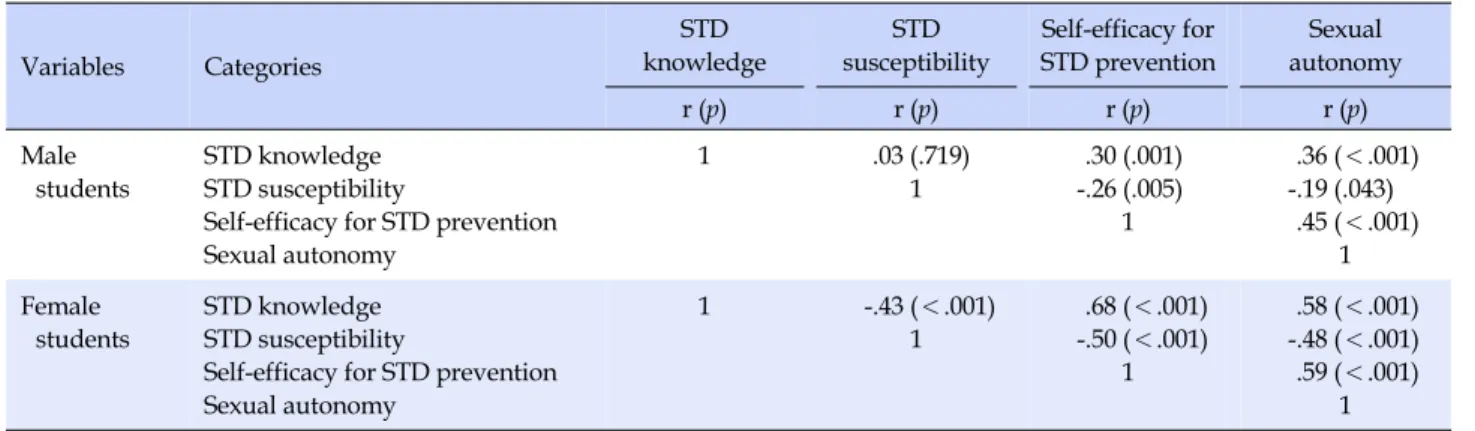
In male students, their STD knowledge was positively correlated with their self-efficacy for STD prevention (r=.30, p=.001) and sexual autonomy (r=.36, p<.001), while their
Table 1. College Students’ Characteristics (N=267)
Variables Categories Male (n=113) Female (n=154)
x2 or t (p) n (%) or M±SD n (%) or M±SD
Grade Freshmen
Sophomore Junior Senior
38 (33.6) 27 (23.9) 23 (20.4) 25 (22.1)
55 (35.7) 54 (35.1) 25 (16.2) 20 (13.0)
6.61 (.086)
Learning experience in safe sex Yes No
50 (44.2) 63 (55.8)
66 (42.9) 88 (57.1)
0.05 (.901)
Learning experience in condom use Yes No
40 (35.4) 73 (64.6)
62 (40.3) 92 (59.7)
0.65 (.446)
Had sexual intercourse† Yes
No
25 (22.1) 88 (77.9)
7 (4.5) 146 (94.8)
19.67 (<.001)
Had a STD‡ Yes
No
2 (1.8) 111 (98.2)
1 (0.6) 153 (99.4)
0.74 (.576)
STD knowledge 0.59±0.40 0.56±0.36 0.53 (.600)
STD susceptibility 2.20±0.81 2.77±0.87 -5.42 (<.001)
Self-efficacy for STD prevention 3.24±0.64 2.75±0.68 6.05 (<.001)
Sexual autonomy 3.51±0.74 3.49±0.85 0.19 (.850)
STD=sexually transmitted disease; †There was a missing response; ‡Fisher's exact test.
Table 2. Correlational Relationships among Variables (N=267)
Variables Categories
STD knowledge
STD susceptibility
Self-efficacy for STD prevention
Sexual autonomy
r (p) r (p) r (p) r (p)
Male students
STD knowledge STD susceptibility
Self-efficacy for STD prevention Sexual autonomy
1 .03 (.719)
1
.30 (.001) -.26 (.005)
1
.36 (<.001) -.19 (.043)
.45 (<.001) 1 Female
students
STD knowledge STD susceptibility
Self-efficacy for STD prevention Sexual autonomy
1 -.43 (<.001)
1
.68 (<.001) -.50 (<.001)
1
.58 (<.001) -.48 (<.001) .59 (<.001)
1 STD=sexually transmitted disease.
self-efficacy for STD prevention had a positive correlation with their sexual autonomy (r=.45, p<.001). Moreover, their STD susceptibility was negatively correlated with their self-efficacy for STD prevention (r=-.26, p=.005) and sexual autonomy (r=-.19, p=.043). In female students, their STD knowledge was positively correlated with their self-effi- cacy for STD prevention (r=.68, p<.001) and sexual autono- my (r=.58, p<.001), while their self-efficacy for STD pre- vention was positively correlated with their sexual autono- my (r=.59, p<.001). Moreover, their STD susceptibility was negatively correlated with their STD knowledge (r=-.43, p<.001), self-efficacy for STD prevention (r=-.50, p<.001), and sexual autonomy (r=-.48, p<.001) (Table 2).
4. Gender Difference in Mediating Effects of Self- efficacy for STD Prevention
This study tested the regression hypotheses for inde- pendent variables through multicollinearity, error terms, and outlier examination before data analysis. The var- iance inflation factor was lower than 10 (1.10~1.33), the Durbin-Watson statistic was close to the reference value of 2 (1.95~2.01), and Cook's Distance did not exceed 1.0 (0.14~0.21). Thus, the study results are reliable as the basic hypotheses for the regression formula are all satisfied.
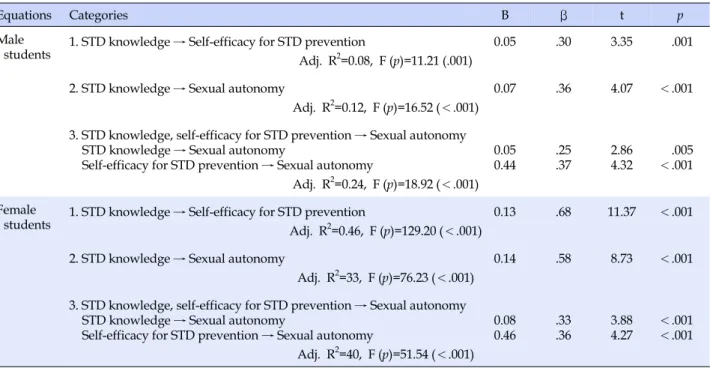
This study used 3-step regression equations to test the mediating effects of self-efficacy for STD. Proposed medi-
Table 3. Mediating Effect of Self-efficacy for STD Prevention in the Relationship between STD Knowledge and Sexual Autonomy (N=267)
Equations Categories B β t p
Male
students 1. STD knowledge → Self-efficacy for STD prevention 0.05 .30 3.35 .001
Adj. R2=0.08, F (p)=11.21 (.001)
2. STD knowledge → Sexual autonomy 0.07 .36 4.07 <.001
Adj. R2=0.12, F (p)=16.52 (<.001) 3. STD knowledge, self-efficacy for STD prevention → Sexual autonomy
STD knowledge → Sexual autonomy
Self-efficacy for STD prevention → Sexual autonomy 0.05
0.44 .25
.37 2.86
4.32 .005
<.001 Adj. R2=0.24, F (p)=18.92 (<.001)
Female
students 1. STD knowledge → Self-efficacy for STD prevention 0.13 .68 11.37 <.001 Adj. R2=0.46, F (p)=129.20 (<.001)
2. STD knowledge → Sexual autonomy 0.14 .58 8.73 <.001
Adj. R2=33, F (p)=76.23 (<.001) 3. STD knowledge, self-efficacy for STD prevention → Sexual autonomy
STD knowledge → Sexual autonomy
Self-efficacy for STD prevention → Sexual autonomy 0.08
0.46 .33
.36 3.88
4.27 <.001
<.001 Adj. R2=40, F (p)=51.54 (<.001)
STD=sexually transmitted disease.
Table 4. Mediating Effect of Self-efficacy for STD Prevention in the Relationship between STD Susceptibility and Sexual
Autonomy by Gender (N=267)
Equations Categories B β t p
Male
students 1. STD susceptibility → Self-efficacy for STD prevention -0.21 -.26 -2.85 .005 Adj. R2=0.06, F (p)=8.13 (.005)
2. STD susceptibility → Sexual autonomy -0.17 -.19 -2.05 .043
Adj. R2=0.03, F (p)=4.19 (.043) 3. STD susceptibility, Self-efficacy for STD prevention → Sexual autonomy
STD susceptibility → Sexual autonomy
Self-efficacy for STD prevention → Sexual autonomy
-0.07
0.50 -.08
.43 -0.90
4.85
.370
<.001 Adj. R2=0.19, F (p)=14.30 (<.001) Female
students 1. STD susceptibility → Self-efficacy for STD prevention -0.39 -.50 -7.03 <.001 Adj. R2=0.24, F (p)=49.36 (<.001)
2. STD susceptibility → Sexual autonomy -0.47 -.48 -6.75 <.001
Adj. R2=0.23, F (p)=45.50 (<.001) 3. STD susceptibility, Self-efficacy for STD prevention → Sexual autonomy
STD susceptibility → Sexual autonomy
Self-efficacy for STD prevention → Sexual autonomy -0.25 0.59
-.25
.47 -3.43
6.37 .001
<.001 Adj. R2=0.39, F (p)=49.00 (<.001) STD=sexually transmitted disease.
ators (e.g., self-efficacy for STD) were regressed against each independent variable in the first equation, dependent variables against independent variables in the second equation, and dependent variables against independent variables and mediators in the third equation (Tables 3, 4).
According to Baron and Kenny [18], the following con- ditions should be met for a factor to have mediating ef- fects. Independent variables should be significantly affec- ted in the first equation, while independent variables should have significant effects on dependent variables in
the second equation, mediators should have meaningful influence on dependent variables in the third equation, and the influence of independent variables on dependent variables should be less in the third equation than in the second equation. If the influence of independent variables on dependent variables is not significant when mediators are controlled in the third equation, the relevant factor plays a full mediator role, while it plays a partial mediator role if the influence in question is not significant.
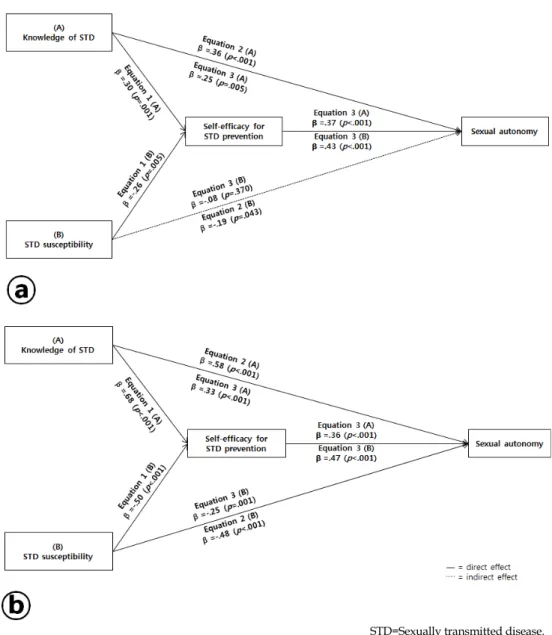
In the male students, the mediating effects of their self- efficacy for STD prevention in the relation in which their STD knowledge and STD susceptibility influence their sexual autonomy have been corroborated using Baron and Kenny's method [16]. Their self-efficacy for STD preven- tion plays a partial mediator role as the influence of their STD knowledge, the independent variable, is significant in the third equation for knowledge of STD (β=.25, p=.005).
However, their self-efficacy for STD prevention plays a full mediator role since their STD susceptibility, the indepen- dent variable, does not have meaningful effects in the third equation for STD susceptibility (β=-.08, p=.370). In the fe- male students, the mediating effects of their self-efficacy on STD prevention in the relation in which their STD knowl- edge and STD susceptibility influence their sexual autono- my have been corroborated. Their self-efficacy for STD pre- vention plays a partial mediator role as the influence of their STD knowledge, the independent variable, is signifi- cant in the third equation for STD knowledge (β=.33, p<
.001). Their self-efficacy for STD plays a partial mediator role since their STD susceptibility, the independent varia- ble, has meaningful influence in the third equation for STD susceptibility (β=-.25, p=.001) (Figure 1).
The results of the Sobel test [19] for testing the signifi- cance of the mediating effects of self-efficacy for STD pre- vention are as follows. In the case of the male students, the mediating effects of their self-efficacy for STD prevention in the relationship between their STD knowledge and sex- ual autonomy was corroborated (Z=2.68, p=.007), and the same effects were also confirmed in the relationship be- tween their STD susceptibility and sexual autonomy (Z=
-2.45, p=.014). In the female students, the mediating effects of their self-efficacy for STD prevention in the relationship between their STD knowledge and sexual autonomy have been corroborated (Z=4.00, p<.001), and the same effects were also confirmed in the relationship between their STD susceptibility and sexual autonomy (Z=-4.73, p<.001).
DISCUSSION
This study evaluated gender differences in mediating
effects of self-efficacy for STD prevention in the relation- ship among STD knowledge, STD susceptibility, and sex- ual autonomy to provide basic data for development of a customized program to promote college students’ sexual autonomy as an effective way of preventing sexual health problems in Korea.
In this study, less than 50% of both male and female col- lege students were found to have received education re- garding safe sex and condom use. As the concern for sex- uality and libido are heightened in early adulthood, social problems of STD, unwanted pregnancy and sex-related crimes etc. occur more often [1,5,7]. Given that various is- sues related to college students’ sex have been raised and preventive measures are emphasized, it should be of con- cern that more than half of the college students surveyed for this study have not received sex education. This lack of education coupled with inappropriate sources of infor- mation about sex may lead to problems associated with sex among college students. Accordingly, it is necessary to provide a suitable sex education program for college stu- dents. In this study, only 7% of female students reported having had sex, while 22.1% of males reported to have sex- ual experiences. Moreover, 1.8% of the male students and 0.6% of the female students had been affected by STD.
These frequencies are lower than those reported by Shin et al. [20], who found that 50.8% of male college students and 19.0% of female college students had sexual experiences, as well as those reported by Lee et al., [4], who found that 10.0% of male college students and 8.9% of female college students had been affected by STD. This study attempted to obtain honest responses in that anonymity was guaran- teed, and the questionnaire was administered in an in- dependent place and returned in sealed envelopes. How- ever, due to Korean culture in which people feel shameful if they have sex when unmarried, it is possible that this study results differ from those of previous studies as some might not respond honestly. Since sexual experiences in- crease rapidly during college life, resulting in more occur- rence of STD such as chlamydia and gonorrhea [3,13], ad- ditional study is necessary.
The scores related to STD knowledge were low, with male students having a mean score of 5.86 and females 5.61 out of 18. These scores are lower than those scores pre- sented by Shin et al., [1], but similar to those reported by Shin et al. [20], both of whom used a similar tool as to that employed in this study. The reason for the low level of STD knowledge among male and female students was likely that their levels of education regarding safe sex and condom use are low. The STD may induce serious prob- lems such as organ strictures and infertility in addition to
STD=Sexually transmitted disease.
Figure 1. Model showing the influence of knowledge about and susceptibility to STD on sexual autonomy, and the mediating effect of self-efficacy of STDs in male (a) and female students (b).
the symptoms of infection [4]. Accordingly, promotion of accurate knowledge of the effects of STD may serve as a powerful measure that can prevent their spreads.
The male students’ mean score for STD susceptibility was 2.20, while that of female students was 2.77 out of 5.
There was no previous study found employing female col- lege students as subjects. Kim [11] adopted the same meas- urement tool in a study of only male students and found a mean score lower than that of this study. Repetitive re- search seems necessary to determine the STD suscepti- bility of both male and female students. In this study, fe- male students were found to have greater susceptibility to STD than male students. This difference likely occurred
because it is more likely for female students to have seri- ous problems associated with sexual health such as un- wanted pregnancy and STD.
The male and female student's scores for condom use were 3.24 and 2.75, respectively. There was no previous study found investigating use of condoms by female col- lege students. Kim [11] utilized the same measurement tool with only male students as its subjects and found a mean score lower than that of this study. Condom use cannot be implemented without collaboration with the male partner [20]. As a result, it is difficult to identify previous studies re- lated to condom use with female students. In Korean soci- ety, men have a higher tendency to have sexual intercourse
acknowledged as an autonomous choice [14,15]. Therefore, the use of condoms has been emphasized among men; ac- cordingly, studies of condom use have been designed to in- vestigate male populations [13,21]. However, female col- lege students should be educated regarding condom use so that they can protect themselves from STD and pregnancy [13].
The sexual autonomy scores were high, but no sig- nificant gender differences were observed, with scores of 3.51 and 3.49 being calculated for males and females, re- spectively. These findings were similar to those reported by Shin et al., [1], who used the same measurement tool.
These results suggest that college students have come to have sexual morals and a sense of sex different from pre- vious generations and more freely make decisions about sex because of the current recognition of sex culture and the development of mass media.
Female students’ STD knowledge, STD susceptibility, self-efficacy for STD prevention, and sexual autonomy were found to be significantly correlated with each other, but male students’ STD knowledge and susceptibility ap- peared to have no significant correlation. There is no com- parison since similar previous studies have not been found. The reason of the results, however, is that male stu- dents’ experience or inexperience of sexual relations and openness to sex rather than their STD knowledge have some influence on the recognition of the risk of STD infection.
Overall purpose of this study was to test the mediating effects of self-efficacy on STD prevention. First, self-effi- cacy played a partial mediator role in the relationship be- tween STD knowledge and sexual autonomy for both male and female students and its size is similar in both groups. This means that self-efficacy for STD prevention based on STD knowledge acts as a crucial factor for male and female students’ sexual autonomy; however, there are other factors than self-efficacy that influence STD preven- tion. Although comparison is difficult as there have been no studies carried out in a similar method with college stu- dents, exploratory research seems necessary for various variables including attitudes toward sex, gender roles etc.
that can have influence on sexual autonomy.
Second, the male students’ self-efficacy for STD pre- vention plays a full mediator role in the relationship be- tween their STD susceptibility and sexual autonomy. This means that male students’ efficacy for STD prevention in- creases and their sexual autonomy is enhanced when their STD susceptibility decreases. STD susceptibility means recognition of the risk of infection, which would likely cause anxiety. For male students, such anxiety influences
their confidence regarding STD prevention, as can be seen in a study conducted by Kim [11]. Accordingly, for male students, it is necessary to provide systematic sex educa- tion so that they do not have anxiety regarding knowledge and understanding of STD. It is also necessary to provide diverse strategies to increase self-efficacy of STD pre- vention by offering information of preventative behavior and efficient methods.
The female students’ self-efficacy for STD prevention plays a partial mediator role in the relationship between their STD susceptibility and sexual autonomy. This means that their self-efficacy based on their susceptibility is a great influential factor for the promotion of sexual autono- my, but that there are no other influential factors. Thus, it seems necessary to explore various mediating factors that influence female students’ sexual autonomy. Female stu- dents showed markedly lower sexual autonomy than males as sexual sensitivity increased. Wrong or over-ex- aggerated information regarding STD may heighten fe- male students’ sexual sensitivity and increase negative perceptions of sexuality, which can eventually decrease sexual autonomy [5]. Accordingly, it is necessary to pro- vide female students with information enabling them to protect themselves from getting STD and offer educational programs to promote positive perceptions of healthy sex- uality.
Overall, male and female students showed differences in sexual experience, and both groups had higher sexual autonomy as their STD knowledge and self-efficacy for STD prevention increased. Furthermore, their self-efficacy for STD prevention plays a partial mediator role in the course in which they enhance their sexual autonomy equipped with STD knowledge. However, male students’
self-efficacy for STD prevention plays a full mediator role, while that of female students’ plays a partial mediator role in the course of the promotion of their sexual autonomy with their STD susceptibility lowered. To promote college students’ healthy recognition of sex, a strategy for promot- ing their self-efficacy for STD prevention is necessary.
Although Baron and Kenny’s [18] procedure is a classic method to examine whether any mediating effect exists, it has low statistical power and difficulty in controlling mea- surement error [22-24]. Thus, future studies test the medi- ating effects of self-efficacy for STD prevention as they re- late to STD knowledge, susceptibility and sexual autono- my through structural equation modeling.
CONCLUSION
Mediating effects of self-efficacy of STD prevention was
examined for gender comparison. To promote sexual au- tonomy with consideration of the gender differences, it is necessary to develop customized strategies to promote sexual sensibility for female students and self-efficacy among male students. Educational programs should be developed to increase male and female college students’
knowledge of sex that focuses on the promotion of their self-efficacy for STD prevention. Both male and female college students’ sexual autonomy should be investigated by adding other variables that can influence the self-effi- cacy for STD prevention.
REFERENCES
1. Shin YH, Chun YK, Cho SM, Cho YR. The effects of a sex edu- cation program on knowledge related to sexually transmitted disease and sex autonomy among university students. Journal of Korean Academy of Nursing. 2005;35(7):1304-13.
2. World Health Organization media Centre. Sexually transmit- ted infections (STIs). WHO; 2015 [cited 2016 January 20].
Available from: http://www.who.int/mediacentre/factsheets /fs110/en/
3. Westrom L, Joesoef R, Reynolds G, Hagdu A, Thompson SE.
Pelvic inflammatory disease and fertility. A cohort study of 1,844 women with laparoscopically verified disease and 657 control women with normal laparoscopic results. Sexually Transmitted Diseases. 1992;19(4):185-92.
4. Lee SJ, Ha US, Kim SW, Cho YH, Yoon MS. Prevalence of chla- mydial and gonococcal infections and sexual behavior in uni- versity students in Korea. Korean Journal of Urology. 2004;
45(7):707-13.
5. Kim KW, Kang KH, Jeong GH. Self-efficacy and sexual au- tonomy among university students. Journal of Korean Public Health Nursing. 2012;26(1):51-9.
http://dx.doi.org/10.5932/JKPHN.2012.26.1.051
6. Woo NS, Ka YH. A study on the sexual knowledge, sexual atti- tudes and sexual behavior in Korean and American college students. The Korean Journal of Woman Psychology. 2005;
10(2):113-33.
7. Kang HS, Jang SB. Development of college student’s condom attitude scale. Journal of Korean Academy of Nursing. 2004;34 (5):751-9.
8. Ko YS. A study on male and female university students' sexual attitude and sexual behavior [master's thesis]. Seoul: Ewha Womans University; 2001.
9 Choi MS, Ha NS. A study on the knowledge, attitude, and expe- rience in sex and sexual autonomy of college students. Korean Journal of Women Health Nursing. 2004;10(4):318-30.
10. Wolf S. Freedom within reason. Oxford: Oxford University Press; 1994.
11. Kim SJ. Predictors of male college students' condom use based upon the health belief model. [master's thesis]. Suwon: Ajou University; 2009.
12. Chang SB. Development of sexual autonomy measurement for college students. Korean Journal of Women Health Nursing.
2002;8(1):106-15.
13. Cho GY, Kim YH. Factors affecting sexual autonomy among female university students. Journal of the Korea Academia- Industrial cooperation Society. 2014;15(11):6710-8.
http://dx.doi.org/10.5762/KAIS.2014.15.11.6710
14. Shim CS, Lee YS, Oh SH. Study on the relationship between gender-role stereotypes, sexual assault awareness and permis- sible limit in the college students. Korean Journal of Women Health Nursing. 2012;18(2):117-25.
15. Yoo MS, Park JW, You MA. The relationships among gender egalitarianism, sexual attitudes and sexual harassment myths among Korean university students. Journal of Korean Society Maternal and Child Health. 2012;16(1):14-22.
16. Faul F, Erdfelder E, Buchner A, Lang AG. Statistical power anal- yses using G*Power 3.1: Tests for correlation and regression analyses. Behavior Research Methods. 2009;41(4):1149-60.
17. Mahoney CA, Thomb DL, Ford OJ. Health belief and self-effi- cacy models: their utility in explaining college student con- dom use. AIDS Education and Prevention. 1995;7(1):32-49.
18. Baron RM, Kenny DA. The moderator-mediator variable dis- tinction in social psychological research: conceptual, strategic, and statistical considerations. Journal of Personality and So- cial Psychology. 1986;51(6):1173-82.
19. Sobel, ME. Asymptotic confidence intervals for indirect effects in structural equation models. Sociological Methodology. 1982;
13:290-312.
20. Shin KR, Park HJ, Kang MJ, Park IS, Bae KE, Seo SR, et al.
Survey on actuation sexual attitude among college students.
Health Promotion Research Report. Seoul: Korea Health Pro- motion Foundation, 2011 November.
21. Lee HK. Predictors of condom use intentions according to expe- rience of sexual intercourse in male college students. Korean Journal of Women Health Nursing. 2010;16(2):194-203.
http://dx.doi.org/10.4069/kjwhn.2010.16.2.194
22. Ji SH, Kang YS. Discussion on mediation tests of structural equation model in social science field. Journal of the Korean Data Analysis Society. 2014;16(6):3121-31.
23. Preacher KJ, Hayes AF. SPSS and SAS procedures for estimating indirect effects in simple mediation models. Behavior Research Methods, Instruments, & Computers. 2004;36(4):717-31.
24. Rucker DD, Preacher KJ, Tormala ZL, Petty RE. Mediation analysis in social psychology: current practices and new re- commendations. Social and Personality Psychology. 2011;5(6):
359-71. http://dx.doi.org/10.1111/j.1751-9004.2011.00355.x