Journal of Forest and Environmental Science
Journal of Forest and Environmental Science Vol. 32, No. 2, pp. 205-211, May, 2016 http://dx.doi.org/10.7747/JFES.2016.32.2.205
An Assesesment of Leaf Chlorophyll Concentration of Afforestation Tree Species in South-Eastern, Nigeria
Agbaeze Umazi Udeagha1,3,*, Simon Alyegba Shomkegh2 and Koko Sunday Daniel1
1Department of Forestry and Natural Environmental Management, University of Uyo, Uyo 520271, Akwa Ibom State, Nigeria
2Department of Social and Environmental Forestry, Federal University of Agriculture, Makurdi 970211, Benue State, Nigeria
3Department of Forest Technology, Hussaini Adamu Federal Polytechnic, Kazaure 705101, Jigawa State, Nigeria
Abstract
Leaf chlorophyll content provides valuable information about physiological status of plants. However, fewer studies have investigated the difference in chlorophyll concentration in leaves of tropical afforestation tree species. Therefore, this study examines the difference in foliar chlorophyll contents of six tropical afforestation tree species namely: Tectona grandis, Pentaclethra macrophylla, Piptademiastrum africanum, Azadirachta indica, Brachystegia eurycomaand Gmelina arborea found in the relict forest in Umudike, South east, Nigeria. A single factor experiment in a completely randomised design in three replicates was employed to analyse the rate of leaf chlorophyll contents. Fisher’s least significant different was used to test for significance in mean difference in foliar chlorophyll contents between tree species at 95% confidence interval using analysis of variance. The results of this study showed a significant difference in foliar chlorophyll concentration between the tree species with Tectona grandis having a higher chlorophyll concentration than other trees this could be as a result of its higher vegetative activity which increases its primary productivity followed by Pentaclethra macrophylla while Azadirachta indica having least the chlorophyll concentration. The study further revealed that other indigenous tree species like Piptademiastrum africanum and Brachystegia eurycoma have higher chlorophyll concentration. Further studies should be carry out to examine factors that have contributed informed the differences in the chlorophyll concentration of these trees species, thus this would broaden the understanding of their physiological status and equally encourage there conservation.
Key Words: physiological status, chlorophyll concentration, tree species, tree foliar, environmental stress, productivity
Received: July 7, 2015. Revised: October 18, 2015. Accepted: November 26, 2015.
Corresponding author: Agbaeze Umazi Udeagha
Department of Forest Technology, Hussaini Adamu Federal Polytechnic, Kazaure 705101, Jigawa State, Nigeria Tel: 2349050077802, Fax: 2348066302590, E-mail: [email protected]; [email protected]
Introduction
Chlorophyll is a key indicator of the physiological status of forest canopy (Curran et al. 1990; Curran et al. 1995).
However, the chlorophyll content of a forest canopy can be an indicator of such measures of physiological status as photosynthetic capacity, developmental stage, productivity, and stress (Ustin et al. 1988; Curran et al. 1990;
Richardson et al. 2002; Khaleghi et al. 2012). Chlorophyll is the green pigment in tree leaves which initiates photosyn- thesis by absorbing energy from sunlight and transfers this energy to other molecules (Lei et al. 1996; Spear 1997;
Ekanayake et al. 2004). Thus, this energy is used to syn- thesis carbohydrate from CO2 and water (Khaleghi et al.
2012). Chlorophyll is of two types’ chlorophyll a and chlor- ophyll b which both of them works as photoreceptor in pho-
tosynthesis (Falk et al. 1996; Khaleghi et al. 2012). The chlorophylls Chl a and Chl b, are the most important of these pigments, and are thus virtually essential for the oxy- genic conversion of light energy to the stored chemical en- ergy the powers the biosphere (Richardson et al. 2002;
Oyetunji et al. 2007). In addition, Oyetunji et al. (2007) stated that chlorophyll content is also used to determine light use efficiency for photosynthesis which occurs at cel- lular level. The intensity of chlorophyll fluorescence is di- rectly related to the concentration of excited chlorophyll molecules, which suggests that a change in the fluorescence yield be related to a change in the efficiency of photosyn- thesis, therefore, providing a measure of leaf photosynthetic ability of plants (Curran et al. 1995; Larcher 1995;
Oyetunji et al. 2007; Richardson et al. 2002; Khaleghi et al.
2012).
From the applied perceptive, leaf pigmentation is im- portant to both land managers and ecophysiologists (Richardson et al. 2002). According to Curran et al. 1990;
Curran et al. 1995; Filella et al. 1995; Richardson et al.
(2002), these are informed by several factors, first, the amount of solar radiation absorbed by a leaf is largely a function of synthetic pigments, and therefore low concen- trations of chlorophyll can directly limit photosynthetic po- tential and hence primary production. Secondly, much of leaf nitrogen is incorporated in chlorophyll, so quantifying chlorophyll gives an indirect measure of nutrient status in plants (Filella et al. 1995; Moran et al. 2000). Thirdly, pig- mentation can be directly related to stress physiology, as concentrations of carotenoids increase and chlorophylls generally decreases under stress and during senescence (Penuelas and Filella 1998). Fourthly, the relative concen- trations of pigments are known to change with abiotic fac- tors such as light (eg sun leaves have Chl a: Chl b ratio) (Larcher 1995) and so quantifying these proportions can provide important information about relationship between plants and their environment (Richardson et al. 2002;
Heschel et al. 2014).
Thus, chlorophyll is at the centre of photosynthesis oxi- dation – reduction reaction between carbon (IV) oxide and water (H2O) (Richardson et al. 2002; Curran et al. 1990;
Curran et al. 1995). When chlorophyll absorbs light energy the molecules enters into a higher energy state in which it easily gives up an electron to the first available electron-ac-
cepting molecules nearby (Flagella et al. 1995). Leaf chlor- ophyll probe is a powerful and sensitive intrinsic measure- ment of the photosynthetic process (Oquist and Wass 1988), which can be used to detect the influence of various environmental stress factors (Oyetunji et al. 2007;
Richardson et al. 2002; Flagella et al. 1995).
However, in photosynthesis, antenna pigments in leaf chloroplasts absorbs solar radiation, and through resonance transfer the resulting excitation is channelled to the reaction centre pigment, which release electrons and sets in motion the photochemical process (Richardson et al. 2002).
Although, other factors contribute immensely to primary productivity of trees in relation to foliar chlorophyll concen- tration such as amount of leaves (leaf structure character- istics), water use efficiency, fresh and dry weight of tissue per unit leaf area and some underlying physiology of the plant- nitrogen nutrition, growth environment (eg. Shade plant growth in sun, pioneer plant grown in partial shade).
This study is own focusing on the physiology characteristic of these afforestation tree species using only leaf chlorophyll as a treatment.
The tree species used in these studies included, Tectona grandis Linn. F (Teak), Piptademiastrum africanum Benth, Azadirachta indica A. Juss, Pentaclethra macrophylla (Hook.
F). Brenan, Brachystegia eurycoma Harms and Gmelina ar- borea Roxb found in relict forest of Umudike. Relict forest are forest which still in exist as a remnant of a widely dis- tributed forest, even though the environment in which the originally develop has been modify due to changing human landscape. More so, in this study a trees is define base on the height if tree is less than 6meters is categorised as a shrub and greater than 6 meters it is referred as a tree (Keay et al. 1964; Hutchinson and Dalziel 1972; Keay 1989;
Ekukudo et al. 2001; Ekukudo 2003). However, these are tropical multi-purpose trees which have numerous econom- ics and ecological benefits. More so, these tree species are highly preferred for their timber quality, non-timber forest products (NTFPs) and their regulating, provisioning and supporting ecosystem services (Borokini 2014a, 2014b;
Langenberger and Liu 2013; Hashmat et al. 2012; Ekukudo et al. 2001; Ekukudo 2003; Keay 1989; Hutchinson and Dalziel 1972; Keay et al. 1964). However, information on the leaf physiological status could give more insight to plant physiologist to identify which tree species has higher pig-
ment than other and which could related to their ability to withstand environmental stress. Richardson et al. (2002) stated that from physiological perceptive, leaf chlorophyll content, for example varies both between and within species and is therefore a parameter of significant interest in its own right. However, information on the physiological status of most tropical afforestation tree species are limited with re- gards to their multiple values and environmental sustain- ability role the play.
Thus, the rationale for this research is to compare the difference in leaf/foliar chlorophyll concentrations of some tropical afforestation tree species which are commonly found in South Eastern, Nigeria. This could act as an in- centive for physiologist to further examine other characteristics of these trees species in other to improve their economic and ecological functions and equally sustain their conservation.
Materials and Methods
Study Area
The study was conducted at a relict forest in Umudike, South Eastern, and Nigeria. Umudike is located in Abia State on latitude 050, 281N and longitude 070, 321E. The average elevation is 119 metres. The rainfall pattern is bi- modal in distribution with an annual rainfall of between 2,000∼3,000 mm (Korieocha et al. 2011; John et al.
2014). The rainy season starts from March to October while the dry season starts from November to March when the North East trade (harmattan) wind weeps across the en- tire area. However, the commencement and cessation of rainfall had dramatically changed due to changing climate and can no longer be predicted as usual. These changes are becoming very obvious recently (the past five years). The ambient temperature is between 24oC to 32oC and relative humidity ranges from 60∼80%. The area has lateritic soil, which is generally characterised by excessive leaching, re- sulting in the loss of soil nutrients. The vegetation of the area is that of tropical rain forest in formation but due to un- guided agricultural expansion and conversion pressure, the area has dramatically been reduced to shrubs and grass veg- etation or derived savannah.
Sampling Techniques
The tree species were selected based on the two principal
groups of tropical tree species in the relict forest, the climax (shade tolerant) and pioneer (or light demanding) and exot- ic and indigenous (Keay et al. 1964; Hutchinson and Dalziel 1972; Denslow 1987; Swaine and Whitmore 1988;
Keay 1989; Whitmore 1999). Out of the tree species se- lected three were pioneers (exotic) Tectona grandis Linn. F (Teak), Azadirachta indica A. Juss and Gmelina arborea Roxb and were introduced into Nigeria during colonial era because of their preferred timber, non-timber, aesthetic val- ues and invaluable environmental services the provide while the remaining were climax species (indigenous) and leguminous with great importance in fixation nitrogen in the soil which improves soil fertility (Udeagha 2008). In addition, these tree species are widely used for afforestation programmes in Nigeria because of their very high level of adaptation to adverse environmental changes (Keay1989;
Ekukudo et al. 2001; Udeagha 2008; Ekukudo 2003;
Borokini 2014a), thus their physiological status are not well documented.
The leaves of the six tree species were randomly selected from a relict forest of about 50 years (Latitude N 050 28.
695’ and Longitude E 0070 32. 471’) umudike, which has been undergoing modification due consistent human interference. Leaves of trees of 6 meters and above were collected and used for the laboratory analyses. Three leaves were collected from each trees per specie in the same place to ensure randomisation and representativeness of the tree species in the relict forest. In all a total of 108 leave samples were collected used for the experiment. This study also adopted some of the approaches used by Curran et al.
(1990), Curran et al. (1995) and Khaleghi et al. (2012) in arriving at the sample size. The experiment was repeated three (replicate) times in order to minimise sample error (Groves 2004).
Laboratory Analyses
Determination of Chlorophyll contents
Leaf chlorophyll content was determined using the method described by Arnon (1949); Ekanayake and Adeleke (1996) and Phoguodume et al. (2012). Six fully expanded upper leaves of the trees were collected and used for extraction of chlorophyll. Leaf tissue weighing 2 g was crushed in a mortar and 80% acetone added to it in suffi- cient quantities to allow the tissue to be thoroughly homo-
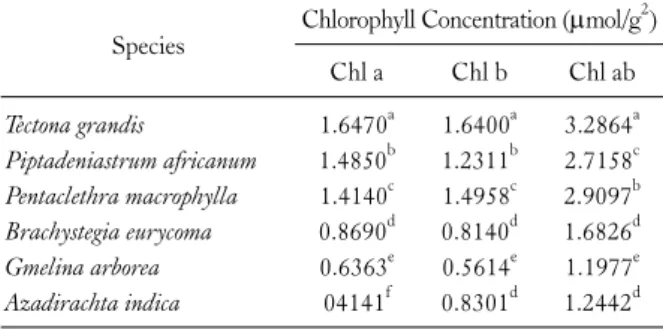
Table 1. Mean chlorophyll concentration in the leaves of tree spe- cies for chlorophyll a, chlorophyll b and chlorophyll ab
Species Chlorophyll Concentration (mol/g2)
Chl a Chl b Chl ab
Tectona grandis 1.6470a 1.6400a 3.2864a Piptadeniastrum africanum 1.4850b 1.2311b 2.7158c Pentaclethra macrophylla 1.4140c 1.4958c 2.9097b Brachystegia eurycoma 0.8690d 0.8140d 1.6826d Gmelina arborea 0.6363e 0.5614e 1.1977e Azadirachta indica 04141f 0.8301d 1.2442d Chl a, Chlorophyll a; Chl b, Chlorophyll b and Chlorophyll ab.
a,b,c,d,e,fMeans with different superscripts (letters) are significantly different from each other, means followed by the same superscripts are not significantly different using FLSD (p<0.05).
genized. The supernatant was decanted through a filter pa- per into a 100 ml volumetric flask. Acetone was again added to the residue in the mortar and the extraction procedure repeated. Additional acetone was used to wash off the chlor- ophyll until the 100 ml mark was attained in the volumetric flask. The resulting solution was thoroughly mixed and 5 ml pipetted into a 50 ml volumetric flask and made up to vol- ume with 80% acetone. The extracts were kept in the dark at 4oC for seven days. The absorbance of the extract was then measured at 645, 663, and 652 nm wavelengths for chlor- ophyll a, b and ab, respectively, using model 690 spec- trophotometer with 80% acetone been used as blank. The experiment was carryout at the Biochemistry Laboratory, College of Biological and Natural Sciences, Michael Okpara University of Agriculture, Umudike, Nigeria.
Unlike other methods which use solvents like Dimethyl Formamide (DMF) and Dimethyl Sulfoxide (DMSO), the use of acetone in this method was because it is not toxic to human and not easily absorbed by the skin (Dae Park et al. 2012). Concentrations of chlorophyll (mg/g fresh leaf weight) were calculated as follows: chlorophyll a=(20.2x D645)x(50/1000)x(100/5)x(1/2); chlorophyll b=(8.02xD663)x (50/1000)x(100/5)x(1/2); and total chlorophyll=(20.2xD645
+8.02xD663)x(50/1000)x(100/5)x(1/2), where D=absorb- ance (Anon (1949), Ekanayake and Adeleke (1996) and Phoguodume et al. (2012).
Statistical analysis
The mean values were computed for each tree and the variations in the mean tree chlorophyll were evaluated through analyses of variance (ANOVA) (p<0.05), while Fisher Least Significant Difference (LSD) was applied for separation of significantly different means of foliar chlor- ophyll difference per tree at 95% confidence interval.
Results and Discussion
Chlorophyll concentration
The outcomes of statistical analyses done on the data from the experiments conducted to examine the difference in foliar chlorophyll concentration (Table 1) for the mean separation test showed that T. grandis has a higher chlor- ophyll concentration among other tree species investigated
Chlorophyll concentration Chlorophyll a
Chlorophyll a concentrations of all the tree species are significantly different from each other. T. grandis had the highest chlorophyll concentration with A. indica having the lowest chlorophyll a concentration.
Chlorophyll b
Significant differences occurred in chlorophyll b concen- tration among all the tree species. T. grandis and P. macrophylla have the highest concentration of chlorophyll b but were stat- istically different from each other (p<0.05) (Table 1). B. eur- ycoma and A. indica concentration are not statistically sig- nificant from which other while G. arborea had the lowest chlorophyll b concentration among the entire tree species investigated. Lahai et al. (2003) explained that the variation observed in chlorophyll b concentration could be due to in- crease in environmental stress experienced due to ex- tremities in weather events. A similar phenomenon was re- ported by Carter (1994); Craig and Shih (1998) and Sari et al. (2005) that extreme weather events increased stress con- ditions for nutrition and some other stress conditions which cause the reduction in photosynthetic activities and chlor- ophyll contents in the trees (Filella et al. 1995; Moran et al.
2000). This could have been the reason for low chlorophyll content in G.aborea and A. indica (Curran et al. 1990;
Filella et al. 1995; See Richardson et al. 2002). On the oth-
er hand, the high concentration of chlorophyll b which en- hances the utilization of carbon (IV) oxide to produce car- bohydrate in T.grandis could be attributed to its ability to withstand extreme weather events than other tree species examined (Larcher 1995; Falk et al. 1996; Carter and Knapp 2001; Richardson et al. 2002; Khaleghi et al. 2012;
See Heschel et al. 2014). This confirmed with the findings of Ekanayake et al. (2004), Pervial and Sheriffs (2002), Flagella et al. (1995) that chlorophyll concentration pro- vides rapid and accurate techniques of detecting and quan- tifying plant tolerance to stress. This implies that trees with higher foliar chlorophyll content could have the ability to withstand adverse weather events as would increase their adaptive capacity.
Chlorophyll ab
T. grandis was significantly different from all other tree species, in terms of chlorophyll ab concentration. A. indica and B. eurycoma are significantly similar to each other (Table 1) with G. arborea having the lowest chlorophyll ab concentration (Table 1). The reason for the low foliar chlor- ophyll concentration in some of the tree species investigated could be due to decrease in photosynthetic activity paral- leled by a reduction in leaf chlorophyll content which affects crop and tree performance (Curran et al. 1990; Filella et al.
1995; Ekanayake et al. 1998; Richardson et al. 2002;
Ekanayake et al. 2004; Heschel et al. 2014). This implies that the foliar chlorophyll content of tree species play im- portant role in enhancing the primary productivity of trees.
Tree species with higher concentration of chlorophyll could have the tendency to grow faster and sequester more carbon that would enhance photosynthetic activities in the trees (See Richardson et al. 2002; Khaleghi et al. 2012).
However, Langenberger and Liu (2013), noted that teak are perceived to have high timber value because of it fast growth rate, which make it be a suitable complement in smallholder land management systems diversifying pro- duction and income base for farmers. According Clark et al.
(2000) functional state of photosynthesis has been consid- ered as an ideal to monitor the health and vitality of plants.
Gitelson et al. (2003) also stated that leaf chlorophyll con- tent provides valuable information about physiological sta- tus of plants.
Conclusion
The study indicates that significant difference (p<0.05) occurred between all the tree species for the parameters investigated. However, the understanding of spectral fea- tures of tropical trees is important in order to determine their physiological activities in respect to photosynthetic function and primary productivity as this could assist in un- derstanding the physiological status of most afforestation tree species in Nigeria. Although the leaf area varies per tree, the study shows that leaf area does not actually influ- ence the foliar chlorophyll concentration in the trees investigated. For instance, T. grandis has largest leaf area followed by G. arborea which in this case has the lowest chlorophyll concentration while other trees with small leaf area (P. africanum, B. eurycoma, P. macrophylla, among oth- ers) have higher chlorophyll concentration. Further studies should be carry out to examine factors that have informed the differences in the chlorophyll concentration of the trees spe- cies, thus this would broaden the understanding of their phys- iological status and equally encourage there conservation.
References
Arnon DI. 1949. Copper enzymes in isolated chloroplasts. poly- phenoloxidase in beta vulgaris. Plant Physiol 24: 1-15.
Borokini TI. 2014a. A Systematic compilation of endemic Flora in Nigeria for Conservation management. Journal of Threatened Taxa 6: 6406-6426.
Borokini TI. 2014b. A Systematic Compilation of IUCN Red-list- ed Threatened Plant Species in Nigeria. International Journal of Environmental Science 3: 104-133.
Carter GA, Knapp AK. 2001. Leaf optical properties in higher plants: Linking Spectral characteristics to Stress and Chloro- phyll concentration. Am J Bot 88: 677-684.
Carter GA. 1994. Ratios of Leaf reflectance in narrow wavebands as indicators of plant stress. Int J Remote Sensing 15: 697-703.
Clark AJ, Landolt W, Bucher JB, Strasser RJ. 2000. Beech (Fagus sylvatica) response to ozone exposure assessed with a Chloro- phyll a fluorescence performance index. Environ Pollut 109:
501-507.
Craig JC, Shih SF. 1998. The spectral response of stress conditions in Citrus trees: development of methodology. Soil and Crop Science Society of Florida 57: 16-20.
Curran PJ, Dungan JL, Gholz HL. 1990. Exploring the relation- ship between reflectance red edge and Chlorophyll content in slash pine. Tree Physiol 7: 33-48.
Curran PJ, Windham WR, Gholz HL. 1995. Exploring the rela-
tionship between reflectance red edge and Chlorophyll concen- tration in slash pine leaves. Tree Physiol 15: 203-206.
Denslow JS. 1987. Tropical rainforest gaps and tree species diversity. Annu Rev Ecol Syst 18: 431-451.
Ekanayake IJ, Adeleke MTV. 1996. Selected procedure for in- strumentation in Ecophysiological studies of root crops.
Procedures Manual No. 3, Crop Procedures Division (CID), IITA, Ibadan, Nigeria, pp 103.
Ekanayake IJ, Okarter UC, Adeleke MTV. 1998. Dry season dust alters photosynthetic characteristics of field grown Cassava in the dry season in two agroecozones of Nigeria. In: Root Crops and Poverty Alliviation (Akorada MO, Ekanayake IJ, eds).
Proceedings of the Sixth Symposium of ISTRC-AB, Lilogwe, Malawi, pp 402.
Ekanayake IJ, Oyetunji OJ, Osonubi O, Lyasse O. 2004. The ef- fects of arbuscular mycorrhizal fungi and water stress on leaf Chlorophyll production of cassava (Manihot esculenta Crantz). J Food Agric Environ 2: 190-196.
Etukudo IG, Akpan-Ebe IN, Udofia A, Attah VI. 2001. Element of Forestry. Revised Edition. Usanga and sons press, Uyo, Akwa Ibom, Nigeria, pp 1-176.
Etukudo IG. 2003. Ethnobotany: Conventional and Traditional Uses of Plants. Vol. 1. The Verdict Press, Uyo, Akwa Ibom, Nigeria, pp 1-191.
Falk S, Maxwell DP, Laudenbach DE, Huner NPA, Baker NR.
1996. In Advances in Photosynthesis, V.5, Photosynthesis and the Environment. Kluwer Academic Publishers, Dordrecht, Boston, London, pp 367-385.
Ferri CP, Formaggio AR, Schiavinato MA. 2004. Narrow band spectral indexes for Chlorophyll determination in Soybean cano- pies (Glycin max (L) Merril). Braz J Plant Physiol 16: 131-136.
Filella I, Serrano L, Serra J, Penuelas J. 1995. Evaluating wheat ni- trogen status with canopy reflectance indices and discriminant analysis. Crop Science 35: 1400-1405.
Flagella Z, Pastore D, Campanile RG, Di Fonzo N. 1995. The quantum yield of photosynthetic electron transport evaluated by Chlorophyll fluorescence as an indicator of drought tolerance in durum wheat. J Agric Sci Cambridge 125: 325-329.
Gitelson AA, Gritz Y, Merzlyak MN. 2003. Relationships be- tween leaf Chlorophyll content and spectral reflectance and algo- rithms for non-destructive Chlorophyll assessment in higher plant leaves. J Plant Physiol 160: 271-282.
Groves RM. 2004. Survey error and Survey cost. John Wiley and Sons, Hoboken, NJ, pp 62.
Hashmat I, Azad H, Ahmed A. 2012. Neem (Azadirachta indica A. Juss) A Nature’s Drugstore: An overview. International Research Journal of Biological Sciences 1: 76-79.
Heschel SM, Evakow A, Wolfson BK, Carlson JE, Holsinger KE.
2014. Drought response diversification in African Protea species. Int J Plant Sci 175: 442-447.
Hutichinson J, Dalziel JM. 1979. Flora of West Africa. London:
Crown Agents for Overseas Governments and Adminstrations.
2300p. African Plants Database (version 3.4.0). Conservatoire et Jardin botaniques de la ville de Geneve and South Africa National Biodiversity Institute, Pretoria. http://www.ville-ge.
ch/musinfo/bd/cjb/africa/. Accessed December 2013.
John C, George U, Chukwuemeka OS. 2014. Time Series Analysis and Forecasting of Monthly Maximum Temperatures in South Eastern Nigeria. International Journal of Innovative Research and Development 3: 165-171.
Keay RWJ, Onochie CFA, Stanfield DP. 1964. Nigerian Trees. Vol 1. Federal Department of Forest Research, Ibadan, pp 344.
Keay RWJ. 1989. Trees of Nigeria. Clarendon press, Oxford, pp 437.
Khaleghi E, Arzani K, Mollaemi N, Barzegar M. 2012.
Evaluation of Chlorophyll Content and Chlorophyll Fluore- scence Parameter and Relationships between Chlorophyll a, b and Chlorophyll Content Index under Water Stress in Olea euro- paea cv. Dezful. World Academy of Science, Engineering and Technology 6: 627-630.
Korieocha DS, Ogbonna MC, Korieocha JN, Nwokocha CC.
2011. Effect of Fluazifopbutyl and Atrazine/Metolachlor (Tank mixed) for Weed Control in Sweetpotato (Ipomoea batatas) in South Eastern, Nigeria. Journal of Agriculture and Social Research 11: 72-80.
Lahai MT, Ekanayake IJ, George JB. 2003. Leaf Chlorophyll con- tent and Tuberous Root yield of Cassava in land valley. African Crop Science Journal 11: 107-117.
Langenberger G, Liu J. 2013. Performance of smallholder Teak plantations (Tectona grandis) in Xishuangbanna, Southwest China. Journal of Tropical Forest Science 25: 289-298.
Larcher W. 1995. Physiological Plant Ecology. 3rd ed. Springer, Berlin, Germany.
Lei TT, Tabuch R, Koike T. 1996. Functional Relationship between Chlorophyll content and Leaf reflectance, and Light capturing efficiency of Japanese Forest species. Physiol Plant 96: 411-418.
Moran JA, Mitchell AK, Goodmanson G, Stockburger KA. 2000.
Differentiation among effects of nitrogen fertilization treatments on conifer seedlings by foliar reflectance: a comparison of methods. Tree Physiol 20: 1113-1120.
Oquist G, Wass R. 1998. A portable microprocessor operated in- strument for measuring Chlorophyll fluorescence kinetics in stress physiology. Physiolgia Plantarum 73: 211-217.
Oyetunji OJ, Ekanayake IJ, Osonube O. 2007. Chlorophyll Fluorescence Analysis for Assessing Water Deficit and Arbuscular Mycorrizal Fungi (AMF) Inoculation in Cassava (Manihot esculenta Crantz). Advances in Biological Research 1:
108-117.
Penuelas J, Filella I. 1998. Visible and near-infrared reflectance techniques for diagnosing plant physiological status. Trends in Plant Science 3: 151-156.
Pervial GC, Sheriffs CN. 2002. Idenification of Drought-Tolerant woody perennials using Chlorophyll Fluorescence. Journal of Arboriculture 28: 215-223.
Phonguodme C, Lee DK, Sawathvong S, Park YD, Ho WM, Combalicer EA. 2012. Effects of Light Intensities on the Growth Performance, Biomass Allocation and Chlorophyll Content of Five Tropical Deciduous Seedlings in Lao PDR.
Journal of Environmental Science and Management Special Issue 1-2012: 60-67.
Richardson AD, Duigan SP, Berlyn GP. 2002. An evaluation of noninvasive methods to estimate foliar Chlorophyll content.
New Phytologist 153: 185-194.
Sari M, Sonmez NK, Karaca M. 2005. Relationship between Chlorophyll content and canopy reflectance in Washington Navel orange trees (Citrus sinensis (L.) Osbeck). Pakistan J Bot 37: 1093-1102.
Spear BR. 1997. “Photosynthetic Pigment” in UCMP Glossary (online) University of California Berkeley Museum of
Paleontology. Verified availability March 12, 2007.
Swaine MD, Whitmore TC. 1988. On the definition of ecological species groups in tropical rain forests. Vegetatio 75: 81-86.
Udeagha AU. 2008. Determination of the rates of absorbances and concentrations of Chlorophyll contents and proximate composi- tion on the leaves of six tropical trees species. Unpublished B.Sc project, Michael Okpara University of Agriculture, Umudike, Nigeria, pp 42.
Ustin SL, Curtiss B, Martens S, Vanderbilt VC. 1988. Use of high spectral resolution sensors to detect air pollution injury in confer forests. In: Remote Sensing Applications for Acid deposition (Fenstermaker LK, ed). US Environmental protection Agency, Las Vegas, NV. 89293-3478, pp 72-85.
Whitmore TC. 1999. An introduction to tropical rain forest. 2nd ed. Oxford University Press, Oxford, pp 119-155.