* Corresponding author: (E-mail) [email protected]
Indigenous Food Habit of the Hajong Tribe Community in Bangladesh: Implication for Sustainable Extraction and
Biodiversity Conservation in North-East Bangladesh
Md. Parvez Rana1*, Md. Shawkat Islam Sohel1, Sayma Akhter1, and Mohammad Rakibul Hassan2
1Department of Forestry and Environmental Science, School of Agriculture and Mineral Science, Shahjalal University of Science and Technology, Sylhet-3114, Bangladesh
2Department of Development Studies, Dhaka University, Bangladesh
ABSTRACT : The Hajong are the ancient tribal forest community among the ethnic minorities of the North-East region of Bangladesh. The study was carried out with respect to three income groups highlighting their indigenous knowledge. A total of forty-five households (fifteen from each income groups) were assessed using different participatory appraisals through semi -structured questionnaires. A special type of indigenous knowledge on food habit was explored in the Hajong community, which correspond to the severe dependence on forest resources. They collect their food resources from homestead forest (45%) followed by forest (40%), market and others. They have indigenous hunting procedure to trap the animal in the forest. Twenty three tree species were tremendously planted in their homestead forests which are the very important source of food. Male are highly responsible to collect the food materials from forest as well as other sources.
Keywords : Special and favorite food, Food habit, Fruit consumption, Hajong, Bangladesh
INTRODUCTION
Foods, fodders, medicine and other forest products have made a traditional economy of the tribal communities of the world (Miah and Chowdhury, 2003). Tribal people are the ecosystem people who live in harmony with the nature and maintain a close link between man and environment (Sajem and Gosai, 2006). The livelihoods of tribal and forest dwellers are mainly dependent on the forests which have built up their socioeconomic and cultural life (Shroff, 1997). The socio-economic and cultural life of the tribals and forest dwellers is closely associated with forest to a great extent (Shroff, 1997; Tiwari 1986). The forest has been playing a vital role in the economy of the tribals in Bangladesh. The religious, cultural and economic activities of them depend on forests (Khisa, 1998). The Hajong are the ancient tribal forest community among the ethnic minorities of the North-East region of Bangladesh who represent
different types of socio-political organization compared to the other ethnic group. The Hajong as an organized kin group live in hamlets, a small settlement comprising five to twenty household which is considered to be the primary socio-economic unit of Hajong life and the name of which is known by its founding sibs (Nasrin and Khalifa, 2004).
The Hajong are basically a farming community. Once they were accustomed to Jhum farming, but now they follow plough farming (Ahmed, 2003). They also have developed indigenous knowledge system of their own in practicing the special type of utilization pattern of forest produces (Alam and Khisa, 2000; Rashid and Rashid, 2002; Ahmed, 2003; Anon, 2003; Nasrin and Khalifa, 2004). But most of the wealth of indigenous knowledge of the tribal people in North-East region is being threatened by the settlements of the non-tribal people in the region. The lifestyle and ethno-forestry perception along with the indigenous knowledge governing the daily activities of the ethnic communities
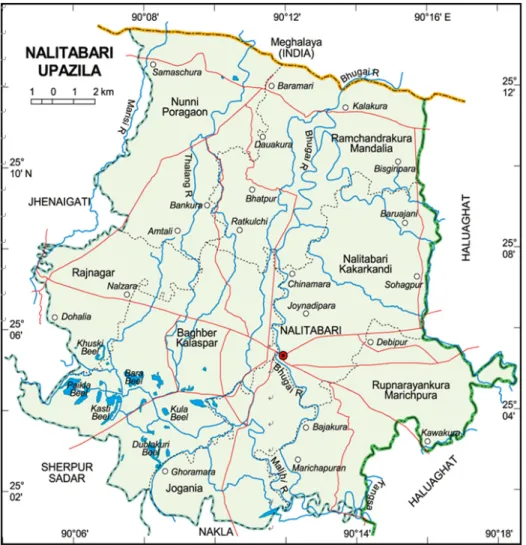
Fig. 1. Map of the Study Area.
need to be explored highly, in order to conserve them as well as to assess the possibilities to conserve the forest resources by utilizing such traditional indigenous concepts.
It was hypothesized that the Hajong community encom- passed a particular type of food habit including indigenous knowledge. So far it was found through literature review, the information about various works carried out on different tribes of Bangladesh come into existence. Banik (1998), Khisa (1998), Sattar (1998), Siddiqi (1998), Alam and Khisa (2000), Alam (2002), Mohiuddin et al., (2002), Miah and Chowdhury (2003), Halim et al., (2007), Mukul et al., (2007), Partha and Hossain (2007), Uddin et al., (2007) were carried out several studies on various tribes regarding the exploration of ethno-botany and indigenous knowledge.
But the Hajong were ignored earlier despite they were the original forest dwellers in North-East region of Bangladesh.
The Hajong have special and particular relationship and dependency on forest for their food. However, no study was carried out previously on food habit regarding forest dependence. So this study was undertaken to ascertain those in North-East region, Bangladesh.
Materials and methods Study area
The study was conducted at Nayabil Union (a rural administrative unit consist of a number of villages) of Nalitabari upazila (Sub-district; administrative entity) of Sherpur district, Bangladesh over a period of Six months from June 2008 to October 2008 (Figure 1). It is located between 25°19' and 25°13' north latitudes and between
90°04' and 90°19' east longitudes. The upazila occupies an area of 327.61 sq km including 1.68 sq km river area and 78 sq km forest area. The upazila is bounded on the north by India, on the east by Haluaghat of Mymensingh district, on the south by Nakla and Sherpur upazila and the west by Jhenaigati upazila (BBS, 2005). The upazila consists of 12 unions, 108 mauzas and 138 villages. The average population of each union, mauza and village are 32,333, 2,096, and 1,640 respectively. The area lies in the semi drier part of the Bangladesh. The maximum tempe- rature is usually 30° C during the month of May and maximum temperature is about 10°C during the month of January. It has been observed that 34.58% of the main houses of the dwelling household are made of straw/
bamboo, 0.25% are made of cement and the remaining 65.17% are made of a combination of different types of materials (BBS, 2005). The total population of Hajong tribe in Bangladesh is 11,477. But the total populations of Hajong tribe in the study area are 436 in 77 households (Anon, 2003).
Methods
The Hajong are one of the ancient among the tribes of the North-East region of Bangladesh. They mainly live in three district of Bangladesh. These are Maymensingh, Sherpur and Netrokona (Ahmed, 2003). Sherpur has been selected for study by random sampling. Out of five upazilas of Sherpur district, the Hajong are concentrated in the hilly areas of Sribardi, Jhenagati and Nalitabari upazillas. A list of three upazilas of Sherpur district was arranged alpha- betically and Nalitabari was selected randomly from the list. Nayabil union of Nalitabari upazila is inhabited mostly by the Hajong. So this union was selected purposively. A list of the Hajong hamlet and households (based on annual income) were collected from the office of ‘World Vision’, an NGO working locally for the improvement of the Hajong tribe. Three hamlets were finally selected at random from the list. A preliminary socio-economic survey was carried out to ascertain important socio-economic parameters of the study area to select respondents for detailed study.
The hamlets were surveyed completely at that stage. A semi-structured questionnaire was used for the survey, worked out in advance and pre-tested for intelligibility.
Household heads were the respondents of the study and they took help from other members of the family when viewed necessary. Based on the total annual income, the study peoples were categorized into three groups as follows:
high-income group (having total annual income >Tk. 30,000), medium income group (having total annual income range of Tk. 20,000 ~ Tk. 30,000) and low income group (having total annual income of <Tk. 20,000). From each of the three hamlets, 15 households were selected by taking 5 from each farm category randomly. Thus, a total of 45 households were selected from the study area.
Results and discussion Indigenous food habit of the Hajong tribe
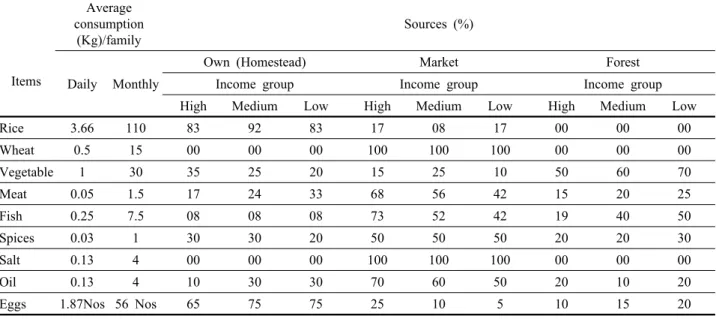
Study found that rice is the main staple food of the Hajong tribe; getting three times in a day at morning, noon and night. In addition with rice; meat, fish, eggs, vegetables were regarded as side dish (Table 1). Salt and oils were found to be used as condiments in cooking the vegetables and curry to increase its taste and delicacy.
Green chilies were very common as a condiment. Findings reveal that rice consumed by the Hajong mainly came from the farmer’s own agricultural field irrespective of farm category. Most of the meat consumed by the high and the medium income farmers were obtained from the market followed by low-income groups major source of meat was forest. Each farm category gets fish (8%) from the own (Homestead) and the rest mainly from market.
Most of the poor farmers (50%) followed by medium farmers (40%) collected fish through fishing in the water bodies in and within the forests. Farmer of all categories consumed eggs mostly obtained from their own poultry. They were more interested to allow hatching of chicken to increase the number in their clutch to facilitate income through further selling them. All the farmers bought spices, salt, and oils mostly from the neighboring market.
Table 1. Food habit of the Hajong tribe in the study area.
Items
Average consumption
(Kg)/family
Sources (%)
Daily Monthly
Own (Homestead) Market Forest
Income group Income group Income group
High Medium Low High Medium Low High Medium Low
Rice 3.66 110 83 92 83 17 08 17 00 00 00
Wheat 0.5 15 00 00 00 100 100 100 00 00 00
Vegetable 1 30 35 25 20 15 25 10 50 60 70
Meat 0.05 1.5 17 24 33 68 56 42 15 20 25
Fish 0.25 7.5 08 08 08 73 52 42 19 40 50
Spices 0.03 1 30 30 20 50 50 50 20 20 30
Salt 0.13 4 00 00 00 100 100 100 00 00 00
Oil 0.13 4 10 30 30 70 60 50 20 10 20
Eggs 1.87Nos 56 Nos 65 75 75 25 10 5 10 15 20
Figure 2. Source of food of Hajong tribe community in the study area.
Special and favorite food
Rice, fish, fruit, vegetables, meat, pork, ducks and chicken are their favorite food. The study observed Binny bat, a special type of food item produced from Aush paddy which is wetened for preparation, very popular among the Hajong. It is also known as rotten rice. Different kinds of cakes are prepared by women. Wine is familiar in the Hajong society. These are prepared from rotten rice. Anon (2003) also reported about wine produced from rotten rice. The survey revealed that various parts of the plants were used as food by the Hajong (Table 2). Along with those foods, the Hajong were also reported to consume wild animals like pig by hunting. In one month they
could catch four to five (average) pigs from the forest.
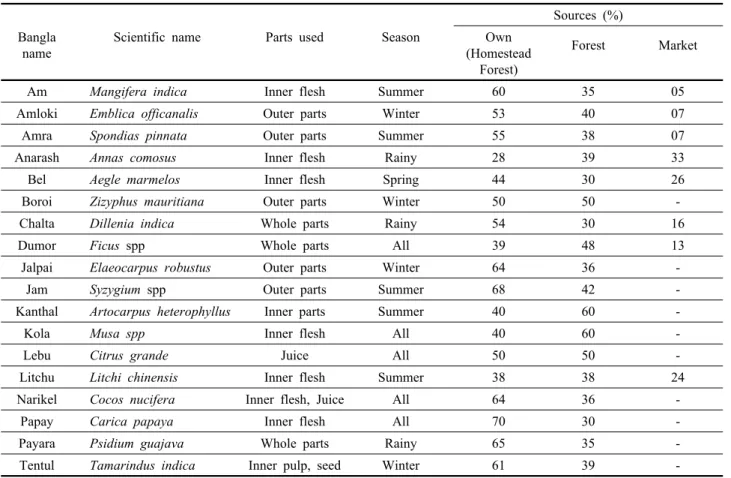
Fruits provided a seasonal food supply to the Hajong tribe (Table 3) and especially children most frequently consumed wild fruits as snack food. Fruits are good source of vitamins and minerals. Most of the wild fruits were reported to usually be looted prematurely by children and the Hajong generally considers fruits as the children’s food rather than food for adults. The sources of fruit were recorded during the study, most of which were collected from own homestead forest (72%) followed by forest (20%) and market (8%) (Figure 2).
Source of food
Study reveals that Hajong tribe community highly de- pendent on forest for their daily requirements of food.
They depend on homestead forest (45%) followed by forest (40%), market and others (Figure 3).
The use of plant parts as food by the tribals in Chi- ttagong Hill Tracts (CHTs) is also evident from the other studies. The young shoots of Bambusa spp. and Daemonorops jenkinsianus are used as vegetables by the tribes in CHTs, Bangladesh (Jalil and Chowdhury, 2000). Maikhuri et al., (2000) stated that the Bhotiya of India depends to a large extent on wild resources of plant and animal origin for
Table 2. Plants parts used as food by the Hajong tribe collected from forest.
Kinds Common Name Scientific Name Mode of use
Root & Tubers Yam Dioscorea spp
Cooked as vegetables Taro Calocasia esculanta
Young shoots
Muli bans Melocanna baccifera
After removing the sheaths, the inner tender portion is thoroughly washed, cut into pieces and then cooked as vegetable. Also sliced and dried to preserve Young shoots for use in time of food scarcity
Rattan/Cane Daemonorops jenkinsianus The young stem is peeled off and the inner soft and tender portion is cooked as vegetable
Young leaves Sajna Moringa oleifera
Cooked as vegetables and used as pickles Tentul Tamarindus indica
Inner stem Banana Musa spp
The white core after peeling off the outside is cut into pieces, the hair like strings from the pieces are removed by finger to make them free from nuisance during eating as a vegetables
Flowers Turmeric Curcuma longa
Cooked as vegetables Gamar Gmelina arborea
Inflorescence Banana Musa spp Cooked as vegetable
Kanthal Artocarpus heterophyllus Used as pickle and snack
Fruits Banana Musa spp
Green fruits are cooked as vegetables Kanthal Artocarpus heterophyllus
Seeds Kanthal Artocarpus heterophyllus Cooked as vegetables
Figure 3. Source of fruit species of Hajong tribe community of Bangladesh.
their food security. Samal (1997) revealed that the Kandha tribe of Koraput, India, extracts tamarind seeds to eat.
Mango stones and tamarind seeds are powdered and then made into gruel with other food items for consumption.
Jana and Chauhan (2000) also agreed in this regard. They state that seeds of Tamarindus indica are edible after roasting and eaten by the Nepalies tribe of Sikkim, India.
Chandra (2002) mentions that 80% of the forest dwellers in Orissa, Bihar, Madhya Pradesh and Jharkhand and Himachal Pradesh depend on forests for 25%-50% of
their annual food requirement. Tribals in Chotanagpur plateau depend on forest food for four to five months (Surin and Bahadur, 1980). In West-central Bhutan, through- out the year there is always a forest plant in the diet (Namgyel and Ghimiray, 1998). Kumar and Goel (2000) consider the flowers and fruits of Madhuca indica as the most important minor forest products. In Madhya Pradesh, Bihar, Orissa and adjoining tracts of Peninsular, India, M.
indica flowers also constitute an important article of food for the tribals (Chandra, 2002). The flowers are very good source for the preparation of ‘Daru’, a country-liquor that is popularly used in all the tribal areas of Bihar, India (Kumar and Goel, 2000). Banik (1997) stated that the young shoots of several species of bamboo were important vegetable ingredients in the daily meals in China, Japan, Taiwan and Thailand. Approximately 150 species of wild plants consumed in India, Malaysia and Thailand, have been identified as source of emergency foods by the FAO (Anon, 1984). Around thirty different types of fruits were consumed by the Hajong (Nasrin and Khalifa, 2004).
Table 3. Fruit consumption of the Hajong tribe in the study area.
Sources (%) Bangla
name
Scientific name Parts used Season Own
(Homestead Forest)
Forest Market
Am Mangifera indica Inner flesh Summer 60 35 05
Amloki Emblica officanalis Outer parts Winter 53 40 07
Amra Spondias pinnata Outer parts Summer 55 38 07
Anarash Annas comosus Inner flesh Rainy 28 39 33
Bel Aegle marmelos Inner flesh Spring 44 30 26
Boroi Zizyphus mauritiana Outer parts Winter 50 50 -
Chalta Dillenia indica Whole parts Rainy 54 30 16
Dumor Ficus spp Whole parts All 39 48 13
Jalpai Elaeocarpus robustus Outer parts Winter 64 36 -
Jam Syzygium spp Outer parts Summer 68 42 -
Kanthal Artocarpus heterophyllus Inner parts Summer 40 60 -
Kola Musa spp Inner flesh All 40 60 -
Lebu Citrus grande Juice All 50 50 -
Litchu Litchi chinensis Inner flesh Summer 38 38 24
Narikel Cocos nucifera Inner flesh, Juice All 64 36 -
Papay Carica papaya Inner flesh All 70 30 -
Payara Psidium guajava Whole parts Rainy 65 35 -
Tentul Tamarindus indica Inner pulp, seed Winter 61 39 -
Kanthal (Artocarpus heterophyllus) and Am (Mangifera indica) was the fruit tree species frequently observed in almost every house of the Hajong community.
Hunting procedure
The survey revealed that the Hajong did hunting for dual purposes; one was for the highly valued meats and another was for protecting their plantation. Hajong community mainly hunting pig from the forest as their big source of meat. The procedure of pig hunting was very simple and less time consuming. For hunting eight to ten people with net (used as trap) entered in to the forest area where pig used to live and hide themselves to find any pig. When they noticed any pig, they put the net in one side of the pig and rest of the people surround the pig from other three sides. Then hunter moves towards the pig, consequently the circle become smaller and the pig was caught in the net. This method was very useful because the pig could
not jump over the net. In one day they could catch three or four pigs.
Homestead forest as an important source of food
Study found that Hajong community prefers species in their homestead forest which will be beneficial for use in long term. Twenty three tree species were tremendously planted in their homestead forest (Table 4). Before plantation they considered seed availability, rotation of the species and more importantly uses of the species. Am (Mangifera indica) and Kanthal (Artocarpus heterophyllus) were more dominant in the study area.
Gender role in food collection and preparation
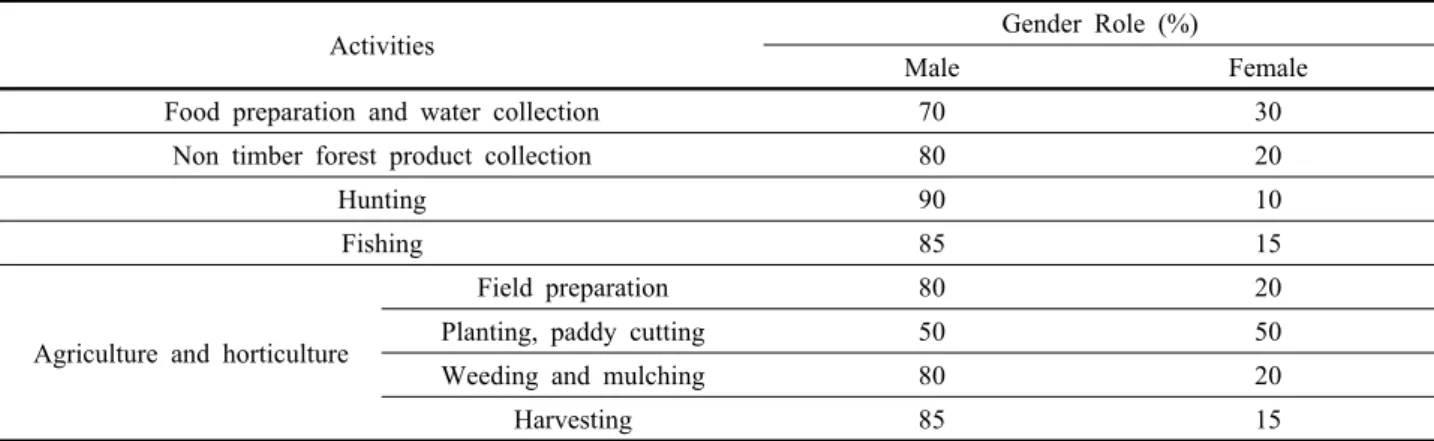
Firewood collection from forest for daily cooking was the task of women. Harvesting water from the pond and carrying it to the home two times daily was also the job
Table 4. Tree species in homestead forest of the Hajong tribe in the study area.
Local Name Scientific Name Uses Preference Occurrence
Akashmoni Acacia auricoliformis Fuel wood +++ C
Am Mangifera indica Fruit +++ C
Amloki Emblica officinalis Fruit, Medicine + FC
Amra Spondias pinnata Fruit, Medicine + R
Arjun Terminalia arjuna Medicine, Fuel wood + C
Bamboo Bambusa spp. Fodder ++ C
Bel Aegle marmelos Fruit, Medicine + FC
Boroi Zizyphus mauritiana Fruit ++ R
Chalta Dillenia indica Fruit + C
Dumor Ficus spp. Fruit, Fodder ++ R
Jalpai Elaeocarpus robustus Fruit, Fuel wood ++ FC
Jam Syzygium sp. Fruit + FC
Kadam Anthocephalus chinensis Fodder +++ C
Kanthal Artocarpus heterophyllus Fruit, Fodder +++ C
Litchu Litchi chinensis Fruit + FC
Mahagoni Swietenia mahagoni Furniture +++ C
Narikel Cocos nucifera Fruit + FC
Nim Azadirachta indica Medicine +++ FC
Payara Psidium guajava Fruit ++ C
Rain tree Samanea saman Fuel wood +++ C
Simul Bombax ceiba Fuel wood, Fodder ++ FC
Supari Areca catechu Fruit ++ C
Tentul Tamarindus indica Fruit, Medicine + R
Key: Preference: +++High, ++Medium, +low.
C-common, FC-fairly common, R-rare
Table 5. Gender role of the Hajong tribe in the study area.
Activities Gender Role (%)
Male Female
Food preparation and water collection 70 30
Non timber forest product collection 80 20
Hunting 90 10
Fishing 85 15
Agriculture and horticulture
Field preparation 80 20
Planting, paddy cutting 50 50
Weeding and mulching 80 20
Harvesting 85 15
of women while the young girls helped their mother. The poultry was also observed to be feed and taken care by the woman. Hunting was exclusively the job of men who also prepared the hunting devices and traps. Fishing and
non timber forest product collection from the forest is the major job performed by men. Young boys support in that job. In the preparation of horticultural and agricultural land were only done by men and the women, even did
not go there during such operation whereas, the planting, sowing of seeds and paddy cutting were done participating both of the sexes. Weeding, mulching and harvesting were done by men only with the collaboration of young boys.
Conclusion
The dependence of Hajong tribe on forests was so much that they constituted one of the integral components of forest ecosystem, where they had developed a balance with nature which might be viewed as a biome, a balance between man (here the Hajong themselves) on one hand and flora and fauna on the other. The study shows a particular pattern of food habit of the Hajong community in Bangladesh. The indigenous knowledge on food habit especially on wildlives and wild plants by the Hajong may provide some important and valuable information on the nutritional and medicinal effects on the human body.
They possessed an intimate relation with each and every component of forest like herbs, shrubs, trees, creepers, wild animals both harmless and ferocious ones, insects, even soil and water also. For a full understanding on the medicinal values of the food materials up taken by the Hajong, more anthropological and chemical researches are needed.
Acknowledgement
The authors deem their heartfelt gratitude to Mr. Mo- hammad Shaheed Hossain Chowdhury, Doctoral student, Forest Policy Laboratory, Department of Forest Science, Faculty of Agriculture, Shinshu University, 8304 Minamiminowa -Mura, 399-4598 Nagano-Ken, Japan for providing necessary literatures during manuscript preparation. Finally, we app- reciated the hearty cooperation of the Hajong of the North -east area during the time of our field data collection.
Reference
Ahmed, R. 2003. The Hajong. Banglapedia, National Encyclopedia of Bangladesh. Volume-4. Asiatic Society of Bangladesh, Nimtali,
Dhaka, Bangladesh. 620 pp.
Alam, M.K. 2002. Ethnobotanical knowledge and indigenous non- timber food crops for sustainable development of upland forming system in the CHT. In: Farming practices and sustainable de- velopment in Chittagong Hill Tracts, Khan NA et al., (eds).
CHTDB Government of BGD and VFFP-IC Swiss Agency for Development and Cooperation. pp. 155-63.
Alam, M.K., Khisa, S.K. 2000. The perception of ethno-botany in Chittagong Hill Tracts and its linkage with biodiversity. In: Of Popular wisdom: Indigenous knowledge and practices in Bangladesh, Khan, N.A. (ed.). BARCIK/IARD, Dhaka, Bangladesh. pp. 39- 46.
Anonymous. 1984. Food and fruit bearing forest species 2: Examples from South-Eastern Asia. FAO Forestry Paper, 44(2). FAO, Rome, Italy.
Anonymous. 2003. Manush, Jatigushti Parichiti (in Bangali), Series- 4. FIDDB, House-77, Road-7/A, Dhanmondi, Dhaka, Bangladesh.
56 pp.
Banik, R.L. 1997. The edibility of shoots of Bangladesh bamboos and their continuous harvesting effect on productivity. Bangladesh Journal of Forest Science 26(1): 1-10.
Banik, R.L. 1998. Ethno-botany of bamboo and rattan and their Indigenous management and utilization in Chittagong Hill Tracts.
In: Applied Ethno-botany, Banik, R.L., Alam, M.K., Pei, S.J., Rastogi, A., (eds.). Bangladesh Forest Research Institute. pp.
93-102.
BBS (Bangladesh Bureau of Statistics). 2005. Bangladesh Population Census, Zila Series: Sherpur. Ministry of Planning, Government of the People’s Republic of Bangladesh, Dhaka, Bangladesh.
Chandra, V. 2002. Forest as source of wild edible plants for tirbals.
Annals of Forestry 10(1): 159-66.
Halim, M.A., Chowdhury, M.S.H., Wadud, A.I., Uddin, M.S., Sarker, S.K., Uddin, M.B. 2007. The use of plants in traditional health care practice of the Shaiji community in South-Western Bangladesh. Journal of Tropical Forest Science 19(3): 168–75.
Jalil, S.M., Chowdhury, J.K. 2000. Participatory forest Management:
Implications for Policy and Human Resources Development in Bangladesh and the Chittagong Hill Tracts. In: Participatory Forest Management: Implication for Policy and Human Resources De- velopment in the Hindu-Kush-Hiamalayas, Anupam, B., (ed.).
ICIMOD, Kathmandu, Nepal. pp. 1-44.
Jana, S.K., Chauhan, A.S. 2000. Ethno-botanical aspects of legumes in Sikkim. Journal of Non-Timber Forest Products 7(1&2): 46 -52.
Khisa, S.K. 1998. Ethno-botanical cultural background of ethnic communities in forest resource management in Chittagong Hill Tracts. In: Applied Ethno-botany, Banik, R.L., Alam, M.K., Eei, S.J., Rastogi, A. (eds). Bangladesh Forest Research Institute, Chittagong, Bangladesh. p 56-63.
Kumar, K., Goel, A.K. 2000. Ethnography of Madhuca longifolia (Koenig) Macbride: A survival plant for the Tribals of Bihar (India). Journal of Non Timber Forest Products 7(1&2): 59-62.
Maikhuri, R.K., Nautiyal, S., Rao, K.S., Semwal, R.L. 2000. Indigenous knowledge of medicinal plants and wild edibles among three
tribal subcommunities of the Central Himalayas, Inida. Indigenous knowledge and Development Monitor 8(2): 7-13.
Miah, M.D., Chowdhury, M.S.H. 2003. Indigenous healthcare practice through medicinal plants from forests by the Mro tribe in Ban- darban region, Bangladesh. INDILINGA- African Journal of Indigenous Knowledge Systems 2(2): 61-73.
Mohiuddin, M., Alam, M.K., Zashimuddin, M. 2002. Indigenous knowledge for appropriate farming systems in Chittagong Hill Tracts. Paper presented on Regional workshop on the “Appropriate Soil and Water Conserving Farming Technologies for the Chittagong Hill Tracts”. 7-8 August, 2002, Organized By CHTDB, Khagrachari, Bangladesh. p 1-30.
Mukul, S.A., Uddin, M.B., Tito, M.R. 2007. Medicinal plant di- versity and local healthcare among the people living in and around a conservation area of Northern Bangladesh. Int. J. For.
Usuf. Mngt. 8 (2): 50-63.
Namgyel, P., Ghimiray, A.C. 1998. Forest the superstore: A case study of rural peoples dependence on forest resources in west- central Bhutan. In: Applied Ethno-botany, Banik, R.L., Alam, M.K., Pei, S.J., Rastogi, A. (eds.). Bangladesh Forest Research Institute, Chittagong, Bangladesh. pp. 16-9.
Nasrin, M., Khalifa, M.H. 2004. Bangladesher Khudro Jatisatar Ethno-botanical Onosilon (in Bangali). In: Bon, Bonbinash O Bonobasir Jibon Shangram, Gain, P., (ed). Society for Environment and Human Development, 4/4/1 (B), Block-A, Lalmatia, Dhaka, Bangladesh. p 65-101.
Partha, P., Hossain, A.B.M.E. 2007. Ethnobotanical investigation into the Mandi ethnic community in Bangladesh. Bangladesh J.
Plant Taxon. 14(2): 129-45.
Rashid, M.H., Rashid, A.Z.M.M. 2002. The Prospects of Medicinal Plant Cultivation and Floriculture in the Upland Farming System.
In: Farming Practices and Sustainable Development in Chittagong Hill Tracts, Khan, N.A. et al., (eds.). CHTDB, Government of
Bangladesh & VFFP-IC Swiss Agency for Development and Cooperation. pp. 255-8.
Sajem, A. L. and K. Gosai. 2006. Traditional use of medicinal plants by the Jaintia tribes in North Cachar Hills district of Assam, northeast India. Journal of Ethnobiology and Ethnomedicine 2:33-39.
Samal, J. 1997. Role of forest in a poor resource base tribal economy: A micro analysis. In: Forest Management in Tribal Areas, Mohapatra, P.M., Mohapatro, P.C., (eds.). Concept Publishing Company, Mohan Garden, New Delhi, India. Pp. 105-24.
Sattar, M.A. 1998. Indigenous technology fir processing of forest Produces. In: Applied Ethno-botany, Banik, R.L., Alam, M.K., Eei, S.J., Rastogi, A., (eds.). Bangladesh Forest Research Institute, Chittagong, Bangladesh. p 83-4.
Shroff, J. 1997. Forest policy and tribal development. In: Forest Management in Tribal Areas, Mohapatra, P.M., Mohapatro, P.C., (eds.). Concept Publishing Company, New Delhi, India. Pp.
65-9.
Siddiqi, M.A. 1998. Hill farming system of Marma Tribe in Chittagong Hill Tracts [Dissertation]. Institute of Forestry and Environmental Sciences, University of Chittagong, Chittagong, Bangladesh. 120 pp.
Surin, V., Bahadur, T. 1980. Forest produce and forest dwellers.
Seminar on the Role of Women in Community Forestry. Dehra Dun, India. pp. 55-61.
Tewari, D.N. 1986. Forests and Tribals. In: Social Forestry and Tribal Development, Desh, B., Garg, R.K., (eds.). India En- vironmental society, New Delhi, India. p 21-30.
Uddin, M.B., Chowdhury, M.S.H., Mukul, S.A., Khan, A.S.A., Uddin, M.S., Chowdhury, S. 2008. Status and distribution of medicinal plants in the north-eastern region of Bangladesh. Int.
J. For. Usuf. Mngt. 9(1): 16-23.
(Received May 18, 2009; Accepted August 19, 2009)