Cataract and Refractive Surgery in
; a Survey of KSCRS Members From 1995~2006
Sang Chul Yoon, MD, Jee Woong Jung, MD, Hee Jin Sohn, MD, Kyung Hwan Shyn, MD, PhD
Department of Ophthalmology, Gachon University of Medicine and Science, Gil Medical Center, Incheon, Korea
Purpose: This purpose of this report was to study trends in cataract and refractive surgeries conducted during the past twelve years and to compare results to previous reports from the ASCRS and New Zealand (NZ) in order to forecast future medical services.
Methods: We surveyed members of the Korean Society of Cataract and Refractive Surgery (KSCRS) every year from 1995 to 2006, and studied changes in cataract and refractive surgeries (RS).
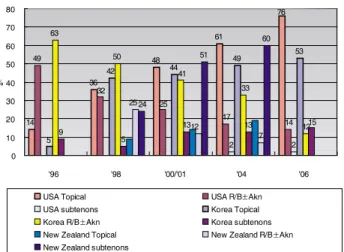
Results: The duration of hospitalization has been gradually decreasing to the point that a one day hospitalization following surgery has become common. The rate of topical anesthesia use has significantly increased since 1998.
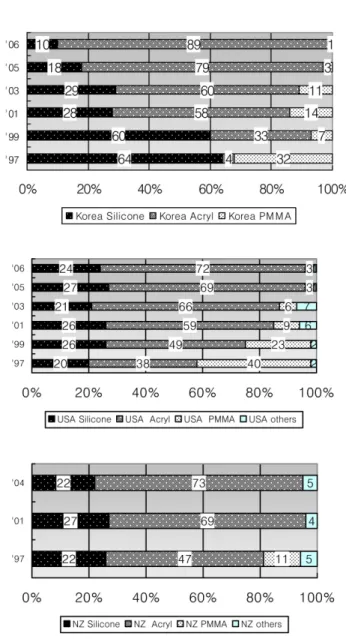
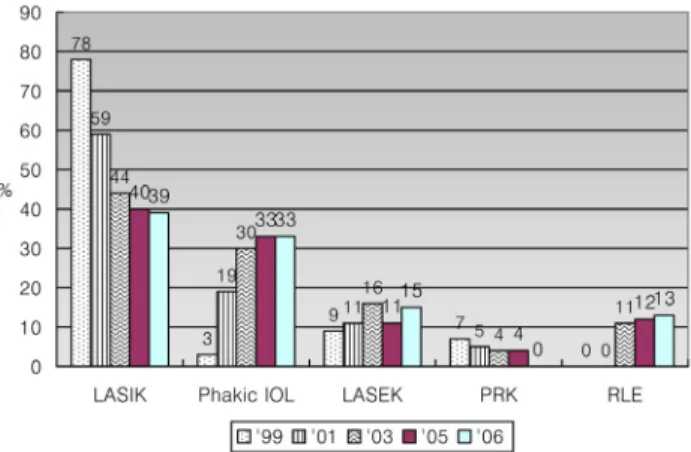
Sutureless incision methods are now commonly practiced. The use of acryl IOL as an optic material has been gradually increasing for cataract surgeries. KSCRS members showed an interest in the special intraocular lenses as multifocal IOL. While Excimer laser PRK was the most popular refractive surgery during the first stage, KSCRS members increasingly prefer LASIK to the Excimer laser PRK. Regression of the corrected visual acuity, dry eye, night halo, and flashes were the most common complications following refractive surgeries. Medical disputes related to PRK and LASIK have been gradually increasing throughout the study period.
Conclusions: We confirm that the KSCRS practice styles for cataract and RS are similar to those of the ASCRS and NZ. We infer a world-wide trend from the comparison of these three societies.
Korean J Ophthalmol 2009;23:142-147 ⓒ 2009 by the Korean Ophthalmological Society.
Key Words: Cataract surgery, KSCRS, Refractive surgery, Survey
Received: May 30, 2008 Accepted: August 6, 2009
Reprint requests to Kyung Hwan Shyn, MD, PhD. Department of Oph- thalmology, Gachon University of Medicine and Science, Gil Medical Center, Ga Chon Medical School, #1198 Guwol-dong, Namdong-gu, Incheon 405- 760, Korea. Tel: 82-32-460-3368, Fax: 82-32-460-3358 E-mail: campbell05
@naver.com
* Presented in part at the XXV Congress of the ESCRS, Stockholm, Sweden, September, 2007
Cataract and refractive surgeries have been rapidly develo- ping and are the most commonly practiced in the field of oph- thalmology. In light of these facts, this survey was conducted in an attempt to understand the current trends of cataract and refractive surgeries and to compare the results to related reports from America and New Zealand in an attempt to forecast future medical services.
This study was conducted by surveying members of the Ko- rean Society of Cataract and Refractive Surgery (KSCRS) every year from 1995 to 2006.
1-11 In America, Dr. Leaming
12-16 has conducted a similar survey of the members of the American Society of Cataract and Refractive Surgery every year since 1985 for a variety of subjects related to ophthalmology. Current data from Leaming’s study is available, with results available through the World Wide Web. In New Zealand, surveys on ca- taract and refractive surgeries have been conducted every three
years since 1997.
17-19
The aims of this study are to understand trends in cataract and refractive surgeries over the past 12 years and to provide basic information on improved surgical methods and impro- vements in medical equipment and systems.
Materials and Methods
The questionnaire used for this study was composed of multiple-choice questions related to ophthalmology. The num- ber of questions in the questionnaire has increased every year from sixty-two original questions in 1995 to 128 questions in 2006. These 128 questions have the following distribution:
seventy-two questions regarding cataract surgery, forty-nine for refractive surgery, and seven for other procedures. The for- mat of the questionnaire is very similar to that used in America for ease of comparison.
The multiple-choice questionnaire, including a reply enve- lope, was sent to every member of the KSCRS in February.
Responding members of the KSCRS were not financially re-
imbursed. Although the membership of the KSCRS has inc-
reased from 150 in 1995 to 348 members in 2006, the survey
response rate has decreased every year from a high of 40% in
1995 to 21.0% in 2006. Questionnaires arriving by a March
deadline of were analyzed for that year. Each questionnaire
was analyzed and the total number of questionnaires for that