176 https://e-kcj.org
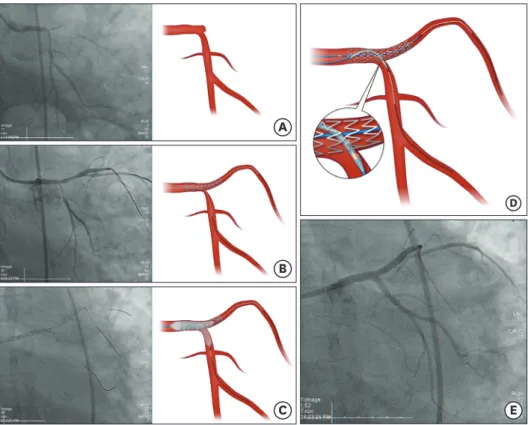
An 86-year-old man with a recent myocardial infarction underwent coronary angiography, which revealed total occlusion of the left anterior descending coronary artery (LAD) ostium and intermediate stenosis of the proximal left circumflex artery (LCX) (Figure 1A, Supplementary Figure 1A and 1B). After stenting with a 3.5×38-mm Resolute Integrity™
(Medtronic, Minneapolis, MN, USA) from the left main (LM) to the LAD, we attempted T-stenting with a 2.75×18-mm Promus Premier™ (Boston Scientific, Natick, MA, USA) in the compromised LCX ostium (Figure 1B, Supplementary Figure 1C). Despite repeated Korean Circ J. 2018 Feb;48(2):176-178
https://doi.org/10.4070/kcj.2017.0180 pISSN 1738-5520·eISSN 1738-5555
Images in
Cardiovascular Medicine
Received: Aug 11, 2017 Revised: Sep 27, 2017 Accepted: Sep 29, 2017 Correspondence to Hong-Seok Lim, MD, PhD
Department of Cardiology, Ajou University School of Medicine, 164, World cup-ro, Yeongtong-gu, Suwon 16499, Korea.
E-mail: [email protected] Copyright © 2018. The Korean Society of Cardiology
This is an Open Access article distributed under the terms of the Creative Commons Attribution Non-Commercial License (https://
creativecommons.org/licenses/by-nc/4.0) which permits unrestricted noncommercial use, distribution, and reproduction in any medium, provided the original work is properly cited.
ORCID iDs Uram Jin
https://orcid.org/0000-0001-8406-8886 Hong-Seok Lim
https://orcid.org/0000-0002-3127-2071 Seung-Jea Tahk
https://orcid.org/0000-0001-6521-178X Conflict of Interest
The authors have no financial conflicts of interest.
Author Contributions
Conceptualization: Lim HS; Project administration: Lim HS; Resources: Lim HS, Tahk SJ; Supervision: Lim HS; Visualization:
Lim HS, Jin U; Writing - original draft: Jin U;
Writing - review & editing: Lim HS, Tahk SJ, Jin U.
Uram Jin , MD, Hong-Seok Lim , MD, PhD, and Seung-Jea Tahk , MD, PhD
Department of Cardiology, Ajou University School of Medicine, Suwon, Korea
Longitudinal Stent-Strut Injury at the Distal End of a Newer-generation Drug-eluting Stent
A
B
C
D
E
Figure 1. Procedural findings. (A) Pre-PCI CAG. (B) After deployment of a stent into the LAD, the LCX ostium was compromised. (C) A two-step kissing balloon inflation at the left main bifurcation for lesion preparation. (D) Illustration of the stent that could not be inserted into the LCX: the distal tip was stuck at the LCX ostium. (E) Final CAG showing successful PCI results in LAD and LCX.
CAG = coronary angiogram, LAD = left anterior descending artery, LCX = left circumflex artery, PCI = percutaneous
coronary intervention.
predilation and kissing balloon (KB) inflation at the LM bifurcation (Figure 1C), the stent failed to cross the LCX ostium and its distal tip became stuck (Figure 1D). After removing the whole stent system, prolapse and deformation of the distal struts were noted (Figure 2). A 2.5×14-mm Resolute Integrity™ was chosen instead and successfully deployed. The procedure was completed with a final KB at the LM bifurcation (Figure 1E). To address increasing concerns regarding longitudinal stent deformation (LSD) with newer-generation drug- eluting stents (DESs), the Promus Premier™ was redesigned to reinforce the axial strength of proximal end, where almost all LSDs occurred in the previous Promus Element™.
1-3)However, the distal end of the Promus Premier™ is also vulnerable to longitudinal injury, as highlighted in this case. This is a reminder that caution is needed when using thinner-strut DESs because of their increased vulnerability to different types of deformation or injury due to the current prioritization of stent performance at the expense of strength.
4)5)Clinicians need to be aware of the potential for longitudinal injuries not only to the proximal but also to the distal end of stent-struts, particularly in complicated lesions requiring complex procedures.
ACKNOWLEDGEMENTS
We would like to acknowledge the important contribution made by Min-Kyoung Kim, who was responsible for medical illustration.
SUPPLEMENTARY MATERIAL
Supplementary Figure 1
Angiographic and procedural findings of left circumflex artery (A, B) Pre-PCI CAG. (C) Compromised LCX ostium after deployment of a stent into the LM-LAD.
Click here to view
177 https://e-kcj.org https://doi.org/10.4070/kcj.2017.0180
Distal Longitudinal Stent-Strut Injury
A
B C
Figure 2. The stent after removal. (A) Stent-strut injury of the distal end of the stent. (B and C), Struts at the
distal end of the stent were inversely bent.
REFERENCES
1. Hanratty CG, Walsh SJ. Longitudinal compression: a “new” complication with modern coronary stent platforms--time to think beyond deliverability? EuroIntervention 2011;7:872-7.
PUBMED | CROSSREF
2. Shannon J, Latib A, Takagi K, et al. “Procedural trauma risks longitudinal shortening of the Promus Element™ stent platform”. Catheter Cardiovasc Interv 2013;81:810-7.
PUBMED | CROSSREF
3. Ormiston JA, Webber B, Ubod B, White J, Webster MW. Stent longitudinal strength assessed using point compression: insights from a second-generation, clinically related bench test. Circ Cardiovasc Interv 2014;7:62-9.
PUBMED | CROSSREF
4. Williams PD, Mamas MA, Morgan KP, et al. Longitudinal stent deformation: a retrospective analysis of frequency and mechanisms. EuroIntervention 2012;8:267-74.
PUBMED | CROSSREF
5. Arnous S, Shakhshir N, Wiper A, et al. Incidence and mechanisms of longitudinal stent deformation associated with Biomatrix, Resolute, Element, and Xience stents: angiographic and case-by-case review of 1,800 PCIs. Catheter Cardiovasc Interv 2015;86:1002-11.
PUBMED | CROSSREF