RESEARCH ARTICLE
Clinical impact of diabetes mellitus on 2-year clinical outcomes following PCI with second- generation drug-eluting stents; Landmark analysis findings from patient registry: Pooled analysis of the Korean multicenter drug-
eluting stent registry
Cheol Hyun LeeID, Sang-Woong Choi, Seung-Woon Jun, Jongmin Hwang, In-Cheol Kim, Yun-Kyeong Cho, Hyoung-Seob Park, Hyuck-Jun Yoon, Hyungseop Kim, Chang- Wook Nam, Seongwook Han, Kwon-Bae Kim, Seung-Ho HurID*
Division of Cardiology, Department of Internal Medicine, Keimyung University Dongsan Hospital, Daegu, South Korea
Abstract
Background
Patients with diabetes mellitus are at an increased risk for adverse clinical events following percutaneous coronary interventions (PCI). However, the clinical impact of diabetes mellitus (DM) on second-generation drug-eluting stent (DES) implantation is not well-known. The aim of the current analysis was to examine the clinical impact of DM on clinical outcomes and the time sequence of associated risks in patients treated with second-generation DES.
Methods
Using patient-level data from two stent-specific, all-comer, prospective DES registries, we evaluated 1,913 patients who underwent PCI with second-generation DES between Feb 2009 and Dec 2013. The primary outcomes assessed were two-year major cardiac adverse events (MACE), composite endpoints of death from any cause, myocardial infarction (MI), and any repeat revascularization. We classified 0–1 year as the early period and 1–2 years as the late period. Landmark analyses were performed according to diabetes mellitus status.
Results
There were 1,913 patients with 2,614 lesions included in the pooled dataset. The median duration of clinical follow-up in the overall population was 2.0 years (interquartile range 1.9–
2.1). Patients with DM had more cardiovascular risk factors than patients without DM. In multivariate analyses, the presence of DM and renal failure were strong predictors of MACE and target-vessel revascularization (TVR). After inverse probability of treatment weighting a1111111111
a1111111111 a1111111111 a1111111111 a1111111111
OPEN ACCESS
Citation: Lee CH, Choi S-W, Jun S-W, Hwang J, Kim I-C, Cho Y-K, et al. (2020) Clinical impact of diabetes mellitus on 2-year clinical outcomes following PCI with second-generation drug-eluting stents; Landmark analysis findings from patient registry: Pooled analysis of the Korean multicenter drug-eluting stent registry. PLoS ONE 15(6):
e0234362.https://doi.org/10.1371/journal.
pone.0234362
Editor: Carmine Pizzi, University of Bologna, ITALY Received: February 11, 2020
Accepted: May 23, 2020 Published: June 10, 2020
Copyright:© 2020 Lee et al. This is an open access article distributed under the terms of theCreative Commons Attribution License, which permits unrestricted use, distribution, and reproduction in any medium, provided the original author and source are credited.
Data Availability Statement: All data are available within the paper and its Supporting Information files.
Funding: Korea Health Industry Development Institute (KR) Grant nr. HI17C2594 Dr. Seongwook Han.
Competing interests: No authors have competing interests.
(IPTW) analyses, patients with DM had significantly increased rates of 2-year MACE (HR 2.07, 95% CI; 1.50–2.86; P<0.001). In landmark analyses, patients with DM had signifi- cantly higher rates of MACE in the early period (0–1 year) (HR 3.04, 95% CI; 1.97–4.68; P<
0.001) after IPTW adjustment, but these findings or trends were not observed in the late period (1–2 year) (HR 1.24, 95% CI; 0.74–2.07; P = 0.41).
Conclusions
In the second-generation DES era, the clinical impact of DM significantly increased the 2- year event rate of MACE, mainly caused by clinical events in the early period (0–1 year).
Careful observation of patients with DM is advised in the early period following PCI with sec- ond-generation DES.
Introduction
Previous studies have shown that percutaneous coronary interventions (PCI) with drug-elut- ing stent (DES) has a better outcome than bare-metal stents in patients with diabetes mellitus (DM) [1–4]. Two large randomized trials showed that second-generation DES outperformed first-generation DES by reducing target lesion revascularization (TLR), target vessel revascu- larization (TVR), and stent thrombosis (ST). But, these improvement of device-oriented clini- cal outcomes between first- and second-generation DES were seen only in patients without DM and not in patients with DM [5,6]. DM still remains associated with an increased risk of in-stent restenosis, TLR, or TVR in patients undergoing PCI [7]. However, the overall clinical outcomes, early (0–1 year) and late period (>1 year) efficacies and safety of second-generation DES in DM patients remain controversial. Therefore, to compare the overall clinical outcomes and time sequence of efficacy and safety of two second-generation DES (everolimus-eluting stent (EES) and zotalolimus-eluting stent (ZES)) in patients with or without DM, we investi- gated the two-year clinical results of patients included in two stent-specific, prospective DES registries.
Materials and methods
Study design and population
DM (type 1 or type 2) was defined as either a previous diagnosis of DM treated with pharma- cologic or nonpharmacologic measure, or a new DM was defined according to the American Diabetes Association as history of either presence of classic symptoms of DM with unequivocal elevation of plasma glucose (2 h post-prandial or random of �200 mg/dL), fasting plasma glu- cose elevation on �126 mg/dl during hospitalization or Hemoglobin A1C �6.5% (48 mmol/
mol). Patients were considered insulin-treated if they were taking insulin. Patients were con- sidered noninsulin-treated if they were taking only oral hypoglycemic agents or were on a therapeutic lifestyle modification only or both oral agents and therapeutic life-style modification.
The study populations were pooled from two independent, multicenter, all-comer, observa- tional studies of patients undergoing PCI with second-generation DES from of the Korean Registry of Xience V EVERolimus-Eluting coronary STent system (K-EVEREST) and the Clinical Outcomes iN patientS with zoTArolimus-eluting stent implaNTation (CONSTANT) registry. Inclusion criteria, exclusion criteria, and the key features of each registry are
Abbreviations: DES, drug-eluting stent; DM, diabetes mellitus; EES, everolimus-eluting stent;
IPTW, inverse probability of treatment weighting;
MACE, major cardiac adverse events; MI, myocardial infarction; PES, paclitaxel-eluting stent;
PCI, percutaneous coronary interventions; SES, sirolimus-eluting stent; ST, stent thrombosis; TLR, target lesion revascularization; TVR, target vessel revascularization; ZES, zotalolimus-eluting stent.
summarized inS1 Table. Briefly, the K-EVEREST and CONSTANT registries involved pro- spective, multicenter recruitment of unrestricted patients undergoing PCI with DESs in Korea, and included the use of second-generation DES in contemporary PCI situations. The pooled dataset consisted of individual patient data from two different cohorts of the DES registry.
These registries were supported by the Keimyung University Dongsan Hospital, Deagu, Korea, and there was no industry involvement in the design, conduct, or analysis of the study.
The study protocol was approved by the Keimyung University Dongsan Hospital ethics com- mittee/ institutional review boards at each participating center, and all patients provided writ- ten informed consent for participation in this prospective registry.
PCI procedures and clinical follow-up
In the K-EVEREST and CONSTANT registries, PCI procedures were performed according to standard techniques at the discretion of the treating physician. These registries did not specify the stent types based on clinical or anatomic features. Thus, each operator was responsible for the choice of a specific DES. Periprocedural anticoagulants were administered according to standard regimens. Glycoprotein IIb/IIIa inhibitors were administered at the discretion of the operator. All patients undergoing PCI received a loading dose of aspirin and P2Y12receptor inhibitor (clopidogrel, prasugrel, or ticagrelor) before or during PCI. After the procedure, aspi- rin was continued indefinitely and P2Y12receptor inhibitors were prescribed for at least 12 months, regardless of the DES type. Drugs for secondary prevention were prescribed accord- ing to current guidelines.
Clinical follow-up was conducted during hospitalization and at one month, 12 months, and 24 months. At each visit, information pertaining to the patients’ clinical status, all interven- tions, and outcome events were recorded. Baseline characteristics and outcome data were col- lected using a dedicated, electronic case report form by specialized personnel at each
participating center. The internet-based system provided each center with immediate and con- tinuous feedback on the processes and quality-of-care measures. Monitoring and verification of registry data were periodically performed at the participating hospitals by members of the academic coordinating center (Clinical Research Center, Keimyung University Dongsan Hos- pital, Deagu, Korea).
Study outcomes and definitions
The primary clinical outcomes were major cardiac adverse events (MACE), composite end- points of death from any cause, myocardial infarction (MI), any repeat revascularization. Sec- ondary clinical outcomes included death (cardiac or non-cardiac), MI (Q-wave or non-Q- wave), repeat revascularization, and stent thrombosis.
Death was considered to have a cardiac cause unless an unequivocal non-cardiac cause could be established. The protocol definition of MI was pre-specified and was based on the universal definition of MI [8]. MI was defined as any increase in cardiac enzymes above the upper range limit with or without the development of Q waves on the electrocardiogram and peri-procedural MI was excluded from the analysis. Repeat revascularization included any type of percutaneous or surgical revascularization procedures and was categorized as revascu- larization of any lesion, target lesion, or target vessel. Definite stent thrombosis was assessed according to the Academic Research Consortium definition [9]. All outcomes of interest were confirmed by source documentation collected at each hospital and were carefully verified and adjudicated by independent clinicians at each hospital.
Statistical analysis
Based on a history of DM, the data were reported as frequencies and percentages for dichoto- mous and categorical variables, and as the mean± standard deviation for continuous variables.
Dichotomous and categorical variables were assessed using Chi-square tests and Fisher’s exact tests, and continuous variables were assessed using Student’s t tests or the Wilcoxon rank-sum tests, as appropriate. Observed event rates at 2-year and survival curves were generated using the Kaplan-Meier method and compared with the log-rank test. For clinical outcomes, we pre- specified examining the event rates 2-year of follow-up, and separately from 0 to 1 years and from 1 to 2 years (as the landmark analyses). We further classified the 0–1 year period as the early period and the 1–2 year period as the late period. Univariate and multivariate analyses of hazard ratios, including the baseline covariates in Tables1and2, were calculated using the Cox proportional hazard method. Factors with p values <0.1 in the univariate analysis were entered into the multivariate model. In addition, unadjusted and adjusted Cox proportional hazard models were used to compare clinical events according to a history of DM. To compen- sate for the nonrandomized design of the observational studies and to reduce the effect of potential confounding factors on the outcomes, we used a propensity score method. We fitted weighted Cox proportional hazards models using the inverse probability of treatment weight- ing (IPTW) [10].
All reported P values were 2-sided and have not been adjusted for multiple testing. All anal- yses were performed with SPSS software version 22.0 (SPSS Inc., Chicago, Illinois) and the R programming language.
Results
Characteristics of the study patients
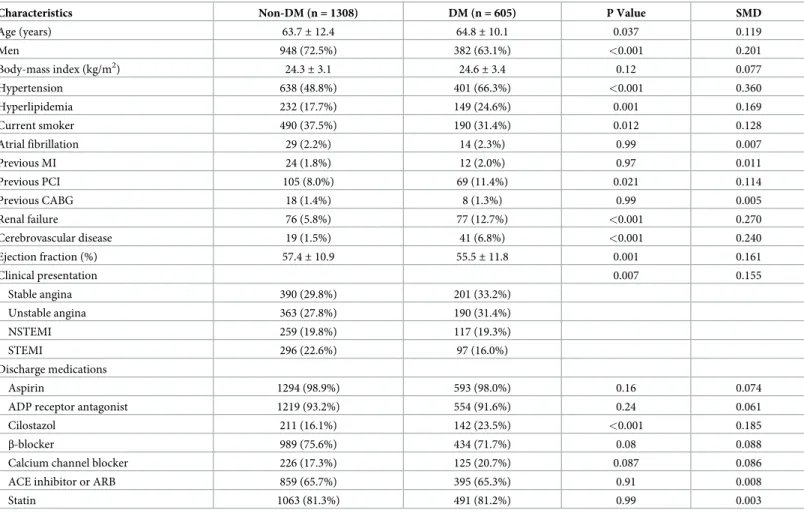
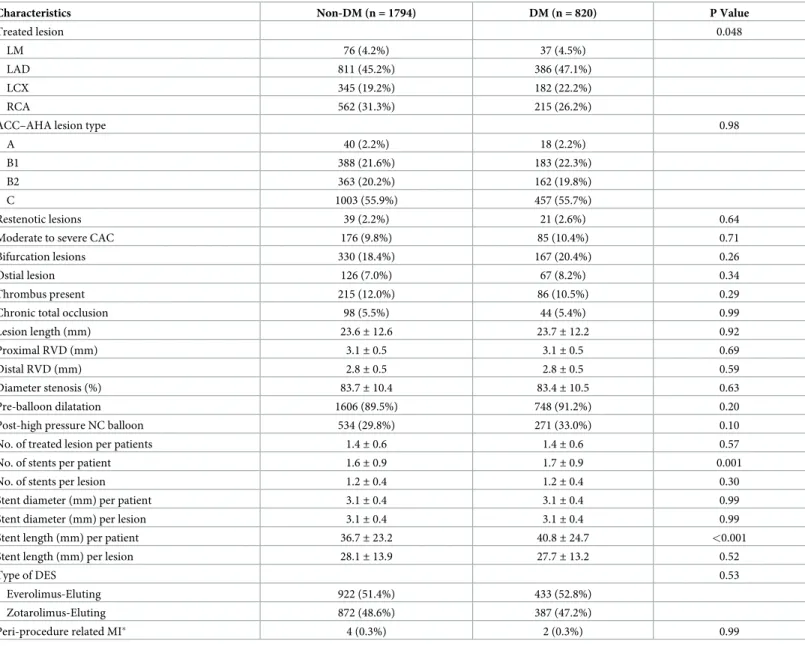
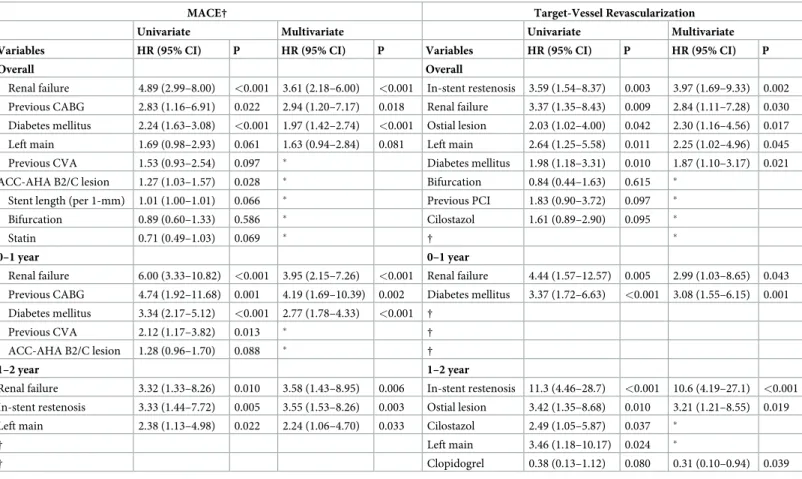
During February 2009 and December 2013, a total of 1,913 patients from two stent-specific, prospective K-EVERST and CONSTANT registries were included in the current study (S1 Fig). The baseline demographics and clinical characteristics of the study population according to the patients’ DM status are shown inTable 1. The mean age of the patients was 63.9 years and approximately 70% of patients were men. Patients with DM were older, included more men, and had higher rates of hypertension, hyperlipidemia, histories of previous PCI, renal failure, and cerebrovascular disease than patients without DM. There was no difference in dis- charge medication between the two groups, except for cilostazol.Table 2shows the lesion and procedural characteristics of the study population according to patients’ DM status. The num- ber of stents was higher and the stent length was longer in patients with DM.Table 3shows the univariate and multivariate analyses of MACE and TVR. DM and renal failure had the highest correlation with 2-year clinical outcomes in multivariate analyses. However, the type of DES was not a significant predictor of 2-year clinical outcomes.
Clinical impact of diabetes mellitus
The median duration of clinical follow-up in the overall population was 2.0 years (interquartile range 1.9–2.1). The baseline characteristics after IPTW adjustment are shown in theS2 Table.
The Kaplan–Meier estimates of primary and secondary outcomes at 2-years according to DM status are shown inTable 4andFig 1. The incidence of 2-year MACE was significantly higher in patients with DM than in those without DM (12.7% vs. 6.2%, P<0.001). Death, MI, and repeat revascularization showed significantly higher rates in patients with DM than in those without DM. After IPTW adjustment, patients with DM also showed higher event rates of pri- mary and secondary endpoints, including cardiac death, MI, and repeat revascularization than
patients without DM. In addition, the impact of diabetes mellitus according to clinical and procedural subgroups is shown inS2 Fig.
Landmark analyses of clinical outcomes
A landmark analysis (Table 5andFig 2) after IPTW adjustment revealed that, the incidences of MACE (2.8% vs. 8.9%, HR 3.04, 95% CI; 1.97–4.68; P <0.001), cardiac death, MI, and repeat revascularization in the early (0–1 year) period were significantly higher in patients with DM than those without DM. However, these findings were not observed in the late period (1–2 year). The incidence of MACE (3.5% vs. 4.2%, HR 1.24, 95% CI; 0.74–2.07; P = 0.41), cardiac death, MI, and repeat revascularization in the late period were not statistically different between patients with and without DM.
Discussion
The major findings from the analyses of two well-managed registries for the impact of DM on clinical outcomes of patients treated with second-generation DES are (1) that, despite the
Table 1. Baseline demographic and clinical characteristics of patients.
Characteristics Non-DM (n = 1308) DM (n = 605) P Value SMD
Age (years) 63.7± 12.4 64.8± 10.1 0.037 0.119
Men 948 (72.5%) 382 (63.1%) <0.001 0.201
Body-mass index (kg/m2) 24.3± 3.1 24.6± 3.4 0.12 0.077
Hypertension 638 (48.8%) 401 (66.3%) <0.001 0.360
Hyperlipidemia 232 (17.7%) 149 (24.6%) 0.001 0.169
Current smoker 490 (37.5%) 190 (31.4%) 0.012 0.128
Atrial fibrillation 29 (2.2%) 14 (2.3%) 0.99 0.007
Previous MI 24 (1.8%) 12 (2.0%) 0.97 0.011
Previous PCI 105 (8.0%) 69 (11.4%) 0.021 0.114
Previous CABG 18 (1.4%) 8 (1.3%) 0.99 0.005
Renal failure 76 (5.8%) 77 (12.7%) <0.001 0.270
Cerebrovascular disease 19 (1.5%) 41 (6.8%) <0.001 0.240
Ejection fraction (%) 57.4± 10.9 55.5± 11.8 0.001 0.161
Clinical presentation 0.007 0.155
Stable angina 390 (29.8%) 201 (33.2%)
Unstable angina 363 (27.8%) 190 (31.4%)
NSTEMI 259 (19.8%) 117 (19.3%)
STEMI 296 (22.6%) 97 (16.0%)
Discharge medications
Aspirin 1294 (98.9%) 593 (98.0%) 0.16 0.074
ADP receptor antagonist 1219 (93.2%) 554 (91.6%) 0.24 0.061
Cilostazol 211 (16.1%) 142 (23.5%) <0.001 0.185
β-blocker 989 (75.6%) 434 (71.7%) 0.08 0.088
Calcium channel blocker 226 (17.3%) 125 (20.7%) 0.087 0.086
ACE inhibitor or ARB 859 (65.7%) 395 (65.3%) 0.91 0.008
Statin 1063 (81.3%) 491 (81.2%) 0.99 0.003
Data are shown as mean (SD) for continuous variables and absolute numbers (percentage) for dichotomous variables.
Abbreviations: CABG, coronary artery bypass grafting; CAD, coronary artery disease; CHF, congestive heart failure; NSTEMI, non-ST-elevation myocardial infarction;
MI, myocardial infarction; PCI, percutaneous coronary intervention; STEMI, ST-elevation MI; SMD, standardization mean differences
https://doi.org/10.1371/journal.pone.0234362.t001
second-generation DES era, DM was still an independent factor for increased adverse cardiac events; (2) that most MACE occurred in the early (0–1 year) period, and DM did not affect the events in the late (1–2 year) period; and (3) that, in multivariate analyses, DM was an indepen- dent predictor of MACE and TVR in the early period, but not in the late period.
Previous studies of DES in diabetes mellitus
The clinical outcomes of the second-generation DES in patients with DM have been evaluated and early findings showed that the second-generation DES in DM patients had better clinical
Table 2. Baseline lesion and procedural characteristics.
Characteristics Non-DM (n = 1794) DM (n = 820) P Value
Treated lesion 0.048
LM 76 (4.2%) 37 (4.5%)
LAD 811 (45.2%) 386 (47.1%)
LCX 345 (19.2%) 182 (22.2%)
RCA 562 (31.3%) 215 (26.2%)
ACC–AHA lesion type 0.98
A 40 (2.2%) 18 (2.2%)
B1 388 (21.6%) 183 (22.3%)
B2 363 (20.2%) 162 (19.8%)
C 1003 (55.9%) 457 (55.7%)
Restenotic lesions 39 (2.2%) 21 (2.6%) 0.64
Moderate to severe CAC 176 (9.8%) 85 (10.4%) 0.71
Bifurcation lesions 330 (18.4%) 167 (20.4%) 0.26
Ostial lesion 126 (7.0%) 67 (8.2%) 0.34
Thrombus present 215 (12.0%) 86 (10.5%) 0.29
Chronic total occlusion 98 (5.5%) 44 (5.4%) 0.99
Lesion length (mm) 23.6± 12.6 23.7± 12.2 0.92
Proximal RVD (mm) 3.1± 0.5 3.1± 0.5 0.69
Distal RVD (mm) 2.8± 0.5 2.8± 0.5 0.59
Diameter stenosis (%) 83.7± 10.4 83.4± 10.5 0.63
Pre-balloon dilatation 1606 (89.5%) 748 (91.2%) 0.20
Post-high pressure NC balloon 534 (29.8%) 271 (33.0%) 0.10
No. of treated lesion per patients 1.4± 0.6 1.4± 0.6 0.57
No. of stents per patient 1.6± 0.9 1.7± 0.9 0.001
No. of stents per lesion 1.2± 0.4 1.2± 0.4 0.30
Stent diameter (mm) per patient 3.1± 0.4 3.1± 0.4 0.99
Stent diameter (mm) per lesion 3.1± 0.4 3.1± 0.4 0.99
Stent length (mm) per patient 36.7± 23.2 40.8± 24.7 <0.001
Stent length (mm) per lesion 28.1± 13.9 27.7± 13.2 0.52
Type of DES 0.53
Everolimus-Eluting 922 (51.4%) 433 (52.8%)
Zotarolimus-Eluting 872 (48.6%) 387 (47.2%)
Peri-procedure related MI� 4 (0.3%) 2 (0.3%) 0.99
Data are shown as mean (SD) for continuous variables and absolute numbers (percentage) for dichotomous variables.
�Peri-procedure related MIs were calculated per patient.
Abbreviations: LAD, left anterior descending artery; LCX, left circumflex artery; LM, left main; RCA, and right coronary artery; CAC, coronary artery calcification;
RVD, reference vessel diameter; NC, non-compliant. Other abbreviations are as inTable 1.
https://doi.org/10.1371/journal.pone.0234362.t002
outcomes than the first-generation DES. The use of EES, second-generation DES, reduced the 8-month angiographic restenosis rates of MI, death, or stent thrombosis compared to implan- tation with sirolimus-eluting stent (SES) in patients with DM and coronary artery disease in the ESSENCE-DIABETES (Randomized Comparison of EES Versus SES Implantation for De Novo Coronary Artery Disease in Patients With Diabetes Mellitus) trial [11].
In contrast, recent findings that second-generation DES had no difference in clinical out- comes compared to first-generation DES have also been reported in diabetes patients. In the SPIRIT (Clinical Evaluation of the XIENCE V Everolimus Eluting Coronary Stent System) IV randomized trial, comparison of EESs with PES showed no difference in 1-year target-lesion failure in diabetic patients (6.4% vs. 6.9%, p = 0.80) [12]. And another recent patient-level pooled analysis from two large-scale prospective multicenter randomized trials according to the presence of DM found no significant differences in the rates of 3-year all-cause death, MI, any TLR (DM stratum, 10.1% vs. 8.7%, P = 0.23; and non-DM stratum, 6.2% vs. 5.7%, P = 0.62), or stent thrombosis [13]. Our study using stent-specific, clinical registries of diverse types of second-generation DES in routine clinical practice also found similar clinical out- comes to recent studies and may provide important information that DM is a still strong clini- cal risk factor in the second-generation DES era.
Table 3. Univariate and multivariate Cox proportional hazard analyses for MACE and TVR in enrolled patients.
MACE† Target-Vessel Revascularization
Univariate Multivariate Univariate Multivariate
Variables HR (95% CI) P HR (95% CI) P Variables HR (95% CI) P HR (95% CI) P
Overall Overall
Renal failure 4.89 (2.99–8.00) <0.001 3.61 (2.18–6.00) <0.001 In-stent restenosis 3.59 (1.54–8.37) 0.003 3.97 (1.69–9.33) 0.002 Previous CABG 2.83 (1.16–6.91) 0.022 2.94 (1.20–7.17) 0.018 Renal failure 3.37 (1.35–8.43) 0.009 2.84 (1.11–7.28) 0.030 Diabetes mellitus 2.24 (1.63–3.08) <0.001 1.97 (1.42–2.74) <0.001 Ostial lesion 2.03 (1.02–4.00) 0.042 2.30 (1.16–4.56) 0.017 Left main 1.69 (0.98–2.93) 0.061 1.63 (0.94–2.84) 0.081 Left main 2.64 (1.25–5.58) 0.011 2.25 (1.02–4.96) 0.045
Previous CVA 1.53 (0.93–2.54) 0.097 � Diabetes mellitus 1.98 (1.18–3.31) 0.010 1.87 (1.10–3.17) 0.021
ACC-AHA B2/C lesion 1.27 (1.03–1.57) 0.028 � Bifurcation 0.84 (0.44–1.63) 0.615 �
Stent length (per 1-mm) 1.01 (1.00–1.01) 0.066 � Previous PCI 1.83 (0.90–3.72) 0.097 �
Bifurcation 0.89 (0.60–1.33) 0.586 � Cilostazol 1.61 (0.89–2.90) 0.095 �
Statin 0.71 (0.49–1.03) 0.069 � † �
0–1 year 0–1 year
Renal failure 6.00 (3.33–10.82) <0.001 3.95 (2.15–7.26) <0.001 Renal failure 4.44 (1.57–12.57) 0.005 2.99 (1.03–8.65) 0.043 Previous CABG 4.74 (1.92–11.68) 0.001 4.19 (1.69–10.39) 0.002 Diabetes mellitus 3.37 (1.72–6.63) <0.001 3.08 (1.55–6.15) 0.001 Diabetes mellitus 3.34 (2.17–5.12) <0.001 2.77 (1.78–4.33) <0.001 †
Previous CVA 2.12 (1.17–3.82) 0.013 � †
ACC-AHA B2/C lesion 1.28 (0.96–1.70) 0.088 � †
1–2 year 1–2 year
Renal failure 3.32 (1.33–8.26) 0.010 3.58 (1.43–8.95) 0.006 In-stent restenosis 11.3 (4.46–28.7) <0.001 10.6 (4.19–27.1) <0.001 In-stent restenosis 3.33 (1.44–7.72) 0.005 3.55 (1.53–8.26) 0.003 Ostial lesion 3.42 (1.35–8.68) 0.010 3.21 (1.21–8.55) 0.019 Left main 2.38 (1.13–4.98) 0.022 2.24 (1.06–4.70) 0.033 Cilostazol 2.49 (1.05–5.87) 0.037 �
† Left main 3.46 (1.18–10.17) 0.024 �
† Clopidogrel 0.38 (0.13–1.12) 0.080 0.31 (0.10–0.94) 0.039
�Not retained as independent predictor in multivariate analysis.
†Not significant in univariate analysis.
Abbreviations: CHF, congestive heart failure; CI, confidence interval; HR, hazard ratio; MACE, major adverse cardiac event; TVR, target-vessel revascularization. Other abbreviations are as in Tables1and2.
https://doi.org/10.1371/journal.pone.0234362.t003
Differences in clinical outcomes of diabetic versus non-diabetic patients between early and late periods
In the current study, there was a difference in MACE between DM patients and non-DM patients in the early period, and it was driven mainly by target-vessel repeat revascularization.
And TVR events in our study most commonly occurred within 6–9 months after DES implan- tation. This phenomenon might be due to neointimal growth in the several months following DES implantation, and follow-up angiography at around 9 months. In another large cohort study, similar to our data, clinical events occurred mainly in DM patients at 6–9 months, and the TVR rate was 3.5%, which are in line with our results [14]. A previous animal study sup- ported the hypothesis that delayed neointimal hyperplasia and inflammation may cause early aggravation of neo-atherosclerosis in patients with DM [15]. Therefore, the difference in clini- cal outcomes between the DM and non-DM patients in the early period may have been caused by the time required for healthy neointima to completely cover the stent strut.
In the late period, interestingly, most clinical outcomes did not show any difference between patients with or without DM. In our data, the occurrence of MACE was 4.2% in the DM group and 3.5% in the non-DM group in the late period, and there was no significant dif- ference between the groups. After IPTW adjustment, the TVR rate was slightly lower in DM patients compared to the non-DM group (1.3% in the DM group and 1.5% in the non-DM group, HR 0.86, 95% CI; 0.34–2.17; P = 0.75) in the late period. This trend is plausible because the neoinimal growth or thrombogenic material is more active near the stent strut in the early period after implantation and thus, it could be affected by the type of immunosuppressive drug, platform design or polymer in a DES. In contrast, beyond 1-year, the rapid reaction of neointimal growth or thrombogenic material near the stent would have subsided and be less affected by the differences in the DES components. Thus, even between DES and bare metal stent, the long-term clinical outcome after 1-year would not be different in previous several studies [4,16]. The rapid decrease in repeat revascularizations in the late period has also been observed in several previous studies and trials related to DM [17,18]. And, our current study showed a difference in the clinical outcomes in the early and late periods in DM patients through landmark analysis, similar to the previous study.
Table 4. Hazard ratios of 2-year event rates of clinical outcomes according to diabetes mellitus.
Unadjusted IPTW adjusted
Characteristics Non-DM (n = 1308) DM (n = 605) P Value Hazard Ratio (95% CI) P Value Hazard Ratio (95% CI) P Value
MACE 76 (6.2) 75 (12.7) <0.001 2.24 (1.63–3.08) <0.001 2.07 (1.50–2.86) <0.001
Death from any cause 23 (1.9) 31 (5.2) <0.001 2.97 (1.73–5.09) <0.001 2.21 (1.27–3.83) 0.005
Cardiac death 10 (0.8) 17 (2.8) <0.001 3.74 (1.71–8.17) 0.001 2.42 (1.11–5.27) 0.026
Non-cardiac death 13 (1.1) 14 (2.5) 0.021 2.37 (1.11–5.05) 0.025 2.02 (0.92–4.40) 0.078
Myocardial infarction 5 (0.4) 10 (1.6) 0.003 4.43 (1.51–12.95) 0.007 4.71 (1.63–13.63) 0.004
Q wave MI 2 (0.2) 5 (0.7) 0.022 5.51 (1.07–28.42) 0.041 5.74 (1.15–28.57) 0.033
Non-Q wave MI 3 (0.3) 5 (0.9) 0.055 3.70 (0.88–15.49) 0.073 3.98 (0.96–16.61) 0.058
Repeat revascularization 56 (4.6) 47 (8.2) <0.001 1.91 (1.30–2.81) 0.001 2.07 (1.41–3.03) <0.001
Target vessel 31 (2.6) 27 (4.9) <0.001 1.98 (1.18–3.31) 0.010 1.94 (1.16–3.26) 0.012
Target lesion 22 (3.9) 19 (5.2) 0.029 1.96 (1.06–3.62) 0.032 1.81 (0.95–3.42) 0.071
Non-target vessel 25 (2.1) 20 (3.5) 0.042 1.83 (1.01–3.29) 0.045 2.22 (1.26–3.91) 0.006
Definite or probable stent thrombosis 3 (0.2) 3 (0.5) 0.32 2.2 (0.44–10.91) 0.33 2.52 (0.53–12.03) 0.25
�Cumulative rates of events based on Kaplan-Meier estimates.
Abbreviations: DM, diabetes mellitus; CI, confidence interval; IPTW, inverse probability of treatment weighting; MACE, major adverse cardiac event; MI, myocardial infarction.
https://doi.org/10.1371/journal.pone.0234362.t004
Predictor of the clinical outcome according to period after DES implantation
In multivariate analyses of the current cohort registry, patient factors, such as DM and chronic renal failure, were found to be independent predictors of MACE and TVR in the early period.
On the other hand, anatomical and procedural factors, such as in-stent restenosis and ostial lesions, were found to independent predictors of MACE and TVR in the late period, and this finding was similar to that reported by another study [18]. As mentioned previously, patient fac- tors were still important risk factors in the second generation DES era in the early period. Our results provide useful information to physicians and suggest that more intensive cardiac evalua- tion and management of risk factors in the early period following DES implantation may be helpful for DM patients. However, follow-up strategies of 1-year after DES implantation in DM patients may be acceptable without any difference from non-DM patients. In the late period, intensive cardiac evaluation may be helpful in patients with complex procedural factors. In addition, the listed DM, chronic renal failure, in-stent restenosis, and ostial lesions were associ- ated with worse outcomes following second generation DES implantation, so coronary artery bypass grafting (CABG) options should always be considered in treatment planning.
Fig 1. Kaplan-Meier curve for 2 years clinical outcomes according to diabetes mellitus. In each figure, cumulative-incidence curves are shown for major adverse cardiac events (MACE) stratified by diabetes mellitus (Panel A), cardiac death (Panel B), myocardial infarction (Panel C), and target vessel revascularization (Panel D). MACE was defined as a composite of death from any causes, myocardial infraction, or repeat revascularization.
https://doi.org/10.1371/journal.pone.0234362.g001
Study limitations
Several limitations of our study should be considered. First, as this study was observational in nature, the overall findings should be considered hypothetical and hypotheses-generating only. Second, analysis of clinical outcomes was limited to the 2-year period after the index PCI because of the study protocol. Our study was not able to draw any conclusions regarding very long-term prognoses beyond 2-years in diabetic patients. Third, because the data were from observational registries, the clinical events may not have been meticulously captured, and patient follow-up may not have been as strict as would have been in a randomized trial. This may have been the reason for the low event rates seen in this study, especially the rate of target MI, which was much lower in our study than in the previous randomized controlled trial. We cannot completely exclude the possibility of under-investigating of clinical outcomes, such as MI, TVR, or ST, in the patients lost to follow-up. However, our data showed a relatively high follow-up rate compared to other registries, which is a meaningful value.
Conclusions
In the real-world practice using second-generation DES, DM significantly increased the 2-year event rate of MACE, mainly due to clinical events in the early period (0–1 year). Therefore, in DM patients, we advise intentional cardiac evaluation and management of risk factors in the early period after PCI with second-generation DES.
Table 5. Landmark analysis of 1-year and 1- to 2 year event rates of clinical outcomes according to diabetes mellitus.
MACE During 1 year Follow-up MACE During 1- to 2 year Follow-up
Characteristics Crude Event rate
(%)
IPTW adjusted Hazard Ratio (95% CI)
P Value Crude Event rate (%)
IPTW adjusted Hazard Ratio (95% CI)
P Value
Non- DM
DM Non-
DM DM
MACE 35 (2.8) 52
(8.9)
3.04 (1.97–4.68) <0.001 41 (3.5) 23 (4.2)
1.24 (0.74–2.07) 0.41
Death from any cause 9 (0.7) 18
(3.1)
3.04 (1.34–6.90) 0.008 14 (1.2) 13 (2.2)
1.67 (0.78–3.57) 0.19
Cardiac death 3 (0.2) 8 (1.4) 4.03 (1.11–14.57) 0.034 7 (0.6) 9 (1.5) 1.74 (0.63–4.78) 0.29
Non-cardiac death 6 (0.5) 10
(1.7)
2.48 (0.85–7.26) 0.097 7 (0.6) 4 (0.7) 1.59 (0.50–5.03) 0.43
Myocardial infarction 1 (0.1) 6 (1.0) 15.73 (1.82–135.7) 0.012 4 (0.3) 4 (0.6) 2.13 (0.53–8.58) 0.29
Q wave MI 1 (0.1) 1 (0.2) 3.40 (0.27–45.04) 0.35 1 (0.1) 4 (0.6) 7.72 (0.94–63.10) 0.057
Non-Q wave MI 0 (0.0) 5 (0.9) - - 3 (0.3) 0 (0.0) - -
Repeat revascularization 26 (2.1) 34 (6.0)
3.02 (1.82–5.02) <0.001 30 (2.6) 13 (2.4)
1.21 (0.65–2.24) 0.54
Target vessel 14 (1.1) 21
(3.7)
3.16 (1.61–6.20) <0.001 17 (1.5) 6 (1.3) 0.86 (0.34–2.17) 0.75
Target lesion 8 (0.6) 15
(2.7)
3.70 (1.50–9.10) 0.005 14 (1.2) 4 (0.8) 0.73 (0.25–2.16) 0.57
Non-target vessel 12 (1.0) 13
(2.3)
2.85 (1.32–6.18) 0.008 13 (1.1) 7 (1.2) 1.66 (0.71–3.86) 0.24
Definite or probable Stent thrombosis
1 (0.1) 2 (0.3) 5.26 (0.48–58.06) 0.18 2 (0.2) 1 (0.2) 1.23 (0.12–12.47) 0.86
�Cumulative rates of events based on Kaplan-Meier estimates.
Abbreviations: DM, diabetes mellitus; CI, confidence interval; IPTW, inverse probability of treatment weighting; MACE, major adverse cardiac event; MI, myocardial infarction.
https://doi.org/10.1371/journal.pone.0234362.t005
Supporting information
S1 Fig. Key features of each stent-specific registry. Abbreviations: DES, drug-eluting stents;
PCI, percutaneous coronary intervention.
(TIF)
S2 Fig. Impact of diabetes mellitus across clinical and procedural subgroups. Abbrevia- tions: MACE, major adverse cardiac event; TVR, target vessel revascularization.
(TIF)
S1 Table. Key features of each stent-specific registry. Abbreviations: DES, drug-eluting stents; DS, diameter stenosis; CoCr-EES, cobalt-chromium everolimus-eluting stent(s); IQR, interquartile range; Re-ZES, Resolute zotarolimus-eluting stent(s).
(PDF)
S2 Table. Adjusted baseline characteristics of patients using inverse probability weighting.
Data are shown as mean (SD) for continuous variables and absolute numbers (percentage) for dichotomous variables. Abbreviations: CABG, coronary artery bypass grafting; CAD, coronary artery disease; CHF, congestive heart failure; NSTEMI, non-ST-elevation myocardial
Fig 2. Kaplan-Meier landmark curves between 0 and 1 years and 1 and 2 years according to diabetes mellitus. In each figure, cumulative-incidence curves are shown for major adverse cardiac events (MACE) stratified by diabetes mellitus (Panel A), cardiac death (Panel B), myocardial infarction (Panel C), and target vessel revascularization (Panel D). MACE was defined as a composite of death from any causes, myocardial infraction, or repeat revascularization.
https://doi.org/10.1371/journal.pone.0234362.g002
infarction; MI, myocardial infarction; PCI, percutaneous coronary intervention; STEMI, ST- elevation MI; SMD, standardization mean differences.
(PDF) S1 Data.
(CSV)
Author Contributions
Data curation: Sang-Woong Choi, Seung-Woon Jun, Jongmin Hwang, In-Cheol Kim, Yun- Kyeong Cho, Hyoung-Seob Park, Hyuck-Jun Yoon, Hyungseop Kim, Chang-Wook Nam, Seongwook Han, Kwon-Bae Kim.
Formal analysis: Yun-Kyeong Cho, Hyuck-Jun Yoon, Seongwook Han.
Writing – original draft: Cheol Hyun Lee.
Writing – review & editing: Seung-Ho Hur.
References
1. Moussa I, Leon MB, Baim DS, O’Neill WW, Popma JJ, Buchbinder M, et al. Impact of sirolimus-eluting stents on outcome in diabetic patients: a SIRIUS (SIRolImUS-coated Bx Velocity balloon-expandable stent in the treatment of patients with de novo coronary artery lesions) substudy. Circulation. 2004; 109 (19):2273–8. Epub 2004/05/05.https://doi.org/10.1161/01.CIR.0000129767.45513.71PMID:
15123524.
2. Sabate M, Jimenez-Quevedo P, Angiolillo DJ, Gomez-Hospital JA, Alfonso F, Hernandez-Antolin R, et al. Randomized comparison of sirolimus-eluting stent versus standard stent for percutaneous coro- nary revascularization in diabetic patients: the diabetes and sirolimus-eluting stent (DIABETES) trial.
Circulation. 2005; 112(14):2175–83. Epub 2005/10/06.https://doi.org/10.1161/CIRCULATIONAHA.
105.562421PMID:16203930.
3. Ortolani P, Balducelli M, Marzaroli P, Piovaccari G, Menozzi A, Guiducci V, et al. Two-year clinical out- comes with drug-eluting stents for diabetic patients with de novo coronary lesions: results from a real- world multicenter registry. Circulation. 2008; 117(7):923–30. Epub 2008/02/06.https://doi.org/10.1161/
CIRCULATIONAHA.107.730416PMID:18250265.
4. Stettler C, Wandel S, Allemann S, Kastrati A, Morice MC, Schomig A, et al. Outcomes associated with drug-eluting and bare-metal stents: a collaborative network meta-analysis. Lancet. 2007; 370 (9591):937–48. Epub 2007/09/18.https://doi.org/10.1016/S0140-6736(07)61444-5PMID:17869634.
5. Kedhi E, Joesoef KS, McFadden E, Wassing J, van Mieghem C, Goedhart D, et al. Second-generation everolimus-eluting and paclitaxel-eluting stents in real-life practice (COMPARE): a randomised trial.
Lancet. 2010; 375(9710):201–9. Epub 2010/01/12.https://doi.org/10.1016/S0140-6736(09)62127-9 PMID:20060578.
6. Stone GW, Rizvi A, Newman W, Mastali K, Wang JC, Caputo R, et al. Everolimus-eluting versus pacli- taxel-eluting stents in coronary artery disease. N Engl J Med. 2010; 362(18):1663–74. Epub 2010/05/
07.https://doi.org/10.1056/NEJMoa0910496PMID:20445180.
7. Elezi S, Kastrati A, Pache J, Wehinger A, Hadamitzky M, Dirschinger J, et al. Diabetes mellitus and the clinical and angiographic outcome after coronary stent placement. J Am Coll Cardiol. 1998; 32 (7):1866–73. Epub 1998/12/19.https://doi.org/10.1016/s0735-1097(98)00467-7PMID:9857865.
8. Thygesen K, Alpert JS, White HD. Universal definition of myocardial infarction. J Am Coll Cardiol. 2007;
50(22):2173–95. Epub 2007/11/27.https://doi.org/10.1016/j.jacc.2007.09.011PMID:18036459.
9. Laskey WK, Yancy CW, Maisel WH. Thrombosis in coronary drug-eluting stents: report from the meet- ing of the Circulatory System Medical Devices Advisory Panel of the Food and Drug Administration Center for Devices and Radiologic Health, December 7–8, 2006. Circulation. 2007; 115(17):2352–7.
Epub 2007/05/02.https://doi.org/10.1161/CIRCULATIONAHA.107.688416PMID:17470710.
10. Robins JM, Hernan MA, Brumback B. Marginal structural models and causal inference in epidemiology.
Epidemiology. 2000; 11(5):550–60. Epub 2000/08/24.https://doi.org/10.1097/00001648-200009000- 00011PMID:10955408.
11. Kim WJ, Lee SW, Park SW, Kim YH, Yun SC, Lee JY, et al. Randomized comparison of everolimus- eluting stent versus sirolimus-eluting stent implantation for de novo coronary artery disease in patients
with diabetes mellitus (ESSENCE-DIABETES): results from the ESSENCE-DIABETES trial. Circula- tion. 2011; 124(8):886–92. Epub 2011/08/04.https://doi.org/10.1161/CIRCULATIONAHA.110.015453 PMID:21810659.
12. Kereiakes DJ, Cutlip DE, Applegate RJ, Wang J, Yaqub M, Sood P, et al. Outcomes in diabetic and non- diabetic patients treated with everolimus- or paclitaxel-eluting stents: results from the SPIRIT IV clinical trial (Clinical Evaluation of the XIENCE V Everolimus Eluting Coronary Stent System). J Am Coll Car- diol. 2010; 56(25):2084–9. Epub 2010/12/15.https://doi.org/10.1016/j.jacc.2010.10.006PMID:
21144968.
13. Nakatsuma K, Shiomi H, Natsuaki M, Morimoto T, Igarashi K, Kadota K, et al. Second-generation ver- sus first-generation drug-eluting stents in patients with and without diabetes mellitus: pooled analysis from the RESET and NEXT trials. Cardiovasc Interv Ther. 2018; 33(2):125–34. Epub 2017/02/06.
https://doi.org/10.1007/s12928-017-0458-9PMID:28150119.
14. Park KW, Lee JM, Kang SH, Ahn HS, Kang HJ, Koo BK, et al. Everolimus-eluting Xience v/Promus ver- sus zotarolimus-eluting resolute stents in patients with diabetes mellitus. JACC Cardiovasc Interv.
2014; 7(5):471–81. Epub 2014/05/24.https://doi.org/10.1016/j.jcin.2013.12.201PMID:24852802.
15. Morice MC, Serruys PW, Barragan P, Bode C, Van Es GA, Stoll HP, et al. Long-term clinical outcomes with sirolimus-eluting coronary stents: five-year results of the RAVEL trial. J Am Coll Cardiol. 2007; 50 (14):1299–304. Epub 2007/10/02.https://doi.org/10.1016/j.jacc.2007.06.029PMID:17903626.
16. Lee SW, Park SW, Kim YH, Yun SC, Park DW, Lee CW, et al. A randomized comparison of sirolimus- versus paclitaxel-eluting stent implantation in patients with diabetes mellitus: 4-year clinical outcomes of DES-DIABETES (drug-eluting stent in patients with DIABETES mellitus) trial. JACC Cardiovasc Interv. 2011; 4(3):310–6. Epub 2011/03/26.https://doi.org/10.1016/j.jcin.2010.12.006PMID:
21435609.
17. Mehran R, Dangas GD, Kobayashi Y, Lansky AJ, Mintz GS, Aymong ED, et al. Short- and long-term results after multivessel stenting in diabetic patients. J Am Coll Cardiol. 2004; 43(8):1348–54. Epub 2004/04/20.https://doi.org/10.1016/j.jacc.2003.04.004PMID:15093865.
18. Jensen JK, Jensen LO, Terkelsen CJ, Lassen JF, Tilsted HH, Hansen KN, et al. Incidence of definite stent thrombosis or in-stent restenosis after drug-eluting stent implantation for treatment of coronary in- stent restenosis: from Western Denmark Heart Registry. Catheter Cardiovasc Interv. 2013; 81(2):260–
5. Epub 2012/04/19.https://doi.org/10.1002/ccd.24398PMID:22511512.