한국표면공학회지 J. Kor. Inst. Surf. Eng.
Vol. 47, No. 4, 2014.
http://dx.doi.org/10.5695/JKISE.2014.47.4.192
<연구논문>
Synthesis and Luminescence Properties of Sr/SmSi 5 N 8 :Eu 2+ Phosphor for White Light-Emitting-Diode
Luong Van Duong, Hong-Ro Lee
*Department of Nano Materials Engineering, Chungnam National University, Daejeon 305-764, Korea
(Received July 25, 2014 ; revised August 11, 2014 ; accepted August 14, 2014)
Abstract
Red-emitting nitride phosphors recently attracted considerable attention because of their high thermal stability and high color rendering index properties. For excellent phosphor of white light-emitting-diode, ternary nitride phosphor of Sr/SmSi
5N
8:Eu
2+with different Eu
2+ion concentration were synthesized by solid state reaction method. In this work, red-emitting nitride Sr/SmSi
5N
8:Eu
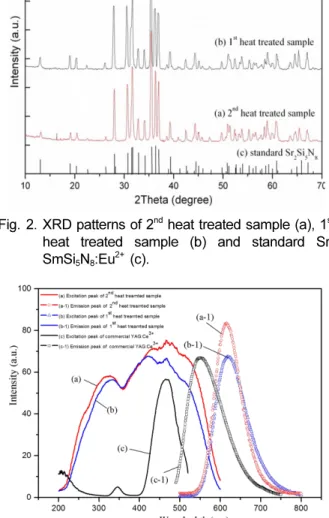
2+phosphor was successfully synthesized by using multi-step high frequency induction heat treatment. The effects of molar ratio of component and experimental conditions on luminescence property of prepared phosphors have been investigated. The structure and lumi- nescence properties of prepared Sr/SmSi
5N
8:Eu
2+phosphors were investigated by XRD and photoluminescence spectroscopy. The excitation spectra of Sr/SmSi
5N
8:Eu
2+phosphors indicated broad excitation wavelength range of 300 - 550 nm, namely from UV to visible area with distinct enhanced emission peaks. With an increase of Eu
2+ion concentration, the peak position of emission in spectra was red-shifted from 613 to 671 nm.
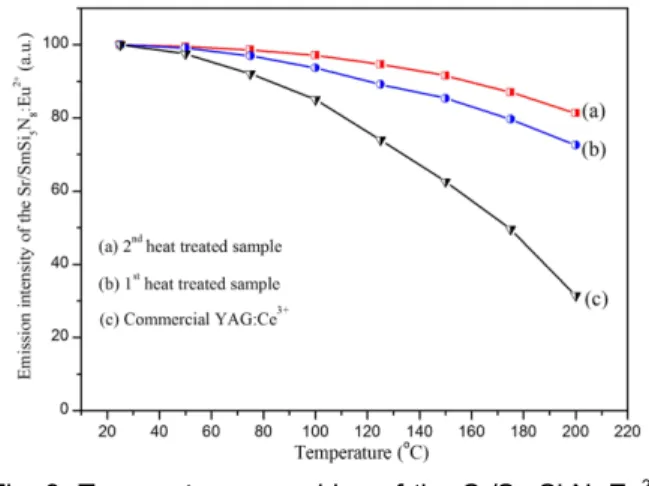
After via multi-step heat treatment, prepared phosphor showed excellent luminescence properties, such as high emission intensity and low thermal quenching, better than commercial phosphor of Y
3Al
5O
12:Ce
3+. Using Eu
2O
3as a raw material for Eu
2+dopant with nitrogen gas flowing instead of using commercial EuN chemical for Sr/SmSi
5N
8:Eu
2+synthesis is one of characteristic of this work.
Keywords: Luminescence, White LED, Sr/SmSi
5N
8:Eu
2+, Phosphor, Photoluminescence, Multi-step High Fre- quency Induction Heating, EuN
1. Introduction
White light-emitting-diode (LED) of a high degree of brightness with low cost and easy fabrication have attracted much attention since finding out cool white light emission could be generated by combining the blue emission of InGaN diode chip with yellow luminescence of Y
3Al
5O
12:Ce
3+(YAG:Ce
3+) phosphor
1-4). However, this white light has a low color rendering index (CRI) because the emitted yellow light lacks sufficient red emission. In order to obtain a warm and good color rendering white light output, LED emission should be adjusted by two methods. One is to compensate the red deficiency of YAG: Ce
3+- based LED with a separate red light
5)and the other is to combine UV chip with red, green, and blue-
emitting (RGB) phosphors
6). In recent years, SiN
4- base covalent nitride materials, including nitri- dosilicates, nitridoaluminosilicates and other nitrides etc., have been extensively studied as a good host lattices for White LED because nitride materials have strong absorption of the light emitted by the LED chips, i.e., UV (350 - 410 nm) or blue (440 - 480 nm) light. In general, the stronger absorption, the higher emitting efficiency. Another strong point is higher quantum or conversion efficiency. The other good point is chemical stability which refers to the stability in chemical composition and crystal structure of phosphor. Low chemical stability of a phosphor will not only make the production process more complex and costly, but also reduce the luminous efficiency and seriously shorten the lifetime of LED products.
Consequently, the phosphor should be stable under the ambient atmosphere, and will not chemically
*