- 752 - Research Note
Comparison of Anti-Oxidative and Cox-2 Promoter Activities of Lepidoptera Extracts
Hyeong-U Son1, Jin-Chul Heo2 and Sang-Han Lee1,2†
1
Department of Food Science & Technology, and
2
Food & Bio-Industry Research Institute, Kyungpook National University, Daegu 702-701, Korea
Lepidoptera
추출물에 의한 항산화 및 Cox-2 프로모터 활성 비교손형우1․허진철2․이상한1,2†
1경북대학교 식품공학과, 2경북대학교 식품생물산업연구소
Abstract
Lepidoptera (butterflies) extracts, traditionally employed as medicines, have various biological activities. Five species of Lepidoptera (Papilio maackii, Papilio xuthus, Pieris rapae, Eurema hecabe, and Sasakia charonda) were extracted with distilled water (DW), dimethyl sulfoxide (DMSO), ethanol (EtOH), and methanol (MeOH). Each extract was analyzed for anti-oxidant and anti-inflammatory activities using the 1,1-diphenyl-2-picrylhydrazyl (DPPH) assay method, the ferric reducing ability of plasma (FRAP) test, and a cyclooxygenase-2 (COX-2) promoter assay. The results suggest that Lepidoptera extracts have valuable anti-oxidant and anti-inflammatory properties, supporting the idea that the extracts may serve as a food biomaterial(s) preventing oxidative processes and inflammatory damage.
Key words:Lepidoptera, extracts, anti-oxidant, anti-inflammatory, COX-2 promoter assay
Introduction
1)
Insects are also considered as the main component of Oriental medicinal resource. Twenty-two kinds of medicinal insects were recorded at the first medicinal book (Shen Nong Ben Cao Jing in Chinese; Shin Nong Bon Cho Kyung in Korean), and 74 kinds were recorded at a botanical list named Bon Cho Gang Mok (‘Compendium of Materia Medica').
In 1949, 13 orders, 51 families and 143 species were listed in the Chinese medical fauna, and then 239 species, which have perhaps been handed down among people, were listed statistically (1). The insect's egg, larva, pupa, and imago were used in oriental medicine, especially groupings of insects that were classified for medicinal use, and have been exploited as valuable materials in Oriental medicine (2). Among them, Lepidoptera contain plentiful of alkaloids. Isoxanthopterin,
†Corresponding author. E-mail:[email protected], Phone:82-53-950-7754, Fax:82-53-950-6772
belonging to an alkaloid group that has anti-bacterial, anti-tumor, and anti-inflammatory activities, and this compound also has been used as a remedy for contusion (1,2).
Lepidoptera that are classifed as Papiliopolytes (Linné), Papiliomachaon (Linné), Papilioxuthus (Linné), Pierisrapae (Linné), Ypthimachinensis Leech, Papiliomaackii (Ménétriès), Euremahecabe (Linné), and Sasakiacharonda (Hewitson), etc, are used for medicinal purposes, mostly through dried larvae, valuable to gastritis, abdominal pain, and swelling (3).
Ordinary, insects contain low molecular weight antioxidants in the body to defend the environmental stress outside, which many different antioxidant effects have been reported.
Extracts of insects usually have various phenolic compounds, which are known to have strong antioxidant activities.
Lepidoptera have been reported to contain various phenolic compounds and their larvae are known to produce antioxidant activity (4,5).
On the other hand, it is known that oxidative stress are
associated with various kinds of human diseases during the inflammatory process (6). During this process, cells are ubiquitously exposed to a variety of other oxides to form oxidized complexes with DNA, lipids, and protein structures causing major organizational changes such as tissue damage and induce various diseases if antioxidative systems do not function in their proper roles inside the human body (7).
Additionally, ROS (reactive oxygen species), one of the well-known oxidants, triggers various protective enzymes such as superoxide dismutase, catalase, glutathione reductase, etc to reduce oxidative stress (8-10). The enzymatic defense mechanism of ROS can induce additional effects through various food/biomaterials that have been used as antioxidant materials. Vitamins and many other compounds, including plant and animal-origin extracts are being developed.
Cyclooxygenase-2 (COX-2), which is a specific biomarker of the molecular inflammatory process, is available to an indicator of anti-inflammatory activity, because the enzyme can be induced by the inflammatory onset of various biological attacks from the outside (11).
Therefore, in this experiment, to confirm the antioxidant activity, we measured whether the expression levels of COX-2 promoter was inhibited or not by Lepidoptera extracts. The major finding of this study is thatLepidoptera extracts have the potential to alleviate oxidative stress as well as immunostimulatory conditions.
In materials and methods, five species of butterflies were used in this experiment: Papilio maackii, Papilio xuthus, Pieris rapae, Eurema hecabe, and Sasakia charonda. The samples were extracted using distilled water, dimethyl sulfoxide (DMSO), ethanol, and methanol at 60°C for 24 hr, thereafter the extracts were centrifuged at 3,000 rpm for 10 min to collect each supernatant. The antioxidant activity with 1,1-diphenyl-2-picrylhydrazyl (DPPH) and ferric ion reducing antioxidant power (FRAP) was carried out to determine each free-radical scavenging activity. The extract (10 μl) was added with 0.2 mM DPPH (190 μl), and incubated for 30 minutes at room temperature, measuring the absorbance at 517 nm (12). DPPH radical scavenging activity (%
inhibition) was expressed as a percentage of the control absorbance subtracted with the absorbance of the sample (13).
A FRAP assay was developed to measure the ferric-reducing ability of plasma at a low pH (13). Reduction of the ferric-tripyridyl triazine (Fe3+-TPTZ) complex into the ferrous (Fe2+) form was accompanied by an intense blue color.
Absorption was recorded at 593 nm (12). The COX-2
promoter assay was carried out as described previously. In order to compare the expression of the COX-2 gene promoter, luciferase activity level was measured. By inserting the promoter region in the EcoR1 and Xho1 restriction site, the glioma cells (U-118MG, ATCC, Manassas, VA) were used (14). Transfection with the lipofectamine was obtained using a single colony from G418 selection was used to build a stable cell line inserted with the pGL3 vector (Promega).
The cell lysates treated with five kinds of butterflies extracts (10 μg/ml) were measured by Victor3 (Wallac, Turku, Finland) in the luciferase (Promega, E1500) expression levels.
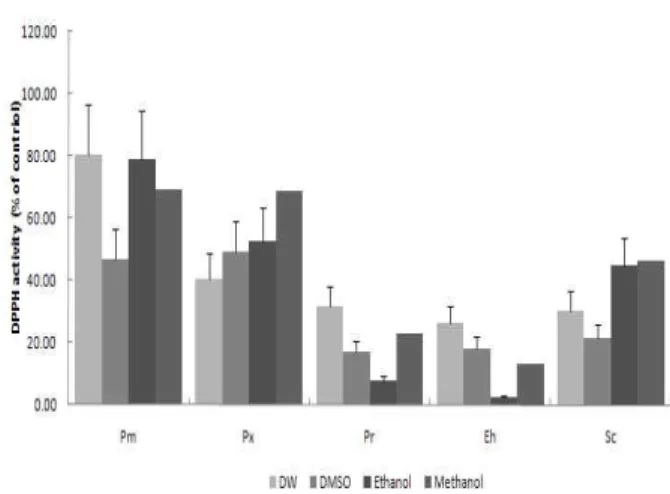
We tested the anti-oxidant and immunoregulatory activities by the Lepidopteraextracts. It was reported that the extracts of Pieris brassicae contained phenolic compounds, which were identified by analytical procedures with exhibitory biological activities (4,5). In this study, we first selected five species of butterflies in order to confirm their biological activity, and develop a resource and/or a biomaterial for nutraceutical and/or cosmeceutical. In the Papilio maackii extract, DPPH antioxidant activity exhibited over 80% of the radical scavenging activity of control in the aqueous extracts, and ethanol extracts. The activity also showed 70%, and 47%
of control in the methanolic and DMSO extracts, respectively, suggesting that the activity was not significant in the used solvent system (Fig. 1). InPieris rapae, andEurema hecabe extracts, the anti-oxidant activities were lower than those of other kinds of extracts, by 20% or less, in their activities.
The activity was higher in their activity by scoring DW, ethanol, methanol, but the DMSO extracts are relatively lower.
Fig. 1. Antioxidant activity of Lepidoptera extracts measured by DPPH assay (Pm, Papilio maackii; Px, Papilio xuthus; Pr, Pieris rapae; Eh, Eurema hecabe; Sc, Sasakia charonda).
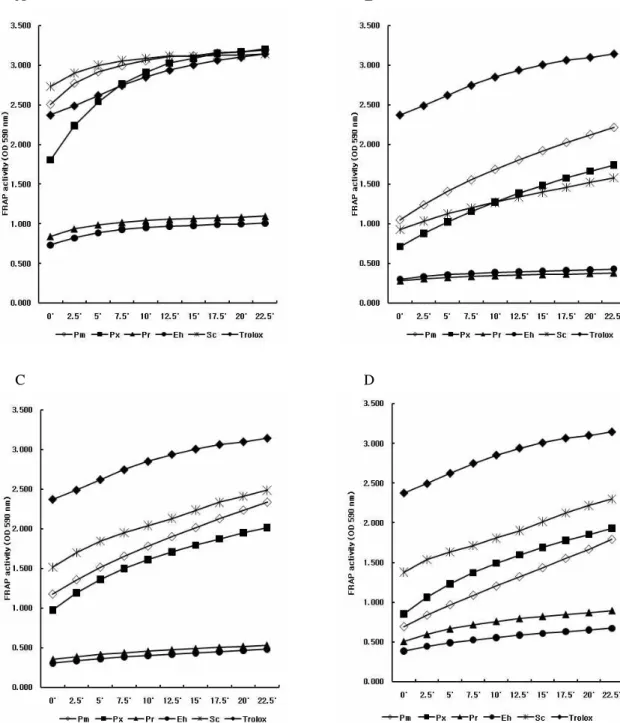
In the FRAP assay, the activities were increased in a time-dependent manner except for the Pieris rapae, and Eurema hecabeextracts (Fig. 2A, B, C, and D). It was also shown that the aqueous extract exhibited a higher activity than any other solvent system (Fig. 2A, and compare B, C, and D). Overall, the most active sample was the Papilio maackiiextract, regardless of solvent system used, suggesting that the antioxidant activity was dependent on the type of sample (Fig. 2A, see columns of Pm).
A B
C D
Fig. 2. Radical scavenging activity ofLepidoptera with DW (A), DMSO (B), ethanol (C) and methanol extracts measured by FRAP assay (D) (PM, Papilio maackii; Px, Papilio xuthus; Pr, Pieris rapae; Eh, Eurema hecabe; Sc, Sasakia charonda).
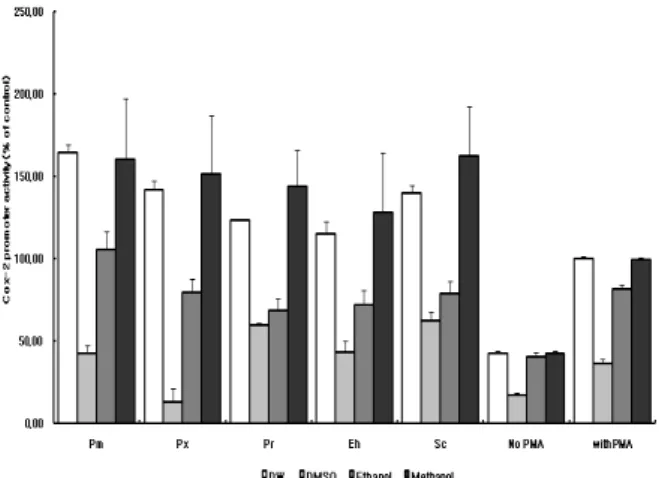
The COX-2 promoter assay revealed that each sample did not show significant differences in the five kinds of extracts (Fig. 3), but the DMSO extract of Papilio xuthus showed the most potent activity in the promoter assay (Fig. 3, see DMSO column of Px).
Insects are known to be the most diverse animal biosphere in the world, and can be used in various fields for better utilization. In the past, especially medicinal herbs in the Orient, are used to determine the efficacy and the mass
production importance as a factor of commercial value (14,15). In conclusion, we selected five species of Lepidoptera, then extracted with DW, DMSO, ethanol, and methanol to examine their antioxidant and immuneregulatory activities. The results showed that the antioxidant activities and COX-2 inhibitory activity of the samples was confirmed, indicating that the present samples are worthy of development into an antioxidant food resource and/or a biomaterial if the convincing isolation or purification data of the active components are accurately classified.
Fig. 3. COX-2 promoter activity of Lepidoptera with DW (white column), DMSO (blight grey), ethanol (dark grey) or methanol (black) extracts measured by FRAP assay (Pm,Papilio maackii; Px, Papilio xuthus; Pr, Pieris rapae; Eh, Eurema hecabe; Sc, Sasakia charonda).
요 약
나비류 추출물은 전통적으로 다양한 활성을 보유하여
의약용으로 사용되어졌다. 5종의 나비(산제비나비[Papilio
maackii], 호랑나비[Papilio xuthus], 배추흰나비[Pieris rapae], 남방호랑나비[Eurema hecabe], 왕오색나비[Sasakia charonda])를 이용하여 물, dimethly sulfoxide (DMSO), ehtanol 및 methanol로 추출한 추출물로 항산화 활성 및 Cox-2 promoter assay를 수행하였다. 그 결과 산제비나비의 추출물이 전반적으로 높은 항산화활성을 나타내었으며, Cox-2 promoter assay에서는 호랑나비의 DMSO 분획이 가 장 저해활성이 높은 것으로 나타났다. 활성이 높은 추출물 을 대상으로 분리 및 정제를 통하여 유용한 식의약 소재로 의 기초연구가 더 필요하다.
Acknowledgement
This work was supported by a grant (2009101- 060-005-001-02-00) from the Agenda Program, Rural Development Administration, the Republic of Korea.
References
1. Wang MY, Jia MR. (2001) Process in pharmacodynamic and clinical study of officinal insects. Lishizhen Med.
Material Med. Res., 12, 937-938
2. Xiang YY. (2009) Process on the studies and application of officinal insects in Chian. J. Anhui Agric. Sci., 37, 3014-3016
3. Lu YF. (2004) Brief introduction of medicinal insect resources in Jiangsu. J. Jiansu Forestry Sci. Technol., 2, 45-46
4. Ferreres F, Fernandes F, Oliveira JM, Valentão P, Pereira JA, Andrade PB. (2009) Metabolic profiling and biological capacity of Pieris brassicae fed with kale (Brassica oleracea L. var. acephala). Food Chem. Toxicol., 47, 1209-1220
5. Sousa C, Pereira DM, Valentão P, Ferreres F, Pereira JA, Seabra RM, Andrade PB. (2009) Pieris brassicae inhibits xanthine oxidase.J. Agric. Food Chem., 57, 2288-2294
6. Luiking YC, Engelen MP, Deutz NE. (2010) Regulation of nitric oxide production in health and disease. Curr.
Opin. Clin. Nutr. Metab. Care, 13, 97-104
7. Federico A, Morgillo F, Tuccillo C, Ciardiello F, Loguercio C. (2007) Chronic inflammation and oxidative stress in human carcinogenesis, Int. J. Cancer, 121, 2381-2386
8. Ajaikumar KB, Asheef M, Babu BH, Padikkala J. (2005) The inhibition of gastric mucosal injury by Punica granatum L.(pomegranate) methanolic extract. J.
Ethnopharmacol., l4, 171-176
9. MacNee W. (2001) Oxidative stress and lung inflammation in airways disease. Eur. J. Pharmacol., 429, 195-207 10. Matsuyama T, Ihaku D, Tanimukai T, Uyama O, Kitada
O. (1993) Superoxide dismutase suppressed asthmatic response with inhibition of manganese superoxide induction in rat lung. Nihon Kyobu Shikkan Gakkai Zasshi, 31, 139-145
11. Luo C, He ML, Bohlin L. (2005) Is COX-2 a perpetrator or a protector? Selective COX-2 inhibitors remain
controversial. Acta. Pharmacol. Sin., 26, 926-933 12. Heo JC, Lee DY, Son M, Yun CY, Hwang JS, Kang
SW, Kim TH, Lee SH. (2008) Effects of mole crickets (Gryllotalpa orientalis) extracts on anti-oxidant and anti-inflammatory activities. Korean J. Life Sci., 18, 509-514
13. Park J, Heo, An SM, Yun EY, Han SM, Hwang JS, Kang SW, Yun CY, Lee SH. (2005) High throughput- compatible screening of anti-oxidative substance by insect extract library. Korean J. .Food Preserv., 12, 482-488
14. Ma Y, Wang X, Zhao Y, Kawabata T, Okada S. (1997) Inhibitory effects of Chinese ant extract (CAE) on nephrotoxicity induced by ferric-nitrilotriacetate (Fe-NTA) in Wistar rats. Res. Commun. Mol. Pathol. Pharmacol., 96, 169-178
15. Freire SM, Torres LM, Souccar C, Lapa AJ. (1996) Sympathomimetic effects of Scopariadulcis L. and catecholamines isolated from plant extracts. J. Pharm.
Pharmacol., 48, 624-628
(접수 2010년 6월 21일, 수정 2010년 10월 6일, 채택 2010년 10월 8일)