- 385 -
A Study on Components Related to Flavor and Taste in Commercial Broiler and Korean Native Chicken Meat
Kyung Haeng Lee1, Hyun Joo Kim2, Hyun Jung Lee2, Mingu Kang2 and Cheorun Jo2†
1
Department of Food and Nutrition, Korea National University of Transportation, Jeungpyung 368-701, Korea
2Department of Animal Science and Biotechnology, Chungnam National University, Daejeon 305-764, Korea
일반 육계와 한국 토종닭의 정미인자 비교 분석
이경행1․김현주2․이현정2․강민구2․조철훈2†
1한국교통대학교 식품영양학과, 2충남대학교 동물자원생명과학과
Abstract
The characteristics of the components related to the meat taste of the commercial broiler (CB) and the Korean native chicken (KNC) were compared. The breast meat from CB showed higher amounts of C16:1 and C18:2 but lower amounts of C16:0 and C22:6. The thigh meat from CB showed a higher amount of C18:1 but lower amounts of C16:0, C18:0, C20:4, and C22:6. The flavor- and taste-contributing amino acids, including aspartic acid, threonine, serine, glycine, alanine, tyrosine, lysine, histidine, and arginine, were significantly higher in the KNC breast meat, but the level of amino acids in the thigh meat were not different between the two breeds. The measurement of the volatile compounds revealed that CB contains much higher volatile compounds compared to KNC in their fresh breast and thigh meat. Both in the breast and thigh meat, however, the amount of flavor compounds increased significantly after cooking; as such, KNC turned out to have more flavor compounds than CB.
Key words:Commercial broiler, Korean native chicken, Fatty acids, Amino acids, Volatile compounds
서 론
1)
최근 국민소득의 향상 및 외식산업의 발달로 우리나라 계육 소비량은 꾸준히 증가하고 있다. 선진국을 비롯한 국 외에서도 계육의 소비량은 빠르게 증가하고 있는데 이와 같은 원인으로서 계육은 인체에 필요한 모든 필수 아미노산 이 풍부하고 지방 및 콜레스테롤의 함량이 적기 때문이라고 할 수 있다(1-2). 또한 계육은 다른 고기에 비해 부드럽고 특유의 풍미가 있어 모든 연령층에게 선호되고 있다.
닭고기 중 소비자들에게 가장 많이 소비되고 있는 일반 육계는 대부분이 해외로부터 수입한 육용 broiler이며 그 다음이 역시 수입종인 난육 겸용의 왕추가 이용되고 있다.
육계(broiler)는 사육기간이 짧아 경제성이 좋고 대량생산 이라는 측면에서 뛰어나기 때문에 국내 양계농가에서는
†Corresponding author. E-mail:[email protected] Phone:82-42-821-5774, Fax:82-42-825-9754
일반육계 사육을 선호하고 있다. 반면 한국 토종닭은 성장 속도 및 근육 형성 속도가 느려 비경제적이라는 이유로 일반 육계에 비해 사육이 이루어지지 않고 있을 뿐만 아니 라 계절별 수요 예측에 따른 공급 물량 조절이 매우 어려운 실정이다(3-4).
한편, 토종닭은 예로부터 풍미가 깊고 담백한 것으로 알 려져 있으나, 과학적인 근거 제시가 매우 미비한 실정이다.
육류의 풍미에 관여하는 성분으로는 유리아미노산, 핵산관 련물질, 무기질, 단백질 분해물, 당 및 향미 성분 등 여러 가지가 복합적으로 작용하는 것으로 알려져 있다(5-7). 현 재까지 계육의 맛과 관련된 성분으로서 핵산물질인 inosine-5'-monophosphate(IMP)가 일반육계에 비해 토종닭 에 다량 함유되어있다는 일부 연구결과만 발표되었을 뿐, 다른 정미인자들에 관한 연구는 상대적으로 미비한 실정이 다(8). 일본의 경우 자국의 토종닭과 교잡종간(9-10) 그리고 broiler에 대한 비교 연구(11-12)가 이루어져있어 구체적인
과학적 근거를 제시하고 있다. 따라서 우리나라도 일반육 계와 토종닭과의 관능적 차이를 나타내는 성분이 무엇인지 규명해야 할 필요가 있다고 판단된다. 최근 일반육계와 비 교하여 농촌진흥청에서 개발, 보급하고 있는 우리맛닭TM과 북한닭 등으로부터 유래한 계육의 물리화학적 특성 차이를 비교한 연구가 발표된 바 있었다(4,8).
따라서 본 연구에서는 일반육계 및 토종닭의 맛의 차이 를 규명하고자 일반 육계와 토종닭의 지방산, 유리아미노 산 및 휘발성 향기 성분을 분석 비교하였다.
재료 및 방법
실험동물
실험에 사용된 동물은 암수 구분 없이 부화한 200수의 일반육계(Ross 종)와 200수의 토종닭(우리맛닭TM)을 20개 의 펜(3.0 m × 1.0 m)에 20수씩 완전임의 배치하고 사료와 물은 자유롭게 섭취할 수 있게 하였고, 깔짚은 톱밥을 사용 하였으며 24시간 점등을 실시하였다.
사료 조성은 일반육계 사료(Chunhajeil Feed Co, Daejeon, Korea)로써, 일령에 따라 초생추(0~1주령), 전기(1~3주 령) 및 후기(3~13주령) 사료를 급여하였으며 후기 사료의 조성은 20% 조단백질, 4% 조섬유, 3,100 ME kcal/kg이었다.
사료는 자유롭게 급여시켰으며 체중이 시장 출하 체중인 2 kg 내외의 일반육계(5주) 및 토종닭(13주)을 각각 경동맥 방혈을 통하여 희생시키고 우모를 제거한 후, 가슴육 및 다리육을 채취하여 냉장 보관(4℃)하며 실험에 사용하였다.
지방산 조성
일반육계와 토종닭의 가슴육과 다리육의 지방산 조성을 측정하기 위하여 Folch 등(13)의 방법에 따라 각각의 가슴 육과 다리육에서 지방을 추출하였다. 즉 가슴육 및 다리육 각각 30 g에 150 mL의 Folch solvent (methanol:chloroform
= 1:2)를 첨가하여 지방을 추출하였으며 이 용액에 0.88%
KCl 용액을 첨가한 후 마개를 닫은 다음 격렬하게 혼합하고 2시간 동안 실온에 방치하였다. 상층은 제거하고 하층인 chloroform 층은 무수 Na2SO4를 이용하여 수분을 제거하고 여과시켰으며 고순도 질소가스를 이용하여 용매를 제거하 였다.
지방산 분석을 위하여, 추출한 지질 100 μL에 BF3- methanol (Sigma-Aldrich Co, St Louis, MO, USA)을 1 mL 첨가하고 30분 동안 70℃에서 methylation 시켰다. 그 후 methylation 시킨 시료를 냉각시키고 2 mL의 hexane (HPLC grade)과 5 mL의 증류수를 첨가하여 혼합한 후 층분리가 일어나면 fatty acid methyl ester가 용해된 hexane 층을 분획 하여 GC vial로 옮긴 후 기체 크로마토그래피(Shimadzu Gas Chromatography 17-A, Tokyo, Japan)로 지방산 조성을
측정하였다. 이때 사용한 column은 capillary column (30 m × 0.32 mm × 0.25 μm film thickness, Omegawax 320, Supelco Inc, Bellefonte, PA, USA)이었으며 oven 온도 20 0℃, inlet 온도 250℃, detector 온도 250℃로 측정하였다.
Carrier gas로는 helium을 사용하여 유속은 분당 0.79 mL/min로 split ratio는 100:1로 하였다. 지방산은 지방산표 준품의 retention time과 비교하였으며 상대 양은 검출된 각각의 피크에 대한 면적비를 이용하여 계산하였다.
아미노산 조성
시장 출하시기에 도계한 일반육계 및 토종닭의 가슴육과 다리육의 아미노산의 함량 차이를 측정하기 위하여 Choe 등(14)의 방법을 사용하였다. 즉 가슴육 및 다리육 5 g에 6 N HCl 40 mL를 첨가하여 110℃에서 24시간 동안 가수분 해 시켰다. 가수분해물은 rotary evaporator (Eyela, Tokyo, Japan)를 이용하여 HCl을 제거하고 잔사물은 증류수로 3회 세척하고 Adventec filter paper No 5B (Toyo, Japan)를 이용 하여 여과하였다. 여과액은 50 mL로 정용한 후 amino acid analyzer (Hitachi L-8500A, Tokyo, Japan)를 이용하여 측정 하였다. HCl을 첨가하기 전에, cysteine 및 methionine은 20 mL의 stabilizing solution (85% formic acid 45 mL와 30%
H2O2 5 mL)을 첨가하여 cysteic acid와 methione sulfone으 로 전환시켜 분석하였다.
휘발성 향기성분 측정
일반육계와 토종닭의 신선육 상태와 가열육 상태의 휘발 성 향기성분을 분석하기 위하여, 신선육은 냉장 상태에서, 가열육은 각각의 가슴육과 다리육을 100℃에서 1시간 동안 가열하여 다시 실온으로 냉각시킨 후, 실험에 사용하였다.
준비된 시료(2 g)에 대한 휘발성 향기 성분 분석을 위해 기체크로마토그래피(Agillent GC 6890N, Palo Alto, CA, USA)를 이용하여 HP-5MS capillary column (30 m × 0.25 mm id × 0.25 μm film thickness)을 사용하여 분리하였다.
Column 온도는 35℃에서 7분간 유지 후 3℃/min 비율로 70℃까지 도달시킨 다음 6℃/min 비율로 250℃까지 증가시 켜 5분간 유지하였다. MS source, MS quadrupole 및 MS transfer line의 온도는 각각 230, 150, 및 280℃로 설정하였 다. Injector 온도는 250℃로 설정하였으며 carrier gas는 helium을 사용하였다.
시료의 휘발 성분 포집은 solid phase micro-extraction (SPME) 방법을 활용하였다. 분석 시 사용된 fiber는 carboxen/polydimethylsiloxane (CAR/PDMS, 75 μm thickness)으로 코팅된 것을 사용하였다. 시료의 휘발 성분 포집을 위하여 35℃에서 5분간 휘발 성분의 유도를 촉진시 킨 후 head-space로 포집하였다. 휘발 성분을 포집한 fiber는 injector에 5분간 정치시켜 휘발 성분이 column을 통과하도 록 하여 크로마토그램을 얻었다. GC/MSD 분석으로 얻은
mass spectrum을 GC/MSD의 소프트웨어로 내장된 mass spectrum database (NIST Library, mass spectral search program, version 5.0, USA)를 이용하여 분석 및 동정하였다.
통계처리
본 시험에서 얻어진 결과는 SPSS 12.0 (Statistical Package for Social Sciences, SPSS Inc, Chicago, IL, USA) program을 사용하여 각 실험구간의 유의성을 검증한 후 Duncan's multiple range test에 의해 실험군간의 차이를 5% 유의수준 에서 분석하였다.
결과 및 고찰
지방산 조성
일반 육계와 토종닭의 지방산 조성을 측정한 결과를 Table 1에 제시하였다. 가슴육의 경우, 일반 육계의 주요 지방산은 육제품에서 향미와 관련되어 있다고 알려진 지방 산인 oleic acid (C18:1)가 가장 많은 것으로 확인되었으며 (15-16), palmitic acid (C16:0), stearic acid (C18:0) 및 linoleic acid(C18:2)의 순으로 나타났다. 또한, 불포화지방산과 포 화지방산의 비율이 1.38로 불포화지방산이 포화지방산보 다 함량이 많은 것으로 확인되었다. 토종닭 가슴육에서도 일반 육계와 동일한 주요 지방산으로 구성되어 있었으나 불포화지방산 및 포화지방산 비율은 1.18로 일반 육계에 비하여는 약간 높은 포화지방산으로 구성되어 있었다. 그 러나 토종닭의 다가불포화지방산인 arachidonic acid (C20:4) 및 docosahexaenoic acid (C22:6)는 일반 육계에 비하여 높은 Table 1. Fatty acid composition (%) of the breast and thigh meat from commercial broiler (CB) and Korean native chicken (KNC)
Breast Thigh
CB KNC CB KNC
C16:0 24.23±0.20b 28.47±0.19a 23.09±0.27b 24.64±0.30a C16:1 1.83±0.16a 1.09±0.06b 1.98±0.12 1.74±0.07 C18:0 17.69±0.46 17.46±0.17 21.42±0.09b 23.48±0.89a C18:1 34.51±0.54a 31.45±0.31b 32.54±0.34a 28.00±0.19b C18:2 15.20±0.16a 13.17±0.39b 17.13±0.17 17.07±0.41 C20:4 2.91±0.20 3.36±0.26 1.90±0.16b 2.56±0.37a C20:5 1.05±0.25 1.21±0.04 0.81±0.04 0.85±0.08 C22:6 2.59±0.26b 3.78±0.32a 1.12±0.11b 1.65±0.23a SFA 41.91±0.45b 45.93±0.33a 44.52±0.19b 48.12±1.19a USFA 58.09±0.45a 54.07±0.33b 55.48±0.19a 51.88±1.19b USFA/SFA 1.38±0.03a 1.18±0.02b 1.25±0.01a 1.08±0.05b
a,bMeans within the same row with different superscript differ significantly (P<0.05).
Abbreviation: SFA, Saturated fatty acid; USFA, unsaturated fatty acid; USFA/SFA, ratio between USFA and SFA.
것으로 확인되었다(P<0.05). Kim 등(17) 및 Chae 등(2)은 출하 주령에 맞추어 도계한 토종닭 및 일반 육계의 지방산 조성에서의 지방산 조성을 측정한 결과, palmitic acid (C16:0), oleic acid (C18:1) 및 linoleic acid (C18:2)가 일반 육계 및 토종닭의 주요 지방산이라고 발표하였으며, 이는 본 연구결과와 거의 유사한 것으로 나타났다.
다리육의 경우, 일반 육계 및 토종닭의 지방산 조성은 가슴육에서의 경우와 마찬가지로 동일한 주요 지방산으로 구성되어 있었으며 불포화 및 포화지방산 비율이 각각 1.25 및 1.08로 가슴육에서의 결과보다는 다소 낮은 비율로 구성 되어 있었다. 또한 가슴육과 마찬가지로 다가불포화지방산 의 함량이 토종닭 다리육에서 비교적 일반 육계보다는 높은 것으로 나타났다. Jeon 등(8)은 남한 토종닭, 북한 토종닭 및 일반 육계를 도계시기에 도계하여 지방산 조성을 측정한 결과, docosahexaenoic acid (C22:6)의 함량이 가슴육에서는 각각 2.53, 2.25 및 0.53%, 다리육에서는 각각 0.58, 0.48 및 0.12%로 토종닭이 일반육계에 비하여 함량이 많았으며 불포화 지방산과 포화 지방산의 비에서는 일반육계가 토종 닭에 비하여 높다고 하여 본 결과와 일치하는 경향이었다.
최근, 다가불포화지방산이 식품의 감칠맛, 깊은 맛 (kokumi) 및 향미를 증대시킨다는 연구결과가 발표되고 있 다(18). 본 연구결과에서 arachidonic acid의 함량이 육계에 비해 토종닭에서 높게 나타났는데 Rikimura와 Takahashi (19)의 연구결과에 따르면 이 지방산은 계육의 풍미에 매우 중요한 물질로 일본 토종닭인 Hinai-jidori육도 일반 육계에 비해 다리육에서 높게 나타났다고 발표하였다. Kiyohara 등(20)은 계육에 있는 arachidonic acid가 계육이 가지고 있 는 감칠맛의 강도를 개선시킨다고 보고하였다. Docosahexaenoic acid(C22:6, DHA)의 경우 계육의 맛에 영향을 미치는 인자 로 자세한 연구는 미비한 실정이나 Koriyama 등(21)이 참치 유, 대두유 및 옥수수유의 관능적 특성을 비교 연구할 때 유일하게 DHA를 함유(22.85%)한 참치유가 신맛과 쓴맛을 억제하고 감칠맛을 증가시킨다고 보고하였다. 또한 DHA 는 관능적 영향뿐만 아니라 학습기능 향상, 순환기 계통 질환 및 동맥경화 예방 등(22-24) 생체 내에서 기능성 인자 로 작용하게 되어 식품 또는 의약품의 형태로 섭취되고 있는데 토종닭의 경우, 일반육계에 비하여 많은 함량을 보 이는 것으로 보아 arachidonic acid와 함께 토종닭이 일반육 계에 비해 맛과 기능적 우수성을 보여주는 주요한 지방산이 라고 판단된다.
아미노산 조성
일반 육계와 토종닭을 도계한 후, 가슴육과 다리육을 분 리하여 이들의 아미노산 조성을 측정한 결과는 Table 2와 같다. 가슴육에서의 아미노산 조성은 일반 육계 및 토종닭 모두 17종이 아미노산이 검출되었으며 총 아미노산 함량은 각각 21.12 및 21.71로 일반육계보다 토종닭의 수치가 약간
높았지만 유의적인 차이는 없는 것으로 확인되었다.
가슴육의 결과를 살펴보면 토종닭에서 일반 육계보다 유의적인 함량이 높게 나타난 아미노산으로는 aspartic acid, threonine, serine, glycine, alanine, tyrosine, lysine, histidine 및 arginine으로 확인되었으며, 일반 육계의 경우 토종닭보 다 phenylalanine의 함량이 높은 것으로 나타났다. 하지만 다리육에서는 일반 육계와 토종닭의 아미노산 함량이 유의 적으로 차이가 없는 것으로 나타났다.
아미노산 함량은 식품의 기호성에 영향을 미치는 중요한 요소이고(25), 식품의 풍미를 예측하는 하나의 중요한 요소 가 될 수 있다(19). 또한 glutaminc acid, aspartic acid, alanine 및 glycine 등은 식품의 향기와 맛을 부여하게 된다(26).
Fukunaga 등(9)은 일반 육계에 비하여 토종닭이 아미노산 의 함량이 많아 높은 기호도를 나타낸다고 하였으며, Choe 등(2)은 토종닭에서 glycine, alanine 및 proline의 함량이 높았고 쓴맛을 지닌 phenylalanine(9)의 함량에서는 토종닭 보다 일반육계에서 높은 함량을 보였다고 하여 본 연구결과 와 일치하는 경향이었다. 또한 Batzer 등(27)은 많은 아미노 산들이 육류의 풍미에 관계되지만 tyrosine과 phenylalanine 은 육류의 풍미에 관여하지는 않는다고 발표된 바 있다.
Table 2. Amino acid composition (%) of the breast and thigh meat from commercial broiler (CB) and Korean native chicken(KNC)
Breast Thigh
CB KNC CB KNC
Cysteine 0.24±0.00 0.25±0.00 0.21±0.00 0.23±0.01 Methionine 0.50±0.00 0.51±0.01 0.44±0.03 0.49±0.01 Aspartic acid 2.21±0.01b 2.30±0.00a 2.04±0.06 1.95±0.01 Threonine 1.07±0.01b 1.12±0.00a 1.00±0.03 0.96±0.01 Serine 0.93±0.01b 0.96±0.00a 0.90±0.03 0.86±0.00 Glutamic acid 3.56±0.03 3.64±0.02 3.39±0.10 3.22±0.02 Glycine 0.97±0.01b 1.01±0.00a 0.96±0.04 0.89±0.01 Alanine 1.34±0.01b 1.41±0.00a 1.22±0.04 1.19±0.02 Valine 0.94±0.05 1.01±0.00 0.83±0.01 0.81±0.01 Isoleucine 0.88±0.05 0.95±0.00 0.82±0.01 0.78±0.01 Leucine 1.99±0.02 2.05±0.00 1.80±0.05 1.73±0.00 Tyrosine 0.66±0.00b 0.70±0.00a 0.61±0.03 0.62±0.00 Phenylalanine 0.88±0.03a 0.60±0.00b 0.85±0.02 0.81±0.00 Lysine 1.98±0.03b 2.08±0.01a 1.85±0.06 1.79±0.01 Histidine 0.72±0.01b 0.89±0.01a 0.62±0.02 0.57±0.00 Arginine 1.34±0.01b 1.38±0.01a 1.26±0.04 1.22±0.01 Proline 0.90±0.03 0.86±0.01 0.87±0.04 0.83±0.00 Total 21.12±0.29 21.71±0.04 19.67±0.62 18.95±0.09
a,bMeans within the same row with different superscript differ significantly (P<0.05) (n = 10).
휘발성 향기 성분 분석
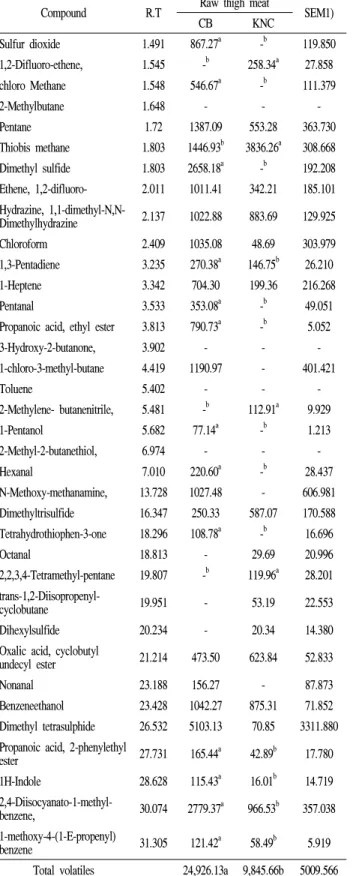
토종닭과 일반 육계의 휘발성 향기 성분 변화를 비교 분석하기 위해 향기 성분을 측정하는 방법 중 유기용매를 사용하지 않고 적은 양의 시료로도 간단하게 처리할 수 있는 SPME법(28)으로 휘발성 향기 성분을 추출한 다음 GC/MSD를 이용하여 측정하였다(Table 3과 4).
가슴육의 경우, 일반 육계는 13종의 향기성분이 검출되 었고 토종닭에서는 11종이 검출되었으며 총 향기성분량을 적분한 결과 각각 15,311.91 및 4,276.92로 일반 육계가 보다 많은 향을 지니는 것으로 나타내었다. 일반 육계는 hexane, sulfur, carbon disulfide, dimethyl sulfide 및 isothiocyanato- cyclohexane이 주요 향기 성분이었으며 토종닭에서는 carbon disulfide가 주요 향기 성분으로 두 품종 간에는 향기 성분에 큰 차이를 볼 수 있었다(Table 3).
다리육의 경우, 일반 육계에서는 26종의 향기성분이 검 출되었고 토종닭은 21종으로 가슴육과 마찬가지로 일반 육계에서 많은 종류의 향기 성분이 검출되었다. 일반 육계 다리육에서의 주요 향기성분으로는 dimethyl tetrasulphide 로 확인되었으며, 그 밖의 성분으로는 2,4-diisocyanato- 1-methyl-benzene, dimethyl sulfide, thiobis methane, pentane 이 검출되었다. 한편 토종닭에서는 thiobis methane이 주요 Table 3. Major volatile compounds (area count × 103) of the raw breast meat from commercial broiler (CB) and Korean native chicken (KNC)
Compound R.T Raw breast meat
SEM1)
CB KNC
Sulfur dioxide 1.491 453.29a -b 34.251
2-Nonanone 1.710 370.47 242.54 267.678
Dimethyl sulfide 1.803 1209.89a -b 235.823
Carbon disulfide 1.878 1416.89 1768.00 104.329
Hexane 2.208 6952.88a 22.79b 1179.318
Chloroform 2.409 441.09 851.65 338.501
Benzene 3.425 333.41 110.46 62.930
Tricyclo[4.1.0.0(2,7)]hept-3-ene 5.438 - 40.35 28.532 Methanamine, N-methoxy- 13.728 126.17a -b 9.526
Phenol 17.772 205.84a 121.66b 13.816
dihexylsulfide 20.234 -b 21.67a 5.907
4-Methylphenol, 22.179 665.98 316.23 158.726
Isothiocyanato-cyclohexane, 27.035 1200.61a 760.60b 32.524
1-Phenoxypropan-2-ol 27.422 - - -
Sulfur 42.875 1872.91 - 624.814
2-Butenedioic acid (E)-,
bis(2-ethylhexyl) ester 43.830 62.48 20.97 10.906 Total volatiles 15,311.91a 4,276.92b 1183.594
a,bMeans within the same row with different superscript differ significantly (P<0.05).
1)Standard errors of the mean (n = 15).
Table 4. Major volatile compounds (area count x 103) of the raw thigh meat from commercial broiler (CB) and Korean native chicken (KNC)
Compound R.T Raw thigh meat
SEM1)
CB KNC
Sulfur dioxide 1.491 867.27a -b 119.850
1,2-Difluoro-ethene, 1.545 -b 258.34a 27.858
chloro Methane 1.548 546.67a -b 111.379
2-Methylbutane 1.648 - - -
Pentane 1.72 1387.09 553.28 363.730
Thiobis methane 1.803 1446.93b 3836.26a 308.668
Dimethyl sulfide 1.803 2658.18a -b 192.208
Ethene, 1,2-difluoro- 2.011 1011.41 342.21 185.101 Hydrazine, 1,1-dimethyl-N,N-
Dimethylhydrazine 2.137 1022.88 883.69 129.925
Chloroform 2.409 1035.08 48.69 303.979
1,3-Pentadiene 3.235 270.38a 146.75b 26.210
1-Heptene 3.342 704.30 199.36 216.268
Pentanal 3.533 353.08a -b 49.051
Propanoic acid, ethyl ester 3.813 790.73a -b 5.052
3-Hydroxy-2-butanone, 3.902 - - -
1-chloro-3-methyl-butane 4.419 1190.97 - 401.421
Toluene 5.402 - - -
2-Methylene- butanenitrile, 5.481 -b 112.91a 9.929
1-Pentanol 5.682 77.14a -b 1.213
2-Methyl-2-butanethiol, 6.974 - - -
Hexanal 7.010 220.60a -b 28.437
N-Methoxy-methanamine, 13.728 1027.48 - 606.981 Dimethyltrisulfide 16.347 250.33 587.07 170.588 Tetrahydrothiophen-3-one 18.296 108.78a -b 16.696
Octanal 18.813 - 29.69 20.996
2,2,3,4-Tetramethyl-pentane 19.807 -b 119.96a 28.201 trans-1,2-Diisopropenyl-
cyclobutane 19.951 - 53.19 22.553
Dihexylsulfide 20.234 - 20.34 14.380
Oxalic acid, cyclobutyl
undecyl ester 21.214 473.50 623.84 52.833
Nonanal 23.188 156.27 - 87.873
Benzeneethanol 23.428 1042.27 875.31 71.852
Dimethyl tetrasulphide 26.532 5103.13 70.85 3311.880 Propanoic acid, 2-phenylethyl
ester 27.731 165.44a 42.89b 17.780
1H-Indole 28.628 115.43a 16.01b 14.719
2,4-Diisocyanato-1-methyl-
benzene, 30.074 2779.37a 966.53b 357.038
1-methoxy-4-(1-E-propenyl)
benzene 31.305 121.42a 58.49b 5.919
Total volatiles 24,926.13a 9,845.66b 5009.566
a,bMeans within the same row with different superscript differ significantly (P<0.05).
1)Standard errors of the mean (n = 15).
휘발성 성분으로 확인되었으며, 2,4-diisocyanato-1-methyl- benzene, hydrazine, 1,1-dimethyl-N,N-dimethylhydrazine, benzeneethanol의 순으로 다리육에서도 두 종간에 향기 성 분의 차이가 있음을 알 수 있었다(Table 4).
일반 육계와 토종닭을 가열처리하였을 때의 휘발성 향기 성분 변화를 비교 분석하기 위하여 100℃에서 가열한 후 Table 5. Major volatile compounds (area count x 103) of the cooked breast meat from commercial broiler (CB) and Korean native chicken (KNC)
Compound R.T Cooked breast meat
SEM1)
CB KNC
2-Nonanone 1.710 1944.16b 3650.53a 87.157
Carbon disulfide 1.878 677.96 693.58 36.129
2-methoxy- ethanol 2.000 - - -
Hexane 2.208 233.92b 774.04a 7.804
Chloroform 2.409 152.53b 237.14a 17.543
3-methylbutanal 2.894 -b 253.11a 6.235
(E)-1,3-Pentadiene 3.235 151.69 194.26 11.730
1-Heptene 3.342 -b 299.15a 17.001
Pentanal 3.533 446.74b 3314.36a 241.138
N-ethyl-N-[(1-methylethoxy)
methyl]-ethanamine 3.784 128.25 302.40 221.172
Toluene 5.402 - 28.91 20.440
1-Pentanol 5.682 1127.60 1144.74 60.981
Octane 6.953 175.25b 2402.95a 76.975
Hexanal 7.010 274.92 - 127.281
Cyclooctane 7.279 -b 736.15a 34.839
2-Octene 7.756 -b 357.93a 3.284
1-Hexanol 11.083 4202.95 4877.15 247.990
2-Heptanone 12.361 - 39.15 27.683
1-Octen-3-ol 17.546 470.09b 851.45a 80.558
Phenol 17.772 195.80b 285.74a 13.186
5-methyl-isothiazole 17.891 - 35.00 24.751
(R)-(3-2H1)-2,2-
Dimethylcyclobutanone 17.959 - 87.26 36.124
2-pentyl-furan 18.117 132.77b 455.78a 13.535 2,2,11,11-Tetramethyl-dodecane 19.868 -b 57.62a 1.677 Dihexylsulfide 20.234 38.06b 128.09a 14.113 Cyanic acid ethyl ester 21.117 -b 60.03a 5.038 4-Methylphenol 22.179 489.28b 1054.48a 36.106 Isothiocyanato-cyclohexane 27.035 568.91b 735.29a 31.123 2-Butenedioic acid (E)-,
bis(2-ethylhexyl) ester 43.830 -b 59.01a 1.227 Total volatiles 11,410.88b 23,115.30a 495.838
a,bMeans within the same row with different superscript differ significantly (P<0.05).
1)SEM : Standard errors of the mean (n = 15).
측정한 결과를 Table 5 및 6에 제시하였다. 가열한 가슴육에 서의 향기 성분은 일반 육계의 경우 17종의 향기 성분이 검출되었고 토종닭은 27종의 향기 성분이 검출되었으며 총 향기 성분에 대한 적분 값은 각각 11,410.88 및 23,115.30 으로 신선육에서의 결과와는 반대로 토종닭의 향기성분량 이 많은 것으로 나타났다. 일반 육계에서 가장 많은 함량을 나타낸 향기성분으로는 1-hexanol이었으며 토종닭에서도 Table 6. Major volatile compounds (area count x 103) of the cooked thigh meat from commercial broiler (CB) and Korean native chicken (KNC)
Compound R.T Cooked thigh meat
SEM1)
CB KNC
2-Nonanone 1.710 4645.80 6025.56 1252.370
Carbon disulfide 1.878 880.31 445.74 161.377
Hexane 2.208 1270.36 1527.18 98.534
Chloroform 2.409 402.76 398.86 21.751
3-methyl butanal 2.894 -b 263.66a 34.242
Arsine 2.905 203.21a -b 11.820
(E)-1,3-pentadiene 3.235 196.33 162.27 58.639
1-Heptene 3.342 208.06 1086.89 526.923
Benzene 3.425 - - -
Heptane 3.551 5377.59 6145.79 983.231
1-Pentanol 5.682 1592.52 1173.40 277.547
2-Hexanone 6.583 - 39.56 27.973
Octane 6.953 -b 4073.20a 749.110
Hexanal 7.010 3265.32a -b 127.448
Cyclooctane 7.279 - 551.74 195.116
Octyl 2-methylbutanoate 7.355 397.47a 92.18b 76.056
2-Octene 7.756 38.94 156.60 62.023
1-Hexanol 11.083 6378.61 5548.04 1134.276
2-Heptanone 12.361 26.82 572.50 264.751
1-Octen-3-ol 17.546 656.71b 1214.05a 83.285
Phenol 17.772 203.07b 246.33a 5.323
2-pentyl-furan, 18.117 228.18b 585.76a 37.191 1,2-dichloro-benzene, 18.931 -b 73.47a 4.098 Octamethyl-cyclotetrasiloxane, 19.036 - 45.45 32.136
Dihexylsulfide 20.234 - 20.55 14.533
4-Methyl-phenol 22.179 685.59b 1008.43a 40.543 Cyclohexane, isothiocyanato- 27.035 614.88b 814.34a 19.969 Propanoic acid, 2-phenylethyl
ester 27.731 51.67a -b 2.371
2-Butenedioic acid
(E)-,bis(2-ethylhexyl) ester 43.830 40.58b 72.48a 4.631 Total volatiles 27,364.78 32,344.03 1513.756
a,bMeans within the same row with different superscript differ significantly (P<0.05).
1)SEM : Standard errors of the mean (n = 15).
동일한 성분이 가장 많은 것으로 나타났다. 일반 육계 가슴 육에서는 1-hexanol, 2-nonanone, 1-pentanol이 주요 향기성 분이었으나 토종닭에서는 1-hexanol, 2-nonanone, pentanal, octane, 1-pentanol, 4-methylphenol이 주요 향기성분으로 나 타나 신선육과는 다른 양상의 향기 성분을 보였으며 가열한 가슴육에서도 두 종간에 향기성분이 다른 것을 확인할 수 있었다(Table 5).
가열한 다리육에서는 일반 육계의 경우 21종의 향기 성 분이 검출되었고 토종닭은 26종의 향기 성분이 검출되어 신선육과 달리 가열육에서의 총 향기성분량은 토종닭에서 많은 것으로 나타났다. 일반 육계에서 가장 많은 함량을 나타낸 향기성분으로는 1-hexanol로 가열한 가슴육과 동일 하였으며 주요 향기 성분으로는 1-hexanol, heptane, 2-nonanone, hexanal, 1-pentanol, hexane이었으며 가열한 토 종닭 다리육에서는 heptane이 가장 많은 함량을 가진 향기 성분이었으며 주요 향기 성분으로는 heptane, 2-nonanone, 1-hexanol, octane, hexane, 1-octen-3-ol, 1-pentanol, 1-heptene, 4-methyl-phenol의 순으로 일반 육계 가열 다리육과는 다른 양상을 보였다(Table 6). Kwon 등(29)은 육류를 가열하였을 때 각종 향기 성분들이 형성되어지고 향기 성분의 양이 증가한다고 발표한 바 있다.
일반적으로 식품의 구성성분들은 열처리 및 효소작용을 받으면 물리적, 화학적으로 변화가 일어나 향미가 달라지 는데, 그 조건에 따라 향미 양상도 달라지게 되며 특히 Maillard 반응이 주요한 반응으로 활용되고 있다(30). 가열 처리를 통해 식품 성분 중 환원당과 질소 화합물이 갈색화 반응을 일으키면 갈색색소와 향기성분을 생성하고 이 때 생성된 Maillard 반응 생성물은 여러 생리활성을 가지는 것으로 알려져 있다(31). Choi 등(32)은 300℃이상의 고온에 서 아미노산류와 반응하면 pyrazine화합물과 갈색화 반응 물을 생성하게 되는데, 단백질은 열을 받아 30℃이상이 되 면 분해가 시작되며 35~50℃에서는 고기의 근육섬유가 개열되어 imidazolium 그룹이 증가하며 이때 -SH그룹도 증 가하게 된다고 보고하였다. 아미노산은 열분해 되면 아미 노산의 종류에 따라 hexanal, 3-methyl-butanol, 2-methyl- propanol 등과 같은 갈색화 반응으로 고기향으로 알려진 화합물들이 생성되며, 그 밖에 benzene, toluene, ethylbenzene, -OH 화합물 및 imodazole 유도체 등이 생성될 수 있다고 발표된 바 있어(33), 본 실험에서도 유사한 양상을 보이는 것을 확인할 수 있었다. 이와 같은 결과로 보아 일반 육계 및 토종닭을 가열하였을 때 신선육에 비하여 향기 성분의 종류와 양 등 향기 성분의 변화가 많이 일어남을 알 수 있었으며, 특징적으로는 신선육에서는 일반 육계가 많은 향기 성분을 함유하고 있었으나 가열 후에는 토종닭의 향기 성분이 많아지는 것을 볼 수 있었다.
이상의 결과를 종합하여 볼 때, 일반 육계와 토종닭의 정미인자 중에 지방산의 arachidonic acid 및 docosahexaenoic
acid 함량, 아미노산 중 aspartic acid, threonine, serine, glycine, alanine, tyrosine, lysine, histidine, arginine의 함량이 일반 육계보다 토종닭에서 다소 많은 함량을 보였으며, 휘 발성 향기 성분은 토종닭 가열육에서 일반 육계에 보다 높은 함량을 가진 것으로 나타나, 토종닭이 일반 육계보다 조리 후에 풍미가 상승하는 주요 인자로 볼 수 있다고 판단 된다.
요 약
일반 육계와 토종닭의 정미인자를 비교 분석하기 위하여 시장 출하 시기인 체중2 kg 내외의 일반 육계(5주)와 토종닭 (13주)을 각각 도계한 후 가슴육, 다리육의 정미성분인 지방 산, 유리아미노산 및 휘발성 향기 성분을 분석하였다. 가슴 육 및 다리육에서 일반 육계와 토종닭간의 주요 지방산은 큰 차이가 없었으나 토종닭에서 다가불포화지방산인 arachidonic acid 및 docosahexaenoic acid의 함량이 일반 육 계에 비하여 높은 것으로 나타났다. 가슴육에서의 아미노 산 조성은 풍미성분들인 aspartic acid, threonine, serine, glycine, alanine, tyrosine, lysine, histidine, arginine의 함량이 일반 육계에 비하여 토종닭에서 유의적으로 높았으나 다리 육에서는 일반 육계와 토종닭 간에 유의적인 차이가 없었 다. 휘발성 향기 성분을 측정한 결과, 가열에 의하여 토종닭 이 일반 육계보다 고기의 풍미에 영향을 미치는 향기 성분 의 양이 증가한 것으로 확인되었다.
감사의 글
본 논문은 농촌진흥청 공동연구사업(과제번호:
PJ90701104)의 지원에 의해 이루어진 것으로 이에 감사를 드립니다.
참고문헌
1. Jaturasitha S, Srikanchai T, Kreuzer M, Wicke M (2008) Difference in carcass and meat characteristics between chicken indigenous to northern Thailand (black boned and Thai native) and imported extensive breeds (Bresse and Rhode Island Red). Poult Sci, 87, 160-169 2. Chae H, Cho S, Park B, Yoo Y, Kim J, Ahn C, Lee
J, Kim Y, Choi Y (2002) Changes of the fatty acid, amino acids and collagen contents in domestic broiler chickens of different marketing standard. Korean J Food Sci Ani Resour, 22, 1-7
3. Ahn DH, Park SY (2002) Studies on components related to taste such as free amino acids and nucleotides in Korean native chicken meat. J Korean Soc Food Sci Nutr, 31, 547-552
4. Lee KH, Jung Y, Jung S, Lee JH, Heo KN, Jo C (2011) Physicochemical characteristics of the meat from Korean native chicken and broiler reared and slaughtered as the same condition. Korean J Poult Sci, 38, 225-230 5. Fuke S (1993) Food science. In Umami: Taste and
behavior. Kawamura Y, ed. Kyoritsu Shuppan, Tokyo, p 51-96
6. Fuke S, Shimizu T (1993) Sensory and preference aspects of umami. Trends Food Sci Technol, 4, 246-251 7. Kawamura Y, Halpern BP (1987) Recent developments
in umami research. In Umami: A basic Taste. Kawamura Y, Kare MR, eds Marcell Dekker, New York, p 637-642 8. Jeon HJ, Choe JH, Jung Y, Kruk ZA, Lim DG, Jo C (2010) Comparison of the chemical composition, textural characteristics, and sensory properties of North and South Korean native chickens and commercial broilers. Korean J Food Sci Ani Resour, 30, 171-178
9. Fukunaga T, Koga K, Maita Y, Matsuoka S (1989) Free amino acid, carnosine and 5'-inosinic acid contents in the breast and leg meats from the cross and triple-cross chickens of Satsuma native fowl. Bull Fac Agric Kagoshima Univ, 39, 223-232
10. Karasawa Y, Aoki K, Hirakata A. (1989) Study of free amino acids and purine compounds of leg and breast muscles on different strains of chicken. Jpn Poult Sci, 26, 29-34
11. Saegusa H, Hirano H, Ozawa S, Goda Y, Shimada N, Saito S (1987) Differences in concentration of free amino acid in breast and thigh muscles from Japanese game chicken and broiler. Jpn J Zootech Sci, 58, 707-710 12. Fujimura S, Muramoto T, Katsukawa M, Hatano T,
Ishibashi T (1994) Chemical analysis and sensory evaluation of free amino acids and 5'-inosinic acid in meat of Hinai-dori, Japanese native chicken-Comparison with broilers and layer pullets. Anim Sci Technol (Jpn), 65, 610-618
13. Folch JM, Lee M, Sloan Stanley GH (1957) A simple method for the isolation and purification of total lipids from animal tissues. J Biol Chem, 226, 497-509 14. Choe JH, Nam KC, Jung S, Kim B, Yun HJ, Jo C (2010)
Differences in the quality characteristics between commercial Korean native chickens and broilers. Korean J Food Sci Ani Resour, 30, 13-19
15. Dryden FD, Marchello JA (1970) Influence of total lipid and fatty acid composition upon the palatability of three bovine muscles. J Anim Sci, 31, 36
16. Lunt DK, Smith SB (1991) Wagyu beef holds profit potential for U.S. feel lot. Feedstuffs, 19, 18-24 17. Kim YH, Min JS, Hwang SG, Lee SO, Kim IS, Park
HI, Lee MH (1999) Fatty acids composition and sensory characteristics of the commercial native chicken meat.
Korean J Food Sci Technol, 31, 964-970
18. Yamamoto T, Watanade U, Fujimoto M, Sako N (2009) Taste preference and nerve response to 5'-inosine monophosphate are enhanced by glutathione in mice.
Chem Senses, 34, 809-818
19. Rikimura K, Takahashi H (2010) Evaluation of the meat from Hinai-Jidon chicken and broilers: Analysis of general biochemical components, free amino acids, inosine-5'-monophosphate, and fatty acids. J Poult Res, 19, 327-333
20. Kiyohara R, Yamaguchi S, Rikimaru K, Takahashi H (2011) Supplemental arachidonic acid-enriched oil improves the taste of thigh meat of Hinai-jidori chickens.
Poult Sci, 90, 1817-1822
21. Koriyama T, Wongso S, Watanabe K, Abe H (2006) Fatty acid compositions of oil species affect the 5 basic taste perceptions. J Food Sci, 67, 868-873
22. Herold PM, Kinsella JE (1986) Fish oil consumption and decreased risk of cardiocascular disease; A comparison of finding from animal and human feeding trials. Am J Clin Nutr, 107, 890
23. Mori TA, Codde JP, Vandongen R, Beilin LJ (1987) New fingings in the fatty acid composition of individual platlet phospholipids in man after dietary fish oil supplementation. Lipids, 22, 744
24. Kinselia JE (1987) Effect of polyunsaturated fatty acid on factors related to cardiovascular disease. Am J Cardiol, 60, 23
25. Watanabe K, Sato Y (1974) Meat flavor. Japan J Zootech Sci 45, 113-128.
26. Ruiz-Capillas C, Moral A (2001) Changes in free amino acids during chilled storage of hake(Merluccius merluccius, L.) in controlled atmospheres and their use as a quality control index. Eur Food Res Technol, 212 302-307.
27. Batzer OF, Santoro AT, Tan MC, Landmann WA, Schweigert BS (1960) Precursors of beef flavor. J Agric Food Chem, 8, 498-501.
28. Baranauskiene R, Venskutomis PR, Galdikas A, Senuliene D, Setkus A (2005) Testing of microencapsulated flavours by electronic nose and SPME-GC. Food Chem, 92, 45-54.
29. Kwon JH, Kwon YJ, Nam KC, Lee EJ, Ahn DU (2003) Effect of electro-beam irradiation before and after cooking on the chemical properties of beef, pork, and chicken. Meat Sci, 80, 903-909.
30. Moon JH, Choi IW., Park YK, Kim Y (2011) Development of natural meat-like flavor based on maillard reaction products. Korean J Food Sci Ani Resour, 31, 129-138.
31. Park NY, Jeong YI, Lee GD, Kwon JH (2000) Monitoring of Maillard reaction characteristics under various roasting conditions of polygonatum odoratum root. J Korean Soc Food Sci Nutr, 29, 647-654.
32. Choi JB, Chung HY, Kong UY, Moon TW (1996) Analysis of volatile components of a chicken model food system in retortable pouches. Korean J Food Sci Technol, 28, 772-778.
33. Merritt C, Jr. Robertson DH (1967) Analysis of proteins, peptides, and amino acids by pyrolysis-gas chromatography and mass spectrometry. J Chromatogr, 5, 96.
(접수 2012년 4월 2일 수정 2012년 4월 27일 채택 2012년 5월 4일)