Research Report
Volatile Flavor Compounds in the Leaves of Fifteen Taxa of Korean Native Chrysanthemum Species
Su Jeong Kim 1* , Tae Joung Ha 2 , Jongyun Kim 3 , Jung Hwan Nam 1 , Dong Lim Yoo 1 , Jong Taek Suh 1 , and Ki Sun Kim 4
1
Highland Agriculture Research Center, National Institute of Crop Science, Rural Development Administration, Pyeongchang 232-955, Korea
2
R&D Performance Evaluation & Management Division, Research Policy Bureau, Rural Development Administration, Jeonju 560-500, Korea
3
Division of Horticulture and Landscape Architecture, Pai Chai University, Daejeon 302-735, Korea
4
Department of Plant Science, Seoul National University, Seoul 151-921, Korea
Abstract: This study was conducted to compare the volatile flavor compounds found in the leaves of 15 taxa of Korean native Chrysanthemum species. The volatile flavor compounds from the taxa were collected using a simultaneous steam distillation and extraction technique and were analyzed using gas chromatography/mass selective detector (GC/MSD). A total of 45 volatile flavor compounds were identified with six functional groups: 14 alcohols, 4 ketones, 19 hydrocarbons, 5 esters, 2 acids, and 1 aldehyde. The main functional group in 15 taxa of Chrysanthemum species was alcohols, accounting for 28.7% of volatile flavor compounds, followed by ketones (21.2%) and hydrocarbons (13.2%). Camphor, which is known for its antimicrobial properties, was the most abundant volatile compound (30%) in C. zawadskii ssp. latilobum and var. leiophyllum. In particular, C. indicum subspecies and C. boreale contained -thujone, which has outstanding anti-bacterial, anti-cancer, anti-inflammatory, anti-ulcer, and anti-diabetic efficacies. C. indicum var. albescens could be used in perfumes, since it showed 21 times more camphene than C. indicum. In addition, C. indicum var. acuta contained a fairly high content of 1,8-cineole, which has an inhibitory effect on mutagenesis. C. lineare contained only pentadecanoic acid compounds, whereas other taxa hexadecanoic acids. Overall, the Korean native Chrysanthemum species had considerable variation in volatile flavor compounds in their leaves. This study provides a good indication of specific potential use for various applications.
Additional key words: borneol, camphor, GC/MSD, ketone, native plant
*Corresponding author: [email protected]
※ Received 22 October 2013; Revised 10 April 2014; Accepted 29 April 2014. This work was carried out with the support of “Cooperative Research Program for Agriculture Science & Technology Development (Project No. PJ00646008 and No. PJ00876405)” Rural Development Administration, Republic of Korea. The authors would like to thank Dr. Jeong-Hun Lee and Ms. Mi Yeong Park for their assistance with Herbaria vouchers specimen production. Our special thanks are also extended to Dr. Manjulata for the English manuscript of the study.
Ⓒ 2014 Korean Society for Horticultural Science
Introduction
Korean native Chrysanthemum species are perennial Asteraceae plants that have been used as natural medicine or food as well as an ornamental since the ancient times (Choi, 1992). Since Korean native Chrysanthemum species contain a lot of terpene compounds, they have been used as ingredients in cosmetics (Kim et al., 1995; Matsuda et al., 2002), foods (Ko and Jeon, 2003), and folk medicines (Kim et al., 1998; Nam and Yang, 1995) for a long time. Recently,
the antioxidant activation and anti-inflammatory effects of the flavor compounds in Korean native Chrysanthemum species have been reported (Bae and Lee, 2008; Sung et al., 2007; Yoon and Cho, 2007), and food processing studies with its healthful benefits have been conducted, such as utilizing Chrysanthemum species for cookie powder (Bae et al., 2009) and rice cake powder (Park and Shin, 1998;
Park et al., 2000). Chrysanthemum species also have been
proposed as a potential ingredient for herbal cosmetics
involving the effects of tyrosinase inhibitory activity associated
with anti-oxidant activation, whitening, and moisturizing effects (Bae et al., 2009; Sung et al., 2007; Yoon and Cho, 2007).
There are three main native Chrysanthemum species in Korea: C. zawadskii, C. indicum, and C. boreale, with each species having several subspecies (Lee, 2006). In particular, C. zawadskii has been used for treating various women’s diseases, menstrual irregularity, cold stomach, indigestion, pneumonia, bronchitis, urinary disorders, and neurode- generative diseases (Lee et al., 2008). C. zawadskii also has a great potential as a pharmacological ingredient in shampoo products due to its high anti-bacterial activity against dandruff (Lee and Lee, 2007). Previous research indicated that C. indicum also contains several healthful volatile flavor compounds and various vitamins, which benefit blood flow in long-term use, refresh the body, help digestion, alleviate fever and headaches, lower blood pressure, and offer efficacy such as inhibitory effects against tuberculosis and various viruses (Shin et al., 2004; Sung et al., 2007).
C. indicum had been used to make chrysanthemum wine for celebrations during the Chosun Dynasty (AD 1392 to 1897). C. indicum has also been used as a medicinal wine for patients with hypertension (Choi, 1992) and a natural flavoring ingredient in traditional foods (Bae et al., 2009) in Korea. Dried C. indicum was also used to make tea or added to foods (Yoon and Cho, 2007). The benefits of C.
boreale were reported to be associated with sedation of the central nervous system, hypotensive effects (Nam et al., 1997), and anti-microbial effects (Cha et al., 2000; Jang et al., 1999; Nam and Yang, 1995). Additional benefits include reductase inhibitory effects of enzyme aldose (Shin et al., 1995), related to anti-cancer (Nam et al., 1997), and diabetic complications (Shin et al., 1995).
With the increasing interest and use of Korean native Chrysanthemum species as pharmacological ingredients, cosmetics ingredients, and in health food, several studies on volatile flavor compounds of Chrysanthemum species have been conducted. Byun et al. (2006) reported that anti-oxidant compounds such as flavonoids, terpenoids, and phenolic compounds were the main functional compounds of the Korean native Chrysanthemum species. Through previous research, it was reported that the main compounds of volatile flavors derived from C. indicum and C. boreale were 1,8-cineole, germacrene-D, camphor, -pinene, and camphene, whereas those from C. zawadskii ssp. latilobum were mainly terpenoids such as camphene and ocimene (Hong, 2002; Jiang et al., 2005; Kim, 1997; Wang and Yang, 2006; Wang et al., 2008). However, despite these studies, species-specific volatile flavor compounds found in Korean
native Chrysanthemum species are not clearly compared yet. This study aims to provide a comparison of volatile flavor compounds among 15 taxa of Korean native Chrysanthemum species by analyzing and comparing the species-specific volatile flavor compounds. Results of the study provide clear species-specific volatile flavor compound resource, which could be used as basic data for the germplasms and potential ingredient for functional foods, medicines, and cosmetics.
Materials and Methods Plant Materials
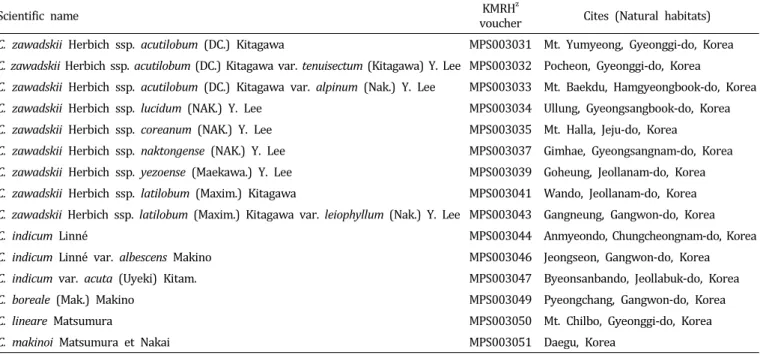
Fifteen taxa of Korean native Chrysanthemum species were collected from different regions, and grown in green- house at Highland Agriculture Research Center (37°40′N, 128°43′E, altitute 722 m), Rural Development Administration in Pyeongchang, Korea since 2010 (Table 1). From July 12-14, 2011, 20 g of leaves from each Chrysanthemum species were collected. The leaves were stored in -70°C deep freezer and freeze-dried using freezing dryer (FDT- 12012, Operon Co., Gimpo, Korea).
Extraction of Volatile Flavor Compounds
To extract the volatile flavor compounds, simultaneous steam distillation (SDE; Likens & Nickerson type) were done following the extraction method of Schultz et al.
(1977). Two grams of freeze-dried leaf sample and 500 mL of distilled water were added to one of the flasks, and heated-reflux was performed for 2 h on a 100°C heating mantle. Meanwhile, the essential oils were extracted by adding 50 mL of n-pentane:diethyl ether mixture (1:1 = v:v) in the other flask and heated-refluxing to 40°C. The extracted volatile flavor compounds were dehydrated using anhydrous sodium sulfate (Na
2SO
4). Afterwards, they were filtered using filter paper (No. 1, Whatman Limited, Maidstone- kent, UK), and concentrated using 99.9% nitrogen gas.
Finally, the concentrated compounds were dissolved in 0.2 mL of diethyl ether and analyzed using gas chromatography/
mass selective detector (GC/MSD) as below.
Analysis of Volatile Flavor Compounds
The extracted volatile flavor compounds were analyzed
and identified using GC/MSD as described in Table 2. About
1.0 μL of the extracted volatile flavor compounds was
injected into GC (Agilent 7890A, Agilent Co., Wilmington,
DE, US A) equipped with HP-5MS capillary column (30 m
Table 1. List of 15 taxa of Korean native Chrysanthemum species used in this study.
Scientific name KMRH
zvoucher Cites (Natural habitats) C. zawadskii Herbich ssp. acutilobum (DC.) Kitagawa MPS003031 Mt. Yumyeong, Gyeonggi-do, Korea C. zawadskii Herbich ssp. acutilobum (DC.) Kitagawa var. tenuisectum (Kitagawa) Y. Lee MPS003032 Pocheon, Gyeonggi-do, Korea
C. zawadskii Herbich ssp. acutilobum (DC.) Kitagawa var. alpinum (Nak.) Y. Lee MPS003033 Mt. Baekdu, Hamgyeongbook-do, Korea C. zawadskii Herbich ssp. lucidum (NAK.) Y. Lee MPS003034 Ullung, Gyeongsangbook-do, Korea C. zawadskii Herbich ssp. coreanum (NAK.) Y. Lee MPS003035 Mt. Halla, Jeju-do, Korea
C. zawadskii Herbich ssp. naktongense (NAK.) Y. Lee MPS003037 Gimhae, Gyeongsangnam-do, Korea C. zawadskii Herbich ssp. yezoense (Maekawa.) Y. Lee MPS003039 Goheung, Jeollanam-do, Korea C. zawadskii Herbich ssp. latilobum (Maxim.) Kitagawa MPS003041 Wando, Jeollanam-do, Korea C. zawadskii Herbich ssp. latilobum (Maxim.) Kitagawa var. leiophyllum (Nak.) Y. Lee MPS003043 Gangneung, Gangwon-do, Korea
C. indicum Linné MPS003044 Anmyeondo, Chungcheongnam-do, Korea
C. indicum Linné var. albescens Makino MPS003046 Jeongseon, Gangwon-do, Korea
C. indicum var. acuta (Uyeki) Kitam. MPS003047 Byeonsanbando, Jeollabuk-do, Korea
C. boreale (Mak.) Makino MPS003049 Pyeongchang, Gangwon-do, Korea
C. lineare Matsumura MPS003050 Mt. Chilbo, Gyeonggi-do, Korea
C. makinoi Matsumura et Nakai MPS003051 Daegu, Korea
z
Korea Medicinal Resource Herbarium at Rural Development Administration in Korea.
Table 2. Analytical condition of GC-MS for the identification of volatile flavor compounds in 15 taxa of Korean native Chrysanthemum species.
Instrument Gas chromatography/mass spectroscopy
Model Agilent 7890A model (Agilent Technologies 7890A GC System, Wilmington, DE, USA) Column HP-5MS (30 m × 0.25 mm, film thickness: 0.25 μm)
Detector Triple-Axis detector
Temperature: 250°C
Carrier gas He (1 mL・min
-1)
Initial temperature: 50°C Initial time: 5 min
Oven temp. Rate: 7°C・min
-1Final temperature: 250°C Final time: 30°C・min
-1Injection Port Temperature: 250°C
Injection volume: 1 μL (split ratio 50:1)
Electron voltage 70 eV
Tem perature prim ing 5 m in 7°C・min
-130 m in initial 50°C → 50°C → 250°C → 250°C
Data Wiley 70 database system
× 0.25 mm i.d., 0.25 μm film thickness) and was analyzed by split mode (split ratio = 50:1). As for GC analysis conditions, the inlet and detector temperatures were maintained at 250°C, and the helium carrier gas flow rate at 1.0 mL per minute. The oven temperature was kept at 50°C for 5 min, raised by 7°C per min, and then maintained for 30 min
at 250°C. For GC/MSD conditions, the electron ionization
energy was 70 eV, the ion source temperature was 250°C,
and the mass range was 20-400 a.m.u. Regarding verification
of the compounds, the mass spectrum obtained using
GC/MSD was compared with Wiley 275L database system
(Wiley 70, Agilent Co., Wilmington, DE, USA) and mass
Table 3. Variation in the functional group of volatile flavor compounds among 15 taxa of Korean native Chrysanthemum species in greenhouse of highland area.
Functional group Peak area (%) of volatile flavor compounds in Chrysanthemum species
zA B C D E F G H I J K L M N O Mean
Alcohols 24.3 22.8 34.4 35.9 31.3 27.4 25.8 28.5 26.2 24.2 43.0 20.6 41.3 19.7 25.0 28.7 Ketones 30.9 28.7 21.6 18.3 10.6 31.2 26.2 31.7 36.1 7.4 8.4 9.4 19.2 13.1 25.8 21.2 Hydrocarbons 9.4 12.4 13.8 21.3 15.4 18.2 18.4 11.1 11.2 11.5 18.9 15.5 9.2 3.3 8.1 13.2 Esters 11.3 9.5 3.8 4.2 4.2 7.0 2.0 5.3 2.9 0.0 0.6 3.5 0.3 2.2 0.2 3.8 Acids 0.0 0.0 0.2 0.2 0.0 0.0 0.6 0.0 0.3 5.0 1.5 0.5 0.6 10.9 1.5 2.1 Aldehyde 0.1 0.1 0.2 0.0 0.2 0.3 0.2 0.8 0.6 0.0 0.4 0.3 0.3 0.0 0.1 0.3
z
A, C. zawadskii ssp. acutilobum; B, C. zawadskii ssp. acutilobum var. tenuisectum; C, C. zawadskii ssp. acutilobum var. alpinum;
D, C. zawadskii ssp. lucidum; E, C. zawadskii ssp. coreanum; F, C. zawadskii ssp. naktongense; G, C. zawadskii ssp. yezoense;
H, C. zawadskii ssp. latilobum; I, C. zawadskii ssp. latilobum var. leiophyllum; J, C. indicum; K, C. indicum var. albescens; L, C.
indicum var. acuta; M, C. boreale; N, C. lineare; O, C. makinoi.
spectral data from the previous literature (Kondjoyan and Berdague, 1996) for the identification. C
5-C
20of alkane (Aldrich Chemical Co., Milwaukee, WI, USA) were used as reference flavor compound materials and expressed in terms of relative peak area (%).
Statistical Analysis
In order to compare the volatile flavor compounds among Chrysanthemum species, analysis of variance (ANOVA) was used to compare the means (n = 4) of the peak area from GC/MSD using SAS program (SAS institute, ver. 9.2, Cary, NC, USA). Levels of significance were calculated using ANOVA test at p ≤ 0.05, 0.01, and 0.001. Values of p
≤ 0.05 were considered to be statistically significant.
Results and Discussion
Volatile Flavor Compounds Found in Korean native Chrysanthemum Species
Identification of the volatile flavor compounds in 15 taxa of Korean native Chrysanthemum species was accomplished by comparing the mass spectra of their components with the Wiley database, and their GC retention time with GC/MSD spectral data (data not shown).
The flavor compounds of 15 taxa of Chrysanthemum species are constituted of six large functional groups, such as alcohols, ketones, hydrocarbons, esters, acids, and aldehyde. On the average, alcohols were the highest flavor compound group (28.7%) in 15 taxa of Chrysanthemum species, followed by ketones (21.2%), and hydrocarbons (13.2%) based on peak area (Table 3). Three functional groups consisted of 63.1% of the total flavor compounds
in 15 taxa of Chrysanthemum species. These compositions were dependent on the taxa; alcohols were the most abundant flavor compounds in 8 taxa, and ketones were the most abundant in the other 7 taxa. All the taxa showed negligible amount (< 1%) or no aldehyde compound. Although most taxa contained little (< 2%) to none acid compound, C.
indicum and C. lineare contained particularly high acid contents at 4.95% and 10.88% of peak area, respectively.
Esters consisted of 0.0-11.3% of peak area depending on the species, and C. zawadskii ssp. acutilobum had the highest esters contents among the taxa.
Comparison of the flavor compounds in 15 taxa of Chrysanthemum species is shown in Table 4. GC chromatogram showed 45 volatile flavor compounds from 12 to 32 volatile flavors each depending on taxa. The six flavor compounds, including sabinene, cis-chrysanthenol, borneol, m-thymol, chrysanthenone, and camphor showed the most significant differences among the taxa (p ≤ 0.001). Sabinene was detected at a significant amount only in C. zawadskii subspecies and C. makinoi. cis-Chrysanthenol was detected only in four taxa of C. zawadskii subspecies such as ssp.
naktongense, yezoense, latilobum, and latilobum var. leiophyllum.
Significant differences (p ≤ 0.01) in γ-terpinene, 1-octen- 3-ol, linalool, -terpineol, hinesol, and trans-chrysanthenyl acetate were found among the taxa. In particular, γ-terpinene, 1-octen-3-ol and -terpineol were detected only in C.
zawadskii subspecies and C. makinoi, while hinesol was
detected only in C. indicum subspecies and C. boreale. To
investigate the differences in flavor compounds among 15
taxa of Chrysanthemum species, we compared the flavor
compounds within the six functional categories of the
compounds below.
Table 4. Components of the volatile flavor compounds obtained from 15 taxa of Korean native Chrysanthemum species in greenhouse at highland areas.
Volatile flavor compounds Peak area (%) of volatile flavor compounds in Chrysanthemum species
zp value
A B C D E F G H I J K L M N O
Alcohols NS
1-Octen-3-ol 0.20 0.07 0.30 0.09 0.39 0.58 0.06 0.38 0.25 0.37 **
1-Decanol 1.84 NS
Linalool 0.36 0.07 0.17 0.76 0.44 **
cis-Chrysanthenol 9.24 13.98 14.81 14.13 9.41 ***
Borneol 11.32 12.48 18.52 20.94 18.96 1.10 0.91 0.66 0.62 5.40 18.29 2.86 3.27 1.70 1.82 ***
Epoxylinalol 0.03 NS
-Terpineol 1.49 0.86 1.08 0.36 1.13 0.86 0.28 0.52 0.66 1.53 **
Myrtenol 1.05 0.57 1.72 0.32 0.39 1.24 1.34 0.81 0.60 1.68 0.54 2.85 0.51 0.23 NS
Piperitol 0.15 0.14 4.12 12.39 NS
m-Thymol 2.85 2.98 1.97 4.26 3.39 ***
Eugenol 1.31 1.80 0.06 0.17 NS
Hinesol 4.79 2.95 6.73 3.49 **
-Cadinol 2.72 NS
Phytol 7.36 5.86 10.84 9.92 7.03 12.72 7.37 11.12 9.02 12.21 21.08 4.05 21.62 13.48 11.12 NS Ketones
Chrysanthenone 1.15 1.02 0.25 1.99 0.88 ***
Camphor 28.61 25.67 19.61 18.01 10.07 29.77 24.88 30.79 33.22 6.44 8.39 8.91 18.25 13.11 24.88 ***
Pinocarvone 1.07 0.04 0.83 0.02 0.16 0.30 0.29 0.62 0.91 0.99 0.49 0.99 NS
Thyme camphor 1.22 2.98 1.16 0.26 0.40 *
Hydrocarbons
2,4-Dimethyl-heptene 0.04 0.02 0.10 0.12 0.53 0.03 0.57 0.34 0.32 0.07 0.20 0.04 0.22 0.21 NS
-Thujene 0.15 0.08 0.14 0.04 0.13 0.03 0.10 NS
-Pinene 1.27 0.58 0.25 0.86 0.36 0.44 0.80 1.33 0.59 0.01 1.19 0.45 0.21 0.79 0.99 NS Camphene 2.04 1.53 1.28 1.23 0.12 0.22 0.10 0.06 0.18 0.17 3.57 0.28 0.98 0.42 0.39 NS
Sabinene 0.38 0.07 0.11 0.06 0.19 0.70 0.65 0.56 0.28 0.23 ***
-Pinene 0.95 0.17 0.12 0.27 0.10 0.36 1.41 0.07 0.05 0.25 0.08 0.06 0.95 NS
-Terpinene 0.02 0.26 0.19 1.30 0.99 0.26 0.08 0.25 0.20 NS
p-Cymene 0.93 1.22 0.09 0.08 1.36 0.99 1.10 1.01 0.26 0.02 0.17 0.13 0.37 1.28 *
Limonene 0.22 0.12 0.09 0.06 0.97 0.23 NS
γ-Terpinene 0.43 0.61 0.84 0.36 1.21 1.01 0.54 0.53 0.11 0.22 **
-Thujone 0.05 0.28 0.08 0.27 *
trans-Caryophyllene 0.47 0.84 1.27 1.23 1.15 0.32 0.64 0.60 0.29 2.62 0.21 2.39 0.63 1.17 NS
-Selinene 0.35 0.19 1.38 0.22 0.60 1.79 1.24 0.96 *
Germacrene-D 0.25 0.64 1.16 0.92 1.89 3.71 1.74 0.97 1.11 2.67 2.96 0.18 3.17 1.89 1.01 NS
-Muurolene 0.29 2.65 3.80 0.15 NS
δ-Cadinene 0.09 0.66 1.66 8.03 2.56 7.31 5.38 1.88 1.49 1.06 2.59 2.07 0.95 1.39 NS
-Longipinene 3.80 NS
Caryophyllene oxide 1.11 3.69 2.23 2.37 1.94 1.51 2.75 1.35 3.87 2.34 3.65 3.90 1.67 NS γ-Gurjunene 0.68 1.72 2.84 0.65 1.85 0.66 0.68 0.92 1.40 2.18 1.15 2.09 0.65 NS Esters
1,8-Cineole 1.27 0.73 1.13 0.74 1.06 1.03 0.26 0.91 0.29 0.02 0.55 3.50 0.26 0.20 0.05 NS trans-Sabinene hydrate 6.97 6.20 1.88 0.36 0.40 2.70 0.49 0.37 0.04 NS cis-Sabiene hydrate 1.85 2.21 0.18 0.42 1.48 2.91 0.84 3.37 2.27 *
trans-Chrysanthenyl acetate 0.27 0.39 0.36 0.68 0.30 0.14 **
Bornyl acetate 1.17 0.40 0.58 2.66 1.00 1.98 NS
Acids
Pentadecanoic acid 10.88 NS
Hexadecanoic acid 0.24 0.23 0.63 0.25 4.95 1.45 0.48 0.64 1.50 NS Aldehyde
trans-2-Hexenal 0.07 0.10 0.16 0.02 0.23 0.33 0.16 0.80 0.64 0.01 0.37 0.28 0.25 0.13 NS No. of total compound 30 30 31 30 30 31 32 31 32 21 21 21 22 12 25
z
For species name, refer to Table 3.
NS,*,**,***