This is an Open Access article distributed under the terms of Copyright: © 2020 Korean Journal of Agrcultural Science
ANIMAL
Determination and comparison of growth performance parameters between two
crossbred strains of Korean native chickens with a white semi broiler chicken for 84 days post-hatch
Shan Randima Nawarathne
1,†, Soo Kee Lee
1,†, Hyun Min Cho
1, Samiru Sudharaka Wickramasuriya
1, Jun Seon Hong
1, Yu Bin Kim
1, Jung Min Heo
1,*, Young-Joo Yi
2,*1
Department of Animal Science and Biotechnology, Chungnam National University, Daejeon 34134, Korea
2
Department of Agricultural Education, Sunchon National University, Suncheon 57922, Korea
†
These authors have contributed equally to this work.
*
Corresponding authors: [email protected], [email protected]
Abstract
The aim of this study was to investigate the growth performance between two different crossbred strains of Korean native chickens denoted as 1E and 2E with a white semibroiler (LL) from hatch to d-84 post-hatch. A total of 450 one-day-old chicks were randomly distributed into cages which included 15 replicate cages each for 1E and 2E with 9 replicate cages for LL.
A three phase feeding program was used as a starter (Day 1 - 35; crude protein [CP] 20.3%;
metabolizable energy [ME] 3,059 kcal·kg
-1), grower (Day 36 - 56; CP 18.6%; ME 3,123 kcal·kg
-1) and finisher (Day 57 - 84; CP 16.7%; ME 3,187 kcal·kg
-1). The results revealed that LL had a higher (p < 0.05) BW during d-8 to d-84 compared with the other two cross breed groups. A higher (p < 0.05) ADG was observed from the LL during the entire period except from d-1 to d-14 and d-71 to d-84 when compared with 1E and 2E. Shank length did not vary (p > 0.05) between the strains, despite LL having a SL that was 2.86% higher (p < 0.05) when compared with the other strains from d-15 to d-21 post-hatch, and 1E had a SL that was 2.28% (p < 0.05) higher when compared with the other strains during the first week of the experiment.
Keywords: cross breed, growth performance, Korean native chickens, shank length, white semi broiler
OPEN ACCESS
Accepted: April 01, 2020 Revised: March 23, 2020 Received: March 05, 2020
Citation: Nawarathne SR, Lee SK, Cho HM, Wickramasuriya SS, Hong JS, Kim YB, Heo JM, Yi YJ. 2020. Determination and comparison of growth performance parameters between two crossbred strains of Korean native chickens with a white semi broiler chicken for 84 days post-hatch. Korean Journal of Agricultural Science 47:255-262.
https://doi.org/10.7744/kjoas.20200016
Introduction
Chicken meat industry in Korea is one of the major sub-sectors in the livestock industry and per capita consumption of chicken meat showed a rapid increment from 2.4 kg in 1980 to 15.4 kg in 2014 (Shin et al., 2017) which was a 541.67% increment and also with an increase of approximately 89% in 2018 compared to that of 2005 (Park et al., 2019). The reason for increasing chicken consumption was the consumer preference towards healthy white meat compared with red meat (MAFRA, 2014). Even though the per capita consumption of chicken meat increased, data from the MAFRA (2014) concluded that chicken meat self-sufficiency rate in Korea has fallen during the same time period by 24.9%. With compared with past, approximately 90% of the poultry industry in Korea undergo their products based on the imported chicken breeding stocks (Choi et al., 2015) and those data indicate that rearing Korean Native Chicken (KNC) for food purpose became suppressed by imported chicken breeds in now-a-days.
KNC is a well-renowned breed for its superior meat quality, taste and high market price (Choi et al., 2015).
Furthermore, KNC meat is characterized by low-fat content and high protein content (Kong et al., 2006) and also it is darker and reddish than broilers, contains more essential fatty acids and collagen (Jeon et al., 2010) with better sensory properties (Choe et al., 2010). However, possessing a low growth rate and poor commercial performances KNC almost became extinct in recent history but Korean government started to practice conservation strategies through the National Institute of Animal Science (NIAS) from 1994 up to date which obtained an ultimate goal of developing five lines of KNC (Seo et al., 2013; Choi et al., 2015) classified mainly by plumage colour representing black, grey, red, yellow, and white lines (Jin et al., 2014; Cahyadi et al., 2015). The cross breeds used in this study (1E and 2E) to evaluate growth performance was developed by the Golden Seed Project, Korea.
White semi broiler is a hybrid species generated by artificial fertilization between male broiler and female hen which characterized by white fur, small build, and low-fat muscle mass. White semi broiler chicks (LL) used in this study was offspring of Hy-Line female and Ross® male chickens (LL; Hy-Line female × Ross® male). This chicken breed is widely known as a main ingredient in Samgyetang (Korean chicken soup) and it has a large industrial presence, especially since Samgyetang ingredients sold on the market account for 60 - 70 % in Korea.
Moreover, white semi chicks maintain its unique form of meat despite high temperature heating, and has a chewy, elastic, and suitable advantage for consumers� taste (Cho et al., 2007; Ahn et al., 2009; Lee et al., 2018). Therefore, this study was conducted to compare growth performance between three different strains of commercial KCN including 1E and 2E with the white semi broiler strain from hatch to 84 days of age post-hatch.
Materials and Methods
All procedures were approved, and birds were cared for according to the guidelines of the Animal Care and Use
Committee Chungnam National University, South Korea (Protocol No. CNU-00613).
Birds and housing
A total of 450 one-day-old 1E, 2E and LL chicks with the similar initial body weight were randomly allotted to 39 cages which include 15 replicate cages each for 1E and 2E with 9 replicate cages for LL. Each pen of 1E and 2E contained 12 birds and LL contained 10 birds. Raised wire floor cages (76 × 61 × 46 cm
3) were provided as housing for birds and same environment condition was provided to each group. Furthermore, continuous lighting regime of 25 lux was practiced during the experimental period. The temperature of the cages was maintained at 32 ± 2℃ during the week one post-hatch, then it was gradually lowered to 20 ± 2℃ until the birds were 5 weeks old, then after the same temperature was maintained for the entire experimental period. Moreover, relative humidity was maintained at 70 ± 5% at 1 week, 65 ± 5% at 2 weeks, and 60 ± 5% thereafter.
Experimental design and diet
The experiment was conducted using completely randomized design (CRD) with general linear model (GLM).
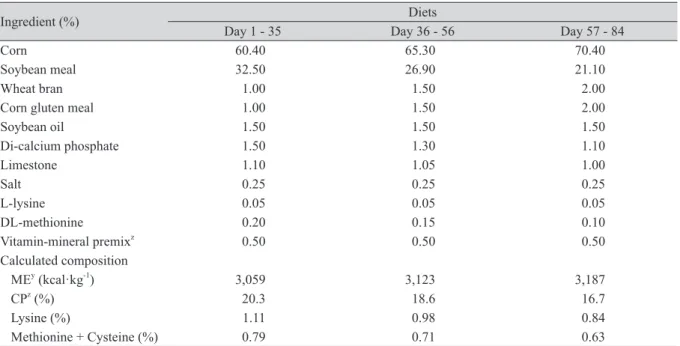
Corn-soybean meal basal diet was provided to birds which formulated according to the Korean Feeding Standard for Poultry of NIAS (2012) that included starter phase (Day 1 - 35; crude protein [CP] 20.3%, metabolizable energy [ME] 3,059 kcal·kg
-1), grower phase (Day 36 - 56; CP 18.6%, ME 3,123 kcal·kg
-1) and finisher phase (Day 57 - 84; CP 16.7%, ME 3,187 kcal·kg
-1) (Table 1). Diets were provided in ad-libitum basis using metal feed troughs and birds had free access to fresh clean drinking water via nipple drinkers throughout the experiment.
Table 1. Composition of the experimental diets (%, as-fed basis).
Ingredient (%) Diets
Day 1 - 35 Day 36 - 56 Day 57 - 84
Corn 60.40 65.30 70.40
Soybean meal 32.50 26.90 21.10
Wheat bran 1.00 1.50 2.00
Corn gluten meal 1.00 1.50 2.00
Soybean oil 1.50 1.50 1.50
Di-calcium phosphate 1.50 1.30 1.10
Limestone 1.10 1.05 1.00
Salt 0.25 0.25 0.25
L-lysine 0.05 0.05 0.05
DL-methionine 0.20 0.15 0.10
Vitamin-mineral premix
z0.50 0.50 0.50
Calculated composition
ME
y(kcal·kg
-1) 3,059 3,123 3,187
CP
z(%) 20.3 18.6 16.7
Lysine (%) 1.11 0.98 0.84
Methionine + Cysteine (%) 0.79 0.71 0.63
ME, metabolizable energy; CP, crude protein.
z