• 검색 결과가 없습니다.

Mitochondrial D-Loop Variations for Discrimination of Commercial Korean Native Chicken Populations

N/A
N/A
Protected

Academic year: 2021

Share "Mitochondrial D-Loop Variations for Discrimination of Commercial Korean Native Chicken Populations"

Copied!
5
0
0

로드 중.... (전체 텍스트 보기)

전체 글

(1)

Mitochondrial D-Loop Variations for Discrimination of Commercial Korean Native Chicken Populations

Hasina Sultana

1

, Md. Rashedul Hoque

1

, Dong-Won Seo

1

, Bo-Seok Kang

2

, Kang-Nyeong Heo

2

, Cheorun Jo

1

and Jun-Heon Lee

1,†

1

Department of Animal Science and Biotechnology, Chungnam National University, Daejeon 305-764, Korea

2

Poultry Science Division, National Institute of Animal Science, RDA, Cheonan 331-801, Korea

ABSTRACT The increasing demand for Korean native chicken meat indicates that the discovery of haplotypes is very important from both economic and conservation points of view. In this study, mtDNA D-loop sequences from two crossbred Korean native chicken populations of 138 individuals were investigated. Twenty six nucleotide substitutions were identified from sequence analysis and were classified into 12 haplotypes. The haplotype H_8 represents 73.47% of Woorimatdag (chicken population) sequences, which were identified in all five Woorimatdag chicken populations investigated. The H_7 haplotype (Dhap1) for D population covers 45% sequences, which indicate maternal inheritance from black Korean native chicken. On the other hand, Chap3 and Chap4 for C population are specific haplotypes, as H_5 and H_2, respectively. Based on the network profiles, six SNPs (C199T, A239G, G242A, A291G, T330C and C391A) of the D-loop region are effective markers for discrimination between Woorimatdag and Hanhyup chicken populations. Also, the phylogenetic analyses of Woorimatdag and Hanhyup chicken populations were used to identify the genetic relationships among the haplotypes. The results presented here can be used for developing molecular markers to discriminate between two commercial Korean native chickens.

(Key words : D-loop variation, haplotype, Korean native chicken)

To whom correspondence should be addressed : [email protected] INTRODUCTION

In Korea, there has been a strong increasing demand for meat of the Korean native chicken. Two commercial Korean native chicken populations (Woorimatdag and Hanhyup) have recently been developed by crossing Korean native chickens with other commercial chicken breeds in order to increase the meat-related traits. Thus, ‘Woorimatdag’ has been developed by a government institution, the National Institute for Animal Science (NIAS), and the Hanhyup chicken population was de- veloped by a private company in Korea. Based on the crossing experiments, five distinct Woorimatdag chicken populations have been developed in Korea. For the comparison of Woori- matdag and Hanhyup chicken populations, the D-loop varia- tions in the mitochondrial genome have been initially investi- gated (Hoque et al., 2011).

In order to understand the evolutionary relationship of do- mestic and wild populations, DNA technology is routinely applied.

This mtDNA has been considered as a powerful source of molecular information to identify the ancestors of many spe-

cies (Harpending et al., 1998). Polymorphisms in the mtDNA

are successfully used for the analysis of phylogenetic and

genetic diversity. MtDNA is inherited maternally and has a

high mutation rate as well as an absence of recombination

(Coble et al., 2004; Vallone et al., 2004). It is not only an

ideal marker for the reconstruction of evolutionary relation-

ships among species, but also enables the tracing of hybridi-

zation between species and subspecies of domesticated ani-

mals (Nijman et al., 2003). The control region or D-loop of

the mitochondrial genome is considered more suitable for

inter-specific population studies (Baker and Marshall, 1997)

than the use of coding genes for distinction of species or breeds

by phylogenetic analysis (Moore and Defilippis, 1997). The

analysis of the D-loop region in mtDNA sequences from

Gallus species and domestic chickens suggests the presence

of monophyletic origin in domestic chicken, the sole ancestor

of all domestic chickens being the red jungle fowl subspecies

(Gallaus gallus gallus in Southeast Asia) of Thailand and

adjacent areas (Fumihito et al., 1994, 1996). Niu et al. (2002)

examined the mtDNA of Chinese native chicken populations

(2)

and confirmed that their most likely origin was Thailand and adjacent geographic areas. Also, the phylogenetic relationships between Korean native chicken and other breeds have re- cently been investigated using D-loop sequence variations in mtDNA, and attempts to discriminate between Korean native chickens have been made using mtDNA and the LEI0258 marker (Cho et al., 2011; Hoque et al., 2011; Hoque et al., 2009; Lee et al., 2007).

In this study, the chicken mtDNA D-loop region was used for the demarcation of haplotypes in two commercial Korean native chicken populations (Woorimatdag and Hanhyup) in order to construct an appropriate breeding plan as well as to develop molecular markers for these breeds.

MATERIALS AND METHODS

1. Sampling and DNA Extraction

A total of 98 individuals of five different versions of Woori- matdag chicken populations were used in this study. The num- ber of animals used in this study are version 1 (K, n=20), version 2 (A, n=20), version 3 (C, n=20), version 4 (B, n=

18), version × (D, n=20) and these were collected from Na- tional Institute of Animal Science (NIAS). The blood and muscle samples were used for genomic DNA extraction using modified manual methods (Miller et al., 1988). For the com- parison of haplotypes, a previously determined D-loop se- quence data from the Hanhyup commercial chicken popula- tion (40 samples) was included in the analysis (Hoque et al., 2011).

2. PCR Amplification and Sequencing

The D-loop hyper-variable region in mtDNA was used to PCR amplify a 591 bp fragment by the following primer pair (Forward: 5'-AGGACTACGGCTTGAAAAGC-3' and Reverse:

5'-ATGTGCCTGACCGAGGAACCAG-3'). The PCR reactions included approximately 50 ng of genomic DNA and 2X Prime Taq Premix (GeNet Bio, Korea) in a 25 uL reaction volume.

PCR was performed in a My-Genie96 Thermal Block (Bio- neer, Korea) with an initial denaturation step at 94 ℃ for 10 min, followed by 35 cycles of 30 sec at 94℃, 30 sec at 61℃, 40 sec at 72℃, and a final extension step at 72℃ for 10 min.

The PCR products for mtDNA were electrophoresed on 1.5%

agarose gels with ethidium bromide, and DNA bands were visualized under ultraviolet light. Purification of PCR pro- ducts was performed using an Accuprep

PCR purification kit (Bioneer, Korea) according to the manufacturer’s instructions.

Purified PCR products were also confirmed using agarose gels for sequencing. All the purified PCR products were se- quenced by Genotech (www.genotech.co.kr).

3. Sequence Analysis

The chicken mtDNA D-loop nucleotide sequence data were aligned using the ClustalW program (Thompson et al., 1994).

Nucleotide replacement export data from mtDNA were carried out in haplotype sequences by using MEGA5 (Tamura et al., 2011). A rectangular Kimura 2-parameter model neighbor- joining (NJ) phylogenetic tree with 1000 bootstrap replica- tions was constructed using MEGA5. Also, the median-joining network profile with positional SNPs for the differentiation of haplotypes was constructed using NETWORK4610 software (Bandelt et al., 1999).

RESULTS AND DISCUSSION

1. Haplotype Analysis

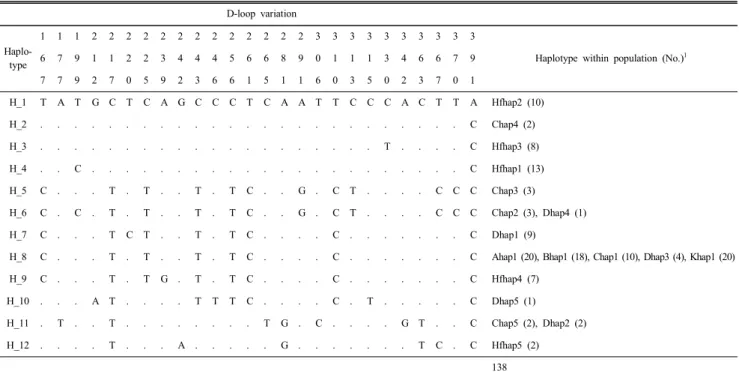
Based on the analysis of 138 D-loop sequences from Woo- rimatdag and Hanhyup chicken populations, 26 nucleotide sub- stitutions were identified, representing 12 haplotypes (Table 1). Among these haplotypes, seven haplotypes were identified in Woorimatdag chicken populations. All of the A, B and K populations had haplotype H_8, which may due to their having a common origin in the Rhode Island Red (RIR) breed.

However, C and D populations are the offspring of red and black Korean native chicken breeds, which were used as ma- ternal sources. While, the Chap1 haplotype in the C popula- tion contains 50% of sequences which were found in H_8 haplotype. Based on their haplotype sharing, RIR and red Ko- rean native chicken are possibly related. Also, H_8 haplotype (Dhap3) in the D population accounts for 20% of sequences.

Thus, the concern of specific haplotype, 45% of the H_7 haplotype (Dhap1) of the D population was indicated to have been maternally inherited from black Korean native chicken.

Additionally, H_2 (Chap4) and H_5 (Chap3) haplotypes are

specific haplotypes in C population. Whereas, C and D chic-

(3)

Table 1. Haplotypes identified using the mitochondrial D-loop sequence polymorphisms between Woorimatdag and Hanhyup chicken populations

D-loop variation

Haplo- type

1 1 1 2 2 2 2 2 2 2 2 2 2 2 2 2 3 3 3 3 3 3 3 3 3 3

Haplotype within population (No.)1

6 7 9 1 1 2 2 3 4 4 4 5 6 6 8 9 0 1 1 1 3 4 6 6 7 9

7 7 9 2 7 0 5 9 2 3 6 6 1 5 1 1 6 0 3 5 0 2 3 7 0 1

H_1 T A T G C T C A G C C C T C A A T T C C C A C T T A Hfhap2 (10)

H_2 . . . C Chap4 (2)

H_3 . . . T . . . . C Hfhap3 (8)

H_4 . . C . . . C Hfhap1 (13)

H_5 C . . . T . T . . T . T C . . G . C T . . . . C C C Chap3 (3)

H_6 C . C . T . T . . T . T C . . G . C T . . . . C C C Chap2 (3), Dhap4 (1)

H_7 C . . . T C T . . T . T C . . . . C . . . C Dhap1 (9)

H_8 C . . . T . T . . T . T C . . . . C . . . C Ahap1 (20), Bhap1 (18), Chap1 (10), Dhap3 (4), Khap1 (20)

H_9 C . . . T . T G . T . T C . . . . C . . . C Hfhap4 (7)

H_10 . . . A T . . . . T T T C . . . . C . T . . . C Dhap5 (1)

H_11 . T . . T . . . T G . C . . . . G T . . C Chap5 (2), Dhap2 (2)

H_12 . . . . T . . . A . . . G . . . T C . C Hfhap5 (2)

138

1
The mtDNA haplotypes for the Hanhyup chicken population has been previously published (Hoque et al., 2011)

ken populations are more diverse among Woorimatdag chicken populations, indicating multiple maternal origins for these populations. On the other hand, Hanhyup chicken populations had five haplotypes, H_1, H_3, H_4, H_9 and H_12, as detailed in Table 1. Interestingly, D-loop variations in mtDNA have been clearly differentiated between Woorimatdag and Hanhyup chicken populations. In our analysis, six SNPs of D-loop region can be used as effective markers for discrimi- nation between Woorimatdag and Hanhyup chicken popula- tions by using positional SNPs at C199T, A239G, G242A, A291G, T330C and C391A. Our previous studies also suggested that C225T, A239G and G243A SNPs are effective for chicken population discrimination (Hoque et al., 2011). This study conveys the vital importance of differential markers between commercial Korean native chicken populations.

2. Network Profiling and Phylogenetic Analysis Based on the network profiles, the relationship of 12 ha- plotypes from D-loop sequences was identified between Woo- rimatdag and Hanhyup chicken populations (Fig. 1). This re- sult can also be used to select nucleotide positions for the

discrimination of Korean native chicken populations. As has been previously mentioned, Woorimatdag and Hanhyup haplo- types are completely separated by the D-loop nucleotide po- sitions. Three haplotypes, H_1, H_3 and H_4, are represen- tative of Hanhyup haplotypes, which can be differentiated from Woorimatdag haplotypes by observation of the C391A, T330C and C199T nucleotide positions. Among these, the C199T nucleotide position is also used for distinguishing H_5 and H_6 haplotypes. In this case, H_4 is differentiated from H_6 by using A291G or T370C nucleotide positions. Two further Hanhyup haplotypes, H_9 and H_12, are also diffe- rent to Woorimatdag haplotypes by using A239G and G242A nucleotide substitutions. This network profile is effective for the selection of markers between and within populations. Other study also reported that allele-specific SNP typing in mtDNA D-loop region at the five SNP sites (C310T, A342G, C446T, A686G and C1213T) were SNP haplotypes that can be used for identification of the origins of chicken meat (Harumi et al., 2011).

The phylogenetic analysis between Woorimatdag and Han-

hyup chicken populations was conducted in order to identify

(4)

Fig. 1. Network profiles of the 12 haplotypes, which indicate the linked nucleotide positions between and within Woo- rimatdag and Hanhyup chicken populations. The order of the mutations on the branch is arbitrary. The median vectors (mv) are nucleotide junctions.

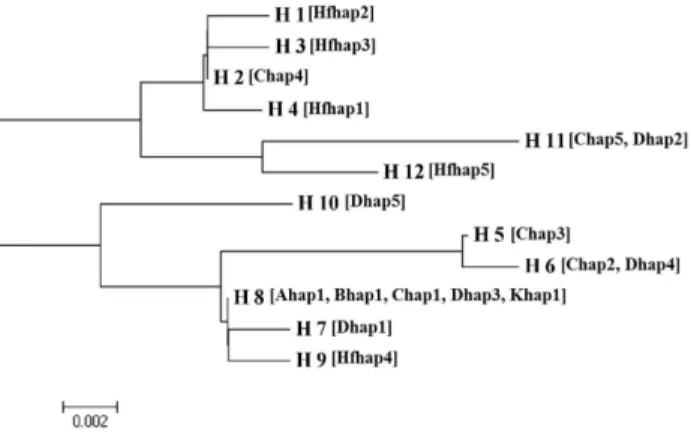
the genetic relationships among the haplotypes. Based on the Kimura’s 2-parameter model, a neighbor-joining phylogenetic tree was constructed based on the frequencies of transitional and transversional substitution rates (Fig. 2). Besides, five haplotypes were distributed among the Hanhyup chicken population which is distinguishable to Woorimatdag chickens.

Based on phylogenetic analysis, three haplotypes in Hanhyup chickens (H_1, H_3 and H_4) are closely related to the Woorimatdag C population. Only one haplotype (H_12) is clo- sely located to Woorimatdag C and D populations. However, H_9 haplotype is closely related with H_7 (Dhap1) and H_8 (Ahap1, Bhap1, Chap1, Dhap3 and Khap1). This result may indicate that Hanhyup chickens were also developed by using red and black Korean native chickens as maternal sources.

Therefore, our phylogenetic analyses also provide some clues

Fig. 2. The constructed neighbor-joining phylogenetic tree using the Kimura 2-parameter model between Woorimatdag and Hanhyup chicken populations.

as to the relationship between Woorimatdag and Hanhyup chicken populations in Korea.

In this study, we investigated the D-loop variations to iden- tify haplotypes, and to compare Woorimatdag and Hanhyup chicken populations. Also, the network profiles and phyloge- netic relationships may be helpful for the selection of genetic markers for discrimination among chicken populations.

ACKNOWLEDGEMENTS

This study was carried out with the support of a grant from the FTA Agriculture Research Project (Project No. PJ9070112011), RDA, Republic of Korea.

LITERATURE CITED

Baker AJ, Marshall HD 1997 Mitochondrial control region sequences as tools for understanding evolution. In: Avian Molecular Evolution and Systematic (Ed. Mindell DP).

Academic press, San Diego pp. 51-82.

Bandelt HJ, Forster P, Rohl A 1999 Median-joining networks for inferring intraspecific phylogenies. Mol Biol Evol 16:

37-48.

Cho CY, Lee PY, Ko YG, Kim HK, Park MN, Yeon SH 2011 Multiple maternal origins of Korean native chicken based on the mtDNA D-loop variation. Korean J Poult Sci 38(1):5-12.

Coble MD, Just RS, O’Callaghan JE, Letmanyi IH, Peterson CT, Irwin JA, Parsons TJ 2004 Single nucleotide polymor- phisms over the entire mtDNA genome that increase the power of forensic testing in Caucasians. Int J Legal Med 118:137-146.

Fumihito A, Miyake T, Sumi S, Takada M, Ohno S, Kondo N 1994 One subspecies of the red jungle fowl (Gallus gallus gallus) suffices as the matriarchic ancestor of all domestic breeds. Proc Natl Acad Sci USA 91:12505-12509.

Fumihito A, Miyake T, Takada M, Shingu R, Endo T, Gojo- bori T, Kondo N, Ohno S 1996 Monophyletic origin and unique dispersal patterns of domestic fowls. Proc Natl Acad Sci USA 93:6792-6795.

Harpending HC, Batzer MA, Gurven M, Jorde LB, Rogers

AR, Sherry ST 1998 Genetic traces of ancient demography.

(5)

Proc Natl Acad Sci USA 95:1961-1967.

Harumi T, Sano A, Minematsu T, Naito M 2011 Allele-spe- cific PCR and sequencing of the mitochondrial D-loop region in four layer breeds. Anim Sci J 82(2):223-226.

Hoque MR, Jung KC, Park BK, Choi KD, Lee JH 2009 Genetic variability of mtDNA D-loop region in Korean native chickens. Korean J Poult Sci 37(4):323-328.

Hoque MR, Lee SH, Jung KC, Kang BS, Park MN, Lim HK, Choi KD, Lee JH 2011 Discrimination of Korean native chicken populations Using SNPs from mtDNA and MHC polymorphisms. Asian-Aust J Anim Sci 24(12):1637-1643.

Lee YJ, Bhuiyan MSA, Chung HJ, Jung WY, Choi KD, Jang BG, Paek WK, Jeon JT, Park CS, Lee JH 2007 Mitochon- drial DNA diversity of Korean Ogol chicken. Asian-Aust J Anim Sci 20(4):477-481.

Miller SA, Dykes DD, Polesky HF 1988 A simple salting out procedure for extracting DNA from human nucleated cells.

Nucleic Acids Res 16(3):1215-1215.

Moore WS, Defilippis VR 1997 The window of taxonomic resolution for phylogenies based on mitochondrial cytoch- rome b. In: Avian Molecular Evolution and Systematic (Ed.

Mindell DP). Academic press, San Diego pp. 84-119.

Nijman IJ, Otsen M, Verkaar EL, de Ruijter C, Hanekamp E 2003 Hybridization of banteng (Bos javanicus) and zebu (Bos indicus) revealed by mitochondrial DNA, satellite DNA, AFLP and microsatellites. Heredity 90:10-16.

Niu D, Fu Y, Luo J, Ruan H, Yu XP, Chen G, Zhang YP 2002 The origin and genetic diversity of Chinese native chicken breeds. Biochem Genet 40:163-174.

Tamura K, Peterson D, Peterson N, Stecher G, Nei M, Ku- mar S 2011 MEGA5: Molecular evolutionary genetics analysis using maximum likelihood, evolutionary distance, and maximum parsimony methods. Mol Biol Evol 10:1093.

Thompson JD, Higgins DG, Gibson TJ, Clustal W 1994 Im- proving the sensitivity of progressive multiple sequence alignment through sequence weighting, position-specific gap penalties and weight matrix choice. Nucleic Acids Res 22:4673-4680.

Vallone PM, Just RS, Coble MD, Butler JM, Parsons TJ 2004 A multiplex allele specific primer extension assay for fo- rensically informative SNPs distributed throughout the mitochondrial genome. Int J Legal Med 118:147-157.

(

received: 2012. 11. 13, revised: 2012. 12. 17, accepted: 2012. 12. 17

)

수치

Table  1.  Haplotypes  identified  using  the  mitochondrial  D-loop  sequence  polymorphisms  between  Woorimatdag  and  Hanhyup  chicken  populations D-loop  variation  Haplo-type 1 1 1 2 2 2 2 2 2 2 2 2 2 2 2 2 3 3 3 3 3 3 3 3 3 3
Fig.  2.  The  constructed  neighbor-joining  phylogenetic  tree  using  the  Kimura  2-parameter  model  between  Woorimatdag  and  Hanhyup  chicken  populations.

참조

관련 문서

Salty taste intensity scores for chicken rice porridge of salt solution and various level of soy sauce solution ··· 26 Fig.. Photograph of Salad dressing

william James Hall, M.D., Medical Missionary to the Slums of New York; Pioneer Mission of Korean Native Costumes, China Medical Journal, 1916.3; Medical Needs of Korean

1 John Owen, Justification by Faith Alone, in The Works of John Owen, ed. John Bolt, trans. Scott Clark, "Do This and Live: Christ's Active Obedience as the

This study selected Korea University for South Korean university and the University of Pennsylvania and the University of Chicago, US for foreign

Therefore, A lot of native English-speaking teachers have come to Korea to teach English.. The purpose of this study is to assess the job satisfaction of

For this, this study analyzed the ethnic and national identity of Korean Chinese by approaching the context of political, cultural and ideological systems

This study suggests the necessity of internship program utilizing foreign Korean-entrepreneurs networks, the necessity of human network database for

Objectives: The aim of this study was to study the relationship between smoking, alcohol drinking and vitamin D level among Korean adults using data from the