This is an Open Access article distributed under the terms of the Creative Commons Attribution Non-Commercial License (http: //creativecommons.org/licenses/by- nc/4.0/) which permits unrestricted non-commercial use, distribution, and reproduction in any medium, provided the original work is properly cited.
Copyright: © 2018 Korean Journal of Agrcultural Science
https://doi.org/10.7744/kjoas.20180065
ANIMAL
Growth performance of Korean crossbred domestic chickens for 12 weeks after post hatching
Jun Seon Hong1, Hyun Min Cho1, Samiru Sudharaka Wickramasuriya1, Taeg Kyun Shin1, Eun Joo Kim1, Jung Min Heo1,*, Yong-Joo Yi2,*
1Department of Animal Science and Biotechnology, Chungnam National University, Daejeon 34134, Korea
2Division of Biotechnology, Safety Environment and Life Science Institute, Chonbuk National University, Iksan 54596, Korea
*Corresponding author: [email protected], [email protected]
Abstract
This study was conducted to investigate the growth performance between six different Korean crossbred native chickens. A total of 312 one-day-old male chickens from the same paternal line with six different maternal lines were allocated into six groups (1A, 2A, 3A, 4A, 5A, and 6A) to give four replicate cages (13 birds per cage). Corn soybean meal based diets were provided as a starter (0 - 5 weeks: 20% crude protein [CP] and 3,050 kcal/kg metabolizable energy [ME]), grower (5 - 8 weeks: 18% CP, 3 and 100 kcal/kg ME) and finisher (8 - 12 weeks: 17% CP and 3,150 kcal/kg ME) diet. Chickens were able to access their respective feed and water ad libitum. In week 2, 2A had a lower body weight (p < 0.05) than that of the other groups. In contrast, in weeks 4 and 8, 2A had a higher body weight (p < 0.05). Similarly, in week 6, 2A had a higher body weight (p = 0.76) than that of the others. However, no difference (p > 0.05) was observed in the body weight after week 10. Meanwhile, 2A had a lower feed conversion ratio (FCR) than that of the other groups (p < 0.05) and a higher average daily feed intake (ADFI; p <
0.05) compared to the other groups in week 6. In conclusion, crossbred 2A had a lower growth performance in week 2; however, in weeks 4 and 6, 2A had a higher growth performance than that of the other groups. Based on this conclusion, we can use those results as a basis for further study.
Keywords: crossbreed, growth performance, Korean native chicken
Introduction
국내 가계 경제가 활성화되면서 닭고기를 포함한 육류 소비량은 매년 꾸준히 증가하는 추세이다.
닭고기의 1인당 소비량은 2010년 10.7kg에서 2016년 13.8kg으로 증가하였으며 이는 1인이 1년간 닭고기 튀김을 14마리 먹는 수치에 해당된다. 국내 닭고기 생산량 또한 매년 증가하여 2010년 436천 톤에서 2016년 599천 톤으로 증가하였다(MAFRA, 2018). 이와 같이 1인당 닭고기 소비량과 생산량 OPEN ACCESS
Accepted: September 7, 2018 Revised: August 2, 2018 Received: June 21, 2018 DOI:
Citation: Hong JS, Cho HM,
Wickramasuriya SS, Shin TK, Kim EJ, Heo JM, Yi YJ. 2018. Growth performance of Korean crossbred domestic chickens for 12 weeks after post hatching. Korean Journal of Agricultural Science. https://
doi.org/10.7744/kjoas.20180065
이 증가함에 따라 한국 재래닭의 소비량도 증가하였다고 보고된다(KNCA, 2018).
한국 재래닭이란 예로부터 우리나라에서 사육되어온 닭으로 최소 7세대 이상 다른 품종과 섞임이 없이 순수 혈통을 유지 하여 온 재래종 품종 또는 내종으로 사육 유래가 명확하고, 품종 고유의 유전적 특성이 대를 이어 유지되는 닭으로 깃털 색깔 에 따라 적갈색종, 황갈색종, 흑색종, 백색종 및 회갈색종으로 구분할 수 있다(NIAS, 2017a).
한국 재래닭은 식육의 기호성에 영향을 주는 asparticacid, alanine, glycine, glutamicacid 등의 아미노산과 필수 지방산인 arachidonicacid 등의 함유량이 일반 육계에 비해 높으며, 조리 후의 휘발성 향기 성분도 일반 육계에 비해 높은 함량을 가지 고 있는 것으로 알려져 있다(Leeetal., 2012). 하지만 육용실용계인 Ross308이 800g에 도달하는데 19일이 걸리는 데 비하 여(Avigen, 2014), 재래닭은 체중이 800g에 도달하기까지 5주 가량의 시간이 소요되어 실용계에 비해 경제성이 떨어진다 (Naetal., 2009).
상대적으로 미진한 생산능력을 개선하기 위한 교배법으로 잡종강세를 이용하는데, 잡종강세란 순종 간 교배시에 나타나 는 비 상가적 유전효과로서 여러 경제형질에서 자손이 순종인 부모세대에 비해 우수한 형질을 나타내는 현상을 말한다 (Shull, 1948). 한국 재래닭에서도 잡종강세를 이용한 많은 연구가 선행되어왔고, 여러 경제형질에서 향상된 효과를 볼 수 있 다고 보고하고 있다(Parketal., 2010; Leeetal., 2014; Choietal., 2017).
이번 대표적인 경제형질인 체중, 사료 요구율 등을 기준으로 한국 재래닭 교배조합의 성장 성상을 비교함으로써 상호간의 경제형질 개선 기초자료 생산에 목적을 두었다.
Materials and Methods
본 실험은 충남대학교 동물위원회 심의규정(CNU-00613)에 의해 검토된 후 수행 되었다. 본 실험에 공시된 닭의 사양은 본 대학교 닭 사육 관리 지침에 따랐으며, 동물의 관리 및 취급은 본 대학 동물실험윤리위원회의 규정을 준수하고, 승인을 받 았다.
공시동물과 실험설계
실험에서 사용된 공시동물은 한협(Hanhyup, Geumsan, Korea)에서 생산된 순종재래닭 종계 부계 1계통, 모계 6계통을 이 용해 만든 6개의 교배조합(i.e., 1A, 2A, 3A, 4A, 5A, 6A) 수컷을 각각 52수씩 선발하여 총 312수를 이용하였다. 공시동물은 각각 4반복 처리하였고, 반복별로 13수씩 생시 체중을 기준으로 완전 임의 배치하였다.
사육형태
실험에서 사용된 공시 동물은 12주간 batterycage (76cm × 61cm × 46cm)에서 실험을 진행했다. Batterycage당 13수 씩 배치하였고 물과 사료는 무제한급이를 실시했다.
사료 급여 체계
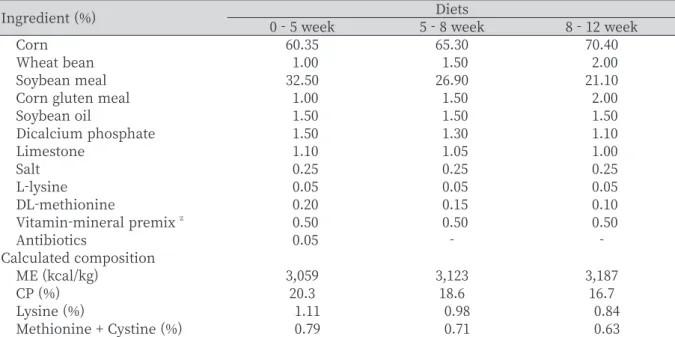
급여한 사료는 NIAS (2012)의 KoreanFeedingStandardforPoultry에서 제시한 옥수수-대두박 위주의 준육용계 사료를 초기(crudeprotein [CP] 20.0%, metabolizableenergy [ME] 3,050kcal/kg), 전기(CP18.0%, ME3,100kcal/kg), 후기(CP 16%, ME3,150kcal/kg)로 각각 배합 생산하여 이용하였다(Table1).
점등 및 기타사양관리
점등은 부화 후 12주령까지 종야 점등을 실시하였고 점등 광도는 25lux였다. 계사의 온도는 부화 후 1주일은 32 ± 2℃를
유지하였고, 이후 일주일마다 3℃씩 온도를 하강하여 4주령 이후에는 20 ± 2℃를 유지했다. 습도는 1주령에 70 ± 5%, 2주 령에 65 ± 5%, 그 이후로는 60 ± 5%를 유지했다.
일당증체량 및 체중
일당증체량 및 체중은 부화 후 2주간격으로 12주까지 오전 8시에 사료 급여를 중단하고 오전 10시에 개체별로 측정하였 다.
사료섭취량
사료섭취량은 2주 간격으로 사료 잔량을 측정하여 급여한 사료로부터 계산하였다.
사료요구율
사료요구율은 부화 후 12주령까지의 12주간 사료섭취량을 증체량으로 나누어 계산하였다.
통계처리
교배조합 재래닭의 체중, 일당증체량, 사료섭취량, 사료요구율에 대한 분석은 SPSS24.0 (SPSSInc., Chicago, IL, USA) 의 GLMprogram (GeneralLinearModel, one-wayANOVAprocedure)을 이용하여 분석하였으며, batterycage단위로 계산 하였다. 또한 사후검정은 Duncan의 다중검정을 이용하였고, 95%의 신뢰수준에서의 유의성을 검정하였다.
Table 1. Composition of the experimental diets (g/kg, as-fed basis).
Ingredient (%) Diets
0 - 5 week 5 - 8 week 8 - 12 week
Corn 60.35 65.30 70.40
Wheat bean 1.00 1.50 2.00
Soybean meal 32.50 26.90 21.10
Corn gluten meal 1.00 1.50 2.00
Soybean oil 1.50 1.50 1.50
Dicalcium phosphate 1.50 1.30 1.10
Limestone 1.10 1.05 1.00
Salt 0.25 0.25 0.25
L-lysine 0.05 0.05 0.05
DL-methionine 0.20 0.15 0.10
Vitamin-mineral premix z 0.50 0.50 0.50
Antibiotics 0.05 - -
Calculated composition
ME (kcal/kg) 3,059 3,123 3,187
CP (%) 20.3 18.6 16.7
Lysine (%) 1.11 0.98 0.84
Methionine + Cystine (%) 0.79 0.71 0.63
ME, metabolizable energy; CP, crude protein.
z Vitamin and mineral mixture provided the following nutrients per kg of diet: vitamin A, 24,000 IU;
vitamin D3, 6,000 IU; vitamin E, 30 IU; vitamin K, 4 mg; thiamin, 4 mg; riboflavin, 12 mg; pyridoxine, 4 mg; folacine, 2 mg; biotin, 0.03 mg; vitamin B8 0.06 mg; niacin, 90 mg; pantothenic acid, 30 mg; Fe, 80 mg (as FeSO4 ・H2O); Zn, 80 mg (as ZnSO4 ・ H2O); Mn, 80 mg (as MnSO4 ・H2O); Co, 0.5 mg (as CoSO4
・H2O); Cu, 10 mg (as CuSO4 ・ H2O); Se, 0.2 mg (as Na2SeO3); I, 0.9 mg (as Ca (IO3) ・2H2O).
Results
실험간 재래닭들의 음수와 사료 섭취는 원만하게 이뤄졌으며 급사증후군(SDS, SuddenDeathSyndrome), 스트레스에 의 한 폐사, 질병의 증상은 발견되지 않았다. 실험에서 사용된 재래닭의 체중, 일당증체량, 사료섭취량, 사료요구율은 Table2에 나타내었다.
생시체중은 교배조합 1A가 가장 높았고 2A, 4A, 3A, 5A, 6A의 순서로 나타났다(p < 0.05). 2주령에는 각 그룹간의 유의적 인 차이가 나타나지 않았지만 4주령에는 1A가 가장 높았으며 2A와 4A그룹이 가장 낮았다(p < 0.05). 8주령에는 2A그룹이 다른 그룹에 비하여 높은 체중을 나타냈다(p < 0.05). 이후 10주령와 12주령에는 그룹간 체중의 유의적인 차이가 나타나지 않았다(p > 0.05).
일당증체량은 4주령까지는 유의적인 차이가 나타나진 않았지만 6주령에서는 2a와 6a가 가장 높은 일당증체량을 나타냈 Table 2. Effect of crossbred male Korean native chicken based on maternal line for 12 weeks from hatch.
Item 1A 2A 3A 4A 5A 6A SEM p-value
Body weight (g)
Initial 41.65d 40.89cd 39.24ab 39.91bc 38.72a 38.93ab 0.526 0.000
Week 2 198.51 164.89 184.32 164.96 180.21 173.05 13.814 0.146
Week 4 552.42b 506.48a 503.52a 477.34a 506.81a 493.22a 18.110 0.006
Week 6 906.86 932.41 870.77 850.92 840.64 910.62 35.169 0.076
Week 8 1461.15ab 1538.87b 1415.15a 1351.57a 1398.56a 1431.79a 49.234 0.013 Week 10 1981.65 1993.74 1945.43 1951.77 1990.20 1988.21 46.341 0.837 Week 12 2539.30 2534.51 2472.68 2548.87 2561.72 2545.67 52.070 0.609 Average daily gain (g/d)
Week 2 11.20 8.86 10.36 8.93 10.11 9.58 0.978 0.156
Week 4 25.28 24.40 22.80 22.31 23.33 22.87 1.219 0.156
Week 6 25.32a 30.42b 26.23a 26.68a 23.84a 29.81b 1.477 0.000
Week 8 39.59b 43.32c 38.88ab 35.76a 39.85b 37.23ab 1.644 0.001
Week 10 37.18ab 32.49a 37.88bc 42.87c 42.26bc 39.74bc 2.488 0.002
Week 12 39.83 38.63 37.66 42.65 40.82 39.82 2.190 0.301
Week 0 - 12 29.73 29.69 28.97 29.87 30.04 29.84 0.621 0.610
Average daily feed intake (g/d)
Week 2 15.67 19.78 20.90 16.50 17.37 17.56 2.475 0.284
Week 4 52.89 45.65 50.45 46.76 45.44 48.30 3.378 0.206
Week 6 69.15a 81.60b 66.06a 70.06a 59.44a 60.07a 5.022 0.001
Week 8 105.67 107.93 106.05 112.54 108.31 105.08 11.141 0.987
Week 10 120.87 115.43 122.62 131.38 136.42 123.24 7.304 0.076
Week 12 159.08 162.69 151.24 160.54 165.32 153.27 8.323 0.517
Week 0 - 12 87.22 88.85 86.22 85.52 85.81 86.61 2.946 0.888
Feed conversion ratio (g/g)
Week 2 1.49 2.29 2.03 1.61 1.82 1.72 0.280 0.076
Week 4 2.14bc 1.88ab 2.22c 1.83a 2.13bc 1.98abc 0.129 0.022
Week 6 2.73b 2.71b 2.54b 2.13a 2.64b 1.88a 0.135 0.000
Week 8 2.67 2.49 2.74 2.92 2.64 2.91 0.155 0.061
Week 10 3.26 3.60 3.28 3.23 3.09 3.34 0.247 0.463
Week 12 4.01 4.23 4.07 3.80 3.78 4.09 0.261 0.485
Week 0 - 12 2.93 2.99 2.98 2.86 2.86 2.90 0.091 0.585
SEM, standard error of mean.
다(p < 0.05). 8주령에는 2A가 가장 높았고 4A가 가장 낮았다(p < 0.05). 10주령에는 2A가 가장 낮은 일당증체량을 나타냈고 4A가 가장 높은 일당증체량을 나타냈다(p < 0.05). 이후 12주령에는 유의적인 차이가 나타나지 않았다.
사료섭취량은 6주령에서는 2A가 높은 사료섭취량을 보였으며(p < 0.05), 6주령를 제외하고는 유의적인 차이가 나타나지 않았다.
사료요구율은 4주령에는 3A가 가장 높게 나타났고 4A가 가장 낮게 나타났다(p < 0.05). 6주령에는 1A와 2A가 가장 높게 나타났으며 6A가 가장 낮게 나타났다(p < 0.05). 2주령에는 유의적인 차이가 나타나지 않았으며(p > 0.05) 8주령 이후로도 유의적인 차이는 나타나지 않았다.
Discussion
실험의 결과 12주령의 평균 체중은 2.53 ± 0.03kg으로 나타났다. 이는 교배조합을 구성하지 않은 재래닭을 사용한 실험 의 12주령 수컷 체중인 1.10 ± 0.14kg (Kimetal., 2014)에 비하여 2배 이상의 체중을 보였으며, 2원교배종을 이용한 교배 조합의 12주령 체중인 1.92 ± 0.1kg (Leeetal., 2013)과 다른 2원교배종 실험에서의 12주령 체중인 1.68kg (Leeetal., 2014)에 비해 비교적 높은 체중을 보였다. 이러한 차이는 사육 장소, 계절 등의 환경적인 요인이 있겠지만, 교배조합을 통한 잡종강세의 효과를 크게 본 것으로 추정 된다. 하지만 국내에서 주로 쓰이는 육용실용계인 Ross308 수컷의 2.5kg체중을 얻 기 위한 기간은 38일(Avigen, 2014)로 국내 재래닭 교배조합에 비해 월등히 높은 성적을 낼 수 있기 때문에 아직은 더 많은 개량을 필요 할 것으로 판단된다.
NIAS (2017b)에 따르면 토종닭 실용계인 우리맛닭의 삼계용 출하 체중을 생체중 800g정도로 권고하고 있고, 현재 하림 에서 출하하는 삼계용 닭의 생체중 역시 850g으로 명시해 두고 있다. 또한 삼계 출하 체중을 넘어가는 6주차에 2A의 일당 증체량이 가장 높았으므로 2A가 삼계용 출하 체중을 빠르게 달성할 수 있을 것으로 사료되어 본 연구의 교배조합 중 삼계용 닭을 만들기 위하여 교배조합 2A의 모계를 사용한 교배조합을 구성하면 좋은 성적을 거둘 수 있을 것이라 사료된다.
사료 요구율은 중요한 경제 형질 중 하나이며 통계청에 따르면 한국 육계 생산비 중 사료비가 차지하는 비율은 평균 56.7% 인 것으로 조사되었는데(StatisticsKorea, 2017), 생산비의 절반 이상을 사료가 차지하는 현 시점에서 사료요구율을 개선하 는 것이 농가의 부담을 줄일 수 있는 방법으로 사료된다. 본 실험에서 0 - 12주간 평균 사료요구율은 2.92 ± 0.18로 나타났는 데, 이는 교배조합을 구성하지 않은 재래닭 수컷의 평균 사료요구율인 6.01 ± 0.64에 비교하여 개선된 결과를 보여주었으 며(Kimetal., 2014), 다른 2원교배종 실험의 사료요구율인 2.99 ± 0.12와 유사한 결과를 보였다(Chaetal., 2016). 따라서 재 래닭의 높은 사료요구율을 교배조합을 통하여 개선할 수 있을 것이라 사료된다.
Conclusion
본 연구에서 구성한 교배조합간의 0 - 12주간의 체중, 일당증체량, 일당사료섭취량, 사료요구율을 비교해 보았을 때 4주령 까지는 유의적인 차이가 나타났지만 12주령에 도달했을 때에는 교배조합간의 유의적인 차이는 없었다. 4주령에는 2A가 유 의적으로 높은 체중, 일당증체량, 낮은 사료요구율을 보였다. 교배조합을 구성함으로서 교배조합을 구성하지 않은 한국재래 닭의 체중, 일당사료섭취량, 일당증체량, 사료요구율에 비해서 향상된 수치를 보였다(Kimetal., 2014). 또한 다른 교배조합 을 구성한 다른 실험의 재래닭과 비교해 보았을 때에도 비교적 높은 결과를 나타냈다(Leeetal., 2013; Leeetal., 2014). 위의 결과로 보아 잡종강세를 이용한 교배조합이 한국 재래닭의 생산성 향상을 시키기 위한 기초자료로 활용 될 수 있을 것으로 사료된다.
Acknowledgements
본 연구는 IPET 농림수산식품기술기획평가원 GoldenSeedProject (213010051SB240)의 연구비 지원에 의해 수행되었 으며, 이에 감사드립니다.
Reference
Avigen. 2014. Ross 308 broiler performance objectives. pp. 1-6. Avigen Inc., Huntsville, USA.
Cha BJ, Hong EC, Kim SH, Kim CD, Heo KN, Choo HJ, Oh KS, Kang BS. 2016. Economic performance test of commercial chickens (CC) crossbred with parent stock (PS) of Korean native chicken (KNC). Korean Journal Poultry Science 43:207-212. [in Korean]
Choi ES, Bang MH, Kim KG, Kwon JH, Chung OY, Sohn SH. 2017. Production performances and heterosis effects of Korean native chicken breed combinations by diallel crossing test. Korean Journal Poultry Science 44:123-134. [in Korean]
Shull GH. 1948. What is “Heterosis”? Genetics 33:439-446.
Kim YS, Byun MJ, Suh SW, Kim JH, Cho CY, Park SB, Ko YG, Lee JW, Choi SB. 2014. Comparison of growth performance at rearing stage between Korean native chicken and imported chickens. Journal of the Korean Society of International Agriculture 26:568-573. [in Korean]
KNCA (Korean Native Chicken Association). 2018. The number of slaughtered chicken. Assessed in http://
www.knca.kr on 1 July 2018. [in Korean]
Lee KH, Kim HJ, Lee HJ, Kang MG, Jo CR. 2012. A study on components related to flavor and taste in commercial broiler and Korean native chicken meat. Korean Journal of Food Preservation 19:385-392.
[in Korean]
Lee MJ, Heo KN, Choi HC, Hong EC, Kim CD. 2014. The performance test in crossbreds of Korean native chickens for the establishment of new lines. Korean Journal Poultry Science 41:39-44. [in Korean]
Lee MJ, Kim SH, Heo KN, Kim HK, Choi HC, Hong EC, Choo HJ, Kim CD. 2013. The study on productivity of commercial Korea chickens for crossbred Korean native chickens. Korean Journal Poultry Science 40:291-297. [in Korean]
MAFRA (Ministry of Agriculture, Food and Rural Affairs). 2018. Major statistics of agriculture and food in 2017. p. 382. MAFRA, Sejong, Korea. [in Korean]
Na JC, Park SB, Bang HT, Kang HK, Kim MJ, Choi HC, Seo OS, Ryu KS, Jang HK, Choi JT. 2009. Effect of protein and energy levels on performance and carcass rate in cross bred chicks. Korean Journal Poultry Science 36:23-28. [in Korean]
NIAS (National Institute of Animal Science, Korea). 2012. Korean feeding standard for poultry. NIAS, Wanju, Korea. [in Korean]
NIAS (National Institute of Animal Science, Korea). 2017a. Definition of Korean native chicken. Assessed in http://www.nias.go.kr on 27 July 2017. [in Korean]
NIAS (National Institute of Animal Science, Korea). 2017b. About Woorimatdak. Accessed in http://
www.nias.go.kr on 27 July 2017. [in Korean]
Park MN, Hong EC, Kang BS, Kim HK, Seo BY, Choo HJ, Na SH, Seo OS, Han JY, Jong HB. 2010. The study on production and performance of crossbred Korean native chickens (KNC). Korean Journal Poultry Science 37:347-354. [in Korean]
Statistics Korea. 2017. Investigation of production cost of livestock products. p. 29. Statistics Korea, Daejeon, Korea. [in Korean]