Kor. J. Pharmacogn.
47(2) : 165∼ 171 (2016)
165
히어리의 항염증 효능
이하나·차동석·전 훈* 우석대학교 약학대학
Anti-inflammatory Effects of MeOH Extract of Corylopsis gotoana Uyeki
Ha Na Lee, Dong Seok Cha, and Hoon Jeon* College of Pharmacy, Woosuk University, Jeonbuk 55338, Korea
Abstract − Corylopsis gotoana (Hamamelidaceae) has been used as a traditional medicine for the treatment various diseases including cold, edema and vomiting. However, previous studies regarding component analysis and pharmacological actions of C. gotoana are extremely limited until now. In this study, we investigated anti-inflammatory activities of the methanolic extract of the twigs of Corylopsis gotoana (MCG) both in vitro and in vivo. MCG effectively inhibited excessive NO production in IFN-γ and LPS-stimulated mouse peritoneal macrophages without notable cytotoxicity. In addition, we also found that MCG could attenuate the expression of inflammatory mediators such as inducible nitric oxide synthase (iNOS) and cyclooxygenase- 2 (COX-2). We further tested in vivo anti-inflammatory activity of MCG using paw edema mouse model. Herein, MCG demon- strated significant suppression on the paw edema induced by both of trypsin and carrageenan. These results indicated that MCG has potent anti-inflammatory potential and may be useful for prevention and treatments of inflammatory diseases.
Key words − Corylopsis gotoana Uyeki, Anti-inflammation, Nitric oxide, Paw edema
염증(inflammation)이란 외상, 감염, 유해성 물질 등의 인 체 내부 및 외부 자극으로 인하여 조직이 손상을 입었을 때 일어나는 신체에서 일어나는 방어적인 반응이며 손상된 조 직에서는 발열, 발적, 부종, 통증 등과 같은 병리적인 반응 이 발생한다.1) 정상적인 신체에서 염증반응은 박테리아를 죽이거나 종양을 제거하는 등의 몸을 보호해 주는 보호기 전으로 작용하는 동시에 만성적인 염증은 류마티스 관절염, 천식과 같은 면역성질환 또는 암이나 돌연변이와 같은 병 적인 상태를 야기하기도 한다. 따라서 과도한 염증반응의 조절은 만성염증성 질환의 치료에 있어서 매우 중요한 부 분을 차지한다.2)
염증반응은 호중구(neutrophil)나 대식세포(macrophage)와 같은 면역관련 세포에 의해 생성되는 cytokines, chemokine, nitric oxide(NO), prostagladins(PGs) 등의 다양한 염증성 매 개인자에 의해 유도된다고 알려져 있다.3-5) 그 중 NO는 선 천적·후천적 면역기전과 염증 반응에 매우 중요한 역할을 수행하는 대식세포에 의해서 생성된다. 염증반응이 일어나
게 되면 여러 가지 인자들에 의해 대식세포가 활성화되고 이는 많은 양의 NO의 생성으로 이어진다.6) NO는 reactive nitrogen species(RNS) 중 하나로서 신체 내에서 많은 생체 대사에 이용되며 혈관의 항상성 유지 및 항혈전 작용 등의 긍정적인 역할 뿐만 아니라 염증반응, 세포자살과 같은 병 리적인 기전에도 관여한다.7,8) 이러한 NO는 L-arginine이 L- citrulline으로 대사되는 과정에서 NO synthase(NOS)에 의해 서 생합성되는데 그 중 Ca2+ 비의존성을 갖는 iNOS가 Ca2+
의존성인 neuronal NOS(nNOS), endothelial NOS(eNOS) 등의 두 NOS보다 많은 양의 NO 생성에 기여한다고 알려 져 있다.7,9)
또한 cyclooxygenase(COX)는 arachidonic acid로부터 prostagladins(PGs)을 생합성하는 효소로 COX-1과 COX-2 두 가지 isoform으로 존재한다. COX-1은 체내 대부분의 조 직에 항상 발현되어 있어 혈소판의 형성, 위장 세포의 보호 및 신장 기능의 유지 등의 생리적인 역할을 통해 항상성을 조절하며, COX-2는 염증반응이 일어날 때 분비되는 cytokines에 의해 유도되어 염증관련 prostaglandins(PGs)의 생합성에 관여한다. COX-2는 다양한 종류의 prostaglandin 중 prostagladin E2(PGE2)를 과량 생성할 수 있는데, 이는 곧
*교신저자(E-mail):[email protected] (Tel): +82-63-290-1577
염증 반응의 증가로 이어진다.10,11)또한 많은 연구를 통해 COX-2에 의한 PGE2의 과다생성이 NO의 생성과 관련되어 있다고 보고되었기에 iNOS와 더불어 염증반응에 있어서 중 요한 인자로 인식되고 있다.12,13)
히어리(Corylopsis gotoana)는 조목나무과(Hamamelidaceae) 에 속하는 낙엽관목으로 송광납판화라는 이명을 가졌으며 우리나라에서만 자생하는 식물로 지리산 일대와 전라남도 지방에 자생하며 비탈진 곳 혹은 물 빠짐이 좋은 환경에서 자란다고 알려져 있다. 현재까지 보고된 연구를 살펴보면, 히어리의 약리작용에 관한 것보다는 히어리 군락의 환경, 식생 조건 및 그 특징에 관한 것이 대부분이다.14,15)히어리 는 caffeoyl 유도체, tannin류 및 flavonoid류 등의 phenolic compounds와 chalcone계 성분인 isosalipurposide를 함유하 고 있으며, 약리작용으로는 항산화, 전립선 암세포의 증식 억제 및 간세포 보호작용 등이 보고되었다.16-18) 또한, 한방 에서는 히어리가 열을 꺼뜨리고 붓기를 내리며 구역질을 멎 게 하는데 사용되어 왔으며19) 이러한 효능은 히어리와 동속 식물인 납판화(Corylopsis sinensis Hemsl.)에서도 나타난다 고 기록되어 있다.20) 최근 히어리 잎의 성분 및 항염증 활성 이 보고되었음21)에도 불구하고 히어리 가지에 관한 약리연 구는 매우 제한적이며, 성분에 대한 연구 결과 가지의 구성 성분은 잎과는 다른 것으로 알려져 있다.22)
이에 본 연구에서는 히어리의 해열 및 부종억제 효과를 바탕으로 히어리 가지의 항염증 효과 및 그 기전을 검정하 였다. 본 연구에서는 IFN-γ와 LPS로 자극된 쥐의 복강대식 세포를 이용하여 히어리에 의한 NO 생성량 변화를 측정하 였고 염증성 매개인자인 iNOS 및 COX-2의 발현량을 관찰 하였다. 더불어, trypsin과 carrageenan으로 유도된 부종 유 도 모델을 사용하여 히어리의 in vivo 항염증 효과를 확인 하였다.
재료 및 방법
실험재료 − 실험에 사용된 히어리 가지는 2014년 7월 전 북 전주 소재의 한약업사에서 구입하여 우석대학교 약학대 학 김대근 교수의 감정을 거친 후 건조 작업을 시행하였다.
건조된 약재(WH084) 200 g은 9000 mL의 100% methanol 을 사용해 세 번 추출되었다. 추출은 50oC를 유지한 상태에 서 초음파 추출기를 통해 이루어졌다. Methanol 추출물은 회전식 농축기를 이용하여 4.24 g(수율: 2.12%)으로 농축되 었으며 이 샘플은 그 후 동결건조 과정을 거쳐 실험에 사용 되기 전까지 -20oC에서 보관하였다.
시약 및 기기 − 실험에 필요한 모든 시약은 Sigma- Aldrich(USA)에서, 세포 배양에 필요한 물품은 Nunc(USA) 에서, DMEM과 FBS 등은 Life Technologies(USA)에서 구 입하였다. 흡광도는 microplate reader(GENios, Tecan,
Austria)와 spectrophotometer(UV-1800, Shimadzu, Japan)를 이용해 측정하였다.
대식세포의 배양 − 2.5 mL의 TG(thioglycollate)를 ICR mouse에 복강 주사하여 대식세포의 발현을 유도하고 3일 뒤에 10 U/mL의 heparin을 함유한 PBS 8 mL을 투여하여 mouse의 복강에서 대식세포를 채취하였다. 그 뒤 DMEM 배지를 이용하여 24-well tissue culture plate(3×10⁵ cells/
well)에 고르게 안착시키고 3시간 동안 37oC, 5% CO2의 조 건에서 안정시켰다. 마지막으로 PBS로 3회 세척 후 10%
FBS를 함유한 DMEM 배지로 교체해 주었다.
세포 독성 측정 − 히어리가 대식세포에 미치는 영향을 측 정하기 위해서 MTT cytotoxicity assay를 수행하였다.23) 농 도별로 히어리를 처리한 대식세포를 24시간 배양한 뒤 5 mg/mL의 MTT 용액을 넣고 3시간 추가 배양하였다. 그 뒤 DMSO로 형성된 formazan crystal을 녹여 microplate reader (GENios, Tecan, Austria)를 이용해 570 nm에서 흡광도를 측 정하였다.
NO 생성 억제능 측정 − TG로 유도된 ICR mouse 대식 세포에 농도별로 히어리 처리를 하고 안정화 시킨 뒤 rIFN- γ를 처리하였다. 그 후 6시간이 지나고 rIFN-γ(20 U/mL)를, 6시간 뒤 LPS(10 μg/mL) 처리하였고 48시간 뒤 세포의 배 지 상등액 100 μL를 원심분리하여 부유물이 남지 않도록 한 후 griess reagent와 상온에서 반응시켰다. 반응이 끝나면 microplate reader를 이용하여 540 nm에서 흡광도를 특정하 였다. NO2−가 분석의 standard로 사용되었으며 nitro-L- arginine methyl ester(L-NAME, 100μg/mL)가 비교대조군 으로 사용되었다.
iNOS Enzyme 활성 측정 − iNOS enzyme의 활성을 알아 보기 위해 Israf 등의 시험법을 약간 수정하여 시행하였다.24) 안정화된 대식세포에 rIFN-γ(20 U/mL)와 LPS(10 μg/mL) 처 리를 한 후 12시간 배양시켜 iNOS 생성을 유도한 뒤 배지 를 바꿔주었다. 농도별로 히어리를 처리해 주고 12시간 후 앞에서와 같은 방법으로 배지 안의 NO의 농도를 측정하였다.
Western Blot Analysis − rIFN-γ(20 U/mL)와 LPS(10 μg/
mL)로 염증 반응을 유도한 대식세포를 PBS로 세척한 후 cell scrapper로 긁어 수집하였다. 이를 2X sample buffer를 이용하여 sampling을 하고, 7.5% acrylamide gel에 전기영 동을 하여 단백질을 분리한 후, PVDF membrane으로 옮겨 졌다. 그 뒤 항체의 비특이적 결합을 차단하기 위하여 blocking buffer 용액을 처리한 뒤 1차 항체를 첨가하여 4oC 에서 overnight 반응시켰다. 다음날 tween 20을 함유한 PBS(PBST)로 10분씩 3회 세척한 다음 2차 항체로 1시간 반응시켰다. 이어서 PBST로 10분씩 7회 세척한 뒤 ECL시 약으로 반응시킨 후 필름에 현상하여 단백질을 확인하였다.
실험동물 − 실험에 사용된 ICR mouse(5주령, 수컷)는 다 물 사이언스(Daejeon, Korea)에서 구입하였다. 모든 실험동
물은 22±1oC의 온도와 12시간 주기의 또한 일정한 양의 사 료와 식수를 주기적으로 공급하였다. 본 연구에서 시행된 동물실험은 우석대학교에서 규정하는 동물실험 윤리규정을 준수하였다. 실험동물은 8마리에서 12마리가 무작위로 선택 되어 구획화되었다.
Trypsin, Carrageenan으로 유도한 발바닥 부종 실험 − 부종은 ICR mouse의 오른쪽 뒷발에 피하주사로 유도되었 다(1% trypsin 30 μL, 1% carageenan 30μL in saline). 왼 쪽 발에는 30 μL의 saline이 대조군으로 주사되었으며, 부종 은 피하주사 후 1시간이 지났을 때 plethysmometer(LE7500, Panlab, Spain)를 이용하여 측정하였다. 히어리와 비교대조 군으로 사용된 indomethacin(10 mg/kg)은 trypsin과 cara- geenan을 피하주사하기 1시간 전에 경구로 투여 되었다.
통계 분석 − 본 실험의 모든 데이터는 Student’s t-test를 이용하여 분석하였으며 대조군과 비교하여 p<0.01, p<0.001 일 때 유의성이 있는 것으로 간주하였다.
결과 및 고찰
염증반응이란 체내에 존재하는 방어기전으로 외상이나 화 상, 세균 침입 따위에 대항하기 위해 꼭 필요한 요소이다.
그러나 그 정도가 과도할 경우 여러 가지 병변의 발생원인 이 될 수 있다. 현재 대표적으로 사용되는 소염제로는 COX inhibitor인 아스피린 및 이부프로펜 등의 비스테로이드성 소
염제(non-steroidal anti-inflammatory drug, NSAIDS)가 있 으나 부작용으로 위장 출혈, 궤양, 천공 및 항혈전작용 등 이 보고되고 있다.25,26) 따라서 상대적으로 부작용이 적고 효 능 및 안정성이 우수한 소염제의 개발이 필요한 실정이며 우수한 항염증 활성을 가지고 있는 천연물에 대한 연구가 활발하게 이루어지고 있다.27,28)
본 연구에서는 히어리 가지 메탄올 추출물이 염증반응에 미치는 영향을 세포 및 동물모델을 사용하여 확인하였다.
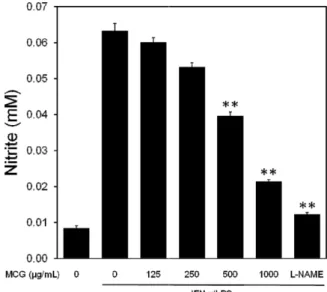
먼저 IFN-γ와 LPS로 자극한 대식세포에 대한 히어리의 NO 생성 억제 효능을 확인하였으며, 그 결과를 양성대조군으로 사용한 L-NAME과 비교분석하였다. L-NAME은 NOS의 기 질로 작용하는 L-arginine과 구조가 유사하기에 L-argnine의 세포내 유입을 경쟁적으로 저해하여 NO의 합성을 억제하 는 물질로 보고되어 있다.29) 본 실험의 결과, rIFN-γ 및 LPS 에 의해서 자극된 복막 대식세포는 음성대조군에 비해 약 8.9배의 NO를 생성하였으며, 이러한 NO 생성의 증가는 히 어리의 처리에 의해 농도의존적으로 억제되는 것을 관찰할 수 있었다. 특히, 고농도군(1000 μg/mL)에서는 비교대조군 으로 사용된 L-NAME의 효과에는 미치지 못하지만 뛰어난 효과를 관찰할 수 있었다(Fig. 2).
기존 연구 결과들에 따르면 NO의 생성은 iNOS enzyme 의 활성 및 발현량과 직접적으로 관련이 있다고 보고되어
있다.30,31) 이에 히어리의 NO 생성 억제 활성의 정확한 기
Fig. 1. Effects of MCG in the viability in rIFN-γ/LPS-treated peritoneal macrophages. MCG-treated peritoneal macrophages (3×10⁵ cells/well) were primed for 6hr with rIFN-γ (20 U/
mL). The peritoneal macrophages were then stimulated with LPS (10μg/mL) for 24 hr. Cell viability was evaluated by MTT colormetric assay as described in the method. The results are expressed as mean±S.D. of three independent experiments duplicate in each run.
Fig. 2. Effects of MCG on NO production in rIFN-γ/LPS- treated peritoneal macrophages. Peritoneal macrophages (3×10⁵ cells/well) were cultured with various concentration of MCG.
The peritoneal macrophages were then stimulated with rIFN-γ (20 U/mL) and LPS (10μg/mL). After 48 hr of culture, NO releas was measured by the Griess method. NO released into the medium is presented as the mean±S.D. of three indepen- dent experiments. Differences between groups were statisti- cally analysed by Student’s t-test (**p<0.001).
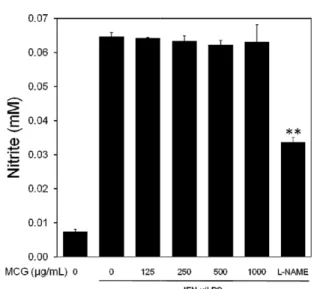
전을 알아보기 위하여 NO 생성에 있어서 결정적인 역할을 하는 iNOS enzyme의 활성을 조사하였으며, 먼저 시행한 NO assay와 마찬가지로 비교대조군으로 L-NAME을 사용 하였다. iNOS enzyme 활성 분석의 결과, 비교대조군으로 사용된 L-NAME은 iNOS enzyme의 활성을 절반 정도 억 제한 반면 히어리를 처리한 군에서는 농도유의적인 변화를 관찰할 수 없었다(Fig. 3).
한편 western blotting을 통해 iNOS의 발현량을 분석한 결 과 IFN-γ와 LPS 처리에 의해 현저하게 증가된 iNOS의 발 현이 히어리에 의해 현저히 감소한 것을 확인할 수 있었다.
특히, 히어리 500 μg/mL 이상의 농도에서는 iNOS의 발현 을 거의 관찰할 수 없었다(Fig. 4A). 이상의 결과를 통해 히 어리의 NO 생성 억제 효능은 iNOS enzyme의 활성 억제가 아닌 iNOS의 발현을 억제에 기인한 것으로 사료된다. 또한 히어리의 세포독성 실험의 결과를 미루어볼 때 히어리의 NO 억제 효능은 세포 독성과도 무관함을 알 수 있었다(Fig.
1).
NO와 더불어 염증 인자인 COX-2는 암 및 염증 등의 병 리적인 상황에서 분비되는 growth factors, pro-inflammatory molecules, cytokines 등의 자극에 의해 유도되며 통증 및 발 열에 관여하는 PGE2를 생성한다.32-34) 이에 본 연구에서는 Fig. 3. Effects of MCG on iNOS enzyme activity. iNOS
enzyme activity was measured by stimulating peritoneal mac- rophages (3×10⁵ cells/well) with rIFN-γ (20 U/mL) for 6 hr, then stimulates with LPS (10μg/mL). After 12 hr, various concentration of MCG were treated and incubated for another 12hr. The supernatant were obtained and measured by the Griess method as described previously. Differences between groups were statistically analysed by Student’s t-test (**p<0.001).
Fig. 4. Effects of MCG on iNOS and COX-2 expression. Peritoneal macrophages (5×10⁶ cells/well) were pre-treated with MCG and then stimulated for 6hr with rIFN-γ (20 U/mL). The peritoneal macrophages were then stimulated with LPS (10 μg/mL) for 24 hr. The protein extracts were prepared and sampled were analysed for iNOS and COX-2 expression by western blotting as described in the method. The expression of iNOS and COX-2 was quantified by densitometric analysis. The expression levels of the rIFN-γ/LPS treated control cells were considered to be 100% for the percentage calculations.
western blotting을 통해 히어리에 의한 COX-2의 발현량의 변화를 측정하였다. 실험 결과, IFN-γ와 LPS 처리는 복강 대식세포에서 발현되는 COX-2 단백질의 양을 크게 증가시 켰으며 히어리는 농도의존적으로 COX-2의 발현을 감소시 키는 것을 알 수 있었다(Fig. 4B). 이러한 결과를 바탕으로 COX-2가 생합성하는 PGE2의 생성이 히어리에 의해 감소 될 것으로 예상된다.
히어리 메탄올 추출물의 항염증 활성을 동물 모델에서 다 시 한 번 검정하기 위하여 ICR mouse를 이용하여 paw edema 실험을 수행하였다. 본 연구에서는 부종을 유발하기 위하여 trypsin과 carrageenan을 사용하였다. Trypsin은 PAR2 (protease activated receptor 2)를 선택적으로 활성화시켜 염 증반응을 유도하고 혈관투과성을 증가시켜 부종을 일으킨 다고 보고되어 있다.35-37) Trypsin으로 유도한 부종 실험에서 히어리 투여군은 대조군에 비하여 부종을 저농도군(250 mg/
kg)은 19.04%, 고농도군(500 mg/kg)은 37.21% 감소시킨 것 을 확인할 수 있었으며 비교대조군으로 사용된 NSAIDs인 indomethacin 역시 유의적으로 부종 억제 효능을 나타내었 다(Fig. 5A). Koetzner 등은 PAR2 활성에 의한 염증 및 부 종이 COX-2 및 PGs의 생성과도 깊은 관련이 있다고 보고 하고 있으며,37) 따라서 히어리의 부종 억제 활성에 COX-2 발현 억제가 관여되어 있는 것으로 추정된다.
한편, carrageenan은 체내 serotonin, histamine 및 bradykinin과 PGs 등의 염증매개 물질의 분비를 촉진시켜 염증과 부종을 발생시킨다고 알려져 있다.Carrageenan으로 유발된 부종 실험 결과, 히어리 투여군은 저농도군(250 mg/
kg)과 고농도군(500 mg/kg) 모두에서 유의적인 부종 억제
활성(각각 10.22%, 30.95%)이 있는 것을 관찰할 수 있었다 (Fig. 5B).
이상의 실험 결과로 히어리 가지 메탄올 추출물이 뛰어난 항염증 활성을 가지고 있는 것을 알 수 있었으며 이러한 결 과는 이전 연구들에서 밝혀진 히어리 가지에 포함된 bergenin, (−)-catechin, (−)-epicatechin, 4-methoxy-3,5-dihydroxybenzoic acid 및 gallic acid 등의 성분과 관련이 있는 것으로 추정된
다.19,38-42) 더불어 추가적인 연구를 통하여 히어리가 향후 새
로운 천연물 소염제 개발에 있어서 좋은 후보군이 될 수 있 을 것으로 사료된다.
결 론
히어리는 대식세포에서 IFN-γ/LPS에 의해서 생성된 NO 를 농도 의존적으로 감소시켰는데 이는 히어리의 세포 독 성과 iNOS enzyme의 활성 저해가 아닌 iNOS의 발현 억제 를 통해 나타난 결과이다. 또한 히어리는 염증성 매개 물질 인 COX-2의 발현을 농도의존적으로 저해하였다. 마우스를 이용한 부종실험에서 히어리는 trypsin과 carrageenan으로 유도된 부종을 모두 효과적으로 억제하였으며, 이상의 결과 를 통해 히어리가 뛰어난 항염증 활성이 있는 것을 알 수 있었다.
인용문헌
1. Lawrence, T., Willoughby, D. A. and Gilroy, D. W. (2002) Anti-inflammatory lipid mediators and insights into the res- Fig. 5. Effects of MCG on paw edema in mice. Mice were pre-treated distilled water, indomethacin and MCG before injected tryp- sin(A) or carrageenan(B) solution, After 1 hr, the trypsin or carrageenan solution was injected in a volume of 30μL subcutaneously.
Both of trypsin and carrageenan was dissolved in sterile 0.9% saline. The size of edema was assessed by measuring the volume of hind paw immediately before and 1 hr after the agonist injection. Data show the mean±S.E.M. (n=8-12). *p<0.01 and **p<0.001 compared to vehicle-treated group.
olution of inflammation. Nature Reviews Immunology 2: 787- 795.
2. Rakel, D. P. and Rindfleisch, A. (2005) Inflammation: nutri- tional, botanical, and mind-body influences. South. Med. J.
98: 303-311.
3. Fujiwara, N. and Kobayashi, K. (2005) Macrophages in inflammation. Current Drug Targets-Inflammation & Allergy 4: 281-286.
4. Ley, S., Weigert, A. and Brüne, B. (2010) Neuromediators in inflammation—a macrophage/nerve connection. Immunobi- ology 215: 674-684.
5. Saha, K., Lajis, N., Israf, D., Hamzah, A. S., Khozirah, S., Khamis, S. and Syahida, A. (2004) Evaluation of antioxidant and nitric oxide inhibitory activities of selected Malaysian medicinal plants. J. Ethnopharmacol. 92: 263-267.
6. Varin, A. and Gordon, S. (2009) Alternative activation of macrophages: immune function and cellular biology. Immu- nobiology 214: 630-641.
7. Brown, G. C. (1999) Nitric oxide and mitochondrial res- piration. Biochimica et Biophysica Acta (BBA)-Bioenergeics 1411: 351-369.
8. Nagy, G., Clark, J. M., Buzás, E. I., Gorman, C. L. and Cope, A. P. (2007) Nitric oxide, chronic inflammation and auto- immunity. Immunol. Lett. 111: 1-5.
9. Bredt, D. S. (1999) Endogenous nitric oxide synthesis: bio- logical functions and pathophysiology. Free Radic. Res. 31:
577-596.
10. Crofford, L. J. (1997) COX-1 and COX-2 tissue expression:
implications and predictions. J. Rheumatol. Suppl. 49: 15-19.
11. Jeong, J. B. and Jeong, H. J. (2010) Rheosmin, a naturally occurring phenolic compound inhibits LPS-induced iNOS and COX-2 expression in RAW264. 7 cells by blocking NF- κB activation pathway. Food and Chem. Toxicol. 48: 2148- 2153.
12. Chang, Y., Li, P., Chen, B., Chang, M., Wang, J., Chiu, W.
and Lin, C. (2006) Lipoteichoic acid-induced nitric oxide synthase expression in RAW 264.7 macrophages is mediated by cyclooxygenase-2, prostaglandin E 2, protein kinase A, p38 MAPK, and nuclear factor-κB pathways. Cell Signal 18:
1235-1243.
13. Park, E., Min, H., Ahn, Y., Bae, C., Pyee, J. and Lee, S. K.
(2004) Synthesis and inhibitory effects of pinosylvin deriv- atives on prostaglandin E 2 production in lipopolysaccharide- induced mouse macrophage cells. Bioorg. Med. Chem. Lett.
14: 5895-5898.
14. Lee, J. H., Kang, H. C., Ahn, H. C. and Cho, H. S. (1999) Vegetation structure and sprouting dynamics of Corylopsis coreana community belong to Korean endemic plants.
Korean J. Environ. Ecol. 13: 280-287.
15. Jang, H. T., Kim, N. C., Kim, M. Y., Kwon, H. J. and Song, H. K. (2008) Vegetation and soil properties of Corylopsis coreana population in Korea. Korean J. Environ. Ecol. 22:
609-615.
16. Boo, H., Shin, J., Shin, J., Choung, E., Bang, M., Choi, K.
and Song, W. (2012) Assessment on antioxidant potential and enzyme activity of some economic resource plants. Korean Journal of Plant Resources 25: 349-356.
17. Han, J. Y., Cho, S. S., Yang, J. H., Kim, K. M., Jang, C. H., Park, D. E., Bang, J. S., Jung, Y. S. and Ki, S. H. (2015) The chalcone compound isosalipurposide (ISPP) exerts a cyto- protective effect against oxidative injury via Nrf2 activation.
Toxicol. Appl. Pharmacol. 287: 77-85.
18. Kim, M. H., Ha, S. Y., Oh, M. H., Kim, H. H., Kim, S. R. and Lee, M. W. (2013) Anti-oxidative and anti-proliferative activ- ity on human prostate cancer cells lines of the phenolic com- pounds from Corylopsis coreana Uyeki. 18: 4876-4886.
19.박종희 (2004) 한국약초도감, 636. 신일상사, 서울.
20.김창민, 신민교, 안덕균, 이경순 (1997) 중약대사전, 699, 도서출판 정담, 서울.
21.중앙대학교 산학협력단 (2014) 히어리 잎 추출물 또는 이로부터 분리된 페놀성 화합물을 유요성분으로 포함하 는 항염증 또는 항산화 조성물. 대한민국 특허. 등록번 호 1014023710000
22. Kwon, O. K., Kim, C. S., Suh, W. S., Park, K. J., Cha, J. M., Choi, S. U., Kwon, H. C. and Lee, K. R. (2016) Phenolic compounds from the twigs of Corylopsis coreana Uyeki and their cytotoxic activity. Kor. J. Pharmacogn. 47: 1-6.
23. Mosmann, T. (1983) Rapid colorimetric assay for cellular growth and survival: application to proliferation and cyto- toxicity assays. . J. Immunol. Methods 65: 55-63.
24. Israf, D., Khaizurin, T., Syahida, A., Lajis, N. and Khozirah, S. (2007) Cardamonin inhibits COX and iNOS expression via inhibition of p65NF-κB nuclear translocation and Iκ-B phosphorylation in RAW 264.7 macrophage cells. Mol.
Immunol. 44: 673-679.
25. Bjarnason, I., Hayllar, J., MacPherson, A. J. and Russell, A.
S. (1993) Side effects of nonsteroidal anti-inflammatory drugs on the small and large intestine in humans. Gastro- enterology 104: 1832-1847.
26. Singh, G. and Triadafilopoulos, G. (1999) Epidemiology of NSAID induced gastrointestinal complications. J. Rheumatol.
Suppl. 56: 18-24.
27. Kim, H. P., Son, K. H., Chang, H. W. and Kang, S. S. (2004) Anti-inflammatory plant flavonoids and cellular action mech- anisms. J. Pharmacol. Sci. 96: 229-245.
28. Yuan, G., Wahlqvist, M. L., He, G., Yang, M. and Li, D.
(2006) Natural products and anti-inflammatory activity. Asia Asia Pac. J. Clin. Nutr. 15: 143.
29. Moore, P., Babbedge, R., Wallace, P., Gaffen, Z. and Hart, S.
(1993) 7-Nitro indazole, an inhibitor of nitric oxide synthase, exhibits anti-nociceptive activity in the mouse without increasing blood pressure. Br. J. Pharmacol. 108: 296-297.
30. Kimura, H., Hokari, R., Miura, S., Shigematsu, T., Hirokawa, M., Akiba, Y., Kurose, I., Higuchi, H., Fujimori, H., Tsuzuki,
Y., Serizawa, H. and Ishii, H. (1998) Increased expression of an inducible isoform of nitric oxide synthase and the for- mation of peroxynitrite in colonic mucosa of patients with active ulcerative colitis. Gut. 42: 180-187.
31. Sawa, T. and Ohshima, H. (2006) Nitrative DNA damage in inflammation and its possible role in carcinogenesis. Nitric Oxide 14: 91-100.
32. Koetzner, L., Gregory, J. A. and Yaksh, T. L. (2004) Intra- thecal protease-activated receptor stimulation produces ther- mal hyperalgesia through spinal cyclooxygenase activity. J.
Pharmacol. Exp. Ther. 311: 356-363.
33. Mantovani, A., Allavena, P., Sica, A. and Balkwill, F. (2008) Cancer-related inflammation. Nature 454: 436-444.
34. Masferrer, J. L., Zweifel, B. S., Manning, P. T., Hauser, S. D., Leahy, K. M., Smith, W. G., Isakson, P. C. and Seibert, K.
(1994) Selective inhibition of inducible cyclooxygenase 2 in vivo is antiinflammatory and nonulcerogenic. Proc. Natl.
Acad. Sci. 91: 3228-3232.
35. Kawabata, A., Kawao, N., Kuroda, R., Tanaka, A., Itoh, H.
and Nishikawa, H. (2001) Peripheral PAR-2 triggers thermal hyperalgesia and nociceptive responses in rats. Neuroreport 12: 715-719.
36. Kelso, E. B., Lockhart, J. C., Hembrough, T., Dunning, L., Plevin, R., Hollenberg, M. D., Sommerhoff, C. P., McLean, J.
S. and Ferrell, W. R. (2006) Therapeutic promise of pro- teinase-activated receptor-2 antagonism in joint inflamma- tion. J. Pharmacol. Exp. Ther. 316: 1017-1024.
37. Vergnolle, N., Hollenberg, M. D., Sharkey, K. A. and Wal- lace, J. L. (1999) Characterization of the inflammatory response to proteinase-activated receptor-2 (par2)-activating peptides in the rat paw. Br. J. Pharmacol. 127: 1083-1090.
38. Gao, X., Guo, M., Zhang, Z., Wang, T., Cao, Y. and Zhang, N. (2015) Bergenin plays an anti-inflammatory role via the modulation of MAPK and NF-κB signaling pathways in a mouse model of LPS-induced mastitis. Inflammation 38:
1142-1150.
39. Shahid, A., Ali, R., Ali, N., Hasan, S. K., Bernwal, P., Afzal, S. M., Vafa, A. and Sultana, S. (2016) Modulatory effects of catechin hydrate against genotoxicity, oxidative stress, inflammation and apoptosis induced by benzo (a) pyrene in mice. Food and Chem. Toxicol. 92: 64-74.
40. Cordero-Herrera, I., Chen, X., Ramos, S. and Devaraj, S.
(2015) (−)-Epicatechin attenuates high-glucose-induced inflammation by epigenetic modulation in human monocytes.
Eur. J. Nutr. : 1-5 (DOI: 10.1007/s00394-015-1136-2).
41. Hsu, C., Fang, S. and Yen, G. (2013) Anti-inflammatory effects of phenolic compounds isolated from the flowers of Nymphaea mexicana Zucc. Food & function 4: 1216-1222.
42. Tsang, M. S., Jiao, D., Chan, B. C., Hon, K., Leung, P. C., Lau, C., Wong, E. C., Cheng, L., Chan, C. K. and Lam, C. W.
(2016) Anti-inflammatory activities of pentaherbs formula, berberine, gallic acid and chlorogenic acid in atopic der- matitis-like skin inflammation. Molecules 21: 519.
(2016. 4. 25 접수; 2016. 5. 18 심사; 2016. 6. 23 게재확정)