Kor. J. Hort. Sci. Technol. 30(4):400-408, 2012 DOI http://dx.doi.org/10.7235/hort.2012.11111
Potential of Initial CA Condition on Quality Maintenance of ‘Fuji’
Apples during Export Simulation after Long-term Storage
Youn-Moon Park* and Hyo Geun Park
Department of Food Science and Biotechnology, Andong National University, Andong 760-749, Korea
Abstract. Effects of initial controlled atmosphere (CA) treatment on quality maintenance of ‘Fuji’ apples were assessed and compared with 1-methylcyclopropene (1-MCP) treatment and continuous CA storage. Apples were harvested twice at different maturity, treated with 1 μL・L-1 1-MCP and then stored for 8 months at 0°C under 3 conditions: air, CA for the first month followed by air (initial CA), and continuous CA (full CA). CA storage was performed with 1.5 kPa O2 and < 1.0 kPa (N2 balance). Following long-term storage, export simulation, refrigerated shipment and local distribution, were performed by holding apples at 0°C for 2 weeks and on the shelf at 20°C for 7 days. Both the application of 1-MCP and CA storage reduced ethylene production and respiration rates. Initial CA storage was also effective on reducing the metabolism although the effects were not as noticeable as full CA. Full CA storage with or without 1-MCP treatment maintained titratable acidity, flesh firmness, and sensory quality at the acceptable to excellent level even after the export simulation following 8-month storage regardless of harvest maturity. In contrast, effects of initial CA storage were limited to the maintenance of firmness and texture in early-harvested apples. Overall results indicated that harvest maturity is the critical factor for export fruit quality after long-term storage when separate treatment of initial CA storage or 1-MCP treatment is applied as a postharvest program.
Additional key words: ethylene evolution, internal browning, Malus domestica, respiration, texture
*Corresponding author: [email protected]
※ Received 9 September 2011; Revised 10 March 2012; Accepted 17 March 2012. This study was carried out with the support of “Cooperative Research Program for Agricultural Science and Technology Development(Project No. 200803A01081319)”, Rural Development Administration, Republic of Korea.
Introduction
Acceptable eating quality of ‘Fuji’ apples seems to be maintained for 5 to 6 months when stored under refrigerated air conditions (Park et al., 2006). Accordingly, export shipping to Asian countries has been restricted to relatively a shorter period considering the fruit quality deterioration during the local distribution in the importing countries (Song and Kim, 2004).
To increase storage potential and export period, 1-methyl- cyclopropene (1-MCP) treatment and controlled atmosphere (CA) storage have been applied. 1-MCP inhibits ethylene perception (Blankenship and Dole, 2003), thus reducing ethylene production, respiration, ethylene-induced quality changes in apples (Choi, 2005; Kweon et al., 2006; Lim et al., 2007; Mir et al., 2001; Park et al., 2009; Pre-Aymard et al., 2005) and also alleviate physiological disorders (Fan et al., 1999; Watkins et al., 2000).
CA storage strongly influences the quality changes during
storage period as well as market quality after a certain period of shelf life. Acidity and flesh firmness could be maintained longer in CA storage than in refrigerated air storage (Lau, 1998; Park and Yoon, 2005; Park et al., 2006;
Saftner et al., 2002). Continued suppression of physiological metabolism even after storage provides residual effects on quality maintenance on the shelf (Park and Youn, 1999b;
Park et al., 2006).
From industrial points of view, however, it is not always feasible to maintain continuous CA conditions from the time of harvest to the target period of shipment. Various CA storage procedures can be applied to meet the acceptable quality level according to the cultivar, harvest maturity, and shipment schedule. For example, delayed CA to avoid physiological disorders in ‘Fuji’ (Argenta et al., 2000; Park and Youn, 1999a), ‘Bramley’s Seedling’ (Colgan et al., 1999), ‘Braeburn’ (Elgar et al., 1998) apples still provided potential effects on quality maintenance. Vice versa, apples may be stored under CA conditions during the early period
only, i.e. CA storage for first one to four month-period and then under air storage condition for the remaining period.
The benefit from relatively short CA storage followed by successive air storage has not been clearly demonstrated.
Determination of storage potential under such circumstances is sometimes very useful when CA condition is inevitably destroyed after a certain period of storage by operational accidents or by prearranged stepwise shipping program.
Another postharvest approach for the extension of storage potential is the decision of optimum harvest window according to storage plan (Argenta et al., 2002; Hwang et al., 1998; Park et al., 1997). However, in ‘Fuji’ apples, harvest time tends to be delayed beyond the optimum maturity to enhance coloration and soluble solids content (SSC). Thus, effects of 1-MCP treatment and practical CA storage program should be evaluated as countermeasures against short storage potential in late-harvested ‘Fuji’ apples.
The present study was conducted to estimate the effects of initial CA environment on storage potential of ‘Fuji’
apples under export simulation. Effects of harvest maturity and 1-MCP treatment in combination with CA storage were carefully analyzed to provide practical guidelines for technical application. Long-term storage as long as 8 months and two-week shipment period plus 7-day shelf life was taken into account as an export simulation program.
Materials and Methods
Fruit Source
‘Fuji’ apples were harvested twice at 10-day intervals, Oct. 21 and 31, from the orchard located in Cheongwon area, central districts of South Korea. Empirically by the calendar date, fruit maturity at the first harvest (early harvest) was supposed to be the optimum stage for long- term storage, while the second harvest (late harvest) was supposed to be too late for the purpose of long-term storage.
After each harvest, fruit maturity was estimated experi- mentally by starch-iodine index method (Park et al., 2005) using a 6 point scale from score 5.0 (full starch stain indicating immature) to 0.0 (no starch stain indicating overmature).
Following 8-month storage under experimental conditions, fruits were removed from the store and put in the laboratory for 4-6 h before export simulation. Refrigerated shipment was simulated by holding apples at 0°C for 2 additional weeks, while local distribution was performed by putting fruits on the shelf at 20°C for 7 days.
Experimental Treatments
Immediately after harvest, apples were treated with 1.0
μL・L-1 1-MCP for 16 h at 20°C. Apples were placed in airtight 1 m3 rigid plastic tent with 70 mg commercial 1-MCP releasing agent (Smart FreshTM, 3.3% active ingredient, Rohm and Hass, Korea) for treatment or without 1-MCP releasing agent for control. A diaphragm air-circulation pump was operated for even distribution of 1-MCP inside the tent. Control and treated apples were then stored for 8 months under refrigerated air, initial CA, or continuous CA conditions. For initial CA, first month storage was performed under CA and the rest of the storage period was performed under air. To establish CA conditions of 1.4-1.6 kPa O2
(1.5 kPa in average throughout the storage period) with <
1.0 kPa CO2, compressed premixed gas (1.6% O2 + 0%
CO2 with N2 balance) was intermittently supplied 3-4 times a day through 1 m3 gas-tight tent structure in which fruit samples were placed. The number and the amount of gas flow were adjusted on three-day basis to ensure proper level of CA. Storage temperature was 0°C with 90-95%
RH.
Measurement of Respiration Rate and Ethylene Production Respiration rate and ethylene evolution rates were measured at harvest, after 8-month storage, and after 2-week shipment simulation. Fruit were transferred into the temperature equilibrium chamber and held more than 12 h until fruit temperature reached 20°C. Each fruit was put into a 2.5 L airtight respirometer and the increases in CO2 and C2H4
concentrations during 4-h incubation were measured. Headspace gas sample was taken using a 1 mL syringe and the concent- rations of the gases were analyzed by gas chromatography method (Park and Yoon, 2006). CO2 concentrations were analyzed using a gas chromatograph (model 600D, Young Lin Instrument Co., Ltd., Anyang, Korea) equipped with a thermal conductivity detector and a Porapak Q packed column. Ethylene concentrations were measured using a gas chromatograph (model GC-17A Shimadzu Corp., Tokyo, Japan) equipped with a flame ionized detector and a Porapak Q packed column.
Assessment of Fruit Quality
After 8-month storage and export simulation period (2-week shipment plus 7-day shelf life), SSC, titratable acidity (TA), flesh firmness, and sensory texture were evaluated. To measure SSC and TA, fruit juice was extracted from the whole fruit using a kitchen juicer. SSC of the juice was measured using a digital reading refractometer (model PAL-1, Atago Co., Ltd., Tokyo, Japan) and TA was calculated from the titration of the juice with 0.1 N NaOH until pH 8.1. Flesh firmness was measured by using a texture analyzer (model EZ-Test/CE, Shimadzu Corp., Kyoto, Japan) equipped
Table 1. Quality and metabolic characteristics of ‘Fuji’ apples at harvest in 2009.
Harvest date
Physiological characteristics Quality attribute
Respiration rate (CO2 mL·kg-1·h-1)
Ethylene evolution
(C2H4 μL·kg-1·h-1) Starch index SSC (°Bx)
Acidity (%)
Firmness (N/5 mm Φ)
Oct. 21 10.8 ± 0.2z 0.8 ± 0.0 2.2 ± 0.1 14.2 ± 0.2 0.33 ± 0.03 14.8 ± 0.2
Oct. 31 10.0 ± 0.4 0.8 ± 0.1 1.3 ± 0.2 13.4 ± 0.3 0.34 ± 0.03 14.7 ± 0.2
zMean ± standard error (n = 6).
Table 2. Ethylene evolution rate of ‘Fuji’ apples after 8-month cold storage and additional 2-week storage simulating shipping condition as influenced by harvest date, postharvest 1-MCP treatment, and storage method.
1-MCP
(μL·L-1) Storage
methodz
Ethylene evolution, 20℃ (C2H4 μL·kg-1·h-1)
Early harvest Late harvest
After 8-month
storage After 2-week
shipment After 8-month
storage After 2-week
shipment
0 Air 38.3 ay 35.2 a 50.3 a 60.1 a
Initial CA 4.5 b 11.3 b 6.4 b 17.0 b
Full CA 0.6 c 0.2 c 0.4 b 2.5 c
1 Air 0.6 c 0.2 c 0.5 b 1.8 c
Initial CA 0.5 c 0.2 c 0.7 b 1.9 c
Full CA 0.5 c 0.3 c 0.7 b 1.5 c
Significance
1-MCP(M) ** ** ** **
Storage (S) ** ** ** **
M × S ** ** ** **
zAir, refrigerated storage; initial CA, 1-month CA + 7-month air storage; full CA, 8-month CA storage at 1.5 kPa O2 + < 1.0 kPa CO2 at 0°C.
yMean separation within columns by Duncan's multiple range test at P = 0.05.
**Significant at P ≤ 0.01.
with a 5 mm diameter probe. Penetration force at 1 cm depth into the flesh was converted into Newton (N).
Texture was evaluated by sensory ratings using a 5 point scale, where 5 = excellent, 3 = fair and acceptable, and 1
= poor. Six trained panels estimated fruit texture and the scores were averaged for each treatment. Texture rating score 3 was the least requirement for consumers’ acceptance.
Incidence of internal browning was investigated by counting the number of suffered fruit over the total fruit and by the severity of the disorder. Visual investigation was performed after cutting fruits horizontally along the equator of fruits. The severity was estimated as the percentage of suffered area over the cut surface.
Statistical Analysis
Experiments were carried out in a completely randomized design with 3 treatment factors and 6 replicates. For data to be arranged in a simple manner, however, effects of 1-MCP and storage procedure were analyzed in 2-way analysis of variance (ANOVA) (SAS, 1990) on each harvest date. Effects of harvest date were further analyzed with the
other 2 factors through 3-way ANOVA, and treatment effects were summarized. Mean separation was obtained by Duncan’s multiple range test at the 5% level.
Results and Discussion
Quality and Physiological Characteristics at Harvest As judged by starch-iodine indices (Park et al., 2005), early-harvested ‘Fuji’ apples were at the optimum maturity, while late-harvested apples were overmature for long-term storage although ethylene production rate was lower than 1.0 μL・kg-1・h-1 in the both apples (Table 1). Lower respi- ration rate in the late-harvested apples than that in the early-harvested apples suggested that the late-harvested apples might have been already at the post-climacteric stage.
Extremely low starch index in the late-harvested apples also supported the idea. In late-harvested apples, SSC was rather lower and TA was slightly higher as opposed to expected benefits from late harvest. Flesh firmness was almost same.
Table 3. Respiration rate of ‘Fuji’ apples after 8-month cold storage and additional 2-week storage simulating shipping condition as influenced by harvest date, postharvest 1-MCP treatment, and storage method.
1-MCP (μL·L-1)
Storage methodz
Respiration rate at 20℃
(CO2 mL·kg-1·h-1)
Early harvest Late harvest
After 8-month storage
After 2-week shipment
After 8-month storage
After 2-week shipment
0 Air 10.3 ay 9.8 a 9.9 ay 10.1 a
Initial CA 6.3 b 6.9 b 6.2 b 6.6 b
Full CA 3.3 c 2.4 c 2.7 c 3.4 c
1 Air 3.6 c 2.7 c 5.6 b 3.5 c
Initial CA 3.5 c 2.6 c 3.2 c 2.9 c
Full CA 2.2 d 2.9 c 2.9 c 2.7 c
Significance
1-MCP (M) ** ** ** **
Storage (S) ** ** ** **
M × S ** ** ** **
zAir, refrigerated storage; initial CA, 1-month CA + 7-month air storage; full CA, 8-month CA storage with 1.5 kPa O2 + <1.0 kPa CO2 at 0°C.
yMean separation within columns by Duncan's multiple range test at P = 0.05.
**Significant at P ≤ 0.01.
Metabolic Changes by 1-MCP Treatment and Storage Methods
Ethylene evolution was significantly reduced by 1-MCP treatment and CA storage (Table 2). In control apples without 1-MCP treatment, both initial and continuous CA effectively reduced the ethylene production after 8-month storage and following 2-week shipping simulation. Especially in continuous CA-stored apples, ethylene evolution reduced even below that at harvest except that the rate increased a little after 2-week shipping simulation in late-harvested apples. Compared to continuous CA, initial CA storage seemed not to completely inhibit ethylene production showing relatively higher ethylene evolution after storage and shipping simulation. In 1-MCP treated fruits, in contrast, effects of initial and continuous CA was not noticeable because of predominant effects from 1-MCP treatment. In early-harvested apples, ethylene evolution rates were main- tained at lower levels during storage and following shipping period, whereas, in late-harvested apples, the rates slightly increased during shipping period.
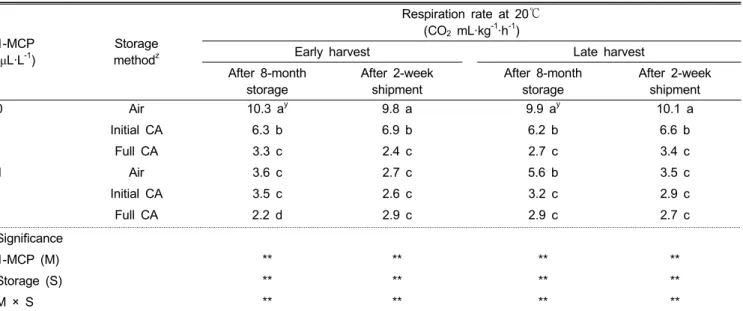
Changing pattern of respiration was similar to that of ethylene evolution. In control fruits without 1-MCP treatment, CA significantly suppressed respiration (Table 3), although the reduction effect of initial CA was not so remarkable as observed in ethylene evolution.
Effects of 1-MCP on ethylene production and respiration observed in the present study are well in accordance with previous researches (Blankenship and Dole, 2003; Lim et
al., 2007; Park et al., 2009). CA storage effects on the metabolism are also similar to the previous observations in apples (Park and Yoon, 2006; Park and Youn, 1999a, 1999b). Significant effects even from 1-month initial CA storage observed in the present study were interesting results and seemed to be used as a very practical application to determine storage methods according to exporting program.
Application of initial CA storage seemed to be a better approach than the application during shipping period after air storage since no significant effects were obtained from the CA container shipping simulation (Park et al., 2010).
Quality Changes by 1-MCP Treatment and Storage Methods
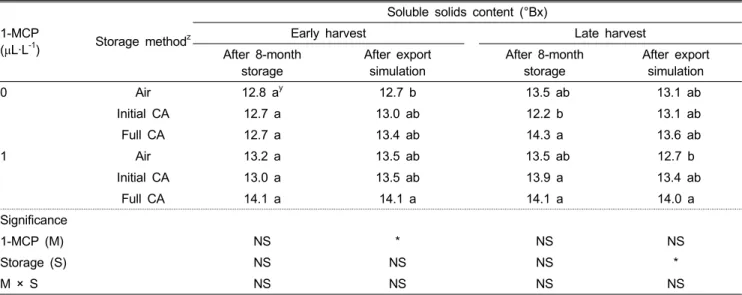
After export simulation, SSC were maintained higher in 1-MCP-treated and CA-stored apples (Table 4). In early- harvested apples, 1-MCP treatment significantly effective on maintaining higher SSC, while, in late-harvested apples, CA storage seemed to be more beneficial. In late-harvested and CA-stored (full) apples, SSC rather increased after storage and export simulation compared to that at harvest.
In contrast, 1-MCP treatment alone seemed not to be enough in maintaining SSC. Although SSC after 8-month storage tended to be higher in late-harvested apples, the trend was not consistent by treatments. Thus, the maturity effects were insignificant (Table 5).
Changes in SSC during storage and shelf life seemed to be very complicated as influenced by harvest maturity,
Table 4. Soluble solids content of ‘Fuji’ apples after 8-month cold storage and export simulation, additional 2-week shipment + 7-day shelf life, as influenced by harvest date, postharvest 1-MCP treatment, and storage method.
1-MCP
(μL·L-1) Storage methodz
Soluble solids content (°Bx)
Early harvest Late harvest
After 8-month storage
After export simulation
After 8-month storage
After export simulation
0 Air 12.8 ay 12.7 b 13.5 ab 13.1 ab
Initial CA 12.7 a 13.0 ab 12.2 b 13.1 ab
Full CA 12.7 a 13.4 ab 14.3 a 13.6 ab
1 Air 13.2 a 13.5 ab 13.5 ab 12.7 b
Initial CA 13.0 a 13.5 ab 13.9 a 13.4 ab
Full CA 14.1 a 14.1 a 14.1 a 14.0 a
Significance
1-MCP (M) NS * NS NS
Storage (S) NS NS NS *
M × S NS NS NS NS
zAir, refrigerated storage; initial CA, 1-month CA + 7-month air storage; full CA, 8-month CA storage at 1.5 kPa O2 + < 1.0 kPa CO2 at 0°C.
yMean separation within columns by Duncan's multiple range test at P = 0.05.
NS,*Nonsignificant or significant at P ≤ 0.05, respectively.
Table 5. Three-way analysis of variance on the effects of harvest date, 1-MCP treatment, and storage procedure on fruit quality of ‘Fuji’ apples after export simulation.
Factor
Treatment significance on quality attributes (after 8-month storage + export simulation) SSC
(°Bx)
Titratable acidity (%)
Firmness
(N/5 mm φ) Texture rating
Harvest maturity NS NS ** **
1-MCP * ** ** **
Storage methodz * ** ** **
zAir, refrigerated storage; initial CA, 1-month CA + 7-month air storage; full CA, 8-month CA storage at 1.5 kPa O2 + < 1.0 kPa CO2 at 0°C.
NS,*,**
Nonsignificant or significant at P ≤ 0.05 or 0.01, respectively.
postharvest 1-MCP treatment, storage method, and shelf environment (Park and Yoon, 2006; Park et al., 2009). SSC measured by refractometer could be increased by conversion of starch into sugars, especially during the early storage period. SSC could be increased even after long-term storage by neutral sugars from the cell wall component degradation regardless of sensorial sweetness (Park and Yoon, 2006) or by dehydration during the storage (Hwang et al., 1998).
Significant effects of 1-MCP and CA storage observed in the present study are contradictory to insignificant effects of 1-MCP (Lim et al., 2007) and CA storage (Park and Yoon, 2006) on SSC changes in apples.
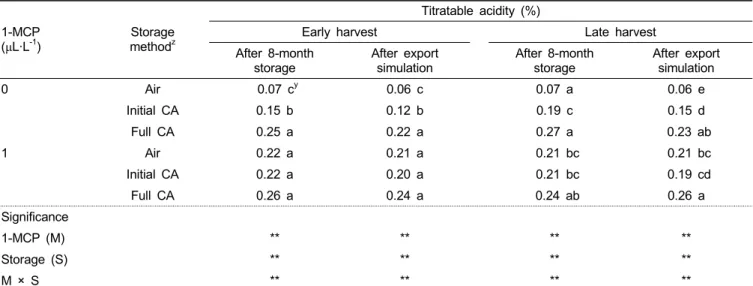
TA and flesh firmness were also maintained better by 1-MCP treatment and CA storage (Tables 6 and 7). In control fruit without 1-MCP treatment, even initial CA
effectively maintained higher TA and firmness. Between harvest dates, differences in TA after storage plus export simulation were not significant, while those in firmness were highly significant (Table 5).
Acceptable TA in ‘Fuji’ apples was proposed as 0.2%
(NFRI, 1985) or 0.24% (Park et al., 2006). When 0.2% TA was used as a criterion, full CA storage without 1-MCP treatment or 1-MCP treatment regardless of storage method can suffice quality requirement after 8-month storage plus export simulation. When 0.24% TA was considered, in contrast, only 1-MCP + full CA may provide qualified fruit.
The criteria of TA for export apples should be decided according to consumers’ preference in importing countries.
Texture rating was also affected significantly by harvest maturity (Table 5), 1-MCP treatment, and CA storage pro-
Table 6. Titratable acidity of ‘Fuji’ apples after 8-month cold storage and export simulation, additional 2-week shipment + 7-day shelf life, as influenced by harvest date, postharvest 1-MCP treatment, and storage method.
1-MCP
(μL·L-1) Storage
methodz
Titratable acidity (%)
Early harvest Late harvest
After 8-month storage
After export simulation
After 8-month storage
After export simulation
0 Air 0.07 cy 0.06 c 0.07 a 0.06 e
Initial CA 0.15 b 0.12 b 0.19 c 0.15 d
Full CA 0.25 a 0.22 a 0.27 a 0.23 ab
1 Air 0.22 a 0.21 a 0.21 bc 0.21 bc
Initial CA 0.22 a 0.20 a 0.21 bc 0.19 cd
Full CA 0.26 a 0.24 a 0.24 ab 0.26 a
Significance
1-MCP (M) ** ** ** **
Storage (S) ** ** ** **
M × S ** ** ** **
zAir, refrigerated storage; initial CA, 1-month CA + 7-month air storage; full CA, 8-month CA storage at 1.5 kPa O2 + < 1.0 kPa CO2 at 0°C.
yMean separation within columns by Duncan's multiple range test at P = 0.05.
**Significant at P ≤ 0.01.
Table 7. Flesh firmness of ‘Fuji’ apples after 8-month cold storage and export simulation, additional 2-week shipment + 7-day shelf life, as influenced by harvest date, postharvest 1-MCP treatment, and storage method.
1-MCP (μL·L-1)
Storage methodz
Firmness (N/5 mm Φ)
Early harvest Late harvest
After 8-month storage
After export simulation
After 8-month storage
After export simulation
0 Air 11.6 by 10.8 c 10.3 b 9.9 c
Initial CA 12.7 ab 11.6 bc 12.1 a 11.1 b
Full CA 13.7 a 12.9 a 12.0 a 12.0 ab
1 Air 13.4 a 12.7 ab 12.0 a 11.3 b
Initial CA 13.6 a 12.9 a 12.6 a 11.6 ab
Full CA 13.6 a 13.0 a 12.6 a 12.5 a
Significance
1-MCP (M) * ** ** **
Storage (S) * * * **
M × S NS NS NS NS
zAir, refrigerated storage; initial CA, 1-month CA + 7-month air storage; full CA, 8-month CA storage at 1.5 kPa O2 + < 1.0 kPa CO2 at 0°C.
yMean separation within columns by Duncan's multiple range test at P = 0.05.
NS,*,**Nonsignificant or significant at P ≤ 0.05 or 0.01, respectively.
cedures (Table 8). Initial CA was also effective on main- taining texture when fruit were stored without 1-MCP treatment. By initial CA storage, the rating was maintained at the critical level (score 3.0) in early-harvested apples. In late-harvested apples, in contrast, the rating was lowered below acceptable level even in 1-MCP-treated and initial CA-stored apples indicating that harvest maturity strongly influenced textural changes during storage and export simulation. The data suggested that full CA storage retarded
firmness loss and texture deterioration on the shelf as well as the changes during storage, which were previously explained by residual effects of CA (Park and Youn, 1999b).
In apples, distinguished effects of 1-MCP treatment on maintaining flesh firmness and texture were reported (Mir et al., 2001; Pre-Aymard et al., 2005; Watkins, 2008). By cultivars, however, CA storage effects seemed to be greater for long-term storage (Park et al., 2009). In the present study, effects of CA storage tended to be more distinguished
Table 8. Texture rating of ‘Fuji’ apples after 8-month cold storage and export simulation, additional 2-week shipment + 7-day shelf life, as influenced by harvest date, postharvest 1-MCP treatment, and storage method.
1-MCP
(μL·L-1) Storage
methodz
Texture rating
Early harvest Late harvest
After 8-month storage
After export simulation
After 8-month storage
After export simulation
0 Air 2.4 by 2.1 c 2.2 c 1.8 c
Initial CA 3.8 a 3.0 b 3.3 ab 2.7 b
Full CA 4.0 a 3.6 a 3.6 a 3.3 a
1 Air 4.0 a 3.5 a 3.2 b 2.6 b
Initial CA 4.0 a 3.5 a 3.3 ab 2.7 b
Full CA 4.1 a 3.8 a 3.6 a 3.5 a
Significance
1-MCP(M) ** ** ** **
Storage(S) ** ** ** **
M × S ** ** ** **
zAir, refrigerated storage; initial CA, 1-month CA + 7-month air storage; full CA, 8-month CA storage at 1.5 kPa O2 + < 1.0 kPa CO2 at 0°C.
yMean separation within columns by Duncan's multiple range test at P = 0.05.
**Significant at P ≤ 0.01.
Table 9. Incidence of internal browning in ‘Fuji’ apples after 8-month storage and export simulation, additional 2-week shipment + 7-day shelf life, as influenced by harvest date, postharvest 1-MCP treatment, and CA storage.
Harvest 1-MCP
treatment
Storage methodz
Incidence of internal browning Fruit basisy
(Suffered/investigated) Area basisx (%)
Oct. 21 No Air 8/16 8.5
Initial CA 7/16 7.3
Full CA 0/16 0.0
1 μL·L-1 Air 0/16 0.0
Initial CA 0/16 0.0
Full CA 0/16 0.0
Oct. 31 No Air 0/16 0.0
Initial CA 0/16 0.0
Full CA 0/16 0.0
1 μL·L-1 Air 0/16 0.0
Initial CA 0/16 0.0
Full CA 0/16 0.0
zAir, refrigerated storage; initial CA, 1-month CA + 7-month air storage; full CA, 8-month CA storage at 1.5 kPa O2 + < 1.0 kPa CO2 at 0°C.
yNumber suffered fruit/number of fruit investigated.
x% injured area over total cut surface in suffered fruit.
than that of 1-MCP treatment although the difference was statistically insignificant (comparison between 1-MCP untreated + full CA vs. 1-MCP treated + air). At the same time, additive effects on quality maintenance were also observed from postharvest 1-MCP treatment and CA storage com- bination as suggested in the previous studies (Bai et al., 2005; Park et al., 2009; Rupasinghe et al., 2000; Watkins et al., 2000).
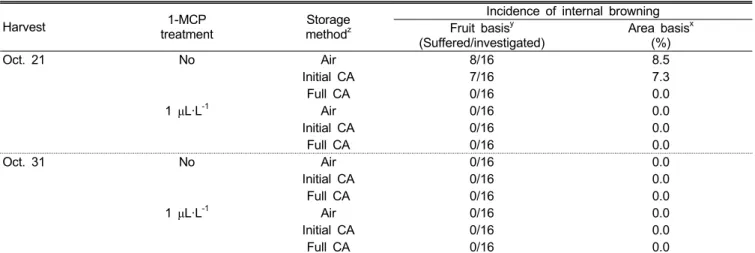
Internal browning disorder occurred only in early-harvested control fruit stored in air or initial CA (Table 9). The incidence based on the number of fruit was 50 and 44%
in air and initial CA, respectively. The symptom based on the suffered area, however, was not so severe as to influence marketability. Internal browning in ‘Fuji’ cultivar has been a potential hazard during CA storage since ‘Fuji’ apples are susceptible to high CO2 injury, especially when harvest is delayed (Argenta et al., 2002; Hwang et al., 1998). The occurrence pattern in the present study, on the contrary, was limited to early-harvested, control without 1-MCP treatment, and air or initial CA-stored apples. No incidence of the disorder in full CA-stored apples suggested that the symptom might have not been due to CA conditions. Visual
assessment of the symptom (picture not presented) suggested that the disorder resembled watercore-related internal breakdown (Pierson et al., 1971). High incidence of the disorder only in early-harvested apples still leaves a contro- versy since watercore tends to develop more as harvest is delayed. Watercore may not be always related to harvest dates since farmers usually pick more colored and mature fruit first and leave relatively immature fruit for the second harvest.
In conclusion, initial CA exerted critical effects on extending storage potential to 8 months for export quality based on texture, especially when apples were harvested early and stored without 1-MCP treatment (Table 8). The storage potential of ‘Fuji’ apples for export consisting of 2-week shipment plus 7-day shelf life appeared to be less than 8 months when fruit were harvested late and stored under initial CA conditions even with postharvest 1-MCP treatment. Only full CA storage could ensure 8-month storage potential when export program is to be followed.
In order to extend storage potential longer than 8 months, apples should be harvested early and 1-MCP-treated, or, without 1-MCP treatment, stored at least under initial CA conditions. More benefits are expected by extended period of initial CA application to 4 months until the period of first shipping of CA-stored apples, thus maintaining quality throughout the remaining period of storage for export under air conditions.
Literature Cited
Argenta, L., X. Fan, and J. Mattheis. 2000. Delaying establishment of controlled atmosphere or CO2 exposure reduces ‘Fuji’ apple CO2 injury without excessive fruit quality loss. Postharvest Biol. Technol. 20:221-229.
Argenta, L.C., X. Fan, and J.P. Mattheis. 2002. Response of ‘Fuji’
apples to short and long duration exposure to elevated CO2
concentration. Postharvest Biol. Technol. 24:13-24.
Bai, J., E.A. Baldwin, K.L. Goodner, J.P. Mattheis, and J.K. Brecht.
2005. Response of four apple cultivars to 1-methylcyclopropene treatment and controlled atmosphere storage. HortScience 40:1534-1538.
Blankenship, S.M. and J.M. Dole. 2003. 1-Methylcyclopropene:
A review. Postharvest Biol. Technol. 28:1-25.
Choi, S.J. 2005. Comparison of the change in quality and ethylene production between apple and peach fruits treated with 1-methylcyclopropene (1-MCP). Kor. J. Food Preserv.
12:511-515.
Colgan, R.J., C.J. Dover, D.S. Johnson, and K. Person. 1999.
Delayed CA and oxygen at 1 kPa or less control superficial scald without CO2 injury on Bramley’s Seedling apples.
Postharvest Biol. Technol. 16:223-231.
Elgar, H.J., D.M. Burmeister, and C.B. Watkins. 1998. Storage and handling effects on a CO2-related internal browning
disorder of ‘Braeburn’ apples. HortScience 33:719-722.
Fan, X., J.P. Mattheis, and S.M. Blankenship. 1999. Development of apple superficial scald, soft scald, core flush, and greasiness is reduced by MCP. J. Agric. Food Chem. 47:3063-3068.
Hwang, Y.S., I. Kim, and J.C. Lee. 1998. Effects of harvest maturity and storage environment on the incidence of watercore, flesh browning, and quality in ‘Fuji’ apples. J. Kor.
Soc. Hort. Sci. 39:569-573.
Kweon, H.J., Y.M. Park, I.K. Kang, S.J. Yang, M.Y. Park, G.S.
Choi, Y.Y. Song, and J.K. Cheong. 2006. Response of early- season apple cultivars, ‘Seokwang’ and ‘Sunhong’ cultivars to 1-MCP treatment and storage temperature. Proc. 27th Intl.
Hort. Congr., Seoul, Korea. p. 271. (Abstr.).
Lau, O.L. 1988. Harvest indices, dessert quality, and storability of ‘Jonagold’ apples in air and controlled atmosphere storage.
J. Amer. Soc. Hort. Sci. 113:564-569.
Lim, B.S., S.Y. Oh, J.W. Lee, and Y.S. Hwang. 2007. Influence of 1-methylcyclopropene treatment time on the fruit quality in the ‘Fuji’ apple (Malus domestica). Kor. J. Hort. Sci.
Technol. 25:191-195.
National Food Research Institute (NFRI). 1985. Quality evaluation of fruits. NFRI, Japan.
Mir, N.A., E. Curell, N. Khan, M. Whitaker, and R.M. Beaudry.
2001. Harvest maturity, storage temperature, and 1-MCP application frequency alter firmness retention and chlorophyll fluorescence of ‘Redchief Delicious’ apples. J. Amer. Soc.
Hort. Sci. 126:618-624.
Park, H.G., B.S. Lim, and Y.M. Park. 2009. Effects of 1-methylcyclopropene treatment and controlled atmosphere storage on poststorage metabolism and quality of ‘Hongro’
apples. Hort. Environ. Biotechnol. 50:313-318.
Park, Y.M., Y.P. Hong, and H.J. Kweon. 2005. Postharvest technology manual. MFAFF, NACF, Korea.
Park, Y.M., H.J. Kweon, H.Y. Kim, and O.H. Ryu. 1997.
Preharvest factors affecting the incidence of physiological disorders during CA storage of ‘Fuji’ apples. J. Kor. Soc. Hort.
Sci. 38:725-729.
Park, Y.M., H.G. Park, and B.S. Lim. 2010. Effects of poststorage short-term controlled atmosphere treatment and shelf temperature on physiology and quality of cold-stored ‘Fuji’
apples. Hort. Environ. Biotechnol. 51:269-274.
Park, Y.M. and T.M. Yoon. 2006. Impact of storage method and shelf temperature on quality attributes and physiological metabolism of ‘Fuji’ apples. Hort. Environ. Biotechnol.
47:148-143.
Park, Y.M., T.M. Yoon, and M.G. Hwang. 2006. Analysis of storage method and shelf temperature effects in determining storage potential of ‘Fuji’ apples based on sensory evaluation.
Kor. J. Hort. Sci. Technol. 24:56-63.
Park, Y.M. and S.W. Youn. 1999a. Changes in postharvest physiology in relation to the incidence of CA disorders during CA storage of ‘Fuji’ apples as influenced by harvest maturity and storage procedures. J. Kor. Soc. Hort. Sci. 40:56-60.
Park, Y.M. and S.W. Youn. 1999b. Poststorage physiology and quality changes of ‘Fuji’ apples as influenced by harvest maturity and storage procedures. Food Sci. Biotechnol. 8:30-33.
Pre-Aymard, C., E. Fallik, A. Weksler, and S. Lurie. 2005. Sensory
analysis and instrumental measurements of ‘Anna’ apples treated with 1-methylcyclopropene. Postharvest Biol. Technol.
36:135-142.
Pierson, C.F., M.J. Ceponis, and L.P. McColloch. 1971. Market diseases of apples, pears, and quinces. Agricultural handbook No. 376. ARS, USDA.
Rupasinghe, H.P.V., D.P. Murr, G. Paliyath, and L. Skog. 2000.
Inhibitory effect of 1-MCP on ripening and superficial scald development in ‘McIntosh’ and ‘Delicious’ apples. J. Hort.
Sci. Biotechnol. 75:271-276.
Saftner, R.A., J.A. Abbott, W.S. Conway, C.L. Barden, and B.T.
Vinyard. 2002. Instrumental and sensory quality characteristics of ‘Gala’ apples in response to prestorage heat, controlled atmosphere, and air storage. J. Amer. Soc. Hort. Sci. 127:1006- 1012.
SAS Institute, Inc. 1990. SAS user’s guide. Statistical Analysis Systems Institute Inc., Cary, NC, USA.
Song, K.H. and B.M. Kim. 2004. A study on the plan for the development of export competitive power of domestic apple to Taiwan. Korean J. Intl. Agr. 16:310-318.
Watkins, C.B. 2008. Overview of 1-MCP trials and uses for edible horticultural crops. HortScience 43:86-94.
Watkins, C.B., J.F. Nock, and B.D. Whitaker. 2000. Response of early, mid and late season apple cultivars to postharvest application of 1-methylcyclopropene (1-MCP) under air and controlled atmosphere storage conditions. Postharvest Biol.
Technol. 19:17-32.