Changes in Physicochemical Properties of Ground Pork Meat Containing Grape Peel during Refrigerated Storage
Gang-Won Choi1,2 and Jong-Wook Lee1*
1Department of Life Sciences, Yeungnam University, Gyeongsan 38541, Korea
2Department of Optometry, Daegu Technical University, Daegu 42734, Korea Received April 15, 2016 /Revised July 18, 2016 /Accepted July 27 2016
This study was carried out to investigate the effect of grape peel on the physicochemical properties of ground pork stored at 4°C for 10 d. Four types of ground pork were evaluated: T0 without grape peel, T1 with 0.3% grape peel, T2 with 0.7% grape peel, and T3 with 1.0% grape peel. The pH in- creased during storage, with that of T3 the lowest (p<0.05). The L-value and a-value decreased during storage, and the a-values of T2 and T3 were significantly higher than those of T0 and T1 (p<0.05). The b-values of T0 and T1 increased with a longer storage period (p<0.05), but those of T2 and T3 were not significantly changed. The TBARS (2-thiobarbituric acid reactive substances) content increased with a longer storage period, and the TBARS content of both T2 and T3 was significantly lower than that of T0 and T1 (p<0.05). DPPH (1,1-diphenyl-2-picrylhydrazyl) free radical scavenging activity de- clined with a longer storage period, and the activity of T2 and T3 was significantly higher than that of T0 and T1 (p<0.05). The VBN content of T0 and T1 also increased with a longer storage period (p<0.05), but the VBN content of T2 and T3 was not significantly changed. After storage for 4 d, the water-holding capacity declined and cooking loss and hardness increased (p<0.05), and these parame- ters were not significantly different among any samples. Chewiness increased with a longer storage period (p<0.05). The results suggest that the addition of grape peel to ground pork can enhance its functionality.
Key words : Functionality, grape peel, ground pork, physicochemical properties
*Corresponding author
*Tel : +82-53-810-2376, Fax : +82-53-811-2376 E-mail : [email protected]
This is an Open-Access article distributed under the terms of the Creative Commons Attribution Non-Commercial License (http://creativecommons.org/licenses/by-nc/3.0) which permits unrestricted non-commercial use, distribution, and reproduction in any medium, provided the original work is properly cited.
Journal of Life Science 2016 Vol. 26. No. 9. 1041~1048 DOI : http://dx.doi.org/10.5352/JLS.2016.26.9.1041
서 론
포도는 갈매나무목(Rhamnales) 포도과(Vitaceae)의 낙엽성 덩굴식물로 열대 및 아열대 지역에서 자생하며, 일부는 온대 지역에도 분포한다[15]. 현재 우리나라에서 재배되고 있는 포 도는 미국종(Vitis labrusca L.), 유럽종(Vitis vinifera L.) 그리고 교잡종(Vitis labruscana L.) 등이 있으며, 1909년에 도입된 캠벨 얼리 품종이 우리나라 환경에 잘 적응하여 지금까지 주 재배 품종으로 재배되고 있다[14]. 포도는 세계적으로 가장 많이 소 비되고 있는 과일 중 하나로 폴리페놀 성분을 함유하고 있어 서[38] 항산화, 항암, 항궤양, 항독성, free radical 소거작용, 동맥경화와 당뇨예방 등의 생리활성 효과를 가지고 있다[2, 6]. 포도에 함유된 폴리페놀 성분은 procyanidin, anthocyanin, viniferine, gallic acid, catechin 등 인 것으로 알려져 있다[25, 28]. 포도는 대부분 생과로 이용하고 있으며, 나머지는 포도주,
포도주스, 포도잼 등으로 가공하고 있다. 포도 가공 중 포도종 자는 생과일 중량의 약 3%, 포도과피는 약 15% 정도가 폐기물 로 처리되고 있다[36]. 포도의 폴리페놀 성분은 과육에는 10%
미만 함유되어 있지만 종자에는 60~70%, 과피에는 28~35%가 함유되어 있어서[31] 이를 자원화하려는 연구도 시도되고 있 다. 그러나 포도과피의 다양한 생리활성에 대한 연구에도 불 구하고, 포도과피를 이용한 육제품에 관한 연구는 아주 미비 한 실정이다.
육제품 중에서 햄버거 패티, 너겟, 소시지, 미트볼, 떡갈비, 프레스햄 등의 분쇄육제품은 식육가공 후 남은 잔육, 저급육, 기호도가 떨어지는 지방이 적은 등심이나 뒷다리살을 이용하 여 품질이나 관능특성을 향상시키기 위하여 20~30%의 동물성 지방을 첨가하여 부가가치를 높인 대표적인 육제품이다[8]. 따 라서 분쇄육제품은 가공이나 저장 중 지방산화의 발생 가능성 이 높다. 지방산화는 영양성분 감소, 색깔변화, 이취발생, 조직 특성 저하 등을 유발하는 주된 원인으로 작용하며[21], 육제품 의 지방산화를 방지하고 저장수명을 연장하기 위하여 buty- lated hydroxy anisole (BHA), butylated hydroxy toluene (BHT), propyl gallate (PG), tertiary butylhydroquinone (TBHQ) 등의 합성항산화제를 사용해 왔다[4]. 그러나 이러한 합성항산화제를 장기간 또는 과량 섭취하게 되면 간, 위, 신장, 순환계 등에 독성을 나타내고, 암을 유발하는 등 안전성 문제
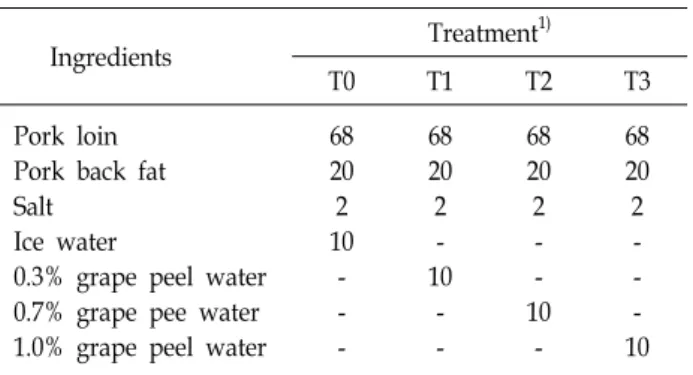
Table 1. Formulation of ground pork meat containing grape peel (%)
Ingredients Treatment1)
T0 T1 T2 T3
Pork loin Pork back fat Salt
Ice water
0.3% grape peel water 0.7% grape pee water 1.0% grape peel water
68 20 2 10
- - -
68 20 2 - 10
- -
68 20 2 - - 10
-
68 20 2 - - - 10
1)T0: ice water, T1: ice water with 0.3% grape peel powder, T2:
ice water with 0.7% grape peel powder, T3: ice water with 1.0% grape peel powder.
가 제기되고 있다[35]. 이러한 이유로 합성항산화제를 대체할 수 있는 천연 항산화물질로서 식물분말 또는 추출물에 대한 연구가 활발하게 진행되고 있다. 이에 대한 연구들로서 민들 레 추출물을 첨가한 분쇄돈육[7], 과일 추출물을 첨가한 돈육 패티[10], 바질을 첨가한 분쇄돈육[17], 식물추출물을 첨가한 분쇄돈육[24], 아보카도 부산물을 첨가한 돈육패티[29] 등이 보고되고 있다. 본 연구에서는 폐기되는 부존자원의 효과적인 이용방법을 제시하고, 이를 이용한 기능성 육제품 제조의 가 능성을 모색하고자 포도과피 분말을 분쇄돈육 제조에 첨가하 여 냉장저장 중 품질변화를 관찰하였기에 보고하고자 한다.
재료 및 방법 분쇄돈육 제조
분쇄돈육 제조에 사용한 돈육 후지(뒷다리)와 등지방은 식 육 전문매장에서 제조 당일 경매를 받아 해체한 것을 구입하 여 이용하였으며, 후지는 과도하게 붙어있는 지방과 결체조직 을 제거하였다. 돈육 후지와 등지방은 분쇄기(IS-12S, Ilshin Machine Co., Daegu, Korea)를 사용하여 3 mm로 분쇄하였다.
포도과피는 Campbell Early종을 구입하여 과육과 과피를 분 리하고, 과피를 70℃ 열풍건조기(FO-450M, Jeio Tech Co., Daejeon, Korea)에서 24시간 동안 건조한 후 분쇄하여 이용하 였다. 과피분말은 증류수에 각각 0.3%, 0.7% 및 1.0%를 분산시 켜 분쇄돈육에 첨가하였다. 분쇄돈육의 배합비율은 Table 1과 같다. 즉, 대조군은 돈육 후지 68%, 등지방 20%, 소금 2%, 냉각 수 10%, T1은 냉각수 대신 과피분말 0.3% 분산액 10%, T2는 0.7% 분산액 10%, 그리고 T3는 1.0% 분산액 10%를 각각 첨가 하고 혼합기(SP-800, Spar Food Machinery MFG Co., Tai- chung, Taiwan)로 5분간 혼합하여 제조하였다. 제조한 분쇄돈 육은 실험을 위하여 두께 12 mm, 직경 50 mm, 무게 35 g으로 성형한 후 4℃에서 10일 동안 냉장저장하면서 실험하였다.
pH 측정
시료의 pH는 대기온도에서 pH 4.0과 pH 7.0 buffer로 보정 한 유리전극이 부착된 pH meter (ATI orion 370, Thermosci- entific Inc., Beverly, MA, USA)를 이용하여 분쇄한 시료 10 g과 증류수 40 ml를 함께 균질화하여(Ultra-Turrax T25, IKA Laboretechnik Co., Staufen, Germany) 측정하였다.
색깔측정
표면의 색깔은 색차계(CR-400, Konica Minolta Inc., Osaka, Japan)를 이용하여 명도(L_value), 적색도(a_value) 및 황색도 (b_value)를 측정하였다. 색깔보정을 위하여 사용한 calibra- tion plate의 L_, a_ 및 b_value는 각각 92.81, 0.27 및 1.83이었다.
2-thiobarbituric acid reactive substances (TBARS) 측정
분쇄돈육의 TBARS는 시료 2 g을 perchloric acid 18 ml와 BHT 50 μl를 함께 균질화하고(Ultra-Turrax T25, IKA Labor- etechnik Co., Staufen, Germany) 여과한 여액 2 ml에 TBA시 약 2 ml를 가하고 531 nm에서 흡광도(UV-1800, Shimadzu Co., Kyoto, Japan)를 측정하여 아래와 같은 식으로 TBARS를 산출하였다[5].
TBARS value (mg malondialdehyde/kg) = O.D. × 5.88 1,1-diphenyl-2-picrylhydrazyl (DPPH) free radical 소거능 측정
DPPH free radical 소거능은 Blois [3]의 방법에 준하였다.
즉, 시료 5 g에 0.01 M phosphate buffer (pH 7.4) 20 ml를 가하여 10,000 rpm에서 20초 동안 균질화하고 3,000 rpm에서 원심분리(Vision Scientific Co., Daejeon, Korea)하여 그 상층 액을 이용하였다. 시료 추출물 4 ml와 DPPH 1 ml를 혼합하고, 실온에서 30분 동안 방치한 후 ice bath 상에서 반응을 종료시 킨 다음 520 nm에서 흡광도를 측정하였으며, 아래의 식에 의 하여 결과를 산출하였다.
DPPH free radical scavenging activity (%) = 1- Sample absorbance
Control absorbance ×100
Volatile basic nitrogen (VBN) 함량 측정
시료의 VBN함량은 conway dish를 이용한 미량확산법[20]
으로 측정하였다. 즉 시료 2 g을 증류수 16 ml와 20% perchlor- ic acid 2 ml를 함께 균질화하고 원심분리하여 얻어진 상층액 을 실험용액으로 이용하였다. 상층액 1 ml와 50% K2CO3 1 ml를 conway dish 외실에 넣고, 내실에는 붕산흡수제 1 ml를 첨가한 후 37℃에서 80분 동안 방치한 다음 0.01 N NaOH로 적정하고 아래의 계산식에 의해 VBN함량을 구하였다.
VBN (mg%) = 0.14 × (b-a) × f
× 100 × d W
Table 2. Changes in pH of ground pork meat containing grape peel during storage at 4℃
Treatment1) Storage days
1 4 7 10
T0 T1 T2 T3
5.53±0.01dA2) 5.51±0.01cB 5.50±0.01cB 5.48±0.01bC
5.61±0.01cA 5.59±0.01bB 5.59±0.01bB 5.59±0.00aB
5.65±0.01bA 5.62±0.01aB 5.61±0.01aC 5.60±0.01aC
5.66±0.01aA 5.63±0.01aB 5.60±0.01aC 5.59±0.01aD
1)T0: ice water, T1: ice water with 0.3% grape peel powder, T2: ice water with 0.7% grape peel powder, T3: ice water with 1.0%
grape peel powder.
2)Mean±standard deviation (n=5), Means in rowa~d and columnA~D followed by different superscripts are significantly different at p<0.05 by Duncan’s multiple range test.
a: 공시험의 0.01 N NaOH 적정량(ml) b: 시료의 0.01 N NaOH 적정량(ml) W: 시료 채취량(g)
f: 0.01 N NaOH의 역가 d: 희석배수
보수력 및 가열감량 측정
보수력(water holding capacity) 측정은 Hoffman 등[11]의 방법에 따라 데시케이트에서 습기를 제거한 여과지 위에 시료 0.3 g을 올려놓고, planimeter (X-Plan, Ushikata 360d II, Worth Point Co., Atlanta, GA, USA)로 눌러 여과지 위에 나타 난 수분의 면적을 구하고, 육의 표면적을 수분의 면적으로 나 눈 값으로 하였다. 가열감량은 시료의 가열전후의 무게를 측 정하여 백분율로 나타내었으며, 가열은 가스 오븐 레인지 (RFO-900, Rinnai Co., Inchon, Korea)에서 중심부의 온도가 75℃가 되게 하였다.
기계적 경도 및 저작성 측정
분쇄돈육의 기계적 조직감 측정은 rheometer (CR-200D, Sun Scientific Co., Tokyo, Japan)를 이용하였다. 경도(hard- ness)는 round adapter 25번을 이용하여 table speed 120 mm/
min, graph interval 30 m/sec, load cell (Max) 2 kg의 조건으 로 측정하였다. 저작성(chewiness)은 (peak max÷distance)×
cohesiveness×springiness로 계산하여 나타내었다.
통계처리
이상의 실험에서 얻어진 결과들은 SPSS 14.0 (statistical package for social science, SPSS Inc, Chicago, IL, USA)을 사용하여 통계처리 하였으며, 각각의 시료에 대하여 평균±표 준편차로 나타내었다. 시료들 사이의 비교를 위한 유의성 검 정은 분산분석을 한 후 p<0.05 수준에서 Duncan’s multiple range test를 실시하였다.
결과 및 고찰 냉장저장 중 pH의 변화
포도과피의 첨가농도를 다르게 하여 제조한 분쇄돈육을 4℃에서 냉장저장하면서 pH의 변화를 측정하고, 그 결과를 Table 2에 나타내었다. 저장초기 대조군(T0), 포도과피 0.3%
첨가군(T1), 0.7% 첨가군(T2) 및 1.0% 첨가군(T3)의 pH는 각각 5.53, 5.51, 5.50 및 5.48로 T0가 가장 높고, T3가 가장 낮았다 (p<0.05). 그 이후 냉장기간이 경과하면서 냉장 10일째는 T0, T1, T2 및 T3가 각각 5.66, 5.63, 5.60 및 5.59로 유의하게 높아졌 으며, 전체 저장기간 동안의 pH는 T0가 가장 높고, 포도과피 첨가농도가 높을수록 낮은 경향이었다(p<0.05). 식품의 pH는 저장기간에 따라 높아지거나 낮아지는데, 특히 식육의 경우는 사후변화 과정에서 해당작용에 의해 젖산이 생성되면 낮아지 고[26], 단백질 분해로 염기성 물질이 축적되면 높아진다[34].
본 연구에서 포도과피 첨가로 pH가 낮아지는 것은 포도에 함 유된 tartaric, oxalic, malic 및 fumaric acid 등의 유기산[1]이 영향을 미친 것으로 판단되고, 본 연구의 예비실험에서 농도 0.3%, 0.7% 및 1.0%의 포도과피의 pH가 각각 4.10, 3.57 및 3.48로 나타난 결과가 이를 뒷받침한다. 이러한 결과는 연잎 추출물을 첨가한 분쇄돈육[22], 아로니아 분말을 첨가한 돈육 패티[18]의 경우 첨가농도가 높아질수록 pH가 낮게 나타났다 는 결과와 유사한 경향이었다.
냉장저장 중 색깔의 변화
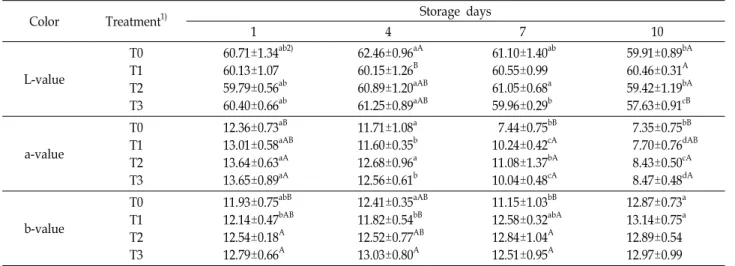
냉장저장 중 분쇄돈육의 표면색깔을 측정한 결과는 Table 3과 같다. 명도(L-value)의 경우 T0 및 T2는 냉장 7일까지 변화 가 없다가 냉장 10일째 낮아졌으며, T3는 냉장 7일 이후부터 낮아졌다(p<0.05). 그러나 T1은 냉장기간 중 명도의 변화가 없 었다. 냉장 10일째의 명도는 T0, T1 및 T2는 명도의 차이가 없었지만 T3는 이들보다 낮게 나타났다(p<0.05). 적색도(a-val- ue)의 경우 냉장기간이 경과하면서 유의하게 낮아지는 경향이 었다(p<0.05). 냉장 중 시료들 사이의 적색도는 대조군인 T0보 다 포도과피 0.7% 및 1.0%를 첨가한 T2 및 T3가 높게 나타났다 (p<0.05). 황색도(b-value)는 냉장 중 T0 및 T1은 냉장 10일째가
Table 3. Changes in Hunter color of ground pork meat containing grape peel during storage at 4℃
Color Treatment1) Storage days
1 4 7 10
L-value
T0 T1 T2 T3
60.71±1.34ab2) 60.13±1.07 59.79±0.56ab 60.40±0.66ab
62.46±0.96aA 60.15±1.26B 60.89±1.20aAB 61.25±0.89aAB
61.10±1.40ab 60.55±0.99 61.05±0.68a 59.96±0.29b
59.91±0.89bA 60.46±0.31A 59.42±1.19bA 57.63±0.91cB
a-value
T0 T1 T2 T3
12.36±0.73aB 13.01±0.58aAB 13.64±0.63aA 13.65±0.89aA
11.71±1.08a 11.60±0.35b 12.68±0.96a 12.56±0.61b
7.44±0.75bB 10.24±0.42cA 11.08±1.37bA 10.04±0.48cA
7.35±0.75bB 7.70±0.76dAB 8.43±0.50cA 8.47±0.48dA
b-value
T0 T1 T2 T3
11.93±0.75abB 12.14±0.47bAB 12.54±0.18A 12.79±0.66A
12.41±0.35aAB 11.82±0.54bB 12.52±0.77AB 13.03±0.80A
11.15±1.03bB 12.58±0.32abA 12.84±1.04A 12.51±0.95A
12.87±0.73a 13.14±0.75a 12.89±0.54 12.97±0.99
1)T0: ice water, T1: ice water with 0.3% grape peel powder, T2: ice water with 0.7% grape peel powder, T3: ice water with 1.0%
grape peel powder.
2)Mean±standard deviation (n=5), Means in rowa~d and columnA,B followed by different superscripts are significantly different at p<0.05 by Duncan’s multiple range test.
Table 4. Changes in TBARS content of ground pork meat containing grape peel during storage at 4℃ (mg/kg)
Treatment1) Storage days
1 4 7 10
T0 T1 T2 T3
0.35±0.02dA2) 0.29±0.01dB 0.13±0.01dC 0.12±0.01dC
0.58±0.02cA 0.35±0.01cB 0.15±0.00cC 0.15±0.01cC
1.10±0.01bA 0.69±0.01bB 0.33±0.01bC 0.28±0.01bD
1.52±0.01aA 0.85±0.01aB 0.36±0.01aC 0.35±0.01aC
1)T0: ice water, T1: ice water with 0.3% grape peel powder, T2: ice water with 0.7% grape peel powder, T3: ice water with 1.0%
grape peel powder.
2)Mean±standard deviation (n=5), Means in rowa~d and columnA~D followed by different superscripts are significantly different at p<0.05 by Duncan’s multiple range test.
가장 높았지만(p<0.05), T2 및 T3는 냉장 중 변화가 없었다.
시료들 사이의 황색도는 냉장 10일을 제외하고 T0보다 T2 및 T3가 높은 경향이었다(p<0.05). 본 연구에 사용한 포도과피의 명도, 적색도 및 황색도는 각각 44.77, 9.35 및 3.71로서 시료들 사이의 색깔에서 차이가 나는 것은 포도과피의 색깔이 영향을 미쳐서 나타난 결과로 판단되며, Rodríguez-Carpena 등[29]은 식물에 함유된 색소가 돈육패티의 색깔에 영향을 미친다고 하였다. 식육 고유의 색깔인 myoglobin의 유도체인 deoxy- myoglobin (진홍색), oxymyoglobib (선홍색), metmyoglobin (암갈색)의 비율이 육색에 영향을 미치는데[23], 냉장 중의 육 제품은 oxymyoglobin의 산화로 형성되는 암갈색의 metmyo- globin이 명도와 적색도의 감소에 영향을 미친다[30]. 또한 metmyoglobin의 형성에는 지질의 산화가 원인이 되기도 하 는데, 냉장 중 포도과피 첨가량에 따라 적색도가 높게 유지되 는 것은 포도과피에 함유된 항산화물질인 폴리페놀성분[28]이 영향을 미쳐서 나타난 결과이다. Choi 등[7]은 민들레 추출물 을 돈육패티에 첨가하였을 경우, Huang 등[12]은 연잎 추출물
을 분쇄돈육에 첨가하였을 경우 metmyoglobin의 형성이 지 연되었다고 하였다.
냉장저장 중 TBARS의 변화
냉장저장 중 지방산패도를 나타내는 TBARS를 측정한 결과 를 Table 4에 나타내었다. TBARS는 지질산화의 2차 산화생성 물인 malondialdehyde의 형성을 측정하여 지질의 산화정도 를 측정하는 수단으로 이용되고 있으며, 이러한 산화생성물은 이취와 불쾌취 형성에 관여한다[17]. 냉장기간이 경과함에 따 라 TBARS는 모든 시료들에서 증가하였다(p<0.05). 시료들 사 이의 TBARS는 대조군인 T0가 가장 높았고, 포도과피 0.7%
및 1.0% 첨가한 T2 및 T3가 가장 낮았으며(p<0.05), 포도과피 의 첨가가 분쇄돈육의 지질산화를 억제하는 것으로 나타났다.
이러한 현상은 포도과피에 함유된 폴리페놀 성분이 영향을 미친 것으로 판단되고[25, 28], Kobus-Cisowask 등[19]은 은행 잎에 함유된 폴리페놀 성분이 미트볼의 TBARS를 감소시켰다 고 하였으며, Shim과 Chin [32]은 파프리카를 첨가한 분쇄돈
Table 5. Changes in DPPH free radical scavenging activity of ground pork meat containing grape peel during storage at 4℃ (%)
Treatment1) Storage days
1 4 7 10
T0 T1 T2 T3
14.11±1.41C2) 24.24±1.16aB 33.35±1.47aA 35.32±0.99aA
13.32±1.17C 23.93±0.89aB 33.07±1.06aA 33.39±0.91bA
13.21±1.14C 21.86±0.88bB 31.52±0.66abA 33.19±1.04bA
12.78±0.61C 22.01±0.88bB 30.33±0.85bA 31.02±1.00cA
1)T0: ice water, T1: ice water with 0.3% grape peel powder, T2: ice water with 0.7% grape peel powder, T3: ice water with 1.0%
grape peel powder.
2)Mean±standard deviation (n=5), Means in rowa~c and columnA~C followed by different superscripts are significantly different at p<0.05 by Duncan’s multiple range test.
Table 6. Changes in VBN content (of ground pork meat containing grape peel during storage at 4℃ (mg%)
Treatment1) Storage days
1 4 7 10
T0 T1 T2 T3
9.57±0.59c2) 9.04±0.68b 9.16±0.81 9.03±0.62
9.66±0.47c 9.34±0.64b 9.00±0.79 9.08±0.78
11.18±0.84bA 9.76±0.53bB 9.47±0.61B 9.52±0.53B
12.39±0.70aA 10.92±0.77aB 9.71±0.52C 9.64±0.44C
1)T0: ice water, T1: ice water with 0.3% grape peel powder, T2: 0.7% ice water with grape peel powder, T3: ice water with 1.0%
grape peel powder..
2)Mean±standard deviation (n=5), Means in in rowa~c and columnA~C followed by different superscripts are significantly different at p<0.05 by Duncan’s multiple range test.
육의 TBARS가 대조군보다 더 낮았다고 하였다.
냉장저장 중 DPPH free radical 소거능의 변화 DPPH free radical 소거능은 DPPH free radical에 대한 전 자공여 활성도를 평가하여 항산화력을 측정하는 것으로서 냉 장저장 중 포도과피를 첨가한 분쇄돈육의 DPPH free radical 소거능에 대한 결과는 Table 5와 같다. 실험 결과 냉장기간이 경과하면서 대조군은 변화가 없었지만 T1, T2 및 T3는 유의하 게 감소하였다(p<0.05). 냉장저장 중 시료들 사이의 DPPH free radical 소거능은 대조군이 가장 낮았고, T2 및 T3가 가장 높게 나타났다(p<0.05). Kim 등[18]은 아로니아 분말 첨가량이 증가함에 따라 돈육패티의 DPPH free radical 소거능이 높았 다는 결과와 유사하였고, Bagchi 등[2] 및 Castillo 등[6]은 포도 과피에 폴리페놀 성분 함량이 높아 DPPH free radical 소거능 이 높다고 하였다. 따라서 본 연구의 포도과피 첨가량이 높을 수록 DPPH free radical 소거능이 높은 것은 첨가량에 따라 폴리페놀 성분이 증가하기 때문인 것으로 판단된다.
냉장저장 중 VBN함량의 변화
육제품의 VBN은 단백질이 저분자 물질로 분해된 albu- mose, peptone, peptide, amino acid 등이 세균의 환원작용에 의하여 생성된 물질로서 육제품의 변패정도를 나타내는 지표 로 활용되고 있다[9]. Table 6은 포도과피를 첨가한 분쇄돈육 의 냉장저장 중 VBN함량의 변화를 나타낸 것이다. 냉장저장
중 VBN함량은 T0 및 T1의 경우 저장기간의 경과와 함께 증가 하였으나(p<0.05), T2 및 T3는 저장기간 중 변화가 없었다. 시 료들 사이의 VBN함량은 냉장 10일째 T0가 가장 높고, T2 및 T3가 가장 낮았다(p<0.05). 우리나라 식품공전[20]에서 식육 및 육제품의 VBN함량은 20 mg% 이하를 허용한계로 지정하 고 있으며, 30~40 mg%를 초기부패로 규정하고 있다. 본 연구 에서는 모든 시료가 허용한계 내에 있었으며, 포도과피의 첨 가가 분쇄돈육의 VBN함량에 영향을 미치는 것으로 나타났다.
특히 포도과피 0.7% (T2) 및 1.0% (T3)를 첨가한 분쇄돈육의 VBN함량이 낮은 것은 포도과피에 함유된 폴리페놀 성분과 유기산의 항균작용[1]으로 미생물 증식이 억제되어 나타난 결 과로 판단된다.
냉장저장 중 보수력의 변화
분쇄돈육의 물리적 성질에 영향을 미치는 보수력을 측정하 고 그 결과를 Table 7에 나타내었다. 냉장초기 분쇄돈육의 보 수력은 87.25~87.92% 사이였으며, 냉장기간이 경과함에 따라 감소하여 냉장 10일째는 82.19~83.83%를 나타내고(p<0.05), 전 체 저장기간 동안 시료들 사이에 유의한 차이가 없어서 포도 과피의 첨가가 보수력에는 영향을 미치지 않았다. 보수력은 근원섬유 사이에 존재하는 수분이 유출되지 않고 남아있는 정도를 나타내는 것으로 관능적 조직감과 다즙성에 영향을 미친다[13]. 본 연구에서 냉장초기 보수력이 높은 것은 제조과 정에 첨가한 소금이 근원섬유단백질의 용해도를 증가시키기
Table 7. Changes in water holding capacity of ground pork meat containing grape peel during storage at 4℃ (%)
Treatment1) Storage days
1 4 7 10
T0 T1 T2 T3
87.92±1.83a2) 87.73±2.01a 87.25±1.89a 87.90±1.63a
83.98±1.64b 83.57±1.80b 82.39±1.94b 83.12±2.21b
83.26±2.16b 83.89±2.12b 82.99±2.33b 82.59±2.56b
83.83±1.89b 83.71±2.58b 82.75±2.15b 82.19±2.55b
1)T0: ice water, T1: ice water with 0.3% grape peel powder, T2: ice water with 0.7% grape peel powder, T3: ice water with 1.0%
grape peel powder.
2)Mean±standard deviation (n=5), Means in rowa,b followed by different superscripts are significantly different at p<0.05 by Duncan’s multiple range test.
Table 8. Changes in cooking loss of ground pork meat containing grape peel during storage at 4℃ (%)
Treatment1) Storage days
1 4 7 10
T0 T1 T2 T3
17.30±2.24b2) 17.98±2.27b 18.87±2.38b 19.19±2.41b
22.47±1.43a 23.38±1.91a 23.68±2.36a 24.22±1.71a
24.03±2.10a 23.78±0.83a 24.21±0.94a 25.01±0.36a
24.38±1.04a 22.58±0.85a 23.13±2.64a 25.25±2.26a
1)T0: ice water, T1: ice water with 0.3% grape peel powder, T2: ice water with 0.7% grape peel powder, T3: ice water with 1.0%
grape peel powder.
2)Mean±standard deviation (n=5), Means in rowa,b followed by different superscripts are significantly different at p<0.05 by Duncan’s multiple range test.
Table 9. Changes in hardness and chewiness of ground pork meat containing grape peel during storage at 4℃
Treatment1) Storage days
1 4 7 10
Hardness (g/cm2) T0
T1 T2 T3
1.87±0.36b2) 1.90±0.54b 1.91±0.29b 1.84±0.33b
2.24±0.75a 2.15±0.18a 2.31±0.37a 2.11±0.24a
2.16±0.28a 2.32±0.49a 2.29±0.28a 2.18±0.34a
2.45±0.44a 2.31±0.54a 2.41±0.22a 2.20±0.35a Chewiness (g)
T0 T1 T2 T3
11.78±1.02c 12.05±0.78c 11.69±0.84c 12.12±1.02d
13.56±0.98b 13.94±0.94b 13.63±0.92b 13.31±0.54c
14.11±1.12ab 14.56±0.67ab 14.09±0.69b 14.26±0.76b
14.95±1.04a 15.03±1.00a 15.36±0.34a 15.41±0.60a
1)T0: ice water, T1: ice water with 0.3% grape peel powder, T2: ice water with 0.7% grape peel powder, T3: ice water with 1.0%
grape peel powder.
2)Mean±standard deviation (n=5), Means in rowa~d followed by different superscripts are significantly different at p<0.05 by Duncan’s multiple range test.
때문에 기인하는 것이고, 저장기간이 경과하면서 단백질의 분 해와 함께 수분의 유출이 증가하면서 보수력은 감소하게 된다 [27].
냉장저장 중 가열감량의 변화
냉장저장 중 분쇄돈육의 가열감량을 측정한 결과를 Table 8에 나타내었다. 냉장초기의 가열감량은 17.30~19.19%로 시료 들 사이에 유의한 차이가 없었다. 그러나 냉장 4일째는 모든
시료의 가열감량이 유의하게 증가하였으며(p<0.05), 그 이후 냉장 10일까지는 변화가 없었고, 냉장기간 중 시료들 사이에 가열감량의 차이가 없어서 포도과피의 첨가는 가열감량에 영 향을 미치지 않았다. 가열감량은 보수력과 상관관계가 있는 데, Jung [16]은 보수력이 높으면 가열감량이 낮아진다고 보고 하였다. 본 연구의 보수력의 결과(Table 7)에서 보듯이 냉장 중 보수력의 변화 형태와 유사하다.
냉장저장 중 경도 및 저작성의 변화
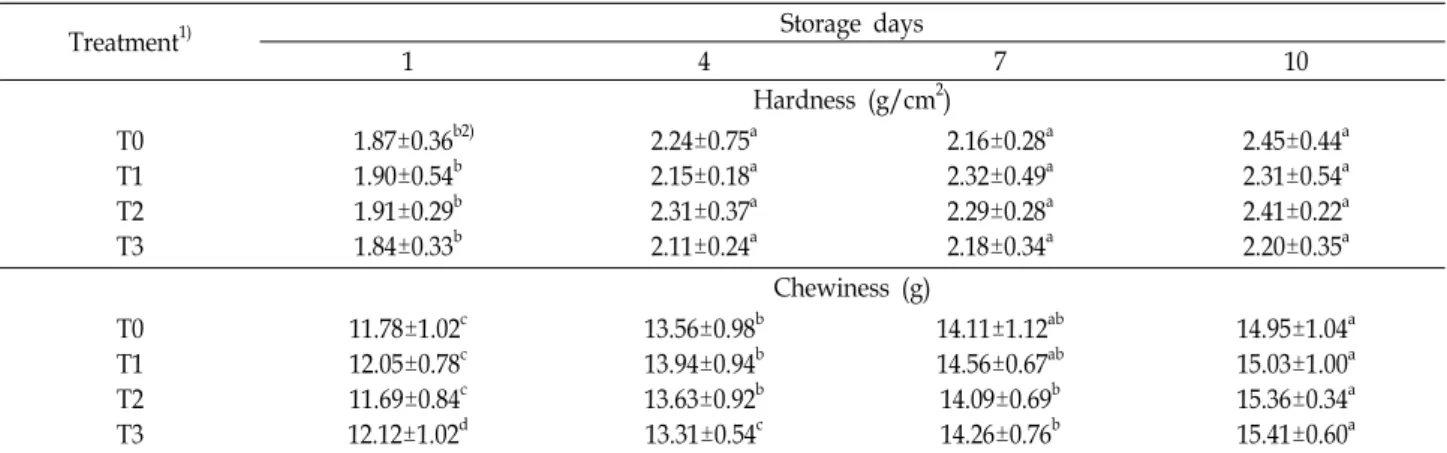
냉장저장 중 분쇄돈육의 경도 및 저작성을 측정한 결과는 Table 9와 같다. 경도는 냉장저장 4일째 유의하게 증가하였으 며(p<0.05), 그 후 10일까지는 유의한 변화가 없었다. 그리고 냉장기간 중 시료들 사이에 유의한 차이가 없었다. 저작성은 냉장기간이 경과하면서 유의하게 증가하였으며(p<0.05), 냉장 중 시료들 사이에는 유의한 차이가 없었다. 따라서 분쇄돈육 제조과정에 포도과피를 첨가하는 것은 경도와 저작성에 영향 을 미치지 않음을 알 수 있었다. 육제품을 씹을 때 치아와 치아 사이에서 느끼는 특성을 기계를 이용하여 객관적으로 판단하 는 경도와 저작성은 함유하고 있는 수분함량, 지방함량, 사후 식육의 상태, 첨가물의 종류 등에 따라서 다르게 나타나며[33], 일반적으로 지방함량이 높으면 경도와 저작성이 낮아진다고 알려져 있다[37]. 본 연구를 위하여 사용한 돈육, 지방, 소금, 물 및 포도과피 0.3%, 0.7% 그리고 1.0%를 첨가한 경우 분쇄돈 육을 구성하는 성분들이 비슷하기 때문에 시료들 사이에 경도 및 저작성의 차이가 없는 것으로 판단된다.
부존자원의 재활용을 위하여 포도과피를 첨가한 분쇄돈육 의 냉장저장 중 품질변화를 관찰한 결과, 육제품에서 관능적 으로 중요한 항목인 적색도의 유지가 뛰어나고, 지방산화가 억제되었으며, 단백질의 변성을 최소화하는 작용이 있는 것으 로 나타났다. 또한 물리적 성질을 나타내는 보수력, 가열감량, 경도 및 저작성에는 영향을 미치지 않아서 육제품에 포도과피 의 사용은 유효한 것으로 판단되며, 모든 결과를 종합적으로 판단할 때 0.7%의 첨가가 가장 적당한 것으로 판단된다.
References
1. Ahn, H. J. and Son, H. S. 2012. Physicochemical properties of different grape varieties cultivated in Korea. Kor. J. Food Sci. Technol. 44, 280-286.
2. Bagchi, D., Ray, S. D., Patel, D. and Bagchi, M. 2001. Protec- tion against drug- and chemical-induced multiorgan toxicity by a novel IH 636 grape seed proanthocyanidin extract.
Drugs Exp. Clin. Res. 27, 3-15.
3. Blois, M. S. 1958. Antioxidant determination by the use of a stable free radical. Nature 26, 1199-1200.
4. Brettonnet, A., Hewavitarana, A., Dejong, S. and Lanari, M.
C. 2010. Phenolic acids composition and antioxidant activity of canola extracts in cooked beef, chicken and pork. Food Chem. 121, 927-933.
5. Buege, A. J. and Aust, S. D. 1978. Microsomal lipid perox- idation. In Methods in Enzymology. Gleischer S. and Parker L. (eds.), Academic Press Inc., New York pp. 302-310.
6. Castillo, J., Benavente-Garcia, O., Lorente, J., Alcaraz, M., Redondo, A., Ortuno, A. and Del Rio, J. A. 2000. Antioxidant activity and radio protective effects against chromosomal damage induced in vivo by X-rays of flavan-3-ols (procyani- dins) from grape seed (Vitis vinifera): comparative study ver- sus other phenolic and organic compounds. J. Agric. Food
Chem. 48, 1738-1745.
7. Choi, Y. J., Park, H. S., Lee, J. S., Park, K. S., Park, S. S.
and Jung, I. C. 2015. Changes in physicochemical properties of pork patty with dandelion extract during refrigerated storage. Kor. J. Food Cook. Sci. 31, 423-430.
8. Choi, Y. J., Park, H. S., Park, K. S., Lee, K. S., Moon, Y.
H., Kim, M. J. and Jung, I. C. 2012. Quality characteristics of pork patty containing lotus root and leaf powder. J. East Asian Soc. Dietary Life 22, 33-40.
9. Coresopo, F. L., Millan, R. and Moreno, A. S. 1978. Chemical changes during ripening of Spanish dry. III. Changes in wa- ter soluble N-compounds. A Archivos de Zootechia 27, 105- 108.
10. Ganhão, R., Morcuende, D. and Estévez, M. 2010. Protein oxidation in emulsified cooked burger patties with added fruit extracts: Influence on colour and texture deterioration during chill storage. Meat Sci. 85, 402-409.
11. Hoffman, K., Hamm, R. and Blüchel, E. 1982. Neues über die best immung der wasserbindung des fleisches mit hilfe der filterpapierpress methode. Fleischwirtschaft 62, 87-93.
12. Huang, B., He, J. S., Ban, X. Q., Zeng, H., Yao, X. C. and Wang, Y. W. 2011. Antioxidant activity of bovine and por- cine meat treated with extracts from edible lotus (Nelumbo nucifera) rhizome knot and leaf. Meat Sci. 87, 46-53.
13. Huff-Lonergan, E. and Lonergan, S. M. 2005. Mechanism of water holding capacity of meat: the role of postmortem biochemical and structural changes. Meat Sci. 71, 194-203.
14. Jang, E. H., Jeong, S. M., Park, K. S. and Lim, B. S. 2013.
Contents of phenolic compounds and trans-resveratrol in different parts of Korean new grape cultivars. Kor. J. Food Sci. Technol. 45, 708-713.
15. Jo, J. E., Yook, H. S., Kim, K. H., Baek, J. Y., Moon, Y. J., Park, S. J. and Jang, S. A. 2010. Effect of drying methods and gamma irradiation on the color changes and antioxidant activity of grape by-product. J. Kor. Soc. Food Sci. Nutr. 39, 1826-1831.
16. Jung, I. C. 1999. Effect of freezing temperature on the quality of beef loin aged after thawing. J. Kor. Soc. Food Sci. Nutr.
28, 871-875.
17. Juntachote, T., Berghofer, E., Siebenhandl, S. and Bauer, F.
2007. Antioxidative effect of added dried Holy basil and its ethanolic extracts on susceptibility of cooked ground pork to lipid oxidation. Food Chem. 100, 129-135.
18. Kim, M. H., Joo, S. Y. and Choi, H. Y. 2015. The effect of aronia powder (Aronia melanocarpa) on antioxidant activity and quality characteristics of pork patties. Kor. J. Food Cook.
Sci. 31, 82-90.
19. Kobus-Cisowask, J., Flaczyk, E., Rudzínska, M. and Kmiecik, D. 2014. Antioxidant properties of extracts from Ginkgo bilo- ba leaves in meatballs. Meat Sci. 97, 174-180.
20. Korea Food & Drug Administration (KFDA). 2009. Fode Code. Munyoungsa, Seoul, pp. 212-251.
21. Lee, J. H. and Jin, K. B. 2012. Evaluation of antioxidant activ- ities of red beet extracts, and physicochemical and microbial changes of ground pork patties containing red beet extracts during refrigerated storage. Kor. J. Food Sci. Ani. Resour. 32,
초록:포도과피를 첨가한 분쇄돈육의 냉장저장 중 품질변화 최강원1,2․이종욱1*
(1영남대학교 생명과학과, 2대구공업대학교 안경광학과)
본 연구는 포도과피 첨가가 분쇄돈육의 냉장저장 중 품질에 미치는 영향을 규명하고자 하였다. 분쇄돈육은 돈 육 68%, 돼지지방 20%, 소금 2%, 냉수 10%를 배합하여 제조한 대조군(T0), 여기에 포도과피 0.3% 첨가한 T1, 0.7%
첨가한 T2 그리고 1.0%를 첨가한 T3 등 네 종류의 분쇄돈육을 제조하였다. 분쇄돈육의 pH는 냉장 중 높아졌으며, T3의 pH가 가장 낮았다(p<0.05). 명도(L-value)와 적색도(a-value)는 냉장 중 감소하였으며, T2 및 T3의 적색도가 T0 및 T1보다 높았다(p<0.05). 그리고 황색도(b-value)는 T0 및 T1의 경우 냉장 중 증가하였지만 T2 및 T3는 유의 한 변화가 없었다(p<0.05). TBARS는 냉장 중 유의하게 증가하였으며, T2 및 T3가 T0 및 T1보다 유의하게 낮았다 (p<0.05). DPPH free radical 소거능은 냉장 중 감소하였으며, T2 및 T3가 T0 및 T1보다 높았다(p<0.05). VBN함량 은 냉장 중 T0 및 T1은 증가하였지만 T2 및 T3는 변화가 없었다(p<0.05). 보수력은 냉장 4일째 감소하였으며 (p<0.05), 냉장 중 시료들 사이에 차이가 없었다. 가열감량과 경도는 냉장 4일째 증가하였으며(p<0.05), 냉장 중 시료들 사이에 차이가 없었다. 저작성은 냉장 중 유의하게 증가하였으며(p<0.05), 시료들 사이에는 차이가 없었다.
이상의 결과에서 포도과피는 분쇄돈육의 품질유지와 산화방지 효과가 있는 것으로 판단된다.
497-503.
22. Lee, K. S., Kim, J. N. and Jung, I. C. 2013. Physicochemical properties of ground pork with lotus leaf extract during re- frigerated storage. J. East Asian Soc. Dietary Life 23, 477-486.
23. Lindahl, G., Enfált, A. C., von Seth, G., Joselí, Å., Hedebro- Velander, I., Andersen, H. J., Braunschweig, M., Andersen, A. and Lundström, K. 2004. A second mutant allele (V1991) at the PRKAG3 (RN) lotus-II. Effect on colour characteristics of pork loin. Meat Sci. 66, 621-627.
24. McCarthy, T. L., Kerry, J. P., Kerry, J. F., Lynch, P. B. and Buckley, D. J. 2001. Assessment of the antioxidant potential of natural food and plant extracts in fresh and previously frozen pork patties. Meat Sci. 57, 177-184.
25. Mato, I., Suarez-Luque, S. and Huidobro, J. F. 2005. A re- view of the analytical methods to determine organic acids in grape juices and wine. Food Res. Int. 38, 1175-1188.
26. Moon, Y. H., Hong, D. J., Kim, M. S. and Jung, I. C. 1998.
Changes in physicochemical and sensory characteristics in vacuum-packaged beef loin during cold storage time. J. Kor.
Soc. Food Sci. Nutr. 27, 214-219.
27. Park, K. S., Park, H. S., Choi, Y. J., Moon, Y. H., Lee, K.
S., Kim, M. J. and Jung, I. C. 2011. Quality changes of pork patty containing lotus (Nelumbo nucifera) leaf and root pow- der during refrigerated storage. J. Life Sci. 21, 1732-1739.
28. Recamales, A. F., Sayago, A., Gonzalez-Miret, M. L. and Hernanz, D. 2006. The effect of time and storage conditions on the phenolic composition and colour of white wine. Food Res. Int. 39, 220-229.
29. Rodríguez-Carpena, J. G., Morcuende, D. and Estévez, M.
2011. Avocado by-products as inhibitors of color deterio- ration and lipid and protein oxidation in raw porcine patties subjected to chilled storage. Meat Sci. 89, 166-173.
30. Sánchez-Escalante, A., Torrescano, G., Djenane, D., Beltrán,
J. A. and Roncalés, P. 2003. Stabilization of colour and odour of beef patties by using lycopene-rich tomato and peppers as a source of antioxidants. J. Sci. Food Agric. 83, 187-194.
31. Shi, J., Yu, J., Pohorly, J. E. and Kakuda, Y. 2003. Polyphe- nolics in grape seeds- biochemistry and functionality. J. Med.
Food 6, 291-299.
32. Shim, Y. W. and Chin, K. B. 2013. Antioxidant activity of the oven-dried paprika powders with various colors and physicochemical properties and antioxidant activity of pork patty containing various paprika powder. Kor. J. Food Sci.
An. 33, 626-632.
33. Song, H. I., Moon, G. I., Moon, Y. H. and Jung, I. C. 2000.
Quality and storage stability of hamburger during low tem- perature storage. Kor. J. Food Sci. Ani. Resour. 20, 72-78.
34. Verma, S. P. and Sahoo, J. 2000. Improvement in the quality of ground chevon during refrigerated storage by tocopherol acetate preblending. Meat Sci. 61, 355-365.
35. Williams, G. M., Iatropoulos, M. J. and Whysner, J. 1999.
Safety assessment of hydroxyanisole and butylated hydrox- ytoluene as antioxidant food additives. Food Chem. Toxicol.
37, 1027-1038.
36. Yoo, M. A., Chung, H. K. and Kang, M. H. 2004. Optimal extract methods of antioxidant compounds from coat of grape dreg. Kor. J. Food Sci. Technol. 36, 134-140.
37. Young, L. L., Garcia, J. M., Lillard, H. S., Lyon, C. E. and Papa, C. M. 1991. Fat content effects on yield, quality, and microbiological characteristics of chicken patties. J. Food Sci.
56, 1527-1528.
38. Zhang, C., Lou, J. Q., Yu, B., Zheng, P., Huang, Z, Q., Mao, X. B., He, J., Yu, J., Chen, J. L. and Chen, D. W. 2015. Dietary resveratrol supplementation improves meat quality of fin- ishing pigs through changing muscle fiber characteristics and antioxidative status. Meat Sci. 102, 15-21.