Changes in the Physicochemical Properties of Ground Pork Meat Containing Persimmon Peel during Refrigerated Storage
Gang-Won Choi*
Department of Hotel Culinary Arts, Daegu Technical University, Daegu 42734, Korea Received April 22, 2019 /Revised July 2, 2019 /Accepted July 2, 2019
This study was carried out to investigate the effect of persimmon peel on the physicochemical proper- ties of ground pork stored at 4℃ for 10 days. Four types of ground pork were evaluated: T0 without dried persimmon peel powder, and T1 with 0.3%, T2 with 0.7%, and T3 with 1.0% dried persimmon peel powder. The pH increased during storage, with the pH of T3 being the lowest (p<0.01). The L-value and b-value were not significantly changed, but the a-value decreased during storage. On the 10th day of storage, the a-values were significantly higher for T2 and T3 than for T0 and T1 (p<0.001).
TBARS significantly increased during storage, with lower values for T2 and T3 than for T0 and T1 (p<0.001). DPPH free radical scavenging activity decreased during storage, with T0 having the lowest value (p<0.001). The VBN content increased during storage, and the VBN content of T0 was the high- est at the 10th day (p<0.05). The water-holding capacity decreased and cooking loss increased during storage. Hardness and chewiness increased, while springiness and gumminess decreased during storage. The results of this study showed that the addition of persimmon peel during the process of making ground pork had antioxidant effects that maintained redness and physical quality. A 0.7% ad- dition was the most appropriate.
Key words : Ground pork, physicochemical properties, persimmon peel, refrigerated storage
*Corresponding author
*Tel : +82-53-560-3857, Fax : +82-53-560-3859
*E-mail : [email protected]
This is an Open-Access article distributed under the terms of the Creative Commons Attribution Non-Commercial License (http://creativecommons.org/licenses/by-nc/3.0) which permits unrestricted non-commercial use, distribution, and reproduction in any medium, provided the original work is properly cited.
Journal of Life Science 2019 Vol. 29. No. 7. 792~799 DOI : https://doi.org/10.5352/JLS.2019.29.7.792
서 론
돈육은 필수아미노산을 함유하고 있는 균형 잡힌 단백질 자원이면서, 철분, 아연과 같은 무기질, 비타민 B군 등 인간의 생리적 기능 유지에 도움이 되는 영양소를 함유하고 있는 식 품자원이다[38]. 그러나 분쇄하여 제조한 소시지, 패티 등의 분쇄육은 약 20~30 g/100 g 정도의 지방을 함유하고 있으며, 분쇄과정에서 다공질 구조를 형성하기 때문에 산화 발생이 용이하고, 미생물에 의한 변질이 우려되고 있다[19]. 이러한 산화와 변질은 분쇄 돈육의 풍미, 조직감, 색깔 등을 변화시켜 저장기간을 단축시킨다. 따라서 돈육 가공업체들에게는 안전 성과 품질을 유지할 수 있는 적절한 저장기술 개발이라는 중 요한 문제에 직면해 있다. 지질 산화와 미생물의 성장을 억제 할 수 있는 방법 중 하나는 항산화작용과 항균작용이 있는 butylated hydroxy anisole (BHA), butylated hydroxy tol- uene (BHT), tertiary- butylhydroxy quinone (TBHQ), propyl gallate (PG) 등의 합성식품첨가물을 사용하는 것이다[42]. 그
러나 이러한 합성식품첨가물들은 독성과 발암물질을 함유하 고 있어서[12] 천연원료에서 얻어진 효과가 있는 물질의 사용 을 권장하고 있다.
과일을 가공하고 폐기되는 껍질, 씨, 펄프 등의 부산물에는 수소공여체나 유리기 제거제로서 활용할 수 있는 페놀화합물 이 풍부하게 함유되어 있다[9]. 그 중 우리나라를 비롯한 중국, 일본 등에서 주로 재배되고 있는 감(Diospyros kaki L.)은 독특 한 풍미와 섬유질, 무기질, 당류, 비타민 C, carotene, poly- phenol 등을 많이 함유하고 있다[13, 35]. 그리고 과육보다 껍 질에 함유된 생물학적인 활성화합물들은 항산화, 항당뇨, 항 뇌졸증, 항비만, 항돌연변이, 항암, 항염증, 항동맥경화 활성과 같은 여러 가지 생리적 기능이 있다[37, 45]. 탄닌 함량이 높은 떫은 감은 탈삽과정을 거쳐 생과로 이용하거나 껍질을 벗겨 곶감의 형태로 소비되는데, 곶감 가공과정에서 약 15%의 껍질 이 폐기되고 있어서[34] 부존자원의 재활용 차원에서 감 껍질 의 활용도를 찾는 것은 의미가 있다. 이미 감 껍질의 생리활성 기능에 대한 기초 연구는 많이 이루어졌으며[40, 48], 최근에는 가축의 사료와 가공식품에 첨가한 연구가 일부 진행되고 있 다. 감 껍질의 급여가 돈육의 기호성, 지방산 조성, 콜레스테롤 함량에 미치는 영향[31], 감 껍질을 이용한 감 식초 제조[27], 감 껍질을 첨가한 설기떡의 품질 특성[44] 등이 보고되고 있지 만 육제품 제조에 직접 첨가한 경우는 매우 제한적이다. 따라 서 본 연구는 감 껍질을 열풍 건조하여 얻어진 분말을 0%, 0.3%, 0.7% 및 1.0% 첨가하여 분쇄 돈육을 제조하고, 4℃에서 냉장저장하면서 이화학적 특성들을 규명하였다.
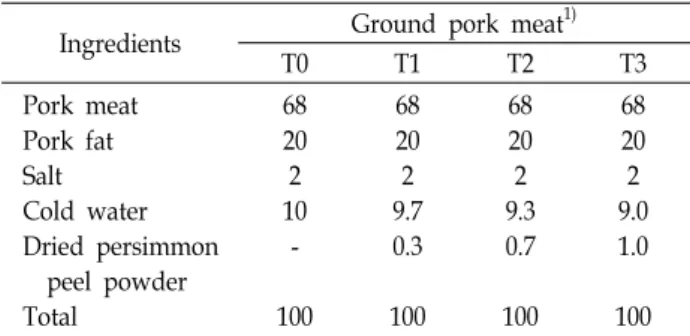
Table 1. Formulation of ground pork meat containing dried persimmon peel powder (%)
Ingredients Ground pork meat1)
T0 T1 T2 T3
Pork meat Pork fat Salt Cold water Dried persimmon peel powder Total
68 20 2 10
-
100
68 20 2 9.7 0.3
100
68 20 2 9.3 0.7
100
68 20 2 9.0 1.0
100
1)T0: ground pork without persimmon peel; T1: ground pork with 0.3% persimmon peel; T2: ground pork with 0.7% persim-
재료 및 방법
분쇄 돈육 제조
본 연구에 사용한 냉장 돈육 뒷다리 살과 등 지방은 도축 24시간 경과 후 발골한 것을 대구시내 식육 전문 매장에서 구 입하였다. 뒷다리 살의 과도한 결합 조직과 피하지방은 제거 하였으며, 분쇄기(IS-12S, Ilshin Machine Co., Daegu, Korea) 를 사용하여 3 mm로 분쇄하였다.
감(Diospyros kaki) 껍질은 청도영농조합에서 곶감을 가공 하고 남은 것을 공급받아 이용하였다. 껍질 건조는 열풍 건조 기(FO-450M, Jeio Tech Co., Daejeon, Korea)를 이용하여 70℃
에서 24시간 동안 건조한 후 분쇄하였다. 껍질 분말은 증류수 와 함께 혼합하여 분쇄 돈육 제조과정에 첨가하였다.
분쇄 돈육의 제조는 Table 1과 같이 제조하였다. 즉, 대조군 (T0)은 돈육, 지방, 소금, 냉수를 혼합하여 제조하였으며, 실험 군은 냉수에 감 껍질 분말을 전체 중량에 대해 각각 0.3%(T1), 0.7%(T2), 1,0%(T3)를 첨가하여 분산시킨 후, 돈육, 지방, 소금 과 함께 혼합기(SP-800, Spar Food Machinery MFG Co., Taichung, Taiwan)로 육의 온도를 10℃ 이하로 유지하면서 5분간 혼합하였다. 제조한 분쇄돈육은 두께, 직경 및 무게를 각각 12 mm, 50 mm 및 35 g으로 성형하고, 24시간 숙성시킨 날을 1일째로 하여 4℃에서 10일 동안 냉장저장하면서 실험하 였다.
pH 측정
분쇄 돈육 10 g과 증류수 40 ml를 균질하고(Ultra-Turrax T25, IKA Laboretechnik Co., Staufen, Germany) 원심분리하 여(Vision Scientific Co., Daejeon, Korea) 얻어진 상등액을 pH meter (MP 220, Mettler Toledo Co., Schwerzenbach, Switz- land)를 이용하여 측정하였다.
색도 측정
분쇄 돈육의 색깔 변화는 색차계(CR-400, Konica Minolta
Inc., Osaka, Japan)를 이용하여 명도(L-value), 적색도(a-val- ue) 및 황색도(b-value)로 나타내었다. 색도 보정은 백색의 cal- ibration plate를 이용하였으며, 이 때 L-, a- 및 b-value는 각각 92.81, 0.27 및 1.83이었다.
TBARS 측정
TBARS (2-thiobarbituric acid reactive substances)는 Buege 와 Aust [3]의 방법에 따라 perchloric acid (Junsei Chemical Co., Tokyo, Japan)와 BHT (Sigma-Aldrich Co., St. Louis, MO, USA)로 반응물을 제조하였다. 흡광도(UV-1800, Shimadzu Co., Kyoto, Japan)는 531 nm에서 반응물 2 ml와 TBA 시약 2 mL로 측정하여 나타난 값에 5.88을 곱하여 TBARS값으로 하였다.
DPPH free radical 소거 활성 측정
DPPH 소거 활성 측정은 Blois [2]의 방법에 준하였다. 즉, 시료 5 g을 pH 7.4 0.01 M phosphate buffer 20 ml로10,000 rpm에서 균질화하고, 3,000 rpm에서 원심분리하여 얻어진 상 등액을 이용하였다. 상등액 4 ml를 DPPH (Sigma-Aldrich) 1 mL와 함께 암소에서 30분 동안 반응시킨 후 520 nm에서 흡광 도를 측정하여 아래의 식으로 결과를 산출하였다.
DPPH free radical scavenging activity (%) = (1 -
) × 100
VBN함량 측정
VBN (volatile basic nitrogen)함량은 식품공전[28]에 준하 여 측정하였다. 즉 시료 2 g을 증류수와 20% PCA (Sigma- Aldrich)를 함께 균질하고 3,000 rpm에서 원심분리하여 얻어 진 상등액을 50% K2CO3와 함께 conway unit (Hanil Lab Tech Co., Yangju, Korea)의 외실에 넣고, 내실에는 0.01 N H2SO4
(Sigma-Aldrich)를 첨가하여 37℃에서 80분 동안 반응시킨 후 0.01 N NaOH로 적정하여 구하였다.
보수력 및 가열 감량 측정
보수력은 Hoffman 등[17]의 방법에 준하여 planimeter (X- Plan, Ushikata 360d II, Worth Point Co., Atlanta, GA, USA) 를 이용하여 측정하였다. 그리고 가열 감량은 200℃로 조절된 가스오븐레인지(RFO-900, Rinnai Co., Inchon, Korea)에서 중 심 온도가 75℃ 되게 가열하고 가열 전후의 무게를 측정하여 백분율로 나타내었다.
기계적 조직감 측정
기계적 조직감을 측정하기 위하여 rheometer (CR-200D, Sun Scientific Co., Tokyo, Japan)를 이용하였다. 분쇄 돈육을 round adapter 25번에 넣고 경도(hardness), 탄성(springiness)
Table 2. Changes of pH of ground pork with dried persimmon peel powder during storage at 4℃
Treatment1) Storage days
1 4 7 10
T0 T1 T2 T3
5.44±0.01dA2) 5.42±0.01cB 5.41±0.01dB 5.40±0.01dC
5.47±0.01cA 5.47±0.01bA 5.44±0.01cB 5.43±0.01cB
5.49±0.01b 5.48±0.01b 5.49±0.01b 5.48±0.01b
5.53±0.01aA 5.52±0.01aB 5.51±0.01aBC
5.50±0.01aC
1)T0: ground pork without persimmon peel; T1: ground pork with 0.3% persimmon peel; T2: ground pork with 0.7% persimmon peel; T3: ground pork with 1% persimmon peel.
2)Mean ± SD., Values with different superscript within a same rowa~d and columnA~C are significantly different (p<0.01**, p<0.001***).
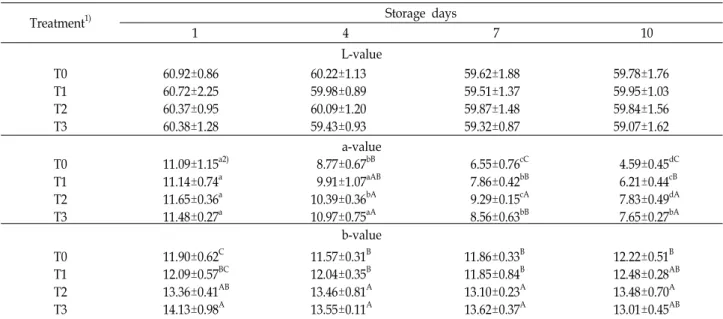
Table 3. Changes of L-, a- and b-value of ground pork with dried persimmon peel powder during storage at 4℃
Treatment1) Storage days
1 4 7 10
L-value T0
T1 T2 T3
60.92±0.86 60.72±2.25 60.37±0.95 60.38±1.28
60.22±1.13 59.98±0.89 60.09±1.20 59.43±0.93
59.62±1.88 59.51±1.37 59.87±1.48 59.32±0.87
59.78±1.76 59.95±1.03 59.84±1.56 59.07±1.62 a-value
T0 T1 T2 T3
11.09±1.15a2) 11.14±0.74a 11.65±0.36a 11.48±0.27a
8.77±0.67bB 9.91±1.07aAB 10.39±0.36bA 10.97±0.75aA
6.55±0.76cC 7.86±0.42bB 9.29±0.15cA 8.56±0.63bB
4.59±0.45dC 6.21±0.44cB 7.83±0.49dA 7.65±0.27bA b-value
T0 T1 T2 T3
11.90±0.62C 12.09±0.57BC 13.36±0.41AB 14.13±0.98A
11.57±0.31B 12.04±0.35B 13.46±0.81A 13.55±0.11A
11.86±0.33B 11.85±0.84B 13.10±0.23A 13.62±0.37A
12.22±0.51B 12.48±0.28AB 13.48±0.70A 13.01±0.45AB
1)T0: ground pork without persimmon peel; T1: ground pork with 0.3% persimmon peel; T2: ground pork with 0.7% persimmon peel; T3: ground pork with 1% persimmon peel.
2)Mean ± SD., Values with different superscript within a same rowa~d and columnA~C are significantly different (p<0.05*, p<0.01**, p<0.001***).
및 응집성(cohesiveness)을 측정하였는데, 측정 조건은 table speed 120 mm/min, graph interval 30 m/sec, load cell (Max) 2 kg의 조건으로 하였다. 그리고 검성(gumminess)은 peak max × cohesiveness로, 씹힘성(chewiness)은 (peak max ÷ distance) × cohesiveness × springiness로 계산하였다.
통계처리
본 실험은 분쇄 돈육을 실험항목별로 3회이상 반복 측정하 였다. 통계 분석은 SPSS 16.0 (statistical package for social science, SPSS Inc., Chicago, IL, USA)을 이용하여 평균±표준 편차를 구하였으며, 일원분산분석(One-way ANOVA)을 한 후, 시료 간 차이를 Duncan’s multiple range test를 이용하여 유의성을 검정하였다.
결과 및 고찰 pH 변화
감 껍질 첨가 유무에 따른 분쇄 돈육의 pH 결과는 Table 2와 같다. 모든 시료들의 pH는 저장 기간의 경과와 함께 유의 하게 증가하였다(p<0.001). 시료들 사이의 pH는 저장 1, 4 및 10일째 감 껍질 첨가량이 많을수록 낮았다(p<0.01). 저장 중 pH의 증가가 하는 것은 단백질의 분해로 염기성 물질이 축적 되어 나타나며[23, 46], 감 껍질 첨가로 pH가 낮아진 것은 감 껍질에 함유된 유기산[22]과 ascorbic acid [32]가 영향을 미친 것으로 판단되며, 본 연구의 결과는 포도과피를 첨가한 분쇄 돈육[6], 연근 및 연잎분말을 첨가한 분쇄 돈육[8]의 경우 분말 의 첨가 농도가 높으면 pH가 낮아진다는 결과와 일치하였다.
색도 변화
분쇄돈육을 10일 동안 냉장하면서 실험한 색도의 결과는
Table 4. Changes of TBARS content of ground pork with dried persimmon peel powder during storage at 4℃ (mg/kg)
Treatment1) Storage days
1 4 7 10
T0 T1 T2 T3
0.27±0.02d2) 0.26±0.01d 0.26±0.01d 0.24±0.01d
0.44±0.02cA 0.36±0.02cB 0.30±0.01cC 0.29±0.02cC
0.84±0.02bA 0.68±0.02bB 0.39±0.02bC 0.36±0.02bC
1.15±0.06aA 0.88±0.02aB 0.44±0.01aC 0.43±0.02aC
1)T0: ground pork without persimmon peel; T1: ground pork with 0.3% persimmon peel; T2: ground pork with 0.7% persimmon peel; T3: ground pork with 1% persimmon peel.
2)Mean ± SD., Values with different superscript within a same rowa~d and columnA~C are significantly different (p<0.05*, p<0.001***).
Table 5. Changes of DPPH radical scavenging activity of ground pork with dried persimmon peel powder during storage at 4℃ (%)
Treatment1) Storage days
1 4 7 10
T0 T1 T2 T3
14.60±1.60aD2) 21.45±0.66aC 25.46±1.32aB 28.82±0.43aA
13.22±1.28aD 20.81±0.28aC 24.29±0.87abB 26.52±1.17bA
10.91±0.79bC 19.11±0.43bB 23.55±0.57bcA 24.28±0.42cA
10.32±0.62bD 17.95±1.25bC 21.39±0.94cB 23.49±1.09cA
1)T0: ground pork without persimmon peel; T1: ground pork with 0.3% persimmon peel; T2: ground pork with 0.7% persimmon peel; T3: ground pork with 1% persimmon peel.
2) a~d A~C ** ***
Table 3과 같다. L-value는 저장 1일부터 10일까지 유의한 변 화가 없었으며, 시료들 사이에도 유의한 차이가 없어서 감 껍 질의 첨가는 L-value에 영향을 미치지 않음을 알 수 있었다.
분쇄 돈육의 a-value는 저장 1일째가 가장 높았으며, 저장기간 동안 감소하여 저장 10일째는 가장 낮았다(p<0.001). 그리고 시료들 사이의 a-value는 저장 1일째는 시료들 사이에 유의한 차이가 없었지만 감 껍질을 0.7% 첨가한 T2가 높은 경향이었 다. 분쇄 돈육의 b-value는 저장 1일부터 10일까지 유의한 변 화를 보이지 않았다. 그러나 시료들 사이에는 1일(p<0.05), 4일 (p<0.01), 7일(p<0.01), 10일(p<0.05)에 T0보다 T2 및 T3가 더 높았다. 식육 및 그 제품의 적색도 유지는 관능적 구매욕구를 일으키는 중요한 지표로서 Sánchez-Escalante 등[41]은 식물 에 함유된 항산화 물질이 적색도를 높게 유지한다고 하였으 며, Candogan [4]은 식물에 함유된 색소가 육제품의 적색도를 높인다고 보고하였다. Huang 등[18]은 연근 뿌리 추출물의 첨가가 metmyoglobin의 형성을 지연시켜 적색도 유지에 영 향을 미친다고 하였으며, Yildiz-Turp와 Serdaroglu [47]은 플 럼퓨레를 첨가한 경우 함유된 anthocyanin이 우육 패티의 적 색도를 개선한다고 하였다. 본 연구에서도 감 껍질에 함유된 항산화 물질[20]의 항산화작용으로 적색도가 유지되고 있었으 며, 감 껍질에 함유된 lycopene [39]이 적색도 향상에 기여한 것으로 판단된다.
TBARS 변화
분쇄 돈육을 10일 동안 냉장하면서 실험한 TBARS의 결과
는 Table 4와 같다. 그 결과 분쇄 돈육의 TBARS는 저장 기간의 경과와 함께 저장 10일째는 T0, T1, T2 및 T3가 각각 1.15, 0.88, 0.44 및 0.43 mg/kg을 나타내었다(p<0.001). 시료들 사이에는 저장 1일째는 차이가 없었지만 4일부터는 T2 및 T3가 T0 및 T1보다 더 낮았다(p<0.001). 저장 중 TBARS의 변화에 대하여 Juntachote 등[24]은 바질을 첨가한 분쇄 돈육이 대조군보다 낮았다고 하였으며, Kim 등[25]은 토마토 페이스트를 첨가한 돈육 패티는 대조군보다 낮다고 하였다. 또한 Choi와 Lee [6]
는 포도과피를 첨가한 분쇄 돈육, Devatkal 등[11]은 키노와 석류 껍질을 첨가한 분쇄육의 TBARS가 대조군보다 낮다고 하여 본 연구의 결과와 유사하였다. 이들은 첨가한 식물에 함 유된 polyphenol [14]이 지방 산화를 억제하여 TBARS를 낮게 한다고 하였으며, 감에도 항산화 물질인 carotene류와 poly- phenol류가 함유되어 있다[35].
DPPH free radical 소거 활성의 변화
Table 5는 냉장 중 분쇄 돈육의 DPPH free radical 소거 활성 측정한 결과이다. 저장 중 DPPH free radical 소거 활성 은 점차적으로 감소하여 10일째는 T0, T1, T2 및 T3가 각각 10.32%(p<0.01), 17.95%(p<0.01), 21.39%(p<0.01) 및 23.49%(p<
0.001)를 나타내었다. 시료들 사이에는 대조군보다 감 껍질 첨 가 정도에 따라 높은 결과를 나타내었다(p<0.001). 감 껍질을 첨가한 분쇄 돈육의 DPPH free radical 소거 활성이 대조군보 다 높은 것은 폴리페놀 성분이 분쇄 돈육에 남아있기 때문이 며[20], Kim 등[26]은 아로니아를 첨가한 돈육 patty, Ha 등
Table 6. Changes of VBN content of ground pork with dried persimmon peel powder during storage at 4℃ (mg%)
Treatment1) Storage days
1 4 7 10
T0 T1 T2 T3
9.32±0.49c2) 9.44±0.65b 9.42±0.81c 9.27±0.73b
10.28±0.53bc 9.71±0.39b 9.58±0.44bc 9.61±0.49ab
10.91±0.93b 11.03±0.61a 10.70±0.61ab 10.59±0.67ab
13.11±0.91aA 11.83±0.27aAB 11.11±0.58aB 10.91±0.80aB
1)T0: ground pork without persimmon peel; T1: ground pork with 0.3% persimmon peel; T2: ground pork with 0.7% persimmon peel; T3: ground pork with 1% persimmon peel.
2)Mean ± SD., Values with different superscript within a same rowa~d are significantly different (p<0.05*, p<0.01**).
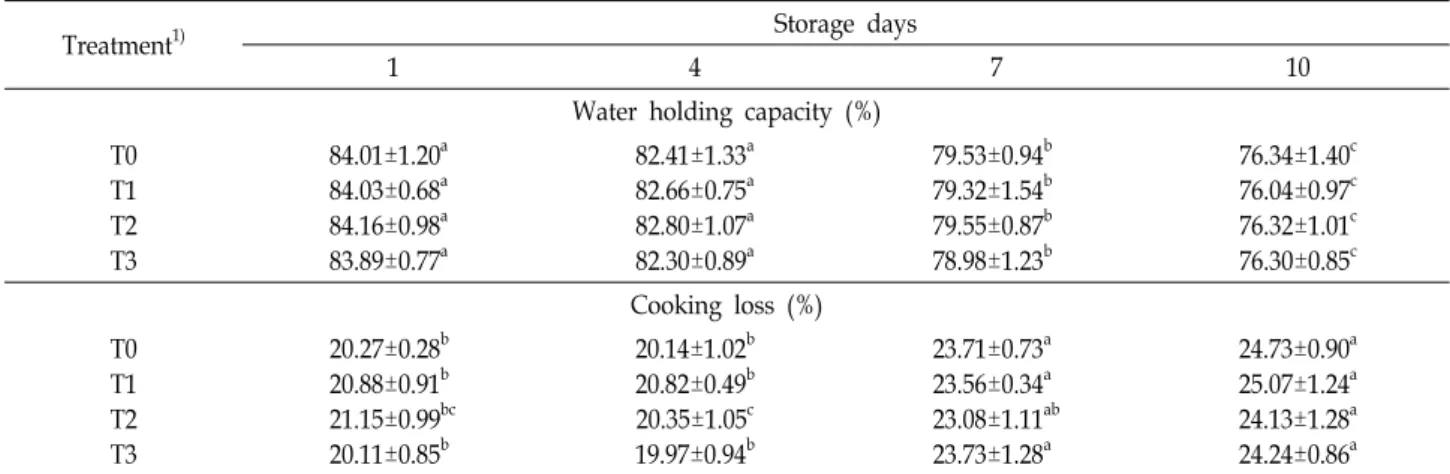
Table 7. Changes of water holding capacity and cooking loss of ground pork with dried persimmon peel powder during storage at 4℃
Treatment1) Storage days
1 4 7 10
Water holding capacity (%) T0
T1 T2 T3
84.01±1.20a 84.03±0.68a 84.16±0.98a 83.89±0.77a
82.41±1.33a 82.66±0.75a 82.80±1.07a 82.30±0.89a
79.53±0.94b 79.32±1.54b 79.55±0.87b 78.98±1.23b
76.34±1.40c 76.04±0.97c 76.32±1.01c 76.30±0.85c Cooking loss (%)
T0 T1 T2 T3
20.27±0.28b 20.88±0.91b 21.15±0.99bc 20.11±0.85b
20.14±1.02b 20.82±0.49b 20.35±1.05c 19.97±0.94b
23.71±0.73a 23.56±0.34a 23.08±1.11ab 23.73±1.28a
24.73±0.90a 25.07±1.24a 24.13±1.28a 24.24±0.86a
1)T0: ground pork without persimmon peel; T1: ground pork with 0.3% persimmon peel; T2: ground pork with 0.7% persimmon peel; T3: ground pork with 1% persimmon peel.
2)Mean ± SD., Values with different superscript within a same rowa~d are significantly different (p<0.05*, p<0.01**, p<0.001***).
[16]은 레드비트를 첨가한 소시지, Cuong과 Chin [10]은 구지 뽕나무 잎 분말의 첨가한 돈육 patty의 DPPH free radical 소 거 활성이 높다고 하여서 본 연구의 결과와 유사하였다.
VBN함량 변화
분쇄 돈육의 VBN함량을 측정한 결과는 Table 6과 같다.
VBN함량은 저장 기간의 경과와 함께 점차적으로 증가하여 저장 10일째에는 T0, T1, T2 및 T3가 각각 13.11(p<0.01), 11.83 (p<0.01), 11.11(p<0.05) 및 10.91 mg%(p<0.05)을 나타내었다.
각 시료들을 비교하면 저장 1, 4 및 7일째에는 차이가 없었지 만 저장 10일째에는 T0가 가장 높고, 감 껍질 1,0% 함유한 T3 가 가장 낮았다(p<0.05). Jeong 등[21]은 저장 중 돈육 patty의 VBN함량은 증가하였고, procyanidin을 첨가한 것이 대조군 보다 낮았다고 하였으며, Lee 등[33]은 소시지 저장 중 VBN함 량은 증가하지만 양파껍질을 첨가하였을 때에는 대조군보다 실험군의 VBN함량이 낮아지는데 이것은 양파에 함유된 항균 물질이 영향을 미친 것으로 보고하였다. 본 연구의 결과 감 껍질 첨가군의 VBN함량이 낮은 것은 유기산, ascorbic acid, tannin [15]의 항균 작용에 기인하는 것으로 판단되며, Choi와
Lee [6]의 포도과피를 첨가한 분쇄 돈육, Lee와 Choi [30]의 감귤껍질을 첨가한 돈육 patty의 VBN함량이 대조군보다 낮았 다는 결과와 일치하는 경향이었다.
보수력 및 가열 감량 변화
분쇄 돈육을 냉장하면서 보수력과 가열 감량을 측정한 결과 는 Table 7과 같다. 시료들의 보수력은 저장 기간의 경과와 함께 점차적으로 감소하였으며, 가열 감량은 저장기간이 경과 하면서 증가하는 경향이었다. 그러나 저장 중 보수력은 낮아 지고 가열 감량은 높아졌지만 감 껍질 첨가에 의한 영향이 없었다. 보수력과 가열 감량은 근원섬유 내에서 수분과 지방 의 유출을 방지하는 단백질의 능력에 의하여 결정되는데[1], Choi 등[7]은 민들레 추출액을 첨가한 돈육 patty, Lee와 Choi [30]는 감귤 껍질 분말을 첨가한 돈육 patty의 보수력은 저장 중 감소하고 가열 감량은 높아진다고 하여 본 연구의 결과와 일치하였다. 본 연구에서 냉장 중 보수력이 감소하고 가열 감 량이 증가하는 것은 냉장에 의하여 근원섬유의 구조가 변화하 면서 수분과 지방을 유지하려는 능력이 감소하여 나타난 결과 로 판단된다.
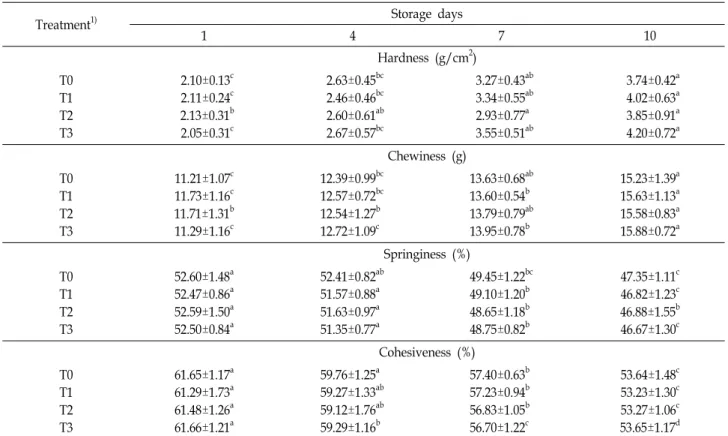
Table 8. Changes of hardness, chewiness, springiness and cohesiveness of ground pork with dried persimmon peel powder during storage at 4℃
Treatment1) Storage days
1 4 7 10
Hardness (g/cm2) T0
T1 T2 T3
2.10±0.13c 2.11±0.24c 2.13±0.31b 2.05±0.31c
2.63±0.45bc 2.46±0.46bc 2.60±0.61ab 2.67±0.57bc
3.27±0.43ab 3.34±0.55ab 2.93±0.77a 3.55±0.51ab
3.74±0.42a 4.02±0.63a 3.85±0.91a 4.20±0.72a Chewiness (g)
T0 T1 T2 T3
11.21±1.07c 11.73±1.16c 11.71±1.31b 11.29±1.16c
12.39±0.99bc 12.57±0.72bc 12.54±1.27b 12.72±1.09c
13.63±0.68ab 13.60±0.54b 13.79±0.79ab 13.95±0.78b
15.23±1.39a 15.63±1.13a 15.58±0.83a 15.88±0.72a Springiness (%)
T0 T1 T2 T3
52.60±1.48a 52.47±0.86a 52.59±1.50a 52.50±0.84a
52.41±0.82ab 51.57±0.88a 51.63±0.97a 51.35±0.77a
49.45±1.22bc 49.10±1.20b 48.65±1.18b 48.75±0.82b
47.35±1.11c 46.82±1.23c 46.88±1.55b 46.67±1.30c Cohesiveness (%)
T0 T1 T2 T3
61.65±1.17a 61.29±1.73a 61.48±1.26a 61.66±1.21a
59.76±1.25a 59.27±1.33ab 59.12±1.76ab 59.29±1.16b
57.40±0.63b 57.23±0.94b 56.83±1.05b 56.70±1.22c
53.64±1.48c 53.23±1.30c 53.27±1.06c 53.65±1.17d
1)T0: ground pork without persimmon peel; T1: ground pork with 0.3% persimmon peel; T2: ground pork with 0.7% persimmon peel; T3: ground pork with 1% persimmon peel.
2)Mean ± SD., Values with different superscript within a same rowa~d are significantly different (p<0.05*, p<0.01**, p<0.001***).
기계적 조직감 변화
냉장 중 분쇄 돈육의 경도, 씹힘성, 탄성 및 응집성을 측정한 결과를 Table 8에 나타내었다. 저장 중 경도와 씹힘성은 유의 하게 증가하였으며, 탄성과 응집성은 감소하는 경향이었다.
그러나 시료들 사이에의 경도, 씹힘성, 탄성 및 응집성의 차이 가 없었다. Lala 등[29]은 로즈마리와 레몬 밤의 첨가가 탄성과 응집성을 감소시키며, Youssef와 Barbut [49]는 수분 손실로 경도가 증가한다고 하였다. Choe 등[5]의 미역취(goldenrod) 잎과 줄기 분말을 첨가한 소시지, Kim 등[26]의 아로니아 분말 을 첨가한 돈육 patty는 대조군과 첨가군 사이에 기계적 조직 감의 차이가 없다고 하여서 본 연구 결과와 일치하는 경향이 었다.
References
1. Aleson-Carbonell, L., Fernandez-Lopez, J., Perez-Alvrez, J.
A. and Kuri, V. 2005. Characteristics of beef burger as influ- enced by various types of lemon albedo. Innov. Food Sci.
Emerg. Technol. 6, 247-225.
2. Blois, M. S. 1958. Antioxidant determination by the use of
3. Buege, A. J. and Aust, S. D. 1978. Microsomal lipid perox- idation. In Methods in Enzymology. Gleischer S. and Parker L. (ed.), Academic Press Inc., New York pp. 302-310.
4. Candogan, K. 2002. The effects of tomato puree on some quality characteristics of beef patties during refrigerated storage. European Food Res. Technol. 215, 305-309.
5. Choe, J. H., Kim, H. Y., Han, D. J. and Kim, Y. J. 2011. Effect of goldenrod (Solidago virgaurea) leaf and stem powder on physical and sensory characteristics of emulsion-type sau- sages. Kor. J. Food Sci. Ani. Resour. 31, 668-675.
6. Choi, G. W. and Lee, J. W. 2016. Changes in physicochemical properties of ground pork meat containing grape peel dur- ing refrigerated storage. J. Life Sci. 26, 1041-1048.
7. Choi, Y. J., Park, H. S., Lee, J. S., Park, K. S., Park, S. S.
and Jung, I. C. 2015. Changes in physicochemical properties of pork patty with dandelion extract during refrigerated storage. Kor. J. Food Cook. Sci. 31, 423-430.
8. Choi, Y. J., Park, H. S., Park, K. S., Lee, K. S., Moon, Y.
H., Kim, M. J. and Jung, I. C. 2012. Quality characteristics of pork patty containing lotus root and leaf powder. J. East Asian Soc. Dietary Life 22, 33-40.
9. Costa, M. P., Monteiro, M. L. G., Frasao, B., S., Silva, V.
L. M., Rodrigues, B. L., Chiappini, C. C. J. and Conte-Junior, C. A. 2017. Consumer perception, health information and
instrumental parameters of cupuassu (Theobroma grandi- florum) goat milk yogurts. J. Dairy Sai. 100, 157-168.
10. Cuong, T. V. and Chin, K. B. 2018. Evaluation of Cudrania tricuspidata leaf on antioxidant activities and physicochem- ical properties of pork patties. Kor. J. Food Sci. An. 38, 889- 900.
11. Devatkal, S. K., Narsaiah, K. and Borah, A. 2010. Anti-oxi- dant effect of extracts of kinnow rind, pomegranate rind and seed powders in cooked goat meat patties. Meat Sci.
85, 155-159.
12. Falowo, A. B., Fayemi, P. O. and Muchenje, V. 2014. Natural antioxidants against lipid-protein oxidative deterioration in meat and meat products : A review. Food Res. Int. 64, 171- 181.
13. Giordani, E., Doumett, S., Nin, S. and Del Bubba, M. 2011.
Selected primary and secondary metabolites in fresh persim- mon (Diospyros kaki Thunb.): A review of analytical methods and current knowledge of fruit composition and health benefits. Food Res. Ind. 44, 1752-1767.
14. Gorinstein, S., Kulasek, G. W., Bartnikowska, E., Leontowicz, M., Zemser, M., Morawiec, M. and Trakhtenberg, S. 1998.
The influence of persimmon peel and persimmon pulp on lipid metabolism and antioxidant activity of rats fed choles- terol. Nutr. Biochem. 9, 223-227.
15. Gurung, M., Adhikari, B. B., Kawakita, H., Ohto, K., Inoue, K. and Alam, S. 2011. Recovery of Au (III) by using low cost adsorbent prepared from persimmon tannin extract.
Chemical Engineering J. 174, 556-563.
16. Ha, S. R., Choi, J. S. and Jin, S. K. 2015. The physicochemical properties of pork sausages with red beet powder. J. Life Sci. 25, 896-902.
17. Hoffman, K., Hamm, R. and Blüchel, E. 1982. Neues über die best immung der wasserbindung des fleisches mit hilfe der filterpapierpress methode. Fleischwirtschaft 62, 87-93.
18. Huang, B., He, J. S., Ban, X. Q., Zeng, H., Yao, X. C. and Wang, Y. W. 2011. Antioxidant activity of bovin and porcine meat treated withextracts from edible lotus (Nelumbo nuci- fera) rhizome knot and leaf. Meat Sci. 87, 46-53.
19. Huang, S., Liu, B., Ge, D. and Dai, J. 2017. Effect of com- bined treatment with supercritical CO2 and rosemary on mi- crobiological and physicochemical properties of ground pork stored at 4℃. Meat Sci. 125, 114-120.
20. Itoh, T., Ohguchi, K., Nakajima, C., Oyama, M., Iinuma, M., Nozawa, Y., Akao, Y. and Ito, M. 2011. Inhibitory effects of flavonoid glycosides isolated from the peel od Japanese persimmon (Diospyros kaki Fuyu) on antigen-stimulated de- granulation in rat basophilic leukaemia RBL-2H3 cells. Food Chem. 126, 289-294.
21. Jeong, J. Y., Seol, K. H., Seong, P. N., Park, B. Y. and Kim, H. W. 2015. Effects of procyanidin on meat quality and shelf-life for preserving pork patties during chilled storage.
Kor. J. Food Sci. An. 35, 564-571.
22. Jeong, Y. J., Seo, J. H., Lee, G. D., Lee, M. H. and Yoon, S. R. 2000. Changes in quality characteristics of traditional kochujang prepared with apple and persimmon during fermentation. J. Kor. Soc. Food Sci. Nutr. 29, 575-581.
23. Jung, I. C., Kim, Y. K. and Moon, Y. H. 2002. Effects of addition perilla leaf powder on the surface color, residual nitrite and shelf-life of pork sausage. J. Life Sci. 12, 654-661.
24. Juntachote, T., Berghofer, E., Siebenhandl, S. and Bauer, F.
2007. Antioxidative effect of added dried Holy basil and its ethanolic extracts on susceptibility of cooked ground pork to lipid oxidation. Food Chem. 100, 129-135.
25. Kim, I. S., Jin, S. K., Yang, M. R., Chu, G. M., Park, J. H., Rashid, R. H., Kim, J. Y. and Kang, S. N. 2013. Efficacy of tomato powder as antioxidant in cooked pork patties. Asian Australas J. Anim. Sci. 26, 1339-1346.
26. Kim, M. H. Joo, S. Y. and Choi, H. Y. 2015. The effect of aronia powder (Aronia melanocarpa) on antioxidant activity and quality characteristics of pork patties. Kor. J. Food Cook.
Sci. 31, 82-90.
27. Kim, S. K., Lee, G. D. and Chung, S. K. 2003. Monitering on fermentation of persimmon vinegar from persimmon peel. Kor. J. Food Sci. Technol. 35, 642-647.
28. Korea Food & Drug Administration (KFDA). 2009. Fode Code. Munyoungsa, Seoul, pp. 212-251.
29. Lara, M. S., Gutierrez, J. I., Timón, M. and Andrés, A. I.
2011. Evaluation of two natural extracts (Rosmarinus officina- lis L. and Melissa officinalis L.) as antioxidants in cooked pork patties packed in MAP. Meat Sci. 88, 481-488.
30. Lee, J. W. and Choi, G. W. 2016. Physicochemical properties of pork patties with tangerine (Citrus unshiu) during re- frigeration storage. J. East Asian Soc. Diet. Life 26, 250-259.
31. Lee, S. M., Kim, I. H. and Choi, Y. M. 2016. Effects of persim- mon peel supplementation on pork quality, palatability, fat- ty acid composition, and cholesterol level. J. Anim. Sci.
Technol. 58, 1-7.
32. Lee, S. O., Chung, S. K. and Lee, I. S. 2006. The antidiabetic effect of dietary persimmon (Diospyros kaki L. cv. Sangju- dungsi) peel in streptozotocin-induced diabetic rats. J. Food Sci. 71, S293-S298.
33. Lee, S. Y., Kim, H. W., Hwang, K. E., Song, D. H., Choi, M. S., Ham, Y. K., Choi, Y. S., Lee, J. W., Lee, S. K. and Kim, C. J. 2015. Combined effect of kimchi powder and on- ion peel extract on quality characteristics of emulsion sau- sages prepared irradiated pork. Kor. J. Food Sci. An. 35, 277-285.
34. Lim, H. S. and Cha, K. H. 2014. Quality characteristics of cookies with persimmon peel powder. Kor. J. Food Cookery Sci. 30, 620-630.
35. Lucas-González, R., Viuda-Martos, M., Pérez-Álvarez, J. A.
and Fernández-Lόpez, J. 2017. Evaluation of perticle size in- fluence on proximate composition, physicochemical, tech- no-functional and physio-functional properties of flours ob- tained from persimmon (Diospyros kaki Thunb.) coproducts.
Plant Foods Human Nutr. 72, 67-73.
36. Lucas-González, R., Viuda-Martos, M., Pérez-Álvarez, J. A.
and Fernández-Lόpez, J. 2018. Changes in bioaccessibility, polyphenol profile and antioxidant potential of flours ob- tained from persimmon fruit persimmon (Diospyros kaki) co-products during in vitro gastrointestinal digestion. Food Chem. 256, 252-258.
초록:감 껍질을 함유한 분쇄 돈육의 냉장 저장 중 이화학적 특성 변화 최강원*
(대구공업대학교 호텔외식조리계열)
본 연구는 감 껍질을 함유한 분쇄 돈육의 냉장 중 품질 변화에 미치는 영향을 규명하고자 하였다. 분쇄 돈육의 제조는 돈육 68%, 돼지 지방 20%, 소금 2%, 냉수 10%로 배합된 대조군(T0), 냉수에 0.3%의 감 껍질이 함유된 T1, 0.7% 함유된 T2 그리고 1.0% 함유된 T3 등으로 하였다. 분쇄 돈육의 pH는 냉장 중 증가하였으며, T3가 가장 낮았 다(p<0.01). L-value 및 b-value는 냉장 저장 중 변화가 없었지만 a-value는 감소하였다. 냉장 10일째 T2 및 T3의 a-value가 T0 및 T1보다 더 높았다(p<0.001). TBARS는 냉장 기간과 함께 증가하였으며, T2 및 T3가 T0 및 T1보다 더 낮았다(p<0.001). DPPH free radical 소거 능력은 냉장 저장 중 감소하였으며, T0가 가장 낮았다(p<0.001). VBN 함량은 냉장 중 증가하였으며, 10일째 T0의 VBN함량이 가장 높았다(p<0.05). 보수력은 냉장 중 감소하였으며, 가 열 감량은 증가하였다. 그러나 냉장 중 시료들 사이의 보수력과 가열 감량의 차이는 없었다. 냉장 중 경도와 저작 성은 증가하였지만 탄성과 뭉침성은 감소하였다. 본 연구의 결과 분쇄 돈육 제조과정에 감 껍질 분말의 첨가는 항산화 작용, 적색도 유지, 물리적 품질 유지 등의 효과가 있었으며, 첨가량은 0.7%가 가장 적당하였다.
37. Mamet, T., Ge, Z. Z., Zhang, Y. and Li, C. 2018. Interactions between highley galloylated persimmon tannins and pectins.
Int. J. Biol. Macromol. 106, 410-417.
38. Paglarini, C. S., Furtado, G. F., Honόrio, A. R., Mokarzel, L., Vidal, V. A. S., Ribeiro, A. P. B., Cunha, R. L. and Pollonio, M. A. R. 2019. Functional emulsion gels as pork back fat replacers in Bologna sausage. Food Str. 20, 1-9.
39. Plaza, L., Colina, C., Ancos B., Sánchez-Moreno, C. and Cano, M. P. 2012. Influence of ripening and astringency on car- otenoid content of high-pressure treated persimmon fruit (Diospyros kaki L.). Food Chem. 130, 591-597.
40. Ramachandraiah, K. and Chin, K. B. 2016. Evaluation of ball-milling time on the physicochemical and antioxidant properties of persimmon by-products powder. Innov. Food Sci. Emerg. Technol. 37, 115-124.
41. Sánchez-Escalante, A., Djenane, D., Torrescano, G., Beltrán, J. A. and Roncales, P. 2003. Antioxidant action of borage, rosemary, oregano, and ascorbic acid in beef patties pack- aged in modified atmosphere. J. Food Sci. 68, 339-344.
42. Schilling, M. W., Pham, A. J., Williams, J. B., Xiong, Y. L., Dhowlaghar, N., Tolentino, A. C. and Kin, S. 2018. Changes in the physicochemical, microbial, and sensory character- istics of fresh pork sausage containing rosemary and green tea extracts during retail display. Meat Sci. 143, 199-209.
43. Sheridon, P. S. and Shilton, N. C. 2002. Analysisof yield while cooking beef burger patties using far infrared radia- tion. J. Food Eng. 41, 147-153.
44. Shin, D. S., Kim, K. M., Han, S. Y. and Han, G. J. 2013.
Changes in the quality characteristics of Sulgidduk by the addition of persimmon peel. Kor. J. Food Cookery Sci. 29, 479- 487.
45. Suzuki, T., Someya, S., Hu, F. and Tanokura, M. 2005. Com- parative study of catechin compositions in five Japanese persimmon (Diospyros kaki). Food Chem. 93, 149-152.
46. Verma, S. P. and Sahoo, J. 2000. Improvement in the quality of ground chevon during refrigerated storage by tocopherol acetate preblending. Meat Sci. 56, 403-413.
47. Yildiz-Turp, G. and Serdaroglu, M. 2010. Effects of using plum puree on some properties of low fat beef patties. Meat Sci. 86, 896-900.
48. Yokozawa, T., Kim, Y. A., Kim, H. Y., Lee, Y. A. and Nonaka, G. I. 2007. Protective effect of persimmon peel polyphenol against high glucose-induced oxidative stress in LLC-PK1 cells. Food Chem. Toxicol. 45, 1979-1987.
49. Youssef, M. K. and Barbut, D. 2011. Effects of two type of soy protein isolates, native and preheated whey protein iso- lated of emulsified meat batters prepared at different pro- tein levels. Meat Sci. 87, 54-60.