연잎추출물 첨가가 분쇄돈육의 냉장저장 중 이화학적 품질에 미치는 영향
이경수1․김주남1․정인철2†
1영남이공대학교 식음료조리계열, 2대구공업대학교 호텔외식조리계열
Physicochemical Properties of Ground Pork with Lotus Leaf Extract during Refrigerated Storage
Kyung-Soo Lee1, Ju-Nam Kim1 and In-Chul Jung2†
1Division of Food Beverage and Culinary Arts, Youngnam College of Science and Technology, Daegu 705-703, Korea
2Division of Hotel Culinary Arts, Daegu Technical College, Daegu 704-721, Korea
Abstract
This study was carried out to investigate the effect of lotus leaf extract on the physicochemical characteristics of ground pork stored at 4℃ for 10 days. Four types of ground pork were evaluated: ice water added (T0), 3% lotus leaf extract added (T1), 7% lotus leaf extract added (T2), and 10% lotus leaf extract added (T3). The pH was increased during storage, but decreased after 10 days of storage (p<0.05). The TBARS increased with a longer storage period (p<0.05), and those of T0, T1, T2 and T3 were 0.777, 0.244, 0.185, 0.182 mg MA/kg, respectively, after 10 days of storage. The VBN content of T0 and T1 increased with a longer storage period (p<0.05), but those of T2 and T3 were not significantly changed. In the case of surface color, the L* increased with a longer storage period, and that of T0 was the highest (p<0.05). The a* decreased with a longer storage period, and the b* was the highest after 1 day of storage (p<0.05). In the case of internal color, L*
was not significantly changed, and a* was decreased with a longer storage period (p<0.05). The b* increased with a longer storage period (p<0.05). Water holding capacity increased with a longer storage period, and those of T2 and T3 were the highest (p<0.05). Cooking loss decreased with a longer storage period, and those of T0 and T1 were higher than those of T2 and T3 (p<0.05). Hardness and chewiness were not significantly different with a longer storage period, or among any samples.
Key words : Lotus leaf extract, ground pork, physicochemical characteristics.
†Corresponding author : In-Chul Jung, Tel : +82-53-560-3851, Fax : +82-53-60-3859, E-mail : [email protected]
서 론
식육은 도축 후 부위별로 해체하여 용도에 따라 가공하거 나 조리용으로 판매되고 있지만, 지방함량이 낮아 선호도가 떨어지는 등심이나 햄부위 그리고 해체 또는 가공과정에서 발생하는 여분의 고기는 부가가치가 높은 미트볼, 소시지, 너겟, 프레스햄 등 분쇄육제품의 원료로 이용하는 경우가 많 다. 분쇄육제품은 품질이나 관능성의 향상을 위하여 동물성 지방을 30% 전후로 사용하기 때문에, 가공과정에서 산패를 방지하기 위하여 합성산화방지제, 보존성 향상을 위하여 합 성보존료, 관능적 색깔의 향상을 위하여 합성발색제를 사용 한다. 분쇄육제품에 사용되는 합성산화 방지제로서는 BHA, BHT, propyl gallate(MaCarthy et al 2001, Minussi et al 2003), 합성보존료로서 sorbic acid(Montesinos-Herroro et al 2009), 합성발색제로서 질산염 또는 아질산염(Stevanovic et
al 2000) 등을 사용하고 있다. 그러나 과학의 발전으로 합성
식품첨가물의 장기간 섭취가 다양한 인체의 위해요소로 확 인되면서(Branen AL 1975, Cassen RG 1995) 관련 업계 및 학계에서는 합성식품첨가물의 사용을 하지 않거나 줄이려고 노력하고 있다. 그 연구의 일환으로서 oregano 및 sage(Fa- sseas et al 2007), rosemary(Sebranek et al 2005), black pe- pper(Martínez et al 2007)의 항산화 작용, 쑥(Jung et al 2003b), 녹차 및 포도씨(Bañón et al 2007), 마늘 및 양파(Park & Kim 2009) 등의 항균 작용 그리고 쑥(Kim YJ 2011), 토마토(Kang et al 2010), 들깻잎(Jung et al 2003a) 등의 아질산염소거 및 적색도 유지 작용 등이 보고되고 있다. 최근에는 연잎의 생 리활성에 관한 보고들이 이루어지면서 연잎을 육제품에 사 용하는 연구도 가능할 것으로 판단된다.
연(Nelumbo nucifera)은 수생식물로 아시아지역을 중심으 로 재배되고 있으며, 뿌리, 잎, 씨, 꽃 등은 식용 또는 약용으 로 이용하고 있다(Arunyanart & Chaitrayagun 2005, Deng et
al 2009). 식용으로서 연근은 당과, 피클, 튀김, 샐러드 등, 연
잎은 차, 밥, 백숙 등에 이용되고 있다(Chiang & Luo 2007).
또한 한방에서 여러 가지 질병의 치료제로 이용되고 있는데, 연근은 지혈, 혈압 강하, 니코틴 해독, 진정 작용, 당뇨, 위궤 양 및 빈혈 치료, 항비만 작용, 항산화 작용 등(Huang et al 2011, Park et al 2005, Yang et al 2007, Yuka et al 2006), 연잎은 해열, 지혈, 고지혈증 억제, 항산화 작용, 항균 작용, 항암작용 등(Huang et al 2011, Ma et al 2010, Jeong et al 2010), 연꽃은 지혈, 미백작용 등(Chang et al 2007)이 보고되 고 있다. 이렇게 연의 다양한 생리활성들이 보고되고 있지만, 연잎을 육제품에 첨가한 연구는 드물다. 따라서 본 연구에서 는 추출율을 달리하여 연잎추출물을 제조하고, 이것을 분쇄 돈육에 첨가하여 냉장저장 중 이화학적 품질변화를 규명하 고자 하였다.
재료 및 방법
1. 재료 및 분쇄돈육 제조
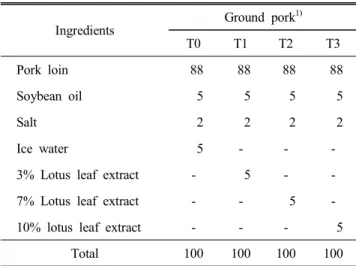
연잎은 동결건조하여 분쇄한 분말을 ㈜다연에서 구입하였 고, 추출물의 제조는 연잎 각각 3%, 7% 및 10%를 증류수 100 mL로 30분간 가열 추출하였으며, 실온에서 1시간 방치 한 후 여과하여 이용하였다. 돈육은 도축 후 약 24시간 정도 경과한 등심을 시중의 축산물 도매점에서 구입하였으며, 과 도한 지방과 결체조직은 제거하여 분쇄돈육 원료로 이용하 였다. 분쇄돈육 제조는 만육기(IS-12S, Ilshin Machine Co., Korea)를 이용하여 돈육등심을 3 mm로 분쇄하였으며, 지방 은 ㈜사조에서 생산된 대두유를 사용하였다. 분쇄돈육 제조 를 위한 원부재료의 배합비율은 Table 1과 같다. 즉, 대조군
Table 1. Formulation of ground pork with lotus leaf extract (%)
Ingredients
Ground pork1)
T0 T1 T2 T3
Pork loin 88 88 88 88
Soybean oil 5 5 5 5
Salt 2 2 2 2
Ice water 5 - - -
3% Lotus leaf extract - 5 - -
7% Lotus leaf extract - - 5 -
10% lotus leaf extract - - - 5
Total 100 100 100 100
1) T0: control, T1: ground pork with 3% lotus leaf extract, T2:
ground pork with 5% lotus leaf extract, T3: ground pork with
(T0)은 분쇄한 돈육 88%와 대두유 5%를 1분간 혼합한 다음 식염 2%와 냉수 5%를 첨가한 후 다시 1분간 혼합하였다. 그 리고 T1은 T0에 첨가한 냉수대신 3% 연잎추출물, T2는 7%
연잎추출물 그리고 T3는 10% 연잎추출물을 첨가하여 네 종 류의 분쇄돈육을 제조하였다. 제조한 분쇄돈육은 직경 약 82 mm, 두께 약 12 mm의 미생물 배양용 페트리 접시에서 무게 100±1 g의 형태로 성형한 후 폴리에틸렌 필름으로 포장하여 24시간 동안 4±1℃의 냉장실에서 겔 형성을 완료하고, 10일 동안 4±1℃의 냉장실에서 저장하면서 실험하였다.
2. pH 측정
분쇄돈육의 pH 측정은 대기온도에서 pH 4와 7 buffer로 보정한 유리전극이 부착된 pH meter(ATI Orion 370, USA)를 이용하여 측정하였는데, 시료는 분쇄한 후 10 g을 취하여 증 류수 40 mL와 함께 균질한 후 측정하였다.
3. TBARS 측정
TBARS(2-thiobarbituric acid reactive substances)는 분쇄돈 육 2 g을 3배의 증류수로 균질한 다음, 여과하여 얻어진 여 과액 1 mL에 7.2% BHT(dibutylhydroxy toluene) 50 μL를 첨 가하고 산화반응을 정지시켰다. 반응 혼합물 2 mL에 TBA (2-thiobatbituric acid) 시약 2 mL를 가하여 혼합한 후 끓는 물에서 15분간 가열하고 냉수에 식힌 다음, 2,000×g로 원심 분리 시켜 상층의 액을 531 nm에서 흡광도를 측정하였다.
공시 대조구도 시료 대신 증류수를 이용하여 같은 방법으로 측정하였다. TBARS는 흡광도 수치에 5.88을 곱하여 계산한 후 시료 kg당 반응물 mg malonaldehyde로 계산하였다(Buege
& Aust 1978).
4. VBN 함량측정
VBN(volatile basic nitrogen) 함량은 Conway unit를 이용 한 미량확산법(KFDA 2009)에 의하여 측정하였다. 즉, 시료 2 g을 증류수 16 mL와 20% perchloric acid 2 mL를 넣고 혼 합한 후, 3,000 rpm에서 15분 동안 원심 분리하여 상층의 액 을 취하였다. 이 액 1 mL와 50% K2CO3 1 mL를 Conway unit 외실에 넣고, 내실에는 10% 붕산흡수제 1 mL를 가한 후 37
℃에서 80분 동안 방치한 다음 0.01 N NaOH로 적정하였다.
그리고 공시 대조구도 같은 방법으로 처리하여 아래와 같은 계산식에 의하여 VBN 함량을 구하였다.
VBN (mg%) = 0.14 × (b—a)×f
× 100 × d W
a: 공시험의 0.01 N NaOH 적정량(mL) b: 시료의 0.01 N NaOH 적정량(mL)
W: 시료 채취량(g) f: 0.01 N NaOH의 역가
d: 희석배수
5. 색깔 측정
분쇄돈육의 색깔은 색차계(CR-200b, Minolta Camera Co., Japan)를 이용하여, 명도(lightness, L-value), 적색도(redness, a-value) 및 황색도(yellowness, b-value)를 측정하였다. 색 보 정을 위해 사용된 표준 백색판의 L-, a- 및 b-value은 각각 92.36, —0.05 및 2.23이었다. 표면 및 내부의 색깔은 냉장고 에서 꺼내는 즉시 측정하였으며, 내부의 측정은 6 mm를 절 단한 중심부에 폴리에틸렌 필름으로 감싼 후 측정하였다.
6. 보수력 및 가열감량 측정
분쇄돈육의 보수력은 Hoffman et al(1982)의 방법으로 측 정하였는데, 데시케이터에서 습기를 제거한 여과지 위에 시 료 0.3 g을 올려놓고, planimeter(X-plan, Ushikata 360d II, Japan)로 눌러 여과지 위에 나타난 수분의 면적을 구하고, 육 의 표면적을 수분의 면적으로 나눈 값으로 표시하였다. 가열 감량을 위한 가열은 가스오븐렌지(RFO-900, Rinnai Co., Korea)에서 200℃로 중심부의 온도가 75℃가 되도록 가열하 고, 가열 전후의 무게 차이를 백분율로 나타내었다.
7. 경도 및 씹힘성 측정
경도 및 씹힘성은 분쇄돈육을 가로×세로×높이를 각각 40
×15×5 mm로 자르고, rheometer(CR-200D, SUN Scientific Co., Japan)를 이용하여 측정하였다. 경도(hardness)는 round adapter 25번을 이용하여 table speed 120 mm/min, graph interval 30 m/sec, load cell(Max) 2 kg의 조건으로 측정하였 다. 그리고 씹힘성(chewiness)은 (peak max÷distance)×cohesi- veness×springiness 값으로 나타내었다.
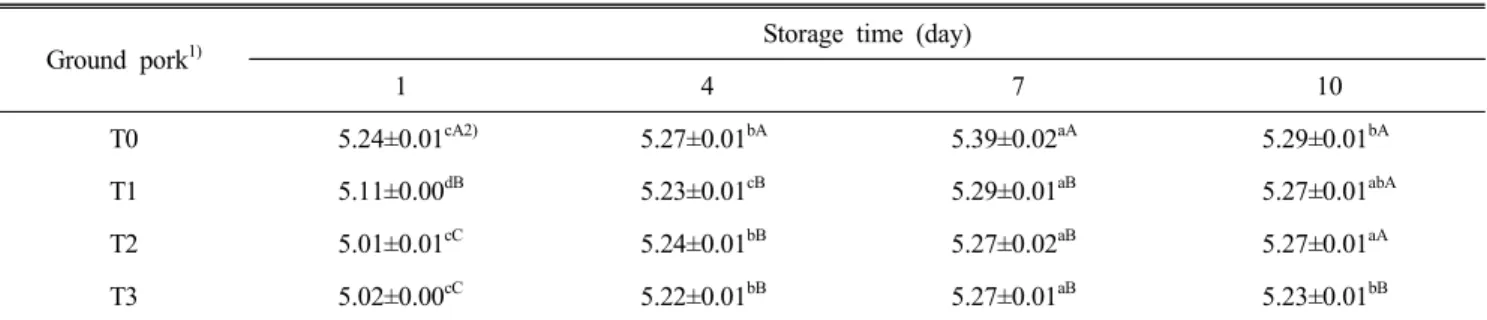
Table 2. Changes in pH of ground pork meat with lotus leaf extract during storage at 4℃ Ground pork1)
Storage time (day)
1 4 7 10
T0 5.24±0.01cA2) 5.27±0.01bA 5.39±0.02aA 5.29±0.01bA
T1 5.11±0.00dB 5.23±0.01cB 5.29±0.01aB 5.27±0.01abA
T2 5.01±0.01cC 5.24±0.01bB 5.27±0.02aB 5.27±0.01aA
T3 5.02±0.00cC 5.22±0.01bB 5.27±0.01aB 5.23±0.01bB
1) T0: control, T1: ground pork with 3% lotus leaf extract, T2: ground pork with 5% lotus leaf extract, T3: ground pork with 10%
lotus leaf extract.
2) Mean±SD (n=5), Means in rowa~d and columnA~C followed by different superscripts are significantly different at p<0.05 by Duncan’s multiple range test.
8. 통계처리
통계처리를 위하여 모든 실험은 3회 이상 반복 측정한 후 평균±표준편차로 나타내었고, 통계처리는 SPSS 14.0(statis- tical package for social science, SPSS Inc., Chicago II., USA) 을 이용하였으며, 실험군들 사이의 유의성은 p<0.05 수준에 서 분산분석(ANOVA)을 실시한 후, 유의한 차이가 있는 경 우 p<0.05 수준에서 Duncan's multiple test로 시료들 사이의 유의성을 검정하였다.
결과 및 고찰
1. 냉장 중 분쇄돈육의 pH 변화
연잎 추출물의 농도를 다르게 하여 첨가한 분쇄돈육을 4
℃에 저장하면서 pH의 변화를 관찰하고, 그 결과를 Table 2 에 나타내었다. 저장초기 T0, T1, T2 및 T3의 pH는 각각 5.24, 5.11, 5.01 및 5.02로 대조군이 유의하게 높았다(p<0.05). 그 후 냉장기간이 경과하면서 저장 7일째는 각각 5.39, 5.29, 5.27 및 5.39로 유의하게 높아졌다가 냉장 10일째 T0, T1 및 T3는 유의하게 낮아지는 경향이었다(p<0.05). 식품 중의 pH 는 저장 상태에 따라 낮아지는 경우도 있고(Kang et al 2010), 높아지는 경우도 있다(Jung et al 2009). 저장 중 pH가 낮아 지는 원인은 젖산 생성 미생물에 의한 것이며(Keeton JT 1993), 높아지는 것은 단백질 분해에 의한 염기성 물질이 축 적되어 나타난 결과이다(Verma & Sahoo 2000). 그러나 본 연구에서 저장 초기 연잎추출물의 농도가 높은 T2 및 T3의 pH가 낮은 것은 저장 초기이기 때문에 젖산균의 영향은 없 는 것으로 판단되며, 연잎에 함유된 malic acid, succinic acid, acetic acid 등의 유기산(Yang et al 2007)이 영향을 미친 것 으로 판단된다. 그리고 10일 동안 냉장하였을 경우, 10% 연 잎추출물을 첨가한 T3만 낮은 pH를 유지한 것으로 보아, 저 장 중 pH의 변화를 적게 하려면 연잎추출물의 농도를 높게
Table 3. Changes in TBARS value of ground pork meat with lotus leaf extract during storage at 4℃ (mg MA/kg) Ground pork1)
Storage time (day)
1 4 7 10
T0 0.216±0.012dA2) 0.395±0.007cA 0.640±0.016bA 0.777±0.039aA
T1 0.159±0.024cB 0.166±0.005cB 0.190±0.014bB 0.244±0.011aB
T2 0.127±0.009cC 0.164±0.010bB 0.168±0.005bC 0.185±0.014aC
T3 0.117±0.012cD 0.164±0.007bB 0.170±0.012abC 0.182±0.016aC
1) T0: control, T1: ground pork with 3% lotus leaf extract, T2: ground pork with 5% lotus leaf extract, T3: ground pork with 10%
lotus leaf extract.
2) Mean±S.D. (n=3), Means in rowa~d and columnA~D followed by different superscripts are significantly different at p<0.05 by Duncan’s multiple range test.
하는 것이 타당할 것으로 사료된다.
2. 냉장 중 분쇄돈육의 TBARS 변화
분쇄돈육을 냉장하면서 관찰한 TBARS의 변화는 Table 3 과 같다. 저장 초기의 TBARS는 T0, T1, T2 및 T3가 각각 0.216, 0.159, 0.127 및 0.117 mg MA/kg으로 대조군인 T0가 가장 높고, 10% 연잎추출물을 첨가한 T3가 가장 낮았다 (p<0.05). 저장 중 분쇄돈육의 TBARS는 점점 증가하여 냉장 10일째에는 각각 0.777, 0.244, 0.185 및 0.182 mg MA/kg을 나타내었으며, T0가 가장 높고, T2와 T3는 유의한 차이가 없 었다(p<0.05). 지방질 식품의 산패 정도를 판단하는 TBARS 는 자동산화 과정에서 생성되는 malonaldehyde의 양을 측정 함으로써 신선도 지표로 이용되고 있으며(Raharjo & Brewer 1993), Turner et al(1954)은 TBARS가 0.46 mg MA/kg 이하 이면 가식권이고 1.2 mg MA/kg 이상이면 완전히 산패한 것 이라고 하였다. 따라서 T0는 냉장 7일 이후부터 이용하기 불 가능하지만, 연잎추출물을 첨가한 분쇄돈육은 저장 말기까 지 안전한 상태를 유지하였다. 이상의 결과에서 연잎추출물
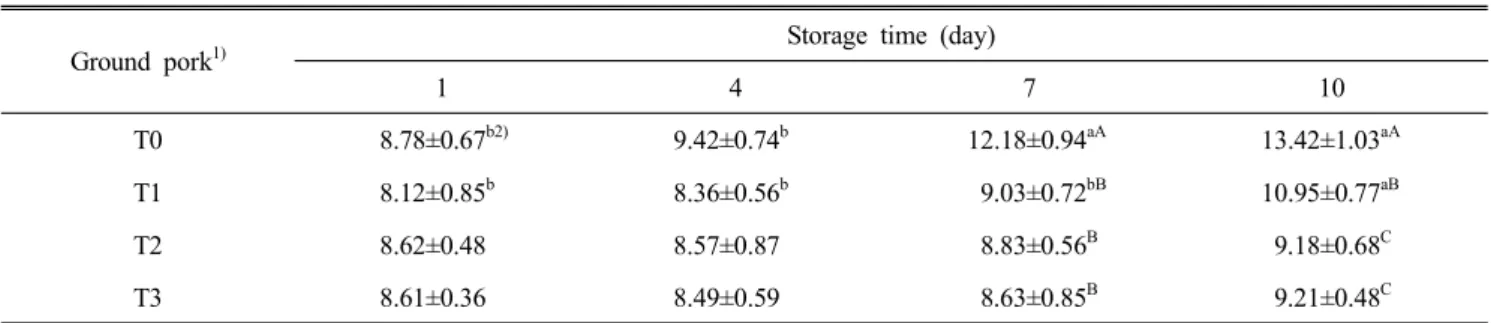
Table 4. Changes in VBN content of ground pork meat with lotus leaf extract during storage at 4℃ (mg%) Ground pork1)
Storage time (day)
1 4 7 10
T0 8.78±0.67b2) 9.42±0.74b 12.18±0.94aA 13.42±1.03aA
T1 8.12±0.85b 8.36±0.56b 9.03±0.72bB 10.95±0.77aB
T2 8.62±0.48 8.57±0.87 8.83±0.56B 9.18±0.68C
T3 8.61±0.36 8.49±0.59 8.63±0.85B 9.21±0.48C
1) T0: control, T1: ground pork with 3% lotus leaf extract, T2: ground pork with 5% lotus leaf extract, T3: ground pork with 10%
lotus leaf extract.
2) Mean±SD (n=3), Means in rowa,b and columnA~C followed by different superscripts are significantly different at p<0.05 by Duncan’s 을 첨가한 분쇄돈육의 TBARS가 낮은 것은 연잎에 함유된 hyperin, isoquercetin, catechin, astragalin, kaempferol, myri- cetin 등의 폴리페놀화합물의 항산화 작용(Awatif et al 2003, Ohkoshi et al 2007)에 의한 것으로 판단된다. 그리고 저장 중 지질의 산패를 적절히 억제하기 위해서 첨가해야 할 연잎 추출물의 농도는 7%가 적당한 것으로 사료된다.
3. 냉장 중 분쇄돈육의 VBN 함량 변화
단백질이 많이 함유된 식품의 VBN(휘발성 염기질소)은 단백질이 albumose, peptone, peptide, amino acid 등의 저분 자 물질로 분해된 것을 세균이 환원작용을 하여 생성된 물질 로서(Coresopo et al 1978), VBN 함량의 증가는 세균의 성장 과 효소작용이 그 원인이기 때문에 단백질의 변패 정도를 나 타내는 지표로 이용되고 있다. Table 4는 냉장저장 중 분쇄 돈육의 VBN 함량 변화를 나타낸 것이다. 저장 초기 VBN 함 량은 T0, T1, T2 및 T3가 각각 8.78, 8.12, 8.62 및 8.61 mg%
로 시료들 사이에 유의한 차이가 없었다. 그러나 저장기간이 경과하면서 T0 및 T1은 VBN 함량이 유의하게 증가하여 10
일째는 13.42 및 10.95 mg%를 나타내었지만(p<0.05), T2 및 T3는 냉장저장 중 유의한 변화가 없었다. 단백질함량이 높은 식육의 신선도 지표로 이용되고 있는 VBN 함량은 20 mg%
이하를 신선하다고 규정하고 있는데(KFDA 2009), 본 연구 의 결과는 모든 시료가 14 mg% 이하를 유지하고 있었다. 그 러나 7%(T2) 및 10%(T3) 연잎추출물을 첨가한 분쇄돈육의 VBN 함량이 대조군(T0)과 3%(T1) 연잎추출물을 첨가한 분 쇄돈육보다 낮은 것은 연잎에 함유된 유기산(Yang et al 2007)과 폴리페놀화합물(Awatif et al 2003, Ohkoshi et al 2007)의 항균 작용으로 미생물의 증식이 억제되면서 나타난 결과로 판단된다.
4. 냉장 중 분쇄돈육의 색깔변화
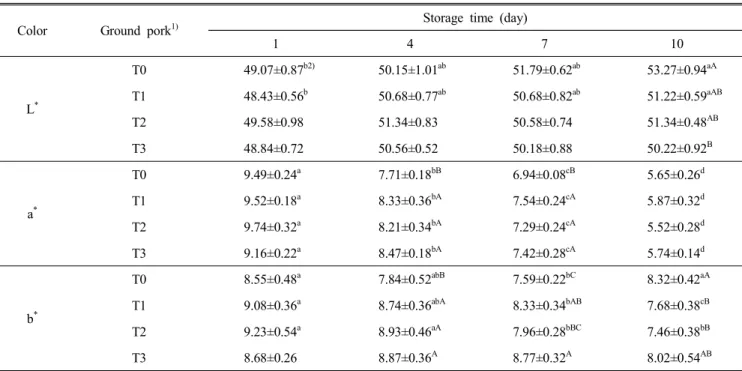
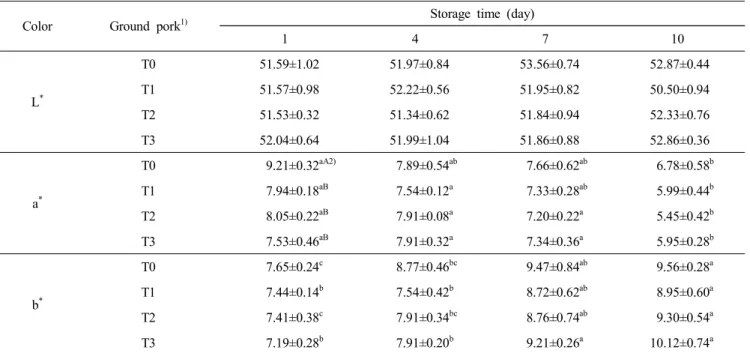
냉장 중 분쇄돈육의 표면 및 내부의 색깔을 측정한 결과 는 Table 5 및 6과 같다. 분쇄돈육의 표면색깔(Table 5)에서 명도(L*)의 경우 T0 및 T1은 저장기간이 경과하면서 유의하 게 증가하였지만(p<0.05), T2 및 T3는 유의한 변화가 없었다.
적색도(a*)는 저장기간이 경과하면서 유의하게 감소하였으 며, 냉장 4일과 7일째의 적색도는 T0가 T1, T2 및 T3보다 유 의하게 낮았다(p<0.05). 그리고 황색도(b*)는 저장 중 유의한 변화가 있었지만, 일률적이지는 않았다(p<0.05). 분쇄돈육의
Table 5. Changes in external color of ground pork meat with lotus leaf extract during storage at 4℃ Color Ground pork1)
Storage time (day)
1 4 7 10
L*
T0 49.07±0.87b2) 50.15±1.01ab 51.79±0.62ab 53.27±0.94aA
T1 48.43±0.56b 50.68±0.77ab 50.68±0.82ab 51.22±0.59aAB
T2 49.58±0.98 51.34±0.83 50.58±0.74 51.34±0.48AB
T3 48.84±0.72 50.56±0.52 50.18±0.88 50.22±0.92B
a*
T0 9.49±0.24a 7.71±0.18bB 6.94±0.08cB 5.65±0.26d
T1 9.52±0.18a 8.33±0.36bA 7.54±0.24cA 5.87±0.32d
T2 9.74±0.32a 8.21±0.34bA 7.29±0.24cA 5.52±0.28d
T3 9.16±0.22a 8.47±0.18bA 7.42±0.28cA 5.74±0.14d
b*
T0 8.55±0.48a 7.84±0.52abB 7.59±0.22bC 8.32±0.42aA
T1 9.08±0.36a 8.74±0.36abA 8.33±0.34bAB 7.68±0.38cB
T2 9.23±0.54a 8.93±0.46aA 7.96±0.28bBC 7.46±0.38bB
T3 8.68±0.26 8.87±0.36A 8.77±0.32A 8.02±0.54AB
1) T0: control, T1: ground pork with 3% lotus leaf extract, T2: ground pork with 5% lotus leaf extract, T3: ground pork with 10%
lotus leaf extract.
2) Mean±SD (n=5), Means in rowa~c and columnA~C followed by different superscripts are significantly different at p<0.05 by Duncan’s multiple range test.
내부 색깔의 경우(Table 6), 명도(L*)는 저장기간의 경과에 의 한 유의한 변화가 없었으며, 시료들 사이에도 유의한 차이가 없었다. 적색도(a*)는 저장기간의 경과와 함께 유의하게 감소 하는 경향이었다(p<0.05). 그리고 황색도(b*)는 저장기간이 경과하면서 유의하게 증가하는 경향이었으며(p<0.05), 이러 한 결과는 내부의 산소분압이 낮아, 표면의 황색도 변화와는 달리 저장 중 metmyoglobin의 형성이 많이 일어나서 나타난 결과로 판단된다. 육제품의 색깔은 myoglobin의 유도체들 즉 deoxymyoglobin(진홍색), oxymyoglobin(선홍색), metmyoglo- bin (암갈색)의 비율에 따라 다르게 나타나며, 이들의 비율이 명도, 적색도 및 황색도의 정도를 결정한다(Lindahl et al 2004). 이 중에서 oxymyoglobin의 산화로 발생하는 암갈색의 metmyoglobin은 적색도의 감소에 영향을 미치는데(Sánchez- Escalante et al 2003), 온도, pH, 산소분압, 지질 산화 등이 metmyoglobin의 형성에 관여한다(Faustman & Cassens 1990).
Huang et al(2011)은 연잎추출물을 분쇄돈육에 첨가하였을 경우 지방산패가 억제되고, metmyoglobin의 형성이 지연된 다고 하였으며, Lee et al(2012)도 분쇄돈육에 연잎추출물을 첨가하였을 경우, 지방산패가 억제되면서 적색도에 영향을 미 치지 않았다고 보고하였다. 이런 결과로 미루어 보아 지방 산패와 색깔의 변화는 밀접한 관계가 있지만, 본 연구에서
Table 6. Changes in internal color of ground pork meat with lotus leaf extract during storage at 4℃ Color Ground pork1)
Storage time (day)
1 4 7 10
L*
T0 51.59±1.02 51.97±0.84 53.56±0.74 52.87±0.44
T1 51.57±0.98 52.22±0.56 51.95±0.82 50.50±0.94
T2 51.53±0.32 51.34±0.62 51.84±0.94 52.33±0.76
T3 52.04±0.64 51.99±1.04 51.86±0.88 52.86±0.36
a*
T0 9.21±0.32aA2) 7.89±0.54ab 7.66±0.62ab 6.78±0.58b
T1 7.94±0.18aB 7.54±0.12a 7.33±0.28ab 5.99±0.44b
T2 8.05±0.22aB 7.91±0.08a 7.20±0.22a 5.45±0.42b
T3 7.53±0.46aB 7.91±0.32a 7.34±0.36a 5.95±0.28b
b*
T0 7.65±0.24c 8.77±0.46bc 9.47±0.84ab 9.56±0.28a
T1 7.44±0.14b 7.54±0.42b 8.72±0.62ab 8.95±0.60a
T2 7.41±0.38c 7.91±0.34bc 8.76±0.74ab 9.30±0.54a
T3 7.19±0.28b 7.91±0.20b 9.21±0.26a 10.12±0.74a
1) T0: control, T1: ground pork with 3% lotus leaf extract, T2: ground pork with 5% lotus leaf extract, T3: ground pork with 10%
lotus leaf extract.
2) Mean±S.D. (n=5), Means in rowa,b and columnA~C followed by different superscripts are significantly different at p<0.05 by Duncan’s multiple range test.
나타난 분쇄돈육의 표면 및 내부의 색깔 변화는 연잎추출물 의 첨가가 영향을 미치지 않았다.
5. 냉장 중 분쇄돈육의 보수력 변화
냉장 중 분쇄돈육의 보수력을 측정한 결과는 Table 7과 같 다. 저장 초기 분쇄돈육의 보수력은 61~63% 사이로 시료들 사이에 유의한 차이가 없었다. 그러나 저장기간의 경과와 함 께 보수력은 증가하여 저장 10일째의 보수력은 T0, T1, T2 및 T3가 각각 66.18%, 72.37%, 78.12% 및 77.25%를 나타내
Table 7. Changes in water holding capacity of ground pork meat with lotus leaf extract during storage at 4℃ (%) Ground pork1)
Storage time (day)
1 4 7 10
T0 61.40±1.46b2) 60.25±1.78bB 65.37±2.12aC 66.18±1.48aC T1 62.40±2.12b 64.37±2.46bA 71.83±1.88aB 72.37±2.64aB T2 61.78±1.84c 65.24±1.24bA 77.72±2.36aA 78.12±2.82aA T3 61.27±2.26b 64.88±1.96bA 75.36±2.24aA 77.25±2.16aA
1) T0: control, T1: ground pork with 3% lotus leaf extract, T2: ground pork with 5% lotus leaf extract, T3: ground pork with 10% lotus leaf extract.
2) Mean±S.D. (n=3), Means in rowa,b and columnA~C followed by different superscripts are significantly different at p<0.05 by Duncan’s multiple range test.
었으며, T0가 가장 낮았고, T2 및 T3가 가장 높았다(p<0.05).
보수력은 근원섬유들 사이에 수분이 유출되지 않고 남아있 는 능력을 측정한 것인데(Huff-Lonergan & Lonergan 2005), 본 연구에서 저장 중 보수력이 증가하는 것은 분쇄돈육 제조 과정에서 첨가한 소금이 근원섬유단백질의 용해도를 증가시 켜 유화력이 높아졌고, 이로 인하여 근원섬유 사이에 존재하 는 수분을 포집하는 능력이 커졌기 때문으로 판단된다. 그리 고 저장 중 시료들 사이에 보수력의 차이가 있는 것은 저장 중 미생물이나 효소에 의하여 단백질의 분해가 진행되면서
수분의 유출이 용이해져서 나타난 결과로 여겨진다. 따라서 저장 10일째 T2와 T3의 보수력이 T0나 T1보다 높은 것은 Table 4의 단백질 변패 정도를 나타낸 VBN 함량의 결과로 해석이 가능하다(Lee et al 2012).
6. 냉장 중 분쇄돈육의 가열감량 변화
냉장 중 분쇄돈육의 가열 감량을 측정한 결과를 Table 8에 나타내었다. 저장 초기 분쇄돈육들의 가열감량은 18~20% 사 이로, 시료들 사이에 유의한 차이가 없었다. 그러나 저장기 간이 경과하면서 유의하게 감소하여 저장 10일째 T0, T1, T2
Table 8. Changes in cooking loss of ground pork meat with lotus leaf extract during storage at 4℃ (%) Ground pork1)
Storage time (day)
1 4 7 10
T0 19.65±0.72a2) 20.47±0.48aA 17.12±0.70bA 16.98±0.84bA T1 19.56±1.02a 19.82±0.66aB 16.57±0.58bAB 16.43±0.38bA T2 18.66±0.88a 17.66±0.82aC 15.25±0.44bB 15.03±0.46bB T3 18.25±0.64a 18.18±0.56aC 15.39±0.60bB 14.98±0.40bB
1) T0: control, T1: ground pork with 3% lotus leaf extract, T2: ground pork with 5% lotus leaf extract, T3: ground pork with 10% lotus leaf extract.
2) Mean±S.D. (n=3), Means in rowa,b and columnA~C followed by different superscripts are significantly different at p<0.05 by Duncan’s multiple range test.
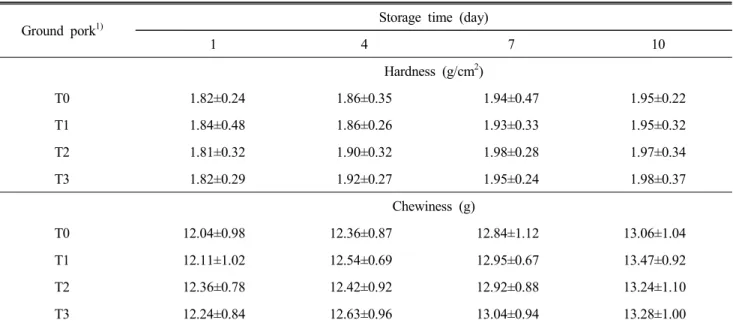
Table 9. Changes in hardness and chewiness of ground pork meat with lotus leaf extract during storage at 4℃
Ground pork1) Storage time (day)
1 4 7 10
Hardness (g/cm2)
T0 1.82±0.24 1.86±0.35 1.94±0.47 1.95±0.22
T1 1.84±0.48 1.86±0.26 1.93±0.33 1.95±0.32
T2 1.81±0.32 1.90±0.32 1.98±0.28 1.97±0.34
T3 1.82±0.29 1.92±0.27 1.95±0.24 1.98±0.37
Chewiness (g)
T0 12.04±0.98 12.36±0.87 12.84±1.12 13.06±1.04
T1 12.11±1.02 12.54±0.69 12.95±0.67 13.47±0.92
T2 12.36±0.78 12.42±0.92 12.92±0.88 13.24±1.10
T3 12.24±0.84 12.63±0.96 13.04±0.94 13.28±1.00
1) T0: control, T1: ground pork with 3% lotus leaf extract, T2: ground pork with 5% lotus leaf extract, T3: ground pork with 10% lotus leaf extract.
2) Mean±S.D. (n=3).
및 T3가 각각 16.98%, 16.43%, 15.03% 및 14.98%를 나타내 었으며, T0 및 T1보다 T2 및 T3의 가열감량이 유의하게 낮 았다(p<0.05). Lee et al (2012)은 연잎추출물의 첨가가 단백 질 변패를 억제하여 수분보유율을 높이기 때문에, 가열에 의 한 감량을 낮게 할 수 있다고 하였다. 그리고 가열감량은 보 수력과 관계가 깊은데, Jung IC(1999)은 보수력이 높으면 가 열감량이 낮아진다고 보고하였다. 따라서 본 연구의 보수력 의 결과(Table 7)에서 보듯이 연잎추출물의 첨가로 단백질의 변패가 억제되면서 보수력이 높아졌고, 이로 인하여 가열감 량이 낮아진 결과로 추측된다.
7. 냉장 중 분쇄돈육의 경도 및 씹힘성 변화
분쇄돈육을 냉장하면서 측정한 경도 및 씹힘성의 결과는 Table 9와 같다. 저장 초기의 경도는 모든 시료가 1.81~1.84 g/cm2이던 것이 저장 10일째는 1.95~1.98 g/cm2으로 증가하 였지만 유의한 변화는 아니었으며, 시료들 사이에도 유의한 차이가 없었다. 씹힘성은 저장초기 모든 시료가 12.04~12.36 g이던 것이 저장 10일째는 13.06~13.47 g으로 증가하였지 만, 유의한 변화는 없었다. 따라서 연잎추출물의 첨가는 분 쇄돈육의 물리적 성질을 나타내는 경도와 씹힘성에 영향을 미치지 않음을 알 수 있었다. 식품을 씹을 때 치아 사이에서 느끼는 특성을 객관적으로 나타내는 조직감인 경도 및 씹힘 성은 제품이 함유한 수분함량, 지방함량, 원료육의 상태, 첨 가물의 종류 등에 따라 다르게 나타나며(Song et al 2000), 지방첨가량이 많아지면 경도와 씹힘성이 낮아진다(Young et
al 1991). 본 연구의 결과는 10% 연잎추출물을 첨가한 분쇄
돈육의 경도 및 씹힘성에 차이가 나지 않았다는 Lee et al(2012)의 결과와 일치하는 경향이었다. 이상의 결과에서 분쇄돈육을 제조할 때에 물 대신 연잎추출물을 첨가하면 저 장 말기의 지방산패와 단백질의 변패가 억제되고, 보수력이 높고 가열감량이 낮은 제품을 얻을 수 있다는 것을 확인하였 다. 그리고 모든 실험항목들을 고려하면 연잎추출물은 7%가 적절한 것으로 판단된다.
요 약
본 연구는 연잎추출물의 첨가가 분쇄돈육의 냉장 중 이화 학적 품질에 미치는 영향을 규명하고자 하였다. 분쇄돈육은 돈육 88%, 대두유 5%, 소금 2%, 냉수 5%를 배합하여 제조 한 대조군(T0), 여기에 냉수대신 3% 연잎추출물을 첨가한 T1, 7% 연잎추출물을 첨가한 T2 그리고 10% 연잎추출물을 첨가한 T3 등 네 종류의 분쇄돈육을 제조하였다. 이들은 냉 장 중 pH, TBARS, VBN 함량, 표면과 내부의 색깔, 보수력, 가열감량, 경도 및 씹힘성을 측정하였다. 분쇄돈육의 pH는 저장 중 높아지다가 10일째 유의하게 감소하였다(p<0.05).
TBARS는 저장 중 유의하게 증가하여 저장 10일째 T0, T1, T2 및 T3가 각각 0.777, 0.244, 0.185 및 0.182 mg MA/kg을 나타내었다(p<0.05). VBN 함량은 저장 중 T0 및 T1은 유의 하게 증가하였으나, T2 및 T3는 유의한 변화가 없었다. 표면 색깔의 경우, 명도(L*)는 저장 중 증가하였으며, T0가 가장 높았다(p<0.05). 적색도(a*)는 저장 중 감소하였으며, 황색도 (b*)는 저장 초기가 가장 높았다(p<0.05). 내부 색깔의 경우, 명도는 저장 중 유의한 변화가 없었으나, 적색도는 유의하게 감소하였다(p<0.05). 그러나 황색도는 유의하게 증가하였다 (p< 0.05). 보수력은 저장 중 유의하게 증가하였으며, T2 및
T3가 가장 높았다(p<0.05). 가열감량은 저장 중 유의하게 감 소하였으며, T0 및 T1이 T2 및 T3보다 유의하게 높았다 (p<0.05). 경도 및 씹힘성은 저장 중 유의한 변화가 없었으며, 시료들 사이에도 차이가 없었다.
문 헌
Arunyanart S, Chaitrayagun M (2005) Induction of somatic embryogenesis in lotus (Nelumbo nucifera Geartn.). Scien- tia Horticulturae 105: 411-420.
Awatif E, Catharine B, Alexander IG, Simon PM, Graham GS, Roger DW (2003) Two very unusual macrocyclic fla- vonoids from the water lily Nymphaea lotus. Phytoche- mistry 63: 727-731.
Bañón S, Díaz P, Rodríguez M, María DG, Alejandra P (2007) Ascorbate, green tea and grape seed extract increa- se the shelf life of low sulphite beef patties. Meat Sci 77:
626-633.
Branen AL (1975) Toxicological and biochemistry of butyla- ted hydroxy anisole and butylated hydroxy toluene. J Am Oil Chem Soc 52: 59-63.
Buege AJ, Aust SD (1978) Microsomal lipid peroxidation, In Methods in Enzymology, Gleischer S. and Parker L. (ed.), Academic Press Inc., New York. pp 302-310.
Cassen RG (1995) Use of sodium nitrite in cured meat today.
Food Technol 49: 72-80.
Chang MS, Kim HM, Yang WM, Kim DR, Park EH, Ko EB, Choi MJ, Kim HY, Oh JH, Shim KJ, Yoon JW, Park SK (2007) Inhibitory effects of Nelumbo nucifera on tyrosi- nase activity and melanogenesis in clone M-3 melanocyte cells. Korean J Herbology 22: 87-94.
Chiang PY, Luo YY (2007) Effects of pressurized cooking on the relationship between the chemical compositions and texture changes of lotus root (Nelumbo nucifera Geartn.).
Food Chem 105: 480-484.
Coresopo FL, Millan R, Moreno AS (1978) Chemical changes during ripening of Spanish dry. III. Changes in water so- luble N-compounds. A Archivos de Zootechia 27: 105-108.
Deng SG, Deng ZU, Fan YW, Peng Y, Li J, Xiong DM, Liu R (2009) Isolation and purification of three flavonoid glycosides from the leaves of Nelumbo nucifera (lotus) by high-speed counter-current chromatography. J Chromato- graphy B 877: 2487-2492.
Fasseas MK, Mountzouris KC, Tarantilis PA, Polissiou M,
Zervas G (2007) Antioxidant activity in meat treated with oregano and sage essential oils. Food Chem 106: 1188- 1194.
Faustman C, Cassens RG (1990) The biochemical basis for discoloration in fresh meat: A review. J Muscle Foods 1:
217-243.
Hoffman K, Hamm R, Blüchel E (1982) Neues über die bes- timmung des fleisches mit hilfe der filterpapierpress me- thode. Fleischwirtschaft 62: 87-93.
Huang B, He JS, Ban XQ, Zeng H, Yao XC, Wang YW (2011) Antioxidant activity of bovine and porcine meat treated with extracts from edible lotus (Nelumbo nucifera) rhizome knot and leaf. Meat Sci 87: 46-53.
Huff-Lonergan E, Lonergan SM (2005) Mechanism of water- holding capacity of meat: the role of postmortem bioche- mical and structural changes. Meat Sci 71: 194-203.
Jeong CH, Son KB, Kim JH, Kang SK, Park EY, Seo KI, Shim KI (2010) Antioxidant and anticancer activities of lotus (Nelumbo nucifera) leaf and root. Korean J Food Pre- serv 17: 131-138.
Jung IC (1999) Effect of freezing temperature on the quality of beef loin aged after thawing. J Korean Soc Food Sci Nutr 28: 871-875.
Jung IC, Kang SJ, Kim JK, Hyon JS, Kim MS, Moon YH (2003a) Effect of addition of perilla leaf powder and car- cass grade on the quality and palatability of pork sausage.
J Korean Soc Food Sci Nutr 32: 350-355.
Jung IC, Kang SJ, Kim MS, Yang JB, Moon YH (2003b) Effects of carcass grade and addition of mugwort powder on the storage stability of pork sausage. Korean J Food Sci Ani Resour 23: 285-291.
Jung IC, Lee KS, Moon YH (2009) Changes in the quality of ground beef with addition of medicinal plants (cinnamon, licorice and bokbunja) during cold storage. J East Asian Soc Dietary Life 19: 224-230.
Kang SN, Jin SK, Yang MR, Kim IS (2010) Changes in quality characteristics of fresh pork patties added with to- mato powder during storage. Korean J Food Sci Ani Re- sour 30: 216-222.
Keeton JT (1993) Effect of fat and NaCl/phosphate levels on the chemical and sensory properties of pork patties. J Food Sci 48: 129-132.
Kim YJ (2011) Effect of the addition method of mugwort on antioxidant effect, total plate counts, and residual nitrite
content of emulsified sausage during cold storage. Korean J Food Sci Ani Resour 31: 122-128.
Korean Food & Drug Administration (KFDA) (2009) Food Code. Munyoungsa, Seoul. pp 212-251.
Lee KS, Kim JN, Jung IC (2012) Quality characteristics and palatability of ground pork meat containing lotus leaf and root extracts. J East Asian Soc Dietary Life 22: 851-859.
Lindahl G, Enfält AC, von Seth G, Joseli Å, Hedebro-Ve- lander I, Andersen HJ, Braunschweig M, Andersson A, Lundström K (2004) A second mutant allele (V1991) at the PRKAG3 (RN) lotus-II. Effect on colour characteristics of pork loin. Meat Sci 66: 621-627.
Ma WY, Lu YB, Hu RL, Chen JH, Zhang ZZ, Pan YJ (2010) Application of ionic liquids based microwave-assisted ex- traction of three alkaloids N-nornuciferine, O-nornuci- ferine, and nuciferine from lotus leaf. Talanta 80: 1292- 1297.
MaCarthy TL, Kerry JP, Kerry JF, Lynch PB, Buckley DJ (2001) Assessment of the antioxidation potential of natural food and plant extracts in fresh and previously frozen pork patties. Meat Sci 57: 177-184.
Martínez L, Cilla I, Beltrán JA, Roncalés P (2007) Effect of illumination on the display life of fresh pork sausage pac- kaged in modified atmosphere. Influence of the addition of rosemary, ascorbic acid and black pepper. Meat Sci 75:
443-450.
Minussi RC, Rossi M, Bologna L, Cordi L, Rptilio D, Pastore GM, Duran N (2003) Phenolic compounds and total antioxidant potential of commercial wine. Food Chem 82:
409-416.
Montesinos-Herroro C, del Río MA, Pastor C, Brunetti O, Palou L (2009) Evaluation of brief potassium sorbate dips to control postharvest Penicillium decay on major citrus species and cultivars. Postharvest Biol Technol 52: 117- 125.
Ohkoshi E, Miyazaki H, Shindo K, Watanabe H, Yoshida A, Yajima H (2007) Constituents from the leaves of Nelumbo nucifera stimulate lipolysis in the white adipose tissue of mice. Plant Medica 73: 1255-1259.
Park IB, Park JW, Kim JM, Jung ST, Kang SG (2005) Quality of soybean paste (doenjang) prepared with lotus root powder. J Korean Soc Food Sci Nutr 34: 519-523.
Park WY, Kim YJ (2009) Effect of garlic and onion juice addition on the lipid oxidation, total plate counts and re-
sidual nitrite contents of emulsified sausage during cold storage. Korean J Food Sci Ani Resour 29: 612-618.
Raharjo MC, Brewer MS (1993) Effect of natural antioxidants on oxidative stability of cooked, refrigerated beef and po- rk. J Food Sci 72: 282-288.
Sánchez-Escalante A, Torrescano G, Djenane D, Beltrán JA, Roncalés P. 2003. Stabilization of colour and odour of beef patties by using lycopene-rich tomato and peppers as a source of antioxidants. J Sci Food Agric 83: 187-194.
Sebranek JG, Sewalt VJH, Robbins KL, Houser TA (2005) Comparison of a natural rosemary extract and BHA/BHT for relative antioxidant effectiveness in pork sausage. Meat Sci 69: 289-296.
Song HI, Moon GI, Moon YH, Jung IC (2000) Quality and storage stability of hamburger during low temperature sto- rage. Korean J Food Sci Ani Resour 20: 72-78.
Stevanovic M, Cadez P, Zlender B, Filipic M (2000) Geno- toxicity testing of cooked cured meat pigment (CCMP) and meat emulsion coagulates prepared with CCMP. J Food Protec 63: 945-952.
Turner EW, Patnter WD, Montie EJ, Basserkt MW, Struck GM, Olson FC (1954) Use of 2-thiobarbituric acid reagent to measure rancidity of frozen pork. Food Technol 8: 326- 330.
Verma SP, Sahoo J (2000) Improvement in the quality of gr- ound chevon during refrigerated storage by tocopherol acetate preblending. Meat Sci 61: 355-365.
Yang HC, Heo NC, Choi KC, Ahn YJ (2007) Nutritional composition of white-flowered and pink-flowered lotus in different parts. Korean J Food Sci Technol 39: 14-19.
Young LL, Garcia JM, Lillard HS, Lyon CE, Papa CM (1991) Fat content effects on yield, quality, and microbiological characteristics of chicken patties. J Food Sci 56: 1527- 1528.
Yuka O, Eri H, Yukitaka F, Shoji I, Yasushi O (2006) Anti- obesity effect of Nelumbo nucifera leaves extract in mice and rats. J Ethnopharmacology 106: 238-244.
접 수:
최종수정:
채 택:
2013년 08월 01일 2013년 08월 26일 2013년 08월 29일