Physicochemical Characteristics of Ground Pork with Safflower Seed Powder as an Animal Fat Replacer
Kyung-Sook Park
1, Young-Joon Choi
1, Yoon-Hee Moon
2, Hyun-Suk Park
1, Min-Ju Kim
3and In-Chul Jung
1*
1
Division of Hotel Culinary Arts, Daegu Technical College, Daegu 704-721, Korea
2
Department of Food Science and Biotechnology, Kyungsung University, Busan 608-736, Korea
3
Hanjin Company, Busan 614-080, Korea
Received March 31, 2012 /Revised July 15, 2012 /Accepted July 20, 2012
This study was carried out to investigate the effect of the addition of safflower seed (Carthamus tinctor- ius L.) on the physicochemical properties of ground pork as an animal fat replacer. Three types of ground pork were evaluated: 20% pork fat added (control), 10% pork fat and 10% safflower seed pow- der added (10% SS), and 20% safflower seed powder added (20% SS). The moisture, protein, and ash contents were highest in 20% SS, and the fat content was highest in the control (p<0.05). The cooking yield, moisture retention, fat retention, and water-holding capacity were highest in 20% SS, and the control showed a reduction in the diameter (p<0.05). The external and internal L-, a-, and b-values of the control were higher than those of the 10% SS and the 20% SS (p<0.05). The cholesterol content of the control, the 10% SS, and the 20% SS was 50.85, 21.77, and 17.91 mg/100 g, respectively, and that of the 20% SS was lowest among the samples (p<0.05). The linoleic acid content of the control, the 10% SS, and the 20% SS was 28.68%, 41.04%, and 54.26%, respectively. The total unsaturated fatty acid content of the control, the 10% SS, and the 20% SS was 50.53%, 55.76%, and 64.93%, respectively.
The linoleic acid and the total unsaturated fatty acid content were highest in the 20% SS (p<0.05).
There was no significant difference in amino acid composition.
Key words : Safflower seed (Carthamus tinctorius L.), animal fat replacer, physicochemical properties
*Corresponding author
*Tel:+82-53-560-3851, Fax:+82-53-560-3859
*E-mail : [email protected]
서 론
홍화(Carthamus tinctorius L.)는 국화과에 속하는 일년생 초 본으로서 한냉, 건조, 염분 등에 내성이 강하여 세계의 어느 지역에서나 생육이 가능하며, 우리나라를 비롯한 아시아 지역 에서는 전통 한약재로 사용되어 왔다. 홍화씨는 linoleic acid 가 풍부하기 때문에 미국과 유럽에서는 전통적으로 식물성 유지로 소비하였으며, 한국에서는 골다공증, 관절염 등의 치 료에 사용하고 있다[24,47]. 그리고 홍화씨는 항산화 활성[26], 콜레스테롤 저하작용[9], 배변효과[37], 라디칼 소거활성[50], 항 tyrosinase 활성 및 멜라닌 억제활성[35], 섬유아세포 증식 촉진[42], 항암[5], 항염증[22], 통증 및 불안완화[45], 허혈 후 심장기능장애 보호효과[19] 등의 효능이 있는 것으로 보고되 고 있다. 이들의 효능은 세로토닌 유도체, 리그난, 플라보노이 드와 같은 폴리페놀화합물인 것으로 알려져 있다[9].
최근에 들어 소득향상, 소비패턴 변화, 문화생활 등 사회적 환경이 변화면서 식생활과 관련된 질병 즉, 뇌질환, 심혈관 질환, 신장질환, 비만, 암 등의 발생이 증가하고 있다. 특히 동물성 지방은 포화지방, 콜레스테롤 함량, 열량 등이 높고, 섬유소가 적기 때문에 이들의 과다섭취는 고혈압, 동맥경화,
대장암, 비만 등의 만성질환을 유발한다[8,27]. 동물성 지방이 많이 함유된 대표적인 가공식품이 육제품인데, 일반적으로 고 기를 분쇄하여 제조하는 소시지, 햄버거 패티, 프레스 햄, 너겟 등의 분쇄 육제품은 기호적 가치를 향상시키기 위하여 약 30%
내외의 동물성 지방을 첨가한다[7]. 육제품에 함유된 지방은 조직감, 다즙성, 풍미 등 기호성을 높여주고[14], 유화력 향상, 가열감량 감소, 보수력 증가 등 이화학적 가치를 향상시키며 [10], 필수지방산, 지용성비타민, 열량공급 등 영양적인 면에서 도 반드시 필요한 성분이다[30]. 게다가 지방 첨가량을 줄일 경우 살코기의 비율이 높아지기 때문에 생산 원가가 높다. 그 러나 소비자들은 지방함량이 낮은 제품을 더 선호하는 실정이 다. 이와 관련하여 많은 연구자들이 동물성지방의 대체물질 또는 지방산 조성 개선에 관하여 많은 노력을 기울이고 있다.
연구자들은 지방의 대체물질로서 타피오카 전분[6], 감자전
분[29], 이눌린과 oligofructose [11], 유청분말[39], carra-
geenan, xanthan, guar, locust bean gum 등의 hydrocolloid류
[20], 곡류 및 과일 섬유[16] 등에 관하여 연구하였으며, 지방산
조성의 변화를 위하여 동물성 지방을 대체한 올리브유[31], 해
바라기유[34], 대두유[49] 등에 관한 것들이 보고되었다. 홍화
씨는 지방이 40% 전후 함유되어 있으며, 다가불포화 지방산인
linoleic acid가 70~80% 전후로 함유되어 있어서[41] 동물성
지방을 대체할 수 있는 성질을 가지고 있다. 게다가 단백질
약 17%, 섬유소 약 40%, 비타민 E가 약 750 mg% 함유되어
있어서 영양적 가치도 높다[23]. 따라서 홍화씨는 지방함량이 높아 동물성 지방을 대체할 수 있으며, 불포화지방산을 많이 함유하고 있어서 지방산 조성을 개선할 수 있기 때문에 동물 성 지방을 대체할 수 있을 것으로 기대된다. 본 연구는 육제품 에 사용되고 있는 동물성지방 대체물질 개발의 일환으로 분쇄 돈육에 홍화씨 분말을 첨가하고 이화학적 품질특성을 검토하 였다.
재료 및 방법
분쇄돈육 제조
실험재료로 사용한 홍화씨 분말은 경북 의성군에 소재하는 의성농산 영농조합에서 2011년 재배 및 생산하여 180℃에서 20분 동안 볶은 후 분쇄한 것을 구입하여 사용하였다. 분쇄육 재료로 사용한 돈육등심과 지방은 식육 전문매장에서 분쇄돈 육 제조 당일 새벽에 경매를 받아 해체한 것을 구입하여 이용 하였다. 분쇄돈육의 제조는 등심에 과도하게 붙어있는 지방과 결체조직을 제거한 후 분쇄기(IS-12S, Ilshin Machine Co., Korea)로 분쇄하였으며, 지방은 돼지 등지방의 껍질을 제거한 후 분쇄하여 이용하였다. 분쇄돈육은 돈육등심 68%, 냉수 10%, 소금 2%에 돼지지방 20%(control), 돼지지방 10%와 홍화 씨 10%(10% SS), 그리고 홍화씨 20%(20% SS)를 첨가하여 혼 합기(K5SS, Kitchen Aid Inc., USA)로 3분간 혼합하였다. 제조 한 분쇄돈육은 무게 100±2 g, 직경 80±2 mm, 두께 20±2 mm로 성형하여 48시간 동안 겔 형성을 위하여 숙성시킨 후 실험에 이용하였다.
일반성분 측정
수분함량은 상압가열건조법으로 분석하고, 단백질함량은 단백질분석기(Tecator kjeltec auto 1030 analyzer, Sweden), 지방함량은 지방분석기(Soxtec system 1046, Sweden)를 이용 하였으며, 회분함량은 직접회화법으로 분석하였다[25].
수율, 수분 보유율 및 지방 보유율 측정
분쇄돈육의 수율, 수분 보유율 및 지방 보유율은 아래의 식 으로 계산하였다[13]. 분쇄돈육의 가열은 가스오븐렌지 (RFO-900, Rinnai Co., Korea)에서 200℃로 중심부의 온도가 75℃가 되도록 가열하였다.
Cooking yield (%)= Cooked weight Raw weight ×100 Moisture =
retention (%)
Cooking yield(%)×Cooked moisture content (%) 100
Fat retention (%)= Cooked weight(g)×Cooked fat(%) Raw weight(g)×Raw fat(%) ×100
보수력 및 직경감소율 측정
보수력은 Hoffman 등[18]의 방법으로 측정하였는데, 데시 케이터에서 습기를 제거한 여과지 위에 시료 0.3 g을 올려놓 고, planimeter (X-plan, Ushikata 360d II, Japan)로 눌러 여과 지 위에 나타난 수분의 면적을 구하고 육의 표면적을 수분의 면적으로 나눈 값으로 표시하였다. 직경 감소율은 가열 전후 의 직경을 백분율로 나타내었는데, 결과는 다음 식으로 나타 내었다.
Reduction in = diameter (%)
Raw diameter-Cooked diameter Raw diameter ×100
색깔측정
분쇄돈육 외부 및 내부의 색깔은 색차계(Chromameter CR-200b, Minolta Camera Co., Osaka, Japan)를 이용하여 명 도(lightness, L-value), 적색도(redness, a-value) 및 황색도 (yellowness, b-value)를 측정하였다. 색 보정을 위해 사용된 표준 백색판의 L-, a- 및 b-value는 각각 92.36, -0.05 및 2.23이 었다.
콜레스테롤 함량 측정
콜레스테롤 함량은 분쇄돈육 1 g을 ethanol로 추출한 후 50% KOH 용액으로 검화시키고, toluene으로 재추출한 다음 0.5 M KOH와 물로 toluene 층을 수 회 씻어준다. 이 용액은 감압농축하고 3 ml dimethylformamide 시약으로 녹여[4] GC (Trace GC, Thermo Finigan, Germany)로 분석하였다. 이때 column 온도는 2.0℃/min의 속도로 280℃까지 충분히 warm- ing up시켰고, injector와 detector의 온도는 각각 270℃와 300℃
이었다.
지방산 조성 측정
지방산 조성은 Folch 등의 방법[15]으로 정제하고, 14%
BF
3-methanol 용액을 사용하여 methylation 시켰으며, 이것을 GC (Gas chromatography SRI 8610C, USA)로 분석하였다.
사용된 column은 Quadrex (30 m × 0.25 mm I.D. 0.25 μm film thickness)이었다. Column oven온도는 110℃에서 15분 동안 유지한 후 1분에 3℃씩 온도를 높여 250℃에 도달하면 30분 동안 유지하여 peak의 분리효율을 높였다. Injector온도 는 250℃, detector온도는 270℃, split ratios는 1:20으로 carrier gas는 He으로 1분당 0.7 ml를 유지시켰으며, 시료 1 μl를 주입 하여 지방산 분석을 하였다.
아미노산 조성 측정
아미노산 조성은 test tube에 분쇄돈육 0.02 g과 6 N HCl
15 ml를 넣고 감압 밀봉한 후 110℃에서 24시간 동안 가수분해
하였다. 이 분해물을 55℃에서 rotary evaporator로 감압농축
Table 1. Chemical composition of raw and cooked ground pork with safflower seed powder
Ground pork1) Moisture (%) Protein (%) Fat (%) Ash (%)
…Raw ground pork…
Control 59.76±0.292)c3) 18.16±0.03c 19.43±0.06a 2.65±0.02c
10% SS 62.62±0.24b 20.61±0.05b 13.66±0.01b 3.11±0.01b
20% SS 69.32±0.22a 21.47±0.08a 5.75±0.02c 3.46±0.02a
…Cooked ground pork…
Control 59.83±0.06c 19.14±0.14c 18.29±0.05a 2.74±0.01c
10% SS 62.90±0.26b 20.49±0.05b 13.50±0.02b 3.11±0.01b
20% SS 66.67±0.28a 23.33±0.09a 6.40±0.01c 3.60±0.02a
1)Control: ground pork with pork fat 20%, 10% SS: ground pork with pork fat 10% and safflower seed 10%, 20% SS: ground pork with safflower seed 20%.
2)Mean±standard deviation.
3)a-cMeans with different superscripts in the same column significantly differ at
p
<0.05.하고 pH 2.2 (citric acid) dilution buffer를 이용하여 25 ml로 정용한 후, 이 중 1 ml를 취하여 membrane filter 0.22 μm로 여과하고 아미노산분석기(Amino acid analyzer S433, Sykam, Germany)로 분석하였다. 분석에 사용한 column 및 조건은 column size 4 mm × 150 mm, 온도 57~74℃, 유속은 buffer 0.45 ml/min, 시약 0.25 ml/min, buffer pH 범위는 3.45~10.85, 검출 흡광도는 570 nm와 440 nm로 병행하였으며, 반응온도는 120℃이었다.
통계처리
실험결과에 대한 통계처리는 SPSS 14.0(statistical package for social science, SPSS Inc., Chicago II., USA)을 이용하였으 며, 시료들 사이의 유의성은 p<0.05 수준에서 분산분석 (ANOVA)을 실시한 후 유의한 차이가 있는 경우 p<0.05 수준 에서 Ducan's multiple range test로 시료들 사이의 유의성을 검정하였다.
결과 및 고찰
분쇄돈육의 일반성분
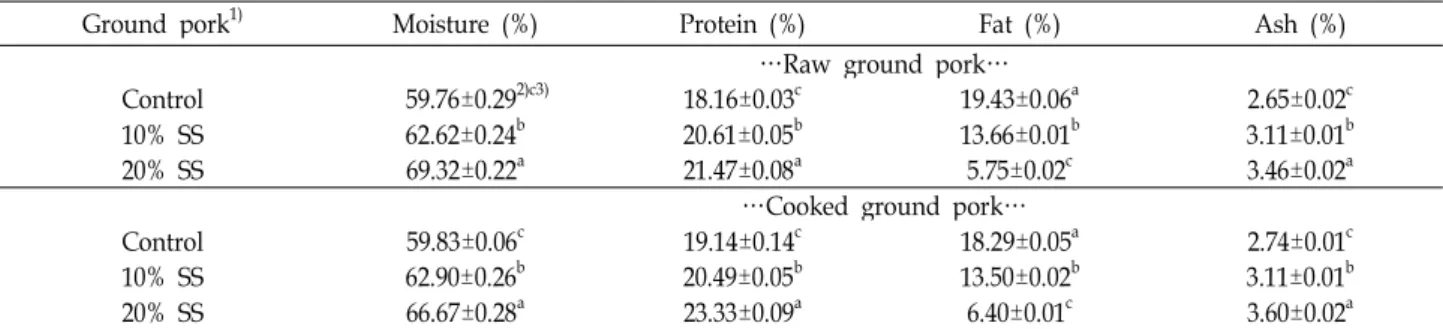
동물성지방의 대체물질로 사용하기 위하여 돼지지방 20%(control), 돼지지방 10%와 홍화씨 10%(10% SS) 그리고 홍화씨 20%(20% SS)를 첨가하여 제조한 분쇄돈육의 일반성분 은 Table 1과 같다. 가열 전 생육의 수분함량은 대조군, 10%
SS 및 20% SS가 각각 59.76%, 62.62% 및 69.32%, 단백질함량은 각각 18.16%, 20.61% 및 21.47%, 지방함량은 각각 19.43%, 13.66% 및 5.75% 그리고 회분함량은 각각 2.65%, 3.11% 및 3.46%로 수분, 단백질 및 회분함량은 20% SS가 가장 높았고 지방함량은 대조군이 가장 높았다(p<0.05). 가열육의 수분함 량은 대조군, 10% SS 및 20% SS가 각각 59.83%, 62.90% 및 66.67%, 단백질함량은 각각 19.14%, 20.49% 및 23.33%, 지방함 량은 각각 18.29%, 13.50% 및 6.40% 그리고 회분함량은 각각 2.74%, 3.11% 및 3.60%로 생육과 마찬가지로 20% SS의 수분,
단백질 및 회분함량이 가장 높았으며, 대조군은 지방함량이 가장 높았다(p<0.05). 홍화씨는 5.3%의 수분, 47.6%의 지방, 17.3%의 단백질, 24.0%의 섬유질을 함유하고 있어서[32] 돼지 지방을 첨가한 대조군과 일반성분의 차이가 있는 것으로 사료 된다. 이러한 결과는 육제품에 동물성 지방의 대체물질로서 Piñero 등[33]이 수용성 섬유질 첨가로 수분함량이 증가하고, 지방함량이 감소한다는 결과와 Gök 등[17]이 양귀비씨 분말 을 첨가하였을 경우 단백질과 회분함량이 증가하고 지방함량 이 감소한다는 결과와 일치하였다.
분쇄돈육의 수율, 수분보유율, 지방보유율, 보수력 및 직경 감소율
분쇄돈육의 수율, 수분보유율 및 지방보유율을 측정한 결과 는 Table 2와 같다. 홍화씨 첨가는 분쇄돈육의 수율, 수분보유 율 및 지방보유율에 영향을 미쳤는데, 홍화씨 첨가량이 많을 수록 분쇄돈육의 수율, 수분보유율 및 지방보유율은 유의하게 증가하였다(p<0.05). 이상의 결과에서 대조군의 수율이 낮은 것은 가열에 의하여 지방이 감소하였기 때문이며, Anderson 과 Berry [3]도 완두콩 섬유를 첨가하였을 경우 수율이 증가한 다고 하였으며, Berry [6]도 타피오카 전분을 첨가하였을 경우 수율이 증가한다고 하여 본 연구의 결과와 유사하였다. 그리 고 홍화씨를 20% 첨가한 분쇄돈육의 수분보유율과 지방보유 율이 높은 것은 홍화씨에 함유된 단백질과 섬유질[32]이 수분 결합력과 지방의 안정화에 영향을 미친 것으로 판단되며, 이 러한 결과는 bambara groundnut 씨앗 분말[2], 완두콩 섬유 [3], 귀리 수용성 섬유[33], 옥수수 분말[40], 개암껍질[44]을 첨 가하였을 경우 수분보유율과 지방보유율이 증가한다고 하여 서 본 연구의 결과와 유사하였다.
돼지지방을 첨가한 대조군의 보수력은 93.76%로 돼지지방 을 10% 대체한 10% SS 및 20% 대체한 20% SS의 각각 98.27%
및 98.05%보다 유의하게 낮았으며, 10% SS 및 20% SS 사이에
는 유의한 차이가 없었다(p<0.05). 대조군, 10% SS 및 20% SS
의 직경감소율은 각각 10.54%, 9.77% 및 7.11%로 대조군이
Table 2. Cooking parameter of ground pork with safflower seed powder Ground pork1) Cooking
yield (%) Moisture
retention (%) Fat
retention (%) Water holding
capacity (%) Reduction in diameter (%) Control 89.06±1.052)b3) 53.29±1.87c 83.84±2.21c 93.76±2.05b 10.54±1.21a
10% SS 90.83±1.36ab 57.13±1.09b 89.77±1.54b 98.27±1.84a 9.77±0.55b
20% SS 92.07±1.22a 61.38±2.13a 102.48±2.36a 98.05±1.59a 7.11±0.86c
1)Control: ground pork with pork fat 20%, 10% SS: ground pork with pork fat 10% and safflower seed 10%, 20% SS: ground pork with safflower seed 20%.
2)Mean±standard deviation.
3)a-c
Means with different superscripts in the same column significantly differ at
p
<0.05.Table 3. Color parameter of external and internal ground pork with safflower seed powder
Ground pork1) Hunter's color
L-value a-value b-value
…External color…
Control 68.01±1.142)a3) 8.59±0.21a 10.79±0.77a
10% SS 49.65±0.72b 2.50±0.17b 8.01±0.42b
20% SS 41.30±0.51c 1.86±0.08c 6.36±0.25c
…Internal color…
Control 70.64±1.72a 8.11±0.95a 11.24±0.43a
10% SS 51.26±0.98b 2.58±0.24b 8.65±0.17b
20% SS 45.98±0.75c 1.72±0.05c 6.67±0.24c
1)Control: ground pork with pork fat 20%, 10% SS: ground pork with pork fat 10% and safflower seed 10%, 20% SS: ground pork with safflower seed 20%.
2)Mean±standard deviation.
3)a-cMeans with different superscripts in the same column significantly differ at
p
<0.05.가장 높았고 20% SS가 가장 낮아서(p<0.05) 돼지지방 대체물 질로 첨가한 홍화씨가 분쇄돈육의 보수력 및 직경감소율에 영향을 미친 것을 알 수 있었다. 보수력은 근원섬유 내의 공간 에 수분을 보유하는 능력을 나타낸다[21]. Dexter 등[12]은 지 방 대체물질을 첨가한 저지방 육제품에서 보수력이 더 높다고 하였으며, Troy 등[43]은 고지방 육제품의 보수력이 낮은 것은 지방함량이 높고 단백질 함량이 낮기 때문이라고 설명하였다.
직경감소율은 분쇄돈육의 형태변화를 측정한 것으로 Sánchez-Zapata 등[38]은 tiger nut 섬유를 육제품에 첨가하였 을 경우 직경감소율이 낮아진다고 하였으며, Akesowan [1]은 분리대두단백 첨가량이 많을수록 직경감소율은 낮아진다고 하여서 본 연구의 결과와 유사하였다.
분쇄돈육의 색깔
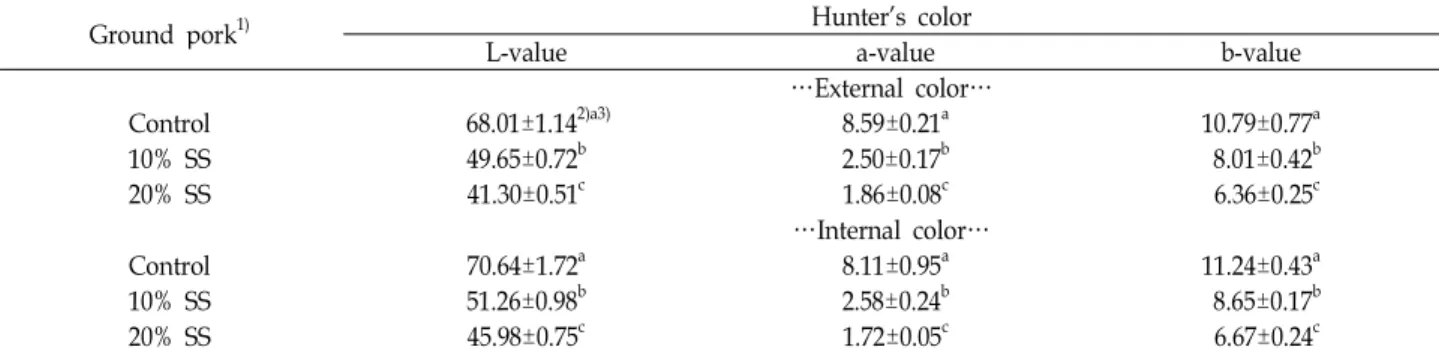
분쇄돈육의 외부 및 내부의 색깔을 측정한 결과는 Table 3과 같다. 분쇄돈육 외부색깔의 경우 명도를 나타내는 L값, 적색도를 나타내는 a값 그리고 황색도를 나타내는 b값은 돼지 지방을 첨가한 대조군이 가장 높았고, 홍화씨 첨가량이 많을 수록 유의하게 낮아졌다(p<0.05). 내부색깔의 경우도 L, a 및 b값이 대조군이 가장 높고, 20% SS가 가장 낮았다(p<0.05). 육 제품의 색깔은 myoglobin의 화학적 상태에 따라 명도, 적색도 및 황색도에 영향을 미친다[28]. 즉 돈육의 색깔은 선적색인
oxymyoglobin 상태일 때 소비자들이 선호하게 되고, 산화되 어 적갈색의 metmyoglobin 상태가 되면 기호도가 저하되는 데, 이 때의 L, a 및 b값은 낮아진다. 그러나 본 연구에서 홍화 씨 분말의 첨가로 L, a 및 b값이 낮아진 것은 홍화씨 특유의 짙은 회색이 영향을 미쳐서 나타난 결과로 소비자들의 색깔 선호도에는 어느 정도 영향을 미칠 수 있으나 최근 색깔이 있는 식물분말을 첨가한 다양한 가공식품들이 출시되고 있기 때문에 붉은 색이 아닌 식육가공품의 생산도 고려해볼 사안으 로 판단된다.
분쇄돈육의 콜레스테롤 함량
콜레스테롤 함량을 측정한 결과는 Table 4와 같다. 대조군, 10% SS 및 20% SS의 콜레스테롤 함량은 각각 50.85, 21.77 및 17.91 mg/100 g으로 홍화씨 첨가량이 많을수록 콜레스테 롤 함량이 유의하게 감소하였다(p<0.05). 콜레스테롤의 감소 율은 대조군에 비하여 10% SS는 57.18%, 20% SS는 64.79%가 감소하는 경향이었다. 이러한 결과는 소고기 patty에 양귀비 씨를 각각 5%, 10% 및 20% 첨가했을 때 대조군보다 콜레스테 롤이 각각 28.5%, 49.4% 및 88.1% 감소했다는 Gök 의 결과[17], 귀리 수용성 섬유질을 13.4% 첨가하였을 경우 약 6.0% 감소했 다는 Piñero의 결과[33], 개암 오일을 각각 15%, 30% 및 50%
첨가했을 때 각각 16.1%, 61.4% 및 70.3% 감소했다는
Table 4. Cholesterol content of ground pork with safflower seed powder
Ground pork1) Cholesterol (mg/100 g) Cholesterol reduction (%)
Control 50.85±0.672)a3) 0
10% SS 21.77±0.64b 57.18±0.65b
20% SS 17.91±0.08c 64.79±0.11a
1)Control: ground pork with pork fat 20%, 10% SS: ground pork with pork fat 10% and safflower seed 10%, 20% SS: ground pork with safflower seed 20%.
2)Mean±standard deviation.
3)a-cMeans with different superscripts in the same column significantly differ at
p
<0.05.Table 5. Fatty acid composition of ground pork with safflower seed powder (%)
Fatty acids Ground pork
1)Control 10% SS 20% SS
Myristic acid C
14:01.58±0.09
2)a3)1.36±0.05
b0.88±0.01
cPalmitic acid C
16:032.76±0.54
a27.56±0.87
b21.39±0.75
cPalmitoleic acid C
16:14.09±0.10
a3.33±0.08
b2.24±0.03
cMagaric acid C
17:00.50±0.03
a0.50±0.01
a0.19±0.01
bMagaroleic acid C
17:10.36±0.02
a0.39±0.03
a0.23±0.01
bStearic acid C
18:013.87±0.09
a11.54±0.92
b8.48±0.21
cOleic acid C
18:14.09±0.11
a3.95±0.08
a2.83±0.05
bLinoleic acid C
18:228.68±1.08
c41.04±0.89
b54.26±0.94
aγ -Linolenic acid C
18:3n6,9,122.91±0.09
a1.32±0.01
c1.42±0.05
bLinolenic acid C
18:3n9,12,151.65±0.10
a1.16±0.09
b0.46±0.00
cArachidic acid C
20:0- 0.26±0.00
b0.39±0.01
aEicosenoic acid C
20:11.11±0.06
a1.05±0.04
a0.57±0.04
bEicosadienoic acid C
20:22.34±0.07
a1.32±0.02
b1.22±0.01
ccis-11,14,17-Eicosatrienoic acid C
22:21.24±0.02
a1.02±0.02
b0.51±0.01
cArachidonic acid C
20:40.38±0.02 0.38±0.02 0.35±0.02 Heneicosanoic acid C
21:01.78±0.08
c2.15±0.12
b2.43±0.05
aBehenic acid C
22:0- 0.21±0.00
b0.57±0.01
acis-13,16-Docosadienoic acid C
22:20.63±0.01
a0.45±0.00
b0.37±0.00
cTricosanoic acid C
23:00.41±0.03
b0.44±0.02
b0.48±0.01
aLignoceric acid C
24:00.35±0.01
a0.22±0.00
c0.26±0.00
bNervonic acid C
24:11.27±0.05
a0.35±0.01
c0.47±0.01
bTotal saturated fatty acid 49.47±2.09
a44.24±1.98
b35.07±1.03
cTotal unsaturated fatty acid 50.53±2.17
c55.76±2.91
b64.93±3.12
a1)Control: ground pork with pork fat 20%, 10% SS: ground pork with pork fat 10% and safflower seed 10%, 20% SS: ground pork with safflower seed 20%.
2)Mean±standard deviation.
3)a-cMeans with different superscripts in the same row significantly differ at
p
<0.05.Yildiz-Turp [48]의 결과와 유사하였다.
분쇄돈육의 지방산 조성
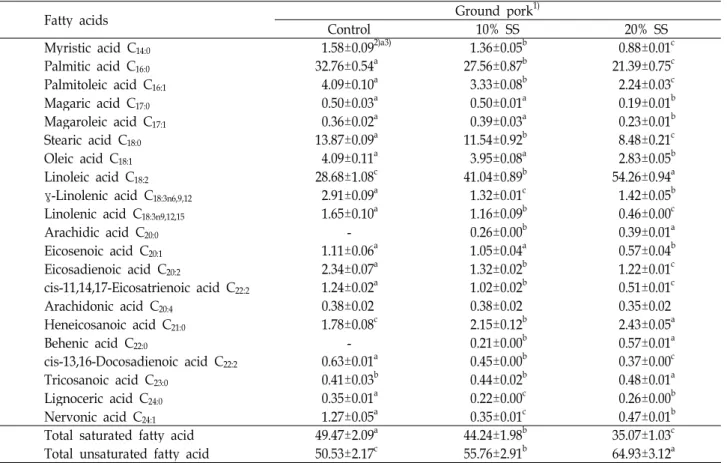
분쇄돈육의 지방산 조성은 Table 5와 같다. 가장 많이 함유 된 포화지방산은 palmitic acid이고, 불포화지방산은 linoleic acid이었다. 대조군, 10% SS 및 20% SS의 palmitic acid 함량은 각각 32.76%, 27.56% 및 21.39%로 대조군이 가장 높고, 20%
SS가 가장 낮았다(p<0.05). 그리고 linoleic acid는 대조군, 10%
SS 및 20% SS가 각각 28.68%, 41.04% 및 54.26%로 20% SS가
가장 높고, 대조군이 가장 낮았다(p<0.05). 전체 포화지방산과 불포화지방산의 함량은 대조군 각각 49.47% 및 50.53%, 10%
SS 각각 44.24% 및 55.76% 그리고 20% SS 각각 35.07% 및
64.93%로 홍화씨 첨가량이 많을수록 포화지방산은 감소하고
불포화지방산은 유의하게 증가하였다(p<0.05). 돼지지방의 지
방산 조성은 palmitic acid 25% 내외, linoleic acid 41% 내외이
며[34], 홍화씨의 지방산 조성은 품종에 따라 차이가 있지만
palmitic acid 5~8%, linoleic acid 71~76%[36] 정도 함유되어
있다. 따라서 분쇄돈육을 제조할 때에 동물성지방의 첨가는
Table 6. Amino acid composition of ground pork (% in dry sample)
Amino acids Ground pork1)
Control 10% SS 20% SS
Aspartic acid 4.98±0.512) 5.17±0.43 5.17±0.69
Threonine 2.03±0.31 1.93±0.16 1.96±0.09
Serine 1.69±0.15 1.71±0.08 1.74±0.21
Glutamic acid 6.60±0.37 6.66±0.35 7.02±0.41
Proline 1.64±0.11 1.61±0.09 1.66±0.16
Glycine 2.03±0.41 1.97±0.19 1.92±0.07
Alanine 2.44±0.25 2.47±0.10 2.38±0.15
Valine 2.03±0.20 2.06±0.12 2.05±0.10
Isoleucine 1.83±0.07 1.80±0.10 1.80±0.10
Leucine 3.33±0.17 3.31±0.19 3.33±0.11
Tyrosine 1.54±0.09a3) 1.15±0.12b 1.18±0.15b
Phenylalanine 1.73±0.10b 1.79±0.05b 1.91±0.03a
Histidine 2.02±0.15 2.26±0.09 2.18±0.12
Lysine 3.74±0.34 3.54±0.17 3.39±0.45
Arginine 2.63±0.23 2.68±0.12 2.75±0.16
Total 40.26±2.87 40.11±0.31 40.44±2.93
1)Control: ground pork with pork fat 20%, 10% SS: ground pork with pork fat 10% and safflower seed 10%, 20% SS: ground pork with safflower seed 20%.
2)Mean±standard deviation.
3)a,bMeans with different superscripts in the same row significantly differ at
p
<0.05.포화지방산 함량이 높아서 만성질환의 발생을 유발할 수 있지 만[8,24], 이것을 홍화씨로 대체할 경우 불포화지방산 함량을 증가시키고 포화지방산 함량을 감소시키기 때문에 기능적으 로도 우수하다고 판단된다.
분쇄돈육의 아미노산 조성
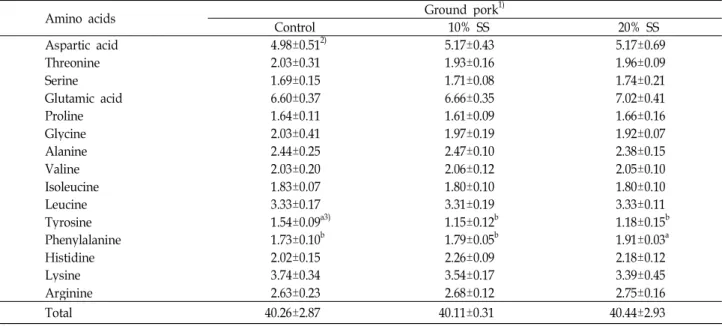
분쇄돈육의 아미노산 조성을 측정한 결과는 Table 6과 같 다. 분쇄돈육의 아미노산 함량은 glutamic acid가 가장 많이 함유되어 있었는데 대조군, 10% SS 및 20% SS가 각각 6.60%, 6.66% 및 7.02%이었으며, 그 다음으로 aspartic acid, lysine, leucine 및 arginine의 순으로 많이 함유되어 있었다. 그리고 총아미노산 함량은 대조군, 10% SS 및 20% SS가 각각 40.26%, 40.11% 및 40.44%로 유의한 차이가 없어서 홍화씨의 첨가가 분쇄돈육의 아미노산 조성에는 영향을 미치지 않았다. Yang 등[46]은 돼지고기의 아미노산 조성이 glutamic acid, aspartic acid, lysine, leucine 및 arginine의 순으로 많이 함유되어 있다 고 보고하여 본 연구의 결과와 일치하는 경향이었다.
이상의 결과에서 분쇄돈육을 제조할 때 돼지지방을 대체하 여 홍화씨를 첨가한 경우 수율, 수분보유율, 지방보유율 및 보수력을 증가시켜 품질을 향상시킬 수 있으며, 직경감소율을 낮추어 형태변형을 최소화할 수 있고, 콜레스테롤 함량을 낮 추고 불포화지방산 조성을 향상시켜 영양적으로도 우수하였 다. 다만 색깔의 경우 홍화씨의 첨가로 명도와 적색도가 낮은 단점이 있지만 앞으로 홍화씨의 첨가비율, 첨가방법 등이 체 계적으로 이루어져서 이런 단점들을 보완할 수 있다면 홍화씨
는 동물성지방의 대체물질로서 적절한 것으로 판단된다.
References
1. Akesowan, A. 2010. Quality characteristics of light pork bur- gers fortified with soy protein isolated.
Food Sci. Biotechnol.
19, 1143-1149.
2. Alakali, J. S., Irtwange, S. V. and Mzer, M. T. 2010. Quality evaluation of beef patties formulated with bambara ground- nut (
Vigna subterranean
L.) seed flour.Meat Sci.
85, 215-223.3. Anderson, E. T. and Berry, B. W. 2001. Effects of inner pea fiber on fat retention and cooking yield in high fat ground beef.
Food Res. Int.
34, 689-694.4. AOAC. 1993. Official Methods of Analysis. 17th eds., Association. Official Methods of Analysis of AOAC International, Chap. 4. pp. 5-37.
5. Bae, S. J., Shim, S. M., Park, Y. J., Lee, J. Y., Chang, E. J.
and Choi, S. W. 2002. Cytotoxity of phenolic compounds isolated from seeds of safflower (
Carthamus tinctorius
L.) on cancer cell lines.Food Sci. Biotechnol.
11, 140-146.6. Berry, B. W. 1997. Sodium alginate plus modified tapioca starch improves properties of low-fat beef patties.
J. Food Sci.
62, 1245-1249.7. Candogan, K. and Kolsarici, N. 2003. Storage stability of low-fat beef frankfurters formulated with carrageenan or carrageenan with pectin.
Meat Sci
. 64, 207-214.8. Cengiz, E. and Gokoglu, N. 2005. Changes in energy and cholesterol contents of frankfurter-type sausages with fat re- duction and fat replacer addition.
Food Chem.
91, 443-447.9. Cho, S. H., Lee, H. R., Kim, T. H., Choi, S. W., Lee, W.
J. and Choi, W. 2004. Effects of defatted safflower seed ex- tract and phenolic compounds in diet on plasma and liver lipid in ovariectomized rats fed high-cholesterol diets.
J.
Nutr. Sci. Vitaminol.
50, 32-37.10. Choi, J. W., Kim, S. H., Mun, S. H., Lee, S. J., Shim, J. Y.
and Kim, Y. R. 2011. Optimizing the replacement of pork fat with fractionated barley flour paste in reduced-fat sausage.
Food Sci. Biotechnol.
20, 687-694.11. Devereux, H. M., Jones, G. P., McCormack, L. and Hunter, W. C. 2003. Consumer acceptability of low fat foods contain- ing inulin and oligofructose.
J. Food Sci.
68, 1850-1854.12. Dexter, D. R., Sofos, J. N. and Schmidt, G. R. 1993. Quality characteristics of turkey bologna formulated with carra- geenan, starch, milk and soy protein.
J. Muscle Foods
4, 207-223.13. El-Magoli, S. B., Laroia, S. and Hansen, P. T. M. 1996. Flavor and texture characteristics of low fat ground beef patties formulated with whey protein concentrate.
Meat Sci.
42, 179-193.14. Eswarapragada, N. M., Reddy, P. M. and Prabhakar, K. 2010.
Quality of low fat pork sausage containing milk-co-precipitate.
J. Food Sci. Technol.
47, 571-573.15. Folch, J., Lees, M. and Sloane-Stanley, G. H. 1957. A simple method for the isolation and purification of total lipids from animal tissues.
J. Biol. Chem.
226, 497-507.16. García, M. L., Domínguez, R., Cálvez, M. D., Casas, C. and Selgas, M. D. 2002. Utilization of cereal and fruit fibers in low-fat dry fermented sausages.
Meat Sci
. 60, 227-236.17. Gök, V., Akkaya, L., Obuz, E. and Bulut, S. 2011. Effect of ground poppy seed as a fat replacer on meat burgers.
Meat Sci.
89, 400-404.18. Hoffman, K., Hamm, R. and Blüchel, E. 1982. Neues über die bestimmung der wasserbindung des fleisches mit hilfe der filterpapierpress methode.
Fleischwirtschaft
62, 87-93.19. Hotta, Y., Nagatsu, A. and Liu, W. 2002. Protective effects of antioxidative serotonin derivatives isolated from saf- flower against postischemic myocardial dysfunction.
Mol.
Cell Biochem.
238, 151-162.20. Hsu, S. Y. and Chung, H. Y. 2001. Effects of j-carrageenan, salt, phosphate and fat on qualities of low emulsified meatballs.
J. Food Eng.
47, 115-121.21. Huff-Lonergan, E. and Lonergan, S. M. 2005. Mechanism of water-holding capacity of meat: the role of postmortem biochemical and structural changes.
Meat Sci.
71, 194-203.22. Kawashima, S., Hayashi, M., Takii, T., Kimura, H., Zhang, H. L., Nagatsu, A., Sakakibara, J., Murata, K., Oomoto, Y.
and Onozaki, K. 1998. Serotonin derivative, N-(p-cou- maroyl) serotonin, inhibits the production of TNF-α, 1L-1α, 1L-1β, and 1L-6 by endotoxin-sitimulated human blood monocytes.
J. Interferon Cytokine Res.
18, 423-428.23. Kim, E. O., Lee, K. T. and Choi, S. W. 2008. Chemical com- parison of germinated- and ungerminated-safflower (
Carthamus tinctorius
) seeds.J. Korean Soc. Food Sci. Nutr
. 37, 1162-1167.24. Kim, J. H., Jeon, S. M., An M. Y., Ku, S. K., Lee, J. H., Choi,
M. S. and Moon, K. D. 1998. Effects of diet of Korean saf- flower (
Carthamus tinctorius
L.) seed powder on bone tissue in rats during the recovery of rib fracture.J. Korean Soc. Food Sci. Nutr.
27, 698-704.25. Korean Food & Drug Administration (KFDA). 2009.
Food Code
. Munyoungsa, Seoul, pp. 212-251.26. Koyama, N., Kuribayashi, K., Seki, T., Kobayashi, K., Furuhata, Y., Suzuki, K., Arisaka, H., Nakano, T., Amino, Y. and Ishii K. 2006. Serotonin derivatives, major safflower (
Carthamus tinctorius
L.) seed antioxidants, inhibit low-den- sity lipoprotein (LDL) oxidation and atherosclerosis in apo- lipoprotein E-deficient.J. Agric. Food Chem.
54, 4970-4976.27. Kumar, M. and Sharma, B. D. 2004. The storage stability and textural, physico-chemical and sensory quality of low-fat ground pork patties with carrageenan as fat replacer.
International J. Food Sci. Technol.
39, 31-42.28. Lindahl, G., Enfält, A. C., von Seth, G., Joseli, Å., Hedebro-Velander, I., Andersen, H. J., Braunschweig, M., Andersson, A. and Lundström, K. 2004. A second mutant allele (V1991) at the PRKAG3 (RN) lotus-II. Effect on colour characteristics of pork loin.
Meat Sci
. 66, 621-627.29. Liu, H., Xiong, Y. L., Jiang, L. and Kong, B. 2008. Fat reduc- tion in emulsion sausage using an enzyme-modified potato starch.
J. Sci. Food Agric.
88, 1632-1637.30. Mela, D. J. 1990. The basis of dietary fat preference.
Trend Food Sci. Technol.
1, 55-78.31. Muguerza, E., Ansorena, D., Bloukas, J. G. and Astiasarán, I. 2003. Effect of fat level and partial replacement of pork backfat with olive oil on the lipid oxidation and volatile compounds of Greek dry fermented sausages.
J. Food Sci.
68, 1531-1536.
32. Panford, J. A., Williams, P. C. and deMan, J. M. 1988.
Analysis of oilseeds for protein, oil, fiber and moisture by near-infrared reflectance spectroscopy.
J. Am. Oil Chem. Sco.
65, 1627-1634.
33. Piñero, M. P., Parra, K., Huerta-Leidenz, N., Arenas de Moreno, L., Ferrer, M., Araujo, S. and Barboza, Y. 2008.
Effect of oat's soluble fibre (β-glucan) as a fat replacer on physical, chemical, microbiological and sensory properties of low-fat beef patties.
Meat Sci.
80, 675-680.34. Rodríguez-Carpena, J. G., Morcuende, D. and Estévez, M.
2012. Avocado, sunflower and olive oils as replacers of pork back-fat in burger patties: Effect on lipid composition, oxi- dative stability and quality traits.
Meat Sci.
90, 106-115.35. Roh, J. S.,Han, J. Y., Kim, J. H. and Hwang, J. K. 2004.
Inhibitory effects of active compounds isolated from saf- flower (
Carthamus tinctorius
L.) seeds for melanogenesis.Biol. Pharm. Bull.
27, 1976-1978.36. Sabzalian, M. R., Saeidi, G. and Mirlohi, A. 2008. Oil content and fatty acid composition in seeds of three safflowers species.
J. Am. Oil Chem. Soc.
85, 717-721.37. Sakamura, S., Terayama, Y., Kawakatsu, S., Ichihara, A. and Saito, H. 1978. Conjugated serotonins related to cathartic ac- tivity in safflower seeds (
Carthamus tinctorius
L.).Agric. Biol.
Chem.
42, 1805-1806.38. Sánchez-Zapata, E., Muñoz, C. M., Fuentes, E.,
초록:동물성지방 대체제로서 홍화씨 (Carthamus tinctorius L.) 를 첨가한 분쇄돈육의 이화학적 품질특 성
박경숙
1․최영준
1․문윤희
2․박현숙
1․김민주
3․정인철
1*
(
1대구공업대학교 호텔외식조리계열,
2경성대학교 식품생명공학과,
3한진상사)
본 연구는 동물성지방 대체물질로서 홍화씨(Carthamus tinctorius L.)의 첨가가 분쇄돈육의 이화학적 품질특성 에 미치는 영향을 검토하였다. 분쇄돈육은 돈육등심 68%, 냉수 10%, 소금 2%에 돼지지방 20%(control), 돼지지방 10%와 홍화씨 10%(10% SS) 그리고 홍화씨 20%(20% SS)를 첨가하여 제조하였다. 생육 및 가열육의 수분, 단백질 및 회분함량은 20% SS가 가장 높았고, 지방함량은 대조군이 가장 높았다(p<0.05). 수율, 수분보유율, 지방보유율 및 보수력은 20% SS가 가장 높았으며, 직경감소율은 대조군이 가장 높았다. 외부 및 내부의 명도(L-value), 적색 도(a-value) 및 황색도(b-value)는 대조군이 10% SS 및 20% SS보다 유의하게 높았다(p<0.05). 콜레스테롤 함량은 대조군, 10% SS 및 20% SS가 각각 50.85, 21.77 및 17.91 mg/100 g으로 20% SS가 가장 낮았다(p<0.05). Linoleic acid 함량은 대조군, 10% SS 및 20% SS가 각각 28.68%, 41.04% 및 54.26%이었다. 전체 불포화지방산 함량은 대조 군, 10% SS 및 20% SS가 각각 50.53%, 55.76% 및 64.93%이었다. 지방산 조성에서 linoleic acid 및 전체 불포화지 방산 함량은 20% SS가 가장 높았다(p<0.05). 아미노산 조성은 시료들 사이에 유의한 차이가 없었다.
Fernández-López, J., Sendra, E., Sayas, E. and Navarro, C.
2010. Effect of tiger nut fibre on quality characteristics of pork burger.
Meat Sci.
85, 70-76.39. Serdaroğlu, M. 2006. Improving low fat meatball character- istics by adding whey powder.
Meat Sci
. 72, 155-163.40. Serdaroğlu, M. and Değirmencioğlu, Ö. 2004. Effects of fat level (5%, 10%, 20%) and conflour (0%, 2%, 4%) on some properties of Turkish type meatballs (koefte).
Meat Sci.
68, 291-296.41. Siddiqi, E. H., Ashraf, M., Al-Qurainy, F. and Akram, N.
A. 2011. Salt-induced modulation in inorganic nutrients, an- tioxidant enzymes, proline content and seed oil composition in safflower (
Carthamus tinctorius
L.).J. Sci. Food Agric
. 91, 2785-2793.42. Takii, T., Hayashi, M., Hiroyuki, H., Kawashima, S., Zhang, H. L., Nagutsu, A., Sakakibara, J. and Onozaki, K. 1999.
Serotonin derivative, N-(p-coumaroyl) serotonin, isolated from safflower (
Carthamus tinctorius
L.) oil cake augments the proliferation on normal human and mouse fibroblasts in synergy with basic fibroblasts growth factor (βFGF) or epidermal growth factor (EGF).J. Biochem.
125, 910-915.43. Troy, D. J., Desmond, E. M. and Buckley, D. J. 1999. Eating quality of low-fat beef burgers containing fat-replacing func- tional blends.
J. Sci. Food Agric.
79, 507-516.44. Turhan, S., Sagir, I. and Ustun, N. S. 2005. Utilization of
hazelnut pellicle in low-fat beef burgers.
Meat Sci.
71, 312-316.45. Yamamotová, A., Pometlová, M., Harmatha, J., Rašková, H.
and Rokyta, R. 2007. The selective effect of N-feruloylser- otonins isolated from
Leuzea xarthamoides
on nociception and anxiety in rats.J. Ethnopharm.
112, 368-374.46. Yang, S. J., Koh, S. M., Yang, T. I., Jung, I. C. and Moon, Y. H. 2006. Feeding effect of citrus byproducts on the quality of cross-bred black pig in Jeju island.
J. Korean Soc. Food Sci. Nutr.
35, 897-902.47. Yeilaghi, H., Arzani, A., Ghaderian, M., Fotovat, R., Feizi, M. and Pourdad, S. S. 2012. Effect of salinity on seed oil content and fatty acid composition of safflower (
Carthamus tinctorius
L.) genotypes.Food Chem.
130, 618-625.48. Yildiz-Turp, G. and Serdaroğlu, M. 2008. Effect of replacing beef fat with hazelnut oil on quality characteristics of suck-A Turkish fermented sausage.
Meat Sci.
78, 447-454.49. Youn, D. H., Park, K. S., Lee, K. S., Jung,I. C., Park, H. S., Moon, Y. H. and Yang, J. B. 2007. Quality and sensory score of ground pork meats on the addition of pork fat, olive oil and soybean oil.
Korean J. Life Sci.
17, 964-969.50. Zhang, H. L., Nagatsu, A., Watanabe, T., Sakakibara, J. and Okuyama, H. 1997. Antioxidative compounds isolated from safflower (