Anti-inflammatory Effect of Heat-Killed Enterococcus faecalis, EF-2001
Moon-Suk Choi1, Sang-Jin Chang1, Yuri Chae1, Myung-Hun Lee1, Wan-Joong Kim1, Masahiro Iwasa1,2, Kwon-Il Han1,2, Wan-Jae Kim2 and Tack-Joong Kim1,3*
1Division of Biological Science and Technology, Yonsei University, Wonju 26493, Korea
2Research & Development Center, Korea BeRM Co. Ltd., Wonju 26361, Korea
3Research & Development Center, Doctor TJ Co. Ltd., Wonju 26493, Korea
Received September 9, 2018 /Revised October 17, 2018 /Accepted October 22, 2018
Inflammation is the most common condition in the human body. Tissue damage triggers inflammation, together with vasodilation and increased blood flow at the inflamed site, resulting in edema. Inflam- matory responses are also triggered by lipopolysaccharide (LPS), a Toll-like receptor Enterococcus faeca- lis, a gram-positive organism, has been reported to possess immunomodulatory and preventive activ- ities; however, its use may present risks of sepsis and other systemic infections. Heat-killed Enterococcus faecalis (EF-2001) has been reported to induce antitumor activity, but its effects on in- flammation are not known. In the present study, we investigated the effect of EF-2001 on LPS-induced macrophage inflammatory responses. EF-2001 treatment reduced nitric oxide (NO) production, indicat- ing suppression of inflammatory reactions. EF-2001 showed no cytotoxicity in macrophages. Further investigation of the anti-inflammatory mechanism of EF-2001 indicated that EF-2001 reduced the LPS-induced expression of inducible nitric oxide synthase and cyclooxygenase-2. EF-2001 also reduced f the LPS induction of several inflammatory molecules involved in the nuclear factor-κB (NF-κB) and mitogen-activated protein kinase pathways, including ERK, JNK, and p38 phosphorylation, in a con- centration-dependent manner. Additionally, EF-2001 inhibited Akt phosphorylation and increased the expression of the inhibitory κB (IκB) protein, an inhibitor of NF-κB. EF-2001 also inhibited the nuclear translocation of p65. These results suggest that EF-2001 has anti-inflammatory properties and may be useful for treating inflammatory diseases.
Key words : Cyclooxygenase-2, EF-2001, Enterococcus faecalis, inducible nitric oxide synthase, inflammation
*Corresponding author
*Tel : +82-33-760-2242, Fax : +82-33-760-2183
*E-mail : [email protected]
This is an Open-Access article distributed under the terms of the Creative Commons Attribution Non-Commercial License (http://creativecommons.org/licenses/by-nc/3.0) which permits unrestricted non-commercial use, distribution, and reproduction in any medium, provided the original work is properly cited.
Journal of Life Science 2018 Vol. 28. No. 11. 1361~1368 DOI : https://doi.org/10.5352/JLS.2018.28.11.1361
Introduction
Inflammation is a series of processes involving various cells and cytokines and functions as a biological defense re- sponse to external stimuli [16]. During inflammation, the production of nitric oxide (NO) and prostaglandins (PGs) is increased. Increased NO and PGs are associated with hay fever, atherosclerosis, rheumatoid arthritis, Alzheimer's dis- ease, and cancer, among other conditions [14]. These re- actions can lead to infection in defective immune systems due to an insufficient immune response; if the inflammatory response to immunity is excessive, tissue degeneration dis- orders and tissue proliferation can result in dysfunction [2].
Toll-like receptors (TLRs) induce innate immunity and
subsequently acquired immunity. When agonists are at- tached to TLRs, they activate nuclear factor (NF)-κB through signaling pathways involving myeloid differential factor 88 or Toll/interleukin-1R domain-containing adapter inducing interferon-β [29]. NF-κB plays an important role in immune responses in humans [13]. Activated NF-κB regulates the ex- pression of several target genes and induces inflammation, leading to various diseases. NF-κB binds to the inhibitor of kappa B alpha (IκBα) in the cytoplasm. Signals activated by various pathogens phosphorylate IκBα. Phosphorylated IκBα is degraded by the 26S proteasome to liberate NF-κB. NF-κB in the cytoplasm is translocated to the nucleus and binds DNA to stimulate target gene expression, leading to cancer or disease [5]. Therefore, if NF-κB can be inhibited, in- flammation-related genes such as cyclooxygenase (COX)-2 and inducible nitric oxide synthase (iNOS) can be reduced, thus preventing cancer and various other diseases. The MAPK signaling pathway, which is involved in the in- flammatory response, includes major signaling pathways such as extracellular signal-regulated protein kinase (ERK), cJun terminal kinase (JNK), and p38 [15]. Activation of ERK,
In this study, we investigated the effects of heat-killed E. faecalis (EF-2001) on NO production and the underlying anti-inflammatory mechanisms.
Materials and Methods
Cell culture
Raw 264.7 cells used to examine the inflammatory re- sponses were obtained from American Type Culture Collection (Manassas, VA, USA). These cells were cultured in Dulbecco's Modified Eagle's medium (DMEM, Welgene, Daegu, South Korea) containing 10% fetal bovine serum and 1% penicillin and streptomycin at 37℃ and 5% CO2.
Heat-killed Enterococcus faecalis (EF-2001) EF-2001 originally isolated from healthy human feces is a commercially available probiotic from Nihon Berumu Co., Ltd. (Tokyo, Japan) and is supplied as a heat-killed, dried powder. One gram of dried EF-2001 contains 7.5×10¹² units prior to being heat-killed [5, 6].
Nitric oxide measurement
Raw 264.7 cells were cultured in a 24-well plate at a den- sity of 1×10⁵ cells/ml for 24 hr. Each well contained different concentrations of EF-2001 (0, 50, 100, 250 μg/ml) and the plate was incubated for 30 min in an incubator. Lipopolysac- charide (LPS) was added to each well at a concentration of 100 ng/ml, and the plate was incubated in an incubator for 18 hr. Next, 500 μl of solution from each well was transferred to a microcentrifuge tube and centrifuged (3,000 rpm, 3 min).
The supernatant (100 μl) was dispensed into a 96-well plate and 100 μl of Griess reagent (1% sulfanilamide, 0.1% N-(1- Naphthyl) ethylenediamine dihydro-chloride, 2.5% phos- phoric acid) was added to each well; the reaction was con- ducted at room temperature for 10 min. Absorbance was measured at 595 nm using a microplate reader (BioTek
plate reader.
Western blotting
Raw 264.7 cells were plated into 6-well plates at a density of 1×10⁵ cells/ml and cultured for 24 hr in an incubator.
EF-2001 was added to the culture at 0, 50, 100, and 250 μg/
ml for 30 min. LPS was then added to each well at a concen- tration of 100 ng/ml and incubated for the appropriate time depending on the protein to be investigated. For the de- tection of COX-2, LPS treatment was for 12 hr, that for i-NOS was 6 hr, for IκB, ERK, and p38, it was 30 min, and for Akt and JNK were 45 min. After washing twice with cold phosphate-buffered saline (PBS; pH 7.2), 200 μl of pro-prep (iNtRON Biotechnology, Inc., Seoul, Korea) was added to each well and reacted in the freezer for 1 hr. After sonication 2-3 times, the protein concentration was quantified using the Bradford (Bio-Rad, Hercules, CA, USA) assay with bovine serum albumin (BSA) as a standard. The SDS-polyacrylamide gel percentage was adjusted according to the protein size to be analyzed and electrophoresis was performed at 100 V for approximately 2 hr. Antibody treatment was per- formed with primary antibodies at a 1:2,500 ratio in an over- night reaction. After washing three times for 10 min with Tris-buffered saline containing Tween 20, the secondary an- tibody was added at a ratio of 1:5,000. Enhanced chem- iluminescence was measured using an LAS 4000 system (GE Healthcare, Little Chalfont, UK).
Confocal microscopy
A cover glass was pre-sterilized and placed on a 6-well plate. Raw 264.7 cells were seeded at a density of 1×10⁵ cells/ml and cultured for 4 hr. The cells were incubated for 30 min in an incubator with EF-2001 (0, 50, 100, 250 μg/ml) in each well of a 6-well plate. LPS was then added to each well at a concentration of 100 ng/ml. Thereafter, the cells were incubated in an incubator for 18 hr. Each well was
s
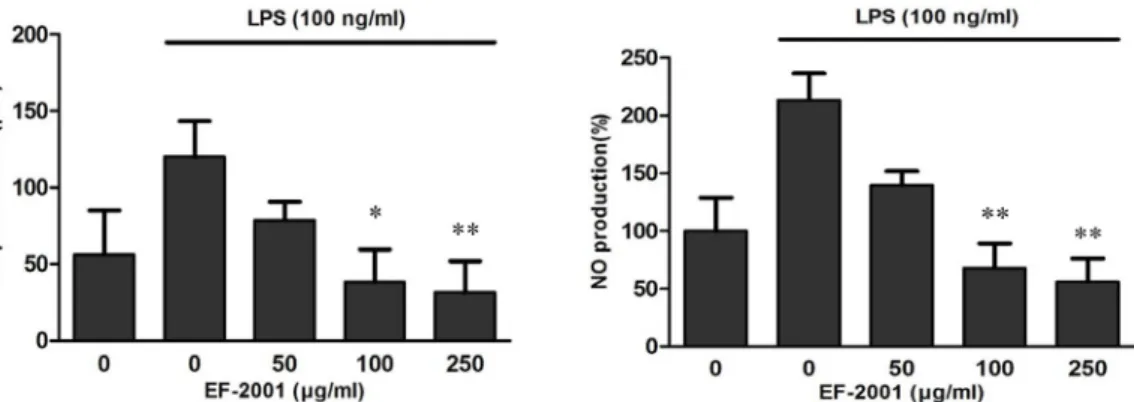
Fig. 1. Effects of EF-2001 on nitric oxide in LPS activated RAW 264.7 cells. LPS-stimulated RAW 264.7 cells were pre-treated with various concentrations (50, 100, and 250 μg/ml) of EF-2001 for 30 min before incubation with or without 100 ng/ml LPS for 18 hr. NO production was measured using Griess reagent and by ELISA. Each value indicates the mean ± SD (n = 4). *p<0.05, **p<0.01.
Fig. 2 Effects of EF-2001 on cell viability in RAW 264.7 cells.
Raw 264.7 cells were treated with various concentrations (50, 100, and 250 μg/ml) of EF-2001 for 23 hr. Cell via- bility was measured by ELISA using EZ-cytox kits. Each value indicates the mean ± SD (n=4).
washed twice with 1× PBS and fixed with 4% paraformalde- hyde for 10 min. After washing twice with 1× PBS, 0.2%
Triton X-100 was added for 20 min to increase cell perme- ability. After washing twice with 1× PBS and blocking with 3% BSA for 30 min, p65 anti-rabbit monoclonal antibody (1:100) diluted in 3% BSA solution was added and the cells were incubated overnight. After washing with 1× PBS, Alexa Fluor 488-conjugated goat anti-mouse IgG secondary anti- body (1:300) diluted in 3% BSA solution was added and in- cubated for 1 hr. After staining the cells, images were cap- tured on a Carl Zeiss LSM710 confocal microscope (Carl Zeiss, Oberkochen, Germany).
Statistical analysis
Experimental results are expressed as the means ± stand- ard deviation. Statistical analysis of all data was performed by one-way analysis of variance (one-way ANOVA) and multiple comparisons were followed by a Tukey–Kramer post-hoc analysis; p<0.05 was considered statistically sig- nificant.
Results
Inhibitory effect of EF-2001 on NO production LPS is an endotoxin present in the extracellular membrane of gram-negative bacteria that stimulates macrophages such as RAW 264.7 and increases cytokine production to secrete inflammatory mediators such as NO. In this study, RAW 264.7 cells induced by LPS showed rapidly increased NO concentrations compared to cells without LPS treatment.
However, EF-2001 decreased LPS-induced NO production in a concentration-dependent manner (Fig. 1).
Cytotoxicity of EF-2001
To analyze the cytotoxicity of EF-2001, Raw 264.7 cells were treated with EF-2001 (0, 50, 100, and 250 μg/ml) for 23 hr. No toxicity was observed with any of the tested con- centrations of EF-2001 (Fig. 2).
Effect of EF-2001 on iNOS and COX-2 protein expression in Raw 264.7 cells induced by LPS
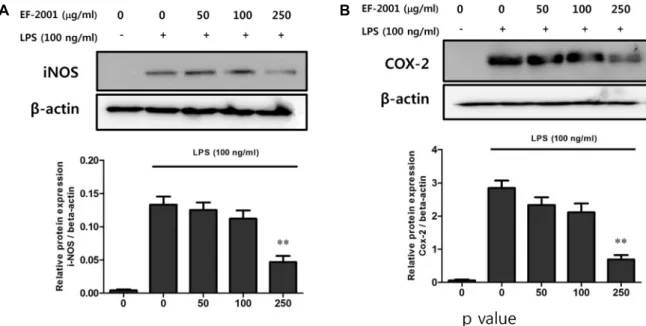
iNOS directly and rapidly increases NO levels in activated macrophages and plays an important role in inflammatory diseases [12, 17]. Furthermore, prostaglandins such as COX-2 play a physiologically important role in inflammation, ede- ma, pain, and fever [7, 10, 11]. Because EF-2001 inhibited NO production, the effect of EF-2001 on iNOS and COX-2 protein expression was examined. LPS-induced iNOS pro- tein expression was decreased by EF-2001 in a concen-
A B
Fig. 3. Inhibition of LPS-induced iNOS and COX-2 expression by EF-2001. (A), (B) RAW 264.7 cells were pre-treated with various concentrations (50, 100, and 250 μg/ml) of EF-2001 for 30 min before incubation with or without 100 ng/ml LPS for 18 hr. Protein expression of iNOS and COX-2 was analyzed by Western blotting, and each image was analyzed using ImageQuant LAS 4000. Each value indicates the mean ± SD (n=4). **p<0.01.
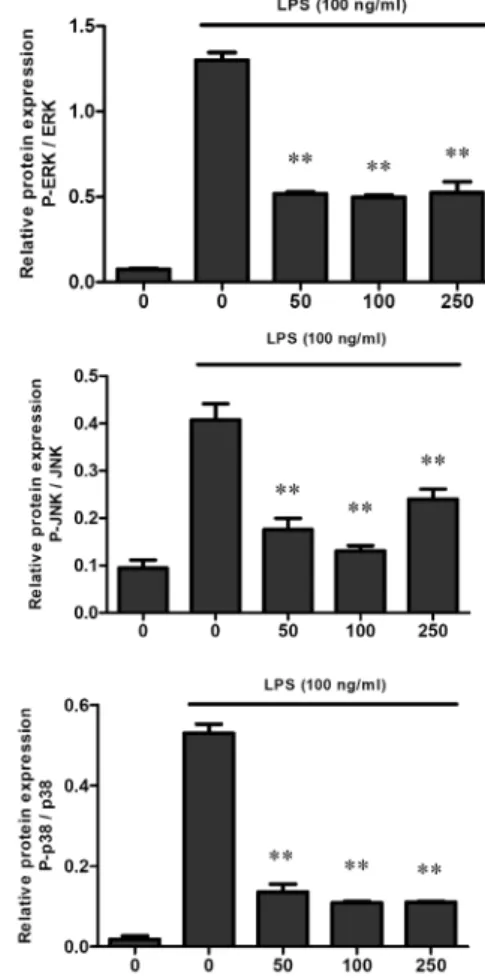
then stimulated with LPS. The results showed that ERK, JNK, and p38 phosphorylation levels were gradually de- creased upon EF-2001 treatment compared to those in the group treated with LPS alone (Fig. 4). These results suggest that EF-2001 decreases the degree of phosphorylation of MAP kinase, which may suppress the inflammatory re- sponse.
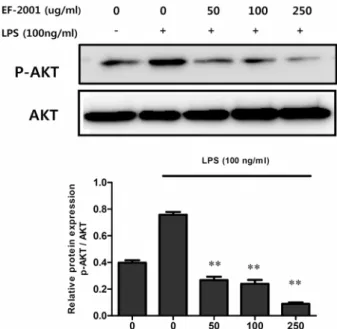
Effect of EF-2001 on Akt-NF-κB activation We investigated whether another pathway, the Akt-NF-κ B pathway, was affected by EF-2001. First, we investigated the degree of phosphorylation of Akt, an upstream molecule in the NF-κB pathway [28]. When Akt phosphorylation was compared to that in the group treated with LPS alone after treatment with EF-2001, Akt phosphorylation was found to be decreased by EF-2001 (Fig. 5). Thus, EF-2001 inhibited
creased compared to that in the group without any treat- ment (Fig. 6). The expression level of IκB was increased com- pared to that in the control group treated with LPS alone after treatment with EF-2001. We then investigated whether EF-2001 affects the activation of NF-κB by confocal micro- scopy. Activated NF-κB translocates into the nucleus follow- ing elimination of IκB. As shown in Fig. 7, p65 labeled with Alexa 488 (green) was only observed in the cytoplasm in the untreated group. However, in the group treated with LPS, p65 migrated into the nucleus. When EF-2001 concen- trations of 50, 100, and 250 μg/ml were used to treat the cells, p65 was found in the cytoplasm. This suggests that the nuclear migration of p65 is inhibited by EF-2001 treatment. Thus, EF-2001 blocked both the Akt-NF-κB path- way and the MAPK pathway.
Fig. 4. Effect of EF-2001 on the LPS-induced MAP kinase pathway in Raw 264.7 cells. Raw 264.7 cells were pre-treated with various concentrations (50, 100, and 250 μg/ml) of EF-2001 for 30 min, followed by stimulation with LPS (100 ng/ml) for ERK (30 min), JNK (45 min), and p38 (30 min). Phosphorylation of ERK, JNK, and p38 was analyzed by Western blotting, and each image was analyzed using ImageQuant LAS 4000. Each value indicates the mean ± SD (n=4). **p<0.01.
Discussion
Inflammation is a defense mechanism that occurs when chemical substances and noxious stimuli are introduced into tissues or living organisms. If inflammation continues to be excessive, the condition becomes chronic [4].
Although EF-2001 was reported to have an effect on atopy [5, 6], its effects on inflammation were unclear. Therefore, in this study, we investigated whether activation of macro- phages was inhibited by EF-2001. Although NO is an im- portant substance involved in vasodilation and neuro- transmission, excessive NO formation is related to the patho- genesis of various diseases including inflammation and can- cer [1, 30]. By measuring the NO produced during in- flammation, we confirmed that EF-2001 decreased NO pro- duction in a concentration-dependent manner (Fig. 1). Next, after the decrease of NO concentration was confirmed, iNOS and COX-2 experiments were carried out. iNOS produces
a much higher concentration of NO than neuronal NOS and endothelial NOS [25]. iNOS and COX-2 protein expressions were suppressed following treatment of the cells with EF-2001 (Fig. 3). These results suggest that EF-2001 inhibits all inflammatory mediators and anti-inflammatory processes.
We then examined the MAPK pathway and Akt-NF-κB pathway that are associated with inflammatory signaling [20]. Proteins in both pathways were evaluated for the de- gree of phosphorylation. Firstly, phosphorylation of three molecules, ERK, JNK, and p38 was confirmed in the MAPK pathway. The degree of phosphorylation of these molecules induced by LPS in EF-2001-treated cells was decreased (Fig.
4). These results suggest that activation of active protein-1, the main transcription factor in the MAPK pathway, is re- duced [18, 19]. In a subsequent study on the Akt-NF-κB pathway, NF-κB translocation from the cytoplasm to the nu- cleus and its function as a transcription factor was examined;
NF-κB cannot act as a transcription factor if its translocation
Fig. 7. Effect of EF-2001 on LPS-induced translocation of p65 in Raw 264.7 cells. Raw 264.7 cells stimulated with LPS (100 ng/ml) in the presence or absence of EF-2001 (50, 100, 250 μg/ml) for 18 hr. p65 localization was visualized by confocal microscopy after immunofluorescence stain- ing with Alexa 488 (green). Cells were stained with DAPI for visualization of nuclei (blue).
Fig. 5. Effect of EF-2001 on LPS-induced phosphorylation of Akt in Raw 264.7 cells. Raw 264.7 cells were pre-treated with various concentrations (50, 100, and 250 μg/ml) of EF- 2001 for 30 min followed by stimulation with LPS (100 ng/ml) for 45 min. Phosphorylation of Akt was analyzed by Western blotting, each image was analyzed using ImageQuant LAS 4000. Each value indicates the mean
± SD (n=4). **p<0.01.
Fig. 6. Effect of EF-2001 on LPS-induced phosphorylation of IκB in Raw 264.7 cells. Raw 264.7 cells were pre-treated with various concentrations (50, 100, and 250 μg/ml) of EF- 2001 for 30 min followed by stimulation with LPS (100 ng/ml) for 30 min. Phosphorylation of IκB was analyzed by Western blotting, each image was analyzed using ImageQuant LAS 4000. Each value indicates the mean
± SD (n=4). **p<0.01.
organism that provides health benefits. Safety concerns in treatment with probiotics have not been clarified. However, some studies have reported complications when patients are treated with certain bacteria, and thus, further studies are needed to confirm that specific probiotics are safe [23].
Heat-treated lactic acid bacteria can be easily stored and have a long shelf life. Recently, heat-killed lactic acid bacteria were reported to exhibit beneficial immune-modulating ef- fects [21]. Taken together, this study suggests that heat-killed Enterococcus faecalis may be used as a therapeutic agent for various inflammatory diseases.
Acknowledgements
This research was financially supported by the Ministry of SMEs and Startups (MSS), Korea, under the “Regional Specialized Industry Development Program (R&D, R000 6434)” supervised by the Korea Institute for Advancement of Technology (KIAT).
References
1. Ambs, S., Hussain, S. P. and Harris, C. C. 1997. Interactive effects of nitric oxide and the p53 tumor suppressor gene in carcinogenesis and tumor progression. FASEB J. 11, 443- 448.
2. Bae, N. Y., Kim, M. J., Kim, K. B. W. R., Park, J. H., Park, S. H., Sung, N. Y., Byun, E. H. and Ahn, D. H. 2016. Anti- Inflammatory effect of Chondrus ocellatus Holmes ethanol ex- tract on lipopolysaccharide-induced inflammatory responses in RAW 264.7 cells. J. Microbiol. Biotechnol. 44, 268-277.
3. Carter, A. B., Knudtson, K. L., Monick, M. M. and Hunning- hake, G. W. 1999. The p38 mitogen-activated protein kinase is required for NF-κB-dependent gene expression: the role of TATA-binding protein (TBP). J. Biol. Chem. 274, 30858- 30863.
4. Cheon, J. M., Kim, H. S., Choi, E. O., Kwon, D. H., Choi, Y. H., Kim, B. W. and Hwang, H. J. 2017. Anti-inflammatory Activities of an Ethanol Extract of Sargassum macrocarpum in Lipopolysaccharide (LPS)-stimulated RAW 264.7 Macrop- hages. J. Life Sci. 27, 1437-1444.
5. Choi, E. J., Iwasa, M., Han, K. I., Kim, W. J., Tang, Y., Hwang, Y. J., Chae, J. R., Han, W. C., Shin, Y. S. and Kim, E. K. 2016. Heat-killed Enterococcus faecalis EF-2001 amelio- rates atopic dermatitis in a murine model. Nutrients 8, 146.
6. Choi, E. J., Iwasa, M., Han, K. I., Kim, W. J., Tang, Y., Han, W. C., Kim, E. K. and Park, Z. Y. 2016. Effect of Enterococcus faecalis EF-2001 on experimentally induced atopic eczema in mice. Food Sci. Biotechnol. 25, 1087-1093.
7. Duerksen-Hughes, P. J., Day, D. B., Laster, S. M., Zachar- iades, N. A., Aquino, L. and Gooding, L. R. 1992. Both tu- mor necrosis factor and nitric oxide participate in lysis of simian virus 40-transformed cells by activated macrophages.
J. Immunol. 149, 2114-2122.
8. Ghosh, S., May, M. J. and Kopp, E. B. 1998. NF-κB and REL proteins: evolutionarily conserved mediators of immune responses. Annu. Rev. Immunol. 16, 225-260.
9. Fisher, K. and Phillips, C. 2009. The ecology, epidemiology and virulence of Enterococcus. Microbiology 155, 1749-1757.
10. Funk, C. D. 2001. Prostaglandins and leukotrienes: advances in eicosanoid biology. Science 294, 1871-1875.
11. Greenhough, A., Smartt, H. J., Moore, A. E., Roberts, H. R., Williams, A. C., Paraskeva, C. and Kaidi, A. 2009. The COX- 2/PGE 2 pathway: key roles in the hallmarks of cancer and adaptation to the tumour microenvironment. Carcinogenesis 30, 377-386.
12. Islam, S., Hassan, F., Tumurkhuu, G., Ito, H., Koide, N., Mori, I., Yoshida, T. and Yokochi, T. 2007. 5-Fluorouracil prevents lipopolysaccharide-induced nitric oxide production in RAW 264.7 macrophage cells by inhibiting Akt-dependent nuclear factor-κB activation. Cancer Chemother. Pharmacol. 59, 227- 233.
13. Janicke, H., Taylor, P. M. and Bryant, C. E. 2003. Lipopoly- saccharide and interferon gamma activate nuclear factor kappa B and induce cyclo-oxygenase-2 in equine vascular smooth muscle cells. Res. Vet. Sci. 75, 133-140.
14. Kim, S. J., Park, H. J., Shin, H. J., Kim, J. S., Ahn, H. J., Min, I. S. and Youn, H. S. 2011. The effects of phenethyl isothiocyanate on nuclear factor-κB activation and cyclo- oxygenase-2 and inducible nitric oxide synthase expression induced by toll-like receptor agonists. J. Appl. Biol. Chem.
54, 279-283.
15. Kim, S. Y., Jo, M. J., Hwangbo, M., Back, Y. D., Jeong, T.
Y., Cho, I. J. and Jee, S. Y. 2013. Anti-inflammatory effect of Stevia rebaudiana as a result of NF-κB and MAPK in- hibition. J. Kor. Med. Opthalmol. Otolaryngol. Dermatol. 26, 54- 64.
16. Kwon, M. S., Mun, O. J., Bae, M. J., Lee, S. G., Kim, M., Lee, S. H., Yu, K. H., Kim, Y. Y. and Kong, C. S. 2015.
Anti-inflammatory activity of ethanol extracts from Hizikia fusiformis fermented with lactic acid bacteria in LPS-stimu- lated RAW264.7 macrophages. Prev. Nutr. Food Sci. 44, 1450- 1457.
17. Lee, H. N., Lim, D. Y., Lim, S. S., Kim, J. D. and Yoon, J. H. 2011. Anti-inflammatory effect of ethanol extract from Eupatorium japonicum. Kor. J. Food Sci. Technol. 43, 65-71.
18. Lee, S. J. and Lim, K. T. 2009. Inhibitory effect of ZPDC glycoprotein on the expression of inflammation-related cy- tokines through p38 MAP kinase and JNK in lipopoly- saccharide-stimulated RAW 264.7 cells. Inflamm. Res. 58, 184-191.
19. Limtrakul, P., Yodkeeree, S., Pitchakarn, P. and Punfa, W.
2016. Anti-inflammatory effects of proanthocyanidin-rich red rice extract via suppression of MAPK, AP-1 and NF-κB pathways in Raw 264.7 macrophages. Nutr. Res. Pract. 10, 251-258.
20. Luo, Y., Liu, M., Yao, X., Xia, Y., Dai, Y., Chou, G. and Wang, Z. 2009. Total alkaloids from Radix linderae prevent the production of inflammatory mediators in lipopoly- saccharide-stimulated RAW 264.7 cells by suppressing NF-κ B and MAPKs activation. Cytokine 46, 104-110.
21. Murosaki, S., Yamamoto, Y., Ito, K., Inokuchi, T., Kusaka, H., Ikeda, H. and Yoshikai, Y. 1998. Heat-killed Lactobacillus plantarum L-137 suppresses naturally fed antigen-specific IgE production by stimulation of IL-12 production in mice.
J. Allergy Clin. Immnol. 102, 57-64.
22. Oh, J. H., Kang, L. L., Ban, J. O., Kim, Y. H., Kim, K. H., Han, S. B. and Hong, J. T. 2009. Anti-inflammatory effect of 4-O-methylhonokiol, a novel compound isolated from Magnolia officinalis through inhibition of NF-κB. Chem. Biol.
Interact. 180, 506-514.
23. Ou, C. C., Lin, S. L., Tsai, J. J. and Lin, M. Y. 2011. Heat-kil-
초록:열처리 사균체 엔테로코커스 패칼리스 EF-2001의 항염증 효과
최문석1․장상진1․채유리1․이명헌1․김완중1․이와사키 마사히로1,2․한권일1,2․김완재2․김택중1,3*
(1연세대학교 생명과학기술학부, 2한국베름㈜ 연구개발센터, 3㈜닥터티제이 기술연구소)
염증은 인체에서 가장 흔히 나타나는 증상으로 조직이 손상되면 염증 반응이 발생하고 염증 부위에서 혈관 확 장과 혈류가 증가하여 부종이 생긴다. Lipopolysaccharide (LPS)는 Toll-like receptor 4에 의해 인식되고 염증 반응 을 일으킨다. 열로 사멸시킨 Enterococcus faecalis 사균체(EF-2001)는 면역 조절 및 예방 활동을 하는 것으로 사전 보고되었고, 항 종양 효과가 있다고 보고되었지만 염증에 미치는 영향에 대해서는 지금까지 연구되지 않았다. 본 연구에서는 LPS에 의한 대식세포 염증 반응에 대한 EF-2001의 효과에 대해 연구하였다. 연구결과에서 EF-2001은 LPS에 의해 유도된 산화 질소의 생성을 감소시켰다. 우리는 EF-2001의 세포 독성이 있는지 확인했으며, 산화 질소 의 감소는 세포독성에 의한 것이 아님을 확인하였다. 또한 이러한 EF-2001의 항염증 효과에 대한 분자기전을 연구 하였다. LPS에 의한 유도된 iNOS와 COX-2의 발현은 EF-2001에 의해 감소되었다. 더해진 분자기작 분석에서 EF-2001은 LPS로 유도된 ERK, JNK 및 p38 인산화를 농도 의존적으로 억제하였다. 더해진 실험에서 EF-2001은 Akt 인산화를 억제하고 NF-κB 억제제인 IκB 단백질 발현을 증가시켰다. 또한, EF-2001은 p65의 핵으로의 이동을 억제함을 알수 있었다. 따라서, 이러한 결과는 EF-2001이 항염증 효과를 가지며 염증 질환 치료에 유용 할 수 활용 될 수 있음을 시사한다.
26. Reddy, D. B. and Reddanna, P. 2009. Chebulagic acid (CA) attenuates LPS-induced inflammation by suppressing NF- kB and MAPK activation in RAW 264.7 macrophages. Bio- chem. Biophys. Res. Commun. 381, 112-117.
31. Yanagisawa, T., Gu, Y. H., Tsuchihashi, E., Umekawa, M., Yamamoto, H., Iwasa, T. and Suzuki, I. 2000. Analgesic and anti-neoplastic effects of the immunization-active fraction of Enterococcus faecalis 2001. J. Orient. Med. 5, 97-102.