현삼속 식물의 종판별을 위한 Mitochondrial DNA의 염기서열 및 PCR-RFLP 분석
이정훈*,§·조익현*,§·이제완*·박춘근*·방경환*·김홍식**·박충범*†
*국립원예특작과학원 인삼특작부, **충북대학교 식물자원학과
Molecular Authentication of Scrophularia herbs by PCR-RFLP Based on rpl-5 Region of Mitochondrial DNA
Jeong Hoon Lee
*,§, Ick Hyun Jo
*,§, Jei Wan Lee
*, Chun Geun Park
*, Kyong Hwan Bang
*, Hong Sig Kim
**and Chung Berm Park
*†*
Department of Herbal Crop Research, NIHHS, RDA, Eumseong 369-873, Korea.
**
Department of Plant resources, Chungbuk National University, Cheongju 361-763, Korea.
ABSTRACT : This study describes an efficient approach to the development of DNA markers for use in distinguishing the
Scrophularia species that have been used as useful medicinal crops. In order to distinguish Scrophularia species, DNA sequences of rpl -5 region in mitochondrial DNA of Scrophularia species were analysed for detecting sequence variations, and the PCR-RFLP method was applied for developing practicable DNA marker patterns. Several DNA variations were detected by the sequence comparison of rpl -5 region among Scrophularia species. Genetic relationship analysis of Scrophu-
laria species was carried out based on these DNA variations. DNA variations of rpl -5 region were revealed that it was signif- icantly efficient in genetic relationship analysis of Scrophularia species. In addition, Scrophularia species tested in this study were completely discriminated by four polymorphic genotypes by PCR-RFLP combined with Tsp 509 I (^AATT) restriction enzyme. Our results suggested that DNA sequence variations of rpl -5 region were sufficiently useful for genetic relationship analysis of Scrophularia species. Polymorphic genotypes by PCR-RFLP using the Tsp 509 I enzyme will be useful for discrim- ination of Scrophularia species as a practicable DNA markers.
Key Words : Scrophularia species, rpl-5, Mitochondria, Tsp509 I, PCR-RFLP
서 언
한약재는 오랫동안 동양권 문화에서 질병의 치료에 중요한 수단으로 사용해 왔다 . 최근 웰빙 시대에 발맞춰 한약재의 이
용 범위는 신 의약품 , 산업품 , 식품 등 다양한 분야로 확대되
어 기능성 천연자원에 대한 활용이 부각되고 있다 . 그 중 현 삼 ( 玄蔘 , Scrophulariae Radix) 은 현삼과 (Scrophulariacae) 에 속하는 다년생 초본으로서 뿌리를 건조하고 살짝 찐 다음 다
시 건조시킨 것으로 한방에서 널리 이용되고 있다 (Song et
al ., 1998; Yu et al , 2001). 현삼속 식물의 분포는 한국을 비 롯하여 세계적으로 일본 , 중국 , 아무르 , 우수리 등에서 자생하 며 (Chae et al ., 2007), 주로 항염 , 해열 , 해독 , 간 기능 보
호 등의 효능으로 알려져 왔다 (Woo, 1963, 1965). 효능에
관여하는 주요 성분은 Buergeriside A1, B1, B3, C1, Phenyl propanoid 등이 있으며 (Lee et al ., 2007; Kim and Kim, 2000; Kim et al ., 2002), 특히 현삼 추출물의 분획물질인 - methoxycinnamic acid 등은 퇴행성 뇌신경세포의 보호에 매우
높은 활성을 보임으로서 뇌졸중 및 치매 치료의 신약개발로 주목받고 있다 (Kim et al ., 2003).
한편 , 한국과 일본은 Scrophularia buergeriana 를 현삼의 기 원식물로 보고 있으며 , 큰개현삼 ( S. kakudensis Franch.), 토 현삼 ( S. koraiensis Nakai.) 을 대용품으로 사용하는 반면 , 중 국에서는 현삼 ( 玄蔘 ) 의 기원식물을 S. ningpoensis 로 보고 있 으며 , S. buergeriana 를 북현삼 ( 北玄蔘 ) 이라 하여 대용품으로 사용하고 있다 (Kim et al ., 2002). 또한 , 중국은 북현삼 ( S.
buergeriana ) 을 점강 ( 漸江 ) 지역에서 대량으로 재배하고 있으
*
,§Jeong Hoon Lee and Ick Hyun Jo contributed egually to this paper
†
Corresponding author: (Phone) +82-43-871-5560 (E-mail) [email protected]
Received 2010 May 12 / 1st Revised 2010 May 27 / 2nd Revised 2010 June 4 / 3rd Revised 2010 June 8 / Accepted 2010 June 11
수행되어져 왔으며 , 최근에는 nrDNA 의 ITS spacer analysis
등의 분자생물학적 기법을 통해 현삼의 근연종을 구분하기 위 한 연구가 꾸준히 수행되어져 왔다 (Park et al ., 2008). 그러 나 기 논문의 분자생물학적 연구는 sequencing step 을 거쳐 얻어진 GC contents 의 비교에 의존한 방법으로 실질적인 현삼
의 기원과 원산지를 구분할 수 있는 효과적인 판별법을 제시 하지는 못했다 .
따라서 본 연구에서는 현삼속 식물의 종 및 원산지 판별을 위하여 중국 및 한국에서 재배된 현삼을 비롯한 3 종류를
Mitochondrial DNA 의 rpl -5 지역의 염기서열 분석과 PCR- RFLP (Polymerase Chain Reaction-Restriction Fragment Length Polymorphism) 를 통하여 종간 유연관계 및 분자생물
학적 판별을 시도하였다 .
재료 및 방법
1. 연구재료 및 DNA 추출
본 연구에 사용된 재료는 2009 년 4 월부터 11 월까지 수집되 었다 . 수집된 자원은 국립원예특작과학원 인삼특작부 시험포
장에 이식하여 보존 , 증식하였으며 , 성숙한 개체들은 증거자료
를 위해 석엽표본으로 제작하여 인삼특작부 내의 Korea Medicinal Herbarium 에 보관하였다 (Table 1). 수집한 샘플은 액체질소로 급냉시켜 막자사발을 이용하여 분말상태가 되도록 마쇄한 후 , DNeasy Plant Mini Kit (QIAGEN, Germany) 을
총 부피는 50 ㎕ 로서 , 10 ng DNA, 0.5 unit Taq DNA polymerase, 10 mM Tris-HCl, pH 8.3, 50 mM KCl, 1.5 mM MgCl2, 0.001% gelatin, 0.5 µM primer 그리고 dATP, dCTP, dGTP, dTTP 각 25 mM 을 포함시켰다 . Primer 는
Arabidopsis thaliana (L.) Heynh. 미토콘드리아 DNA 의 rpl - 5 지역을 바탕으로 짜여진 primer set (forward: 5'- AGTGGTAAAGTCTCATCT-3', reverse: 5'-ATYGTGTGAAAT AAGAGTAG-3') 을 합성하여 사용하였다 (Dumimil et al ., 2002). PCR 반응은 94 ℃에서 5 분간 pre-denaturation 한 후 , 94 에서 30 초 , 55~60 ℃에서 45 초 , 72 ℃에서 1 분으로 구성된
amplifying 을 40 cycle 로 수행하고 , 마지막 단계인 final extention 과정은 72 ℃에서 7 분간 진행시켰다 . 증폭된 DNA product 는 1.5% agarose gel 에서 150 V 로 전기영동한 후 , EtBr 로 염색하여 UV-illuminator 에서 band 를 확인한 후 현상 을 사진으로 기록하였다 .
3. 염기서열 정렬 및 유연관계 분석
rpl -5 지역의 PCR 산물들은 Mega Quick-spin Kit (Intron Bio, Korea) 를 사용하여 정제한 후 Macrogen Co., Ltd.
(Korea) 에 의뢰하여 염기서열을 분석하였다 . 염기서열은
Bioedit program 을 이용하여 편집하였고 , no gap 으로 저장한 후 Cluster X (ver. 1.83) 로 염기서열을 정렬하였다 . 유연관계 분석은 MEGA 4 를 통해 Neighbor-joining (NJ) 기법으로 분 지도를 작성하였으며 , 분지도의 지지정도를 알아보기 위하여
Table 1.List of Scrophularia herbs used in this study.
Species Locality Collection date Voucher
S. buergeriana Miq. (China) NIHHS* June 2009 MPS000608-1
MPS000608-2
S. buergeriana Miq. (Korea) NIHHS June 2009 MPS000609-1
MPS000609-2 MPS000609-3
S. kakudensis Franch. Mt. Seorak May 2009 MPS002349
MPS002350 MPS002351
S. takesimensis Nakai Ulleungun April 2009 -
*NIHHS : National Institute of Horticultural and Herbal Science.
Bootstrap 을 이용하였다 (Felsenatain, 1985, Tamura et al ., 2007).
4. PCR-RFLP 분석
NEB cutter 2.0 (Vincze et al ., 2003) 을 이용하여 rpl -5
지역의 제한효소 절단 패턴을 확인 하였으며 , 종 특이적인 다 양성을 얻을 수 있는 제한효소를 선택하여 증폭 산물을 절단 하였다 . 각각의 PCR 증폭 산물을 6 ㎕씩 취하여 5 unit 의 각
각의 제한효소와 1X 의 반응 버퍼를 혼합하여 총 volume 을 16 ㎕로 조정하였다 . 제한효소의 최적 반응 온도에 따라 65 ℃ 에서 4 시간 동안 반응시켰다 . 제한효소가 처리된 PCR 증폭 산물은 5% polyacrylamide gel 에서 300 volt 로 100 분 동안
전기영동 한 후 , EtBr 로 염색하고 UV 를 조사하여 절단된
PCR 산물의 band 양상을 확인하였다 .
결 과
1. rpl -5 region 의 염기서열 및 유연관계 분석
rpl -5 는 미토콘드리아 ribosomal 단백질의 유전자 부위로서
NADH dehydrogenase (nad3) 의 subunit 3 를 암호화하는 genome 의 upstream 에 위치하며 보존적인 부위로 알려져 있다 (Schuster, 1993). 이러한 rpl -5 지역에 대하여 한국 및 중국의
S. buergeriana 를 포함하는 현삼 속 식물을 대상으로 7 개체 씩 PCR 을 수행한 결과 , 1.5% agarose gel 상에서 적용된 모
Fig. 1.Agarose gel electrophoresis of the PCR products amplified with specific primer in mitochondria rpl- 5 gene region of Scrophularia
herbs, DNA amplicons were analyzed by 1.5% agarose gel electrophoresis, M: molecular marker (2-log DNA ladder).
Fig. 2.
The DNA sequence of S. buergeriana (China), S. buergeriana (Korea) S. kakudensis and S. takesimensis in the rpl- 5 gene region.
*Arrows indicate the restriction enzyme site by Tsp 509 I.
든 개체에 대하여 약 430 bp 의 단일 band 를 확인할 수 있었 다 (Fig. 1). 7 개체씩 적용된 각각의 현삼 식물의 PCR 증폭 산물 중 3 개체를 대상으로 agarose gel 로부터 band 를 추출하 여 염기서열 분석을 수행하였으며 , Clustal X 프로그램을 이용 하여 확보된 염기서열에 대한 Sequence alignment 를 수행하였 다 . rpl -5 지역의 염기서열 분석결과 Scrophularia kakudensis
와 S. takesimensis 가 423 bp 로 가장 짧게 나타났으며 , 한국산 S. buergeriana 가 441 bp 로 가장 길게 나타났다 . 한편 , S.
buergeriana 는 동일종 내에서 국가별 수집지에 따라 각각 중
국산 426 bp, 한국산 441 bp 로 15 bp 의 정도 차이를 보였다 .
또한 , 3 종의 현삼속 식물에서 rpl -5 지역에 대한 염기서열 변 이 site 는 22 개가 유효한 것으로 나타났다 (Fig. 2).
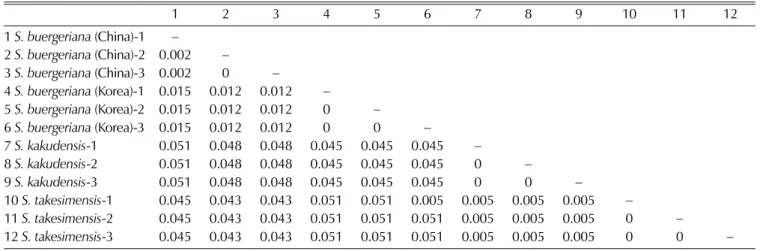
염기서열의 유사도 (Sequence divergency) 는 Kimura-2 parameter 방법으로 계산하였다 . 그 결과 , S . buergeriana 는 S.
kakudensis, S. takesimensis 와 각각 0.048~0.051, 0.043~0.045
의 값으로 높은 유전적 다양성을 보이는 반면 , S. kakudensis
와 S. takesimensis 는 0.005 의 값으로 염기서열의 다양성 정도
가 아주 낮은 것으로 나타났다 (Table 2). 한편 , S . buer- geriana 는 한국산과 중국산의 개체 간에 0.012~0.015 의 값을 보임으로서 종내 유전적 이질성을 확인되었다 . 또한 , 현삼속
10 S. takesimensis-1 0.045 0.043 0.043 0.051 0.051 0.005 0.005 0.005 0.005
−11 S. takesimensis-2 0.045 0.043 0.043 0.051 0.051 0.051 0.005 0.005 0.005 0
−12 S. takesimensis-3 0.045 0.043 0.043 0.051 0.051 0.051 0.005 0.005 0.005 0 0
−Fig. 3.
Neighbor-joining (NJ) tree of rpl -5 sequences of 12 taxa. Bootstrap values are found above branches. The evolutionary distances
were computed using the Tamura-Nei method.
식물의의 미토콘드리아 rpl- 5 region sequence 을 MEGA4 프 로그램을 통해 유연관계를 분석한 결과 , 현삼 3 종 내에서 2 개 의 그룹 (Group) 이 형성 되었다 (Fig. 3). 제 1 그룹은 한국
및 중국에서 수집된 S . buergeriana 가 하나의 그룹을 형성하였
으며 , 제 2 그룹은 S. kakudensis 와 S. takesimensis 의 2 분류군 이 하나의 그룹으로 형성 하였다 .
2. PCR-RFLP 분석
rpl -5 지역의 PCR 산물의 염기서열 분석을 통하여 적용된 분류군들 사이에 존재하는 SNP (Single Nucleotide Polymor- phism) 와 삽입 (Insertion) 및 결실 (Deletion) 변이를 확인하
였으며 (Fig. 2), NEB cutter 2.0 (Vincze et al ., 2003) 을 이 용하여 , SNP, 삽입 및 결실의 변이 중 제한효소 Tsp 509 I 에 의해 4 가지 제한효소 절단 패턴이 나타남을 확인하였다 . 그 결
과 S . buergeriana (China) 에서 201 bp, 102 bp, 66 bp, 30 bp 및 27 bp 크기의 단편을 나타냈고 S . buergeriana (Korea) 는 173 bp, 102 bp, 73 bp, 66 bp 및 27bp 크기의 단
편을 보였다 . S. kakudensis 는 134 bp, 102 bp, 73 bp, 57 bp, 30 bp, 27 bp 의 단편을 S. takesimensis 는 207 bp, 102 bp, 57 bp, 30 bp, 27 bp 의 단편을 각각 나타냈다 (Table. 3). S.
buergeriana (Korea) 의 rpl -5 지역은 262 와 264 bp, 282~
293 bp 의 결실에 의해 S. buergeriana (China) 의 rpl -5 지역보 다 15bp 더 짧게 나타났고 S. kakudensis 와 S. takesimensis 는
324~326 bp, 338~343 bp, 393~401 bp 의 결실로 S. buergeriana (China) 의 rpl -5 지역보다 18 bp 더 짧게 나타났다 . 이러한 밴
드 패턴의 차이는 Tsp 509 I 제한효소 인식부위의 SNP 에 의해 나타난 결과이며 , 제한효소 인식부위가 동일 지역이더라도 삽 입 및 결실 (Insertion/Deletion) 에 의해 단편의 길이가 차이
Fig. 4.PCR-RFLP patterns restricted by Tsp 509from S. buergeriana (China), S. buergeriana (Korea) S. kakudensis and S. takesimensis .
Lane M: 100 bp molecular weight marker (Promega).
Table 3.