Y.-L. Sun
School of Life Sciences, Ludong University, Yantai, 264-025, China
Y.-L. Sun ・ D. Wang ・ S.-K. Hong ( )
Department of Bio-Health Technology, College of Biomedical Science, Kangwon National University, Chuncheon,
Kangwon-Do, 200-701, Korea e-mail: [email protected] M.-H. Yeom ・ D.-H. Kim ・ H.-G. Kim
R&D Center, Amore Pacific Co. Yongin, 446-929, Korea S.-K. Hong
Institute of Bioscience and Biotechnology, Kangwon National University, Chuncheon, Kangwon-Do, 200-701, Korea
Molecular identification of medicinal herbs, Oldenlandia diffusa and Oldenlandia corymbosa based on nrDNA ITS region sequence
Yan-Lin Sun ・ Dong Wang ・ Myung-Hun Yeom ・ Duck-Hee Kim ・ Han-Gon Kim ・ Soon-Kwan Hong
Received: 19 August 2011 / Accepted: 5 September 2011
ⓒKorean Society for Plant Biotechnology
Abstract The medicinal herb Oldenlandia diffusa is known as a folk medicine for the treatment of hepatitis, sore throat, appendicitis, malignant tumors and urethral infection in Southern China and Korea. Another species O. corymbosa, is also used for the therapy of the similar conditions, however, only O. diffusa is referred to the medicinal herb by Chinese Pharmacopoeia. Due to their similar morphology, O. diffusa and O. corymbosa are often misidentified. To easily identify O. diffusa from O. corymbosa, the phylo- genetic utility of nuclear ribosomal DNA (nrDNA) internal transcribed spacers (ITS) were investigated among different O. diffusa and O. corymbosa populations in Korea. The nrDNA ITS sequence of O. diffusa contained 791 bp, with GenBank accession number of JF837601-JF837602. The nrDNA ITS sequence of O. corymbosa was 785-786 bp, with GenBank accession number of JF837603-JF837611. The results showed that there are some certain divergences in the ITS region sequence between both species, even among different populations of the same species. Particularly, O.
corymbosa ST-4 population showed the highest dissimilarity of the ITS region sequence with other nine populations of O.
corymbosa and two populations of O. diffusa. This conse- quence makes us further understand the molecular diver- sification between O. corymbosa and O. diffusa, and help to
promote the correct use and safety.
Keywords Oldenlandia diffusa, Oldenlandia corymbosa, internal transcribed spacer, ribosomal RNA gene, molecular analysis
Introduction
The herb of Oldenlandia diffusa (also known by alternate Hedyotis diffusa) is known as a traditional, folk medicine in Southern China (Liang et al. 2008). It is traditionally used as an herbal tea component, and for the treatment of sore throat, infectious diseases and malignant tumors (Shan et al.
2001; Kitani et al. 2011; Wu et al. 2009; Xu et al. 1997).
Another species, O. corymbos (also known by alternate Hedyotis corymbosa) belonging to the same genus with O.
diffusa, is also used in modern Chinese practice for the treatment of viral infections, cancer, some syndromes in- volving toxic heat, acne, boils, skin ailments, appendicitis, hepatitis, eye diseases and bleeding (Corbineau et al. 1980;
Lin et al. 1987). Due to their similar morphological char- acters (Zhao and Li 2007), both O. diffusa and O. corymbosa are frequently confused with each other in the wholesale and food markets (Liang et al. 2006; Li et al. 2010).
However, according to the Chinese Pharmacopoeia (The State Pharmacopoeia Committee of China 2005), the medical herb refers only to the dried herb of O. diffusa (Liang et al. 2006). The misusing has attracted an increasing attention on their use security. To make sure of their secure uses, clearer classification between these both medicinal herbs is urgently needed.
Many investigations have been reported to attempt to distinguish O. diffusa from O. corymbosa using various classification methods such as fluorescence microscopy (Lau et al. 2004), morphological analysis (Ko 1999; Liang et al.
2006), chemical fingerprints (Liang et al. 2008) and DNA DOI:http://dx.doi.org/10.5010/JPB.2011.38.4.301
Research Article
Table 1 ITS region sequence information about GenBank accession number, the length (bp) and (G+C) % of ITS1, 5.8S and ITS2 of 9 populations of O. corymbosa and 2 populations of O. diffusa
Species Population Accession number
ITS1 integrity
degree
ITS1 Length
(bp)
ITS1 (G+C) %
ITS2 integrity
degree
ITS2 Length
(bp)
ITS2 (G+C)
%
5.8S integrity
degree
5.8S Length
(bp)
5.8S (G+C)
%
O. diffusa LT-L JF837601 + 328 54.27 + 300 60.00 + 163 53.37
LT-S JF837602 - 232 58.62 - 263 61.22 + 163 53.37
O. corymbosa
ST-L JF837603 + 318 55.66 + 304 60.20 + 163 53.37
ST-S JF837611 - 233 58.80 - 268 61.19 + 163 53.37
ST-1 JF837605 - 232 59.05 - 279 59.86 + 163 53.37
ST-2 JF837606 - 233 57.94 - 263 61.60 + 163 53.37
ST-3 JF837607 - 226 59.29 - 279 60.57 + 163 53.37
ST-4 JF837608 - 152 62.50 - 259 58.69 + 163 53.37
ST-5 JF837609 - 232 59.05 - 268 61.19 + 163 53.37
ST-6 JF837610 - 234 58.97 - 279 59.86 + 163 53.37
ST-7 JF837604 + 322 51.86 + 301 60.80 + 163 53.37
+ presents complete sequence, - presents partial sequence sequence analysis (Hao et al. 2004; Liu et al. 2004; Guo et al. 2011). Particularly, Liang et al. (2006) reported that the two species could be distinguished with each other according to transverse sections of stems; Liu et al. (2004) newly designed O. diffusa-specific PCR primers for internal transcribed spacer 2 (ITS2) region amplification to suc- cessfully identify O. diffusa from adulterated O. corymbosa;
Guo et al. (2011) investigated five DNA barcoding regions including ITS, matK, petD, trnH-psbA and rbcL among 25 Oldenlandia species and constructed a phylogenetic tree.
Nowadays, simple conventional morphological methodology for taxon classification has not satisfied the increasing demands of more refined identification. Compared to the conventional identification methods, molecular identification based on DNA cloning and sequencing has been considered a more efficient, faster means. By more rapidly providing more phylogenetic information, molecular marker identifi- cation method has been more frequently utilized for phy- logenetic analysis. Among various molecular identification methods, the sequence analysis of ITS, a region of ribosomal RNA is considered as an effective method to give a higher number of informative sites at species levels (Kitani et al.
2009; Long et al. 2004).
In this study, we investigated the 18S-26S nuclear ribosomal DNA (nrDNA) ITS1 and ITS2 sequence variations between O. diffusa and O. corymbosa, to distinguish these two similar species in the molecular levels. This work would provide more ITS sequence information on O. diffusa and O. cory- mbosa species, help further understand the nucleotide varia- tions among different Korea populations of O. diffusa and
O. corymbosa, and then identify the identification efficiency based on ITS region sequence between the both species.
Materials and Methods
Plant materials
Nine populations of O. corymbosa and two populations of O. diffusa collected from Korea, were used in this study.
The populations were named as ST-L, ST-S, ST-1, ST-2, ST-3, ST-4, ST-5, ST-6 and ST-7 of O. corymbosa, and LT-L and LT-S of O. diffusa, for the convenience of sample management. Mature seeds of O. diffusa and O.
corymbosa were provided by Research and Development Center of Amore-Pacific Co., 446-729, Yongin, Korea. The mature seeds of both species were surface-sterilized with 70% ethanol for 30 seconds and then rinsed with sterile water for five times. The sterilized seeds were then grown in a pot containing a mixture of sterilized soil and ver- miculite (v:v, 3:1) in a green house condition with 40 ~ 60% relative wet rate, a 16/8 h (light/dark) photoperiod, and 24±2℃. After germination, the fresh leaf tissue was sampled and used for DNA extraction. The total or partial ITS sequences of O. corymbosa and O. diffusa have been published by GenBank, NCBI, with the accession numbers shown in Table 1.
DNA extraction and PCR amplification
DNA was extracted from fresh leaves of O. diffusa and O.
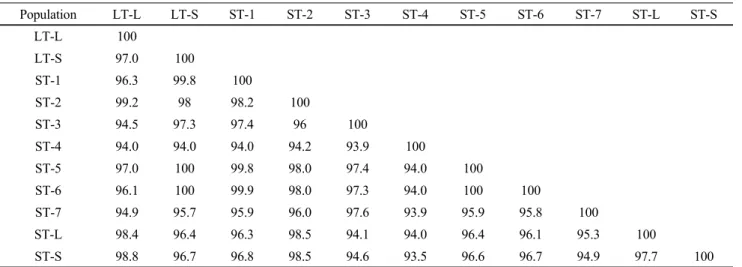
Table 2 Homology matrix (%) of 11 total ITS region sequences
Population LT-L LT-S ST-1 ST-2 ST-3 ST-4 ST-5 ST-6 ST-7 ST-L ST-S
LT-L 100
LT-S 97.0 100
ST-1 96.3 99.8 100
ST-2 99.2 98 98.2 100
ST-3 94.5 97.3 97.4 96 100
ST-4 94.0 94.0 94.0 94.2 93.9 100
ST-5 97.0 100 99.8 98.0 97.4 94.0 100
ST-6 96.1 100 99.9 98.0 97.3 94.0 100 100
ST-7 94.9 95.7 95.9 96.0 97.6 93.9 95.9 95.8 100
ST-L 98.4 96.4 96.3 98.5 94.1 94.0 96.4 96.1 95.3 100
ST-S 98.8 96.7 96.8 98.5 94.6 93.5 96.6 96.7 94.9 97.7 100
corymbosa using the modified cetyltrimethylammonium bromide (CTAB) method described by Kang et al. (1998).
Common ITS primer sets ITS5, 5’-GAA AGT AAA AGT CGT AAC AAG G-3’ and ITS4, 5’- TCC TCC GCT TAT TGA TAT GC-3’ were used to amplify the nrDNA ITS region including ITS1, 5.8S rRNA, ITS2 regions (White et al. 1990). PCR amplification was conducted using this set of primers with the following program: 35 cycles of dena- turation at 95℃ for 1 min, annealing at 53℃ for 1 min, and a final extension step at 72℃ for 1.5 min. All PCR products were purified before DNA sequence analysis using a QIAquick PCR Purification Kit (QIAGEN, Korea) according to the manufacturer’s instructions. Purified PCR products were then sequenced at MACRO GEN Advancing through Genomics (Korea).
Sequence analysis
Homology analysis of the 11 ITS region sequences were performed by DNAMAN 6.0 software according to the Observed Divergency distance method. The phylogenetic tree of O. corymbosa and O. diffusa were also constructed based on neighbor joining method using DNAMAN 6.0.
Results and Discussion Length and G + C content
Total ITS region sequences were successfully amplified by PCR using common primer sets, ITS4/ITS5 from DNAs of nine O. corymbosa populations and two O. diffusa popu- lations. Due to inefficient reading with nucleotide overlapping appeared in sequencing results, only three total ITS region
sequences were obtained from one O. diffusa population, LT-L and two O. corymbosa populations, ST-L and ST-7 (Table 1). According to the total ITS region sequences of O. diffusa LT-L population, the size of the total ITS region was 791 bp, of which 328 bp belonged to ITS1 region, 163 bp belonged to 5.8S rRNA gene, and 300 bp belonged to ITS2 region. For O. corymbosa, the total ITS region ac- counted for 785 or 786 bp varying in ST-L or ST-7 population, respectively, of which ITS1 region accounted for 318 ~ 322 bp, ITS2 region for 301 ~ 304 bp, and 5.8S rRNA region for 163 bp with the identical size of O. diffusa (Table 1). Not only sequence lengths but (G+C) contents (%) of ITS region sequences were different among different populations of O. diffusa and O. corymbosa. The (G+C) contents (%) ranged from 54.27% to 58.62% in ITS1 region of O. diffusa and ranged from 51.86% to 62.50% in O.
corymbosa (Table 1). Most of ITS2 regions showed higher (G+C) contents (%) than ITS1 regions, ranged from 60.00%
to 61.22% in O. diffusa and ranged from 58.69% to 61.60%
in O. corymbosa, except for ST-4 and ST-6 populations in O. corymbosa (Table 1). In this study, expectedly, the (G+C) contents (%) of the 5.8S rRNA region were absolutely identical to 53.37% among 11 sequences of both species.
Homology analysis of O. diffusa and O. corymbosa
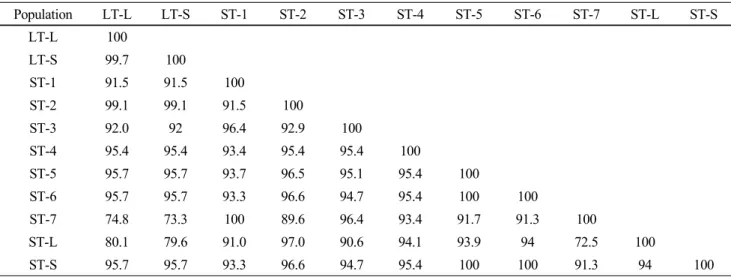
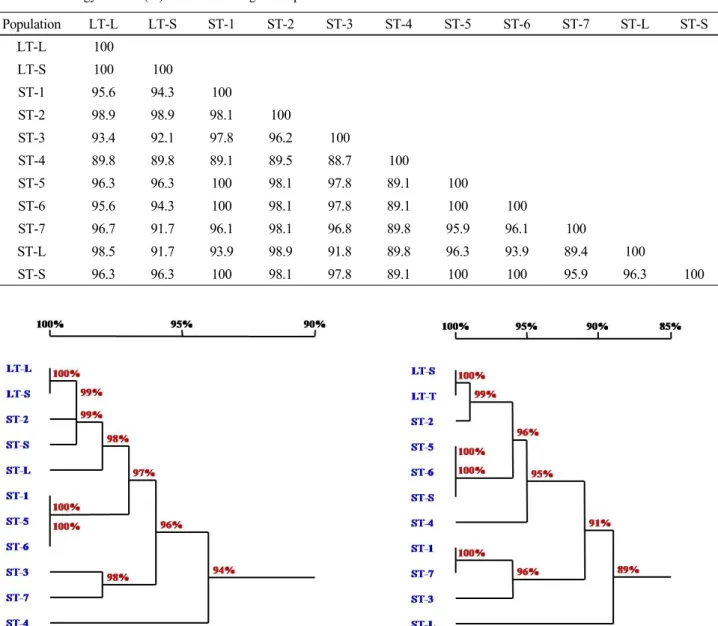
Among nine O. corymbosa populations and two O. diffusa populations, ST-4 population of O. corymbosa had the lowest homology of 93.5% with ST-S population, according to the total ITS region sequence analysis (Table 2). There was a number of nucleotides and length variations in ITS1 region (Fig. 1A, Table 3), but this dissimilarity was mainly owing to the sequence variation of the two populations in ITS2 region, with a low homology of 89.1% (Table 4).
Fig. 1 DNA alignment of O. diffusa, O. corymbosa using total ITS region. Partial alignment of the total ITS regions showing notable base phlomorphisms among different populations of O. diffusa and O. corymbosa in ITS1 (A) and ITS2 (B) regions. The letters on the top line represent the base letters in sequence alignment.
Sequences different from the uppermost sequence are marked as their own sequences in lowercase. ‘-’ represents the base being identical to the uppermost sequence. ‘.’ represents gap
Table 3 Homology matrix (%) of 11 ITS1 region sequences
Population LT-L LT-S ST-1 ST-2 ST-3 ST-4 ST-5 ST-6 ST-7 ST-L ST-S
LT-L 100
LT-S 99.7 100
ST-1 91.5 91.5 100
ST-2 99.1 99.1 91.5 100
ST-3 92.0 92 96.4 92.9 100
ST-4 95.4 95.4 93.4 95.4 95.4 100
ST-5 95.7 95.7 93.7 96.5 95.1 95.4 100
ST-6 95.7 95.7 93.3 96.6 94.7 95.4 100 100
ST-7 74.8 73.3 100 89.6 96.4 93.4 91.7 91.3 100
ST-L 80.1 79.6 91.0 97.0 90.6 94.1 93.9 94 72.5 100
ST-S 95.7 95.7 93.3 96.6 94.7 95.4 100 100 91.3 94 100
ST-4 population showed relatively low homology with all the other populations of either O. corymbosa or O. diffusa, except for ST-S population, according to the total ITS region sequence analysis (Table 2). Similar results were obtained from homology compared with the ITS2 region sequence. ST-4 population not only showed relatively low homology with other populations, but also appeared more information sites when aligned with other ITS2 region sequences (Fig. 1B). However, according to the ITS1 region sequence analysis, ST-4 population showed 93.4 ~ 95.4%
identity with other populations, while ST-7 having 100%
homology with ST-1, showed relatively low homology with other populations, especially two populations of O. diffusa and ST-L population (Table 3). These results were not con- gruent with the evidence of Li et al. (2010) that O. diffusa and O. corymbosa could be clearly authenticated by either ITS1 or ITS2 region sequence. In the report of Li et al.
(2010), O. diffusa showed its own informative nucleotide sites, different from those of O. corymbosa, through which even confused O. diffusa or O. corymbosa starting materials could be authenticated. In our study, both LT-L and LT-S populations belonged to the same species, O. diffusa, how- ever, did not show identical nucleotide sequences in the ITS1 and ITS2 regions (Fig. 1A, B). In addition, ST-1 and ST-7 both belonging to the same species, O. corymbosa, showed 100% identity in ITS1 region, as well as ST-5, ST-6, and ST-S (Table 3). In the ITS2 region, ST-1, ST-5, ST-6, and ST-S populations of O. corymbosa showed 100% identity with each other (Table 4).
Summarizing the above results, it concluded that the ITS1 and ITS2 region sequences of both O. diffusa popu- lations used in this experiment were intra-specifically con- served, while those of O. corymbosa populations were not intra-specifically conversed. This suggestion was not supported by the evidence of Guo et al. (2011) that the total ITS region of O. diffusa and O. corymbosa were intra-specifically conserved but inter-specifically variable, thus, enough to differentiate these both species. In our study, the nucleotide variations appeared in the total ITS regions of different O.
corymbosa populations, and some populations showed more similar ITS regions with O. diffusa populations, e.g.
ST-2 had higher homology with LT-T and LT-S compared to other O. corymbosa populations.
Table 4 Homology matrix (%) of 11 ITS2 region sequences
Population LT-L LT-S ST-1 ST-2 ST-3 ST-4 ST-5 ST-6 ST-7 ST-L ST-S
LT-L 100
LT-S 100 100
ST-1 95.6 94.3 100
ST-2 98.9 98.9 98.1 100
ST-3 93.4 92.1 97.8 96.2 100
ST-4 89.8 89.8 89.1 89.5 88.7 100
ST-5 96.3 96.3 100 98.1 97.8 89.1 100
ST-6 95.6 94.3 100 98.1 97.8 89.1 100 100
ST-7 96.7 91.7 96.1 98.1 96.8 89.8 95.9 96.1 100
ST-L 98.5 91.7 93.9 98.9 91.8 89.8 96.3 93.9 89.4 100
ST-S 96.3 96.3 100 98.1 97.8 89.1 100 100 95.9 96.3 100
Fig. 2 Phylogenetic tree constructed by total ITS region sequences of nine populations of O. corymbosa and two populations of O.
diffusa
Fig. 3 Phylogenetic tree constructed by ITS1 region sequences of nine populations of O. corymbosa and two populations of O.
diffusa
Phylogeny of O.diffusa and O. corymbosa
Based on the phylogenetic tree constructed by 11 total ITS region sequences, O. diffusa and O. corymbosa had not been anticipated divided into two clades, on the contrary, the LT-L population of O. diffusa population formed one monophyletic group with LT-S, near to ST-2 population of O. corymbosa, and ST-S population sharing 99% similarity (Fig. 2). The ST-4 population of O. corymbosa showed the highest dissimilarity with all populations, sharing 94%
similarity according to clustering analysis of the total ITS region sequence. From the phylogenetic tree constructed by ITS1 region sequence, the ST-L population of O.
corymbosa as the Outgroup shared 89% similarity with two
monophletic groups respectively formed by three O. corymbosa populations and the other O. corymbosa populations inter- fused with O. diffusa. The group simply formed by O.
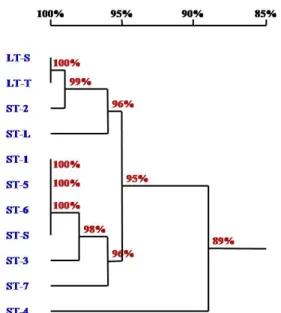
corymbosa populations shared the lowest similarity of 96%, while the other group shared 95% similarity between ST-4 and other populations (Fig. 3). In the ITS2 region phylogenetic tree, ST-4 population of O. corymbosa became the Outgroup, showing 89% similarity with other populations (Fig. 4). All populations of O. diffusa together with popu- lations ST-2 and ST-L of O. corymbosa formed one monophyletic group, showing 96% identity in the lowest level, while other O. corymbosa populations formed another monophyletic group, showing 96% identity in the lowest level as well (Fig. 4).
Fig. 4 Phylogenetic tree constructed by ITS2 region sequences of nine populations of O. corymbosa and two populations of O.
diffusa
The clustering analysis on O. diffusa and O. corymbosa species showed that all species were not form distantly separate clusters, contrarily O. diffusa clade interlaced with some O. corymbosa populations, formed one multi-level group. This suggesting was not congruent with the evidence of Li et al. (2010) that O. diffusa and O. corymbosa could be recognized as distinct species in the genus Oldenlandia phylogenetic tree. The results could be comprehended by the currently available limited sampling of Asian species.
To further understand the phylogeny of O. diffusa and O.
corymbosa, a broader concept of samples could be inves- tigated in the recent molecular phylogenetic analysis.
In conclusion, the total ITS sequences of O. diffusa and O. corymbosa populations collected from Korea were suc- cessfully amplified using common primer set, ITS4/ITS5.
However, due to currently limited sampling of both species, O. diffusa and O. corymbosa could not yet be authenticated only based on ITS region sequences in the present study.
To ensure proper use of herbal materials for efficient treat- ment and correct identification of the two medicinal herbs, O. diffusa and O. corymbosa, additional markers and iden- tification methods should be applied to achieve correct authentication.
Acknowledgements
This research was supported by Nutraceutical Bio Brain Korea 21 Project Group.
References
Corbineau F, Côme D (1980) Principaux paramètres de la germination des graines d’Oldenlandia corymbosa L.
(Rubiacée tropicale). Physiol Vég 18:259-273
Guo X, Simmons MP, But PPH, Shaw PC, Wang RJ (2011) Application of DNA barcodes in Hedyotis L. (Spermacoceae, Rubiaceae). J Syst Evol 49:203-212. doi:10.1111/j.1759- 6831.2011.00130.x
Hao MG, Liu ZQ, Wang JL (2004) Application of the sequences of rDNA ITS to identify Chinese crude drug Hedyotis diffusa. J Anhui Norm Univ (Nat Sci) 27:188-191
Kang HW, Cho YG, Yoon UH, Eun MY (1998) A rapid DNA extraction method for RFLP and PCR analysis from a single dry seed. Plant Mol Biol Rep 16:1-9
Kårehed J, Groeninckx I, Dessein S, Motley TJ, Bremer B (2008) The phylogenetic utility of chloroplast and nuclear DNA markers and the phylogeny of the Rubiaceae tribe Sperma- coceae. Mol Phylogenet Evol 49:843-866. doi:10.1016/j.
ympev.2008.09.025
Kitani Y, Shu Z, Batkhuu J, Sanchir C, Komatsu K (2011) Genetic diversity of Ephedra plants in Mongolia inferred from internal transcribed spacer sequence of nuclear ribosomal DNA. Biol Pharm Bull 34: 717-726
Kitani Y, Shu Z, Batkhuu J, Sanchir C, Komatsu K (2011) Genetic diversity of Ephedra plants in Mongolia inferred from internal transcribed spacer sequence of nuclear ribosomal DNA. Biol Pharm Bull 34:717-726
Kitani Y, Zhu S, Omote T, Tanaka K, Batkhuu J, Sanchir C, Fushimi H, Mikage M, Komatsu K (2009) Molecular analysis and chemical evaluation of Ephedra plants in Mongolia. Biol Pharm Bull 32:1235-1243
Ko WC (1999) Hedyotis. In: Luo XR (ed) Flora Republicae Popularis Sinicae. Science Press, Beijing, vol 71, pp 32-77 Lau P, Peng Y, Zhao Z (2004) Microscopic identification of
Chinese patent medicine (1) - Wu Zi Yan Zong Wan. Nat Med 58:258-265
Li M, Jiang RW, Hon PM, Cheng L, Li LL, Zhou JR, Shaw PC, But PP (2010) Authentication of the anti-tumor herb Baihuas- heshecao with bioactive marker compounds and molecular sequences. Food Chem 119:1239-1245. doi:10.1016/j.foodchem.
2009.09.113
Liang ZT, He MF, Fong WF, Jiang ZH, Zhao ZZ (2008) A comparable, chemical and pharmacological analysis of the traditional Chinese medicinal herbs Oldenlandia diffusa and O. corymbosa and a new valuation of their biological potential.
Phytomedicine 15:259-267. doi:10.1016/l.phymed.2008.01.
003
Liang ZT, Jiang ZH, Leung KSY, Peng Y, Zhao ZZ (2006) Distinguishing the medicinal herb Oldenlandia diffusa from similar species of the same genus using fluorescence micro- scopy. Microsc Res Tech 69:277-282. doi:10.1002/jemt.20312 Lin CC, Chen FY, Namba T (1987) Development of crude drug
resources from Taiwan: pharmacognostical studies on a Chinese crude drug. Shoyakugaku Zasshi 41:180-188
Liu ZQ, Hao MG (2005) Determination of rDNA ITS sequences in Hedyotis diffusa. Shaanxi J Tradl Chin Med 26:167-169 Liu ZQ, Hao MG, Wang JL (2004) Application of allele-specific
primer in the identification of Hedyotis diffusa. Zhong Yao Cai 27:484-487
Long CF, Kakiuchi N, Takahashi A, Komatsu K, Cai SQ, Makage M (2004) phylogenetic analysis of the DNA sequence of the non-coding region of nuclear ribosomal DNA and chloroplast of Ephedra plants in China. Planta Med 70:1080-1084.
Doi:10.1055/s-2004-832651
Shan BE, Zhang JY, Du XN (2001) Immunomodulatory activity and anti-tumor activity of Oldenlandia diffusa in vitro.
Zhongguo Zhong Xi Yi Jie He Za Zhi 21:370-374
The State Pharmacopoeia Committee of China (2005) The ap- pendix of Chinese pharmacopoeia. The Chemical Industry Press, Beijing, vol I, pp 22
White TJ, Bruns T, Lee S, Taylor J (1990) Amplification and direct sequencing of fungal ribosomal RNA genes for phylogenetics.
In: Innis MA, Gelfand DH, Sninsky JJ, White TJ (eds) PCR protocols–a guide to methods and applications. Academic Press, San Diego, Calif, pp 315-322
Wu PK, Tai WCS, Liang ZT, Zhao ZZ, Hsiao WLW (2009) Oleanolic acid isolated from Oldenlandia diffusa exhibits a unique growth inhibitory effect against ras-transformed fibroblasts. Life Sci 85:113-121. Doi:10.1016/j.lfs.2009.04.
025
Xu GJ, Xu LS, Wang ZT (1997) Species systematization and quality evaluation of commonly used Chinese traditional drugs. South-China Edition, Fujian: Fujian Science and Technology Publisher, Fuzhou, China, vol 3-4
Zhao ZZ, Li YS (2007) Easily confused Chinese medicines in Hong Kong. Hong Kong: Chinese Medicine Merchants Association Ltd., Hong Kong