서 론
한국 내 자연서식하고 있는 삵(Amur Leopard cats, Prionailurus bengalensis euptilurus)은 Leopard cats의 한 아종(subspecies)이며, 고양이과(Family Felidae) 삵 속(genus Prionailurus)에 속한다. 삵은 중국, 대만, 인 도, 필리핀 등 아시아 전역에 많이 분포하고 있으며 지 역에 따라 9개의 아종(subspecies)이 있다(Nowak, 1999; Wilson과 Reeder, 2005). 한국 내 서식하는 삵은
영어명으로 Amur leopard cat으로 명칭하고 있으며, 전 에는 학명을 P. bengalensis manchuricus라고 명칭하였 으나(Mori, 1922), 최근에는 P. bengalensis euptilurus 으로 명칭하고 있다(Wilson, 2005). 지역에 따라 Amur leopard cat, Tshushima leopard cat, Manchuria leopard cat 등으로도 부르기도 하며, 인도, 태국, 방글라데시에 서식하고 있는 삵은 멸종위기에 처한 야생동식물의 국 제거래에 관한 협약(Convention on International Trade in Endangered Species of Wild Fauna and Flora, CITES) 부속서 I에 포함되어 있고 그 외 지역의 삵은 CITES 부속서 II에 포함되어 국제적으로 보호받고 있다
Mitochondrial DNA Cytochrome b
분석을 통한 한국 내 삵의 유전적 다양성 조사
김영섭·유미현·정배동1·김종택1*
서울대공원, 1강원대학교 수의과대학
(접수 2010. 12. 4, 게재승인 2010. 12. 28)
Genetic diversity in Korean leopard cats (Prionailurus bengalensis euptilura), based on mitochondrial DNA
cytochrome b gene sequence analysis
Young-Seob Kim, Mi-Hyun Yoo, Bae-Dong Jung1, Jong-Taek Kim1*
Seoul Grand Park Zoo, Gwacheon, Korea
1College of Veterinary Medicine, Kangwon National University, 200-701 Korea (Received 4 December 2010, accepted in revised from 28 December 2010)
353
*Corresponding author: Jong-Taek Kim, Tel. +82-33-250-8673, Fax. +82-33-244-2367, E-mail. [email protected]
Nucleotide sequences of mitochondrial DNA (mtDNA) of 19 leopard cats (Prionailurus bangalensis euptilura) obtained from Seoul grand park zoo in South Korea were determined for analysing genetic diversity. In the leopard cats, 3 haplotypes of the partial cytochrome b sequences (603 base-pairs, bp) were identified. Haplotypes obtained from those genes showed existences of at least 3 maternal lineages of leopard cats in Korea. Tamura-Nei nucleotide distance among 3 haplotypes were 0.00. Molecular phylo- genetic tree showed the similar clustering of haplotypes for genes. Meanwhile, no individual variations within the leopard cats in S. Korea. Genetic surveillance system of leopard cats in S. Korea is warranted for maintaining biological conservation.
Key words : Leopard cat, Prionailurus bangalensis euptilura, Mitochondrial DNA, Cytochrome b Abstract
(Nowak, 1999; Wilson과 Reeder, 2005). 한국 내 삵은 1954년까지 우리나라에는 산간 계곡에서는 흔히 볼 수 있었는데 6·25이후 강력한 “푸라톨(flatol)”과 같 은 살서제를 무제한 사용한 결과 2차적 피해로 말미암 아 멸종상태에 처했고(원, 1967) 근대화 시대에는 급속 한 산업화 때문에 서식지 파괴와 환경오염으로 그 개 체수가 급감하여 정부에서는 1998년부터 “자연보전 법”에 이어 현재는 “야생동·식물보호법”에 의거 멸종 위기야생 동·식물 II급으로 지정하여 보호하고 있다.
Mitochondrial DNA cytochrome b (mtDNA cytochro- me b)의 분자유전학적 연구는 근연한 종들과 종내 집 단의 모계혈통을 분석하여 집단유전학이나 분류학적 연구에 중요하게 이용되고 있고(Avise 등, 1986; Hillis 등, 1996), 염기서열의 비교는 종내 집단 간의 유전적 다양성뿐만 아니라 종 수준의 분류학적 검토에 많이 이용된다(Sunnucks, 2000). 최근에 이러한 mtDNA cyto- chrome b의 분자계통 분석(Masuda 등, 1996)을 통해 집고양이(domestic cats)가 아프리카 야생고양이(wild cats) 및 유럽 야생고양이와 매우 밀접하게 관련 있다 고 보고되었다. 또한, 일본 쓰시마섬의 야생고양이과 야생동물인 삵을 mtDNA cytochrome b 유전자 분석을 통한 방법으로 삵의 한 아종인 쓰시마 삵(P. bengalen- sis euptilurus)으로 분류한 보고가 있다(Masuda와 Yoshida, 1995).
현재 한국 내 삵에 대한 연구보고는 매우 부족한 실 정이며, 유전적 다양성 조사뿐만 아니라 생태나 번식 생리 등에 대한 많은 연구가 필요한 실정이다. 이 연구 는 한국 내 삵 19수에 대한 mtDNA cytochrome b gene 의 염기서열을 분석하고, 염기서열 자료에 기초하여 삵의 계통학적 근연관계(phylogenetic relationships)와 유전적 다양성을 조사하였다.
재료 및 방법
실험동물
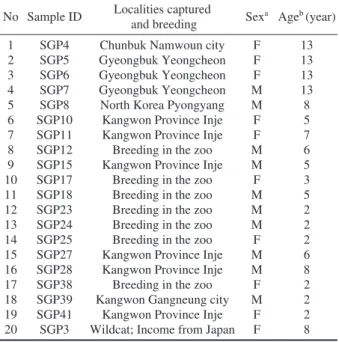
서울대공원에서 사육되었던 삵(leopard cat, P. beng- alensis euptilurus) 19개체와 유럽삵(wildcat, Felis silve- stris) 1개체를 대상으로 하였다(Table 1). 삵 19개체(근 육 8개, 혈액 11개) 및 유럽삵 1개체(근육 1개)의 시료 와 폐사체에서 확보된 근육 시료는 deep-freezer(-70°C) 에 냉동보관한 후 해동하여 분석에 이용하였다. 19개
체(암컷 9마리, 수컷 10마리)중 12마리는 국내에서 포 획된 개체로, 북한(평양동물원)에서 도입된 1마리, 강 원도 인제군 지역에서 포획된 6마리, 경북 영천지역에 서 포획된 3마리, 강릉시 연곡면에서 포획된 1마리, 전 북 남원시 지리산에서 포획된 1마리이다. 나머지 7마 리는 서울대공원 동물원에서 번식된 개체이며 유럽 삵 1개체는 일본에서 도입된 것이다. 11수에서 채취된 혈 액 시료는 응고방지를 위해 EDTA에 넣어 냉동 보관 한 후 분석하였다. 비교분석을 위하여 미국 국립생물 정보센터(NCBI, The National Center for Biotechnology Information) GenBank에 등록되어 있는 삵 및 Dome- stic cat (Felis catus)의 염기서열을 참고하였다.
DNA 추출
DNeasy Tissue kit (Qiagen, Cat. No. 69506, Germany) 을 사용하여 혈액이나 근육에서 DNA를 추출하였으며 정제 후 분석때까지 -20°C에 냉동 보관하였다.
Mitochondrial DNA cytochrome b유전자 분석 cytochrome b 유전자 증폭 : 삵 mtDNA cytochrome b gene은 1,140bp의 크기를 가지며, 이를 증폭하기 위하 여 Kao 등의 방법(1998)에 따라 2종의 L5와 H5 primer 를 사용하였다(Table 2). 추출된 genomic DNA는 L5,
Table 1. The individual properties of leopard cats subjected to this study
No Sample ID Localities captured
and breeding Sexa Ageb(year)
1 SGP4 Chunbuk Namwoun city F 13
2 SGP5 Gyeongbuk Yeongcheon F 13
3 SGP6 Gyeongbuk Yeongcheon F 13 4 SGP7 Gyeongbuk Yeongcheon M 13 5 SGP8 North Korea Pyongyang M 8 6 SGP10 Kangwon Province Inje F 5 7 SGP11 Kangwon Province Inje F 7
8 SGP12 Breeding in the zoo M 6
9 SGP15 Kangwon Province Inje M 5
10 SGP17 Breeding in the zoo F 3
11 SGP18 Breeding in the zoo M 5
12 SGP23 Breeding in the zoo M 2
13 SGP24 Breeding in the zoo M 2
14 SGP25 Breeding in the zoo F 2
15 SGP27 Kangwon Province Inje M 6 16 SGP28 Kangwon Province Inje M 8
17 SGP38 Breeding in the zoo F 2
18 SGP39 Kangwon Gangneung city M 2 19 SGP41 Kangwon Province Inje F 2 20 SGP3 Wildcat; Income from Japan F 8
aSex: F, femalec. M, male
bIt was age at sample collection time
H5 primer를 이용하여 polymerase chain reaction ma- chine(ABI, 2720 PCR, USA)을 사용하여 증폭하였다.
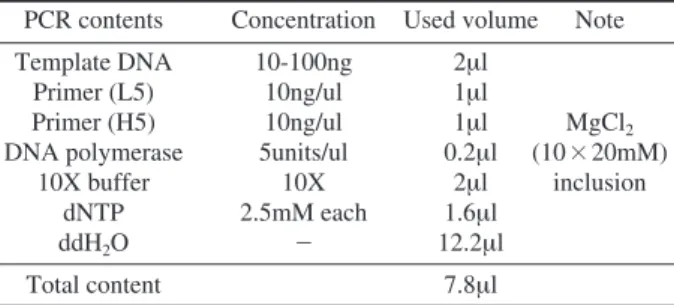
반응조건은 94°C 5분, 그리고 94°C 45초, 55°C 45초, 72°C 90초에서 총 35cycles, 마지막으로 72°C 5분을 실 시하였다(Table 3, Table 4). 증폭산물은 0.8% agarose gel에서 20분간 전기영동 후, ethidium bromide (EtBr) (SIGMA, Germany)로 염색하여 UV(BioDoc-It, USA) (260nm) 상에서 확인하였다.
염기서열 분석
위와 동일 조건으로 mtDNA cytochrome b gene을 대 량 증폭 후, QIAGEN QIAquick gel extraction kit (QIA- GEN, Cat No. 28706, Germany)을 사용하여 염기서열 분석에 적합하게 PCR 산물을 정제하였다. 또한 삵의 mtDNA cytochrome b gene 염기서열분석을 위하여 Sac- chi 등(2002)의 방법에 따라 2종의 280L와 981R primer를 추가로 사용하였다(Table 2). L5, H5와 280L, 981R 등 4개의 primer를 사용하여 mtDNA cytochrome b
gene의 염기서열을 결정하였다. 염기서열분석용 PCR 반응조건 및 반응액 조성은 Table 5과 Table 6과 같다.
염기서열분석용 PCR 산물은 QIAGEN DyeEx 2.0 spin kit(QIAGEN, Cat No. 63206, Germany)을 사용하여 잔 류 BigDye (ABI, BigDye Terminator V3.1 Cycle Sequen- cing kit, USA)를 제거 후 evaporator (Eyela centrifugal evaporator CVE-3100, Japan)에서 건조(¤1hr)하고 HiDi Foramide (ABI, HiDi Foramide, USA)를 20ul 첨가하여 95°C에서 3min 간 반응 후 genetic analyzer (Applied Bio- systems, 310 Genetic Analyzer, USA) 사용하여 염기서 열을 분석하였다.
Phylogenetic tree 작성
염기서열분석 결과는 clustal X (v.1.83)를 사용하여 (Chenna 등, 2003) multiple alignment를 수행하고 비교 분석을 위해 NCBI의 GenBank에서(Benson 등, 2007) Leopard cats (P. bengalensis euptilurus)과 domestic cat (Felis catus)의 염기서열 정보(Table 7)를 얻어 비교하
Table 2. The primers and sequences for mtDNA cytochrome b gene amplification and sequence analysis
Primers Sequence
L5 5′ AGG CGT CGA AGC TTG ACA TGA AAA GCC ATC GTT 3′
H5 5′ CGG AAT TCC ATT TTT GGT TTA CAA GAC 3′
280L 5′ TTT ATC TGT CTA TAC ATG CA 3′
981R 5′ TGT TCT ACT GGT TGG CCT CCA ATT CA 3′
Table 3. The PCR condition for mtDNA cytochrome b gene am- plification
Step Temp (°C) Time
(min. or sec.) Cycles
Denaturation 94 5 min. 1
Denaturation 94 45 sec.
Annealing 55 45 sec. 35
Extention 72 90 sec.
Extention 72 5 min. 1
Table 4. The PCR contents for mtDNA cytochrome b gene amplification
PCR contents Concentration Used volume Note Template DNA 10-100ng 2µl
Primer (L5) 10ng/ul 1µl
Primer (H5) 10ng/ul 1µl MgCl2
DNA polymerase 5units/ul 0.2µl (10×20mM)
10X buffer 10X 2µl inclusion
dNTP 2.5mM each 1.6µl
ddH2O - 12.2µl
Total content 7.8µl
Table 5. The PCR conditions for mtDNA cytochrome b gene sequ- ence analysis
Step Temp (°C) Time
(min. or sec.) Cycles
Denaturation 96 1 min. 1
Denaturation 96 10 sec.
Annealing 50 5 sec. 25
Extention 60 4 min.
Table 6. The PCR contents for mtDNA cytochrome b gene sequ- ence analysis
PCR Concentration Used
contents volume Note
Template Gel extraction
DNA 10-100ng 2µl production
Primer 1.6pM 2µl L5, H5, 280L, 981R
Big Dye v.3.1 2µl
5X buffer 2µl
ddH2O 2µl
Total content 8µl
Table 7. Haplotypes of the Prionailurus bangalensis euptilura (pbe) and domestic cat (dc) in the NCBI GenBank nu- cleotide database
Haplotypes Samples GenBank Localities number and source Prionailurus
pbe bangalensis AB194818 Japan
euptilura
dc Felis catus AB194817 Japan
였다. 각 개체의 유전적 유연관계는 Mega 3 program을 (Kumar 등, 2004) 사용하여 분석 후 Neighbor-joining 방법(Saitou와 Nei, 1987)을 사용하여 phylogenetic tree
를 작성하였다.
결 과
평양, 강원도, 경북, 전북 등의 지역에서 포획된 한국 내 삵 19개체의 mitochondrial DNA cytochrome b의 전 체 염기서열 1140bp 중, 603bp 염기서열을 분석하였다 (Table 8). NCBI GenBank에 등재된 삵의 한 아종인 P.
bangalensis euptilurus (Sample ID; pbe)와 비교하여 한 국내 삵 19개체 중 17개체에서 251번째 염기서열의 변이(A에서 C로)가 확인되었다. 또한 2개체에서(Sam- ples ID; SGP 8, SGP 27) 251번째(A에서 T로)와 477번 째 염기서열(T에서 G로)에 변이가 관찰되었다. 한 개 체당 한 부분의 염기서열에 변이가 확인되어 개체당 염기서열의 차이는 0.16% (1/603 sites) 이내였다. 비교 대상으로 분석한 유럽삵 1개체(Sample ID; SGP 3)는 한국 내 삵의 염기서열과 비교해 총 7 sites에서 변이를 나타내었으며 한국내 삵과의 염기서열 차이는 1.16%
(7/603)이었다(Table 8). 분석된 염기서열 자료로 haplo- type을 작성한 결과 삵 19개체에서 3개의 haplotype을 얻었으며(Table 9), 유럽삵 1개체의 haplotype과 NCBI GenBank에 등재된 삵의 한 아종인 P. bangalensis eup- tilura의 1개 haplotype과 domestic cat (Felis catus)의 1 개 haplotype 등 총 6개의 haplotype으로 nucleotide Tamura-Nei distance를 분석한 결과 삵과 P. banga- lensis euptilura의 nucleotide Tamura-Nei distance는 0.00로 나타났고, domestic cat (Felis catus)과 삵 간에 는 0.12였으며, 유럽삵(wildcat)과 삵 간에는 0.01로 나 타났다(Table 10). 6개의 haplotype으로 작성한 Neighbor-joining tree에서 삵과 P. bangalensis euptilura 는 같은 그룹을 형성하였으나 유럽 삵과 집고양이는 뚜렷이 서로 다른 그룹을 형성하였다(Fig. 1).
Table 9. Four haplotypes (603bp) of the leopard cats in Seoul grand park zoo
Haplotypes Sample ID Localities and source
LC1 South Korea
LC2 SGP 8 Pyongyang in North Korea LC3 SGP 27 Kangwon Province Inje LC4 SGP 3 Wildcat; Income from Japan
Table 10. Nucleotide Tamura-Nei distance* among six cytochrome b haplotypes in three species of Felis. Haplotypes pbe and dc are from NCBI GenBank nucleotide database, whereas LC1 to LC4 are from Seoul grand park zoo in this study
Haplotypesa pbe LC1 LC2 LC3 LC4 dc
pbe
LC1 0.00
LC2 0.00 0.00
LC3 0.00 0.00 0.00
LC4 0.01 0.01 0.01 0.01
dc 0.11 0.12 0.12 0.12 0.11
*The distance were calculated from the sequence data given in Fig. 1
aThe six haplotypes are : LC1 to LC3, three haplotype of Korea leopard cat in Korea, LC4, one haplotype of Felis silvestris, pbe, one haplotype of Prionailurus bengalensis euptilurus (pbe) in NCBI GenBank nucleotide database, dc, one haplotype of domestic cat (dc) in GenBank
Table 8. Nucleotide sequences (603bp) of the mtDNA cyto- chrome b for 19 leopard cats and a Felis silvestris of the Seoul grand park. A Prionailurus bengalensis eupti- lurus was obtained from GenBank
Sample ID Nucleotide sitea
7 130 251 253 262 374 379 460 477
SGP 23 A C C C A T T G T
SGP 24 · · · · · · · · ·
SGP 5 · · · · · · · · ·
SGP 17 · · · · · · · · ·
SGP 38 · · · · · · · · ·
SGP 39 · · · · · · · · ·
SGP 12 · · · · · · · · ·
SGP 7 · · · · · · · · ·
SGP 15 · · · · · · · · ·
SGP 11 · · · · · · · · ·
SGP 6 · · · · · · · · ·
SGP 41 · · · · · · · · ·
SGP 4 · · · · · · · · ·
SGP 18 · · · · · · · · ·
SGP 28 · · · · · · · · ·
SGP 10 · · · · · · · · ·
SGP 25 · · · · · · · · ·
SGP 8 · · T · · · · · ·
SGP 27 · · · · · · · · G
pbeb A
SGP 3c G T · T G C C A
*Dots indicate the same nucleotides as SGP 23, aNuceotide sites where substitution were found among haplotypes, bpbe: pbe (Prionailurus bengalensis euptilurus) was obtained from GenBank, cSGP 3: SGP 3 (Felis silvestris) was obtained from Seoul grand park
SGP5,17,38,39,12,7, 15,11,6,41,4,18,28,
10,25,24,23
고 찰
서울대공원 종보전 실험실에서는 전국각지에서 수 집된 삵의 근육이나 혈액 등 유전자원을 확보하고 있 으며 본 연구는 여기에 보관된 삵의 유전자원을 사용 하여 시행되었다. 실험에 이용된 재료는 서울대공원에 서 1994년부터 2007년 사이에 사육되었던 19개체로 서, 강원도 인제에서 포획된 6마리, 경북 영천에서 포 획된 3마리, 강원 강릉시에서 포획된 1마리, 평양동물 원에서 도입된 1마리, 전북 남원시에서 포획된 1마리, 서울대공원 번식개체 7마리로 전국 각 지역에서 포획 된 개체이다. 이들 개체로부터 mtDNA cytochtome b의 염기서열 중 603bp를 조사한 결과, 삵 19개체 중 3개 체에서 염기 변이가 나타났으며 삵 19개체는 3개의 haplotype으로 구분되었고 3개 haplotype 간의 nucleo- tide Tamura-Nei distance는 0.00로 나타나 Neighbor- joining tree에서 서로 같은 그룹을 형성하고 있음이 확 인되었다.
한국 내 삵 19개체의 mtDNA cytochrome b의 전체 염기서열 을 파악하기 위해서 Kao 등(1998)의 방법과 Sacchi 등(2002)의 방법에 따라 실험을 하였으나 1,140bp 중 603bp 염기서열만이 공통으로 파악되었다.
1,140bp의 크기를 가지는 삵의 mtDNA cytochrome b gene를 완전히 파악하기 위해서는 좀 더 다양한 실험 방법을 개발하여야 할 것으로 생각되었다. 염기서열 분석결과 19개체에서 총 3 sites에 변이를 나타내었으 며(Table 8), 19개체 간 염기서열의 차이는 0.16%
(3/603 sites) 이내였다. 이러한 사실은 이들 개체가 유 전적으로 매우 가까우며 유전적 다양성이 낮다는 것을 의미한다. 비교 대상으로 분석한 유럽삵 1개체는 한국 내 삵의 염기서열과 비교해 총 7sites에서 변이를 나타
내어 한국 내 삵과의 염기서열 차이는 1.16%(7/603)으 로서 유전적인 차이가 있음을 확인시켜 주었다(Table 8).
분석된 염기서열 자료로 haplotype을 작성한 결과 삵 19개체에서 3개의 haplotype을 얻었으며, 서울대공 원에서 번식된 개체는 모두 하나의 haplotype에 속하 여 모두 동일한 종임을 확인시켜 주었다(Table 9). 한 국 내 삵의 3개 haplotype과 유럽삵(wildcat)의 1개의 haplotype, NCBI GenBank에 등재된 P. bangalensis euptilura의 1개 haplotype, GenBank에 등재된 domes- tic cat (Felis catus)의 1개 haplotype 등 총 6개의 haplo- type으로 nucleotide Tamura-Nei distance를 분석한 결 과 삵과 P. bangalensis euptilura간의 nucleotide Tamura- Nei distance는 0.00로 나타났고(Table 10), Neighbor- joining tree에서도 서로 같은 그룹을 형성하였다(Fig.
1). 이러한 사실은 이들 개체 간에는 유전적 거리가 거 의 없고, 유전적으로 매우 가까우며, 동일한 종임을 나 타낸다. 그러므로 한국 내 삵의 아종명(subspecies name)은 P. bangalensis euptilura으로 추정되었다. 또 한, domestic cat (Felis catus)과 삵은 nucleotide Ta- mura-Nei distance가 0.12로 나타났으며, Neighbor-join- ing tree에서도 뚜렷이 서로 다른 그룹을 형성하였다 (Fig. 1). 이는 집고양이와 한국 내 삵은 분류학상 속 (genus)이 각각 달라서 나타난 결과로 추정되었다 (Nowak, 1999). 유럽삵(wildcat)과 한국 내 삵 간의 nucleotide Tamura-Nei distance는 0.01로 나타났으며, Neighbor-joining tree에서도 서로 다른 그룹을 형성한 것으로 보아, 한국 삵과는 다른 아종(subspecies)으로 추정되었으나 한정된 시료를 대상으로 조사되어 더 많 은 연구가 필요할 것으로 보인다.
Tamada 등(2005)에 따르면, 지리적으로 고립된 일본 쓰시마 섬의 북부지방에서 길에서 교통사고로 폐사된 삵 8개체는 1개의 haplotype를 나타내어 mtDNA cyto-
chrome b 염기서열에 차이가 없었다고 하였는데, 이
연구에서는 삵 19개체에서 3개의 haplotype을 나타냈 는데 평양지역과 강원도 인제 지역의 1개체 외는 모두 같은 haplotype에 속한점으로 보아 남한내 삵은 유전 적 다양성이 매우 낮은 것으로 추정되었다. 이러한 사 실은 한반도와 같이 지리적으로 좁은 지역에서 서식하 는 삵의 유전적 다양성은 지리적 거리의 증가에 따라 증가할 것이라는 사실을 알려준다. 한반도는 남북으로 분단 후 지리적으로 고립되어 있어 사람뿐만 아니라 동물들도 자유롭게 왕래할 수 없다. 이와 같이 인위적 인 고립이 오래될수록 삵의 유전적 다양성은 더욱 낮
Fig. 1. Neighbor-joining tree for 6 haplotypes make out the mito- chondrial DNA cytochrome b of leopard cats in korea, dome- stic cat and prionailurus bangalensis euptilura in GenBank.
which based on Tamura-Nei nucleotide distance (LC1, LC2 and LC3; Korea leopard cat, LC4; Felis silvestris, pbe; prionailurus bangalensis euptilura, dc; domestic cat).
LC2 LC3 LC1 pbe LC4
dc
0.01
아질 것으로 보인다. 삵의 유전적 특징(genetic fea- tures)을 더 많이 이해하기 위해서는 앞으로 neclear DNA 변이를 시험하는 것이 필요할 것으로 생각된다.
삵은 집고양이와 교잡이 가능한 것으로 알려졌으며 (McOrist 등, 1991) 집고양이와 삵 사이에 실험적인 교 잡보고(Menotti-Raymond 등, 1999) 및 유럽 야생고양 이와 집고양이 사이에 교잡에 관한 보고 등이 있다 (Randi 등, 2001). 유럽에서는 집고양이와 야생고양이 의 교잡으로 야생고양이 집단의 유전적 보전을 위협하 고 있는 것으로 알려졌다(Pierpaoli 등, 2003). 자연서식 지에서 삵과 집고양이의 잡종에 증거는 아직 관찰되지 않았으나 미래에 nuclear Y chromosome marker와 함 께 한국 내 삵의 유전적 특징을 계속하여 조사할 필요 가 있다. 또한, 삵과 집고양이 사이의 교잡을 통한 유 전적 오염에 가능성을 제거하고 한국 내 삵의 자연서 식지 보호를 통하여 삵의 종(species) 보전에 노력할 필 요가 있다. 본 연구에 한정된 지역의 일부 개체만이 분 석되었다는 단점이 있기에 앞으로 다양한 지역의 다수 의 개체를 확보하여 유전적 다양성을 확인하는 것이 필요하다.
결 론
서울대공원에서 사육되었던 19개체의 삵에서 mtDNA cytochtome b의 염기서열 중 603bp를 조사한 결과, 삵 19개체중 3개체에서 염기 변이가 나타났으며 삵 19개체는 3개의 haplotype으로 구분되었고 3개 haplotype 간의 nucleotide Tamura-Nei distance는 0.00 로 나타나 Neighbor-joining tree에서 서로 같은 그룹을 형성하였다. 19개체간 염기서열의 차이는 0.16%
(3/603 sites) 이내였다. 이러한 사실은 이들 개체가 유 전적으로 매우 가까우며 유전적 다양성이 낮다는 것을 의미한다.
비교대상으로 분석한 유럽삵 1개체는 한국 내 삵의 염기서열과 비교해 총 7sites에서 변이를 나타내어 한 국내 삵과의 염기서열 차이는 1.16%(7/603)으로서 유 전적인 차이가 있음을 확인하였다.
한국 내 삵 개체군의 유전적 특징을 연구하여 삵의 유전적 다양성을 확인하는 것은 멸종하는 한국 삵의 생물학적 보전을 위하여 매우 중요하며 지속적으로 이 루어져야 한다.
감사의 글
본 논문은 에코스타 프로젝트 1408018-1-1 (2008- 311) 사업의 지원을 받아 작성되었습니다.
참 고 문 헌
원병휘. 1967. 한국동식물도감 제7권 동물편(포유류), 문교부:
628-651.
Avise JC, Helfman GS, Saunders NC, Hales LS. 1986. Mito- chondrial DNA differentiation in North Atlantic eels:
Population genetic consequences of an unusual life his- tory pattern. Proc Natl Acad Sci USA 83(12): 4350- 4354.
Benson DA, Karsch-Mizrachi I, Lipman DJ, Ostell J, Wheeler DL. 2007. GenBank. Nucleic Acids Res 35(Database issue): D21-5.
Chenna R, Sugawara H, Koike T, Lopez R, Gibson TJ, Hig- gins DG, Thompson JD. 2003. Multiple sequence align- ment with the Clustal series of programs. Nucleic Acids Res 31(13): 3497-3500.
Hillis DM, Moritz C, Mable BK. 1996. Molecular systematics.
2nd ed. Sinauer Associates, Massachusetts: 655-667.
Kao SH, Chao HT, Wei YH. 1998. Multiple deletions of mito- chondrial DNA are associated with the decline of moti- lity and fertility of human spermatozoa. Mol Hum Reprod 4(7): 657-666.
Kumar S, Tamura K, Nei M. 2004. MEGA3: Integrated Soft- ware for Molecular Evolutionary Genetics Analysis and Sequence Alignment. Brief Bioinform 5(2): 150- 163.
Masuda R, Lopez JV, Slattery JP, Yuhki N, O’Brien SJ. 1996.
Mole-cular phylogeny of mitochondrial cytochrome b and 12S rRNA sequences in the Felidae: ocelot and domestic cat lineages. Mol Phylogenet Evol 6(3): 351- 365.
Masuda R, Yoshida MC. 1995. Two Japanese wildcats, the Tsu- shima cat and the Iriomote cat, show the same mitoch- ondrial DNA lineage as the leopard cat Felis benga- lensis. Zoolog Sci 12(5): 655-659.
McOrist S, Boid R, Jones TW, Easterbee N, Hubbard AL, Jar- rett O. 1991. Some viral and protozool diseases in the European wildcat (Felis silvestris). J Wildl Dis 27(4):
693-696.
Menotti-Raymond M, David VA, Lyons LA, Schäffer AA, Tomlin JF, Hutton MK, O’Brien SJ. 1999. A genetic linka- ge map of microsatellites in the domestic cat (Felis catus).
Genomics 57: 9-23.
Mori T. 1922. On some new mammals from Korea and Man- churia. Ann Mag Nat Hist 10: 607-614.
Nowak RM. 1999. Walker’s Mammals of the world vol II. 6th ed. Johns Hopkins University Press: 812-813.
Pierpaoli M, Birò ZS, Herrmann M, Hupe K, Fernandes M, Ragni B, Szemethy L, Randi E. 2003. Genetic distinc- tion of wildcat (Felis silvestris) populations in Europe, and hybridization with domestic cats in Hungary. Mol Ecol 12(10): 2582-2598.
Randi E, Pierpaoli M, Beaumont M, Ragni B, Sforzi A. 2001.
Genetic identification of wild and domestic cats (Felis silvestris) and their hybrids using Bayesian clustering methods. Mol Biol Evol 18(9): 1679-1693.
Sacchi CT, Whitney AM, Mayer LW, Morey R, Steigerwalt A, Boras A, Weyant RS, Popovic T. 2002. Sequencing of 16S rRNA gene: a rapid tool for identification of Bacil-
lus anthracis. Emerg Infect Dis 8(10): 1117-1123.
Saitou N, Nei M. 1987. The neighbor-joining method: a new me- thod for reconstructing phylogenetic trees. Mol Biol Evol 4(4): 406-425.
Sunnucks P. 2000. Efficient genetic markers for population biology. Trends Ecol Evol 15(5): 199-203.
Tamada T, Kurose N, Masuda R. 2005. Genetic diversity in domestic cats (Felis catus) of the Tsushima Islands, bas- ed on mitochondrial DNA cytochrome b and control re- gion nucleotide sequences. Zoolog Sci 22(6): 627-633.
Wilson DE, Reeder DM. 2005. Mammal species of the world:
A taxonomic and geographic reference. 3rd ed. Johns Hopkins University Press. USA: 2142-2160.