http://dx.doi.org/10.11620/IJOB.2013.38.2.043
Development of Streptococcus sanguinis-, Streptococcus parasanguinis-, and Streptococcus gordonii-PCR Primers Based on the Nucleotide Sequences of Species-specific DNA Probes Screened by Inverted Dot Blot Hybridization
Soon-Nang Park and Joong-Ki Kook*
Korean Collection for Oral Microbiology, Department of Oral Biochemistry, and Oral Biology Research Institute, School of Dentistry, Chosun University, 375 Seosuk-dong, Dong-gu, Gwangju 501-759, Korea
(received Feburary 20, 2013; revised April 14, 2013; accepted April 18, 2013)
*Correspondence to: Joong-Ki Kook, Department of Oral Bioc- hemistry, College of Dentistry, Chosun University, 375 Seosuk- dong, Dong-gu, Gwangju 501-759, Korea.
Tel.: +82-62-230-6877, Fax: +82-62-224-3706, E-mail: [email protected]
This is an Open-Access article distributed under the terms of the Creative Commons Attribution Non-Commercial License(http://creati- vecommons.org/licenses/by-nc/3.0) which permits unrestricted non- commercialuse, distribution, and reproduction in any medium, pro- vided the original work is properly cited.
The objective of this study was to develop PCR primers that are specific for Streptococcus sanguinis, Streptococcus parasanguinis, and Streptococcus gordonii. We designed the S. sanguinis-, S. parasanguinis-, and S. gordonii- specific primers, Ssa21-F3/Ssa21-R2, Spa17-F/Spa17-R, and Sgo41-F1/Sgo41-R1 respectively, based on the nucleotide sequences of the Ssa21, Spa17, and Sgo41 DNA probes that were screened using inverted dot blot hybridization (IDBH). The species-specificity of these primers was as- sessed against 43 strains of mitis group streptococci, in- cluding clinical strains of S. sanguinis, S. parasanguinis, and S. gordonii. The resulting PCR data revealed that species-specific amplicons had been obtained from all strains of the target species tested, and that none of these amp- licons occurred in any other strains from other species.
These results suggest that the Ssa21-F3/Ssa21-R2, Spa17- F/Spa17-R, and Sgo41-F1/Sgo41-R1 primers may be useful in detecting S. sanguinis, S. parasanguinis, and S. gordonii at the species level, respectively.
Key words: Streptococcus gordonii, Streptococcus sangui- nis, Streptococcus parasanguinis, species-specific PCR primer, IDBH.
서 론
현재 Streptococcus 속(Genus)에는 99개의 세균 종(bac- terial species)이 있는 것으로 알려져 있다[http://www.- bacterio.cict.fr/s/streptococcus.html]. 각 세균 종 표준균주 들의 16S rRNA 유전자 염기서열 비교 분석법에 의해 mitis, mutans, anginosus, bovis, pyogenic 및 salivarius 그룹 등의 계통분류학적(phylogenetic) 군으로 분류되고 있다[1]. Mitis 그룹 연쇄구균들(mitis group streptococci, MGS)은 치아표 면에 주된 집락을 이루며 구강 내 다른 세균 종들이 치 아에 부착하는 것을 촉진하거나 저해하기도 하고, 세균성 심내막염 및 패혈증과 같은 전신질환의 원인 인자이기 도 한다[2-10]. MGS 중 Streptococcus gordonii와 S. parasan- guinis는 획득피막의 타액 단백질에 결합하여 치아표면에 초기에 부착되어 구강 미생물의 후속 집락 형성에 관여한 다[2-4]. Streptococcus gordonii는 치주질환의 주요한 원인 균종 중 하나인 Porphyromonas gingivalis와 응집하여, P.
gingivalis의 치면세균막의 집락화에 기여하는 것으로 보 고되었다[5]. 또한 S. sanguinis는 9개월된 갓난아이의 충 치에서 처음 발견되었고[6], 치아우식 원인균인 Streptococ- cus mutans와 경쟁적으로 치아표면에 부착한다[7]. 또한 생명을 위협하는 세균성 심내막염[8,9]과 패혈증[10]의 원 43
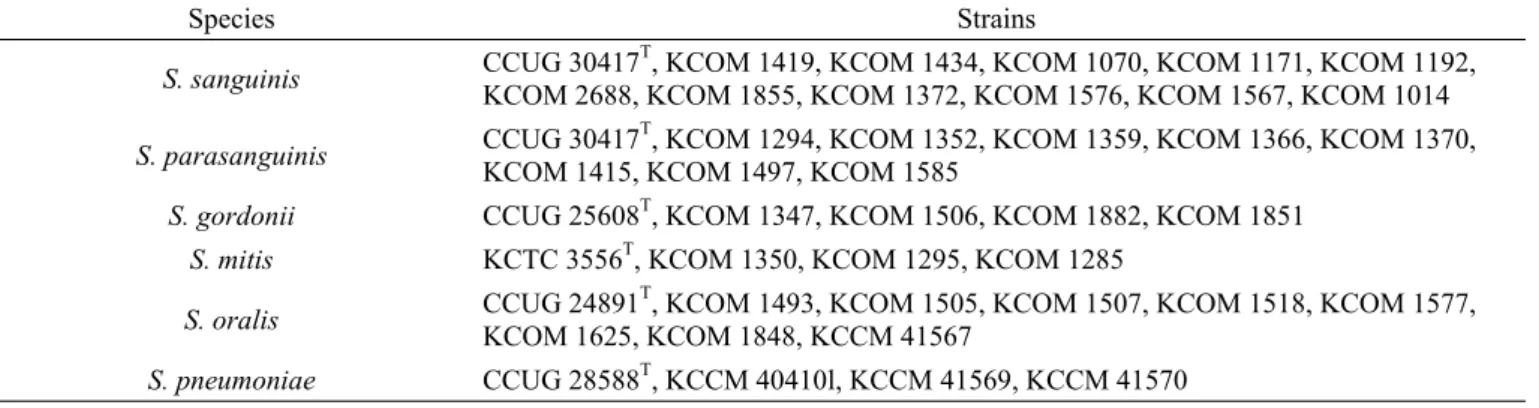
Table 1. The bacterial strains used in this study
Species Strains
S. sanguinis CCUG 30417T, KCOM 1419, KCOM 1434, KCOM 1070, KCOM 1171, KCOM 1192, KCOM 2688, KCOM 1855, KCOM 1372, KCOM 1576, KCOM 1567, KCOM 1014 S. parasanguinis CCUG 30417T, KCOM 1294, KCOM 1352, KCOM 1359, KCOM 1366, KCOM 1370,
KCOM 1415, KCOM 1497, KCOM 1585
S. gordonii CCUG 25608T, KCOM 1347, KCOM 1506, KCOM 1882, KCOM 1851 S. mitis KCTC 3556T, KCOM 1350, KCOM 1295, KCOM 1285
S. oralis CCUG 24891T, KCOM 1493, KCOM 1505, KCOM 1507, KCOM 1518, KCOM 1577, KCOM 1625, KCOM 1848, KCCM 41567
S. pneumoniae CCUG 28588T, KCCM 40410l, KCCM 41569, KCCM 41570 인균종으로 알려져 있다. 그러므로 S. gordonii, S. sang-
uinis와 S. parasanguinis를 정확히 검출할 수 있는 방법 이 개발되어야 구강 및 전신질환의 올바른 진단 및 대단 위 분자역학연구를 수행할 수 있을 것이다.
세균을 종 수준으로 검출하는 분자생물학적 방법 중 하 나가 PCR법이다. PCR 법을 이용하여 세균을 종-수준으 로 검출하기 위해서는 표적 유전자의 핵산염기서열을 바 탕으로 종-특이 PCR 프라이머를 설계하여야 한다. 현재 까지 PCR을 수행하기 위해 가장 널리 사용되는 표적 유전자는 16S rRNA 유전자(16S rDNA) [11-13]이다. 하 지만 -MGS에 속하는 세균 종들의 16S rDNA 상동성이 99% 이상이 되기 때문에 종-특이 PCR 프라미어를 설계 하기 어렵다. 최근 세균의 종 및 아종 특이 DNA 프로브를 신속하고 간편하게 개발하는 inverted dot blot hybridization (IDBH) 검색법이 개발되었다[14]. 이러한 방법으로 여러 세균 종-특이 DNA 프로브 및 균주-특이 DNA 프로브까지 개발할 수 있었다[14-18]. 또한 이들 DNA 프로브의 핵 산염기서열을 바탕으로 종-특이 및 균주-특이 PCR 프라 이머들도 개발되었다[14-18] 본 연구는 IDBH 검색법을 이용하여 MGS에 속하는 Streptococcus sanguinis, Strepto- coccus parasanguinis 및 Streptococcus gordonii 균종들에 대한 종-특이 DNA를 클로닝하고, 이들 핵산염기서열을 바 탕으로 종-특이 PCR 프라이머를 개발하기 위하여 시행 되었다.
재료 및 방법
세균 및 배양 조건
본 연구에서 이용된 균주들은 Korean Collection for Type Cultrue (KCTC, Daejeon, Korea), Korean Culture Center of Microorganism (KCCM, Seoul, Korea), Korean Collection for Oral Microbiology (KCOM, Gwangju, Korea) 및 Culture
Collection, University of Göteborg, (CCUG, Göteborg, Swe- den)에서 분양받아 사용하였다(Table 1).
본 연구에 사용된 모든 균주들은 BHI broth (Brain Heart Infusion broth, Difco Laboratory, Detroit, MI, USA)에 접 종하여 37oC 세균배양기에서 1-2일간 배양하여 다음 실 험에 사용하였다.
세균 지놈 DNA의 추출
세균의 지놈 DNA는 G-spinTM Genomic DNA Extrac- tion Kit (iNtRON Co., Seoul, Korea)를 이용하여 제조회 사의 지시에 따라 세균 지놈 DNA를 추출하였다.
무작위 클로닝 법에 의한 세균 DNA 절편 클로닝 및 플라스미드 추출
세균 DNA 프로브를 클로닝하기 위하여 S. sanguinis CCUG 17826T, S. parasanguinis CCUG 30417T, S. gordonii CCUG 25608T, S. mitis KCTC 3556T, S. oralis CCUG 24891T 및 S. pneumoniae CCUG 28588T 지놈 DNA를 HindⅢ 제 한효소(TaKaRa Bio Inc., Otsu, Japan) 로 절단하였다. 이 들 지놈 DNA 절편과 HindⅢ 제한효소로 절단하고 bacte- rial alkaline phosphatase (TaKaRa)로 5'의 인산기를 제거한 pBluescript ll KS (+) vector (Stratagene, La Jolla, CA, USA) 를 DNA ligase (TaKaRa)로 ligation한 후, 이들 ligation 혼합물을 E. coli DH5α에 형질전환시켰다. 세균 지놈 DNA 절편이 함유된 재조합 플라스미드는 AccuPrepTM Plasmid Extraction Kit (Bioneer, Daejeon, Korea)를 이용하여 제조 회사의 지시대로 추출하였다.
세균 지놈 DNA의 표지 및 정제
지놈 DNA는 DIG-High Prime kit (Roche Diagnostics, Mannheim, Germany)를 이용하여 표지하였다. 표지 과정 은 1 µg의 DNA에 최종 부피가 16 µl가 되도록 증류수를 넣고 끓는 물에서 10분간 가열하여 지놈 DNA를 변성시
Table 2. The information of the PCR primers designed in this study
Target species or strain Primer name: oligonucleotide sequences (5' → 3') Annealing temperature (℃) Amplicon size (bp) S. gordonii Sgo41-F1: ATTCCCTTAGTGTTCTGATTGTT
Sgo41-R1: GACCCTCCGTTTCTTTATGA 54 527
S. parasanguinis Spa17-F: ATGGCCCAAATCACTCCTT
Spa17-R: CAAAATAAAAGATAATGCGGATAA 59 509
S. sanguinis Ssa21- F3: TGGAGCAGCCTGTCGTCATCAT
Ssa21- R2: AGGCAGACCAGCGAGTTTTCATTT 70 635
킨 후 재빨리 얼음에 넣어 식혔다. 여기에 4 µl DIG-High Prime을 첨가하여 잘 섞고 37℃에서 12시간 반응시킨 후 0.2 M EDTA를 넣어 반응을 정지시켰다. DIG (digoxigenin- dUTP)으로 표지된 세균 지놈 DNA 프로브는 QIAEX II Gel Extraction Kit (QIAGEN Inc., Valencia, USA)를 이용하여 정제하였다
Inverted dot blot hybridization (IDBH)
앞에서 클로닝한 S. gordonii CCUG 25608T, S. mitis KCTC 3556T, S. oralis CCUG 24891T, S. parasanguinis CCUG 30417T, S. pneumoniae CCUG 28588T 및 S. sanguinis CCUG 17826T 지놈 DNA들의 HindIII 제한 효소절편들이 클로닝된 재조합 플라스미드 20 ng을 95oC에서 10 분간 끓이고 즉시 얼음에 5분간 방치하였다. 이들 재조합 플 라스미드를 6 장의 nylon membranes에 동일하게 blotting 하였다. 앞에서 준비한 세균 지놈 DNA 절편이 blotting된 mem- brane을 hybridization 용액(5× SSC, 50% formamide, 0.1%
sodium-lauroylsarcosine, 0.02% SDS, 2% Blocking Reagent) 으로 2시간 동안 prehybridization시켰다. 그 후 새로운 hy- bridization 용액에 DIG으로 표지된 각 세균의 지놈 DNA 를 첨가하여 12시간 hybridization시켰다. Membrane을 실 온에서 5분간 2× wash 용액(2× SSC, 0.1% SDS)으로 2 회 세척하고 다시 0.5× wash 용액(0.5× SSC, 0.1% SDS)으 로 68℃에서 15분간 2번 세척하였다. 표지된 지놈 DNA 프로브가 membrane 상의 표적 지놈 DNA 절편과 hybri- dization됨을 알아보기 위한 detection 과정은 Roche Diagno- stics사의 chemiluminescent detection kit를 이용하여 시행 하였다. 즉, membrane을 100 ml의 Blocking solution (buffer 2)에 넣고 30분 반응한 후 buffer 2에 anti-DIG-AP con- jugate를 75 mU/ml (1:10000) 첨가하여 희석한 20 ml an- tibody solution에 membrane을 넣고 30분간 반응시켜서 15 분간 100 ml의 washing buffer로 2회 세척하였다. Mem- brane을 20 ml의 Detection buffer (buffer 3)에서 2~5분간 안정화 시키고, 약 1 ml의 기질 (CSPDⓇ)용액을 뿌려 5분 간 상온에서 반응 후 과량의 액을 제거하고 luminescent reaction이 일어나도록 37℃ 배양기에서 15분간 반응시
켰다. 이것을 상온에서 X-ray film (Lumi-film chemilumine- scentⓇ, Roche Diagnostics)에 1~3 시간 노출시켜 결과를 확인하였다.
세균 지놈 DNA 절편의 핵산염기서열결정
세균 DNA 절편(Ssa21, Spa17 및 Sgo41) 핵산염기서열 은 Big Dye Terminator Cycle Sequencing Kit (Applied Biosys- tems, Foster City, CA, USA)와 ABI PRISM 310 Genetic Analyzer (Applied Biosystems)를 이용하여 결정하였다. 이 들의 핵산염기서열 결정을 위해 ChDC-F (5‘-AAT ACG ACT CAC TAT AGG GCG AA-3’)와 ChDC-R (5’-CCT CAC TAA AGG GAA CAA AAG C-3’) 프라이머[22]를 사용 하였다.
이들 세균 지놈 DNA 절편 핵산염기서열을 바탕으로 종- 특이 또는 균주-특이 PCR 프라이머는 PRIMERSECT 프 로그램(Version 8.0, DNASTAR Inc., Madison, WI)을 이 용하여 설계하였으며, 이들의 핵산염기서열 및 예상되는 PCR 산물의 크기는 Table 2에 정리하였다.
PCR
앞에서 설계된 PCR 프라이머들의 종-특이성을 알아 보기 위하여, 6종 MGS 표준균주(S. sanguinis CCUG 17826T, S. parasanguinis CCUG 30417T, S. gordonii CCUG 25608T, S. mitis KCTC 3556T, S. oralis CCUG 24891T 및 S. pneu- moniae CCUG 28588T) 및 각각의 종에 해당하는 37개 임 상균주(4개 참고균주 포함) 지놈 DNA을 주형으로 하여 PCR을 시행하였다. PCR은 AccuPowerⓇ PCR PreMix (Bioneer, Daejeon, Korea)를 이용하여 시행하였다. AccuPowerⓇ PCR PreMix에는 5 nmole씩의 4가지 deoxynucleoside triphosphate, 0.8 mole KCl, 0.2 mole Tris-HCl (pH 9.0), 0.03 mole MgCl2
그리고, 1 unit Taq DNA polymerase가 들어있다. 여기에 4 ng의 세균 지놈 DNA와 20 pmoles씩의 forward 및 reverse 프라이머들을 넣고 PCR을 시행하였다. 이때 PCR은 My- Genie™ 96 Gradient Thermal Block (Bioneer, Daejeon, Korea)을 이용하여 시행하였다. 이 때 PCR 조건은 다음과 같았다. 초기 변성은 94oC에서 5분간 시행하였고, 변성(94oC,
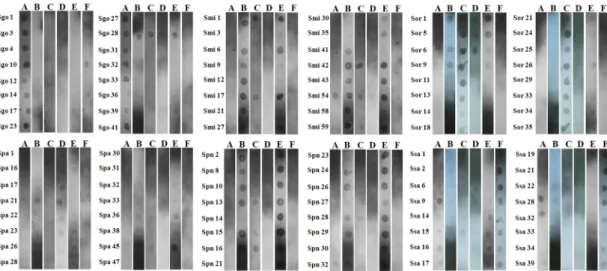
Fig. 1. Composite summary of inverted dot blot hybridization screening. The 96 recombinant plasmid DNAs containing genomic DNA fragments derived from type strains of 6 Streptococcus species were hybridized with DIG-labeled genomic DNAs. The genomic DNAs were from: (A) S. gordonii CCUG 25608T, (B) S. mitis KCTC 3556T, (C) S. oralis CCUG 24891T, (D) S.
parasanguinis CCUG 30417T, (E) S. pneumoniae CCUG 28588T, (F) S. sanguinis CCUG 17826T. Sgo (Sgo1-Sgo41), Smi (Smi1-Smi59), Sor (Sor1-Sor35), Spa (Spa1-Spa47), Spn (Spn2-Spn32), and Ssa (Ssa1-Ssa39) represent, respectively, recombinant plas- mids containing genomic DNA fragments corresponding, in order, to the type strains of 6 Streptococcus species described above.
30초), 결합(54, 59 혹은 70oC, 30초) 및 중합(72oC, 30초)의 세 과정을 30회 반복하고, 추가적인 중합(72oC, 30초)을 10분간 시행하였다.
PCR이 끝난 후 20 µl의 반응물 중 2 µl를 1.5% aga- rose gel과 Tris-acetate buffer (0.04 M Tris-acetate, 0.001 M EDTA, [pH8.0])를 이용해서 100 V에서 30분간 전기 영동한 후, ethidium bromide로 염색하여 UV로 발색시켜 PCR 산물의 크기를 확인하였다.
결 과
S. gordonii CCUG 25608T (Sgo1-Sgo41), S. mitis KCTC 3556T (Smi1-Smi59), S. parasanguinis CCUG 30417T (Spa12- Spa47), S. pneumoniae CCUG 28588T (Spn2-Spn32), S.
sanguinis CCUG 17826T (Ssa1-Ssa39) 및 S. oralis CCUG 24891T (Sor1-Spa35) 유래 지놈 HiindIII 제한효소 DNA 절편이 들어있는 재조합 플라스미드들 각 균주당 16개 씩을 선정하였다(Fig. 1). 선정 기준은 DNA 절편 크기가 0.5-2 kbp 이내인 것으로 하였다(data not shown). IDBH 법에 의해 Ssa21, Spa17 및 Sgo41 DNA 절편이 각각 S.
sanguinis, S. parasanguinis 및 S. gordonii에 대하여 종-특 이성이 있는 것으로 검색되었다(Fig. 1). 종-특이 PCR 프라이머를 설계하기 위하여 이들 3가지 DNA 절편 핵 산염기서열을 결정한 결과, 각각 944 bp, 673 bp 및 708 bp로 구성되었다(data not shown).
앞에서 결정된 3가지 DNA 절편의 핵산염기서열을 바 탕으로 S. sanguinis, S. parasanguinis 및 S. gordonii 종- 특이 PCR 프라이머들(각각 Ssa21-F3/Ssa21-R2, Spa17-F/
Spa17-R 및 Sgo41-F1/Sgo41-R1)을 설계하여 본 연구에서 사용된 6 종 MGS 43 균주들(6개 표준균주 포함)을 대 상으로 PCR를 실시하여 종-특이성을 조사하였다. 그 결 과 모든 PCR 프라이머들은 종-특이적으로 표적 세균 종의 지놈 DNA에서만 예상했던 크기의 PCR 산물을 증 폭시켰다(Fig. 2).
고 찰
본 연구 결과 6종 MGS 표준균주들의 HiindIII 제한효 소 지놈 DNA 절편을 IDBH 법으로 각각의 세균 종-특 이 DNA 프로브로 사용할 수 있는지를 검색한 결과 S.
sanguinis, S. parasanguinis 및 S. gordonii에 대하여 종-특 성이 있을 것으로 생각되는 Ssa21, Spa17 및 Sgo41 DNA 절편을 얻었다(Fig. 1). IDBH 결과 각각의 표적 세균 종 을 특이적으로 검출할 수 있는 것으로 생각되는 이들 3 가지 DNA 절편의 종-특이성은 6종 MGS 표준균주 지놈 DNA들을 이용하여 Southern blot hybridization 법으로 검 증하였다(data not shown). 본 연구에서 선택된 Ssa21 및 Sgo41 DNA 절편들의 핵산염기서열이 암호화하고 있는 단백질을 blastn 프로그램(http://blast.ncbi.nlm.nih.gov/Blast.cgi) 을 이용하여 검색하였다. 그 결과 Ssa21 핵산염기서열은 S.
Fig. 2. Specificity test of the PCR primers, (A) Ssa21-F3/
Ssa21-R2, (B) Spa17-F/Spa17-R, and (C) Sgo41-F1/Sgo41- R1Sgo41-F1/Sgo41-R1, with 4 ng of each bacterial genomic DNA. The PCR reaction products were electrophoresed on 1.5%
agarose gel. Lanes: S, size marker (100 bp ladder); 1, (-) control (DDW); 2, S. sanguinis CCUG 17826T; 3, S. sanguinis KCOM 1419; 4, S. sanguinis KCOM 1434; 5, S. sanguinis KCOM 1070; 6, S. sanguinis KCOM 1171; 7, S. sanguinis KCOM 1192; 8, S. sanguinis KCOM 2688; 9, S. sanguinis KCOM 1855; 10, S. sanguinis KCOM 1372; 11, S. sanguinis KCOM 1576; 12, S. sanguinis KCOM 1567; 13, S. sanguinis KCOM 1014; 14, S. parasanguinis CCUG 30417T; 15, S.
parasanguinis KCOM 1294; 16, S. parasanguinis KCOM 1352; 17, S. parasanguinis KCOM 1359; 18, S. parasanguinis KCOM 1366; 19, S. parasanguinis KCOM 1370; 20, S. para- sanguinis KCOM 1415; 21, S. parasanguinis KCOM 1497; 22, S. parasanguinis KCOM 1585; 23, S. gordonii CCUG 33482T; 24, S. gordonii KCOM 1347; 25, S. gordonii KCOM 1506; 26, S. gordonii KCOM 1882; 27, S. gordonii KCOM 1851; 28, S.
mitis KCTC 3556T; 29, S. mitis KCOM 1350; 30, S. mitis KCOM 1295; 31, S. mitis KCOM 1285; 32, S. oralis CCUG 13229T; 33, S. oralis KCOM 1493; 34, S. oralis KCOM 1505;
35, S. oralis KCOM 1507; 36, S. oralis KCOM 1518; 37, S. oralis KCOM 1577; 38, S. oralis KCOM 1625; 39, S. oralis KCOM 1848; 40, S. oralis KCCM 41567; 41, S. pneumoniae CCUG 28588T;42, S. pneumoniae KCCM 40410; 43, S. pneumoniae KCCM 41569; 44, S. pneumoniae KCCM 41570
sanguinis SK36 지놈 핵산염기서열(GenBank accession num- ber, CP000387)의 1,208,082-1,208,922 nt와 95%(896/944) 상 동성을 보였으며, hydrolase (alpha/beta superfamily)의 일부 분을 암호화하고 있었다(data not shown). Sgo41 DNA 절편 핵산염기서열은 S. gordonii str. Chalis substr. Ch1 균주 지놈 핵산염기서열(GenBank accession number, CP002843) 의 1,131,650-1,132,341 nt (692 bp)와 95% 상동성이 있었 으며, exfoliative toxin A 전사조절인자(lysR family) 단백 질의 일부분을 암호화하고 있었다(data not shown). Spa17 DNA 절편 핵산염기서열의 경우 이미 S. parasanguinis CCUG 30417T (= ATCC 15917T) 지놈 핵산염기서열(GenBank acces- sion number, CP002843)이 결정되어 보고 되었기 때문에 GenBank에서 해당 부위를 검색하여 암호화된 단백질을
찾았다. 그 결과 Spa17 DNA 절편은 S. parasanguinis CCUG 30417T 지놈 핵산염기서열의 1,059.907-1,060,579 nt에 해 당하였으며, lipid phosphate phophohydrolase 2 family 단 백질 일부분을 암호화하고 있었다(data not shown). 이러한 결과들은 본 연구에서 클로닝한 3가지 DNA 절편들(Ssa21, Spa17 및 Sgo41)이 해당 세균 종을 특이적으로 검출하는 DNA 프로브로 사용할 수 있다는 것을 의미한다.
Ssa21, Spa17 및 Sgo41 DNA 절편 핵산염기서열을 바 탕으로 각각 설계된 Ssa21-F3/Ssa21-R2, Spa17-F/Spa17-R 및 Sgo41-F1/Sgo41-R1 프라이머들과 MGS 43 균주 지놈 DNA를 주형으로 하여 PCR을 시행한 결과 각각 S. sang- uinis, S. parasanguinis 및 S. gordonii에 대하여 종-특이 성이 있음을 알 수 있었다(Fig. 2). PCR 프라이머를 개발 하기 위해서는 표적 유전자의 핵산염기서열이 필요하다. 본 연구에서와 같이 세균의 종-특이 PCR의 개발에 있어서 종-특이 DNA 프로브를 이용하면 세균 종-특이 PCR 프 라이머를 용이하게 개발 할 수 있다. 일반적으로 종-특 이 DNA 프로브를 개발하기 위해서는 후보가 되는 지놈 DNA 절편을 표지하여 Southern blot 분석을 시행하여 종- 특이성을 검증한다. 즉, 96개의 후보 DNA 프로브를 검증 하기 위해서는 96번의 Southern blot 분석이 필요하다. 하지 만, 본 연구에서 이용된 IDBH 법으로는 6번의 dot blot hybridization과 3번의 Southern blot 분석으로 3개 세균 종 에 대한 종-특이 DNA 프로브를 얻을 수 있었다(data not shown). 그러므로 IDBH 법은 종-특이 PCR 프라이머의 표 적 유전자가 없을 경우 효과적으로 이용할 수 있는 방법 이라 생각된다.
PCR 프라이머를 설계하는 여러 원칙들 중에서 5'쪽 보 다는 3'쪽의 일치성이 더욱 중요하다는 것은 잘 알려져 있다[23]. 이러한 원칙은 Song 등[24]이 시행한 연구 결과 에서도 증명되었다. 즉, PCR 프라이머의 3’-말단 마지막 염기서열이 주형과 상보적인 경우, 3’-말단에서 2번째 및 3번째 염기서열이 상보적이지 않아도 100% 상동성이 있 는 것에 비해 결합온도가 각각 약 5oC 및 7oC씩 낮은 온 도에서 PCR 산물이 증폭되었지만, 3’-말단 첫 번째 염 기 하나만이라도 상보적이지 않을 경우 PCR 산물이 증폭 되지 않았다[24]. 본 연구에서 설계된 Ssa21-R 프라이머 3’- 말단에서 5번째 염기서열이 S. sanguinis SK36의 것과 상 이 하였지만, 본 연구에서 사용된 임상균주들의 지놈 DNA 주형으로부터 예상되는 크기의 PCR 산물이 증폭되었다.
또한 Sgo41-F1과 Sgo41-R1 프라이머들의 경우 S. gordonii str. Chalis substr. Ch1 지놈 핵산염기서열의 3’-말단으로 부터 3번째 및 9번째의 것과 상보적이지 않았지만, 본 연 구에서 사용된 모든 S. gordonii 임상균주 지놈 DNA로부 터 예상되는 크기의 PCR 산물이 증폭되었다. 이러한 결과
들은 본 연구에서 사용된 S. sanguinis 및 S. sanguinis 임 상균주들 지놈 핵산염기서열들이 Ssa21-R, Sgo41-F1 및 Sgo41- R1 프라이머 결합부위 중 3’-말단에서의 상동성이 높았 기 때문인 것으로 생각된다.
세균 종-특이 PCR 프라이머를 수행하기 위해서는 표적 유전자 핵산염기서열의 결정이 필수적이다. 현재까지 종- 특이 PCR 프라이머 개발에 가장 많이 사용되고 있는 표적 유전자는 16S rDNA이다[11-13]. 하지만 MGS 균종 들처럼 16S rDNA의 상동성이 99% 이상일 경우엔 다른 표적 유전자를 이용하여야 한다. 본 연구에서 사용된 IDBH 법은 이럴 경우 유용하게 사용될 수 있다. 본 연구에서 사 용된 일반적인 PCR법보다는 실시간 정량 PCR (real- time quantitative PCR, qPCR) 법은 특정 세균 종의 정성적 검 출뿐만 아니라 정량적 검출까지도 가능하다. 그러므로 향 후 연구에서 Ssa21, Spn17 및 Sgo41 DNA 절편 핵산염 기서열을 바탕으로 각각 S. sanguinis, S. parasanguinis 및 S. gordonii에 대한 종-특이적 qPCR 프라이머 개발이 가능할 것이다.
이상의 연구 결과를 종합하면, Ssa21, Spn17 및 Sgo41 DNA 절편 핵산염기서열을 바탕으로 설계된 Ssa21-F3/Ssa21- R2, Spa17-F/Spa17-R 및 Sgo41-F1/Sgo41-R1들은 각각 S.
sanguinis, S. parasanguinis 및 S. gordonii을 종-특이적으 로 검출할 수 있어, 향 후 이들 3가지 세균 종과 관련된 구강 및 전신질환 역학 연구에 사용될 수 있을 것으로 생각된다.
참고문헌
1. Kawamura Y, Hou XG, Sultana F, Miura H, Ezaki T. Deter- mination of 16S rRNA sequences of Streptococcus mitis and Streptococcus gordonii and phylogenetic relationships among members of the genus Streptococcus. Int J Syst Bacteriol. 1995;45:406-408.
2. Gibbons RJ, Hay DI, Schlesinger DH. Delineation of a segment of adsorbed salivary acidic proline-rich proteins which promotes adhesion of Streptococcus gordonii to apa- titic surfaces. Infect Immun. 1991;59:2948-2954.
3. Scannapieco FA, Torres GI, Levine MJ. Salivary amylase promotes adhesion of oral streptococci to hydroxyapatite. J Dent Res. 1995;74:1360-1366.
4. Becker MR, Paster BJ, Leys EJ, Moeschberger ML, Ken- yon SG, Galvin JL, Boches SK, Dewhirst FE, Griffen AL.
Molecular analysis of bacterial species associated with child- hood caries. J Clin Microbiol. 2002;40:1001-1009.
5. Lamont RJ, Bevan CA, Gil S, Persson RE, Rosan B. Invol- vement of Porphyromonas gingivalis fimbriae in adherence to Streptococcus gordonii. Oral Microbiol Immunol. 1993;
8:272-276.
6. Caufield PW, Dasanayake AP, Li Y, Pan Y, Hsu J, Hardin
JM. Natural history of Streptococcus sanguinis in the oral cavity of infants: evidence for a discrete window of infec- tivity. Infect Immun. 2000;68:4018-4023.
7. Nyvad B, Kilian M. Comparison of the initial streptococcal microflora on dental enamel in caries-active and in caries- inactive individuals. Caries Res. 1990; 24:267-272.
8. Baddour LM. Virulence factors among gram-positive bac- teria in experimental endocarditis. Infect. Immun. 1994;
62:2143-2148.
9. Douglas CW, Heath J, Hampton KK, Preston FE. Identity of viridans streptococci isolated from cases of infective endocarditis. J Med Microbiol. 1993;39:179-182
10. Herzberg MC, Gong K, MacFarlane GD, Erickson PR, So- beray AH, Krebsbach PH, Manjula G, Schilling K, Bowen WH. Phenotypic characterization of Streptococcus sanguis virulence factors associated with bacterial endocarditis.
Infect Immun. 1990;58:515-522.
11. Ashimoto A, Chen C, Bakker I, Slots J. Polymerase chain reaction detection of 8 putative periodontal pathogens in subgingival plaque of gingivitis and advanced periodontitis lesions. Oral Microbiol Immunol. 1996;11:266-2673.
12. Conrads G, Flemmig TF, Seyfarth I, Lampert F, Lutticken R. Simultaneous detection of Bacteroides forsythus and Prevotella intermedia by 16S rRNA gene-directed multi- plex PCR. J Clin Microbiol. 1999;37:1621-1624.
13. Cho JS, Yoo SY, Kim HS, Hwang HK, Min JB, Kim BH, Baek DH, Shin HS, Kook JK. Identification and detection of Streptococcus anginosus using species-specific 16S rDNA primers. Int J Oral Biol. 2006;31:11-14.
14. Kook JK, Kim MK, Seong JH, Kim DK, Kim BO, Park JC, Kim KK, Choe SJ, Min BM. A new method for rapid screening of bacterial species- or subspecies-specific DNA probes. FEMS Microbiol Lett. 2003;219:121-127.
15. Shin YK, Jeong SU, Yoo SY, Kim MK, Kim HS, Kim BO, Kim DK, Hwang HK, Kook JK. Pi30 DNA probe may be useful for the identification of Prevotella intermedia at the species or strain level. Microbiol Immunol. 2006;48:
931-936.
16. Park CH, Kim PS, Kim HS, Min JB, Hwang HK, Jang HS, Cho KW, Baek DH, Kook JK. Detection of Prevotella intermedia and Prevotella nigrescens using Pn17 and Pn34 DNA Probes. Int J Oral Biol. 2010;35:13-19.
17. Kim MJ, Hwang KH, Lee YS, Park JY, Kook JK. Deve- lopment of Prevotella intermedia-specific PCR primers based on the nucleotide sequences of a DNA probe Pig27.
J Microbiol Methods. 2011;84:394-397.
18. Kim MJ, Lee YS, Park JY, Kook JK. Development of Pre- votella nigrescens-specific PCR primers based on the nuc- leotide sequence of a Pn23 DNA probe. Anaerobe. 2011;
17:32-35.
19. Kim HS, Song SK, Yoo SY, Jin DC, Shin HS, Lim CK, Kim MS, Kim JS, Choe SJ, Kook JK. Development of strain-specific PCR primers based on a DNA probe Fu12 for the identification of Fusobacterium nucleatum subsp.
nucleatum ATCC 25586T. J Microbiol. 2005;43:331-336.
Erratum in: J Microbiol. 2005;43:473.
20. Shin HS, Kim MJ, Kim HS, Park SN, Kim DK, Baek DH, Kim C, Kook JK. Development of strain-specific PCR pri-
mers for the identification of Fusobacterium nucleatum subsp. fusiforme ATCC 51190T and subsp. vincentii ATCC 49256T. Anaerobe. 2010;16:43-46.
21. Kim MJ, Min JB, Lim SA, Kook JK. Strain-specific PCR Primers for the Detection of Prevotella intermedia ATCC 49046. Int J Oral Biol. 2011;36:79-82.
22. Yoo SY, Kim KJ, Lim SH, Kim KW, Hwang HK, Min BM, Choe SJ, Kook JK. First isolation of Streptococcus downei from human dental plaques. FEMS Microbiol Lett. 2005;
249:323-326.
23. Rychlik W. Selection of primers for polymerase chain rea-- ction. 1st ed. In B.A. White (ed.), PCR protocols, Humana Press, Totowa, New Jersey, USA. 1993;31-40.
24. Song SK, Yoo SY, Kim MK, Kim HS, Lim SA, Kim DK, Park JY, Kook JK. Development of Prevotella nigrescens ATCC 33563T-specific PCR primers. Kor J Microbiol. 2008;44:
221-227.