Phylogeographic study of Abies koreana and Abies nephrolepis in Korea based on mitochondrial DNA
Jong-Cheol Yang, Dong-Keun Yi, Min-Jeong Joo and Kyung Choi*
Division of forest biodiversity, Korea National Arboretum, Pocheonsi, Gyeonggido, Korea (Received 20 August 2015; Revised 25 August; Accepted 7 September 2015)
미토콘드리아 DNA 분석을 통한 구상나무와 분비나무의 계통지리학적 연구
양종철·이동근·주민정·최경*
국립수목원 산림생물조사과
ABSTRACT:
Genetic variations of Abies koreana and Abies nephrolepis were assessed using two mitochondrial DNA regions (nad5 intron 4 and nad5 intron 1) for 16 natural populations to understand their phylogeograph- ical history. Seven polymorphic sites of the two combined regions resulted in the resolution of four haplotypes (M1−M4). The average gene diversity within the population (H
S) was 0.098, the total gene diversity (H
T) was 0.620, and the interpopulation differentiation was G
ST= 0.841, N
ST= 0.849. The populations were divided into three groups (northern area, central area, southern area) according to their geographic locations. The popu- lations of the northern and southern areas were mostly fixed for M1 and M2, respectively. The populations of the central area showed the highest levels of gene diversity (H
T= 0.654) due to introgression from the north- ern area and southern area. The presence of a single mtDNA haplotype in the southern area suggests that cur- rent widespread populations have expanded to the central area from a specific refugium population after the last glacial period.
Keywords:
Abies koreana, Abies nephrolepis, phylogeography, mitochondrial DNA, haplotype
적 요:
분비나무와 구상나무의 계통지리적 유연관계 파악을 위하여 16개 지역의 구상나무와 분비나무 집단
에 대하여 미토콘드리아 DNA(nad5 intron 4, nad5 intron 1 지역)를 이용한 유전적 분석을 수행하였다. 그 결 과 총 7 지역의 유전자 변이가 확인되었으며, 4개의 반수체형이 확인되었다. 개체군 내 평균 유전다양성(H
S) 은 0.098, 전체 유전다양성(H
T) 은 0.620으로 관찰되었으며, 개체군 간 분화값은 G
ST= 0.841, N
ST= 0.849 로 확 인되었다. 조사 개체의 지리적 위치에 따라 일본지역을 제외하고 3개의 그룹(북부지역, 중부지역, 남부지역) 으로 나누었다. 북부지역과 남부지역은 대부분 각각 M1, M2 단일의 반수체형을 가지며, 중부지역은 북부지
역과 남부지역의 분포경계에 위치하면서 유전자 유입으로 인해 유전 다양성 (H
T=0.654) 이 가장 높게 나타난
것으로 판단된다. 현재 남부지역의 단일의 반수체형(M2) 분포는 빙하기 때 북부지역에서 남하한 개체군들이 지리적 격리를 통해 분화하게 되고 빙하기 이후 다시 중부지역까지 분포 확장된 결과로 추측된다.
주요어:
분비나무, 구상나무, 계통지리, 미토콘드리아 DNA, 반수체형
*Author for correspondence: [email protected] http://www.pltaxa.or.kr
Copyright © 2015 the Korean Society of Plant Taxonomists
구상나무(Abies koreana Wilson, Pinaceae)는 한반도 특산 식물로서 제주도에서 덕유산까지 분포하는 것으로 알려 져 왔다(Chung, 1958; Lee, 1996; Sun, 2007). 구상나무는 Wilson(1920)에 의해 근연분류군들과 비교하여 수피 및 수 형, 수지구의 위치, 포의 형태 등의 특징으로 인해 새로운 종으로 발표되었다. 그러나 형질 변이의 연속성 및 다양 성으로 인해 근연분류군인 분비나무[Abies nephrolepis (Trautv. ex Maxim.) Maxim.] 와 명확한 구분이 어려운 상황 이다.
구상나무와 분비나무의 형질연구로는 Kim and Kim (1983) 이 우리나라 전나무속(Abies)에 대한 전반적인 외부 및 해부형질에 대한 조사를 수행하였다. 그 후 Chang et al.
(1997) 은 수지구 위치의 비교 연구를 통해 지리산과 덕유 산 지역에서 구상나무형과 분비나무형이 중복되어 나타 나는 것으로 보고하였으며, 지리산 이남에 분포하는 개체 들에서만 확인된 flavanone 성분이 중국의 A. faxoniana Rehder & E.H. Wilson [synonym of A. fargesii var. faxoniana (Rehder & E.H. Wilson) T.S. Liu.] 과 A. georgei Orr [synonym of A. forrestii var. georgei (Orr) Farjon] 에서 확인되어 이들 종이 구상나무의 원시종일 것으로 추정하였다. 또한 Han (2003) 은 잎횡단면의 수지구 비교연구 결과 지역별로 중복 형질을 가지는 것으로 보고하였으며, Song et al. (2007)과 Song et. al. (2008) 은 잎, 구과, 종자, 포침 등의 형질특성에 대한 연구에서 지역별 평균적 산출값의 비교를 통해 두 종 이 구분되는 것으로 보고하였으나 개체군 내 중복형질은 명확히 구분되지는 않는 것으로 확인되었다.
유전학적 연구는 주로 RAPD, SSR 등에 의한 유전다양 성 연구와 (Jung et al., 2000; Kim and Hyun, 2000; Lee et al., 2008; Hong et al., 2011) 엽록체 DNA의 trn-L/trn-V and trn- F/trn-T 유전자를 이용한 연구(Kormutak et al,, 2007)가 일 부 수행되었으나 뚜렷한 지리적 유연관계는 파악되지 않 는 것으로 확인되었다.
소나무과의 식물은 피자식물과는 달리 엽록체 DNA가 부계유전하며, 미토콘드리아 DNA는 모계유전을 한다 (Neale and Sederoff, 1989; Wagner et al., 1992). Abies 속 식 물들의 화분은 바람에 의해 산포되어 이동범위가 넓기 때 문에 부계유전하는 엽록체 DNA 및 양성유전인 핵 DNA 의 변이양상을 통해 지리적 유연관계를 파악하기에는 어 려움이 있다(Burban and Petit, 2003; Du et al., 2009). 그렇기 때문에 최근에는 소나무과의 지리적 유연관계 및 계통학 적 연구를 위하여 엽록체 DNA 및 핵 DNA와 함께 미토콘 드리아 DNA가 많이 이용되고 있다(Wu et al., 1998; Liepelt et al., 2002; Ziegenhagen et al., 2005; Naydenov et al., 2007;
Liepelt et al., 2010; Wang et al., 2011, Aizawa et al., 2012;
Peng et al., 2012; Xiang et al., 2015).
따라서 본 연구에서는 미토콘드리아 DNA의 변이분석 을 통해 구상나무와 분비나무의 지리학적 유연관계를 파 악하고자 수행되었다.
재료 및 방법
연구 재료
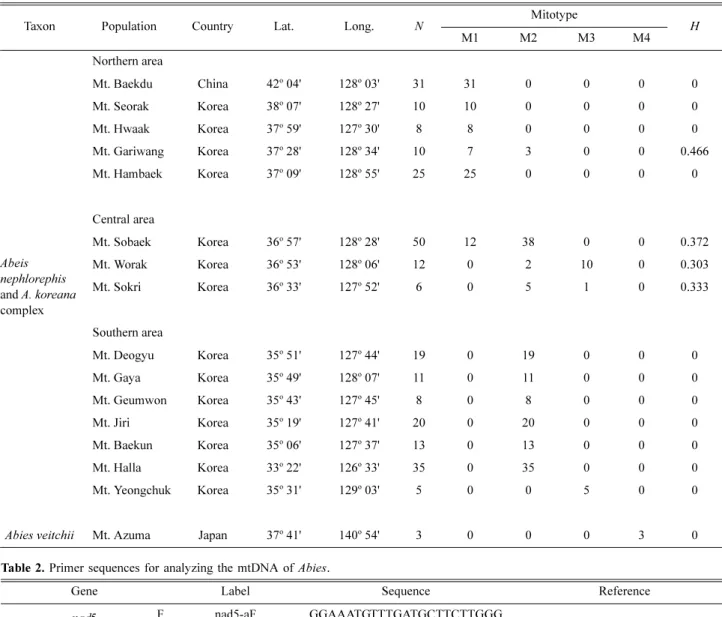
구상나무 및 분비나무에 대하여 국내 자생하는 14지역 270개체, 국외 중국 51개체의 잎 샘플을 수집 또는 표본 (KH) 을 활용하여 확보하였으며, 구상나무 및 분비나무와 근연종으로 알려진(Xiang et al., 2015; Semerikova and Semerikov, 2014) Abies veitchii Lindl. 3개체를 포함하여 총 16지역의 321개체를 실험에 사용하였다. 구상나무와 분 비나무는 형태적으로 중복형질을 갖고 있어 뚜렷한 형태 적 구분이 모호함으로(Chang et al., 1997; Han, 2003) 한반 도 내 분포하는 두 분류군의 전반적인 유연관계를 파악하 기 위하여 개체군별 종을 별도로 구분하지 않고 하나의 복합체로 처리하였다. 본 연구에서 사용한 식물재료의 수 집정보는 Table 1에 정리하였다.
DNA 추출, 증폭, 정제 및 염기서열결정
DNA 추출을 위해 확보한 재료의 잎을 Silica gel로 건조시 켜 사용하였으며, 건조표본을 이용할 경우 가능한 최근에 수집된 표본의 어린잎을 사용하였다. 건조된 식물의 잎 40 mg 을 조직분쇄기 (Tissue Lyser II, QIAGEN, Germany)로 분 쇄하여 1.5 mL 튜브에 옮긴 후, DNeasy plant mini kit (QIAGEN, Germany) 을 이용하여 공급자의 매뉴얼에 따라 Total genomic DNA를 추출하였다. 추출한 DNA는 0.9% agarose gel로 전기 영동하여 추출여부를 확인하였고, Nanodrop 2000 (Thermo scientific, USA) 을 이용하여 DNA의 농도 및 순도를 측정하였 다. 유전자 증폭을 위해 25−100 ng의 genomic DNA를 주형으 로 Dr. MAX DNA polymerase (Doctor protein, Korea)를 이용하 여 중합효소 연쇄반응을 진행하였다.
미토콘드리아 DNA의 nad5 intron 지역의 증폭에는 Wang et al. (2000) 과 Liepelt et al. (2002)에 기존 연구에서 제 시되었던 nad5 intron 1지역과 nad5 intron 4지역의 프라이 머를 사용하였다(Table 2). 유전자 증폭을 위한 PCR과정은 95
oC 에서 5분 동안 pre-denaturation을 시킨 후, 95
oC 에서 30 초의 denaturation, 58
oC 에서 30초의 annealing, 72
oC 에서 1 분의 extension으로 이루어지는 thermal cycle 과정을 35회 반복하였으며, 마지막으로 72
oC에서 7분간 final extension 과정을 진행하였다.
PCR products 는 multiscreen filter plate (Millipore Corp.,
USA)를 이용하여 공급자의 매뉴얼에 따라 정제하였으며,
정제된 PCR products는 BigDye® terminator v3.1 Cycle
Sequencing Kit (Applied Biosystems, USA) 를 사용하여 cycle
sequencing 하였다. 염기서열의 분석은 ABI PRISM 3730XL
Analyzer (Applied Biosystems, USA)를 이용하였다. 이를 통
해 nad5 intron 1 유전자의 경우 총 266개, nad5 intron 4 유전
자의 경우 총 304개의 염기서열을 확인하였다. 각 지역의
염기서열들은 모두 NCBI의 GenBank에 등록되었으며
accession number를 부여받았다(KT448846−KT449415).
염기서열 정렬과 분석
Sequencing된 각 유전자의 염기서열은 MUSCLE (Edgar, 2004)을 이용하여 정렬하였으며 서열을 확인 후 수작업으 로 재정렬하였다. 이 후 Geneious 8.0 (http://www.geneious.com, Kearse et al., 2012) 를 이용하여 재정렬된 서열을 검토하였 고, 이 중 두 유전자구역에 대한 염기서열을 모두 가지는 266개체에 대해 반수체형(haplotype)을 찾기 위한 서열내 의 polymorphic site 분석을 수행하였다(Table 1).
데이터 분석
본 연구 결과의 반수체형 네트워크(haplotype network)
분석을 위하여 TCS ver. 1.21 (Clement et al., 2000)을 사용하 였으며, 개체군 내 유전다양성(H; Nei, 1987)은 ARLEQUIN ver. 3.5.2.1 (Excoffier et al., 2005)을 사용하여 분석하였다. 개체군 내 유전다양성 평균지수(H
S) 와 총 유 전다양성지수(H
T) 그리고 개체군 간 분화지수(G
ST와 N
ST) 는 PERMUT ver. 1.2.1을 사용하여 분석하였다(used 1,000 permutations). G
ST값은 대립형질(allele)의 빈도를 기반으로 하며, N
ST값은 haplotype의 빈도와 haplotype들 사이의 유사 성에 의해 계산된다. 만약 N
ST값이 G
ST값 보다 높으면 유연 관계가 높은 haplotype들이 특정 개체군 내에서 함께 발생 되었을 가능성이 높은 것을 의미하며, 분석된 개체군들은
Table 1. Locations of Abies koreana and A. nephrolepis, proportion of individuals exhibiting each mitotype per population, and gene diversity (H) values for mitotypes.Taxon Population Country Lat. Long. N
Mitotype
M1 M2 M3 M4 H
Abeis nephlorephis and A. koreana complex
Northern area
Mt. Baekdu China 42o 04' 128o 03' 31 31 0 0 0 0
Mt. Seorak Korea 38o 07' 128o 27' 10 10 0 0 0 0
Mt. Hwaak Korea 37o 59' 127o 30' 8 8 0 0 0 0
Mt. Gariwang Korea 37o 28' 128o 34' 10 7 3 0 0 0.466
Mt. Hambaek Korea 37o 09' 128o 55' 25 25 0 0 0 0
Central area
Mt. Sobaek Korea 36o 57' 128o 28' 50 12 38 0 0 0.372
Mt. Worak Korea 36o 53' 128o 06' 12 0 2 10 0 0.303
Mt. Sokri Korea 36o 33' 127o 52' 6 0 5 1 0 0.333
Southern area
Mt. Deogyu Korea 35o 51' 127o 44' 19 0 19 0 0 0
Mt. Gaya Korea 35o 49' 128o 07' 11 0 11 0 0 0
Mt. Geumwon Korea 35o 43' 127o 45' 8 0 8 0 0 0
Mt. Jiri Korea 35o 19' 127o 41' 20 0 20 0 0 0
Mt. Baekun Korea 35o 06' 127o 37' 13 0 13 0 0 0
Mt. Halla Korea 33o 22' 126o 33' 35 0 35 0 0 0
Mt. Yeongchuk Korea 35o 31' 129o 03' 5 0 0 5 0 0
Abies veitchii Mt. Azuma Japan 37o 41' 140o 54' 3 0 0 0 3 0
Table 2. Primer sequences for analyzing the mtDNA of Abies.
Gene Label Sequence Reference
1 nad5
intron 1
F nad5-aF GGAAATGTTTGATGCTTCTTGGG
Wang et al. (2000)
R nad5-bR CTGATCCAAAATCACCTACTCG
2 nad5
intron 4
F nad5-4F CATCCCTCCCATTGCATTAT
Liepelt et al. (2002)
R nad5-4R GGACAATGACGATCCGAGATA
유의한 계통지리학적 구조(phylogeographical structure)를 가지는 것으로 판단할 수 있다(Pons and Petit, 1996).
계층적으로 개체군의 유전적 변이를 확인하기 위한 AMOVA (Analysis of molecular variance) 분석은 ARLEQUIN에 의해 수행되었다. 개체군들의 지리적 비교 분석을 위하여 분비나무 집단으로 생각되는 경기·강원도 이북 (위도 37
o이상)을 북부, 구상나무 집단으로 생각되는 전라도 이남 (위도 36
o이하)을 남부, 그리고 두 분류군의 중복 분포가 나타나는 충청도 (위도 36
o−37
o)지역을 중부 지역으로 3개의 그룹으로 나누어 구분하였다(일본지역은 개체 수가 적어 개체군 분석에서 제외하였음).
결 과
mtDNA의 변이와 염기서열 분포
구상나무와 분비나무의 유전적 차이를 확인하기 위하 여 미토콘드리아 DNA 2지역(nad5 intron 4, nad5 intron 1) 에 대해 집단별 염기서열 분석을 수행하였다. 그 결과 nad5 intron 4 지역의 염기서열은 298−302 bp, nad5 intron 1 지역은 1,259 bp가 확인되었으며, 총 7개의 변이 지역이 확 인되었다(Table 3).
nad5 intron 4 에서는 191−194 bp에서 1개의 indel (insertion/deletion) 이 확인되었으며, 그 외 5개의 단일 염기
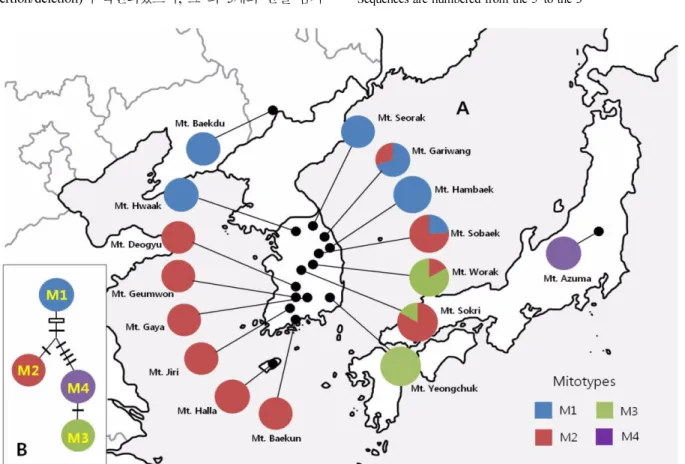
서열(38, 187, 220, 222, 238 bp)에서 치환현상이 관찰되어 총 6개의 변이 지역이 확인되었다. nad5 intron 1 에서는 단 일염기서열(543 bp)의 치환현상으로 인해 1개의 변이 지 역이 확인되었다. 확인된 변이 지역에 의해 4개의 mtDNA haplotype (mitotypes)이 선정되었다(Table 3). 북부지역에 서는 Mitotype M1과 M2가 확인되었으며, 중부지역에서는 M1, M2, M3, 남부지역에서는 M2, M3가 확인되었고, 일본 의 Abies veitchii에서 M4가 확인되었다. Mitotype M1은 백 두산지역에서 부터 강원도 함백산지역까지 관찰되었으 며, 전형적인 분비나무형으로 판단된다. 가리왕산지역에 서는 M2형을 갖는 개체가 일부 확인되었다. M2는 M1과 비교하여 1개의 indel과 2개의 염기서열 치환에 의한 차이
Fig. 1. Geographical distributions (A) and network (B) of mtDNA haplotypes (mitotypes) of Abies koreana and Abies nephrolepis (A. veitchii in japan). In the network, solid bar (single nucleotide substitution) and open bar (indel) on the branches represent mutational steps.
Table 3. Variable sites of the aligned sequences of two mtDNA fragment in four haplotypes.
Mitotype nad5 intron 4 nad5
intron 1 38 187 191-194 220 222 238 543
M1 G C A T A T G T T C
M2 G A - - - - G T T A
M3 T C - - - - T G G C
M4 T C - - - - T G G A
Sequences are numbered from the 5' to the 3'
가 있다. 소백산지역에서 부터 한라산지역까지 확인되었 으며, 전형적인 구상나무형으로 판단된다. M3는 중부지 역의 월악산, 속리산과 남부지역의 영축산 지역에서 관찰 되었다(Fig. 1A).
Mitotype network 분석에서는 M1으로 부터 1개의 indel 이 발생한 후 M2 그룹과 M3와 M4 그룹 두 개로 크게 나 뉘어졌다. M2와 비교하여 M3는 6개의 유전자 변이 지역 이 확인되었으며, M4는 5개의 변이 지역이 확인되었다 (Fig. 1B).
mtDNA에 의한 유전다양성
mtDNA 를 통한 구상나무와 분비나무의 유전다양성 분 석 결과 개체군별로는 가리왕산(H = 0.466), 소백산(H = 0.372), 속리산(H = 0.333), 월악산(H = 0.303) 순으로 나타 났다 (Table 1). 개체군 내 평균 유전다양성(H
S) 은 0.098, 전 체 유전다양성(H
T) 은 0.620로 관찰되었다. 개체군 간 분화 값은 G
ST= 0.841, N
ST= 0.849로 확인되었으며, N
ST값이 G
ST값에 비해 높게 관측되어 유의적 계통지리학적 구조를 가 지는 것으로 나타났다. 지역별로는 북부지역이 G
ST= N
ST= 0.222로 다른 지역에 비해 다소 낮게 확인되었고, 중부지 역에서는 G
ST= 0.486, N
ST= 0.503으로 관찰되어 북부지역 에 비해 개체군 간 분화값이 높은 것으로 확인되었다. 남 부지역에서는 개체군 내 유전다양성(H
S= 0) 이 관측되지 않았으며, 그 결과 개체군 간 분화값은 G
ST= N
ST= 1.000 으 로 관찰되었고, 전체 유전다양성(H
T)은 0.286으로 북부지 역보다는 높고 중부지역 보다는 낮은 것으로 측정되었다 (Table 4).
AMOVA (Analysis of molecular variance) 분석에서는 그 룹 간 변이가 71.88%로 가장 크게 관찰되었으며, 그룹 내
개체군 간 변이는 14.74%가 확인되었고, 개체군 내 변이 는 13.38%로 가장 낮게 나타났다 (Table 5).
고 찰
유전적 다양성과 분화
본 연구에서는 mtDNA (nad5 intron 4, nad5 intron 1)를 통 해 구상나무와 분비나무의 유전다양성과 분화에 대해 분 석하였다. 기존 Pinaceae 관련 집단유전분석 연구들에서 는 mtDNA가 cpDNA와 비교하여 개체군 간 분화값(G
ST) 이 더욱 높게 관찰되었다. Jaramillo-Correa et al. (2008)은 멕시 코에 분포하는 Abies 식물들에 대해 mtDNA G
ST= 0.933, cpDNA G
ST= 0.402 로 보고하였으며, Aizawa et al. (2012)은 동북아시아 잣나무(Pinus koreaiensis)에 대해 mtDNA G
ST= 0.897, cpDNA G
ST= 0.327 로 보고하였다. 본 연구결과에서 는 개체군 간 유전분화값이 G
ST= 0.841로 확인되어 기존 Pinaceae관련 연구결과들(Jaramillo-Correa et al., 2008;
Aizawa et al., 2012) 과 유사하게 관찰되었으며, 국내 구상 나무와 분비나무의 cpDNA 분석연구(Kormutak et al., 2007)에서 확인된 개체군 간 유전분화값(Φ
ST= 0.298) 과 비 교에서도 높은 값을 갖는 것으로 나타났다.
지역별로는 북부지역에서 남부지역으로 개체 간 분화 가 더 높게 일어났다(G
ST0.222<0.486<1.000). 남부지역의 높은 유전분화값은 남서쪽의 M2와 남동쪽의 M3 개체군 들 사이의 뚜렷한 분화에 의해 나타난 현상으로 판단된 다. 중부지역은 개체군 내 유전다양성(Hs = 0.336)과 전체 유전다양성(H
T= 0.654) 이 가장 높게 관찰되었다. 중부지 역의 경우 유일하게 3개의 haplotype (M1, M2, M3)이 확인 되었다. 이는 중부지역이 북부지역과 남부지역의 경계지
Table 4. Estimates of average gene diversity within population (HS), total gene diversity (HT), and two measures of interpopulation differentiation (GST and NST) (mean ± SE in parentheses) for mitotypes.Areas HS HT GST NST
Northern area 0.093 (0.093) 0.120 (0.105) 0.222 (NC) 0.222 (NC)
Central area 0.336 (0.020) 0.654 (0.097) 0.486 (0.126) 0.506 (0.121)
Southern area 0.000 (0.000) 0.286 (0.204) 1.000 (NC) 1.000 (NC)
Whole area 0.098(0.444) 0.620(0.069) 0.841(0.073) 0.849(0.070)
NC : not computed
Table 5. Analysis of molecular variance (AMOVA) data for Abies koreana and A. nephrolepis populations from three geographical regions in Korea.
Source of variation d.f. SS VC Variation(%) Fixation index P value
Among areas 2 54.19 0.263 71.88 FCT=0.524 <0.001
Among populations within
areas 12 11.15 0.054 14.74 FSC=0.866 <0.001
Within populations 280 13.72 0.049 13.38 FST=0.718 <0.001
Total 294 79.06 0.366 100
d.f. : degree of freedom, SS : sum of squares, VC : variance components, F-statistics were based on the haplotype frequenceis