IntroductIon
Fish surgery is the removal of tissue from the fish body, agency, healing and removal of the gland wave tumor, and treatment of the wound transplantation of im- munological healing, and implant; and is used for such means as the cleavage of fins for fish marking and trans- plantation, remote telemetry device, and electrode for behavioral and physiological studies(Summerfelt and Smith, 1990). Fish surgical instruments and equipment for surgery, fish with the use of technical antibiotics, and anesthetics used in parallel, are used to increase the suc- cess rate of a field of science and technology(Marty and Summerfelt, 1990; Summerfelt and Smith, 1990).
Anesthesia has many experimental and other uses in fisheries, primarily to immobilize animals, so fish can be handled more quickly and with less stress(Summerfelt and Smith, 1990). Among its principal uses, anesthesia facilitates the operations of: weighing and measurement;
marking and tagging; study of fish physiology and be- havior; performing surgery; collecting fish in tidal pools and with scuba; photography; preparing fish for live shipment and transport; manually spawning; injection of vaccines and antibiotics; and collection of blood and oth- er tissues(Park et al., 1998a).
Further, in order to investigate the effect of anesthet- ic agents during surgery of fish, clove oil was used to compare the stress responses in fish. Recently, clove oil has received a lot of interest in relation to fish. It is a safe and inexpensive anesthetic. It does not require a withdrawal period like lidocaine hydrochloride, since
—22 — http://www.fishkorea.or.kr
* Corresponding author: In-Seok Park Tel: 82-51-410-4321, Fax: 82-51-404-4750, E-mail: [email protected]
Stress Response and Wound Healing of Surgical Incisions in Far Eastern Catfish, Silurus asotus
By Hyun Woo Gil, Tae Ho Lee
1and In-Seok Park*
Division of Marine Environment and Bioscience, College of Ocean Science and Technology, Korea Maritime and Ocean University, Busan 49112, Republic of Korea
1Department of Marine Bio-Materials and Aquaculture, Pukyung National University, Busan 48513, Republic of Korea
ABSTRACT to find out the stress response and wound healing of surgical incisions, we analyzed the change of stress hormone and the healing process in far eastern catfish, Silurus asotus. the survival rate of the clove oil(1,000ppm) anesthesia group after surgery was about 90% in 3~42 days, while no anesthesia group showed about 74%. thus, the survival rate after anesthesia group was higher than that of the no anesthesia group. the plasma cortisol concentration of the clove oil anesthesia group was higher than that of the no anesthesia group(P<0.05). In addition, the plasma glucose concentration of clove oil anesthesia group was higher than that of the no anesthesia group (P<0.05). the plasma lactic acid concentration of clove oil anesthetized group was higher than that of the not anesthetized group(P<0.05). on the 14 days and 28 days after surgery, there were still stitching fiber of suture and swimming behavior was not active. on the 35 days after surgery, trace of the suture has almost disappeared on the outside of the fish. Finally, 42 days after surgery, stitching fiber was not visible, and the sutured wounds were distinctly recovered. the results of this study showed that the anesthesia group showed higher survival rate and received less postoperative stress than that of the no anesthesia group. Surgical wound healing in the catfish of this study was shown to be successful when using anesthetics.
Key words: Anesthesia, far eastern catfish, stress response, surgical incision, wound healing
there is no element to pollute the environment; and it has been evaluated as being suitable to be used in the field of aquaculture(Park et al., 2009). In addition, its anesthetic effect on freshwater prawn, Macrobrachium resenbergii, and American lobster, Homrtus anericus, as crustaceans, has been confirmed(Coyle et al., 2005; Waterstrat and Pinkham, 2005). Also, the physiological response of fish is almost similar to that of other animals, while the de- gree of stress(intensity and duration) of the biochemistry of the blood and tissues is a different, little known aspect (Selye, 1973; Schreck, 1981). The received stress on the fish is primarily inspired by the nervous system, and the endocrine boundaries cortisol and catecholamine. As a result of secondary causes, excessive secretion of the osmotic adjustment and changes in the carbohydrate me- tabolism, blood circulation and population of cells takes place, decreasing the growth rate of the primary infection or disease, which leads to symptoms such as increased, this phenomenon usually taking place simultaneously (Schreck, 1981).
Far eastern catfish, Silurus astous, is a member of the typical freshwater Siluridae, and an important commer- cial catfish in Korea(Kim et al., 1988). The fish formerly inhabited rivers in Manchuria, Japan, Taiwan, China and Northeast Asia, and elsewhere; and it is widely distribut- ed throughout freshwater systems(Park and Im, 2001).
This species is an example of tasty and nutritious food, and has been used as such; it is also widely used in pri- vate treatment(Park and Im, 2001). This study on wound healing after surgery is rare for research, and study to date has included abdominal surgery, and abdominal area is restricted to areas that considered, then the wound be- side artificial parts of the surgical wound healing after surgery was investigated. Based on the results shown in catfish, surgical wound healing may be less successful after surgical stress, depending on whether hormonal treatments are used, or not.
MaterIalS and MethodS
Far eastern catfish, Silurus asotus, were obtained from the Fisheries Genetics and Breeding Sciences Laboratory, Korea Maritime and Ocean University, Busan, Korea.
Their average total length was 35.0±2.5cm(n=50), with a mean weight of 250±50.25g(n=50). All fish were reared in 450L tanks, under the same hydrological condi- tions. The water temperature was maintained at 20±0.5
°C, and the mean water oxygen concentration was kept close to saturation level(mean: 9.4±0.3mg/L). Prompt
surgery to minimize the effects of stress in 1,000ppm clove oil(Containing 85% eugenol; Sigma, USA) contain anesthesia was performed, and the anesthetized tempera- ture was 20°C. After the start of surgery, the time to re- cover from surgery of the experiment fish exposed to the air was considered to be less than 5 minutes, so that anes- thesia and recovery were complete, and the sutures could take. The samples of control group(non-anesthetic group) were calmed down by method of lower temperature an- esthesia. The far eastern catfish’s dorsal fin, and the lat- eral line connecting the midpoint of the shortest distance, were defined. Using scissors for surgery, the surgical site, including the epidermis and the muscles, were cut deep- ly, and the length of incision was about a 2~3cm wound, parallel to the sideline. The wounded samples were su- tured using suture needle(Ophthalmic suture needle No.
0, Ailee, Korea), and a simple-instrument method of in- cision with 3~4 stitches. To complete, the surgical site was sutured using a brush, and the wound was applied with vaseline(Vaseline intensive care, Unilever, USA).
The surgical sutured group and control group after recov- ery from anesthesia were reared in tanks equipped with filtration system. The water temperature during breeding was maintained at 20±0.5°C. Investigation of the sur- vival rate, herniation rate, and adhesion rate after surgery were immediately observed, until 42 days after surgery.
Blood samples were extracted from five randomly se- lected fish, using syringes lined with the anticoagulant heparin. Blood was extracted from five experimental sam- ples, at fixed intervals of pre (0), 1, 6, 12, 24, 48, 72, and 96 hours after surgery. The collected blood was placed in capillary tubes, and analyzed, after centrifugation at 200×g for 10min. The plasma was then collected, and stored in a deep freezer(SW-UF-200; Samwon Freezing Engineering, Busan, Korea) at -80°C, until analysis.
The cortisol concentration was measured with a radio- immunoassay(RIA) in 50μL samples, using an RIA kit (Coat-A-Count TKCO Cortisol RIA Kit; DPC, USA).
Mixtures of samples in 100μL of antiserum were incu- bated for 45min at 37°C, and then 1,000μL of separation reagent was added. The mixture was placed in a refriger- ator at 4°C for 15min, and then centrifuged at 1,200×g for 15min. The supernatant was assayed for γ-radiation, using an automatic γ-counter(Cobra; Packard, USA).
The plasma glucose concentration was analyzed, accord- ing to the methodology of Raabo and Terkildsen(1960) (Kit 510, Sigma, St Louis, MO, USA), in which the pro- duction of H2O2 by glucose oxidase in the presence of o-dianisidine was evaluated, as the absorbance increase at 450nm. The lactic acid concentration was analyzed
using automatic blood analysis(Boehringer Mannheim Reflotron, Germany).
During the experimental period, five experimental fish- es were sampled and anesthetized, and a picture taken of the surgical site; and the surgical site was extracted, and was fixed in 10% neutral formalin(100mL formalin, 6.5 g Na2HPO4·12H2O, 4.5g KH2PO4, 900mL DW) for 24 hours, with sampling being executed at 7 days intervals, for 42 days after surgery. The samples were then refixed in Bouin’s solution, for a further 24 hours. All fixed tis- sues were routinely dehydrated in ethanol, equilibrated in xylene, and embedded in paraffin, according to standard histological techniques. Transverse sections were then cut at 6μm, and routinely stained using Mayers’ hema- toxlyin and eosin-Y-phloxine B, before being observed under a high-powered microscope(Carl Zeiss, Germany).
One- and two-way analyses of variance(ANOVA) were used to test the significance(P<0.05) of the effects of anesthetic. The differences among groups were analyzed by ANOVA, using the SPSS statistics package(SPSS 9.0, SPSS Inc., Chicago, IL, USA); and multiple comparisons were performed, using Duncan’s multiple range test.
reSultS
Fifteen far eastern catfish, Silurus asotus, of the not anesthetized group died after surgery, and the survival rate of this group gradually decreased, until 7 days after surgery. The survival rate of the not anesthetized group was maintained at 74%, from 8 days to 42 days after sur- gery(Table 1). Three experimental fishes of the clove oil anesthetized group died after surgery, and six experimen- tal fishes died at 2 days and 3 days after surgery(Table 1).
There was no death at the end of the experiment(Table 1).
The survival rate of the clove oil anesthetized group was maintained at 90%, from 3 days to 42 days after surgery (Table 1). The survival rate of the not anesthetized group in all the experimental periods were lower, than that of the clove oil anesthetized group(P<0.05; Table 1).
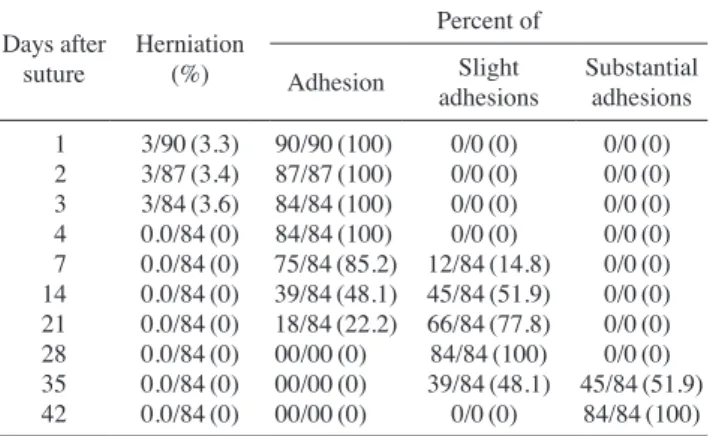
The necropsy of adhesion and herniated rate are shown in Table 2. Three experimental fishes were observed with hernia at 1 day after surgery, and six samples were ob- served with hernia from 2 days and 3 days after surgery.
From 3 days after surgery, no object was observed with hernia during the experimental period. At 7 days after surgery, the surgical site was not healing as a whole, and there were no adhesions. The healing began to progress towards adhesion at 7 days after surgery, and the move- ment of fishes at 7 days after surgery was more active,
than that at 1 day after surgery. At 14 days after surgery, 52% of all samples were observed with slight adhesion, and the ratio of slight adhesion increased until 28 days after surgery. At 28 days after surgery, all samples were observed with slight adhesion, and due to the lack of epidermal melanin, traces of off-white appeared in the surgical site. At 35 days after surgery, 52% of all samples were observed with substantial adhesion as complete ad- hesions in the surgical site, and all experimental samples were completely adhered at 42 days after surgery.
In order to investigate the stress response of fish after surgical treatment, stress hormones were investigated, such as plasma cortisol, plasma glucose, and lactic acid.
Variations of plasma cortisol concentrations during 96 hours after surgery are shown in Fig. 1. Cortisol concen- trations of fish after surgical treatment increased, as time
Table 1. Effect of anesthetic on change of survival rates for surgical incision in far eastern catfish, Silurus asotus*
Days after suture Survival rate(%)
Non-anesthetic Clove oil(1,000ppm) 1 2
3 4 714 2128 3542
75/90(84)a 72/90(81)a 72/90(81)a 69/90(78)a 66/90(74)a 66/90(74)a 66/90(74)a 66/90(74)a 66/90(74)a 66/90(74)a
87/90(97)b 84/90(94)b 81/90(90)b 81/90(90)b 81/90(90)b 81/90(90)b 81/90(90)b 81/90(90)b 81/90(90)b 81/90(90)b
*The samples of non-anesthetic group were calmed down by method of lower temperature anesthesia. Each value is the mean percentage of triplicate experiments(n=90). Means in columns having different superscript letter are significantly different(P<0.05).
Table 2. Necropsy of adhesion and herniated rate at the incision site during 42 days in far eastern catfish, Silurus asotus*
Days after
suture Herniation (%)
Percent of Adhesion Slight
adhesions Substantial adhesions 1 2
3 4 714 2128 3542
3/90(3.3) 3/87(3.4) 3/84(3.6) 0.0/84(0) 0.0/84(0) 0.0/84(0) 0.0/84(0) 0.0/84(0) 0.0/84(0) 0.0/84(0)
90/90(100) 87/87(100) 84/84(100) 84/84(100) 75/84(85.2) 39/84(48.1) 18/84(22.2) 00/00(0) 00/00(0) 00/00(0)
0/0(0) 0/0(0) 0/0(0) 0/0(0) 12/84(14.8) 45/84(51.9) 66/84(77.8) 84/84(100) 39/84(48.1)
0/0(0)
0/0(0) 0/0(0) 0/0(0) 0/0(0) 0/0(0) 0/0(0) 0/0(0) 0/0(0) 45/84(51.9) 84/84(100)
*All samples were anesthetized with 1,000ppm clove oil. Died samples included the percentage of herniation and necropsy of adhesion. Each value is the mean percentage of triplicate experiments(n=90).
passed. Plasma cortisol concentrations differed signifi- cantly between the not anesthetized group, and the clove oil anesthetized group. Mean plasma cortisol concen- tration level of the not anesthetized group and clove oil anesthetized group were 1.0±0.15μg/dL and 0.9±0.20 μg/dL before the experiment, respectively(Fig. 1). Plas- ma cortisol concentrations of the not anesthetized group increased from 15.5±1.51μg/dL at 1 hour, to 38.2±1.43 μg/dL at 6 hours(P<0.05). Plasma cortisol concentra- tions of the clove oil anesthetized group increased from 10.4±1.44μg/dL at 1 hour, to 34.3±1.67μg/dL at 12 hours(P<0.05). Plasma cortisol concentration of the not anesthetized group and clove oil anesthetized group at 96 hours recovered to be 3.2±0.56μg/dL and 2.1±0.60 μg/dL, but were higher than that of the pre group(before surgery; P<0.05). The cortisol concentration of the not anesthetized group was highest at 6 hours; and that of the clove oil anesthetized group was highest at 12 hours. The cortisol concentrations of the not anesthetized group were higher, than those of the clove oil anesthetized group, from 48 hours to 96 hours. The cortisol concentrations of the not anesthetized group showed faster increase and slower recovery, than those of the clove oil anesthetized group.
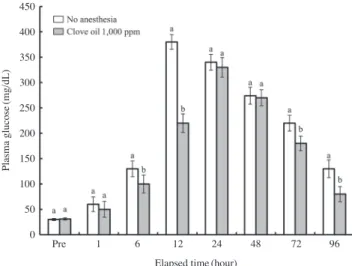
According to the plasma cortisol concentration increas- es, the plasma glucose increases due to feedback action (Fig. 2). The glucose concentrations of the not anesthe- tized group drastically increased from 1 hour to 12 hours after surgery, and those of the clove oil group drastically
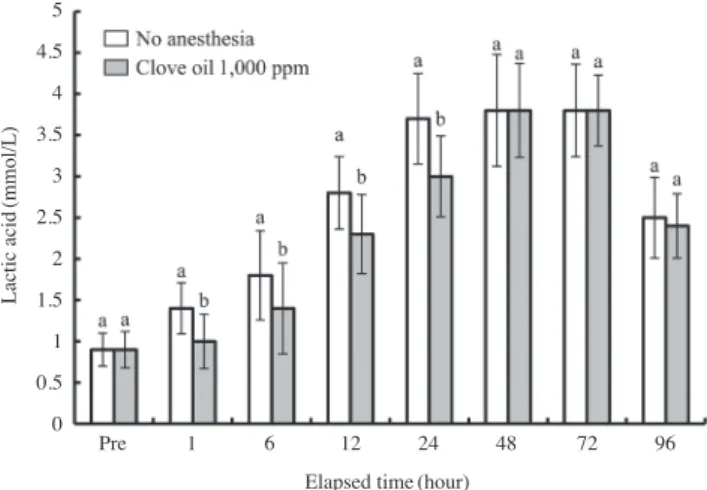
increased from 1 hour to 24 hours(Fig. 2). This is due to the feedback effect of cortisol increasing rapidly, and the plasma glucose rapidly increased to 12 hours. The group treated with clove oil showed the highest glucose at 24 hours(Fig. 2). The glucose concentrations of the not anesthetized group gradually reduced from 12 hours later(Fig. 2). The glucose concentration of the clove oil anesthetized group appeared to peak highly at 24 hour, and drastically decreased after that(Fig. 2). Plasma lactic acid is produced by the amount of oxygen and plasma glucose. So, it showed the slowest reaction. Plasma lactic acid concentrations in the group that was not anesthetized were higher, than those in the clove oil anesthetized group;
and the lactic acid concentrations of all groups showed the highest number in the 48 hours after surgery. Howev- er, lactic acid concentrations of all groups did not reduce rapidly, and showed a trend of maintaining the highest concentration at 48 hours and 72 hours, and gradually de- creased at 96 hours(Fig. 3). The concentrations of three hormones in the not anesthetized group were higher, than those in the clove oil anesthetized group; therefore being anesthetized with clove oil reduced the stress of surgery.
Cortisol concentration increased for the first time. The lactic acid and glucose concentration gradually increased, in the order of the secondary reaction.
Figs. 4 and 5 show the external morphology and histo-
Fig. 1. Variations of the plasma cortisol concentrations in the blood plasma of the far eastern catfish, Silurus asotus, during 96 hours after suture, with the no anesthesia and clove oil(1,000ppm) anesthesia groups. The samples of non-anesthetic group were calmed down by method of lower temperature anesthesia. Pre means control group before surgical incision. Vertical bars are means±SE(n=90). Ac- tually, n=30 for each experiment, because the means and SE were calculated separately for each group. Different letters on error bars are significantly different for each time(P<0.05).
45 40 35 30 25 20 15 10 5 0
Plasma cortisol(μg/dL)
Pre 1 6 12 24 48 72 96 Elapsed time(hour)
Fig. 2. Variations of the plasma glucose concentrations in the blood plasma of the far eastern catfish, Silurus asotus, during 96 hours after suture, with the no anesthesia and clove oil(1,000ppm) anesthesia groups. The samples of non-anesthetic group were calmed down by method of lower temperature anesthesia. Pre means control group before surgical incision. Vertical bars are means±SE(n=90). Ac- tually, n=30 for each experiment, because the means and SE were calculated separately for each group. Different letters on error bars are significantly different for each time(P<0.05).
450 400 350 300 250 200 150 100 50 0
Plasma glucose(mg/dL)
Pre 1 6 12 24 48 72 96 Elapsed time(hour)
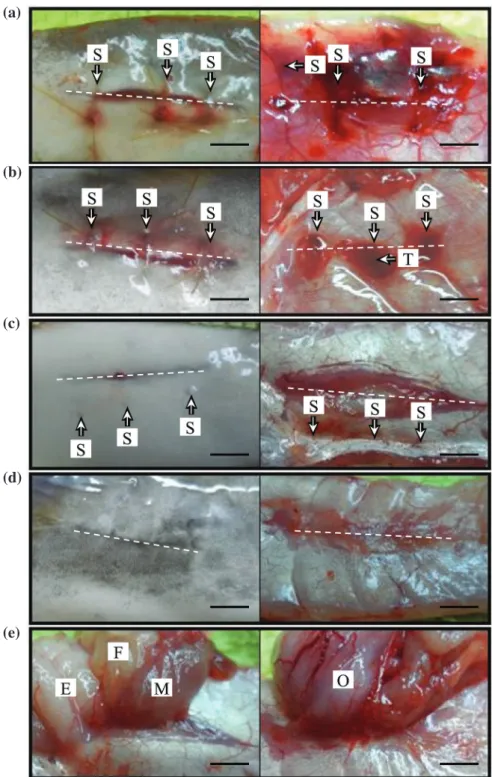
logical observation of the surgical site. Immediately after surgery, the movement of fish was slightly slow, for sur- gery on the side of body. At 14 days after surgery, stitch- ing fiber was still considerable, and surgical site bleeding was observed. In addition, the surgical site showed a slight adhension, and was not healed as a whole(Fig. 4a).
At 28 days after surgery, the movement of fish was more active; sealing trace of the surgical site was clear, but stitching fiber was minimally observed(Fig. 4b). At 35 days after surgery, trace of the suture had almost disap- peared, when observed on the outside of the fish. In addi- tion, sutures were not found; but the result of observation on the inside of the fish showed hemorrhagic conditions, and recovery of the wound was not yet healed(Fig. 4c).
Finally, at 42 days after surgery, no stitching fiber was visible, and the sutured wounds were distinctly recovered (Fig. 4d). At 42 days after surgery, fat and testis were recovering adhesion from the wound treatment, and ad- hesion to the intestine and the wound was observed(Fig.
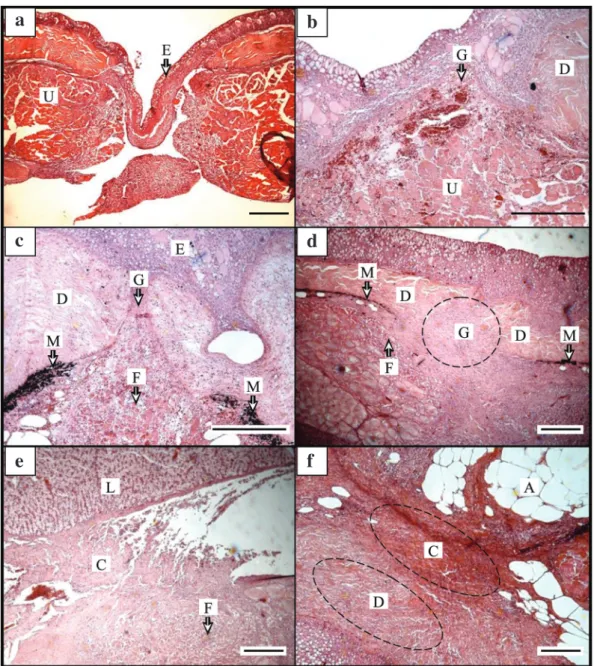
4e).From the results of histological investigation, complete epithelialization from the surgical site was revealed 42 days after surgery(Fig. 5d). The activity of fibroblast was observed, and the fibrobalst was myofibroblast, As can be seen in Fig. 5b, granulation tissue is distributed with much vascularity. At 28 days after surgery, granulation tissue appeared on the fibers of the surgical site. Granula- tion tissue was grown, and indicated new healing muscle
tissue. In addition, the epidermal layer at 14 days after surgery could be observed that was weakly bonded(Fig.
5a). But at 28 days after surgery, granulation tissue form- ing under the epidermal layer could be seen(Fig. 5b).
Between the dermal, it was still the step of moving away among the granulation tissue. At 35 days after surgery, the formation of granulation tissue was often performed (Fig. 5c).
At 42 days after surgery, granulation tissue formation was completed, and it could be seen that the recovery was finished(Fig. 5d). Epithelialization and proliferation by granulation tissue were shown, which was widely distrib- uted. In addition, at 42 days after surgery, the liver had adhesion to the surgical site, and granulation tissue was formed. So they were recovered from the state of being adhesions(Fig. 5e). Fig. 5f shows fat adhering to the sur- gical site, which means that the surgical site was showing recovery. The results of this study indicate that in regard to the healing process, it corresponds to the category of a secondary cure.
dIScuSSIon
In general, various stress factors acting on the far east- ern catfish, Silurus asotus, cause cell stress response, and the neuroendocrine system response. These reactions re- sult in disturbance of the regulation of osmotic pressure, a decrease in disease resistance, and breeding suppres- sion(Ackerman et al., 2000). To overcome the unstable physiological conditions, an energy source(glucose) is required for the maintenance of homeostasis. At this time, the neuroendocrine system response is to promote glu- coneogenesis(Munck et al., 1984), a cellular stress re- sponse that synthesizes protein. The protein is an energy source to make gluconeogenesis(Gamperl et al., 1994).
In this study, the stress response by surgical surgery in- vestigated the cellular reaction and neuroendocrine, and their interaction. Primarily, the activity of the hypothal- amus-pituitary is high, which causes the secretion of cortisol in the blood(Chang and Hur, 1999). The reaction of the secondary water-ion imbalance, the heart rate, the increased oxygen consumption and the increase of ener- gy mobilization, plasma glucose appear in the elevated (Tomasso et al., 1980; McDonald and Milligan, 1997).
This reaction is used as a typical indicator of the neuro- endocrine response. In this experiment, in stress hormone levels, the first increase is cortisol concentration and plasma glucose, and plasma lactic acid concentration is gradually increased in the order of the secondary reac-
Fig. 3. Variations of the lactic acid concentrations in the blood plas- ma of the far eastern catfish, Silurus asotus, during 96 hours after suture, with the no anesthesia and clove oil(1,000ppm) anesthesia groups. The samples of non-anesthetic group were calmed down by method of lower temperature anesthesia. Pre means control group before surgical incision. Vertical bars are means±SE(n=90). Ac- tually, n=30 for each experiment, because the means and SE were calculated separately for each group. Different letters on error bars are significantly different for each time(P<0.05).
5 4.5 4 3.5 3 2.5 2 1.5 1 0.5 0
Lactic acid(mmol/L)
Pre 1 6 12 24 48 72 96 Elapsed time(hour)
tion. This means that plasma glucose and plasma cortisol are usefully employed as a stress index of fish(Park et al., 2008). In this study, the plasma cortisol and glucose concentrations were significantly increased after surgery.
A rapid increase in plasma cortisol levels compared to glucose can be seen; such a result is found to have been studied in the same way in Chang and Hur(1999) and Park et al.(2008).
Fig. 4. External morphology of the surgical site’s healing progress in far eastern catfish, Silurus asotus. Left: outside view; Right: inside view. (a) Surgical site at 14 days after suture; (b) Surgical site at 28 days after suture; (c) Surgical site at 35 days after suture; (d) Surgical site at 42 days after suture; and (e) Adhesion of the surgical site with fat(left), testis(left), midgut(left and right) and stomach(right), at 42 days after suture.
Bars are 1cm. White dotted line: abdominal incision part. E: testis; F: fat; M: midgut; O: stomach; S: stitching site; T: thrombus.
(a)
(b)
(c)
(d)
(e)
In order to determine the level of stress response to surgery in fish, we compared differences between not anesthetized, and anesthetized with clove oil. Recent studies have evaluated the anesthetic efficacy of clove oil in the long finned eel, Anguilla reinhardtii(Walsh and Pease, 2002). The use of anesthetic agents may reduce stress-induced damage to the fish, but may also attenuate the physiological response to stress(Weber et al., 2009).
In this study, the physiological response of stress was
observed. The fish of the not anesthetized group and the clove oil anesthetized group were subjected to a reduction in the stress of surgery. In aquaculture, when anesthetic is added to the transport, fish decrease in vitality. So, the efficient transport and measurement of fish, and attempt at easy handling on injection, reduces the trauma and pain of the experiment fish, and is performed to reduce the stress in handling. At the same time, the use of an- esthetics in fish is still required, even though surgery is
Fig. 5. Histological observation(cross section) of the surgical sites for healing progress in the far eastern catfish, Silurus asotus. (a) Surgical site at 14 days after suture; (b) Surgical site at 28 days after suture; (c) Surgical site at 35 days after suture; (d) Surgical site at 42 days after suture;
(e) Adhesion of the surgical site with liver at 42 days after suture; and (f) Adhesion of the surgical site with fat after suture. H & E staining. Bars are 1 mm. Black dotted elliptical zones around captions in Figs. 5d andf are the area of each caption. A: fat; C: connective granulation tissue; D:
dermal layer; E: epidermal layer; F: fibrosis; G: granulation tissue; L: liver; M: melanocyte; U: muscle.
a b
c d
e f
performed to minimize infection(Summerfelt and Smith, 1990).
Effective wound healing is the rapid healing of the wound, as well as increased survival, and manipulation to allow for surgery(Marty and Summerfelt, 1990). The wound healing response of the animal as a self-defense mechanism is one of the most basic reactions of life. It refers to the process of healing the damage of cells in- duced by external stimuli or implicit, to recover(McGee et al., 1988). The process of wound regeneration or heal- ing of damaged organisms is the same process as aging or growth, and early development of the organism. By studying the differentiation of tissues and cells by the wound healing response, it is possible to obtain a lot of information about early development. The wound of the skin will recover, due to the migration of epithelial cells (Adzick et al., 1985).
During wound healing, Granulation tissue is an abun- dant new connective tissue capillary. That is, what may be seen in the process of wounding is healing. They can remove or separate the necrotic tissue, fill the defect site due to wound, or eliminate foreign material, the original components of which are fibroblasts(Marty and Sum- merfelt, 1990). This study, to externally target far eastern catfish, and the histological findings of the present inves- tigation 35 days after surgery, shows the surgical site was healing almost 100% after 42 days after surgery, showing recovery. These results suggest that compared with Marty and Summerfelt(1990) in the channel catfish, Ictalurus punctaus, complete abdominal wound healing when com- pared with 93 days, and healing of far eastern catfish were faster, than that of channel catfish. As mentioned in Park et al.(1998b), surgical wound healing of the Chinese minnow, Rhynchocypris oxycephalus, was completed at 35 days, and the result of this study was slower than that of Park et al.(1998b). The water temperature is an im- portant factor in wound healing, due to the experimental fish temperature effects on wound healing, Anderson and Roberts(1975) reported the temperature effects of wound healing on White Cloud Mountain fish, Tanichthys albo- nubes, and Roubal and Bullock(1988) investigated the effect of hydrocortison on the wound healing of Atlantic salmon, Salmo salar. Our study is also associated with the future of these two complementary experimental di- ets, and indicates further research will be required. In this study, the results of a survey on the healing process from the outside of the wound of the surgical site are given. It is one that can be used as a scale that can be compared to the histological healing process, to more easily know the extent of wound healing. The results of this study
that was healing normally wounds external to perform a surgical operation of catfish and physiological studies common endocrinological, pharmaceutical and it can be applied.
acknowledgMentS
The comments of anonymous reviewers greatly im- proved the quality of the manuscript. We declare that all experiments in this study comply with the current laws of Korea(Ordinance of Agriculture, Food and Fisheries, No.
1, Regarding Experimental Animals, No. 9, 932) and the Ethic Guideline of Korea Maritime and Ocean University.
reFerenceS
Ackerman, P.A., R.B. Forsyth, C.F. Mazur and G.K. Iwama. 2000.
Stress hormones and the cellular stress response in salmo- nids. Fish Physiol. Biochem., 23: 327-336.
Adzick, N.S., M.R. Harrison, P.L. Glick, J.H. Becksted, R.L. Villa, H. Scheuenstuhl and W.H. Goodson. 1985. Comparison of fetal, new-born, and adult wound healing by histologic, en- zyme histo-chemical, and hydroxyproline determinations. J.
Pediat. Surg., 20: 315-319.
Anderson, C.D. and R.J. Roberts. 1975. A comparison of the effects of temperature on wound healing in a tropical and temper- ate teleost. J. Fish Biol., 7: 173-182.
Chang, Y.J. and J.W. Hur. 1999. Physiological responses of grey mullet(Mugil cephalus) and Nile tilapia(Oreochromis niloticus) by rapid changes in salinity of rearing water. J.
Korean Fish. Soc., 32: 310-316.(in Korean)
Coyle, S.D., S. Dasgupta, J.H. Tidwell and T. Beavers. 2005. Com- parative efficacy of anesthetics for the freshwater prawn, Macrobrachium rosenbergii. J. World Aquacult. Soc., 36:
282-290.
Gamperl, A.K., M.M. Vijayan and R.G. Boutilier. 1994. Experimen- tal control of stress hormone levels in fishes: techniques and applications. Rev. Fish Biol. Fish., 4: 215-255.
Kim, D.S., I.B. Kim, H.T. Huh and I.-S. Park. 1988. Cytogenetic analysis of catfish(Silurus asotus)(Teleostomi: Siluriformes).
Ocean Res., 10: 33-37.
Marty, G.D. and R.C. Summerfelt. 1990. Wound healing in channel catfish by epithelialization and contraction of granulation tissue. Trans. Amer. Fisher. Soc., 119: 140-150.
McDonald, D.G. and C.L. Milligan. 1997. Ionic, osmotic and acid base regulation in stress. In: Iwama, G.W., A.D. Picking, J.P. Sumpter and C.B. Schreck(eds.), Fish stress and Health in Aquaculture. Cambrige: University Press, U.K., pp. 119- 144.
McGee, G.S., J.M. Davidson, A. Buckley, A. Sommer, S.C. Wood-
ward, A.M. Aquino, R. Barbour and A.A. Demetiou. 1988.
Recombinant basic fibroblast growth factor accelerates wound healing. J. Surg. Res., 45: 145-157.
Munck, A., P.M. Guyre and J. Holbrool. 1984. Physiological func- tions of glucocoricoid in stress and their relationship to pharmacological action. Endoc. Rev., 5: 25-34.
Park, I.-S. and J.H. Im. 2001. Determination of the temperature-de- pendent index of mitotic interval for chromosome ma- nipulation in far eastern catfish, Silurus asotus. Korean J.
Ichthyol., 13: 85-88.
Park, I.-S., J.H. Im, J.-H. Kim and D.S. Kim. 1998b. Wound heal- ing of surgical incisions in Rhynchocypris oxycephalus. J.
Aquacult., 11: 167-172.(in Korean)
Park, I.-S., J.H. Kim, J.B. Jung and J.H. Im. 1998a. Effect of lido- caine as an anaesthetic on Rhynchocypris oxycephalus and R. Steindachneri. J. Aquacult., 11: 59-66.(in Korean) Park, M.O., W.J. Hur, S.Y. Im, D.S. Seol, J.H. Lee and I.-S. Park.
2008. Anaesthetic efficacy and physiological responses to clove oil-anaesthetized kelp grouper Epinephelus bruneus.
Aquacult. Res., 39: 877-884.
Park, M.O., S.-Y. Im, D.-W. Seol and I.-S. Park. 2009. Efficacy and physiological responses of rock bream, Oplegnathus fascia- tus to anesthetization with clove oil. Aquaculture, 287: 427- 430.
Raabo, E. and T.C. Terkildsen. 1960. On the enzymatic determi- nation of blood glucose. Scand. J. Clinic. Lab. Invest., 12:
402-407.
Roubal, F.R. and A.M. Bullock. 1988. The mechanism of wound
repair in the skin of juvenile Atlantic salmon, Salmo salar L., following hydrocortisone implantation. J. Fish Biol., 32:
545-555.
Schreck, C.B. 1981. Stress and compensation in teleostean fishes:
response to social and physical factors. In: Pickering, A.D.
(ed.), Stress and Fish. Academic Press, London, U.K., pp.
295-321.
Selye, H. 1973. The evolution of the stress concept. American Sci- entist, 61: 692-699.
Summerfelt, R.C. and L.S. Smith. 1990. Anesthesia, surgery, and related techniques. In: Schreck, C.B. and P.B. Moyle(eds.), Methods for fish Biology. American Fisheries Society, Bethesda, Maryland, U.S.A., pp. 213-272.
Tomasso, J.R., K.B. Davis and N.C. Parker. 1980. Plasma corti- costeroid and electrolyte dynamics of hybrid striped bass (white bass x striped bass) during netting and hauling stress.
Proceed. World Maricult. Soc., 11: 303-310.
Walsh, C.T. and B.C. Pease. 2002. The use of clove oil as an anaes- thetic for the long finned eel, Anguilla reinhardtii(Stain- dachener). Aquacult. Res., 33: 627-635.
Waterstrat, P.R. and L. Pinkham. 2005. Evaluation of eugenol as an anesthetic for the American lobster, Homerus americanus. J.
World Aquacult. Soc., 36: 420-424.
Weber, R.A., J.B. Peleteiro, L.O. Garcia Martin and M. Aldegunde.
2009. The efficacy of 2-phenoxyethanol, metomidate, clove oil and MS-222 as anaesthetic agents in the Senegalese sole (Solea senegalensis Kaup, 1858). Aquaculture, 288: 147- 150.
메기 , Silurus asotus의 외과적 시술시 회복 및 생리학적 반응
길현우
·
이태호1·
박인석한국해양대학교 해양생명과학부, 1부경대학교 해양바이오신소재학과
요 약 : 메기, Silurus asotus의 외과적 시술시 상처 회복 및 스트레스 반응을 알아보기 위하여, 수술 과정에 의한 스트레스 호르몬의 변화 양상과 회복과정을 분석하였다. 수술 후 clove oil(1,000ppm) 마취한 군의 생존율은 수술 후 3~42일 동안 약 90%를 보였으며 무마취군은 약 74%를 보였다. 즉, 마취를 한 후 수술하였을 때 무마취군 보다 생존율이 높게 나타났다. Clove oil로 마취한 군의 혈장 cortisol 농도가 무마취군 보다 높았으며(P<0.05) 아울러, clove oil로 마취한 군의 혈장 lactic acid 농도 역시 무마취군 보다 높았다(P<0.05). 수술 후 14일과 28일째는 아
직 봉합사의 흔적이 남아 있었고 움직임도 활동적이지 않았지만 35일째 되었을 때는 봉합자국은 사라졌고 수술 후
42일에는 봉합사도 관찰되지 않았으며, 봉합 상처도 회복이 되었다. 따라서 메기의 외과시술시, 마취를 한 후 수술
하였을 때 무마취군 보다 생존율이 높게 나타났고, 수술 후 받는 스트레스 양도 적다는 것을 알 수 있다. 즉, 본 연
구의 메기에서의 외과적 상처 회복은 마취제 사용시 성공적으로 이루어짐을 보였다.
찾아보기 낱말 : 마취, 메기, 스트레스 반응, 외과 절개, 상처치유