Copyright © 2012, The Korean Society of Veterinary Service. All Rights Reserved. 347 한국가축위생학회지 제35권 제4호 (2012)
Korean J Vet Serv, 2012, 35(4), 347-350 pISSN 1225-6552, eISSN 2287-7630 http://dx.doi.org/10.7853/kjvs.2012.35.4.347
< Short Communication>
Korean Journal of
Veterinary Service
Available online at http://kjves.org
*Corresponding author: Gee-Wook Shin, Tel. +82-63-270-3903, Fax. +82-63-270-3778, E-mail. [email protected]
Effect of L-theanine on non-specific immunoparameters in catfish (Silurus asortus)
Gang-Joon Heo1, Gee-Wook Shin2*
1College of Veterinary Medicine, Chungbuk National University, Cheongju 361-763, Korea
2Bio-Safety Research Institute and College of Veterinary Medicine, Chonbuk National University, Jeonju 561-756, Korea (Received 27 September 2012; revised 5 November 2012; accepted 9 November 2012)
Abstract
L-theanine was examined for its effects on the generation of superoxide anion, lysozyme and anti-pro- tease in the plasma of catfish (Silurus asotus) by a single intraperitoneal injection with five different concentrations (0, 3, 6, 9 and 12 mg/kg). When compared with the mock-injected group (0 mg/kg), both groups injected with 6 and 9 mg/kg were significantly enhanced in levels of superoxide anion in leuko- cytes, lysozyme and anti-protease in plasma. Based on the results, L-theanine is thought to function as an immunostimulant and/or immunomodulator on non-specific immune responses in catfish.
Key words : L-theanine, Immunostimulant, Non-specific immune response, Catfish
INTRODUCTION
Green tea is a popular beverage in Asia (Vuong et al, 2011). Recent studies have showed that extracts from green tea inhibited the development of heart disease and cancers and stimulated fat oxidation and metabolic rate (Babu et al, 2006; Naito and Yoshikawa, 2009; Vuong et al, 2011). L-theanine (γ-glutamylet-hylamide) is a ma- jor component accounting for 40~60% of the total ami- no acid in green tea (Juneja et al, 1999). Since it is a neurotransmitter with neuroprotective effects, there are many reports about its pharmacodynamics in the neuro- scientific field (Cho et al, 2008; Kimura et al, 2007;
Nathan et al, 2006; Park et al, 2011). In the immuno- logical filed, administration of L-theanine together with L-cystine has been shown to induce a significant in- crease of endogenous antioxidant levels in the liver, and antigen-specific IgG antibody and T helper cytokine in serum of animal models (Bukowski and Percival, 2008;
Kurihara et al, 2007). However, there is limited data
about L-theanine as a stimulator of the innate immune system of vertebrates including fish. Herein, we exam- ined the effects of L-theanine on the generation of su- peroxide anion, lysozyme and antiprotease in the sera of catfishes (Silurus asortus).
Catfishes (average body length 35±2.6 cm and weight 260±61.2 g) were purchased from a commercial fish farm in Cheongju, Korea. After transportation, the fish were immediately divided into five groups and acclimat- ized in experimental 120 L tanks (10 fish in each tank) with an air pump, internal circulatory filter and ther- mo-controller. Five different concentrations (0, 3, 6, 9, 12 mg/kg) of L-theanine (γ-glutamylet-hylamide, Dongbu Fine Chemicals, Seoul, Korea) were prepared in physio- logical saline and intraperitoneally injected into five groups of catfish after anesthesia by benzocaine (ethyl-β- aminobenzoate, Sigma-Aldrich, St. Louis, USA). At day post-injection 1, all fishes were anesthetized by the above method and the blood was collected from a heart puncture using 1 ml preheparinised syringe. The col- lected blood was immediately subjected to the nitroblue tetrazolium (NBT) assay in circulating leukocytes and
348 Gang-Joon Heo, Gee-Wook Shin
Korean J Vet Serv, 2012, Vol. 35, No. 4
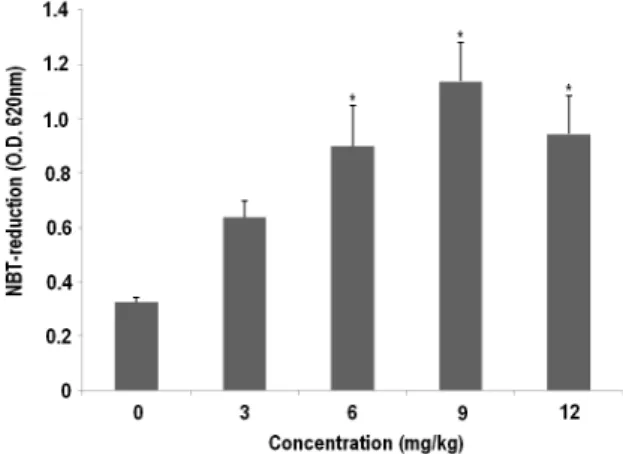
Fig. 1. NBT assays of catfish injected with five different concen- trations of L-theanine (0, 3, 6, 9, 12 mg/kg). Data are pre- sented as mean±SE% of the control. *P<0.05, with stu- dent's t-test.
Fig. 2. Plasma lysozyme activity in catfish injected with five dif- ferent concentrations of L-theanine (0, 3, 6, 9, 12 mg/kg).
Data are presented as mean±SE% of the control. *P<0.05, with student's t-test.
for isolation of plasma for estimating activity of lyso- zyme and anti-protease. All data are presented as means±SD. Data were analyzed using unpaired Student's t-tests to determine significant differences between recip- ient and control groups (P≤0.05).
On gross postmortem, there was no visible lesions in all fish treated with different concentrations of L-the- anine compared with control group.
Superoxide anion plays an important role in oxy- gen-dependent killing mechanisms associated with phag- ocytosis of pathogenic bacteria (Ellis, 1999). Because of this importance, superoxide anion has been widely used for evaluating non-specific immunity of fish to im- munostimulants (Esteban et al, 2000; Kajita et al, 1992;
Verlhac et al, 1998). The NBT reduction test for inves- tigating superoxide anion was performed as described elsewhere (Heo and Shin, 2011). In brief, 0.3 ml blood was mixed with an equal volume of 0.1% NBT (Sigma-Aldrich, St Louis, USA) and then incubated for 2 hr at 25oC. After removing the supernatant, the re- mained cells were fixed with 100% methanol for 3 min, washed twice with 70% methanol, dried on air and then thoroughly mixed with 600 μl of 2 M KOH and 700 μl of dimethyl sulfoxide (DMSO). The absorbance was read spectrophotometrically at 620 nm using KOH/DMSO as a blank. In the result (Fig. 1), NBT values tended to increase in a dose-dependent manner in fish injected with less than 12 mg/kg of L-theanine.
Compared with the control group, significant differences were observed in fish groups injected with 6, 9 and 12 mg/kg. This result indicated that L-theanine could en- hance superoxide anion levels in catfish blood.
Therefore, L-theanine may be an immunomodulator as- sociated with phagocytic activity of leukocytes.
Plasma lysozyme activity was examined by the turbi- dimetric assay using a 0.2 mg/ml suspension of Micro- coccus lysodeikticus cells (Sigma, USA). The plasma was mixed at a 1:10 ratio with the cell suspension in a 96-well microplate at room temperature (RT). The ab- sorbance at 450 nm was measured immediately by an ELISA plate reader. After the initial estimate, the ab- sorbance was measured again at 1, 2, 5, 15 and 30 min post-mixing. One unit of lysozyme caused a decrease in absorbance of 0.001/min. In the control group, activity of plasma lysozyme was an average of 44.4±3.8 units (Fig. 2). The intraperitoneal injection of L-theanine in- creased serum lysozyme activity in a dose dependant manner (62.8±9.3 units at 3 mg/kg, 80.4±13.5 units at 6 mg/kg and 102.0±10.4 units at 9 mg/kg). However, fish injected with 12 mg/kg showed lower lysozyme activity of 93.9±27.1 than that of 9 mg/kg. Lysozyme is a com- ponent of the non-specific immune system for bacter- icidal action and stimulation of phagocytosis (Ellis, 1999). Therefore, lysozyme is a common indicator of the efficacy of a variety of immunostimulants, such as yeast glucan, chitin and chitosan (Esteban et al, 2000;
Effect of L-theanine on non-specific immunoparameters in catfish (Silurus asortus) 349
Korean J Vet Serv, 2012, Vol. 35, No. 4 Fig. 3. Trypsin inhibition capacity measuring plasma anti-pro-
tease activity in catfish injected with five different concen- trations of L-theanine (0, 3, 6, 9, 12 mg/kg). Data are pre- sented as mean±SE% of the control. *P<0.05, with stu- dent's t-test.
Kajita et al, 1992; Verlhac et al, 1998). Based on pre- vious and present results, L-theanine could act as a modulator for lysozymes, playing key roles in non-spe- cific immunity.
Anti-proteases also play a key role in the non-specific immune response of fish by neutralizing pathogenic pro- teases and inhibiting autodigestion due to damaged host tissue (Ellis, 1999). Antiprotease activity was measured by the trypsin inhibitory capacity (TIC) assay (Bowden et al, 1997) using a substrate, Nα-benzoyl-L-arginine 4-nitroanilide hydrochloride (BAPNA). BAPNA was prepared as stock solution of 5 mg/ml in dimethyl sulf- oxide (DMSO) and then diluted two-fold in dilution buffer (200 mM Tris, 250 mM CaCl2, pH 7.8). Fifteen microliters of 0.1 mg/ml trypsin in PBS was mixed with 5 μl of the plasma sample in a 96-well microplate.
After incubation for 5 min at RT, 200 μl of BAPNA was added to the mixture. The absorbance at 405 nm was measured every minute for 15 min. One unit of an- tiprotease activity was defined as a decrease in absorb- ance of 0.001/min. The antiprotease activities from plas- ma were 46.0±11.2, 53.9±1.8, 58.4±2.1 and 39.3±16.6 units in fish injected with 3, 6, 9 and 12 mg/kg of L-theanine, respectively (Fig. 3). The activity tended to increase compared to the mock injection group (33.6±1.9 units). However, a significant difference was seen with 6 and 9 mg/kg injections. Based on the result, injection of the L-theanine could induce increased an-
ti-protease activities from the plasma of catfish.
In the present study, the highest dosage (12 mg/kg) of L-theanine decreased levels of non-specific immune parameters of catfish. There are some reports about the side effects of immunostimulants such as chitosan in fish, including anorexia and decrease of growth rate (Kono et al, 1987). On the other hand, nonspecific cel- lular immunity of carp (Cyprinus carpio L.) was re- ported to be decreased by long term exposure to a high- er dosage of chitosan, compared to the control group (Dautremepuits et al, 2004). It is possible that the in- creasing concentration of L-theanine could result in a side effect, such as inhibition of non-specific immunity of catfish.
Taken together, our results demonstrate that L-the- anine strongly generates superoxide anion, lysozyme and antiprotease in the sera from catfishes. This suggested the possibility of L-theanine as an immunostimulant for catfish.
REFERENCES
Babu PV, Sabitha KE, Shyamaladevi CS. 2006. Therapeutic ef- fect of green tea extract on oxidative stress in aorta and heart of streptozotocin diabetic rats. Chem Biol Interact 162: 114-120.
Bowden TJ, Butler R, Bricknell IR, Ellis AE. 1997. Serum tryp- sin-inhibitory activity in five species of farmed fish. Fish Shellfish Immunol 7: 377-385.
Bukowski JF, Percival SS. 2008. L-theanine intervention enhan- ces human gammadelta T lymphocyte function. Nutr Rev 66: 96-102.
Cho HS, Kim S, Lee SY, Park JA, Kim SJ, Chun HS. 2008.
Protective effect of the green tea component, L-theanine on environmental toxins-induced neuronal cell death.
Neurotoxicology 29: 656-662.
Dautremepuits C, Paris-Palacios S, Betoulle S, Vernet G. 2004.
Modulation in hepatic and head kidney parameters of carp (Cyprinus carpio L.) induced by copper and chitosan. Comp Biochem Physiol Toxicol Pharmacol 137: 325-333.
Ellis AE. 1999. Immunity to bacteria in fish. Fish Shellfish Immunol 9: 291-308.
Esteban MA, Mulero V, Cuesta A, Ortuño J, Meseguer J. 2000.
Effects of injecting chitin particles on the innate immune response of gilthead seabream (Sparus aurata L.). Fish Shellfish Immunol 10: 543-554.
Heo G, Shin G. 2011. Effect of chitosan oligosaccharide on
350 Gang-Joon Heo, Gee-Wook Shin
Korean J Vet Serv, 2012, Vol. 35, No. 4
non-specific immune parameters in catfish (Silurus aso- tus). Philipp J Vet Med 48: 22-26.
Juneja LR, Chu DC, Okubo T, Nagato Y, Yokogoshi H. 1999.
L-theanine - a unique amino acid of green tea and its re- laxation effect in humans. Trends Food Sci Tech 10:
199-204.
Kajita Y, Sakai M, Atsuta S, Kobayashi M. 1992. Immunopoten- tiation activity of freund complete adjuvant in rain- bow-trout Oncorhynchus mykiss. Bull Jap Soc Sci Fish 58: 433-437.
Kimura K, Ozeki M, Juneja LR, Ohira H. 2007. L-Theanine re- duces psychological and physiological stress responses.
Biol Psychol 74: 39-45.
Kono M, Matsui T, Shimizu C. 1987. Effect of chitin, chitosan, and cellulose as diet supplements on the growth of cul- tured fish. Bull Jap Soc Sci Fish 53: 125-129.
Kurihara S, Shibahara S, Arisaka H, Akiyama Y. 2007.
Enhancement of antigen-specific immunoglobulin G pro- duction in mice by co-administration of L-cystine and L-theanine. J Vet Med Sci 69: 1263-1270.
Naito Y, Yoshikawa T. 2009. Green tea and heart health. J Cardiovasc Pharmacol 54: 385-390.
Nathan PJ, Lu K, Gray M, Oliver C. 2006. The neuropharma- cology of L-theanine(N-ethyl-L-glutamine): a possible neuroprotective and cognitive enhancing agent. J Herb Pharmacother 6: 21-30.
Park SK, Jung IC, Lee WK, Lee YS, Park HK, Go HJ, Kim K, Lim NK, Hong JT, Ly SY, Rho SS. 2011. A combina- tion of green tea extract and l-theanine improves memo- ry and attention in subjects with mild cognitive impair- ment: a double-blind placebo-controlled study. J Med food 14: 334-343.
Verlhac V, Obach A, Gabaudan J, Schüep W, Hole R. 1998.
Immunomodulation by dietary vitamin C and glucan in rainbow trout (Oncorhynchus mykiss). Fish Shellfish Immunol 8: 409-424.
Vuong QV, Bowyer MC, Roach PD. 2011. L-Theanine: proper- ties, synthesis and isolation from tea. J Sci Food Agric 91: 1931-1939.