159
Copyright © 2019 The Korean Society of Fisheries and Aquatic Science pISSN:0374-8111, eISSN:2287-8815
서 론
최근 어업에의한 수산물생산이 정체되고 있으나
,
수산물 에대한국내∙
외수요는증대되고있어양식에의한대체충족 이필요하다.
또한물의희소성증대와영양염및오염물질에 대한환경의수용능력저감으로엄격한규제가적용되고있다(NIFS, 2013).
이러한환경에서수산양식업에서발생되는환경오염문제와양식생산물의식품안전성확보를위한생산방법 으로아쿠아포닉스
(aquaponics)
가주목받고있다.
현재까지수 산양식에서사육수의재순환을통한양식방법으로RAS (recir- culating aquaculture system)
와BFT (biofloc technology)
가대 표적이다(FAO, 1986; Avnimelech et al., 2015).
BFT
양식은국내에서2000
년대도입된사육수의재순환양식방법으로양어장내수산생물에의해발생되는오염물중하
사료 내 일인산칼륨(MKP) 수준이 Hybrid 바이오플락(BFT) 아쿠아포닉 시스템 내 메기(Silurus asotus) 및 엽채류 4종의 생산성과 수질변화에 미치는 영향
이동훈·김진영 1 ·임성률·김달영·김주민 2 ·신승준 3 ·김정대 3 *
경기도해양수산자원연구소, 1경기도농업기술원, 2세븐필라, 3강원대학교
Effect of Dietary Monobasic Potassium Phosphate Levels on Water Quality and the Growth of Far Eastern Catfish Silurus asotus and Four Leafy Vegetables in a Hybrid Biofloc Technology Aquaponic System
Dong-Hoon Lee, Jin-Young Kim
1
, Seong-Ryul Lim, Dal-Young Kim, Joo-Min Kim2
, Seung-Jun Shin3
and Jeong-Dae Kim3
*Gyeonggi Province Maritime and Fisheries Research Institute, Yangpyeong 12513, Korea
1
Gyeonggi-do Agricultural Research and Extension Services, Hwaseong 18274, Korea2
Seven Pillars, Dangjin 31778, Korea3
College of Animal Life Sciences, Kangwon National University, Chuncheon 24341, KoreaThis study investigated the effects of dietary monobasic potassium phosphate (MKP) on the growth of the far eastern catfish Silurus asotus and four leafy vegetables in a hybrid biofloc technology aquaponic system. To an experimen- tal diet containing 45% protein and 7% lipid, 1, 2, 3 or 4% MKP was added and was designated as MKP1, MKP2, MKP3, and MKP4, respectively. The optimum MKP levels were determined for the growth of fish and four leafy veg- etables over 10 weeks. After the 10-week feeding trial, weight gain, feed efficiency, specific growth rate and protein efficiency ratio were higher in the fish groups fed MKP2 and MKP3 than in the other groups (P<0.05). The growth of the four leafy vegetables was also higher in the fish groups fed MKP2 and MKP3. Water quality [dissolved oxygen, pH, water temperature, electrical conductivity, turbidity, total ammonia nitrogen (TAN), NO 2 -N, NO 3 -N and PO 4 -P]
was measured six times a week using a portable water quality meter and reagent measurements. The TAN (4.58-20.40 mg/L), NO 3 -N (24.12-52.40 mg/L) and PO 4 -P (20.38-48.48 mg/L) levels increased with time, while the NO 2 -N level remained below 0.1 mg/L throughout the study.
Key words: Silurus asotus , Monobasic potassium phosphate (MKP), Aquaponics, Vegetables, Hybrid biofloc tech- nology (HBT)
*Corresponding author: Tel: +82. 33. 250. 8634 Fax: +82. 33. 259. 5572 E-mail address: [email protected]
This is an Open Access article distributed under the terms of the Creative Commons Attribution Non-Commercial Licens (http://creativecommons.org/licenses/by-nc/3.0/) which permits unrestricted non-commercial use, distribution, and reproduction in any medium, provided the original work is properly cited.
Received 2 January 2019; Revised 25 January 2019; Accepted 3 February 2019 저자 직위: 이동훈(연구사), 김진영(연구관), 임성률(연구사), 김달영(연구사), 김주인(대표이사), 신승준(연구원), 김정대(교수)
https://doi.org/10.5657/KFAS.2019.0159
Korean J Fish Aquat Sci 52(2), 159-172, April 2019
나인
NH 3 -N
을유기탄소(
당밀,
포도당등)
의사용(C:N
비조절)
을통해미생물을 증식시키고미생물총(biofloc)
형성을유도 한후,
이를수산생물(
어류,
갑각류)
이다시섭식하게 함으로 써지속적으로수질을유지하는기술이다.
또한biofloc
형성 에는광물질화,
질산화,
탈질화,
광합성화에관여하는 미생물 을포함하여,
식물플랑크톤,
동물플랑크톤,
생물사체,
사료찌꺼 기등다양한생물적요소들이복합적으로관여한다고알려져 있다(Avnimelech et al., 2015).
현재까지국내순환여과식양식(RAS)
은완전히물을재사용하는것이아니라하루에전체순환수의
10%
이하가환수되고보충되는것이일반적이다(Suh
et al., 2001). Russo et al. (1981)
은RAS
생산방법은용존산소(dissolved oxygen, DO)
부족,
유기물증가, NH 3 -N
등의무기 질소및CO 2
의축적등에의해어류의성장저해및질병발생 등의문제가야기될수있어수질관리의중요성을언급하였고, RAS
는고형물과NH 3 -N
의제거를위해여러장치(
침전조,
여 과기,
회전원판접촉기,
충전층반응기,
유동층반응기,
포말분 리기,
자외선살균기등)
가필요한것으로알려져있다(Losordo et al., 1994; Reyes and Lawson, 1995).
그러나, Scheider et al.
(2006)
의보고에의하면RAS
는초기자본의투자가높아산업 적확대의진행이느리다고하였고,
이러한이유로국내내수 면육상수조식양식에서는유수식양식방법에의한시설이많 은편으로인근하천수및지하수를취수하여사육수로사용하 고간단한침전시설을거쳐배출되는형태로경영되고있으며,
RAS
시스템을구축한양식장은뱀장어와같은고가의어류양식에제한되고있다
.
아쿠아포닉스는어업의수산양식
(aquaculture)
과농업의수 경재배(hydroponics)
가 결합된복합재배 시스템으로,
수산양 식생물의성장과생존을위해공급된먹이(
사료)
가종속및독 립영양미생물(heterotrophic and autotrophic microorganisms)
에의해각종무기물과질산염으로분해및생성된것을식물이 성장영양소로흡수하면서양어수질의안정화와식물성장을이 루어지게하여사육수의교환없이지속적으로농∙
수산물을생 산할수있는친환경생산방법이다(FAO, 2014).
어류등수산 생물이섭취한사료의30%
는체내동화되고나머지70%
는체 외로배출되며,
미섭취된사료는양어수조내잔류하게된다(Emerenciano et al., 2017).
아쿠아포닉스에서식물생산을위 해제공되는양어사료는식물이필요로하는13
종류영양소(N, P, K, S, Ca, Mg, Fe, Mn, Cu, Zn, B, Mo, Al)
중10
종류는식물 이성장할수있는적정량을제공하나, Ca, K, Fe
는아쿠아포닉 스시스템내에서매우부족할정도로존재하여인위적으로추 가되어야함을보고하였다(Rakocy, 2007). Bittsanszky et al.
(2016)
는앞서언급한3
종류영양소외P
또한너무부족한것 으로보고하였고,
특히K
가최대부족한영양소라하였다.
인(P)
은동물이나식물의성장,
번식그리고건강에관련된정상적인생명현상유지를위한필수영양소의하나이다
.
인은인산 염의형태로호흡,
광합성,
근수축,
세포분할,
유전정보의전달,
발효와같은근본적인생화학반응에있어중요한역할을한다
(Lall, 1991).
육상동물뿐아니라수중동물들은동∙
식물성원료 내인을효율적으로이용할수가없기때문에그들의최대성장 을 위해일인산칼슘(monocalcium phosphate, MCP),
이인산 칼슘(dicalcium phosphate, DCP)
또는삼인산칼슘(tricalcium phosphate, TCP)
과같은인산공급제가사료에첨가된다(Kim et al., 1998).
인회석(phosphate rock)
이나동물의뼈에서발견 되는TCP
는강산에만녹는관계로위가없는잉어의경우이용 성이어려우나송어의경우이용성이높다(Ogino et al., 1979).
현재국내에판매되고있는상업용배합사료는어종에따라인 첨가제
(MCP, DCP
및TCP)
를다양하게혼합하여제조하고있 다.
전세계적으로보편화된
UVI (university of virgin islands)
아 쿠아포닉스시스템에서도식물성장을위해서는앞에서언급한 부족한영양소를인위적으로첨가하도록제안하고있다(Rako- cy et al., 2006; Bailey and Ferrarezi, 2017).
이러한UVI
아쿠아포닉스시스템은양식의
RAS
생산방법에수경재배지를결합한것으로시설비문제와시스템운영의복잡성을가지고있 다
.
본연구의목적은아쿠아포닉스생산의효율성증대를위해 어류양식에사용되는배합사료만으로식물에공급하는영양소 를충당할수있도록기존상업용사료에사용되는인제재를일 인산칼륨(monobasic potassium phosphate, MKP)
으로대체하 고,
더불어종속및독립영양미생물이혼합된유용미생물을활 용한hybrid BFT
생산방식을적용하여현재의시스템을단순 화하는방향을제시하고자하였다.
재료 및 방법
실험사료의 제조
실험에사용된
4
종류의사료는조단백질함량이45%,
조지방 함량이7%
전후가되도록실험사료를설계하였으며,
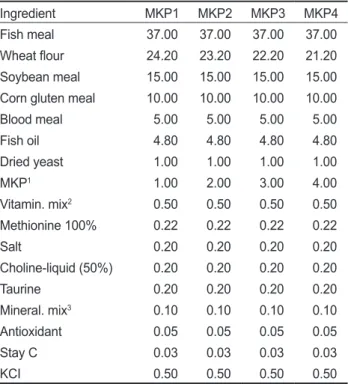
인공급원 으로MKP
를각1, 2, 3
및4%
첨가하여사료내P
와K
함량이 증가하도록하였다(Table 1).
설계된실험사료는사조동아원㈜
당진사료공장(
충청남도당진시)
에서직경6 mm
내외부상EP (extruded pellet)
사료로제작하였으며,
시판되는상업용배합 사료와같은20 kg
단위로포장후냉동(-20℃)
보관하여실험 에사용하였다.
아쿠아포닉 시스템 설치
아쿠아포닉스생산을위한실험시스템은
Fig. 1
와같이1
개 시험구별어류사육수조(L 1.5 m×W 1.5 m×H 0.6 m) 2
개,
식 물베드(L 1.5 m×W 1.5 m×H 0.1 m) 2
개,
펌프(0.5 HP) 1
개 및바이오헬릭스여과기(Isan M Tech. Ltd., Korea) 1
개로구 성되었으며, 4
개조의시험구가야외에설치되었다.
산소공급을 위해에어공급관을설치하여6
개의유니분산기(30 cm)
를사용 하였고,
식물베드지에2
개,
어류사육지4
개로분리하여사용하였다
.
시스템내사육수는직경(
외경) 50 mm PVC
관을통해 어류사육수조,
섬프수조와여과기를 거쳐직경(
외경) 25 mm PVC
관을통해식물베드지로유입된후다시어류사육지로순 환되도록하였다.
또한,
우천시대비하여식물베드위에광이 잘투과되는비닐을설치하여실험기간동안유지하였다. 실험사료의 성분분석
실험사료
4
종의수분(moisture),
조단백질(crude protein),
조 지방(crude lipid),
조회분(crude ash),
조섬유(crude fiber), Mg, Fe, Cu, Mn, Zn, K, Ca
및P
성분분석은부경대학교사료영양 연구소에의뢰하여분석하였다.
아쿠아포닉스 생산성 비교 시험
실험에사용된메기는경기도에위치한세종수산
(
여주시)
에 서1,000
마리를구입한후, 150-210 g
의개체480
마리를선별 하여사용하였다.
본사육실험에앞서어류들은제작된MKP2
사료에적응되었으며,
실험전24 h
절식한후어류의체중측 정이수행되었다.
어체측정은개별측정하였으며, 2
반복4
개 시험구8
개수조에평균186 g
내외개체60
마리가각각수용 되었다.
사료공급은미섭취사료에의한식물생산성의오차배 제를위해어체중당0.5%
로제한하여1
일2
회공급하였다.
실 험은10
주간진행되었으나엽채류는어류의사료적용6
주후 입식되어, 10
주간의어류성장실험과4
주간의엽채류성장시 험이진행되었다.
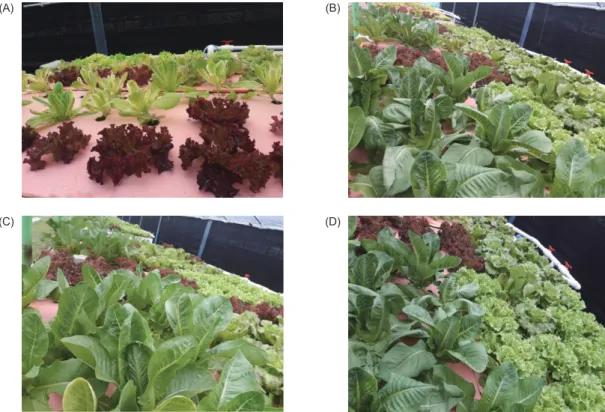
실험에사용된엽채류는상추4
품종롤로로 사(Lollo-rossa),
아바타(Avatar),
카이피라(Caipira),
흑로메인(Heuk-Romaine)
이었으며,
경기도농업기술원 육묘용온실에 서육묘한개체를입식하여사용하였고,
각시험구별4
종엽채 류96
개체가사용되었다.
Table 1. Ingredient composition of the experimental diets
Ingredient MKP1 MKP2 MKP3 MKP4
Fish meal 37.00 37.00 37.00 37.00
Wheat flour 24.20 23.20 22.20 21.20
Soybean meal 15.00 15.00 15.00 15.00
Corn gluten meal 10.00 10.00 10.00 10.00
Blood meal 5.00 5.00 5.00 5.00
Fish oil 4.80 4.80 4.80 4.80
Dried yeast 1.00 1.00 1.00 1.00
MKP1 1.00 2.00 3.00 4.00
Vitamin. mix2 0.50 0.50 0.50 0.50
Methionine 100% 0.22 0.22 0.22 0.22
Salt 0.20 0.20 0.20 0.20
Choline-liquid (50%) 0.20 0.20 0.20 0.20
Taurine 0.20 0.20 0.20 0.20
Mineral. mix3 0.10 0.10 0.10 0.10
Antioxidant 0.05 0.05 0.05 0.05
Stay C 0.03 0.03 0.03 0.03
KCI 0.50 0.50 0.50 0.50
1MKP, Monobasic potassium phosphate. 2Vitamin added to sup- ply the following (per kg diet): vitamin A, 22,000 IU; vitamin D3, 4,400 IU; vitamin E, 320 IU; vitamin K3, 24 mg; thiamine HCl, 50 mg; riboflavin, 60 mg; D-Ca pantothenate, 120 mg; biotin, 2 mg;
folic acid, 20 mg; vitamin B12, 100 mg; niacin, 300 mg; pyridoxine HCl, 30 mg; inositol, 600 mg; ethoxyquin, 67 mg. 3Mineral added to supply the following (per kg diet): copper sulfate (25.4% Cu), 10 mg; zinc sulfate (22.7% Zn), 60 mg; manganous sulfate (32.5%
Mn), 50 mg; magnesium sulfate (24.3% Mg), cobalt chloride (24.8% Co), 2 mg; potassium iodide (76.4% I), 2.0 mg; sodium selenite (45.6% Se), 0.75 mg.
A
B
C D
EE
A
B
C D
E
(A)
(C)
(B)
(D)
Fig. 1. Compartments of the experimental design (left). (A) two vegetable beds(L 1.5×W 1.5 m×H 0.6 m per bed), (B) two fish rear- ing tanks(L 1.5 m×W 1.5 m×H 0.6 m per tank), (C) sump tank, (D) pump (0.5HP), (E) biohelix filter tank (80 L). Water flow, (A)→(B)→(C)→(D)→(E)→(A). Four experimental groups were composed of two replicates each (right).
시료측정
실험어의사료절식
24 h
후,
어체중측정은어류마취제인MS- 222 (Wojin B&G Ltd., Korea)
로마취시킨후개별무게로측정 하였다. 4
종류의엽채류는각각엽수,
엽중량,
뿌리,
엽체길이를 세분화하여측정하였다.
어체분석
실험에서
MKP
의사료내첨가가어체의성분변화에어떠한 영향을미치는지에대해알아보기위해실험전최초메기샘플 과실험후샘플을부경대학교사료영양연구소에분석의뢰하 였다. 2
마리를1
개샘플로하여각시험구당6
점의샘플을분석 하여결과에사용하였다.
수질관리
유용미생물
10
종(Bacillus subtilis, B. amuloliquefaciens, B. licheniformis, Cellumomona sp., Cellulomanas biazotea, Pseudomonas stutzeri, P. denitrificans, Rhodopseudomonas palustris, Nitrobacter winogradskyi
및Nitrosomonas euro- paea)
의혼합시판제품BFT-ST (EgeeTech, Ltd., USA)
를활용한
hybrid BFT
아쿠아포닉스생산수질관리는어류입식후14
일간은Emerenciano et al. (2017)
의방법에준하여사료공 급과함께유기탄소원인정제포도당을계산하여혼합미생물 과함께아쿠아포닉스시스템내섬프수조에투입한후BFT
양식방법을적용하여수질을유지하였다.
이후유기탄소의공 급은중단하고무기탄소원으로이산화탄소(
탄산가스)
를pH
가6.0
이하로떨어질때까지지속적으로사육수조에투입하였다(12
톤수량기준판매되는탄산가스1
통을10
일간사용). 2-3
일간격으로유용미생물을투입하였으나, pH 6.0
이하부터는NO 2 -N
이증가할때유용미생물을투입하였고,
안정적인수질 유지시중단하였다.
수질분석
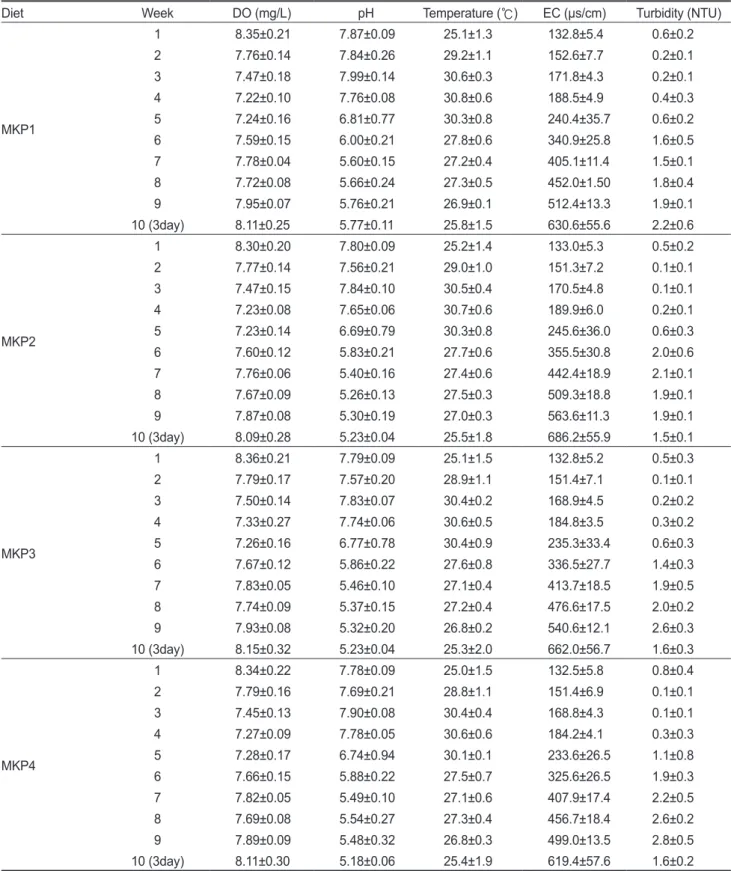
수질측정은
1
주6
회용존산소(DO, mg/L), pH,
수온(℃),
전 기전도도(electrical conductivity, EC; μs/cm),
탁도(NTU), TAN mg/L, NO 2 -N mg/L, NO 3 -N mg/L
와PO 4 -P mg/L
를 측정하였다. DO, pH,
수온, EC
와탁도는현장수질측정기인YSI PRODSS (YSI Inc., USA)
를 사용하였고, TAN, NO 2 - N, NO 3 -N
와PO 4 -P
는 분석시약(NitraVer ⓡ X Reagent Set 2605345-KR, Low Range Ammonia Reagent Set 2604545- KR, NitriVer ⓡ 3 Reagent Set 2608345-KR, PhosVer ⓡ 3 Phos- phater Reagent, HACH Ltd., USA)
과 다목적수질측정기인DR5000 (HACH Ltd., USA)
을이용한비색법으로분석하였 다.
또한식물생산4
주실험종료후,
각시험구의미량원소인K (mg/L), Ca (mg/L), Mg (mg/L), Na (mg/L), Fe (mg/L), Zn (mg/L), Mn (mg/L)
및Cu (mg/L)
는유도결합플라즈마분광광 도계(ICP-OES Optima 8300, Perkin Elmer Co., USA)
로, Cl
(mg/L)
및SO 4 (mg/L)
는이온크로마토그래피(930 Comact IC Flex, Metrohm Co., USA)
를사용하여분석하였다.
혈액분석
10
주간어류사육실험종료후,
일인산칼륨(Monobasic po- tassium phosphate, MKP)
이첨가된4
개시험구의메기혈액성 상변화조사를위해24 h
사료절식이이루어졌다.
이후어류 마취제인MS-222 (Wojin B&G Ltd., Korea)
로마취시킨다음 헤파린(Heparin sodium salt from porcine intestinal mucosa, K3333-10KU, Sigma-Aldrich., Germany)
을처리한1 cc
주사 기를사용하여미부정맥에서시험구별6
마리의혈액을샘플링 하였다.
전혈은Hemoglobin (Hb, g/dL)
과PCV (Hematocrit,
%)
분석에사용하였고,
이후4℃, 12,000 rpm, 10 min
의조 건이설정된원심분리기(Centrifuge 5415 R, Eppendorf Ltd., Germany)
를이용하여혈장(plasma)
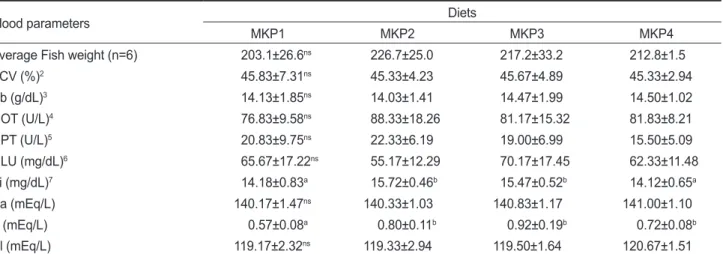
분리후glutamic oxalo- acetic transaminase (GOT, U/L), glutamic pyruvic transami- nase (GPT, U/L), glucose (GLU, mg/dL), inorganic phospho- rus (Pi, mg/ dL), Na (mEq/L), K (mEq/L)
와Cl (mEq/L)
을분 석하였다. PCV
는HAEMATOKRIT 210 (Hettich Ltd., Ger- many)
을이용하여분석하였으며, Hb
등다른혈액요소는시판 되는임상진단키트(Fuji DRI-CHEM slide, Fuji photo film co.
Ltd., Japan)
와함께혈액분석기(DRI-CHEM 3500 I, Fujifilm Ltd., Japan)
를이용하여분석하였다.
통계처리
어류의성장실험에서얻어진모든자료
[
개시어체중,
종료어 체중,
증체율,
사료효율(feed efficiency, FE),
일간성장률(spe- cific growth rate, SGR),
단백질이용효율(protein efficiency ra- tio, PER),
일간사료섭취율(daily feed intake, DFI),
생존율,
전 어체]
의변수는SPSS Version 10 (SPSS, 1999)
프로그램의일 원분산분석(one-way ANOVA)
을이용하여분석하였다.
분석 에앞서모든자료의변량의동질성(homogeneity of variance)
은Cochran’s test (Sokal and Rohlf, 1995)
를이용하여확인하 였다.
실험구별각변수에대한유의차가발견되었을시,
사후검 정은Duncan’s multiple range test
분석을이용하였다(Duncan, 1955).
메기의증체율에기반한사료내최적MKP
수준분석은2
차다항식회귀분석을이용하였으며,
모든통계분석의유의수 준은5% (P<0.05)
에서결정되었다.
결 과
실험사료 4종의 성분분석
실험사료
4
종의조단백질,
조지방,
조회분,
조섬유, Ca, P, Mg,
Fe, Cu, Mn, Zn
및K
함량은Table 2
에제시된바와같다.
각 실험사료의조단백질및조지방함량은44.51% (MKP1)
에서46.46% (MKP3)
및6.60% (MKP3)
에서7.20% (MKP2)
의값을보였다
. MKP
의사료내첨가수준이높아짐에따라P
와K
의 값이상승됨을알수있으며, MKP1
의경우P
함량은1.58%, K
함량은10,626 ppm
로가장낮은값을나타내었고, MKP2
는P
함량1.89%, K
함량14,281 ppm, MKP3
는P
함량2.13%, K
함 량16,499 ppm
그리고, MKP4
는P
함량2.47%, K
함량18,984 ppm
으로분석되었다.
실험 제작 사료 4종의 아쿠아포닉스 생산성 비교 시험
사료내MKP
농도를달리한실험사료를10
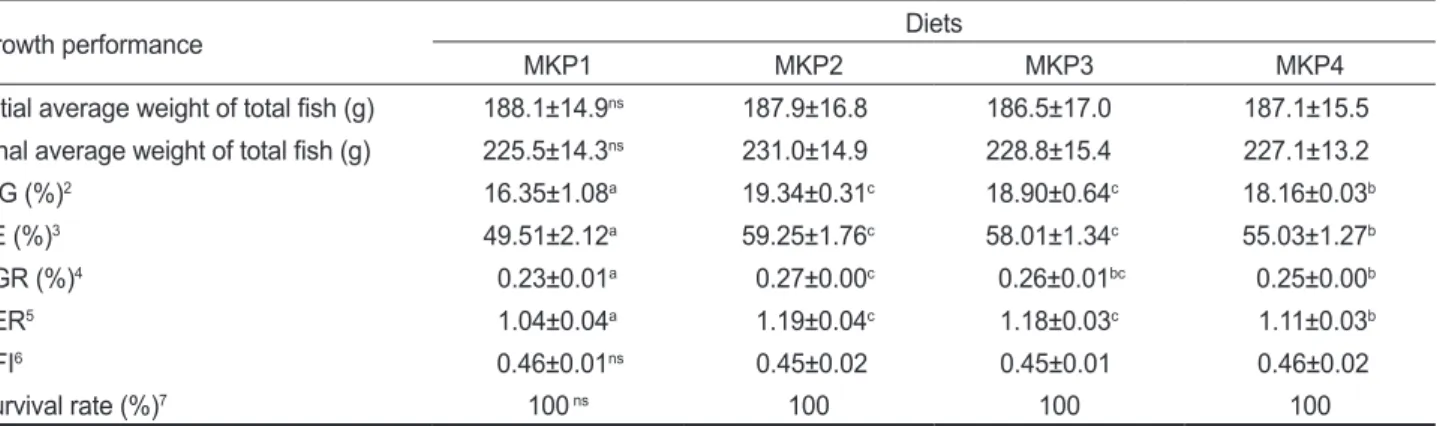
주간메기에급여한결과는
Table 3
과같다. MKP2
구가WG 19.34±0.31%, FE 59.25±1.76%, SGR 0.27±0.00%
및PER 1.19±0.04%
로모 든 시험구에서유의적으로높은값을나타내었으나(P<0.05), MKP3
구와의유의한차이는없었다(P>0.05). DFI
는모든시험구에서 유의한 차이를 보이지 않았으며
0.45% (MKP2,
MKP3)
에서0.46% (MKP1, MKP4)
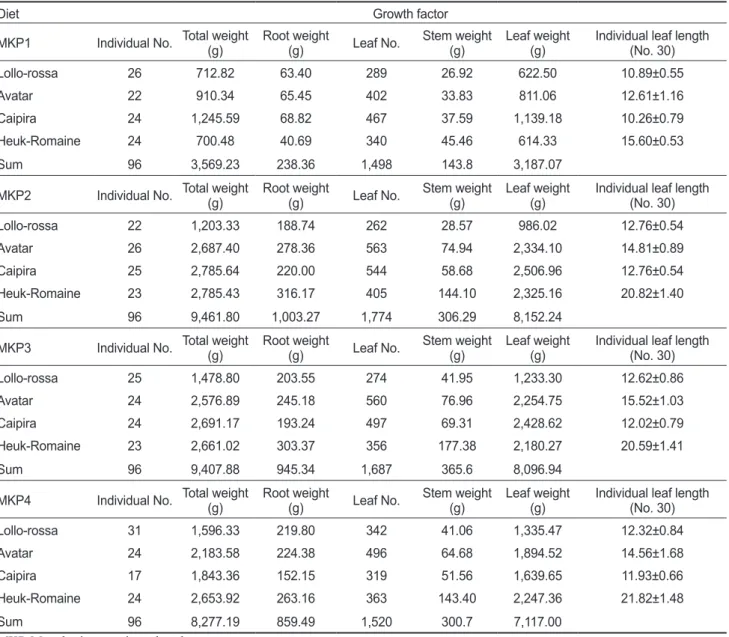
의값을보였다. 4
종류의 엽채류생산시험결과는Table 4
에나타내었다.
시험구별각엽 채류4
종에대하여24
개체씩초기입식계획(
시험구별총96
개체)
이었으나,
초기엽채류의구분이잘되지않은관계로시 험종료시시험구별엽채류종류에따른개체수의차이가나 타났다. MKP2
구와MKP3
구의4
종류엽채류생산성은총중 량9,461.80 g (
엽중량8,152.24 g),
총중량9.407.88 g (
엽중 량8,096.94 g)
으로MKP1, MKP4
에비해높은값을보였다. MKP1
의생산성은총중량3.569.23 g (
엽중량3,187.07 g)
으 로가장낮은값을나타내어3
개시험구에비해엽채류생산성 이저조하였다.
어체분석
사료내
MKP
농도를달리한실험사료를10
주간메기에급여 한후,
어체분석한결과는Table 5
와같다.
수분,
조지방및조 회분의경우최초개시구를포함하여모든시험구에서유의한 차이를나타내지않았다(P>0.05).
조단백질의 경우MKP1
구 에서15.30±0.56%
의값으로다른시험구에비해가장낮았으 며(P<0.05), K
의경우도MKP1
구에서0.10±0.01%
로가장낮 게나타났다(P<0.05). P
의경우는MKP3
구에서0.71±0.25%
의값을나타내어다른시험구에비해가장높은경향을보였 다
(P<0.05).
Table 2. Chemical composition of the experimental diets1
Composition (%) MKP1 MKP2 MKP3 MKP4
Moisture 6.26 7.09 5.87 6.53
Crude protein 44.51 46.30 46.46 46.28
Crude lipid 6.60 7.20 6.69 6.68
Crude ash 9.78 10.72 11.55 12.13
Crude fiber 2.07 1.77 2.05 1.74
Ca 2.27 2.37 2.38 2.49
P 1.58 1.89 2.13 2.47
Composition (ppm) MKP1 MKP2 MKP3 MKP4 Mg 2,109.74 2,090.57 2,090.57 1,964.66
Fe 287.64 321.75 320.45 291.28
Cu 15.79 16.20 16.87 15.88
Mn 39.57 26.87 37.21 34.74
Zn 121.95 120.79 122.78 109.13
K 10,626 14,281 16,499 18,984
1Values are means of 2 determinations. MKP, Monobasic potas- sium phosphate.
Table 3. Growth performance of far eastern catfish Silurus asotus fed diets with graded levels of monobasic potassium phosphate (MKP) for 10 weeks1
Growth performance Diets
MKP1 MKP2 MKP3 MKP4
Initial average weight of total fish (g) 188.1±14.9ns 187.9±16.8 186.5±17.0 187.1±15.5 Final average weight of total fish (g) 225.5±14.3ns 231.0±14.9 228.8±15.4 227.1±13.2
WG (%)2 16.35±1.08a 19.34±0.31c 18.90±0.64c 18.16±0.03b
FE (%)3 49.51±2.12a 59.25±1.76c 58.01±1.34c 55.03±1.27b
SGR (%)4 0.23±0.01a 0.27±0.00c 0.26±0.01bc 0.25±0.00b
PER5 1.04±0.04a 1.19±0.04c 1.18±0.03c 1.11±0.03b
DFI6 0.46±0.01ns 0.45±0.02 0.45±0.01 0.46±0.02
Survival rate (%)7 100 ns 100 100 100
1Values (means±SE of two replicates) with different superscripts in the same row are significantly different (P<0.05). 2Weight gain (%)=[fi- nal weight (g)-initial weight (g)]×100/initial weight (g). 3Feed efficiency (%)=wet weight gain (g)/dry feed intake×100. 4Specific growth rate (%)=(Ln final weight (g)-Ln initial weight (g))/experimental days×100. 5Protein efficiency ratio=wet weight gain (g)/protein intake. 6Daily feed intake (%/av. wt/d)=dry feed intake (g/fish)/[(initial wt+final wt)/2]/experimental days×100. 7Survival rate (%)=final fish number/initial fish number×100. ns, nonsignificant; MKP, Monobasic potassium phosphate.
Table 4. Growth of four leafy vegetables in aquaponic system for 23 days
Diet Growth factor
MKP1 Individual No. Total weight (g) Root weight
(g) Leaf No. Stem weight
(g) Leaf weight
(g) Individual leaf length (No. 30)
Lollo-rossa 26 712.82 63.40 289 26.92 622.50 10.89±0.55
Avatar 22 910.34 65.45 402 33.83 811.06 12.61±1.16
Caipira 24 1,245.59 68.82 467 37.59 1,139.18 10.26±0.79
Heuk-Romaine 24 700.48 40.69 340 45.46 614.33 15.60±0.53
Sum 96 3,569.23 238.36 1,498 143.8 3,187.07
MKP2 Individual No. Total weight (g) Root weight
(g) Leaf No. Stem weight
(g) Leaf weight
(g) Individual leaf length (No. 30)
Lollo-rossa 22 1,203.33 188.74 262 28.57 986.02 12.76±0.54
Avatar 26 2,687.40 278.36 563 74.94 2,334.10 14.81±0.89
Caipira 25 2,785.64 220.00 544 58.68 2,506.96 12.76±0.54
Heuk-Romaine 23 2,785.43 316.17 405 144.10 2,325.16 20.82±1.40
Sum 96 9,461.80 1,003.27 1,774 306.29 8,152.24
MKP3 Individual No. Total weight (g) Root weight
(g) Leaf No. Stem weight
(g) Leaf weight
(g) Individual leaf length (No. 30)
Lollo-rossa 25 1,478.80 203.55 274 41.95 1,233.30 12.62±0.86
Avatar 24 2,576.89 245.18 560 76.96 2,254.75 15.52±1.03
Caipira 24 2,691.17 193.24 497 69.31 2,428.62 12.02±0.79
Heuk-Romaine 23 2,661.02 303.37 356 177.38 2,180.27 20.59±1.41
Sum 96 9,407.88 945.34 1,687 365.6 8,096.94
MKP4 Individual No. Total weight (g) Root weight
(g) Leaf No. Stem weight
(g) Leaf weight
(g) Individual leaf length (No. 30)
Lollo-rossa 31 1,596.33 219.80 342 41.06 1,335.47 12.32±0.84
Avatar 24 2,183.58 224.38 496 64.68 1,894.52 14.56±1.68
Caipira 17 1,843.36 152.15 319 51.56 1,639.65 11.93±0.66
Heuk-Romaine 24 2,653.92 263.16 363 143.40 2,247.36 21.82±1.48
Sum 96 8,277.19 859.49 1,520 300.7 7,117.00
MKP, Monobasic potassium phosphate.
Table 5. Proximate composition (%, as-is basis) of whole body of far eastern catfish Silurus asotus fed diets with graded levels of monobasic potassium phosphate (MKP) for 10 weeks1
Diet
Initial fish MKP1 MKP2 MKP3 MKP4
Moisture (%) 75.29±1.73 ns 77.50±1.39 76.87±2.79 75.66±2.28 76.79±1.09
Crude protein (%) 17.10±1.07b 15.30±0.56a 15.60±1.47ab 16.71±1.34ab 16.51±1.19ab
Crude lipid (%) 4.12±1.18 ns 3.26±1.06 3.82±1.69 3.44±0.99 2.83±0.71
Crude ash (%) 3.80±0.60ns 3.29±0.39 3.47±0.54 3.71±0.40 3.67±0.19
K (%) 0.14±0.01b 0.10±0.01a 0.14±0.01b 0.12±0.01b 0.17±0.02c
P (%) 0.66±0.21a 0.45±0.09a 0.52±0.10a 0.71±0.25b 0.58±0.10a
1Values (means±SD of six replicates) with different superscripts in the same row are significantly different (P<0.05). ns, nonsignificant;
MKP, Monobasic potassium phosphate.