310
서 론메기
(Silurus asotus)
는우리나라의전하천과일본,
중국및대 만에널리서식하고있는어종이며,
특히매운탕으로수요가많 아담수양식종으로가치가높은어종이다.
국내메기생산량은2012
년3,825
톤이었으며,
뱀장어(4,365
톤)
다음으로많은량 이생산되고있다(Statistics Korea 2012).
양식대상종에적합한배합사료를개발하기위해서는대상종 의성장에필요한영양소및영양소별요구량을규명하는연구 가가장먼저수행되어야하며
,
이러한자료를바탕으로영양소 균형을고려하면서그어종이이용할수있는경제적인원료선 택과이용성을조사하여야한다.
사료영양소중지질은단백 질이나탄수화물보다에너지가가높아값비싼사료단백질을 절감시킬수있을뿐만아니라,
필수지방산공급원으로어류의 성장과체내대사에있어중요한영양소이다.
또한사료의지질함량은어류의성장이나체조성에영향을미치는것으로알려 져있으며
,
동일한사료단백질함량에서지질함량을조절함으 로써channel catfish Ictalurus punctatus (Garling and Wilson 1976)
및rockfish Sebastes schlegeli (Lee et al. 2002)
에서성 장및사료효율이개선되었다고보고된바있다.
우리나라의메기양식에사용되고있는배합사료는사료회사 에서상업적으로개발된사료들이유통되고있지만
,
메기사육 에적합한배합사료설계및제조에주요한기초자료가되는영 양소요구량및사료원료이용성에관한연구들은제한적인실 정이다(Kim et al. 2009).
기존에수행된메기사료의적정단백 질및지질함량에조사에관한연구(Kim et al. 2012)
에서지질17%
사료실험구는지질9%
사료실험구에비하여메기의성장을향상시키는것으로보고되었다
.
그러나Kim et al. (2012)
의연구에는실험사료의지질원으로대두유를사용하여사료 내의지질함량을증가시켰다.
그래서본연구에서는경제적인Article history;
Received 10 April 2013; Revised 8 May 2013; Accepted 14 May 2013
*Corresponding author: Tel: +82. 54. 230. 3630 Fax: +82. 54. 000. 0000 E-mail address: [email protected]
Kor J Fish Aquat Sci 46(3) 310-314, June 2013 http://dx.doi.org/10.5657/KFAS.2013.0310 pISSN:0374-8111, eISSN:2287-8815
ⓒ The Korean Society of Fishereis and Aquatic Science. All rights reserved
배합사료의 우지와 덱스트린이 메기( Silurus asotus)의 성장과 체조성에 미치는 영향
This study investigated the utilization of beef tallow and dextrin as non-protein energy sources in the diet of juvenile far eastern catfish Silurus asotus . Three replicated groups of juveniles (initial mean weight of 3.6 g) were fed diets containing high levels of beef tallow or dextrin for six weeks. The final mean weight of fish fed on a 17% lipid diet with a high level of beef tallow was significantly higher than that of fish fed on a 9% lipid diet with a high level of dextrin ( P =0.04). No significant differences were observed in the feed efficiency and protein efficiency ratio of fish fed on the experimental diets. Crude lipid content and the C18:0, C18:1n-9 and C18:2n-6 contents of whole-body fish were significantly affected by diet ( P <0.05). The results of this study suggest that beef tallow is better than dextrin as a non-protein energy source for improving the growth of juvenile far eastern catfish, and that beef tallow could be economically used as an ingredient in practical feed.
Key words; Far eastern catfish, Silurus asotus , Non-protein energy, Beef tallow, Dextrin
국립수산과학원 사료연구센터, 1내수면양식연구센터
Kyoung-Duck Kim*, Jin Do Kim1, Kang-Woong Kim, Maeng Hyun Son and Hyon Sob Han
김경덕*·김진도
1·김강웅·손맹현·한현섭
Influence of Dietary Beef Tallow and Dextrin on the Growth and Body Composition of Juvenile Far Eastern
Catfish Silurus asotus
Aquafeed Research Center, National Fisheries Research & Development Institute, Pohang 791-923, Korea
1
Inland Aquaculture Research Center, National Fisheries Research & Development Institute, Jinhae 645-806, Korea
메기배합사료개발을위한연구의일환으로사료중의비단백 질에너지원으로오징어간유및대두유에비하여가격이저렴 한우지
(beef tallow)
함량을증가시킨사료와덱스트린함량을 증가시킨사료가메기치어의성장및체조성에미치는영향을 조사하였다.
재료 및 방법
실험사료
실험사료는
2
종류를설계하였으며,
원료조성과일반성분분석결과를
Table 1
에나타내었다.
단백질원으로갈색어분을사용하여사료의단백질함량이
40%
가되도록하였고(Kim et al.
2012),
메기의필수지방산요구충족을위하여오징어간유를3%
씩첨가하였다(Kim et al. 2010).
메기사료의비단백질에 너지원으로우지및덱스트린의이용성을조사하기위하여지 질원으로우지를9%
첨가한사료(HL)
와탄수화물원인덱스트린함량을
20%
증가시킨사료(HD)
를설계하였다.
이와같이 설계된원료들을분말형태로잘혼합한후,
원료100 g
당물40 g
내외를첨가하여실험용펠렛제조기로압출성형하였다.
제조된실험사료는상온에서
24
시간건조시킨후, -25℃
에보 관하면서사용하였다.
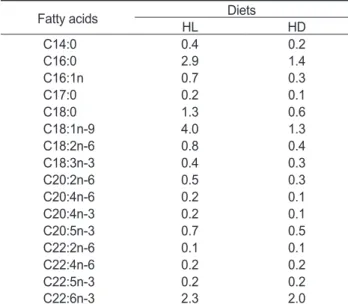
실험사료의지방산분석결과를Table 2
에나타내었다.
실험어 및 사육관리
사육실험은순환여과식사육시설을사용하여실시하였다
.
실험어는2
주간실험수조에순치시킨후,
외형적으로건강한 평균체중3.6 g
의메기치어를선별하여총6
개의500 L
원형수 조에30
마리씩사료별로3
반복수용하여,
실험사료를1
일2
회(09:00, 17:00)
실험어가먹을때까지손으로공급하며6
주간사 육하였다.
사육수는각실험수조에분당10 L
내외로조절하여 흘려주었다.
사육기간동안사육수의평균수온은24±0.5℃
(±
표준편차)
였다. 어체측정 및 성분분석
어체측정은사육실험시작시와종료시에측정전일절식시킨 후
,
각수조에수용된모든실험어의전체체중을측정하였다.
어체성분분석을위하여사육실험종료시,
각실험수조에서10
마리의실험어를시료로취하여냉동보관
(-40℃)
하였다.
실험사료와실험어의수분은
135℃
에서2
시간건조후측정 하였으며,
조단백질(N×6.25)
은Auto Kjeldahl System (Ger- hardt VAP50OT/ TT125, Germany)
을사용하여분석하였다.
조지방은조지방추출기(Velp SER148, Italy)
를사용하여ether
로추출한후측정하였으며,
조회분은550℃
에서4
시간동안 Table 1. Ingredient and nutrient contents of the experimental dietsDiets
HL HD
Ingredient (%)
Brown fish meal 55 55
Dextrin 15 35
Squid liver oil 3 3
Beef tallow 9
α-Cellulose 11
Carboxymethylcellulose 2.5 2.5
Vitamin premix1 2 2
Mineral premix2 2 2
Choline chloride 0.5 0.5
Nutrient contents (dry matter basis)
Crude protein (%) 40.6 40.6
Crude lipid (%) 17.1 9.0
Ash (%) 9.7 9.6
Gross energy (cal/g) 5183 4783
n-3 PUFA (%)3 3.8 3.1
1 Vitamin premix contained the following amount which were diluted in cellulose (g/kg premix): L-ascorbic acid, 121.2; DL-α- tocopheryl acetate, 18.8; thiamin hydrochloride, 2.7; riboflavin, 9.1; pyridoxine hydrochloride, 1.8; niacin, 36.4; Ca-D-pantothe- nate, 12.7; myo-inositol, 181.8; D-biotin, 0.27; folic acid, 0.68;
p-aminobenzoic acid, 18.2; menadione, 1.8; retinyl acetate, 0.73;
cholecalciferol, 0.003.
2 Mineral premix contained the following ingredients (g/kg pre- mix): NaCl, 43.3; MgSO4·7H2O, 136.5; NaH2PO4·2H2O, 86.9;
KH2PO4, 239; CaHPO4, 135.3; Ferric citrate, 29.6; ZnSO4·7H2O, 21.9; Ca-lactate, 304; CuCl, 0.2; AlCl3·6H2O, 0.15; KI, 0.15;
MnSO4·H2O, 2.0; CoCl2·6H2O, 1.0.
3 n-3 poly unsaturated fatty acids (C≥18).
Table 2. Fatty acids content (%) of the experimental diets
Fatty acids Diets
HL HD
C14:0 0.4 0.2
C16:0 2.9 1.4
C16:1n 0.7 0.3
C17:0 0.2 0.1
C18:0 1.3 0.6
C18:1n-9 4.0 1.3
C18:2n-6 0.8 0.4
C18:3n-3 0.4 0.3
C20:2n-6 0.5 0.3
C20:4n-6 0.2 0.1
C20:4n-3 0.2 0.1
C20:5n-3 0.7 0.5
C22:2n-6 0.1 0.1
C22:4n-6 0.2 0.2
C22:5n-3 0.2 0.2
C22:6n-3 2.3 2.0
Fatty acids contents were calculated by total lipid % × area % × 0.892 (Yoshimatsu et al 1997).
회화후측정하였고
,
사료의에너지함량은열량분석기(Parr- 6200, USA)
로분석하였다.
지방산분석을위하여Folch et al.
(1957)
의방법에따라클로로포름과메탄올혼합액(2:1)
으로총지질을추출하였고
, 14% BF
3-methanol
로지방산을meth- ylation
시킨후, capillary column (SP
TM-2560, 100 m×0.25 mm i.d., film thickness 0.2 μm, USA)
이장착된gas chroma- tography (HP-6890Ⅱ, USA)
로지방산을분석하였다. 통계처리
결과의통계처리는
SPSS
프로그램(Version 11.5)
으로t-test
를실시하여평균간의유의성을검정하였다.
결 과
우지및덱스트린함량을다르게한사료로메기치어를
6
주 간사육한결과를표3
에나타내었다.
사육기간동안의생존율 은97-99%
였고,
두실험구간에유의한차이가없었다.
최종체 중은사료의우지함량을높인실험구가덱스트린함량을높인실험구에비하여유의하게높았다
(P=0.04).
사료효율및단백질효율은사료의우지함량을높인실험구가덱스트린함량을 높인실험구에비하여높은값을보였으나
,
유의한차이는없었다
(P=0.06).
일일사료섭취율은두실험구간에통계적인차이가없었다
(P=0.14).
사육실험 종료 후
,
실험어의 전어체 일반성분 분석결과를Table 4
에나타내었다.
전어체의조지질함량은실험사료에유의한영향을받아
,
사료의우지함량을높인실험구가덱스트린함량을높인실험구에비하여높았다
(P=0.04).
전어체의수분
,
조단백질및회분함량은두실험구간에유의한차이를보 이지않았다.
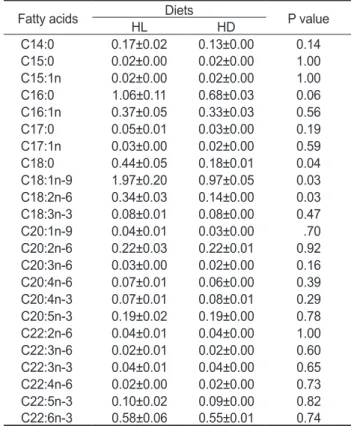
실험어의전어체지방산조성분석결과를
Table 5
에나타내었 다. C16:0, C18:1n-9
및C22:6n-3
이주지방산으로다량함유 되어있었다. C18:0, C18:1n-9, C18:2n-6
은실험구간에유의한 차이를보였으나(P<0.05),
그외의지방산들은두실험구간에 유의한차이가없었다.
고 찰
사료내영양소중단백질은어류의성장과사료비용에많은 영향을미치는중요한영양소이므로
(Lovell 1989)
양식생산 성을높이고사료단가를낮추기위해서는섭취된사료중의단 백질이에너지원으로사용되는것을최소화시키고성장을위 해사용되어야한다.
어류의성장과관련된단백질효율은비단 백질에너지원인지질및탄수화물함량을조절하여향상시킬 수있는것으로알려져있다(Page and Andrew, 1973).
이중에 Table 4. Proximate composition of whole body in juvenile far east-ern catfish Silurus asotus fed the experimental diets for 6 weeks
Diets P value
HL HD
Moisture (%) 74.5±0.77 76.9±0.83 0.10 Crude protein (%) 16.2±0.08 16.2±0.48 0.83 Crude lipid (%) 6.7±0.76 4.4±0.16 0.04
Ash (%) 2.3±0.03 2.5±0.08 0.20
Values are mean ±SE of three replications.
Table 3. Growth performance of juvenile far eastern catfish Silurus asotus fed the experimental diets for 6 weeks
Diets P value
HL HD
Initial mean body
weight (g/fish) 3.6±0.23 3.6±0.23 1.00
Survival (%) 99±1.1 97±0.0 0.12
Final mean weight
(g/fish) 38±2.80 30±0.23 0.04
Feed efficiency (%)1 120±8.4 99±0.5 0.06 Protein efficiency ratio2 2.96±0.20 2.43±0.01 0.06 Daily feed intake 3 4.19±0.31 4.77±0.04 0.14 Valuesare mean ±SE of three replications.
1 Fish wet weight gain× 100/feed intake (dry matter).
2 Fish wet weight gain×100/protein intake.
3 Feed intake (dry matter)×100/[(initial fish weight + final fish weight + dead fish weight)×days fed/2].
Table 5. Fatty acids composition (%) of the juvenile far eastern catfish Silurus asotus fed the experimental diets
Fatty acids HL Diets HD P value
C14:0 0.17±0.02 0.13±0.00 0.14
C15:0 0.02±0.00 0.02±0.00 1.00
C15:1n 0.02±0.00 0.02±0.00 1.00
C16:0 1.06±0.11 0.68±0.03 0.06
C16:1n 0.37±0.05 0.33±0.03 0.56
C17:0 0.05±0.01 0.03±0.00 0.19
C17:1n 0.03±0.00 0.02±0.00 0.59
C18:0 0.44±0.05 0.18±0.01 0.04
C18:1n-9 1.97±0.20 0.97±0.05 0.03
C18:2n-6 0.34±0.03 0.14±0.00 0.03
C18:3n-3 0.08±0.01 0.08±0.00 0.47
C20:1n-9 0.04±0.01 0.03±0.00 .70
C20:2n-6 0.22±0.03 0.22±0.01 0.92
C20:3n-6 0.03±0.00 0.02±0.00 0.16
C20:4n-6 0.07±0.01 0.06±0.00 0.39
C20:4n-3 0.07±0.01 0.08±0.01 0.29
C20:5n-3 0.19±0.02 0.19±0.00 0.78
C22:2n-6 0.04±0.01 0.04±0.00 1.00
C22:3n-6 0.02±0.01 0.02±0.00 0.60
C22:3n-3 0.04±0.01 0.04±0.00 0.65
C22:4n-6 0.02±0.00 0.02±0.00 0.73
C22:5n-3 0.10±0.02 0.09±0.00 0.82
C22:6n-3 0.58±0.06 0.55±0.01 0.74
Values are mean ±SE of three replications.
가
9%
실험구에비하여높은결과를보였으며,
이는사료의지 질함량증가에의한것으로판단된다.
일반적으로지질함량이 높은사료를섭취한어류는체내지질함량이증가하는것으로 알려져있으며,
기존연구에서도유사한결과를보였다(Kim et
al. 2012).
어체의지방산조성은사료지질의지방산조성에영향을받는다는것은알려져있다
(Mugrditchians et al. 1981).
본 연구에서도전어체의대부분의지방산함량은실험사료의각 지방산함량과유사하였으며,
기존의메기연구에서도이러한 결과가보고되었다(Kim et al. 2010).
어체의지방산중18:1n-
9
함량은지질17%
사료실험구가현저히높은결과를보였는데
,
이는고지질실험구의지질원으로사용된우지에18:1n-9
가 다량함유되어있기때문으로판단된다(Lee 2001; Kim et al.
2010).
또한어체의20:5n-3
및22:6n-3
함량은두실험구간에 유의한차이가없었다.
비단백질원으로덱스트린보다우지를혼합한사료를메기에 공급한실험구에서양호한성장결과가나온것으로보아
,
경제 적인메기치어배합사료제조를위하여에너지원으로가격이 저렴한우지를사용하여도좋을것으로판단된다.
사 사
본연구는국립수산과학원
(
친환경실용배합사료개발및품질 관리연구, RP-2013-AQ-109)
의지원에의해운영되었습니다.
참고문헌
El-Sayed AM and Teshima S. 1992. Protein and energy require- ments of Nile tilapia Oreochromis niloticus, fry. Aquacul- ture 103, 55-63.
Folch J, Lees M and Sloane-Stanley GH. 1957. A simple method for the isolation and purification of total lipids from animal tissues. J Biol Chem 226, 497-509.
Garling DL and Wilson RP. 1976. Optimum dietary protein to energy ratios for channel catfish fingerlings Ictalurus punc-
tatus. J Nutr 106, 1368-1375.
Kim KD, Lee SM, Park HG, Bai SC and Lee YH. 2002. Es- sentiality of dietary n-3 highly unsaturated fatty acids in ju- venile flounder Paralichthys olivaceus. J World Aquac Soc 33, 432-440
Kim KD, Lim SG, Hwang JA, Kim JD and Kang YJ. 2009.
Evaluation of soybean meal as a partial substitute for fish meal in diet and experimental practical diet for growth in the far eastern catfish Silurus asotus. Korean J Fish Aquat Sci 42, 349-353.
Kim KD, Kim JD, Lim SG, Kang YJ and Son MH. 2010. Ef- fects of dietary lipid sources on the growth and body compo- sition of the far eastern catfish Silurus asotus. Korean J Fish Aquat Sci 43, 445-450.
Kim KD, Lim SG, Kang YJ, Kim KW and Son MH. 2012.
Effects of dietary protein and lipid levels on growth and 서지질은단백질이나탄수화물보다에너지가가높아대상어
종에대한이용성을조사하여사료중에적정한함량을첨가하 면단백질을절약할수있는영양소이다
(El-Sayed and Teshima 1992; Kim et al., 2002).
본연구에서우지를첨가하여사료의지질을
17%
로높인실 험구는사료지질9%
인실험구와 비교하여성장이증가하는 결과를보였다.
단백질함량20%, 30%
및40%
에지질원으로 오징어간유와대두유를사용하여지질함량을17%
와9%
로다 르게한사료로메기를사육한기존연구(Kim et al. 2012)
에서 도실험어의성장은고지질실험구가저지질실험구에비하여 유의하게증가하여본연구와유사한결과를보였다.
본연구의 사료효율및단백질효율은지질17%
실험구가지질9%
실험 구와비교하여유의적인차이는없었으나증가하는경향을보 여,
사료중에적절한량의지질첨가는섭취된사료중의단백 질이메기치어의성장을위해효율적으로사용되는것으로판 단된다.
메기를대상으로한Kim et al. (2012)
의연구에서도단 백질30%
에지질17%
사료를섭취한메기는단백질40%
에지 질9%
사료를섭취한실험어와성장및사료효율에서차이를 보이지않았다.
이와같은사료내지질(
에너지)
함량증가에따 른어류의성장및단백질효율개선효과는channel catfish
및Chinese longsnout catfish Leiocassis longirostris
와같은타메 기어종에서도보고되었다(Page and Andrew 1973; Pei et al.
2004).
지질원으로오징어간유
,
아마인유,
옥수수유및우지를첨가 한사료로메기를사육한Kim et al. (2010)
연구에서우지사료 실험구는오징어간유및아마인유첨가실험구에비하여성장 및사료효율이저하되는결과를보였으며,
메기의치어의최적 성장을위해서는n-3
계의불포화지방산이함유된아마인유나 오징어간유를사용하는것이바람직하다고보고되었다.
그러 나본연구에서는메기의필수지방산요구충족을위하여오징 어간유를3%
씩첨가하였고,
어분에함유된지질에도n-3
계의 불포화지방산이다량함유되어있으므로본연구의실험사료는 메기치어의필수지방산요구를충족시켰을것으로판단되며,
본연구의두실험구의성장및사료효율은기존연구(Kim et al. 2010)
와비교해보아도양호한결과를보였다.
따라서본연구의실험사료에에너지함량증가를위하여지 질원으로사용된우지는어유및아마인유등에비하여가격이 저렴하므로메기치어사육을위한실용사료의지질원으로사 용할경우
,
사료단가를낮출수있으므로경제적인메기배합 사료제조에유용한사료원료가될것으로판단된다. Channel
catfish
의경우에도지질원으로우지를첨가한실험구가 청어유를첨가한실험구와유사한성장및사료이용률을보였으며
, channel catfish
가우지에대한이용성이좋은것은우지에포함 되어있는다량의포화지방산과단일불포화지방산에대한이 용률이좋기때문인것으로보고되었다(Stickndy and Andrews 1972).
사육실험종료후
,
어체의지질함량은지질17%
사료실험구body composition of juvenile far eastern catfish Silurus
asotus. Asian-Aust J Anim Sci 25, 369-374. http://dx.doi.
org/10.5713/ajas.2011.11089.
Lee SM. 2001. Review of the lipid and essential fatty acid re- quirements of rockfish Sebastes schlegeli. Aquacult Res 32 Supplement 1, 8-17.
Lee SM, Jeon IG and Lee JY. 2002. Effects of digestible protein and lipid levels in practical feed on growth, protein utiliza- tion and body composition of juvenile rockfish Sebastes
schlegeli. Aquaculture 211, 227-239.
Lovell RT. 1989. Nutrition and feeding of fish. Van Nostrand Reinhold, New York, USA, 260.
Mugrditchian DS, Hardy RW and Iwaoka WT. 1981. Linseed oil and animal fat as alternative lipid sources in dry diets of chinook salmon Oncorhynchus tshawytscha. Aquaculture 25, 161-172.
Page JW and Andrews JW. 1973. Interaction of dietary levels of
protein and energy on channel catfish Ictalurus punctatus. J Nutr 103, 1339-1346.
Pei Z, Xie S, Lei W, Zhu X and Yang Y. 2004. Comparative study on the effect of dietary lipid level on growth and feed utilization for gibel carp Carassius suratus gibelio and Chinese longsnout catfish Leiocassis longirostris Gunther.
Aquac Nutr 10, 209-216.
Statistics Korea. 2012. Fishery production survey. Retrieved from http://kosis.kr on March 14, 2013.
Stickney RR and Andrews JW. 1972. Effects of Dietary Lipids on Growth, Food Conversion, Lipid and Fatty Acid Compo- sition of Channel Catfish. J Nutr 102, 249-258.
Yoshimatsu T, Imoto H, Hayash M, Toda K and Yoshimura K.
1997. Preliminary results in improving essential fatty acids enrichments of rotifer cultured in high density. Hydrobiolo- gia 358, 153-157.