The far eastern catfish Silurus asotus is a number of the typical freshwater Siluridae and an important commercial catf ish in Korea (Kim
et al., 1988; Kim, 1997). Although, various stud-ies have been performed on specif ic aspects relating to far eastern catf ish culture, few studies have been directed towards genetic improve- ments which will be determining factors in the future of far eastern catfish culture. Various chromosome manipulation methods are used to restore diploidy for gynogenesis and androgene- sis to produce tetraploid population (Thorgaard, 1983). Efficacy of chromosome manipulation de- pends on accurately an applying an appropriate thermal shock timed to affect chromosome se- paration during from metaphase to anaphase (Saat, 1993).
Optimizing shock induction requires empirical determination of a shock’s magnitude, duration, and time of application (Thorgaard, 1983). The optimal time of application depends on tempera- ture, which affects the rate of embryonic develop- ment in poikilothermic species. A measure of de- velopmental rate suggested by Dettlaff and
Dettlaff (1961) is the duration of one mitotic cycle during early synchronous cell cleavage, or the in- terval between two consecutive cell divisions.
This measure,
τoor “Dettlaff unit” is expressed in minutes (Saat, 1993). The mitotic interval varies inversely with temperature and the relationship must be determined empirically; however, re- gressions of
τoon temperature can be used as a basis for comparing species with similar spawn- ing biology (Dettlaff, 1986).
In this study, therefore, we determined tem- perature-related cleavage rates or mitotic inter- vals (
τo) to establish the eff icient procedures for chromosome manipulation in this species. Dur- ing the 1998 spawning season, mature broodfish were purchased, transported and maintained in Genetics and Breeding laboratory, Faculty of Marine Life Science, Kunsan National Univer- sity, Korea. And three females and five males were selected and each sex was held separately in a 460 l bottom-f iltered circular tanks supplied with temperature controlled freshwater. The flow rate was set at 10 l min
-1and the water tem- perature at 26±0.5� C. Milt was obtained by
Korean J. Ichthyol. 13(1), 85~88, 2001─
─ 85 ──
Determination of the Temperature- - Dependent Index of Mitotic Interval (ττ
o) for Chromosome Manipulation
in Far Eastern Catfish Silurus asotus
In-Seok Park and Jae-Hyun Im*
Division of Ocean Science, College of Ocean Science and Technology, Korea Maritime University, Pusan 606-791, Korea
* Faculty of Marine Life Science, Kunsan National University, Kunsan 573-701, Korea
Temperature-related cleavage rates and mitotic intervals (ττo) in the far eastern catfish Silurus asotus were studied by averaging the duration of the second and third embryonic divisions to establish effective procedures for chromosome mani- pulations. At higher temperatures eggs developed faster and underwent more asynchronous development. Mitotic intervals for far eastern catf ish were 21.5±1.4 min at 22�C, 18.5±1.2 min at 24�C, and 14.0±2.1 min at 26�C. There was a strong negative correlation between ττoand water temperature (Y =-1.85X±21.9, R2 = 0.9868, where Y is ττoand X is temperature).
Key words : Chromosome manipulation, mitotic intervals, Silurus asotus
Silurus asotus
86 I.S. Park and J.H. Im
hand-stripping, 24 hours after injection with human chorionic gonadotropin (HCG) at a dose of 1,000 IU per kg body weight. Milt from 5 ripe males was pooled to inseminate far eastern catfish eggs in vitro. Eggs were obtained by hand -stripping, 24 hours after injection with HCG at a dose of 2,000 IU per kg body weight. Consider- ing the usual ranges for spawning and early development of far eastern catfish, cleavage frequency and mitotic intervals were determined at 3 different temperature of 22, 24 and 26� C.
Freshly ovulated aliquots of 1,000 eggs from each female were pipetted into 3 replicate petri dishes and mixed with 2~3 ml milt which was diluted 40 times with physiological saline (128 mM NaCl, 26.8 mM KCl, 18 mM CaCl
2, 2.4 mM NaHCO
3, pH 7.0). Sperm activation was initiated by the addition of 26� C ambient freshwater. The fer- tilized eggs were incubated in 500 ml containers filled with ambient freshwater and supplied with aeration. Incubation temperatures were main- tained using temperature controlled water baths set at 22, 24 and 26� C.
Samples of approximately 50 eggs were gener- ally taken at 5 minute intervals over the period 30 minutes to 100 minutes post-activation from each replicate. However more frequent samples were taken as the anticipated time to first clea- vage approached. Sampled embryos were exa- mined at a 50X magnif ication to determine the developmental stage. Time to the f irst cleavage furrow was recorded, but was used only as the start for timing of the subsequent synchronous divisions. Time to the f irst division is not used in estimating
τObecause the interval from egg acti-
vation to f irst cleavage is two or more times the duration of subsequent synchronous divisions (Saat, 1993; Shelton and Rothbard, 1993). The time (minutes from activation) when 5 to 10% of the developing embryos reached the 4 (
τII) and 8 (
τIII) cell stages was recorded. The value of 5 to 10% was selected based on the recommended of Dettlaff (1986). Mean mitotic cycle intervals (
τo) were calculated as
τo=
τIII-τ
II/2. The relation- ships between mean mitotic interval and water temperature were examined by simple linear re- gression using SPSS.
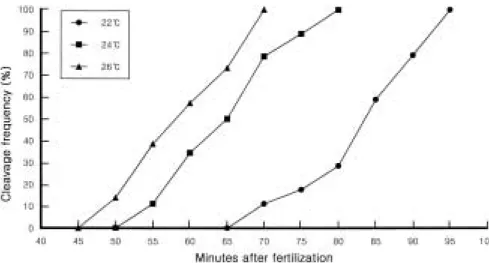
Far eastern catfish eggs underwent cleavage over the temperature range of 22 to 26� C. As shown in Fig. 1, at the higher temperature the eggs of far eastern catf ish showed the faster development. These results are similar to those of pearl oyster Pinctada fucata martensii report- ed by Komaru and Wada (1990). We observed the asynchronous development to first cleavage at all temperatures however this asynchronous devel- opment was more apparent at the lower tempe- ratures. The synchrony of mitotic events is a cri- tical factor to ensure eff icient chromosome mani- pulation (Downing and Allen, 1987). Based on these results, we could predict that chromosome manipulations would be most efficieint at tem- peratures of 22 to 24� C.
In far eastern catfish as in case of some cypri- nids, it is diff icult to determine time of cleavage past the 8-cell stage (Shelton and Rothbard, 1993). For this reason we calculated
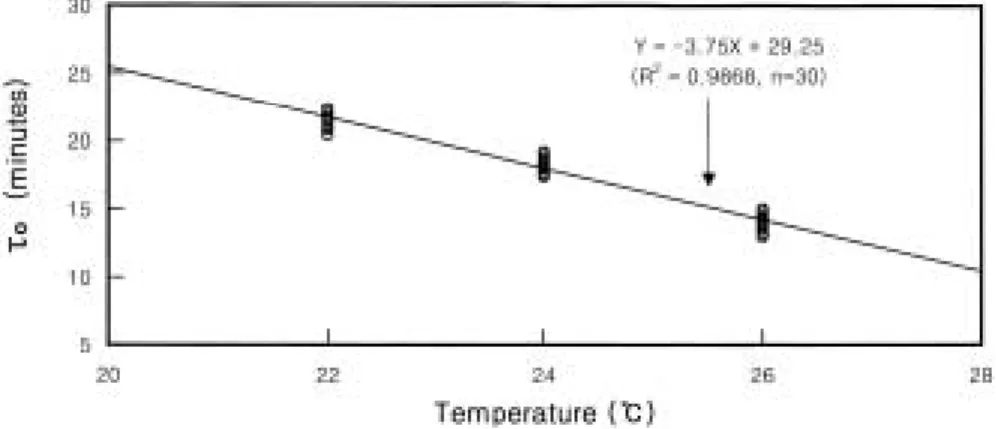
τousing the average interval of the second and third cleavage furrows. Over the range of incubation tempera- tures we tested the relationship between tem-
Fig. 1. The percentages of far eastern catf ish eggs developed to anaphase of first cleavage at three different temperatures over time.
perature and mitotic interval for far eastern cat- fish is best described by the linear relationship Y
= -1.85X
±21.9 (R
2= 0.9868, n = 50)), where Y is
τOand X is temperature in � C (Fig. 2). Mean mitotic intervals and standard deviations were 21.5±1.4 min at 22� C, 18.5±1.2 min at 24� C, and 14.0±2.1 min at 26� C (Fig. 2). In f ish the relationships between mitotic interval and water temperature are typically linear providing tem- peratures are within the range in which the spe- cies of f ish naturally spawn and develop (Shelton and Rothbard, 1993). Far eastern catf ish have much shorter mitotic intervals (
τo) than other species at comparable temperatures (Shelton et
al., 1997).The results of this study conducted that obvi- ous specif ic differences in time of egg develop- ment in far eastern catfish, demonstrated that temperature may be masked by variations in ambient temperature, which is one of the most potent inf luences on rate of development. While, optimization of treatment protocol for chromo- some manipulation in most f ishes proceeds th- rough a long series of iterations, in which the effectiveness of several variables; type of shock;
magnitude of shock; initiation and duration of shock is tested (Thorgaard, 1983). The Results obtained in this work will be helpful for chromo- some manipulation by use of cleavage frequency data and
τodata in far eastern catfish, and esti- mate the
τofor efficient ploidy induction using temperature shock to at 22� C
τo. However, fol- lowing researches are required to test the envi- ronmental factors such as salinities and oxygen inf luence the rate of development in far eastern catfish (Blaxter, 1969).
Acknowledgments
A special thanks to Jo, J.K. of the Mokchang Fish Hatchery, Korea, for assistance with brood- fish management. Comments from anonymous reviews greatly improved the quality of this ma- nuscript. This research was supported by Korea Research Foundation Grant to I.-S. Park, Fis- hery Genetics and Breeding Laboratory, Contri- bution Number KRF-2000-044-H00002.
References
Blaxter, J.H.S. 1969. Development: eggs and lar- vae. In Hoar, W.S. and Randall, D.J. (eds.), Fish Physiology, Vol. III. Academic Press Inc., pp.
177~252.
Dettlaff, T.A. 1986. The rate of development in poikilothermic animals calculated in astronomi- cal and relative time units. J. Therm. Biol., 11 : 1~7.
Dettlaff, T.A. 1991. Introduction: temperature and timing in developmental biology. In Dettlaff, T.A. and Vassetzky, S.G. (eds.), Animal Species for Developmental Studies, Vertebrates, Volume 2. Consultants Bureau, New York, pp. 1~15.
Dettlaff, T.A. and A.A. Dettlaff. 1961. On relative dimensionless characteristics of the develop- ment duration in embryology. Arch. Boil., 72 : 1~16.
Downing, S.L. and S.K. Allen, Jr. 1987. Induced tri- ploidy in the Pacific oyster: optimum treatments with cytochalasin B depend on temperature.
Aquaculture, 61 : 1~15.
Kim, D.S., I.-B. Kim, H.T. Huh and I.-S. Park.
1988. Cytogenetic analysis of catf ish, Silurus asotus (Teleostomi : Siluriformes). Ocean Res., 10 : 33~37.
Temperature--Dependent Index of ττOin Silurus asotusSilurus asotus 87
Fig. 2. Mitotic intervals (τo, Y) for far eastern catfish as a function of temperature (X). Eggs from 3 females were fertilized with pooled sperm from 5 males and were distributed among the temperature treatment.
Kim, I.S. 1997. Illustrated encyclopedia of fauna and f lora of Korea. Vol. 37, freshwater f ishes.
Ministry of Education, pp. 256~261.
Komaru, A. and K.T. Wada. 1990. Gametogenesis of triploid Japanese pearl oyster, Pinctada fucata martensii. In Hoshi, M. and Yamashita, O.
(eds.), Advances in Invertebrate Reproduction 5.
Elsevier, Amsterdam, pp. 469~474.
Saat, T. 1993. The morphology and chronolgy of oocyte final maturation and fertilization in fish.
In Walther, B.T. and Fyhn, H.J. (eds.), Physiolo- gical and Biochemical Aspects of Fish Develop- ment. University of Bergen, Norway, pp. 71~85.
Shelton, W.L. and S. Rothbard. 1993. Determination
of the developmental duration (τo) for ploidy ma- nipulation in carps. Isr. J. Aquacult. - Bamid- geh, 45 : 73~81.
Shelton, W.L., S.D. Mims, J.A. Clark, A.E. Hiott and C. Wang. 1997. A temperature-dependent index of mitotic interval (τo) for chromosome ma- nipulation in paddlef ish and shovelnose sturg- eon. The Prog. Fish-Cult., 59 : 229~234.
Thorgaard, G.H. 1983. Chromosome set manipula- tion and sex control in f ish. In Hoar, W.S., Ran- dall, D.T. and Donaldson, E.M. (eds.), Fish Phy- sioloy, Vol. 9B. Academic Press, New York, N.
Y., pp. 405~434.
88 I.S. Park and J.H. Im
메기
Silurus asotus
염색체조작을 위한 온도 의존적 체세포분열 간격지수 결정박 인 석∙임 재 현
군산대학교 해양생명과학부
메기Silurus asotus에서 염색체조작을 효과적으로 하기 위하여, 여러 온도 조건에서의 난할율
과 제2, 제3 난할 시간의 평균화에 의한 체세포분열 간격지수(τo)를 조사하였다. 빠른 난 발생과 비동시적 발생은 고온에서 더욱 뚜렷하게 나타났다. 메기의 체세포분열 간격지수는 22�C에서 21.5±1.4분, 24�C에서 18.5±1.2분 그리고 26�C에서 14.0±2.1분이었다. 3가지 수온조건과 τo간 에는Y =-1.85X±21.9 (R2 = 0.9868, Y는 τo그리고X는 수온)의 직선회귀가 성립되었다.
Received : October 4, 2000 Accepted : November 25, 2000