• 검색 결과가 없습니다.

Simultaneous Equations and Endogeneity in Corporate Finance: The Linkage between Institutional Ownership and Corporate Financial Performance

N/A
N/A
Protected

Academic year: 2021

Share "Simultaneous Equations and Endogeneity in Corporate Finance: The Linkage between Institutional Ownership and Corporate Financial Performance"

Copied!
9
0
0

로드 중.... (전체 텍스트 보기)

전체 글

(1)

Print ISSN: 2288-4637 / Online ISSN 2288-4645 doi:10.13106/jafeb.2021.vol8.no3.0069

Simultaneous Equations and Endogeneity in Corporate Finance:

The Linkage between Institutional Ownership and Corporate Financial Performance

Qaisar Ali MALIK

1

, Shahzad HUSSAIN

2

, Naeem ULLAH

3

, Abdul WAHEED

4

, Muhammad NAEEM

5

, Muhammad MANSOOR

6

Received: September 30, 2020 Revised: January 30, 2021 Accepted: February 03, 2021

Abstract

The objective of this research is to explore the inconclusive theoretical and empirical association between institutional ownership and firm performance in the context of emerging Pakistani economy. The data set consists of all the non-financial firms listed on the Pakistan Stock Exchange (PSX). Annual data set covers the period ranging from 2010 to 2015. However, the econometric analysis does not include those firms with incomplete data. Thus the final data set comprised of an unbalanced panel of sample of 276 firms with 1231 firms years observations. Data related to the institutional ownership and other variables taken for the study were extracted through the annual financial reports of the firms. The research used Tobin’s Q as a proxy of market measure of firm performance and tested the endogenous relation with institutional ownership through OLS and 2SLS approach. The study also applied Durbin–Wu–Hausman test to determine the endogeneity before analyzing the 2SLS model. The Durbin-Wu-Hausman Test (DWH) conform the endogenous link between institutional ownership and performance and vice versa. The results derived from 2SLS also confirm a highly significant relationship and two way direct proportional relationships between the institutional investment and corporate performance in the studied companies.

Keywords: Institutional Ownership, Corporate Performance, Endogeneity, Firm Size, Tobin’s Q JEL Classification Code: M14, M19, M21

investors, with the objective to maximize the return at a certain level of risk in a minimum time period (Davis, 2003).

In the recent decades it has been observed that in most of the developed economies like USA and UK, the highest proportion of ownership in the corporate organizations is sacked by the bigger institutions through institutional investments in such corporate firms (Mazumder, 2017; Tsai &

Gu, 2007). Contrary to the minority investors, institutional investors tend to have extensive magnitude, proficiency to gather information and capability to observe for better monitoring of the management (Elyasiani & Jia, 2010;

Waheed & Malik, 2019b). Such involvement of institutional investors in the capital structure of these companies has raised the debate in the literature discussing their role in corporate governance mechanisms and the resultant impact on corporate performance (Gillan & Starks, 2003;

Karpoff, 2001; Waheed & Malik, 2019c). Thus the question sprouts whether these massive institutions in the market are effectively playing any positive role in the current corporate governance mechanisms and the better firm performance as the outcome of such mechanism.

1

First Author. Faculty of Management Sciences, Foundation University Islamabad, Pakistan [Postal Address: FURC, New Lalazar, Rawalpindi, Punjab, Pakistan] Email: [email protected]

2

Faculty of Management Sciences, Foundation University Islamabad, Pakistan

3

Faculty of Management Sciences, Foundation University Islamabad, Pakistan

4

Corresponding Author. Faculty of Management Sciences, Foundation University Islamabad, Pakistan [Postal Address: FURC, New Lalazar, Rawalpindi, Punjab, Pakistan]

Email: [email protected]

5

Faculty of Management Sciences, Foundation University Islamabad, Pakistan

6

Faculty of Management Sciences, Foundation University Islamabad, Pakistan

© Copyright: The Author(s)

This is an Open Access article distributed under the terms of the Creative Commons Attribution Non-Commercial License (https://creativecommons.org/licenses/by-nc/4.0/) which permits unrestricted non-commercial use, distribution, and reproduction in any medium, provided the original work is properly cited.
1. Introduction

Institutional investors are specialized financial

institutions which manage the savings of small individual

(2)

The worldwide raise of institutional investors’ share in corporate investments over the past years has significantly enhanced the interest of researchers in knowing the part these institutions are playing in the corporate financial performance (Reddy & Bather, 2013). Institutional investors have extensive involvement in allocation of financial resources in corporations (Vu, Phan & Dang, 2020; Aggarwal, Prabhala, & Puri, 2002; Jenkinson & Jones, 2004; Ritter &

Welch 2002), stock rights (Aggarwal, Klapper, &

Wysocki, 2003; Chemmanur, He, & Hu, 2009), corporate compensation policies (Hartzell & Starks 2003; Hamdani

& Yafeh, 2013), payout policy (Crane et al.,2016; Gaspar et al., 2013; Grinstein, & Michaely, 2005), and shareholder activism and corporate monitoring (Aggarwal et al.,2015;

Cornett et al., 2007; Gillan & Starks, 2000; Waheed &

Malik, 2019c). Since the existence of institutional ownership leads to a highly efficient mechanism of governance and control in such firms (Gillan & Starks, 2003; Waheed &

Malik, 2019c) which results in effective monitoring of the management on the one side, and presents a highly efficient system to build up a highly efficient and effective governing body, using the voting powers (Brickley et al., 1998; Haider

& Fang, 2016). Thus, financial institutions, as a whole, play a very effective role in the area of corporate governance.

Subsequently, corporate decision making process is improved, which enhances firms’ performance (Tsai & Gu, 2007). Such evidenced powers of institutional investors give rise to the question like how these powers of institutional investors affect the corporate performance (Michel et al., 2020), and another question that whether the best performing firms attract institutional investors, or financial institutions have their independent investment decisions to enhance corporate performance.

There has been no such systematic study investigating the endogenous association explaining how institutional ownership and corporate performance affect mutually in the context of developing economies. Due to the economic and financial significance of the institutional investors, it was presumed that it was significant to study the interaction among the studied parameters. Since previous researchers have been establishing the contradictory findings about the extent of endogenous relationship between institutional investment and corporate financial performance, hence this study is an attempt to explore the existence and extent of endogeneity between the two variables. The current study investigates the magnitude and direction of endogeneity existing between the variables under observation, in the presence of firm specific control variables. Moreover, most of such studies are conducted in the technologically advanced and economically developed countries with inconclusive results, with a very rare research done in developing countries and emerging economies like Pakistan. To study this relationship is also significant in Pakistan because majority of the corporations

in Pakistan have concentrated ownership and the right of the minority shareholders are not protected due to poor quality of the governance in the firms (Naqvi et al., 2017; Sajjad et al., 2019; Waheed & Malik, 2019a). The current study augments the existing literature and the knowledge by testing the endogeneity between institutional investments and the performance of the firms in the emerging Pakistani market.

2. Literature Review

The literature suggests that the existence of institutional ownership in the capital structure of the corporate institutions limit the agency conflict related issues and also provides a better indication of the financial stability and viability of such firms in the given financial market circumstances (Masum et al., 2020). The review of the literature revealed both positive and negative effect of institutional ownership in firm’s performance (Agrawal & Knoeber, 1996; Chang et al., 2016; Clay, 2001; Hsu & Koh, 2005; McCahery et al., 2016; Waheed & Malik, 2019b). According to Chang et al. (2016), institutional investors establish an effective monitoring mechanism on behalf of the minority shareholders in the corporation which reduces agency cost and thus firms yield higher rate of return than the market.

Institutional investors with their expertise and knowledge about the financial market are efficient monitors at lower cost than the individual investors and their larger financial stake and longer time horizon enables them to achieve greater incentives (Chang et al., 2016; Hartzell & Starks, 2003; Hsu & Koh, 2005; Waheed & Malik, 2021). According to Yan and Zhang (2009), institutional investors invest on the bases of speculation for short periods of time and they have no concern with the governance of the firm.

The penetration of institutional investors in America has only increased from 17.5% in 1970 to 51% in 2004.

Subsequently the level of interest in literature also increased primarily covering the impact on firm performance with contradicting outcomes leading to the extended enquiries covering multiple relations among the mostly studied dimensions (Chen et al., 2007). Empirical results in different countries have reported contradictory results regarding the influence of institutional investors in firms’ performance.

Agrawal and Knoeber (1996) explored the effectiveness of institutional ownership in removing the agency conflicts arising between management and shareholders. They analyzed the data with ordinary least squares and the two stage least squares models and observed no significant role of institutional ownership in limiting the agency issues and in enhancing firm’s performance. Moreover, Craswell et al.

(1997) in Australia and Loderer and Martin (1997) in United

States failed to find the hypothetical positive relationship

in simultaneous equation model between institutional

ownership and firms performance measure i.e. Tobin’s Q.

(3)

There exists a body of empirical literature which suggests a significant impact of institutional investment on performance of the firms (Bjuggren et al., 2007; Clay, 2001;

Gillan & Starks, 2002; McCahery et al., 2016). Moreover, Chaganti and Damanpour (1991) observed a directly proportional relation between institutional investments and firm performance measure of ROE in US manufacturing sector. They also found that institutional investors enforce and assist the corporations in lowering the long term debt to capital ratio. Clay (2001) and Tsai and Gu (2007) established and observed a directly proportional and causal relation between Institutional investments and the firm performance in OLS and the 2SLS models, and reported that an increase in institutional investment causes an increase in the performance measure of Tobin’s Q. The volatility of stock returns along with the stability of the internal financial structure of the firms is found to be linked with the institutional investments, through improved governance practices. Han and Suk (1998) reported the intuitional investments keeping stabilized inclining trends in the stock returns of firms.

Thus empirical evidence suggests that there are inconsistent findings regarding the role of institutional investors in firms’ performance. Demsetz and Villalonga (2001) concluded that these inconsistent results are the product of inconsistent variables measurement methods, inclusion of different control variables in the models, varying sample size and time periods, estimation methods and endogeneity in the firm’s ownership structure. Tsai and Gu (2007) concluded that the diffused or concentrated structure of ownership of any firm is endogeneity outcome of competitive selection process within the firm which eventually maximizes the firm’s value. Ownership endogeneity means that there are certain inherent factors under which a firm is operating, which determine the most suitable ownership structure for the firms. So, in an endogenous framework performance is very much assumed to have an impact on ownership structure of the firm as ownership structure also affects firm performance. A massive literature discussing the linkages between institutional investors and firms’ performance focuses on the reasons for better firm performance due to the involvement of institutional investors owing to the inherent voting rights (Jensen & Meckling,1976; Shleifer & Vishny, 1986), monitoring and governance (Gillan & Starks, 2000;

Smith, 1996), activism, investors’ choices (Aggarwal et al., 2015; Cornett et al., 2007; Gompers & Metrick, 2001; Pan, Wang, & Zykaj, 2019), investment horizon (Gaspar et al., 2005) and reduced risk taking by managers (Chang et al.

2015). It has been observed that the companies with extended participation of institutional investors are prone to be more shareholders oriented through efficient corporate governance mechanism (Fich et al., 2015; Waheed & Malik, 2019c).

Institutional investors types on the basis of behaviors and the factors affecting those behaviors may also affect

the intensity of corporate performance as an outcome of the explanatory variables (Sahut & Gharbi, 2010). Most of the current literature relates institutional investors in context of homogeneity whereas the heterogeneity of those groups may have different orientations and impacts (Sahut & Gharbi, 2010). Current literature poses endogeneity problem as one of the major issues in corporate governance studies and their outcomes. The exogenous aspect of the variables is well covered and defined (Demsetz & Villalonga, 2001;

Himmelberg et al., 1999). The endogenous aspect proved to be unilateral, bilateral and neutral in varying settings. So more studies are required to explore and identify how endogeneity affects relationships in different settings. To identify the directional relation between institutional ownership and corporate performance the endogeneity between institutional investors and performance need to be checked under various settings to improve the generalizability of the earlier findings. Thus based on the above arguments the current study simultaneously investigates the causal relationship between firm performance and institutional ownership.

3. Research Methodology 3.1. Data Collection

The data set consists of all the non-financial firms listed in Pakistan Stock Exchange (PSX), including but not limited to automobiles, cement, chemicals, fertilizers, Oil and Gas, pharmaceuticals refinery, sugar, textile and tobacco etc. Annual data set covers the period ranging from 2010 to 2015. However, the econometric analysis does not include those firms with incomplete data. Thus the final data set comprised of an unbalanced panel of sample of 276 firms with 1231 firms years observations. Data related to the institutional ownership and other variables taken for the study were extracted through the annual financial reports of the firms.

3.2. Measurement of Variables

The current study has used Tobin’s Q to measure the performance of the firms. Tobin’s Q is considered as a well-established market based performance measurement, and it has a critical importance for individual investors and financial institutions (Chatfield & Dalbor, 2005; Cornett et al., 2007; Waheed & Malik, 2019b). In order to investigate and explore the causality between firm performance and institutional investments the current study adopted Tsai and Gu (2007) simultaneous equations model which is as under;

Tobin’s Q

i,t

= β

0

+ β

1

INS

i,t

+ β

2

Firm Size

i,t

+ β

3

Leverage

i,t

+ β

4

Dividend Yield + ԑ

i,t

(1)

(4)

INS

i,t

= β

0

+ β

1

Tobin’s Q

i,t

+ β

2

Firm Size

i,t

+ β

3

Leverage

i,t

+ β

4

Dividend Yield + ԑ

i,t

(2) In above equations Tobin’s Q and INS reflect the probable endogeneity or exclusive exogenity among explanatory variables. Tobin’s Q is calculated by taking the sum of the market value of equity and the market value of the debt, and then dividing the resultant with the sum total of book value of total assets. Tobin’s Q is widely used as a measure of performance (Chang et al., 2016; Clay, 2001; Gompers et al., 2003). INS is defined as the percentage of outstanding ordinary shares held by the financial institutions at the end of the year (Waheed & Malik, 2021). INS and Tobin’s Q serve as possible endogenous, or purely exogenous, explanatory variables (Demsetz, 1983; Tsai & Gu, 2007).

In order to avoid the spurious correlation between institutional investment and firms’ performance the study controlled different firms’ specific characteristics (Welch, 2003) including firm size, leverage, return on assets and dividend yield (Mahmood & Waheed, 2014). In the light of the financial literature all these independent variables are treated in this model as controlled variable because of their possible effect on institutional ownership and firms’

performance (Agrawal & Knoeber, 1996; Demsetz &

Villalonga, 2001; Kamran & Shah, 2014; Waheed & Malik, 2021). Firm Size is the natural logarithm of the firms’ total assets. Leverage is calculated as book value of debt to the book value of equity. Return on total assets (ROA) is calculated by dividing the net income of the firm by its total assets. Dividend yield is the ratio of annual dividend on each share divided by share price.

3.3. Data Analysis Techniques

Durbin–Wu–Hausman (DWH) is widely used to determine the endogeneity between two variables (Davidson &

MacKinnon, 1993), so before analyzing the 2SLS model DWH test was performed to determine the endogeneity

between Tobin’s Q and INS. In the first step Tobin’s Q (i.e. endogenous variable) is regressed by taking all the observed exogenous variables in the regression model i.e. ROA, firm size, leverage and dividend yield and the corresponding residuals obtained from this equation will be saved.

Tobin’s Q

i,t

= β

0

+ β

1

INS

i,t

+ β

2

Firm Size

i,t

+ β

3

Leverage

i,t

+ β

4

Dividend Yield + Tobin’s Q

res

(3) In the second step “Tobin’s Q

res

” obtained from the third equation will be included and regressed as an additional variable in equation (2).

INS

i,t

= β

0

+ β

1

Tobin’s Q

i,t

+ β

2

ROA

i,t

+ β

3

Firm Size

i,t

+ β

4

Leverage

i,t

+ β

5

Dividend Yield + β

6

Tobin’s Q

res

+ ԑ

i,t

(4)

Now, if the coefficient of Tobin’s Q

res

obtained from equation (4) is significantly different from zero in the t-test, then the equation (1) will be inconsistent and biased so 2SLS is justified, and we can apply it on equation (1). Likewise, we can perform the same two steps on equation (2) in order to justify 2SLS for institutional ownership.

4. Data Analysis & Discussion 4.1. Descriptive Statistics

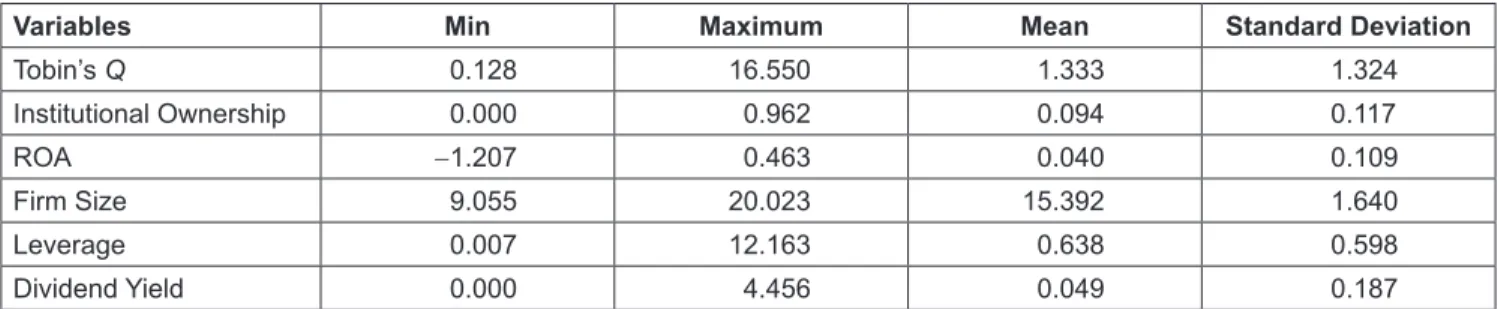
Table 1 below gives the descriptive statistics of the variables under study. The minimum value of Tobin’s Q is 0.128 and maximum value is 16.55, with mean value of 1.333 and standard deviation value 1.324. The minimum value of institutional ownership is 0, which means that the sample contains firms with no institutional ownership whereas;

sample set contains 9.4 percent on average institutional ownership. Firm size is the log of total assets, which has 9.055

Table 1: Descriptive Statistics

Variables Min Maximum Mean Standard Deviation

Tobin’s Q 0.128 16.550 1.333 1.324

Institutional Ownership 0.000 0.962 0.094 0.117

ROA −1.207 0.463 0.040 0.109

Firm Size 9.055 20.023 15.392 1.640

Leverage 0.007 12.163 0.638 0.598

Dividend Yield 0.000 4.456 0.049 0.187

Note: N = 276 firms taken from non-financial sector.

(5)

as minimum value and 20.023 as maximum value. The sample set contains firms with very low leverage i.e. 0.007 and firm having higher value of the leverage is 12.163 with standard deviation of 0.598. Moreover, there are firms in the data which did not pay dividend and maximum value of dividend yield is 4.456 with a lover mean value of 0.049, this indicates that Pakistani firms are not inclined to pay high dividends.

4.2. Correlation Analysis

Table 2 below provides the direction and extent of linkages among the studied variables through correlation statistics. The table clearly states and establishes the non-existence of multicollinearity among the variables. No absolute value of coefficient is found to be more than 0.70.

4.3. Durbin–Wu–Hausman Test (DWH) for Tobin’s Q

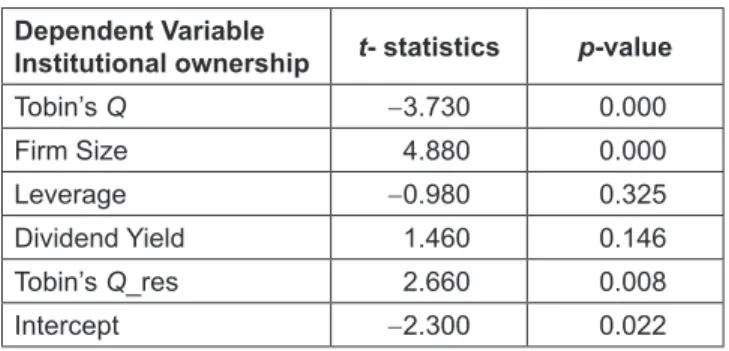
Table 3 below conforms the endogeneity of the of Tobin’s Q through the DWH test by regressing the equation (3).

As the coefficient of Tobin’s Q

res

is highly significant and different from zero (t = 2.660, p = 0.008) at 1% significance level. So, applying the 2SLS on equation (2) is justified.

4.4. Durbin–Wu–Hausman Test (DWH) for Institutional Ownership

Likewise, Table 4 below also confirms the endogeneity of the Institutional ownership by regressing the equation (4).

As the coefficient of Institutional ownership _res is highly significant and different from zero (t = −17.310, p = 0.000) at 1% significance level. So, applying the 2SLS on equation (1) is justified.

4.5. Regression Results: Firms Performance

Table 5 and 6 below show the results of OLS and 2SLS for equation (1). The coefficient of intuitional ownership Table 2: Correlation Matrix

Variables 1 2 3 4 5 6

Tobin’s Q (1) 1

Institutional Ownership (2) −0.0789 1

ROA (3) 0.1839 0.0592 1

Firm Size (4) 0.0329 0.1532 0.1491 1

Leverage (5) 0.2995 −0.0369 −0.5689 −0.1483 1

Dividend Yield (6) −0.0435 0.0396 0.0874 −0.0076 −0.0411 1

The table II presents the correlation coefficients among Tobin’s Q, Institutional ownership, ROA, Firm Size, Leverage and Dividend Yield.

Table 3: DWH Test for Tobin’s Q Dependent Variable

Institutional ownership t- statistics p-value

Tobin’s Q −3.730 0.000

Firm Size 4.880 0.000

Leverage −0.980 0.325

Dividend Yield 1.460 0.146

Tobin’s Q_res 2.660 0.008

Intercept −2.300 0.022

The above table provides the results of Equation (3).

Table 4: DWH Test for Institutional Ownership Dependent Variable

Tobin’s Q t- statistics p-value

Institutional ownership 17.200 0.000

Firm Size −16.180 0.000

Leverage 17.750 0.000

Dividend Yield −14.260 0.000

Institutional ownership _res −17.310 0.000

Intercept 15.390 0.000

The above table provides the results of Equation (4).

with performance variable Tobin’s Q is although positive but insignificant (t = 1.450 and p = 0.1470) in OLS equation. On the other hand, the results of 2SLS equations conform the positive and significant association (t = 3.120 and p = 0.002) that was hypothesized between the performance of the firms and institutional investments. These results confirm the findings of (Han & Suk, 1998; Sahut & Gharbi, 2010; Tsai &

Gu, 2007). However, the results are contradictory with some of the previous results (Agarwal & Knoeber, 1996; Loderer &

Martin, 1997), which could not establish positively

(6)

Table 5: OLS Regression for Firm Performance Dependent

Variable

Tobin’s Q Coefficients t- statistics p-value Institutional

ownership 0.2780356 1.450 0.1470

Firm Size 0.0490397 4.270 0.0000

Leverage −0.0935559 −1.230 0.2180

Dividend

Yield −0.0342397 −0.080 0.9340

Intercept 0.3460633 1.930 0.0540

The above table provides the OLS results of Equation (1).

Table 6: 2SLS Regression for Firm Performance Dependent

Variable

Tobin’s Q Coefficients t- statistics p-value Institutional

ownership 9.560409 3.120 0.002

Firm Size 0.0972651 0.830 0.405

Leverage −0.5770891 −0.500 0.616

Dividend Yield −7.763826 −2.830 0.005

Intercept 1.291634 0.880 0.377

The above table provides the 2SLS results of Equation (1).

Table 7: OLS Regression for Institutional Ownership Dependent

Variable Institutional ownership

Coefficients t- statistics p-value

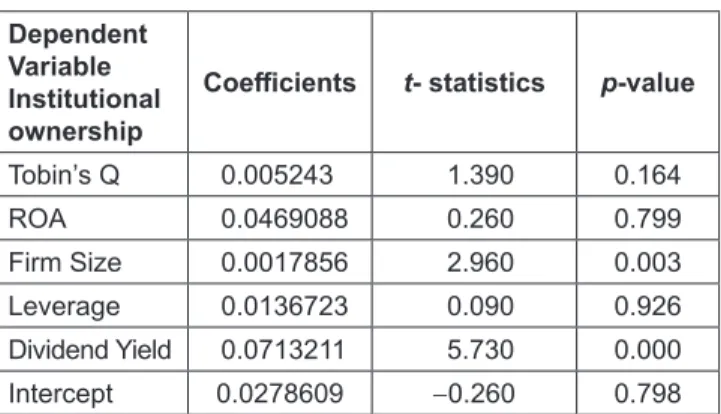
Tobin’s Q 0.005243 1.390 0.164

ROA 0.0469088 0.260 0.799

Firm Size 0.0017856 2.960 0.003

Leverage 0.0136723 0.090 0.926

Dividend Yield 0.0713211 5.730 0.000

Intercept 0.0278609 −0.260 0.798

The above table provides the OLS results of Equation (2).

significant linkages between institutional investments and firms’ performance in two stage least square model.

Firm size is coefficients in both OLS and 2SLS models are positively associated with firms’ performance, although the size coefficient is significant in OLS model and insignificant in 2SLS model. Leverage is found to be negative and insignificant component of firms’ performance in both OLS and 2SLS models. Whereas, dividend yield is negatively associated with firm performance, which indicated that paying dividend in not an indicator to measure the performance in Pakistani firms.

Table 7 and 8 below show the results of OLS and 2SLS for equation (2). The coefficient of Tobin’s Q with institutional ownership is although positive but insignificant (t = 1.390 and p = 0.164) in OLS equation. On the other hand the results of 2SLS equations conforms the positive and significant association (t = 3.480 and p = 0.001) between institutional ownership and firm performance. These results are consistent with some of the earlier findings (Demsetz & Villalonga, 2001; Han & Suk, 1998;

Sahut & Gharbi, 2010; Tsai & Gu, 2007). However, these results are inconsistent with some of the previous results (Agarwal &

Knoeber, 1996; Loderer & Martin, 1997) that could not provide

evidence about positively significant association between institutional ownership and firms’ performance in 2SLS model.

Institutional ownership has an insignificant relationship with ROA in OLS model and this relation is negative and significant with ROA in 2SLS model, which indicates that financial institutions are more inclined towards the market based measure of performance i.e. Tobin’s Q. Firm size coefficients in both OLS and 2SLS models are positively associated with institutional ownership. This shows that financial institutions in Pakistan are more interested to invest in larger firms and these larger firms are also yielding good profitability when measured in terms of Tobin’s Q.

Coefficient of leverage is found insignificant in OLS model but this coefficient is significantly and negatively associated with institutional ownership in 2SLS models, which show that financial institutions in Pakistan avoid to invest in those firms which has higher ratio of debt in their capital structure.

Whereas, dividend yield in both (OLS and 2SLS) models are highly positively associated with intuitional ownership, it means that financial intuitions enforce the firms to share Table 8: 2SLS Regression results for institutional

ownership Dependent Variable Institutional ownership

Coefficients t- statistics p-value

Tobin’s Q 0.0854851 3.480 0.001

ROA −0.4673856 −3.640 0.000

Firm Size 0.0037496 1.450 0.146

Leverage −0.0629695 −2.460 0.014

Dividend Yield 1.009932 5.550 0.000

Intercept −0.0528694 −1.340 0.181

The above table provides the 2SLS results of Equation (2).

(7)

their profitability in term of dividends. This result confirms with the earlier literature and the findings of (Abdullah et al., 2011) for Pakistan.

5. Conclusion

The financial theories talk about the positive role of institutional investors in firm performance. Agency theory describes that financial institutions with their abilities and skills not only monitor the management but also play a very pivotal role in corporate governance mechanism, which leads to the enhanced firm performance. There are a large number of researchers which empirically determine the relationship between institutional investments and the financial performance of the firms but with contradictory findings. The current study augments the existing literature and the body of knowledge by testing the casual relationship between the institutional investments and the financial performance of the firms in the emerging Pakistani economy by using an unbalanced panel of 287 firm from 2010–15.

The results indicate that the presence of financial intuitions in the firms’ ownership not only improve firms’ performance but those firms which outperform in the stock market also attract financial institutions. Financial institutions are more interested in those firms which are evaluated on the basis of market based performance indicators.

The results also indicated the inclination of financial institutions targeting large sized firms, where they play a vital role in the management of liabilities and enforce the governing body to disburse the dividends for the equity holders. The results are corroborative with earlier findings of significant literature covering the dynamics between institutional investments and the financial performance of the corporate firms, confirming that the relation between institutional investments and the financial performance of the corporate firms is bilateral. There are limitations of this study are since the financial institutions influence corporate governance mechanism which also links with the firms’ performance, so the organized data related to corporate governance variables can be included. Secondly, the analyzed sample did not include financial sector firms, which results in the generalizability of results only for non- financial sectors. Moreover as the literature suggests that the institutional investors are heterogeneous so the studies need to be conducted further on how corporate performance is affected owing to the variability in behavior of institutional investors.

References

Abbas, N., Ahmed, H., Malik, Q. A., & Waheed, A. (2018). Impact of investment efficiency on cost of equity: an empirical study on shariah and non shariah compliance firms listed on Pakistan Stock Exchange. Pakistan Administrative Review, 2(3), 307–322.

Abdullah, F., Shah, A., Iqbal, A. M., & Gohar, R. (2011). Investors’

power and the dividend cost minimization model: Which one better explains the dividend policy in Pakistan?. African Journal of Business Management,5(24), 10747–10759.

Aggarwal, R., Klapper, L., & Wysocki, P. (2003). Portfolio preferences of foreign institutional investors. Washington, DC:

The World Bank.

Aggarwal, R., Prabhala, N. R., & Puri, M. (2002). Institutional allocation in initial public offerings: Empirical evidence. The Journal of Finance, 57(3), 1421–1442. https://doi.org/10.1111/

1540-6261.00465

Aggarwal, R., Saffi, P. A., & Sturgess, J. (2015). The role of institutional investors in voting: Evidence from the securities lending market. The Journal of Finance, 70(5), 2309–2346.

https://doi.org/10.1111/jofi.12284

Agrawal, A., & Knoeber, C. R. (1996). Firm performance and mechanisms to control agency problems between managers and shareholders. Journal of Financial and Quantitative Analysis, 377−397. https://doi.org/10.2307/2331397

Bjuggren, P., Eklund, J., & Wiberg, D. (2007). Institutional Owners and Firm Performance: The Impact of Ownership Categories on Investments. Electronic Working Paper Series. Centre of Excellence for Science and Innovation Studies (CESIS).

https://doi.org/10.2139/ssrn.967638

Brickley, J. A., Linck, J. S., & Smith Jr, C. W. (2003). Boundaries of the firm: Evidence from the banking industry. Journal of Financial Economics, 70(3), 351−383. https://doi.org/10.1016/

s0304-405x(03)00170-3

Chaganti, R., & Damanpour, F. (1991). Institutional ownership, capital structure, and firm performance. Strategic Management Journal, 12(7), 479−491. https://doi.org/10.1002/

smj.4250120702

Chang, C. S., Yu, S. W., & Hung, C. H. (2015). Firm risk and performance: The role of corporate governance. Review of Managerial Science, 9(1), 141−173. https://doi.org/10.1007/

s11846-014-0132-x

Chang, K., Kang, E., & Li, Y. (2016). Effect of institutional ownership on dividends: An agency-theory-based analysis.

Journal of Business Research, 69(7), 2551−2559. https://doi.

org/10.1016/j.jbusres.2015.10.088

Chatfield, R. E., & Dalbor, M. C. (2005). Hospitality financial management. Upper Saddle River, NJ: Pearson/Prentice Hall.

Chemmanur, T. J., He, S., & Hu, G. (2009). The role of institutional investors in seasoned equity offerings. Journal of Financial Economics, 94(3), 384–411. https://doi.org/10.1016/j.

jfineco.2008.12.011

Chen, X., Harford, J., & Li, K. (2007). Monitoring: Which institutions matter?. Journal of financial Economics, 86(2), 279–305. https://doi.org/10.1016/j.jfineco.2006.09.005 Clay, D. G. (2001). Institutional Ownership, CEO incentives, and

firm value. PhD Dissertation, University of Chicago.

Cornett, M. M., Marcus, A. J., Saunders, A., & Tehranian, H.

(2007). The impact of institutional ownership on corporate

(8)

operating performance. Journal of Banking & Finance, 31(6), 1771–1794.

Crane, A. D., Michenaud, S., & Weston, J. P. (2016). The effect of institutional ownership on payout policy: Evidence from index thresholds. The Review of Financial Studies, 29(6), 1377–1408.

https://doi.org/10.1093/rfs/hhw012

Craswell, A.T., Taylor, S. L., Saywell, R. A., (1997). Ownership structure and corporate performance: Australian evidence.

Pacific-Basin Finance Journal. 5(3), 301–323. https://doi.

org/10.1016/s0927-538x(96)00028-5

Davidson, R., & MacKinnon, J. G. (1993). Estimation and inference in econometrics. OUP Catalogue.

Davis, E. P. (2003). Institutional investors, financial market efficiency, and financial stability. EIB Papers, 8(1), 77–107.

Demsetz, H. (1983). The structure of ownership and the theory of the firm. The Journal of Law and Economics, 26(2), 375–390.

https://doi.org/10.1086/467041

Demsetz, H., & Villalonga, B. (2001). Ownership structure and corporate performance. Journal of Corporate Finance, 7(3), 209–233. https://doi.org/10.1016/s0929-1199(01)00020-7 Elyasiani, E., & Jia, J. (2010). Distribution of institutional

ownership and corporate firm performance. Journal of Banking & Finance, 34(3), 606–620. https://doi.org/10.1016/j.

jbankfin.2009.08.018

Fich, E. M., Harford, J., & Tran, A. L. (2015). Motivated monitors: The importance of institutional investors׳ portfolio weights. Journal of Financial Economics, 118(1), 21–48.

https://doi.org/10.1016/j.jfineco.2015.06.014

Gaspar, J., Massa, M., Matos, P., 2005. Shareholder investment horizons and the market for corporate control. Journal of Financial Economics 76, 135–165. https://doi.org/10.1016/j.

jfineco.2004.10.002

Gillan, S. L., & Starks, L. T. (2000). Corporate governance proposals and shareholder activism: The role of institutional investors. Journal of Financial Economics, 57(2), 275–305.

https://doi.org/10.1016/s0304-405x(00)00058-1

Gillan, S., & Starks, L. T. (2003). Corporate governance, corporate ownership, and the role of institutional investors: A global perspective. Journal of Applied Finance, 13(2).

Gompers, P. A., & Metrick, A. (2001). Institutional investors and equity prices. The Quarterly Journal of Economics, 116(1), 229–259. https://doi.org/10.1162/003355301556392

Grinstein, Y., & Michaely, R. (2005). Institutional holdings and payout policy. The Journal of Finance, 60(3), 1389–1426.

https://doi.org/10.1111/j.1540-6261.2005.00765.x

Haider, J., & Fang, H. X. (2016). Board size, ownership concentration and future firm risk. Chinese Management Studies, 10(4), 692–709. https://doi.org/10.1108/cms-05-2016-0094

Hamdani, A., & Yafeh, Y. (2013). Institutional investors as minority shareholders. Review of Finance, 17(2), 691–725. https://doi.

org/10.1093/rof/rfr039

Han, K.C., & Suk, D.Y. (1998). The effect of ownership structure on firm performance: Additional evidence. Review of Financial Economics,7(2), 143–155.

Hartzell, J. C., & Starks, L. T. (2003). Institutional investors and executive compensation. The Journal of Finance, 58(6), 2351–2374. https://doi.org/10.1046/j.1540-6261.2003.00608.x Himmelberg, C. P., Hubbard, R. G., & Palia, D. (1999).

Understanding the determinants of managerial ownership and the link between ownership and performance. Journal of Financial Economics, 53(3), 353–384. https://doi.org/10.1016/

s0304-405x(99)00025-2

Hsu, G. C. M., & Koh, P. S. (2005). Does the presence of institutional investors influence accruals management?

Evidence from Australia. Corporate Governance: An International Review, 13(6), 809–823. https://doi.org/10.1111/

j.1467-8683.2005.00472.x

Jenkinson, T., & Jones, H. (2009). IPO pricing and allocation: A survey of the views of institutional investors. The Review of Financial Studies, 22(4), 1477–1504. https://doi.org/10.1093/

rfs/hhn079

Jensen, M. C., & Meckling, W. H. (1976). Theory of the firm: Managerial behavior, agency costs and ownership structure. Journal of Financial Economics, 3(4), 305–360.

Kamran, K., & Shah, A. (2014). The impact of corporate governance and ownership structure on earnings management practices:

Evidence from listed companies in Pakistan. The Lahore Journal of Economics, 19(2), 27–70. https://doi.org/10.35536/

lje.2014.v19.i2.a2

Karpoff, J. M. (2001). The impact of shareholder activism on target companies: A survey of empirical findings. Available at SSRN 885365.

Loderer, C., & Martin, K., (1997). Executive stock ownership and performance tracking faint traces. Journal of Financial Economics,45(2), 223–255. https://doi.org/10.1016/s0304- 405x(97)00017-2

Mahmood, H., & Waheed, A. (2014). Relationship Between Price/

Earning, Dividend Yield, Size and Stock Returns of Listed Pakistani Firms. Journal of Basic and Applied Scientific Research, 55(7), 100–107.

Masum, M. H., Latiff, A. R. A., & Osman, M. N. H. (2020).

Ownership Structure and Corporate Voluntary Disclosures in Transition Economy. The Journal of Asian Finance, Economics, and Business, 7(10), 601–611. https://doi.org/10.13106/

jafeb.2020.vol7.no10.601

Mazumder, M. M. M. (2017). Top-executives Compensation: The Role of Corporate Ownership Structure in Japan. The Journal of Asian Finance, Economics, and Business, 4(3), 35–43.

https://doi.org/10.13106/jafeb.2017.vol4.no3.35

McCahery, J. A., Sautner, Z., & Starks, L. T. (2016). Behind the scenes: The corporate governance preferences of institutional investors. The Journal of Finance, 71(6), 2905–2932. https://

doi.org/10.1111/jofi.12393

(9)

Michel, A., Oded, J., & Shaked, I. (2020). Institutional investors and firm performance: Evidence from IPOs. The North American Journal of Economics and Finance, 51, 101099.

Naqvi, T., Waheed, A., Mahmood, H., & Rafique, M. (2017).

Impact of Political Instability on Financial Development of Pakistan. International Journal of Management Sciences and Business Research, 6(4).

Pan, X., Wang, K., & Zykaj, B. B. (2019). Does institutional ownership predict mutual fund performance? An examination of undiscovered holdings within 13(f) reports. European Financial Management, 25(5), 1249–1285.

Reddy, K., & Bather, A. (2013). Institutional investors, firm performance, and the prospects for socially responsible investing:

Evidence from New Zealand’, Institutional Investors’ Power to Change Corporate Behavior: International Perspectives.

Critical Studies on Corporate Responsibility, Governance and Sustainability, 5(1), 149–175.

Ritter, J. R., & Welch, I. (2002). A review of IPO activity, pricing, and allocations. The Journal of Finance, 57(4), 1795–1828.

Sahut, J. M., & Gharbi, H. O. (2010). Institutional investors’ typology and firm performance: The case of French firms. International Journal of Business, 15(1), 33–50.

Sajjad, T., Abbas, N., Hussain, S., & Waheed, A. (2019). The impact of Corporate Governance, Product Market Competition on Earning Management Practices. Journal of Managerial Sciences, 13(2).

Shleifer, A., & Vishny, R. W. (1986). Large shareholders and corporate control. Journal of Political Economy, 94(3, Part 1), 461-488. https://doi.org/10.1086/261385

Smith, M. P. (1996). Shareholder activism by institutional investors:

Evidence from CalPERS. The journal of finance, 51(1), 227–252. https://doi.org/10.1111/j.1540-6261.1996.tb05208.x

Tsai, H., & Gu, Z. (2007). The relationship between institutional ownership and casino firm performance. International Journal of Hospitality Management, 26(3), 517–530. https://doi.

org/10.1016/j.ijhm.2006.02.003

Vu, V. T. T., Phan, N. T., & Dang, H. N. (2020). Impacts of Ownership Structure on Systemic Risk of Listed Companies in Vietnam. The Journal of Asian Finance, Economics, and Business, 7(2), 107–117. https://doi.org/10.13106/jafeb.2020.vol7.no2.107 Waheed, A., & Malik, Q. A. (2019a). Board characteristics,

ownership concentration and firms’ performance. South Asian Journal of Business Studies, 8(2), 146–165. https://doi.

org/10.1108/sajbs-03-2018-0031

Waheed, A., & Malik, Q. A. (2019b). The Impact of Institutional Investment Horizon on Corporate Governance and Firm Performance. Journal of Independent Studies and Research- Management, Social Sciences and Economics, 17(2), 226–245.

Waheed, A., & Malik, Q. A. (2019c). The Ownership Structure and Corporate Governance: A Case of Pakistan Stock Exchange.

Pacific Business Review International, 12(5), 27–36.

Waheed, A., & Malik, Q. A. (2021). Institutional Ownership Board Characteristics and Firm Performance a Contingent Theoretical Approach. International Journal of Asian Business and Information Management, 12(2), 1–15.

Welch, E. (2003). The relationship between ownership structure and performance in listed Australian companies. Australian Journal of Management, 28(3), 287–305. https://doi.org/10.1177/03128 9620302800304

Yan, X., & Zhang, Z. (2009). Institutional investors and equity returns: Are short-term institutions better informed?. The Review of Financial Studies, 22(2), 893–924. https://doi.org/10.1093/

revfin/hhl046

수치

Table 1 below gives the descriptive statistics of the  variables under study. The minimum value of Tobin’s Q is  0.128 and maximum value is 16.55, with mean value of 1.333  and standard deviation value 1.324
Table 5 and 6 below show the results of OLS and 2SLS  for equation (1). The coefficient of intuitional ownership Table 2:  Correlation Matrix
Table 5:  OLS Regression for Firm Performance Dependent

참조

관련 문서

Controlling shareholders in business groups can maintain their control with the help of indirect pyramidal ownership and/or interlocking ownership among

How Do Family Ownership, Control and Management Affect Firm Value?" Journal of financial economics,

Jung Bum Wee This paper studies the effect of the government economic policy and the optimizing behaviors of financial institution and business firm on

Unlike Korea, in Japan, no positive effects of ownership concentration were found both on the accounting corporate performance such as profit margin, return

Common corporate digital crimes include piracy, financial fraud, espionage, and theft of services.. _______________________________________ such as

 Students needing additional information about grading policies and procedures should meet with their faculty advisor, Executive Director/Chairperson or a

Basic aspects of AUTOSAR architecture and methodology Safety mechanisms supported by AUTOSAR.. Technical safety concepts supported by AUTOSAR Relationship to ISO

GDP impact of COVID-19 spread, public health response, and economic policies. Virus spread and public