Print ISSN: 2288-4637 / Online ISSN 2288-4645 doi:10.13106/jafeb.2020.vol7.no6.409
*The authors acknowledge Ho Chi Minh City Open University, Vietnam, for helping this research.
1
First Author. Ph.D. Candidate, Graduate School, Ho Chi Minh City Open University, Vietnam. Email: [email protected]
2
Corresponding Author. Assistant Professor, Deputy Director, Office of Cooperation and Research Management, Ho Chi Minh City Open University, Vietnam [Postal Address: 97 Vo Van Tan Street, Ward 6, District 3, Ho Chi Minh City, 724000, Vietnam]
3
Assistant Professor, Director, Department of Project Management, Ho Chi Minh City Open University, Vietnam.
© Copyright: The Author(s)
This is an Open Access article distributed under the terms of the Creative Commons Attribution
Non-Commercial License (http://Creativecommons.org/licenses/by-nc/4.0/) which permits
unrestricted noncommercial use, distribution, and reproduction in any medium, provided the
original work is properly cited.
Social Capital and Corporate Performance: Evidence from State Capital Enterprises in Vietnam*
Chin NGO
1, Quyen Le Hoang Thuy To NGUYEN
2, Phong Thanh NGUYEN
3
Received: April 07, 2020 Revised: April 18, 2020 Accepted: May 01, 2020
Abstract
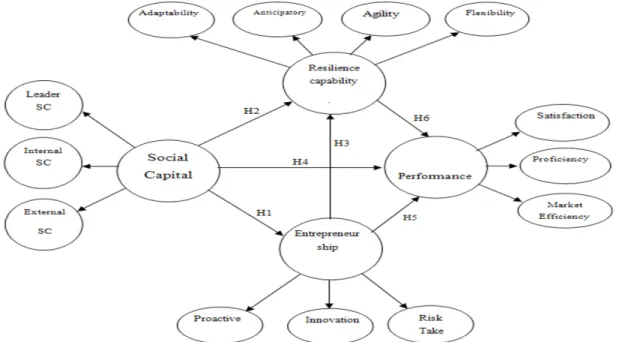
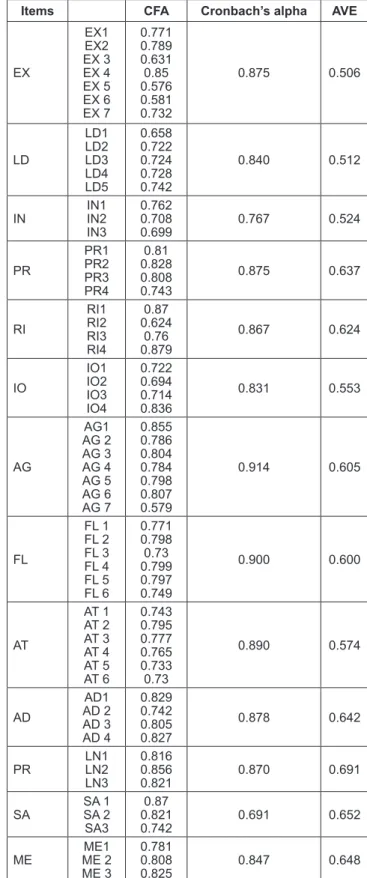
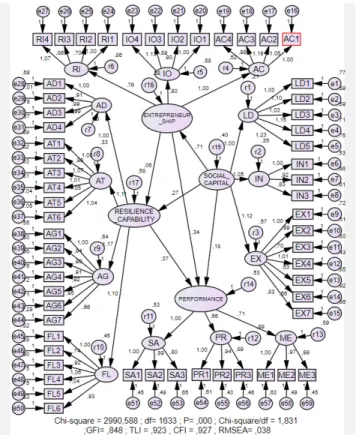
The research has been conducted to explore the combination of three intangible resources, including social capital, entrepreneurship, and resilience capability on the performance of State Capital Enterprises (SCEs) in Vietnam. Both qualitative and quantitative approaches are applied in the study. An in-depth interview of ten CEOs at SCEs in Vietnam was made to explore new indicators for the contextual latent variables in the research models. By employing the data from the authors’ survey of 568 SCEs in Vietnam in 2019, using Cronbach’s alpha, confirmatory factor analysis (CFA) and path analysis (SEM), the mechanism that social capital impacts on SCE performance has been analyzed. In addition to the direct role, social capital indirectly affects corporate performance through entrepreneurship and resilience capability. It was found that social capital has a larger impact on entrepreneurship than resilience capacity. However, the contribution of resilience capacity to the firm performance is much more than the entrepreneurship’s in Vietnamese context. This study enriches the theory by proposing a measurement scale of the contextual latent variables as a result of in-depth interviews with experts using a qualitative analysis technique. In addition, the path analysis findings suggest practical implications for managers to effectively use their resources in SCEs.
Keywords : Social Capital, Entrepreneurship, Resilience Capability, Performance, State-Owned Enterprises, State-Capital Enterprises JEL Classification Code: L31, E24, J24
1. Introduction
A State Capital Enterprise (SCE) is an enterprise in which the State does not hold the majority of charter capital or shares. It is organized and operated in the form of a joint- stock company or a two-member limited liability company.
SCEs have been trending in Vietnam in recent years, in light of the mission of restructuring State-Owned Enterprises (SOEs). Though most of the SOEs report pre-tax profits, these mainly originate from favorable treatment granted by the government. A variety of studies on this topic have been conducted. However, these researches have only focused on favorable tangible resources while ignoring intangible ones.
Social capital, an intangible resource, has received acceptance from the research community for its role in performance at all levels from micro, meso, and macro. Social capital can increase tangible resources through support, coordination, share, and cooperation for mutual benefit (Helliwell &
Putnam, 1995; Putnam, 1993); maintaining and promoting the sustainable operation of the corporation with the leverage of entrepreneurship (Covin & Slevin, 1991); its impact on the resilience capability to rationally respond, adjust, and allocate resources (Weick, Sutcliffe, & Obstfeld, 2008).
Social capital has proven to be a special resource that
can grow with time. It was studied in Vietnam during the
2000s (Huynh, Nguyen, Nguyen, & Nguyen, 2018). This
previous research has shown the benefits of social capital
to enterprises, in particular, promoting innovation (Jiménez-