• 검색 결과가 없습니다.

A Mission Planning System for Multiple Ballistic Missiles

N/A
N/A
Protected

Academic year: 2021

Share "A Mission Planning System for Multiple Ballistic Missiles"

Copied!
7
0
0

로드 중.... (전체 텍스트 보기)

전체 글

(1)

1. INTRODUCTION

M&S stands for Model and Simulation. Simula- tion space, time, actors, and events should be de- fined as the four essential elements of M&S[7].

Therefore, we can reproduce real world objects on- to computer systems as simulation objects, and we observe them within their interactions(or events) on predefined simulation space and time. In defense domain, engineering, engagement, and mission lev- el's M&S were classified[9]. Mission Planning Systems(MPSs) are also a kind of the M&S sys- tems and of mission level’s M&S system in defense domain. The MPSs are operated on the ground and computed in mission level analyses, and the results from the MPSs are finally uploaded onto target weapon systems before their actual flight. It is only way to verify the results of MPSs through M&S, except for Live Fire Testing(LFT). In this paper, we present a new MPS for multiple ballistic mis- siles that is applied with new concept and aims to

obtain the results of planned missions before actual fires in warfare. In order to prove the practicality of our MPS, we have conducted a case study. In the case study, we will presents results of visual verifications with launch interval analysis and minimum approach distances of multiple ballistic missiles.

The remainder of this paper is structured as fol- lows: Section 2 provides the research motivation;

In Section 3, we present the design and im- plementation results of our MPS for ballistic mis- siles; Section 4 conducts a case study with our MPS; As the conclusion, Section 5 summarizes the contributions of this paper and our future works with the system.

2. RESEARCH MOTIVATION

The MPS is an application system for forecast- ing military actions; therefore, obtaining military values in future of information warfare. In other

A Mission Planning System for Multiple Ballistic Missiles

Jingyu Kim

, Chikwon Song

††

ABSTRACT

This paper presents the design and implementation of a Mission Planning System(MPS) for multiple ballistic missiles. MPSs are also a kind of M&S systems in defense domain, and these provide important computations on the ground before flights of flying objects. The proposed MPS in this paper has a new concept which is far from generating a set of waypoints of a flying object and proving the set. In this paper, we firstly discuss the research motivation of our own MPS; then, we introduce the design of our MPS and its functionalities. In order to prove the practicality of our MPS, we have conducted a case study.

Key words: MPS, Mission Planning System, Ballistic Missile, Mission Analysis, Guided Missile Simulation

※ Corresponding Author : Chikwon Song, Address: (34060) 160, Bugyuseong-daero 488beon-gil, Yuseong-gu, Dae- jeon, Korea, TEL : +82-42-821-0436, E-mail : en- [email protected]

Receipt date : Apr. 29, 2019, Revision date : June 7, 2019 Approval date : June 26, 2019

††

The 1st Research and Development Institute, Agency for Defense Development, Korea

(E-mail : [email protected])

††
The 1st Research and Development Institute, Agency

for Defense Development, Korea

(2)

words, the MPSs provide optimum or suboptimum of operational solutions on a certain military sce- nario. These days, a focal point of MPSs newest moves from standalone systems to network sys- tems. Put another way, these became popular to networked joint operational analysis more than lo- cal analyses.

According to Tian et al.[15], they had classified MPSs into five groups and 13 types: the five groups of MPSs are operation levels, type of mis- sions, operation applying, disposing method, and services. 13 types of MPSs are strategy MPS, the- ater MPS, tactic MPS, combat MPS, support MPS, command object MPS, combat Object MPS, off- line MPS, on-line MPS, army MPS, navy MPS, air forces MPS, and Joint MPS. With the classi- fications, strategy MPS, theater MPS and tactic MPS are members of operation levels; combat MPS and support MPS belong to type of missions;

command object MPS and combat object MPS are included in operation applying; off-line MPS and on-line MPS belong to disposing method; army MPS, navy MPS, air forces MPS, and Joint MPS are members of services. In this paper, we focused on the types in tactic level MPS, combat type MPS, combat object MPS, off-line MPS, and MPS serv- ices for Army.

In defense domain, there are two weapon sys- tems closely related to the above MPS types:

Unmanned Aerial Vehicles(UAVs)/Unmanned Su -rface Vehicles(USVs)[16] and missiles. The Main goal of UAVs is gathering information on certain areas or destroying a certain target as military ac- tions[5]. For the missions on reconnaissance, UAVs capture still imagery of specific locations or full motion video within the areas of our interest[8].

Before the flights of UAVs, MPSs should generate an appropriate path on the ground within the areas of our interest. This is called the path planning.

The path planning requires a certain algorithm to make an appropriate path which UAVs/USVs must follow. The algorithm should consider fuel

consuming, terrain threat, time consuming, and threat weapons[6]. In the last three decades, the path planning algorithms have been researched as the follows: Dijkstra and A

*

[11,12], Voronoi dia- gram[2], and concurrent constraint programming- based method[13]. Nevertheless, the studies are still going on. For cruise vehicles, MPSs support and simulate guidance, navigation, and situation assessment of them[4]. In order to deal with these functionalities, we should generate an appropriate path with path planning algorithms and verifying it with a MPS on the ground like UAVs/USVs. In other words, the MPS makes waypoints of a course and proves them with M&S. A set of waypoints are generated by the MPS to avoid air defense;

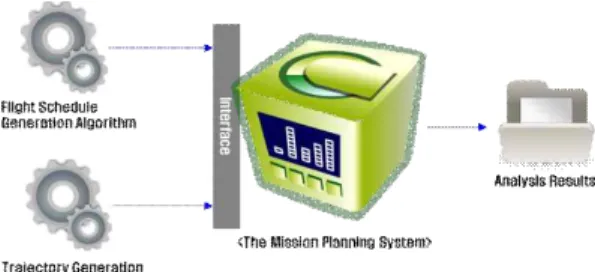
therefore, these are optimized in low observables from threat sensors or being far from coverage of the defense systems such as keeping high altitude or exploiting terrain masking[3]. As a small con- clusion, a lot of MPSs for cruise missiles and UAVs, subsonic flying objects, had been studied and developed; however, there is no study on the MPS related to ballistic missiles, ultra-speed flying objects. Fig. 1. illustrates our MPS and related algorithms.

We need three individual systems for mission analysis of ballistic missiles; the trajectory gen- eration algorithm, flight schedule generation algo- rithm, and our MPS. The trajectory generation al- gorithm computes and records trajectory data such as longitude, latitude, altitude, yaw, pitch, roll, and flight time based on mission time. The flight sched- ule generation algorithm computes fire time of each

Fig. 1. Interfaces with the system.

(3)

ballistic missile in accordance with types of their missiles and location information of the missiles and targets. Our MPS generates a M&S scenario and conducts analyses in mission level on the sce- nario using these two algorithms. The details of our MPS will be discussed in the following section.

In this paper, we do not discuss the trajectory gen- eration algorithm and flight schedule generation algorithm in detail because of confidentiality reasons.

3. IMPLEMENTATION OF THE MISSION PLANNING SYSTEM

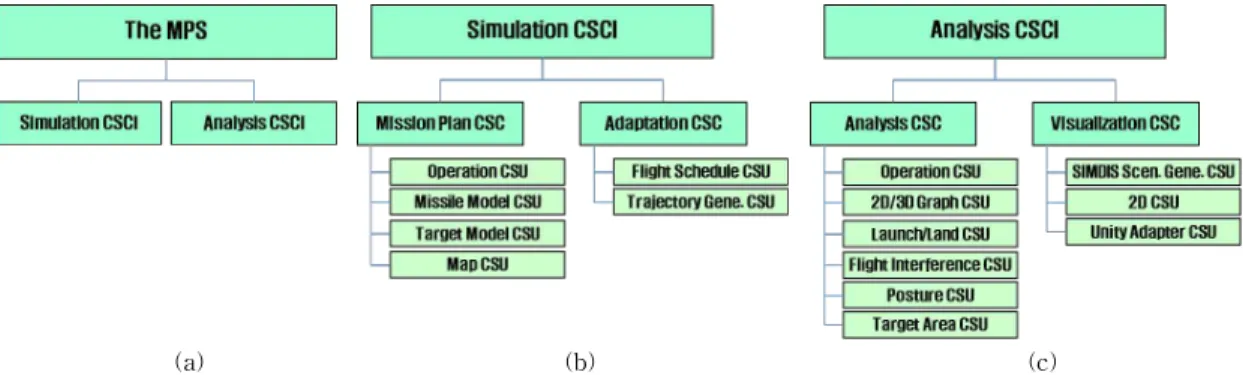
In this section, we present the results of the im- plementation of our MPS. Our MPS consists of two CSCIs(Computer Software Configuration Items):

Simulation CSCI and Analysis CSCI. Fig. 2 shows the functional decompositions of the MPS. These CSCIs are independent of each other; the simu- lation CSCI is implemented with C# language and generates log data of simulations. However, the analysis CSCI is implemented with MATLAB lan- guage[1,10], and it makes results of the analysis from the log data.

3.1 Design of Simulation

The simulation CSCI is composed of two CSCs (Computer Software Components): mission plan CSC and adaptation CSC. In mission plan CSC, there are four CSUs(Computer Software Units):

operation, missile model, target model, and map

CSUs. The operation CSU manages status of sim- ulation objects and simulation time. It additionally manages numbers of missile and target objects as simulation objects. The missile model CSU gen- erates missile objects that contains their Latitude, Longitude, and Altitude(LLA), launcher informa- tion, radius of explosion of warheads, and mini- mum/maximum ranges of the flights as attributes of the missile. The target model CSU produces tar- get objects. These objects include their ID, LLA, size, moving direction, and velocity. The map CSU defines simulation space with topographic infor- mation.

In adaptation CSC, there are two CSUs: flight schedule and trajectory generation CSUs. The flight schedule CSU computes fire time of each missile object using an externally flight schedule algorithm file and assigns the time each object.

The fire time is assigned to each missile object based on mission time. The trajectory generation CSU connects missile objects to external trajectory generation algorithms. In other words, the missile objects inserts LLA of a missile and a target in- formation, and fire time into the trajectory gen- eration algorithm files, and The CSU obtains tra- jectory data and records them an individual soft- ware file with a file name which is a missile ob- ject's ID. These algorithm files are DLL files that are externally compiled and provided.

3.2 Log Data Analyses

(a) (b) (c)

Fig. 2. The functional decompositions of the MPS. (a) MPS, (b) Simulation, and (c) Analysis.

(4)

The analysis CSCI consists of two CSCs: analy- sis CSC and visualization CSC. In analysis CSC, there are six CSUs; operation, 2D/3D graph, launch/land, flight interference, attitude, and target area CSUs. The operation CSU loads the log data from the simulation CSCI and makes ready other CSUs in analysis CSC to do their tasks. In other words, it arranges the data in a formalized matrix onto memory of the system such as mission time, velocity, downrange, etc. The 2D/3D graph CSU extracts certain elements from the formalized ma- trix and display them 2D or 3D graphs. The certain elements indicate axes that analyzers freely selects from the formalized matrix. The launch/land CSU provides results from timeline analyses of launch- ing/landing time of missile objects and launch in- terval analysis of them. The flight interference CSU computes distances in minimum approaches of a certain missile object from the other missiles objects during their flights. It also offers filtering functions; for example, it collects missile objects that have minimum approach distances of under 5.0 km from a certain missile object. Therefore, we can obtain the list of the missile objects and flight peri- ods of the approaching less than 5.0 km. During that period, the flight interference CSU displays and compares distances, height, longitude, and lat- itude of the two missile objects on 2D graphes. The attitude CSU provides timeline analysis of yaw, pitch, and roll data of a certain missile object with a 3D visualization object. Finally, the target area CSU analyzes a certain area in perspectives of a target. In other words, it provides results of a mini- mum miss distance and Circular Error Probability (CEP) centered on a certain target. Moreover, it gives statistics of minimum miss distances and CEPs of all targets in a certain area.

In visualization CSC, there are three CSUs:

SIMDIS scenario generation, 2D, and Unity adapter CSUs. The SIMDIS scenario generation CSU makes an ASCII Scenario Input(ASI) file[14] that is the native scenario input file format for SIMIDS.

In other words, it generates an ASI file from the log data from simulation CSCI. The 2D CSU ex- tracts trajectory data of each missile object from the ASI file that was generated by the SIMDIS scenario generation CSU. With the trajectory data, it visualizes them with missile and target icons on a map of simulation space for timeline analyses on top views. The Unity adapter CSU also extracts trajectory data from the ASI file and map them to predefined 3D missile and target objects in Unity game engine. In Unity game engine, the simulation space should have already made with terrain data and only flights and explosions of the predefined 3D missile and target objects are visualized in cer- tain software camera views.

4. A CASE STUDY

In this section, we have conducted a case study.

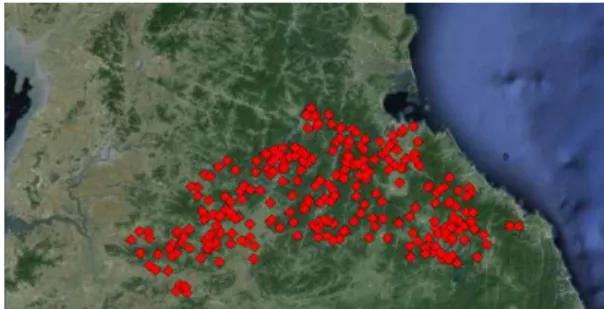
As the simulation space, we had selected the Korean Peninsula and spread approximately 300 targets randomly in the middle areas of the Korean Peninsula. Fig. 3 shows the simulation space.

We have located launchers at three points in areas of the south areas of the Korean Peninsula.

Using our flight schedule algorithm, we have matched the missile models to the targets in one- to-one matching. Before the matches, we should assign minimum and maximum ranges to each missile model. Moreover, we can have matched a missile model and a target model manually.

In this case, the target should be located in the reachable range of the missile model. Also, we can

Fig. 3. The middle of the Korean Peninsula with targets.

(5)

assign a target to more than two missile model manually. After that, we have to generate tra- jectory data for each missile model. Before the generations of the trajectory data, we should as-

sign the trajectory generation algorithms to in- dividual missile models. The missile model should have only one trajectory generation algorithm;

however, each missile model can different algo-

(a) (b) (c)

(d) (e)

(f)

(g) (h) (i)

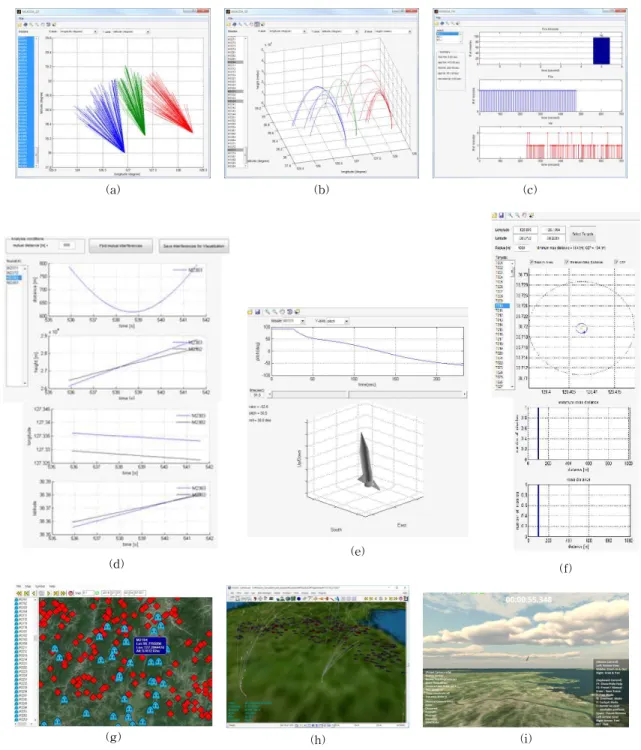
Fig. 4. The results of our case study. (a) 2D Graph (b) 3D Graph (c) Launch/Land (d) Flight Inference (e) Posture

(f) Target Area (g) SIMDIS (h) 2D and (i) Unity.

(6)

rithms. Using our trajectory generation algorithm, we have computed trajectory data for each missile and record them on individual software files. We have analyzed the individual trajectory data. Fig.

4. presents the results of our case study.

In this case study, we have obtained visualized results of LLA, velocity, acceleration, flight dis- tance, and attitude for each ballistic missile on 2D and 3D graphs. In this case, each X-Y-Z axis for data can be selected by analyzers, and reference data of each missile model can be inserted into the graphs. Moreover, we can obtain analyses of yaw, pitch, and roll based on timeline and a 3D object of the ballistic missile. Furthermore, we have visu- ally confirmed the flights to targets on 2D maps, and we have conducted visual verifications of 3D through the interoperability with SIMDIS and Unity game engines. In this case study, we have computed launch interval analysis, number of launching/landing on a certain period, and mini- mum approach distances between a certain missile and the other missiles during the flight. In the sce- nario, missiles are fired in every six second, and there are the most larger number of launch sched- ules on 630 seconds in mission time. Approxi -mately 250 missiles keep distances of more than 5.7 km during their flight. In regard to target area analysis, we can analyze CEP and minimum miss distances on certain areas or a certain target. In the scenario, we have obtained approximately 100 meters of the minimum miss distance; however, we omit analysis of CEPs since all missiles and targets have one-to-one relationships. In this case study, we do not discuss the detailed data because of con- fidentiality reasons.

5. CONCLUSION

In this paper, we have designed and developed a MPS for multiple ballistic missiles. In previous works, the MPSs had focused on generating way- points for subsonic missiles or UAVs, and they at- tempt to prove the waypoints in M&S. However,

we have found out strong motivations for the needs of the MPS in considerations of multiple ultra- speed flying objects; for instance, in order to avoid interferences during their flights.

In this paper, we have proposed the new concept of the MPS which is far from generating a set of waypoints of a flying object and proving them. the MPS presented in this paper allow that mission- level analysis, such as mission effectiveness anal- ysis, can be applied to multiple ballistic missiles.

In our MPS, there are two interfaces to adapt ex- ternally provided algorithms: the trajectory gen- eration algorithm and flight schedule generation algorithm. These interfaces allow us to have mis- sion level analyses with a variety of weapon place- ments and types of missile models. In other words, previously, one weapon system required one MPS.

However, the MPS presented in this paper can be applied to various weapon systems (trajectory generation algorithm) and operation methods(flight schedule generation algorithm). Finally, we have proved the practicality of our MPS through the case study.

For the future works, we plan to design and im- plement our own radar model for M&S in order to upgrade our MPS in this paper by embedding the radar model. In the MPS, it is to be feasible to calculate and analyze intercept probability of in- dividual ballistic missiles based on RCS exposures of each missile in a view of the radar model.

REFERENCE

[ 1 ] B.R. Mahafza, Radar System Analysis and Design Using MATLAB, CHAPMAN and HALL/CRC, New York, 2000.

[ 2 ] D. Eppstein, "Finding the k Shortest Paths,"

Society for Industrial and Applied Mathem- atics Journal of Computing, Vol. 28, No. 2, pp.

652-673, 1999.

[ 3 ] E. Berglund, Mission Planning Technology, a

part of ‘Technologies for Future Precision

Strike Missile Systems’ Report, Swedish

(7)

Defense Research Agency, 2001.

[ 4 ] G.N. Kumar, S. Dadarya, A. Verandani, A.K.

Sarkar, and S.E. Talole, “Cruise Missile Mis- sion Planning Using Genetic Algorithm,”

Proceedings of the International Conference on Modern Research in Aerospace Engin- eering, pp. 353-362, 2018.

[ 5 ] H.B. Mao, UAV Mission Planning, National Defense Industry Press, Beijing, China, 2015.

[ 6 ] H. Chunhua, F. Yong, J. Zhihong, Z. Jihong, and S. Zengqi, “Mission Planning for Unman- ned Aerial Vehicles,” Proceeding of the Institute for Mathematics and Computer Science Multi-conferences on Computational Engineering in Systems Applications, pp.

597-601, 2006.

[ 7 ] Jingyu. Kim, "HLA/RTI based on the Simula- tion Composition Technology," Journal of the Korea Institute of Military Science and Technology, Vol. 19, No. 2, pp. 244-251, 2016.

[ 8 ] L. Evers, T. Dollevoet, A.I. Barros, and H.

Monsuur, "Robust UAV Mission Planning,"

Annals of Operations Research, pp. 1-17, 2011.

[ 9 ] M.D. Pretty, R.W. Franceschini, and J.

Panagos, Multi-Resolution Combat Model- ing, In Engineering Principles of Combat Modeling and Distributed Simulation, John Wiley and Sons, New Jersey, USA, 2012.

[10] R. Aarenstrup, Managing Model-Based Design, The MathWorks Incorporated, 2015.

[11] S.J. Russell and P. Norvig, Artificial Intelli- gence: A Modern Approach, Englewood Cliffs, New Jersey, 1995.

[12] S. Koenig, M. Likhachev, and D. Furcy, Lifelong P lanning A

*

, GIT-COGSCI-2002/2, College of Computing, Georgia Institute of Technology, 2001.

[13] S. Gualandi and B. Tranchero, “Concurrent Constraint Programming-based Path Plann- ing for Uninhabited Air Vehicles,” Proceed- ings of Society of Photographic Instrument- ation Engineers, Vol. 5417, pp. 176-185, 2004.

[14] U.S. Naval Research Laboratory, SIMDIS User Manual, Visualization System Integra- tion Section, Code 5773, USNR, 2012.

[15] Z. Tian, Z. Wei, L. Yaoping, and P. Xianjun,

"Overview on Mission Planning System,"

International Journal of Knowledge Engine- ering, Vol. 2, No. 1, pp. 56-59, 2016.

[16] J. Vasilj, I. Stančić, T. Grujić, and J. Musić,

"Design, Development and Testing of the Modular Unmanned Surface Vehicle Platform for Marine Waste Detection," Journal of Multimedia Information System, Vol. 4, No.

4, pp.195-204, 2017.

Jingyu Kim

received the PhD in Computer Science from Korea Advanced Institute of Science and Tech- nology (KAIST) in 2013. He currently works in Agency of Defense Development (ADD) in Republic of Korea. His research interests include software architecture, analysis of system operations, and system interoperability.

Chikwon Song

received the MS in Eletrical

Eingneering from Pusan Natio-

nal University in 2002. He cur-

rently works in Agency of De-

fense Development (ADD) in

Republic of Korea. His research

interests include Intelligent Control

System, Artificial Neural Network, and Data mining.

수치

Fig. 1. Interfaces with the system.
Fig. 2. The functional decompositions of the MPS. (a)  MPS, (b) Simulation, and (c) Analysis.
Fig. 3. The middle of the Korean Peninsula with targets.
Fig. 4. The results of our case study. (a) 2D Graph (b) 3D Graph (c) Launch/Land (d) Flight Inference (e)  Posture  (f) Target Area (g) SIMDIS (h) 2D and (i) Unity.

참조

관련 문서

NORTH Korea is building two new submarines, including one capable of firing ballistic missiles, a South Korean lawmaker said yesterday, following a closed-door briefing by the

8 UEM Corporate Identity 2008: “To empower each other for mission we share our resources and gifts and exchange co-workers and volunteers…. In working and living together

_____ culture appears to be attractive (도시의) to the

Space-time is the same in all the equal-size reactors of volume V i Let’s compare multiple MFR system with PFR system.. Volume of multiple mixed flow reactor system required

▶ Should you not be able to submit the document(s) (Apostille, academic certificate by Chinese Ministry of Education, certificate by a Korean consulate, bank statement with

Optimizing Arabica coffee production systems in Rwanda: a multiple-scale analysis.. In-depth Study on Analysis of Value Chain for Intensified Crops and

The contribution of this paper can be categorized as follows: (1) Analysis of access control challenges of mission-critical CPSs; (2) Concepts of emergency degree

‘the special law for digital switchover’ states that is the general planning for vitalization of digital switchover, the program schedule of digital broadcast