A Comparison of Predictability of Cardiovascular Events between Each Metabolic Component in Patients with
Metabolic Syndrome Based on the Revised National Cholesterol Education Program Criteria
In-Cheol Hwang,
1Kyoung-Kon Kim,
1Sun-Ha Jee,
2and Hee-Cheol Kang
31Department of Family Medicine, Gachon University of Medicine and Science, Incheon; 2Institute for Health Promotion, Graduate School of Public Health,Yonsei University, Seoul; 3Department of Family Medicine, Yonsei University College of Medicine, Seoul, Korea.
Received: April 17, 2010 Revised: June 12, 2010 Accepted: July 9, 2010
Corresponding author: Dr. Hee-Cheol Kang, Department of Family Medicine, Yonsei University College of Medicine, 250 Seongsan-ro, Seodaemun-gu, Seoul 120-752, Korea.
Tel: 82-2-2228-2332, Fax: 82-2-362-2473 E-mail: [email protected]
∙ The authors have no financial conflicts of interest.
© Copyright:
Yonsei University College of Medicine 2011 This is an Open Access article distributed under the terms of the Creative Commons Attribution Non- Commercial License (http://creativecommons.org/
licenses/by-nc/3.0) which permits unrestricted non- commercial use, distribution, and reproduction in any medium, provided the original work is properly cited.
Purpose: The prevalence of metabolic syndrome (MetS) generally varies depend- ing on its diagnostic definition, and many different definitions inevitably lead to substantial confusion and lack of comparability between studies. Despite extensive research, there is still no gold standard for the definition of MetS, which continues to be a matter of debate. In this study, we investigate whether and to what extent its individual components are related to the risk of cardiovascular disease (CVD) in Korean population. Materials and Methods: We used data from the 2005 Ko- rea National Health and Nutrition Examination Survey, which is a nationally rep- resentative survey of the noninstitutionalized civilian population. The study sam- ple consisted of 1,406 Korean adults (587 men, 819 women) who were diagnosed with MetS based on the revised National Cholesterol Education Program (NCEP) criteria. Central obesity is defined as a waist circumference cutoff point reported in Asia-Pacific criteria for obesity based on waist circumference by the World Health Organization. CVD was defined as presence of stroke, myocardial infarction, or angina pectoris on a medical history questionnaire. Results: The CVD prevalence among the subjects was 6.8% for men and 8.6% for women. Besides age, the com- ponents of MetS showing a significant difference in the number of CVD events were high fasting glucose (FG) in men and high blood pressure (BP) and high FG in women. After adjusting for gender and age, high FG was shown to yield a sig- nificant difference (odds ratio: unadjusted 2.08, adjusted 1.81), alone among all MetS components. However, after adjusting for only age, no significant difference was found. Conclusion: Fasting glucose level is the highest predicting factor for CVD in Korean patients with MetS based on the revised NECP definition.
Key Words: Metabolic components, cardiovascular disease, fasting glucose
INTRODUCTION
Metabolic syndrome (MetS) is characteristically defined as a clustering condition
by lower cutoff points for specific metabolic components or different criteria applied based on ethnicity, more critical is- sues, such as designating which components are essential, have led to large differences in prevalence.9,10 So far, the majority of research into diagnostic criteria for MetS has been done in studies that support specific criteria by com- paring the prevalence11 or prospective incidence12,13 of CVD in people who satisfy each criterion. Rarely have there been studies that investigate the relationship between each com- ponent and the prevalence of CVD,14,15 and all previous studies have examined only the general population. In addi- tion to metabolic components, however, there are many other factors that increase the risk of CVD. Thus, in order to compare the predictability of metabolic components for CVD, it would be more appropriate to study patients who have been diagnosed with MetS.
The purpose of the study was to investigate the relation- ship between the prevalence of CVD and each metabolic component using nationwide data for Koreans who were diagnosed with MetS according to the NCEP guidelines, in which specific factors were not weighted.
MATERIALS AND METHODS
Study population and data collection
This study was based on data obtained from the Third Ko- rean National Health and Nutrition Examination Survey (KNHANES) of noninstitutionalized Korean civilians, which of cardiovascular risk factors including hyperglycemia,
dyslipidemia, hypertension, and central obesity.1 It can not only progress to overt diabetes2-4 but also has close relation- ship with development and prognosis of cardiovascular dis- ease (CVD).5 Although there have been questions as to whether MetS predicts CVD beyond its individual compo- nents,6 it is still meaningful to look into its diagnosis, man- agement, and prevention in medicine or public health.
Despite the fact that the pathophysiology of MetS is yet not clearly known, it has been suggested that an increasing- ly sedentary life style and western dietary habits play a role in developing obesity and dysfunctional energy storage, which can mediate insulin resistance as well as the interac- tion of genetic factors, thereby contributing to recent trends.7 With the rising obese population and worldwide life expec- tancy, the frequency of development of MetS does not seem to diminish for the foreseeable future.8
The conception of MetS has evolved since it was first de- fined by Reaven in 1988 to improve the understanding of links between insulin resistance and vascular disease. Sev- eral definitions have been introduced including the World Health Organization criteria, which emphasizes hypergly- cemia and insulin resistance; the National Cholesterol Edu- cation Program (NCEP) guideline, which deems all meta- bolic components as equally important; and the International Diabetes Federation (IDF) definition, which regards central obesity as a necessary factor (Table 1). These diverse defini- tions have led to substantial confusion and to an inability to compare study results. Although confusion might be caused
Table 1. Metabolic Syndrome Definitions from WHO, NCEP, and IDF
WHO (1999) NCEP (2001) IDF (2005)
Required Insulin resistance* WC† ≥ 94 cm in men or
≥ 80 cm in women
No. of abnormalities ≥ 2 of: ≥ 3 of: ≥ 2 of:
Obesity WHR > 0.9 in men or > 0.85 in women; BMI ≥ 30 kg/m2
WC ≥ 102 cm in men or
≥ 88 cm in women
Triglycerides ≥ 150 mg/dL ≥ 150 mg/dL ≥ 150 mg/dL
HDL cholesterol < 40 mg/dL in men or
< 50 mg/dL in women
< 40 mg/dL in men or
< 50 mg/dL in women
< 40 mg/dL in men or
< 50 mg/dL in women
Hypertension ≥ 140/90 mmHg ≥ 130/85 mmHg ≥ 130/85 mmHg
Glucose ≥ 110 mg/dL‡ ≥ 100 mg/dL
Microalbuminuria Albumin/creatinine ratio > 30 mg/g;
Albumin excretion rate > 20 mcg/min
WHO, World Health Organization; NCEP, National Cholesterol Education Program; IDF, international diabetes federation, WC, waist circumference; WHR, waist to hip ratio; BMI, body mass index; HDL, high density lipoprotein.
*Insulin resistance in top 25%; glucose ≥ 110 mg/dL; 2-hour glucose ≥ 140 mg/dL.
†Waist circumference for Europids (someone of European Extraction, even if living elsewhere).
‡The American Diabetes Association recently suggested lowering this threshold to 100.
cording to the presence of CVD were done by χ2 test, and odds ratios (OR) were calculated using multiple logistic re- gression analysis to evaluate the predictability of each meta- bolic component. All data are summarized as mean ± stan- dard deviation or number (%).
RESULTS
There were 1,406 subjects (587 males and 819 females) di- agnosed with MetS according to the revised NCEP defini- tion out of a total of 5,030 (2,076 males and 2,954 females).
The mean age of those diagnosed was 51.8 ± 13.2 for men (28.3%) and 58.1 ± 13.2 years for women (27.7%). Infor- mation regarding various metabolic risk factors is shown in Table 2. CVD events occurred in 6.9% of men and 8.6% of women. Among these events, stroke occurred with the high- est frequency for both men and women.
Table 3 shows differences in the percentage of CVD events based on each metabolic risk factor. The CVD group was significantly older than the non-CVD group in both men and women. In addition, there was a significant differ- ence in high fasting glucose (FG) in men and high blood pressure (BP) and high FG in women. The percentage of current smokers or who had high triglyceride was higher in the non-CVD group; however, this was statistically insig- nificant. This is not irrelevant, considering standards of Ko- rean health insurance coverage for lipid-lowering drugs and reverse causality due to cross sectional design.
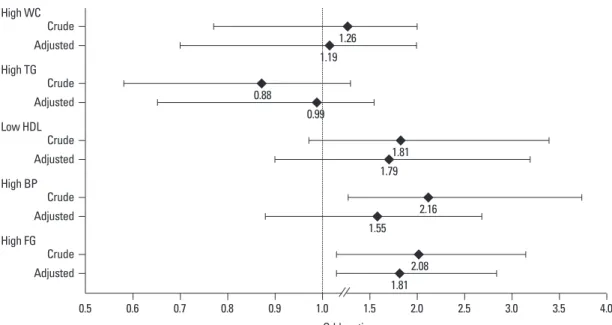
Logistic regression analysis of CVD events for each component of MetS prior to correction showed that high BP and high FG were statistically significant (OR: high BP 2.16, high FG 2.08). After adjustment for age and gender, only high FG showed significance (OR 1.81)(Fig. 1). Gen- der differences, presented in Table 4, show that prior to ad- justment, fasting glucose in men (OR 2.67, 95% CI 1.24- 5.75) and high BP (OR 2.09, 95% CI 1.10-3.96) and high FG (OR 1.84, 95% CI 1.10-3.10) in women were significant.
However, after being adjusted, no significant difference was found in either men or women.
ca
DISCUSSION
We analyzed the relationship between the prevalence of CVD and each metabolic component in a target population, which was not representative of the general population, but was conducted by the Korean Ministry of Health and Wel-
fare in 2005. Detailed descriptions of the survey method have been provided elsewhere.16 Briefly, this survey was a nationwide representative study that used a stratified, multi- stage probability sampling design for the selection of house- hold units. This survey was composed of four parts: health interview, health behavior, health examination, and nutri- tion. The surveys were performed during face-to-face inter- views with the family members of randomly selected house- holds. We performed a cross-sectional analysis of the data from the subjects who completed the health interview and health behavior survey. We excluded individuals with in- complete data for the standardized physical examination, laboratory tests, and anthropometric measures. This result- ed in a final analytical sample of 1,406 subjects (587 men, 819 women) with MetS among the 5,030 participants aged 19 years or older. The presence of CVD was defined as a physician’s diagnosis of any of the following on the Health Interview Survey: stroke, myocardial infarction, and angina.
Smokers were defined as those who were currently smoking at the time of the survey, regardless of the number of ciga- rettes smoked. Participants who exercised twice a week, re- gardless of type or length of the exercise, were considered to partake in exercise.
Definition of the MetS
We used the revised NCEP criteria,17 which were proposed by the National Heart, Lung, and Blood Institute/American Heart Association, and require at least three of the following components: 1) abdominal obesity (waist circumference ≥ 90 cm for Asian men or ≥ 80 cm for Asian women),18 2) tri- glycerides ≥ 150 mg/dL or receiving drug treatment, 3) high density lipoprotein (HDL) cholesterol < 40 mg/dL for men or < 50 mg/dL for women or receiving drug treatment, 4) systolic/diastolic blood pressure ≥ 130/85 mmHg or re- ceiving drug treatment and 5) fasting plasma glucose ≥ 100 mg/dL or receiving drug treatment. The revised NCEP crite- ria had recommended a lower waist circumference cutoff for Asian-Americans because Asians are predisposed to insulin resistance, MetS, and type 2 diabetes at lower waist circum- ferences than Caucasians.
Statistical analysis
Statistical analysis was performed using STATA SE 9 (STA- TA Corporation, Texas, USA) and p values of < 0.05 were considered to be statistically significant. Comparisons of the number of patients with each metabolic risk factor ac-
5.19, and after adjustment it was 2.50 (not shown in table).
In the present study, we found that the only significant factor relevant to CVD prevalence was high FG. Anderson, et al.14 showed that high FG (OR = 1.23, 95% CI 1.06-1.43) and Low HDL (OR = 1.57, 95% CI 1.31-1.89) were signifi- cantly different among the individual MetS factors at risk for coronary artery disease after adjusting for age. Howev- er, secondary analysis for the risk of death or myocardial infarction showed that only high FG was significant (ad- justed hazard ratio 1.46, 95% CI 1.17-1.82). Sixty-five per- cent of subjects had undergone coronary angiography at the start of the study because they were at high risk for coro- was made up of patients who had been diagnosed with
MetS using the revised NCEP criteria. The purpose of se- lecting these subjects would be first to clarify the differenc- es for each factor associated with MetS; and second, to minimize the influence of risk factors other than metabolic components that may increase the risk of CVD. In this study, when additional analysis was performed on the general population of 5,030 subjects, we found that the factors showing significant differences between the groups with and without CVD numbered three for the men (excluding lipid abnormalities) and five for women. Before adjusting for age and smoking, the OR of women with high BP was
Table 2. General Characteristics of Study Subjects* by Gender
Men Women
Number 587 819
Age, yrs 51.8 ± 13.2 58.1 ± 13.2
Current smoker, n (%) 248 (42.3) 51 (6.2)
Exerciser†, n (%) 266 (45.3) 313 (38.2)
Total cholesterol, mg/dL 189.6 ± 34.1 197.0 ± 36.5
LDL cholesterol, mg/dL 113.5 ± 31.7 123.8 ± 33.1
HDL cholesterol, mg/dL 37.3 ± 7.2 41.0 ± 7.7
Fasting glucose, mg/dL 107.6 ± 28.9 104.6 ± 27.3
Systolic blood pressure, mmHg 130.9 ± 15.8 130.6 ± 19.1
Diastolic blood pressure, mmHg 86.1 ± 9.9 81.0 ± 10.1
Triglycerides, mg/dL 194.5 ± 73.9 161.3 ± 69.8
Waist circumference, cm 91.3 ± 6.8 86.9 ± 7.5
CVD events‡, n (%) 40 (6.8) 70 (8.6)
Stroke 23 (3.9) 36 (4.4)
MI 8 (1.4) 10 (1.2)
Angina 11 (1.9) 29 (3.5)
LDL, low density lipoprotein; HDL, high density lipoprotein; CVD, cardiovascular disease; MI, myocardial infarction.
*All subjects were diagnosed with metabolic syndrome by National Cholesterol Education Program criteria.
†Subjects who exercise more than twice a week.
‡Diagnosed by physician as any of the followings: stroke, MI, or angina.
Table 3. Comparison of Frequency of Metabolic Risk Factors According to the Presence of Cardiovascular Disease
Men Women
No CVD CVD p value* No CVD CVD p value*
Number 547 40 749 70
Age, mean (SD) 51.15 (13.2) 60.60 (9.49) < 0.001 57.40 (13.29) 65.26 (9.65) < 0.001 Current smoker, n (%) 237 (43.33) 11 (27.50) 0.050 44 (5.87) 7 (10.00) 0.172 Exercise, n (%) 243 (44.42) 23 (57.50) 0.109 284 (37.92) 29 (41.43) 0.563 Abdominal obesity, n (%) 346 (63.25) 26 (65.00) 0.825 658 (87.85) 61 (87.14) 0.863 Triglycerides, n (%) 417 (76.23) 25 (62.50) 0.052 414 (55.27) 36 (51.43) 0.536 Low-HDL cholesterol, n (%) 415 (75.87) 32 (80.00) 0.554 690 (92.12) 65 (92.86) 0.827 Blood pressure, n (%) 432 (78.98) 36 (90.00) 0.094 523 (69.83) 57 (81.43) 0.041 Fasting blood glucose, n (%) 305 (55.16) 30 (75.00) 0.018 356 (47.53) 42 (60.00) 0.046 HDL, high density lipoprotein; CVD, cardiovascular disease.
*Independent two sample t-test or χ2 test were used.
obesity in recent publications of the pathological mecha- nisms of MetS.19 However, recent studies are somewhat skeptical of considering central obesity as a necessary com- ponent,20,21 and we found no difference in central obesity between individuals with and without CVD, in both men and women. The second major controversy is that there are many other factors that have a great impact on risk for CVD besides the five metabolic components of the criteria, including age.22,23 These components should also be consid- ered in the diagnosis of MetS. In our study, the prevalence of CVD increased 1.76 times for men and 1.66 times for women with every 10 year increase in age, and this result nary artery disease. More than 70% were found to have ste-
nosis. Although this cannot be directly compared with our study, the results also show that high FG had a strong corre- lation with prevalence of CVD, similar to previous reports.
There is still some major controversy regarding the diag- nostic criteria for MetS. One of these is regarding which criterion is the most appropriate. So far, various diagnostic criteria for MetS have been published based on the require- ments of specific components. The IDF presented new di- agnostic criteria that considers racial differences and also considers central obesity as a necessary component based on its strong correlation with insulin resistance and central
Table 4. Predictability of Each Metabolic Component for Cardiovascular Disease by Logistic Regression Anal- ysis According to Gender
Men (n = 587) Women (n = 819)
Crude OR
(95% CI) p value Age-adjusted*
OR (95% CI) p value Crude OR
(95% CI) p value Age-adjusted*
OR (95% CI) p value Abdominal
obesity
1.13
(0.55 - 2.29) 0.740 1.15
(0.56 - 2.39) 0.702 1.17
(0.55 - 2.50) 0.676 1.18
(0.55 - 2.57) 0.668 Triglycerides 0.70
(0.34 - 1.42) 0.322 0.86
(0.41 - 1.80) 0.692 1.05
(0.63 - 1.73) 0.863 1.08
(0.64 - 1.80) 0.781 Low-HDL
cholesterol
1.91
(0.83 - 4.40) 0.129 1.95
(0.84 - 4.57) 0.122 1.49
(0.57 - 3.93) 0.417 1.46
(0.55 - 3.90) 0.446 Blood pressure 2.53
(0.86 - 7.45) 0.092 2.05
(0.68 - 6.19) 0.201 2.09
(1.10 - 3.96) 0.024 1.38
(0.71 - 2.69) 0.340 Fasting blood
glucose
2.67
(1.24 - 5.75) 0.012 2.08
(0.95 - 4.59) 0.067 1.84
(1.10 - 3.10) 0.021 1.69
(0.99 - 2.86) 0.051 OR, odds ratio; CI, confidence interval; HDL, high density lipoprotein.
*Age was stratified into intervals of 10 years.
Fig. 1. Odds ratio of each metabolic component for occurrence of cardiovascular events in all subjects. WC, waist circumference; TG, tri- glycerides; HDL, high density lipoprotein; BP, blood pressure; FG, fasting glucose.
High WC
High TG
Low HDL
High BP
High FG Crude Adjusted
Crude Adjusted
Crude Adjusted
Crude Adjusted
Crude Adjusted
0.5 0.6 0.7 0.8 0.9 1.0
Odds ratio
1.5 2.0 2.5 3.0 3.5 4.0
1.26 1.19
0.88
0.99
1.81 1.79
2.16 1.55
2.08 1.81
CVD events in patients with MetS was considerably di- verse, and high FG had the highest of all of them. In pa- tients with MetS diagnosed according to the revised NCEP criteria, aggressive management should be undertaken to reduce all standard risk factors, but particular and increased attention should be paid to preventing and treating diabetes.
REFERENCES
1. Alberti KG, Zimmet PZ. Definition, diagnosis and classification of diabetes mellitus and its complications. Part 1: diagnosis and classification of diabetes mellitus provisional report of a WHO consultation. Diabet Med 1998;15:539-53.
2. Boyko EJ, de Courten M, Zimmet PZ, Chitson P, Tuomilehto J, Alberti KG. Features of the metabolic syndrome predict higher risk of diabetes and impaired glucose tolerance: a prospective study in Mauritius. Diabetes Care 2000;23:1242-8.
3. Lorenzo C, Okoloise M, Williams K, Stern MP, Haffner SM; San Antonio Heart Study. The metabolic syndrome as predictor of type 2 diabetes: the San Antonio heart study. Diabetes Care 2003;26:3153-9.
4. Wang JJ, Qiao Q, Miettinen ME, Lappalainen J, Hu G, Tuomileh- to J. The metabolic syndrome defined by factor analysis and inci- dent type 2 diabetes in a chinese population with high postprandial glucose. Diabetes Care 2004;27:2429-37.
5. Ford ES. Risks for all-cause mortality, cardiovascular disease, and diabetes associated with the metabolic syndrome: a summary of the evidence. Diabetes Care 2005;28:1769-78.
6. Ding EL, Smit LA, Hu FB. The metabolic syndrome as a cluster of risk factors: is the whole greater than the sum of its parts?: com- ment on “The metabolic syndrome, its component risk factors, and progression of coronary atherosclerosis”. Arch Intern Med 2010;170:484-5.
7. Miranda PJ, DeFronzo RA, Califf RM, Guyton JR. Metabolic syndrome: definition, pathophysiology, and mechanisms. Am Heart J 2005;149:33-45.
8. Ford ES, Giles WH, Dietz WH. Prevalence of the metabolic syn- drome among US adults: findings from the third National Health and Nutrition Examination Survey. JAMA 2002;287:356-9.
9. Koehler C, Ott P, Benke I, Hanefeld M; DIG Study Group. Com- parison of the prevalence of the metabolic syndrome by WHO, AHA/NHLBI, and IDF definitions in a German population with type 2 diabetes: the Diabetes in Germany (DIG) Study. Horm Metab Res 2007;39:632-5.
10. Moebus S, Hanisch JU, Aidelsburger P, Bramlage P, Wasem J, Jöckel KH. Impact of 4 different definitions used for the assess- ment of the prevalence of the Metabolic Syndrome in primary healthcare: The German Metabolic and Cardiovascular Risk Proj- ect (GEMCAS). Cardiovasc Diabetol 2007;6:22.
11. Athyros VG, Ganotakis ES, Elisaf MS, Liberopoulos EN, Goude- venos IA, Karagiannis A; GREECE-METS Collaborative Group.
Prevalence of vascular disease in metabolic syndrome using three proposed definitions. Int J Cardiol 2007;117:204-10.
12. de Simone G, Devereux RB, Chinali M, Best LG, Lee ET, Gallo- way JM, et al. Prognostic impact of metabolic syndrome by differ- ent definitions in a population with high prevalence of obesity and diabetes: the Strong Heart Study. Diabetes Care 2007;30:1851-6.
was shown to be statistically significant (not shown in table).
In the current study, a cutoff point of 100 mg/dL for fast- ing blood glucose was used, which had been recommended at the 2003 American Diabetes Association Conference24 based on studies showing a high risk of developing diabetes or CVD in subjects with impaired glucose intolerance (IGT) and impaired fasting glucose (IFG), so-called prediabetes.
Based on this information, a fasting blood glucose cutoff point of 100 mg/dL was proposed for the diagnostic criteria of MetS at the 2005 IDF conference. Despite the definition of MetS, significant results were observed for prediction of CVD in both men and women when the conventional cut- off point of 110 mg/dL was lowered to 100 mg/dL. This sug- gests that particular caution is necessary to prevent CVD in patients with high FG who have been diagnosed with MetS, at least according to the revised NCEP definition. Among the various diagnostic criteria used to diagnose MetS, the identification of insulin resistance, including IGT and IFG, as a necessary component may more appropriately support prediction of CVD.
It is already widely accepted that ethnically specific val- ues must be applied to waist circumference (WC) cutoff points for central obesity, one of the components of MetS.25 Recently Lee, et al.26 published their research findings on the appropriate cutoff values for Koreans based on the 1998 KNHANES data. According to their study, the WC at which the risk for developing other metabolic components in- creased significantly compared to the general population was 90 cm for men and 85 cm for women. Their study was in accordance with the basic concept of clustering the five CVD risk factors for MetS; however, when CVD is consid- ered as the final outcome of MetS, future studies will be needed to define the cutoff value at which the risk of CVD increases significantly.
There are two limitations to our study. First, the clarity of the cause and effect relationship is affected by the cross- sectional research design. Since the subjects had already been diagnosed with CVD, stringent blood pressure, weight, and blood sugar control were highly likely. In addition, the fact that a greater number of men without CVD events were current smokers underscores these limitations. Sec- ond, the inclusion of the clinical diagnosis of angina pecto- ris with CVD is ambiguous, because unlike myocardial in- farction or stroke, angina pectoris can be diagnosed by symptoms alone without specific blood test results or radio- graphic findings.
In summary, the predictability of each component for
699-706.
20. Lee J, Ma S, Heng D, Tan CE, Chew SK, Hughes K, et al. Should central obesity be an optional or essential component of the meta- bolic syndrome? Ischemic heart disease risk in the Singapore Car- diovascular Cohort Study. Diabetes Care 2007;30:343-7.
21. Lorenzo C, Serrano-Ríos M, Martínez-Larrad MT, González-Vil- lalpando C, González-Sánchez JL, Martínez-Calatrava MJ, et al.
Is waist circumference an essential component of the metabolic syndrome? Diabetes Care 2007;30:2141-2.
22. Rosenbaum P, Gimeno SG, Sanudo A, Franco LJ, Ferreira SR;
Japanese-Brazilian Diabetes Study Group. Analysis of criteria for metabolic syndrome in a population-based study of Japanese-Bra- zilians. Diabetes Obes Metab 2005;7:352-9.
23. Nilsson PM, Engström G, Hedblad B. The metabolic syndrome and incidence of cardiovascular disease in non-diabetic subjects--a population-based study comparing three different definitions. Dia- bet Med 2007;24:464-72.
24. Expert Committee on the Diagnosis and Classifiation of Diabetes Mellitus. Report of the expert committee on the diagnosis and classification of diabetes mellitus. Diabetes Care 2003;26 Suppl 1:S5-20.
25. Alberti KG, Zimmet P, Shaw J; IDF Epidemiology Task Force Consensus Group. The metabolic syndrome--a new worldwide definition. Lancet 2005;366:1059-62.
26. Lee SY, Park HS, Kim DJ, Han JH, Kim SM, Cho GJ, et al. Ap- propriate waist circumference cutoff points for central obesity in Korean adults. Diabetes Res Clin Pract 2007;75:72-80.
13. Hunt KJ, Resendez RG, Williams K, Haffner SM, Stern MP; San Antonio Heart Study. National Cholesterol Education Program versus World Health Organization metabolic syndrome in relation to all-cause and cardiovascular mortality in the San Antonio Heart Study. Circulation 2004;110:1251-7.
14. Anderson JL, Horne BD, Jones HU, Reyna SP, Carlquist JF, Bair TL, et al. Which features of the metabolic syndrome predict the prevalence and clinical outcomes of angiographic coronary artery disease? Cardiology 2004;101:185-93.
15. Taylor H, Liu J, Wilson G, Golden SH, Crook E, Brunson CD, et al. Distinct component profiles and high risk among African Americans with metabolic syndrome: the Jackson Heart Study.
Diabetes Care 2008;31:1248-53.
16. Eum KD, Lee MS, Paek D. Cadmium in blood and hypertension.
Sci Total Environ 2008;407:147-53.
17. Grundy SM, Cleeman JI, Daniels SR, Donato KA, Eckel RH, Franklin BA, et al. Diagnosis and management of the metabolic syndrome. An American Heart Association/National Heart, Lung, and Blood Institute Scientific Statement. Executive summary. Car- diol Rev 2005;13:322-7.
18. WHO/IASO/IOTF. The Asia-Pacific perspective: redefining obe- sity and its treatment. Melbourne: Health Communications Aus- tralia; 2000.
19. Schmidt MI, Watson RL, Duncan BB, Metcalf P, Brancati FL, Sharrett AR, et al. Clustering of dyslipidemia, hyperuricemia, dia- betes, and hypertension and its association with fasting insulin and central and overall obesity in a general population. Atherosclerosis Risk in Communities Study Investigators. Metabolism 1996;45: